

What Size Solar Battery Do I Need? A 2026 Australian Guide
So, what size solar battery do you actually need? For a typical Queensland or New South Wales household using around 15-20 kWh of electricity daily, the optimal size for a solar battery in 2026 is between 10 kWh and 15 kWh. This capacity balances covering your evening energy needs while preserving enough spare capacity to generate financial value in a Virtual Power Plant (VPP).
This guide provides a structured, evidence-based framework for answering the question, "what size solar battery do I need?" We will move beyond simple self-consumption and show you how to size your battery as a performance-driven financial asset.
Why 'Right-Sizing' Your Battery Is Critical for Financial Return
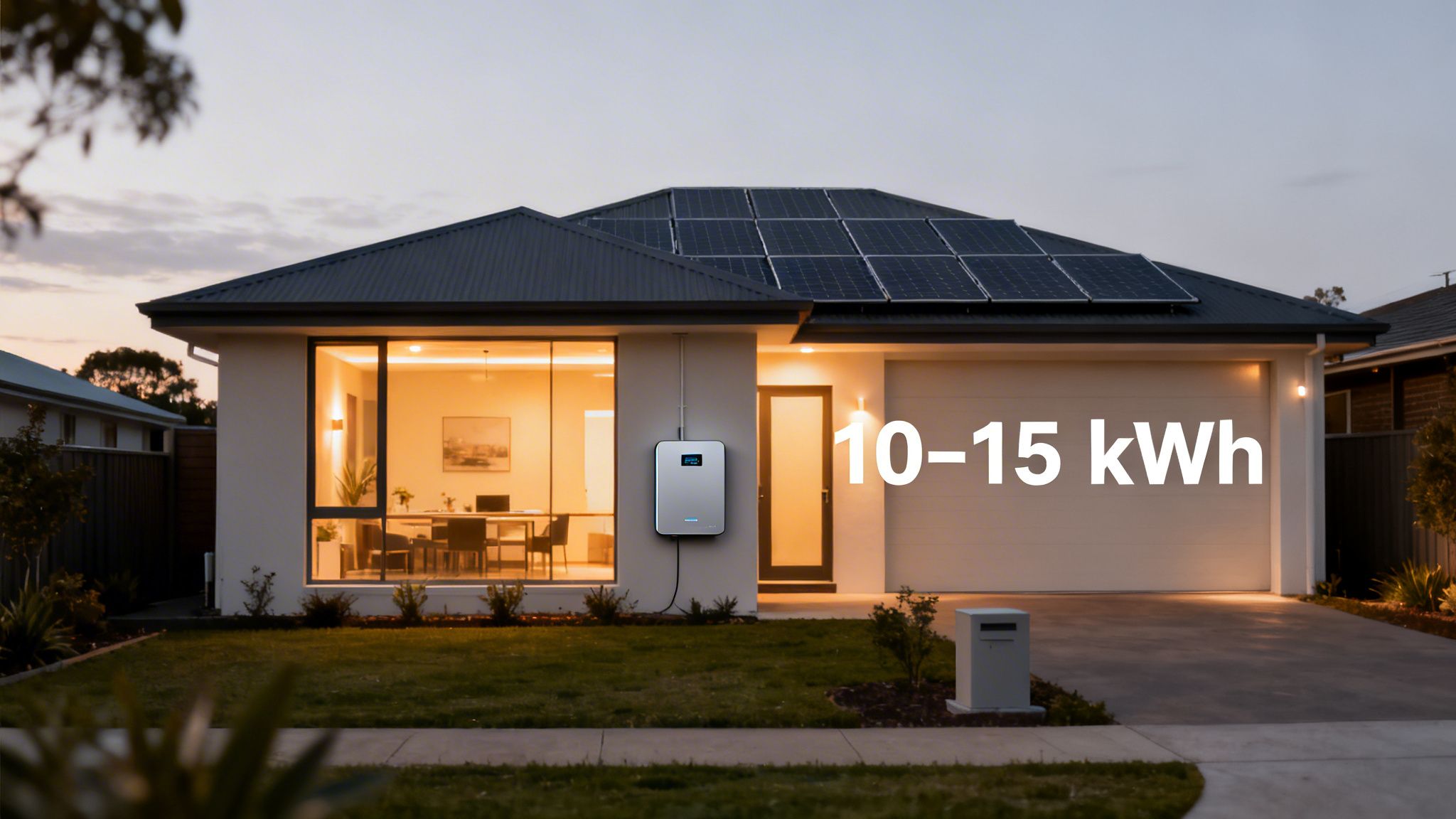
Choosing the right solar battery size is no longer about attempting to go "off-grid." The strategic objective has evolved. Today, the most commercially intelligent way to view your battery is as a financial asset that works for you. The goal is not just to reduce your electricity bill; it's to make your entire home energy system perform profitably. Most battery owners are underutilising their asset, a problem we aim to solve.
This change in mindset is vital for Australian solar owners. Instead of merely storing enough power to get through the night, a correctly sized battery enables participation in grid support services through a Bring Your Own Battery (BYOB) VPP. This unlocks a new mechanism for earning bill allowances and reducing your energy costs far beyond what simple self-consumption can achieve.
Matching Battery Size to Your Commercial Objective
The "right" size is determined by your primary objective. Are you focused solely on covering your own power usage after sunset? Or are you interested in turning your battery into an asset that can generate financial upside? Each goal dictates a different sizing strategy.
The table below provides a starting point for matching your objective with a recommended battery capacity.
Quick Guide: Solar Battery Sizing by Objective
| Primary Objective | Typical Daily Household Usage (QLD/NSW) | Recommended Battery Size (kWh) | Key Outcome |
|---|---|---|---|
| Maximise Self-Consumption | 15-20 kWh | 10-13.5 kWh | Covers most evening and nighttime energy usage, significantly reducing electricity purchased from the grid. |
| VPP Value Optimisation | 15-20 kWh | 13.5-15 kWh | Covers evening needs but preserves spare capacity for VPP events to earn bill allowances. |
| Basic Backup for Outages | 15-20 kWh | 10+ kWh | Powers essential circuits (e.g., lights, refrigerator, modem) for several hours during a grid outage. |
This table illustrates how a small shift in battery size can alter the system's function, moving from simple savings to active earning.
Market Trends: A Shift Towards Smarter Sizing
Australian homeowners are increasingly adopting this more sophisticated approach. Recent market analysis shows a clear trend towards batteries that balance daily needs with VPP potential. Data from SunWiz in early 2026 indicated the average residential battery size installed in Australia had reached 10.34 kWh.
For households in Queensland and NSW with existing solar, a 10-13.5 kWh battery often suffices for daily self-consumption. More importantly, this size unlocks the ability to join a retailer-based VPP program, where you can earn bill allowances by exporting spare energy to the grid when it's most needed.
You can explore the full battery uptake report from PV Magazine for further data on these trends.
The Financial Trap of an Oversized Battery
A common misconception is that a larger battery automatically leads to greater savings. On the surface, more storage seems to promise more energy independence.
However, this "bigger is better" mindset is a financial trap. It often leads homeowners to invest in an expensive system that delivers a worse financial return on investment.
An oversized battery can significantly extend your system’s payback period. The issue is not just the high upfront capital cost; the core problem is paying a premium for storage capacity that is consistently underutilised. Every kilowatt-hour of battery storage has a capital cost. When a significant portion of that capacity remains idle, it's a depreciating asset that isn't contributing to your financial goals. On any given day, a poorly sized battery might only discharge 30-40% of its stored energy, leaving the majority of your investment unproductive.
The goal isn't to own the biggest battery; it's to operate the most profitable one. A right-sized battery that is cycled effectively almost every day will always deliver a faster return on investment.
A more intelligent strategy is to "right-size" your battery from the outset. This involves selecting a capacity that covers your household's evening and overnight power consumption, with a small, strategic reserve. This ensures your battery is constantly charging and discharging, maximising the asset's work rate.
This is where integrating your system with a modern electricity retailer and a Virtual Power Plant (VPP) fundamentally changes the financial equation. Here’s why a right-sized, VPP-connected battery is a superior investment:
- Maximising Asset Utilisation: A VPP can access your battery’s strategic reserve, exporting that energy to the grid during high-priced demand events. This means even your "spare" capacity is actively generating value instead of sitting idle.
- Accelerating Payback Period: Instead of merely saving money, a VPP adds a new value stream. The allowances earned from grid support participation actively reduce your payback period, potentially by several years.
- Lowering Upfront Investment: By choosing a battery that’s correctly sized, you avoid paying for capacity you don't need. This reduces your initial investment and makes the entire project more financially viable.
Ultimately, the answer to "what size solar battery do I need" is rarely the largest one available. It’s the size that allows you to maximise its daily use, balancing your home’s needs with the significant earning potential of a VPP. As a technology-enabled electricity retailer, High Flow Energy helps transform your battery from a simple storage unit into a high-performing asset in Australia's National Electricity Market (NEM).
A 4-Step Process for Sizing Your Solar Battery
Sizing your solar battery is a logical process, not an abstract art. Getting it right is the difference between owning a high-performing asset and a costly, underutilised appliance.
This section provides a step-by-step breakdown to confidently answer the question, "what size solar battery do I need?"
Step 1: Analyse Your Daily Energy Consumption
First, you must establish a clear baseline of your household's daily electricity usage. The most accurate source for this information is your electricity bill.
Look for a section titled "Usage" or "Consumption." Most bills provide an "average daily usage" figure in kilowatt-hours (kWh). If not, it can be calculated easily.
Calculation: Total kWh for the billing period ÷ Number of days in the period = Average Daily kWh.
For example, if you consumed 900 kWh over a 90-day billing cycle, your daily average is 10 kWh. It is crucial to analyse both summer and winter bills, as consumption patterns can vary significantly. Your battery should be sized based on your higher-usage seasons.
Step 2: Determine Your Solar System’s Daily Generation
Next, estimate your solar panel system's daily energy production. This depends on your system's size (in kW), your location in NSW or Queensland, the season, and daily weather conditions.
While a solar installer can provide a precise forecast, a reliable rule of thumb is that a standard 6.6 kW solar PV system in the Sydney or Brisbane area will generate between 20 kWh and 30 kWh on a clear day. This is often more than an average home consumes, creating the opportunity to store the excess energy.
Step 3: Align Sizing with Your Primary Goal
This is where you connect your consumption data and solar generation to your strategic objective for the battery.
For Maximum Self-Consumption: The goal is to power your home with stored solar energy after sunset. You need to determine your evening and overnight energy consumption. If your bill doesn't provide this breakdown, effective home energy monitoring is essential. Your average evening consumption figure becomes your baseline battery size.
For Backup Power: If outage protection is your main concern, identify the essential appliances you need to power (e.g., refrigerator, modem, some lights). Sum their hourly energy draw and multiply it by the number of backup hours you require. For most households, 5-7 kWh of usable capacity is sufficient to manage an evening outage.
For VPP Optimisation: This is the most commercially astute approach. You size for self-consumption and then add a strategic reserve. For instance, if your evening usage is 8 kWh, you might select a 13.5 kWh battery. This leaves a 5.5 kWh buffer that a VPP operator like High Flow Energy can dispatch to support the grid, earning you bill allowances and improving your return on investment.
This process is about finding the optimal balance—moving away from a "bigger is better" mindset to one that's precisely sized for financial value.
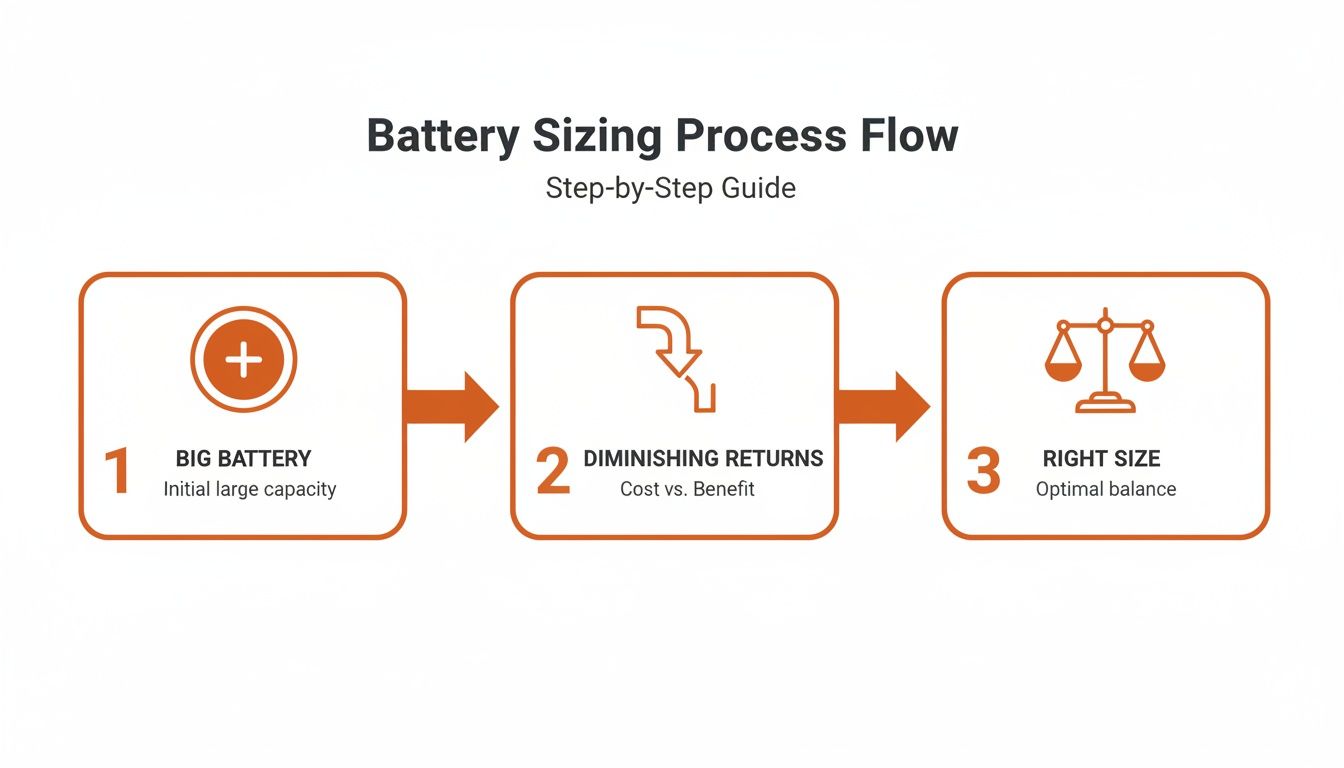
For homeowners in QLD and NSW, this balance is key. A household using 15-20 kWh per day with a 6.6 kW solar system producing 20-30 kWh will find a 13.5 kWh battery often hits the mark perfectly. It can comfortably store enough energy to cover evening usage, where many households consume up to 60% of their daily total.
Step 4: Adjust for Real-World Technical Factors
Finally, we must adjust our estimate for two key technical parameters: Depth of Discharge (DoD) and Round-Trip Efficiency. These are not just industry jargon; they define how a battery performs in a real-world residential setting.
Depth of Discharge (DoD): This represents the usable portion of a battery's total capacity. To preserve battery health, it cannot be drained to 0%. Modern lithium-ion batteries feature a high DoD, typically 90-100%. To calculate usable capacity, multiply the battery's advertised size by its DoD percentage.
Round-Trip Efficiency: Energy conversion is not 100% efficient. When you charge and then discharge a battery, a small amount of energy is lost, primarily as heat. A high-quality modern battery has a round-trip efficiency of 85-95%. This means for every 10 kWh of solar energy you store, you can expect to retrieve 8.5-9.5 kWh.
Sizing Calculation Example: NSW Household
Here is a practical example for a typical Sydney family aiming to cover their evening usage.
| Calculation Step | Example Value | Explanation |
|---|---|---|
| Daily Consumption | 25 kWh | Sourced from the electricity bill (average daily usage). |
| Evening Usage (4pm-10pm) | 10 kWh | This is the target load the battery needs to cover. |
| Round-Trip Efficiency Loss | ~1.1 kWh | To get 10 kWh out, we must store more. Assuming 90% efficiency: 10 kWh ÷ 0.90 = 11.1 kWh. |
| Required Usable Capacity | 11.1 kWh | This is the amount of energy the battery must be able to deliver. |
| DoD Adjustment | 12.3 kWh | Assuming a 90% DoD, the battery's nominal size needs to be 11.1 kWh ÷ 0.90 to provide the required usable capacity. |
| Final Sizing Decision | 13.5 kWh unit | Based on the calculation, a standard 13.5 kWh battery is an excellent commercial fit, providing sufficient capacity with headroom for VPP participation. |
This demonstrates how a structured calculation leads to a specific, data-driven sizing decision.
How a VPP Changes Your Sizing Calculation
Historically, the question "what size solar battery do I need?" was answered defensively. The calculation involved storing just enough energy to cover evening and overnight usage, aiming to minimise electricity purchases from the grid. The battery's role was a shield against high peak electricity tariffs.
Joining a retailer-based Virtual Power Plant (VPP) fundamentally changes this calculation. Your battery transitions from a passive shield to an active participant in your household's finances, capable of generating tangible value.
The sizing calculation is no longer exclusively about self-consumption. It becomes an optimisation problem focused on financial return, turning your hardware into a smart, grid-interactive asset.
From Self-Consumption to Strategic Export
Without a VPP, any battery capacity beyond your own needs is underutilised capital. You have paid for storage that is not delivering a return. A VPP inverts this model, converting that "excess" capacity into a value-generating opportunity.
Opting for a slightly larger battery—for example, a 13.5 kWh unit instead of a 10 kWh one—creates a valuable strategic reserve. This is the spare capacity a VPP operator like High Flow Energy can dispatch to the grid during wholesale price spikes or when the network requires stabilisation services.
This strategic export generates bill allowances, accelerating the payback period for your battery. You are no longer just avoiding costs; you are actively creating a new value stream.
The VPP Sizing Mindset
A VPP-oriented mindset means sizing your battery for both self-sufficiency and market opportunity. You cover your baseline usage first, then add a strategic reserve specifically for VPP events.
This works as follows:
- Cover Your Base Load: First, calculate the capacity needed to power your home through the evening and overnight.
- Add VPP Capacity: Add an extra 3-5 kWh on top of that baseline, designated for VPP participation.
- Retain Priority Access: This is critical. With a professionally managed VPP, your household's energy needs always take precedence. Our platform intelligently forecasts your usage and only dispatches energy that is genuinely surplus.
- Generate Financial Value: This spare capacity is then used to earn allowances that can offset your electricity bills, including fixed daily supply charges.
Joining a Bring Your Own Battery (BYOB) VPP means your battery stops being a simple cost-saving device and becomes a performance asset. The smartest size is one that both serves your home and participates profitably in the wider energy market.
By participating in a VPP, you are extracting the maximum value from your investment every day. It's a fundamental shift that makes "right-sizing" a far more dynamic and rewarding calculation for Australian battery owners. To understand more about this opportunity, read our guide on virtual power plants driving Australia's renewable energy revolution.
Turn Your Battery Into a High-Performing Asset with High Flow Energy
When investing in a home battery, the primary focus is often on the quality of the installation. But what happens post-installation? For most owners, that is where the strategic thinking ends, and a significant amount of financial value is left unrealised.
High Flow Energy was founded for a single purpose: to ensure your solar and battery system performs as hard for your finances as it does for your home. We are not a solar or battery installer. We are a technology-enabled electricity retailer focused entirely on unlocking the full financial potential of the battery you already own.
From a Defensive Asset to an Active Participant
Consider a standard battery setup. It operates defensively, storing energy to shield you from high evening tariffs or grid outages. It is useful, but passive.
Connecting that same battery to the High Flow Energy Virtual Power Plant (VPP) fundamentally changes its role. It becomes an active, intelligent participant in the energy market. Our proprietary platform communicates with your battery, dispatching its spare capacity to help stabilise the grid when demand is high and prices are volatile.
This is not about saving a few extra dollars. It is about transforming your battery from a household capital expense into a high-performing financial asset. The value it generates through grid services directly contributes to paying for your electricity, turning your hardware into an active component of your household’s financial strategy.
You Retain Control and Priority
Enrolling in our Bring Your Own Battery (BYOB) program does not mean ceding control. Your household's energy security remains the absolute priority. Our system is designed to ensure you have all the power you need, whenever you need it. We achieve this through intelligent forecasting and by ring-fencing a portion of your battery's capacity for your own use.
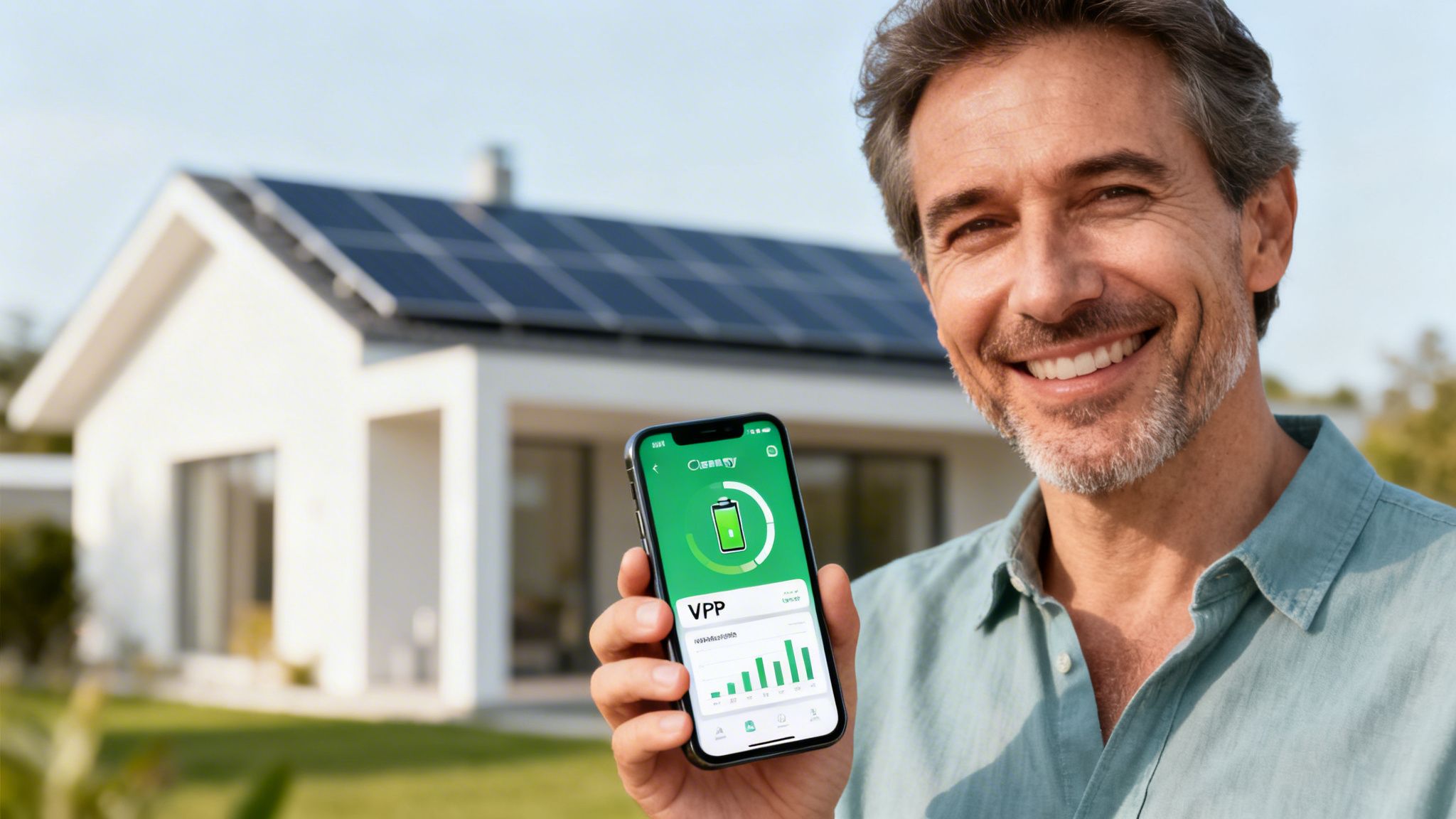
You can monitor all activity in real-time through our companion app—track your system's performance, view the value it’s generating, and see exactly how it’s being optimised for maximum return.
We are compatible with most modern, high-quality battery systems available in Queensland and New South Wales. The technical specifics of your system's connection are an important factor, which you can explore in our guide to AC vs DC coupled batteries.
If you suspect your battery could be delivering more financial value, you are likely correct. Let’s assess what it is truly capable of.
Frequently Asked Questions (FAQ) on Battery Sizing
Even after a structured analysis, it's common to have further questions. Sizing a battery is a significant financial decision, and the technical details are important.
Here are answers to common queries we receive from homeowners in Queensland and New South Wales regarding battery sizing and VPP integration.
Does my inverter’s power rating affect my battery choice?
Yes, absolutely. This is a critical technical detail that is often overlooked. Your battery's capacity (kWh) is like the volume of a water tank, while your inverter's power rating (kW) is like the diameter of the pipe filling and draining it. A large tank with a narrow pipe is inefficient; it will fill slowly and deliver a weak flow of water. The same principle applies to your energy system. Pairing a large battery with an underpowered inverter creates a bottleneck. It will struggle to charge fully from your solar during the day or discharge enough power to cover your evening peak load. For most Australian homes, a 5kW inverter is well-matched to a 10–15 kWh battery, providing enough power to charge efficiently and run multiple appliances simultaneously. An unbalanced pairing means you have paid for performance you cannot access.
Should I get a bigger battery now to prepare for an EV?
While it may seem like prudent future-proofing, purchasing a significantly larger battery today in anticipation of a future electric vehicle (EV) is rarely the most sound financial strategy. You are paying a premium for capacity that will remain idle for years, extending your return on investment period. A more commercially intelligent approach involves two steps:
- Choose a Modular System: Select a battery system that meets your current needs but is designed for expansion. This allows you to add more capacity if and when you purchase an EV, meaning you only invest in the extra storage when it's required.
- Join a Smart VPP: A sophisticated VPP like High Flow Energy is designed to manage complex loads like an EV charger. Our platform can intelligently schedule charging—for example, by automatically using excess solar during the middle of the day—to optimise energy use with your existing system, minimising grid impact and cost. This strategy reduces upfront capital expenditure and provides flexibility.
Will the VPP use my stored power when I need it in a blackout?
No, it will not. Your energy security is paramount. With a retailer-based VPP like High Flow Energy, you always have priority access to your own stored energy. Our system constantly forecasts your home's consumption patterns and maintains a protected reserve exclusively for your use. The only energy ever dispatched to the grid is what our platform determines is genuinely surplus to your immediate and near-term needs. During a grid outage, your battery's sole function is to power your home. All VPP activity is paused, and your backup supply is completely ring-fenced. Your energy security is never compromised.
How do I know if my battery is compatible with High Flow Energy?
Our Bring Your Own Battery (BYOB) VPP is designed for compatibility with a broad and growing list of modern, high-quality battery systems widely installed across Queensland and New South Wales. As a technology-focused electricity retailer, our business is not selling hardware; our objective is to make your existing assets perform better financially. We maintain a list of approved systems from trusted manufacturers known for their reliability and performance in Australian conditions. The fastest way to confirm compatibility is to use the online eligibility checker on our website. It takes only a minute to verify your battery model and receive an initial assessment of the financial uplift you could achieve by joining our VPP.
Most battery owners focus on installation quality. Far fewer focus on ongoing performance and optimisation. High Flow Energy is an electricity retailer built around unlocking the full value of your existing solar and battery system.
If you would like to understand whether your battery is underperforming financially, request an eligibility assessment today.