

Electricity Cost to Charge Electric Car in Australia 2026
The electricity cost to charge an electric car in Australia varies significantly, from almost $0 when using your own rooftop solar to over $20 for a full charge at a public fast charger. The final cost depends on your electricity rate, your car's battery size, and where and when you charge. For Australian EV owners, understanding these factors is the first step towards minimising running costs and maximising the financial return on your vehicle.
This guide provides a commercially intelligent breakdown of the real costs involved, moving beyond simple calculations to explore how strategic charging and participation in a Virtual Power Plant (VPP) can dramatically reduce, or even eliminate, your EV charging expenses.
Calculating Your True EV Charging Costs
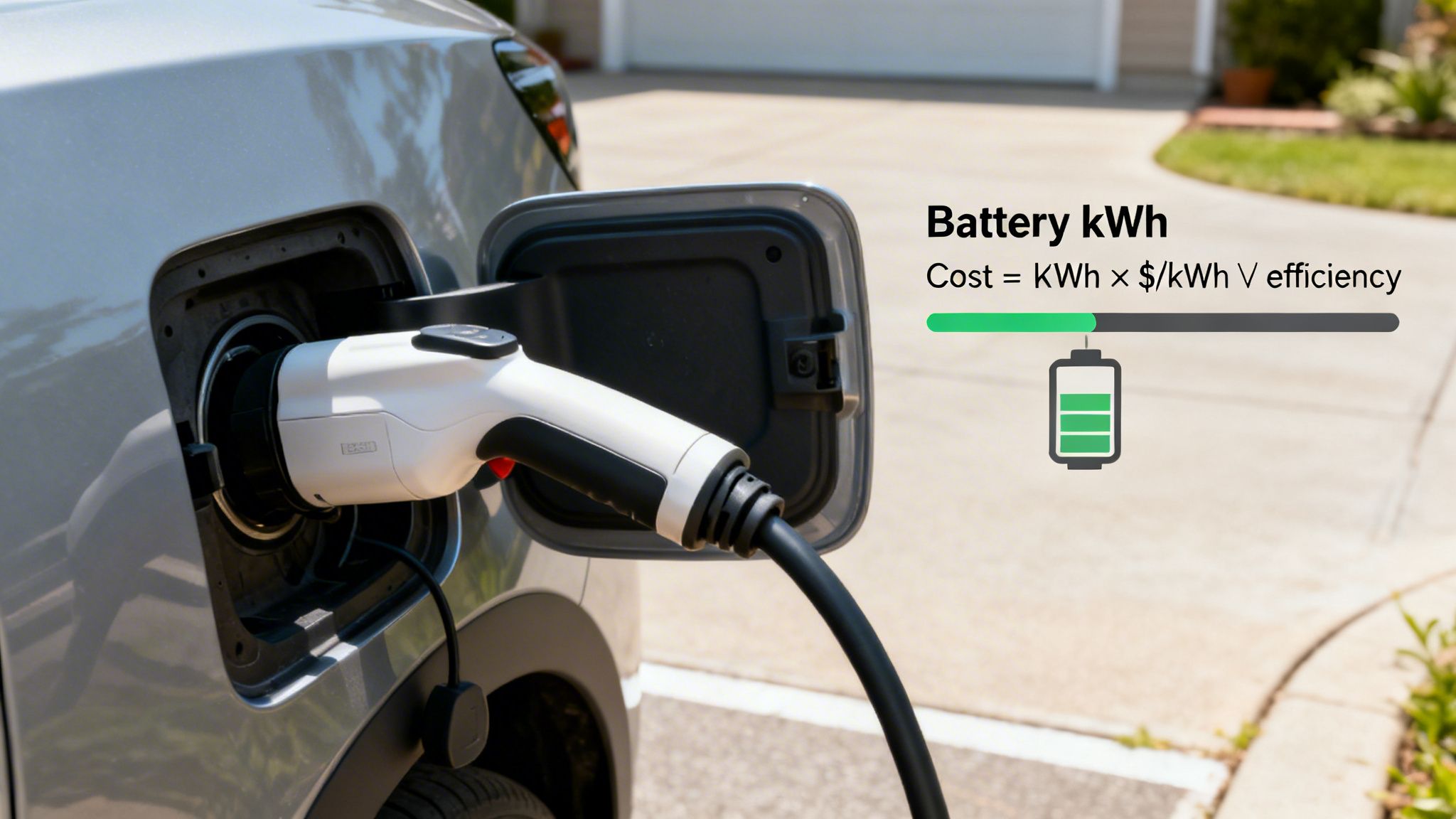
To accurately determine the cost to charge your EV, it's essential to think of its battery not in litres, but in kilowatt-hours (kWh). The cost to fill it is a function of the price you pay for each kWh of electricity.
The basic formula is:
Total Charging Cost ($) = Energy Added (kWh) x Electricity Rate ($ per kWh)
However, this calculation is incomplete. A crucial factor is charging efficiency. During the charging process, some energy is lost as heat, typically around 10% to 15% for a standard AC home charger. This means to deliver 60 kWh of energy to your battery, you may need to draw approximately 69 kWh from the power source.
A more precise formula is:
Total Charging Cost ($) = (Energy Added (kWh) / Charging Efficiency) x Electricity Rate ($ per kWh)
To build an effective cost-management strategy, you must understand the key variables that influence your final electricity bill.
Key Factors That Determine Your EV Charging Cost
| Factor | Description | Typical Australian Range |
|---|---|---|
| Electricity Rate | The price your retailer charges per kilowatt-hour (kWh), which varies by tariff, location (e.g., NSW, QLD), and time of day. | 15c to 50c per kWh |
| Battery Size | The total energy capacity of your EV's battery, measured in kWh. This determines the maximum energy it can store. | 40 kWh to 100 kWh |
| Charging Location | Where you charge—at home using the grid, your own solar, or a public station—has the most significant impact on your per-kWh cost. | $0 (solar) to 85c/kWh+ |
| Charging Efficiency | The percentage of energy successfully transferred from the plug to your battery. Some energy is always lost during conversion. | 85% to 90% |
Mastering these factors is fundamental to developing a charging strategy that minimises expenditure. To gain a deeper understanding of your household's specific energy consumption patterns, a home energy monitoring system provides the data needed for commercially intelligent decision-making.
When You Charge Matters: Peak vs. Off-Peak Tariffs
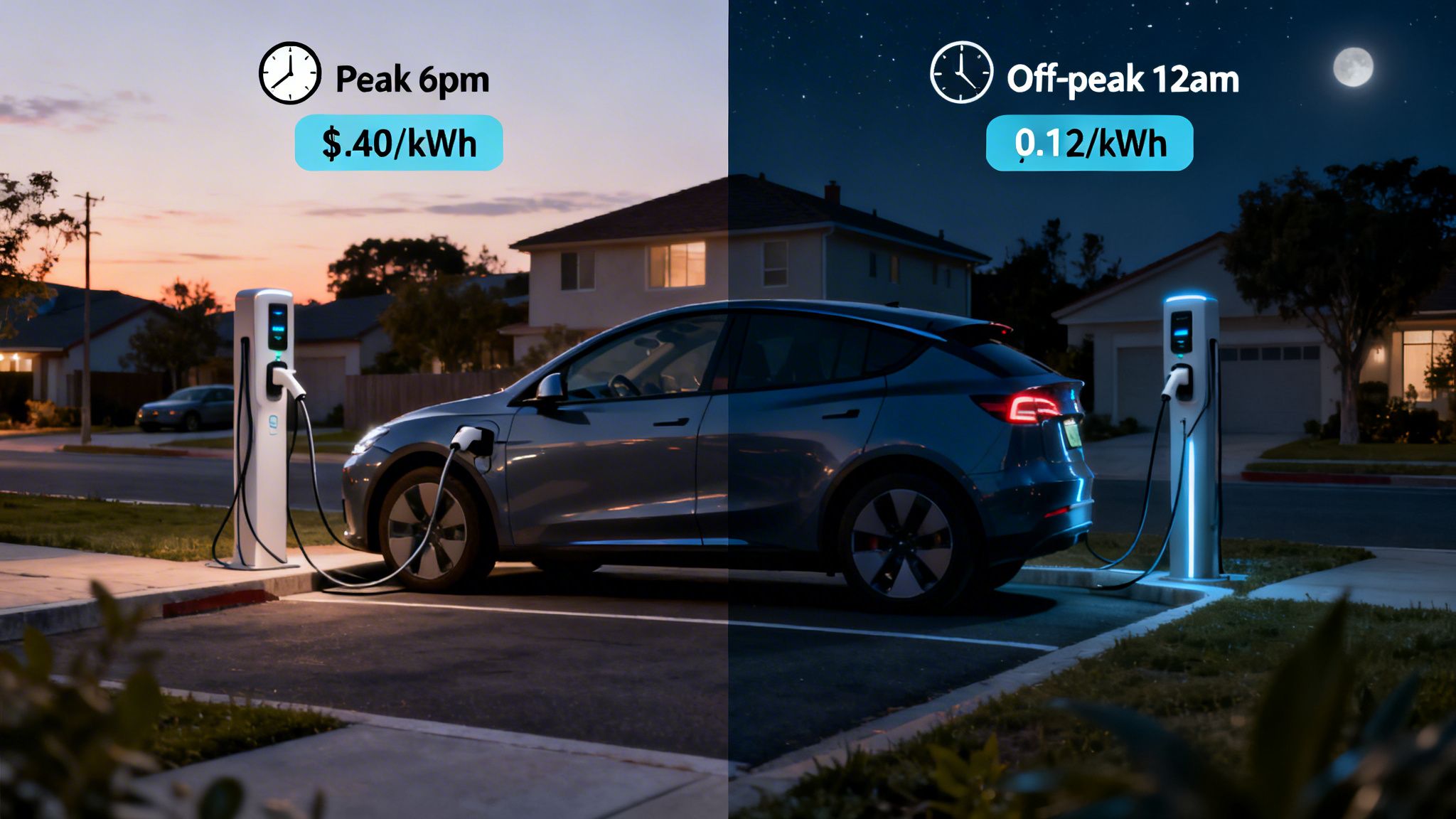
When calculating the electricity cost to charge an electric car, when you charge is as critical as how much energy you use. For households on a Time-of-Use (TOU) tariff, shifting your EV charging session to a different time of day can have a material impact on your quarterly bill.
The electricity grid experiences fluctuating demand, similar to traffic on a motorway. During peak periods, typically 4 pm to 8 pm, demand for electricity is high as households increase their consumption. Consequently, the price of electricity is at its highest.
Conversely, during off-peak periods, usually late at night (e.g., 10 pm to 6 am), demand is low, and electricity is significantly cheaper. Charging your EV during these hours leverages the grid's natural price rhythm to your advantage.
Understanding Time-of-Use Tariffs in Australia
Energy retailers across Australia, including in Queensland and New South Wales, structure their TOU tariffs around three main periods. Understanding these is essential for smart EV charging.
- Peak Period: Late afternoon and early evening (e.g., 4 pm – 8 pm). This is the most expensive time to consume grid electricity.
- Off-Peak Period: Late at night and early morning (e.g., 10 pm – 6 am). This is the most cost-effective time to charge an EV from the grid.
- Shoulder Period: The times between peak and off-peak, with moderately priced electricity.
By shifting your charging from a 6 pm peak window to a midnight off-peak slot, you can often reduce your charging costs by 50% or more. This is a simple, no-cost change in habit that delivers immediate financial benefits.
By programming your EV or home charger to operate only during off-peak hours, you align your consumption with the lowest-cost periods on the grid. This requires no special equipment, only strategic planning.
This principle is the foundation of energy cost reduction. For a more detailed analysis, see our guide on using off-peak electricity rates. The next level of optimisation involves combining this timing with your own solar and battery storage to further reduce costs.
Real-World Charging Cost Scenarios in Australia
To illustrate the financial impact of different charging methods, let's analyse a practical example. We will use a popular EV in Australia, the Tesla Model Y with a 60 kWh battery.
A common charging behaviour is to top up the battery from 20% to 80%, which for a 60 kWh battery means adding 36 kWh of energy. Accounting for a typical 15% charging loss, this requires drawing approximately 41.4 kWh from the power source. This is the figure we will use for our cost calculations.
Cost Breakdown By Charging Method
The cost of this 41.4 kWh top-up depends entirely on your charging source and timing. Below are four common scenarios based on typical electricity rates in Queensland and New South Wales.
Scenario 1: Grid Charging at Peak Time
Charging immediately after arriving home from work at 6 pm. At a peak rate of 45 cents per kWh, this represents the most expensive grid-based option.Scenario 2: Smart Grid Charging at Off-Peak Time
Using your vehicle’s scheduling function to begin charging at 11 pm, when off-peak rates apply. We will use a typical rate of 22 cents per kWh.Scenario 3: Charging with Your Rooftop Solar
Using excess solar generation during a sunny day to charge the EV. The direct marginal cost of this energy is $0.Scenario 4: Charging from Your Home Battery
Using energy stored in your home battery (charged earlier by solar) to charge the EV overnight. The effective cost is also $0.
The financial disparity between these approaches is substantial.
The decision of when and how you charge has a far greater impact on your running costs than the specific EV model you own. Shifting charging from 6 pm to 11 pm can cut the cost by more than half.
Comparing the Dollar Figures
The following table compares the cost for the same 20%-to-80% charge across different methods, with example rates for Queensland and New South Wales.
Sample EV Charging Cost Scenarios (Tesla Model Y 60kWh)
This comparison shows the cost to add 36kWh, requiring 41.4kWh from the source due to 15% charging loss.
| Charging Scenario | Electricity Rate (c/kWh) | Total Cost (QLD Example) | Total Cost (NSW Example) |
|---|---|---|---|
| Grid Charging (Peak) | 45c | $18.63 | $19.46 |
| Grid Charging (Off-Peak) | 22c | $9.11 | $9.52 |
| Rooftop Solar Charging | 0c | $0.00 | $0.00 |
| Home Battery (Solar Charged) | 0c | $0.00 | $0.00 |
The data confirms that charging from your own solar or a solar-charged battery eliminates the direct cost. However, even for those reliant on the grid, strategic timing makes a significant difference. Paying over $18 versus approximately $9 for the same charge highlights the financial penalty of unmanaged charging and reinforces the need for a smart energy strategy.
The Hidden Costs: Supply Charges and Public Charging
Minimising your cost per kWh is only one part of the equation. Two other significant costs that affect your overall electricity bill are fixed supply charges and the high price of public fast charging.
Even with 100% solar self-sufficiency, every grid-connected home pays a daily supply charge. This is a fixed fee for maintaining your connection to the network, typically ranging from $1.00 to $1.50 per day in NSW and Queensland. Over a 90-day billing period, this equates to an unavoidable $90–$135 before any energy is consumed.
Home Charging Versus Public Fast Charging
While home charging offers cost control, public DC fast chargers prioritise convenience and speed at a premium price. Rates often range from 60c to 85c per kWh or higher—double or triple the cost of peak residential rates. Frequent reliance on public fast charging can quickly erode the fuel savings an EV offers.
Additionally, accessing low-cost home charging requires an initial investment in a home charger. The EV charger installation cost is a one-time expense that unlocks long-term savings.
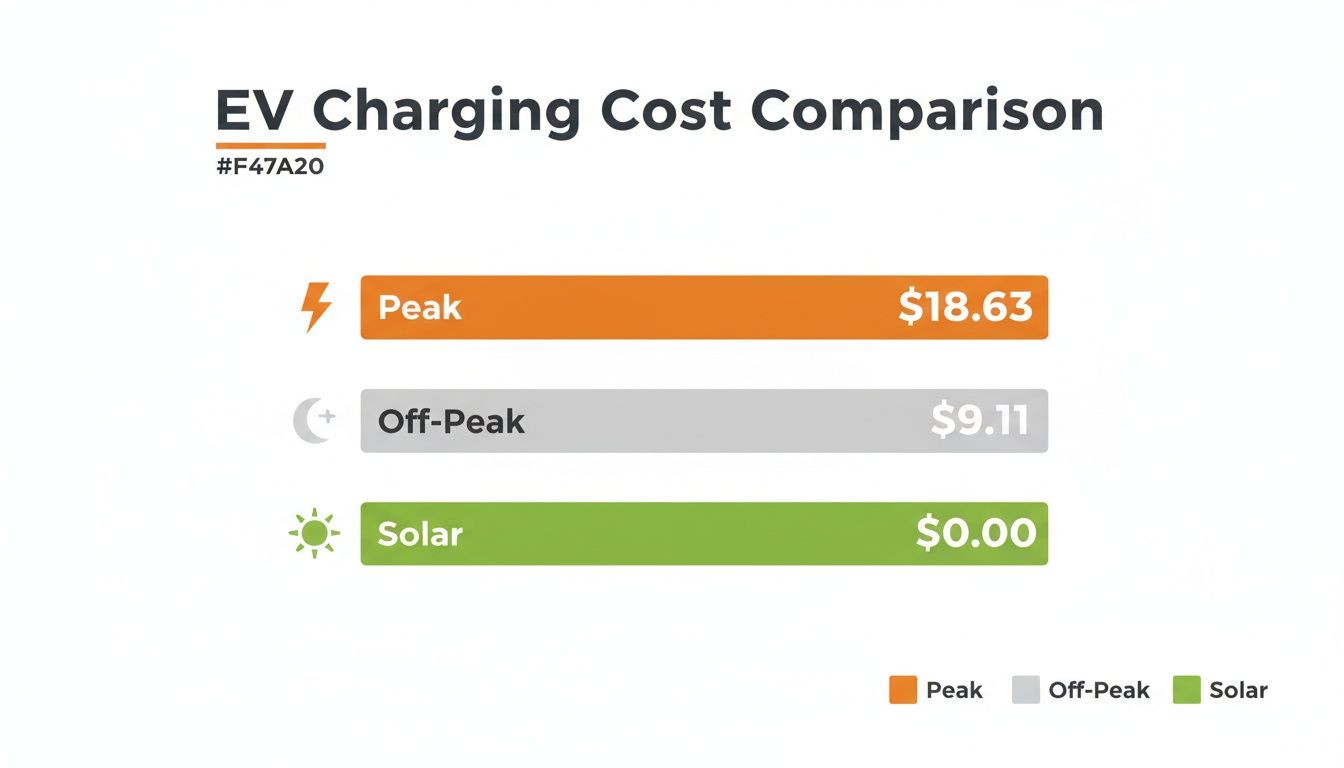
As the chart illustrates, charging during peak grid hours is significantly more expensive than using off-peak power, while charging from your own solar energy is the most economical option.
A truly effective energy cost strategy must address not only variable usage rates but also fixed supply charges and reliance on expensive public chargers.
A retailer-led Virtual Power Plant offers a solution. While a standard solar and battery setup reduces your energy consumption costs, it does not address the fixed daily supply charge. A well-designed VPP, however, can generate an electricity allowance substantial enough to offset both your energy consumption costs and these fixed charges, creating a clear pathway to a potential $0 bill.
How a VPP Makes Your Battery Pay for Your Bill
Owning a solar and battery system is an excellent first step, but merely using it to avoid grid consumption leaves significant financial potential untapped. By joining a retailer-led Virtual Power Plant (VPP), you can transform your battery from a passive storage device into an active, income-generating asset.
A VPP enables your battery to export energy to the grid during periods of high demand and price volatility. This is a coordinated action managed by your VPP operator, such as High Flow Energy. When the National Electricity Market (NEM) is under strain, your battery can be called upon to discharge spare capacity, contributing to grid stability.
In return for this grid support, you earn a substantial electricity allowance.
From Cost Centre to Profit Centre
This allowance fundamentally changes the financial dynamics for battery owners, especially those concerned with the electricity cost to charge an electric car.
The allowance is a credit applied directly to your retail electricity bill, designed to offset your energy expenses, including:
- Any grid electricity consumed by your home.
- The cost of charging your EV overnight.
- The fixed daily supply charges that solar alone cannot eliminate.
This mechanism transforms your battery from an asset that only saves money to one that actively earns credits to pay for the electricity you need.
A well-structured VPP turns your battery into an optimisation tool that works to eliminate your entire bill, not just shift solar energy from day to night. It tackles both your variable usage costs and your fixed daily charges head-on.
Earning Your Way to a $0 Bill
The objective is to generate an allowance large enough to cover your entire quarterly bill, making a genuine $0 bill an achievable outcome, even with the additional load of an EV. The energy your battery exports to the grid effectively pre-pays for the energy you draw later to charge your car or power your home.
This model is financially superior to using a battery in isolation. Instead of simply saving ~30c/kWh by avoiding a grid import, your battery can be dispatched when wholesale electricity prices are significantly higher, creating far greater value. This value is then shared with you as an allowance, delivering a superior financial outcome. Understanding the potential financial returns is key; analysing your solar return on investment provides crucial insights for battery and VPP optimisation.
To learn more about how this works, explore our detailed guide on how Virtual Power Plants are driving Australia’s renewable energy revolution.
Why High Flow Energy Is Your Optimisation Partner
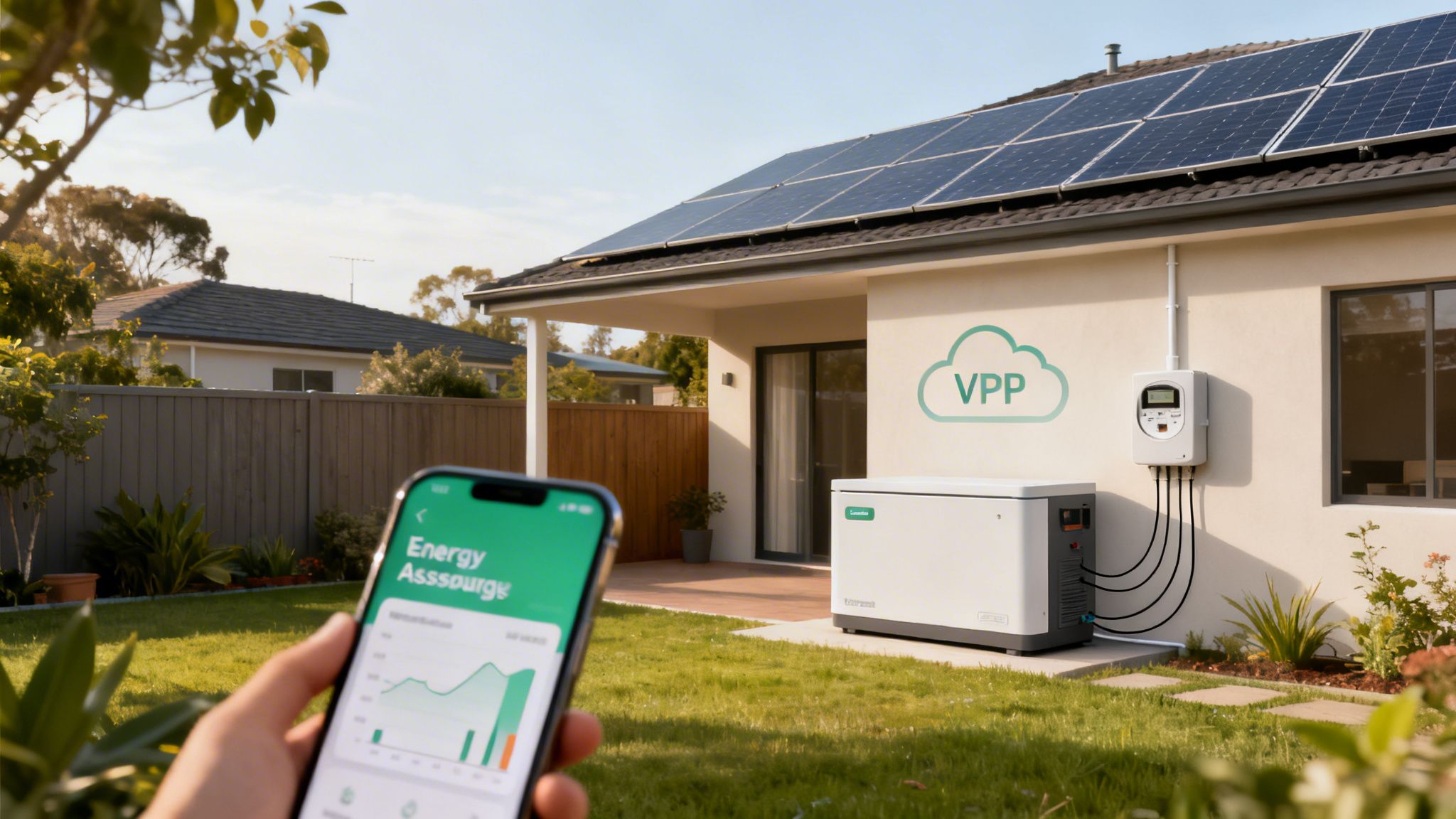
Most battery owners focus on installation quality. Far fewer focus on ongoing performance and optimisation.
High Flow Energy is a technology-enabled electricity retailer specialising in unlocking the full financial value of your existing solar and battery system. We do not sell or install hardware; our purpose is to provide an intelligent retail platform that makes your investment work harder for you.
A True Partner in Performance
Our Bring Your Own Battery (BYOB) Virtual Power Plant (VPP) is designed for Australian solar and battery owners who want to maximise their asset's performance. We coordinate your battery to support the grid during critical demand periods.
In return, you earn a significant electricity allowance. This credit is structured to offset your grid usage—including the electricity cost to charge an electric car—and also address the fixed daily supply charges that solar alone cannot cover.
High Flow Energy provides the strategy and platform to turn your battery into an active asset that helps stabilise the grid and earns its keep.
We position ourselves as your performance partner, focused on helping you understand and improve your system’s financial return.
If you believe your battery is underperforming and want to explore how a VPP can deliver a superior financial outcome, the next step is to assess your eligibility.
Answering Your Top Questions
Here are answers to common questions from EV owners about the intersection of charging costs, batteries, and VPPs.
FAQ
If I join a VPP, will I still have enough power to charge my car?
Yes. As the battery owner, you remain in control. A well-managed VPP, like High Flow Energy's, only utilises your battery's spare capacity for grid support. You can set a minimum reserve level to ensure you always have sufficient energy stored for your household needs, including charging your EV. Your personal energy security is always the priority.
Is it always cheaper to charge at home than at a public charger?
Yes, the cost difference is substantial. Home charging is significantly cheaper than using public DC fast chargers. Even when drawing from the grid during peak times, home charging is more economical than the premium rates of public stations, which can be two to three times higher per kWh in NSW and Queensland. The lowest electricity cost to charge an electric car is achieved at home, ideally using your own solar energy.
How does the High Flow Energy allowance actually cover my EV charging costs?
The allowance is a financial credit earned through your battery's participation in our Bring Your Own Battery (BYOB) VPP. It is applied to your entire retail electricity bill, offsetting all your consumption costs up to the allowance limit. This includes energy used to run your home, charge your EV, and, crucially, it can also eliminate your fixed daily supply charge, making a $0 bill a tangible outcome for many of our customers.
Does a bigger EV battery automatically mean a higher charging cost?
Not necessarily. While a larger battery requires more energy to charge from empty, the most critical factor determining your total cost is the price per kWh of the electricity used. A smart energy strategy focuses on sourcing the lowest-cost energy—from your solar, a solar-charged battery, or via a VPP allowance—regardless of your EV's battery size. The focus should be on the cost of the "fuel," not the size of the "tank."
What happens if my battery is used for the VPP overnight? Can I still charge my car?
High Flow Energy's VPP model is designed to work in harmony with your lifestyle. Grid support events are typically infrequent and of short duration, often occurring in the late afternoon or early evening when wholesale prices are high. Most EV charging happens late at night during off-peak hours. Our system ensures your battery has recovered and is ready to support your overnight charging needs, with your pre-set reserve level always protected.
Most battery owners focus on installation quality. Far fewer focus on ongoing performance and optimisation. High Flow Energy is an electricity retailer built around unlocking the full value of your existing solar and battery system.
If you would like to understand whether your battery is underperforming financially, request an eligibility assessment today.