

Smart Meter Apps: A Guide for Australian Battery Owners
If you already have rooftop solar, a battery, and a retailer app on your phone, you’re probably looking at plenty of data and still wondering one thing: why doesn’t this feel financially optimised?
That’s the gap most battery owners run into. A standard app tells you what happened. It shows imports, exports, daily usage, maybe a rough cost view. Useful, yes. But useful isn’t the same as profitable.
For solar and battery owners in Queensland and New South Wales, the significant opportunity starts when smart meter apps move beyond monitoring and start coordinating your battery against price signals, demand events, and grid services. That’s when your battery stops behaving like a passive storage box and starts behaving like an energy asset.
What Standard Smart Meter Apps Show You
A standard smart meter app is usually the app or portal offered by your electricity retailer, distributor, inverter platform, or battery brand. It pulls data from your meter and turns it into charts.
At a basic level, that’s valuable. Smart meters are now part of mainstream grid modernisation. The global smart meter market is projected to reach USD 21.81 billion by 2030 according to Grand View Research’s smart meters market analysis. The reason that matters to homeowners is clear. Real-time or near real-time data is the foundation for every serious energy app.
The dashboard analogy
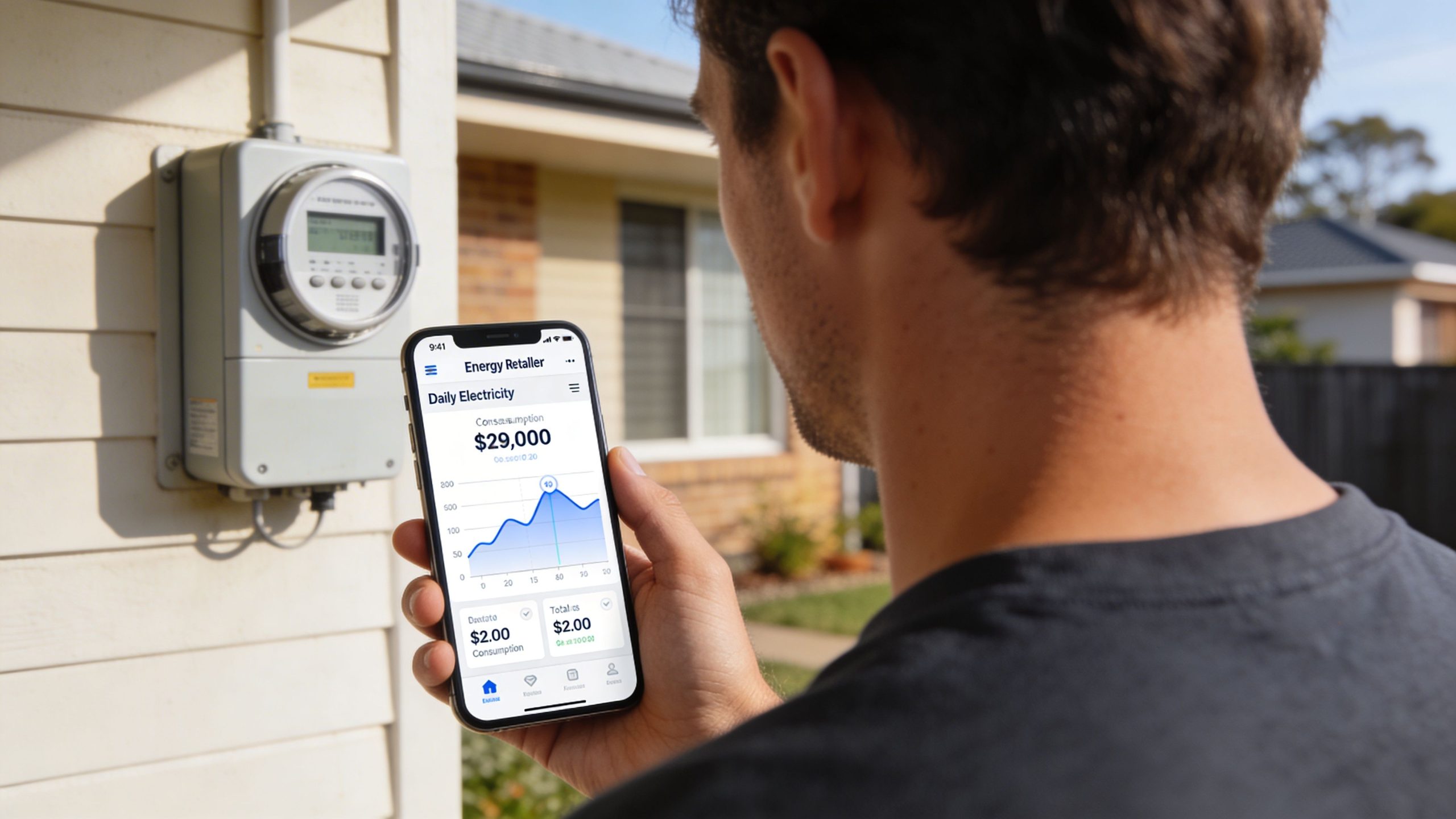
Think of standard smart meter apps like a car dashboard.
The dashboard tells you your speed, fuel level, and engine temperature. It helps you avoid obvious mistakes. It doesn’t choose the best route, time your acceleration, or decide when to conserve fuel for a steep climb.
Most retailer apps work the same way.
They typically show:
- Consumption data so you can see when your home imported power from the grid
- Solar export data so you can track when surplus generation left the house
- Billing views that translate usage into estimated costs or bill history
- Time patterns such as daytime self-consumption and evening grid reliance
That’s helpful for awareness. It’s not the same as active optimisation.
What these apps do well
Standard apps are good at making waste visible.
You might notice your evening demand spike. You might realise the oven, air conditioning, and EV charging are colliding at the wrong time. You might finally see that your battery empties too early and leaves you exposed later in the night.
That kind of visibility matters. For a broader view of how households use basic dashboards and tracking tools, this overview of internet of things applications development is useful because it shows how connected devices turn physical systems into readable software.
Most households don’t have a data problem. They have an action problem.
Where standard apps stop
The limitation is straightforward. Most smart meter apps are view-only tools.
They don’t usually decide when your battery should hold charge for a high-value evening period. They don’t coordinate exports into grid events. They don’t treat your battery as something that can earn value, not just avoid imports.
If you’re only using your app to check yesterday’s graph, you’re doing home energy accounting, not energy trading.
If you want a baseline for that kind of monitoring first, a good place to start is home energy monitoring. But once you’ve reached the point where you can already read the dashboard, the bigger commercial question becomes what your app can do, not just what it can show.
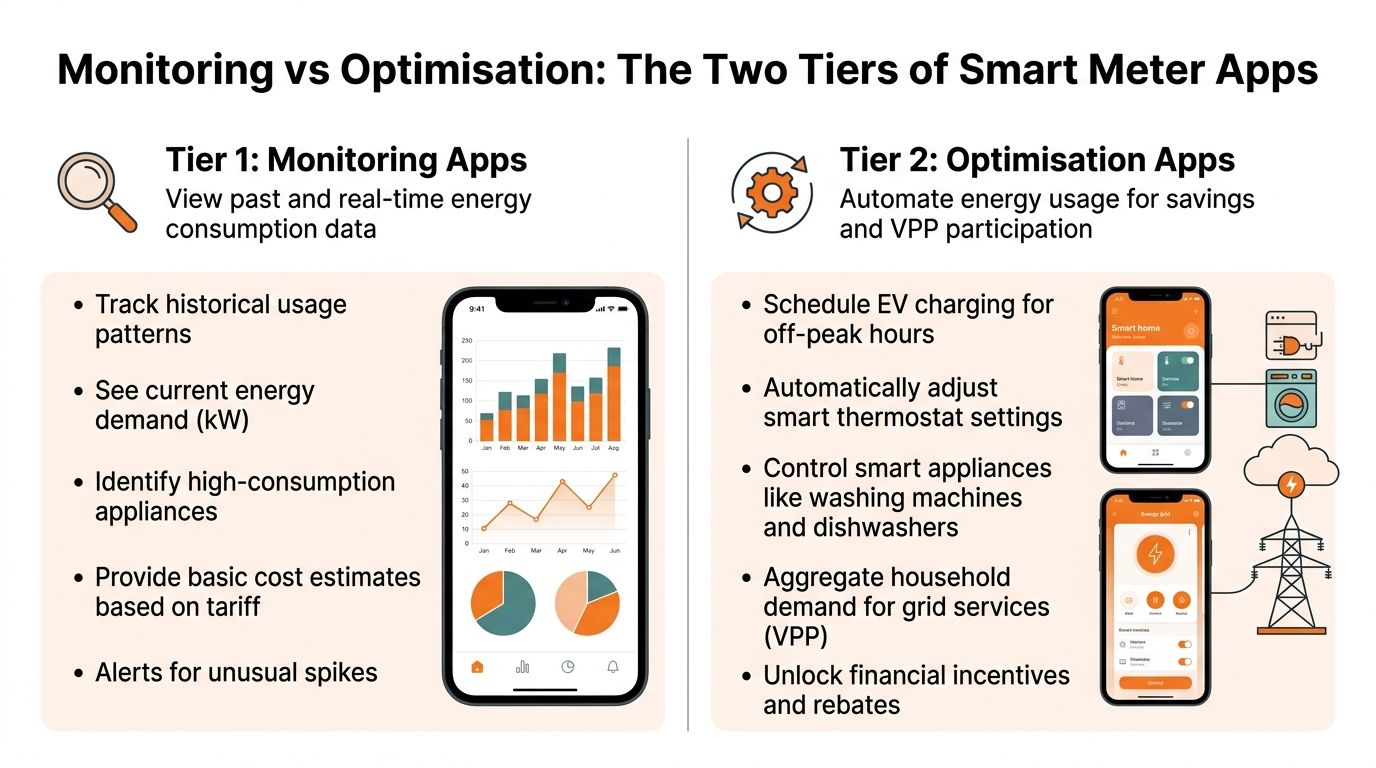
Monitoring vs Optimisation The Two Tiers of Smart Meter Apps
There are two tiers of smart meter apps in the Australian market.
Tier 1 is about visibility. Tier 2 is about decisions.
That distinction matters because plenty of battery owners think they already have an “advanced” app because it has nice charts. A polished interface doesn’t mean the software is managing value.
Tier 1 means monitoring
A Tier 1 app usually comes from a traditional retailer, distributor, inverter platform, or battery manufacturer.
It helps you answer questions like:
- What did I use yesterday
- When did I export solar
- How full was the battery
- What does my bill look like so far
Those are legitimate questions. They just aren’t the questions that extract the most value from a battery.
Tier 2 means optimisation
A Tier 2 app treats the battery as a controllable asset.
Instead of stopping at usage graphs, it combines meter data, battery status, pricing signals, and automation logic. In practical terms, that means the app can influence when energy is stored, when it’s held back, and when spare capacity is dispatched for a higher-value outcome.
There’s also a significant information gap here. Guidance for Australian solar and battery owners on connecting app data to VPP participation is still thin, even though VPP capacity in the NEM surged 85% in 2025 according to the analysis at Volts on freeing smart meter data. Many households have the hardware. Fewer understand the software layer.
The difference in one table
| Feature | Tier 1 Monitoring App (Most Retailers) | Tier 2 VPP Optimisation App (e.g., High Flow Energy) |
|---|---|---|
| Core purpose | Show usage and history | Manage battery value in near real time |
| Data view | Past and current household data | Household data plus dispatch logic and value signals |
| Battery role | Battery is observed | Battery is coordinated |
| Export strategy | Mostly passive | Exports can be timed to higher-value periods |
| Grid participation | Usually none | Can support VPP participation and grid events |
| User benefit | Awareness and bill tracking | Financial optimisation and operational control |
| Typical automation | Basic alerts | AI-driven planning, scheduling, and overrides |
| Best for | Households learning their load profile | Owners who want better battery economics |
What works and what doesn’t
What works is a clear split between human judgement and software execution.
You set priorities. The app handles the fast-moving decisions.
What doesn’t work is trying to manually chase every price movement or demand event from your phone. Wholesale energy conditions change too quickly for manual control to be the primary strategy. If you want a useful non-energy example of how software handles complex utility logic, this piece on AI for utility sector apps is worth reading.
A battery owner who only monitors is still reacting. A battery owner who optimises is participating.
One practical sign you’re still in Tier 1 is that your app can show your evening peak exposure but can’t do much about it. If time-of-use costs are already part of your bill, understanding off-peak electricity is the first step. The second step is software that can act on that timing.
How VPP-Integrated Apps Realize Your Battery's Financial Value
Your battery can save you money in two very different ways.
The basic version is familiar. Store excess solar during the day, use it after sunset, and buy less power from the grid. That is solid household economics, but it is still a Level 1 outcome. A VPP-integrated app moves the battery into Level 2. It starts treating stored energy as a flexible financial asset that can be timed, reserved, and dispatched for higher-value periods.
How the value stack works
The core idea is clear. A kilowatt-hour has different value depending on when it is available.
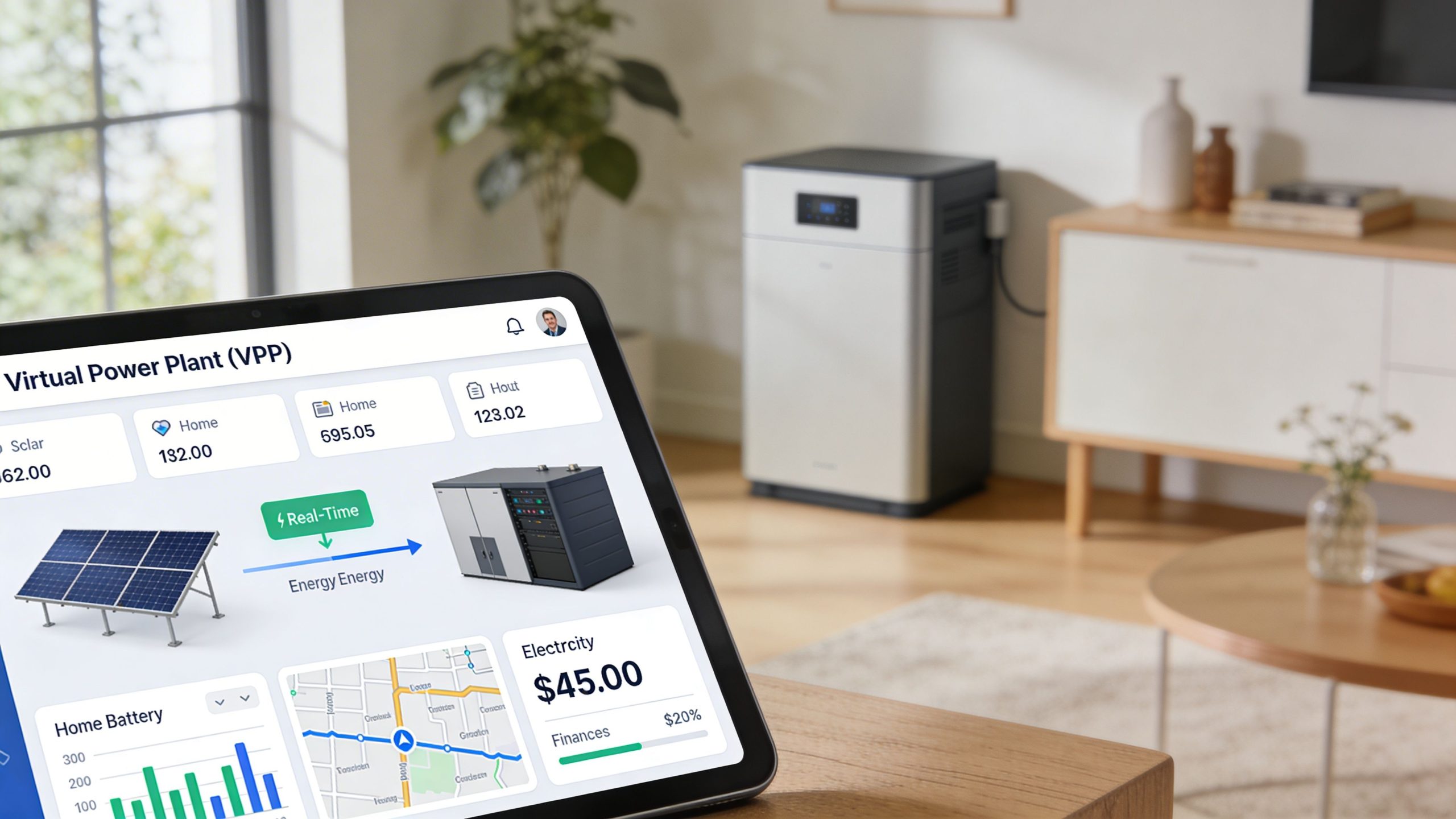
Energy stored at 1pm, when rooftop solar is abundant, is usually less valuable than energy available during the evening peak or a grid support event. A VPP app works like an automated trader with house rules. It watches timing, battery state, site demand, and market signals, then decides whether to charge, hold, discharge, or export.
That process usually looks like this:
Read the site in real time
The app checks imports, exports, household load, solar production, and battery state of charge.Assess the next value window
It considers forecast demand, likely price conditions, and whether a VPP event or grid service call is expected.Set a dispatch plan
The software decides how much capacity to keep for the home, how much to reserve for a possible event, and whether export is worth more than self-consumption in that period.Run the plan automatically
It executes the schedule unless you override it or your settings require a larger backup reserve.
That is the financial step up from monitoring. Level 1 apps report what happened. Level 2 apps help decide what your battery should do next.
Why interval data matters
Battery optimisation is only as good as the timing data behind it.
In Australian VPP deployments, smart meter apps integrated with VPP operations use 15-minute interval recording from Class 0.5S/1.0S precision meters, according to this smart electricity meter features breakdown. The same source notes that this supports AI-driven charge and discharge optimisation, and that VPP participants can achieve 20 to 30% higher solar export value than non-VPP batteries. That link between precise interval data and export value is the commercial point. If the app cannot see the site clearly enough, it cannot time battery decisions well enough.
In practice, interval data is the difference between a rough daily average and a usable dispatch signal. For a battery owner, that affects whether the software holds energy for the dinner peak, exports early, or keeps capacity aside for a paid event later in the day.
Household first, then market value
The best VPP apps do not chase every revenue opportunity.
They protect household outcomes first. That means keeping a reserve buffer, respecting your backup settings, and avoiding the kind of aggressive discharge behaviour that leaves you exposed later that evening. Software should treat your battery as a shared resource with priorities, not as a merchant asset that ignores the home attached to it.
That is why experienced battery owners pay close attention to reserve settings, override controls, forecast screens, and event history. Good automation handles the fast decisions. Good user settings prevent the automation from making the wrong trade-off.
Here’s a useful explainer on how broader virtual power plants are driving Australia’s renewable energy revolution if you want the market context behind what the app is coordinating.
Why the software layer matters more than the hardware alone
Two households can own similar batteries and get very different financial results.
The gap often comes down to orchestration. One battery cycles around the home’s load profile. The other is scheduled against tariff timing, export opportunities, reserve constraints, and VPP dispatch events. Same box on the wall. Different operating model.
For that reason, the app is no longer just a reporting screen. It is the control layer that determines whether your battery only reduces imports or also earns from timing, flexibility, and grid participation.
A short visual example helps make that practical:
Technical Compatibility and Setup Requirements
Many individuals overestimate the hardware hurdle and underestimate the data hurdle.
For VPP participation, the key question usually isn’t “Do I need a whole new system?” It’s “Can my existing system provide the right data and accept the right control signals?”
Meter requirements
The meter matters because dispatch decisions depend on accurate interval data.
Australian VPP-integrated apps commonly rely on 15-minute interval data from Class 0.5S/1.0S precision meters, and that granularity supports AI-driven optimisation and dispatch through OpenADR 2.0b protocols, as outlined in the meter features reference cited earlier. If your meter can’t provide clean interval data, the optimisation layer becomes less precise.
In practical terms, you want:
- Interval visibility so imports and exports can be assessed in manageable blocks
- Bidirectional measurement so the system can distinguish consumption from export
- Reliable communications so the app isn’t making decisions on stale data
Battery and software compatibility
A Bring Your Own Battery model is usually broader than people assume.
Compatibility depends less on brand marketing and more on whether the battery system can integrate with the operator’s software and control framework. Some batteries are easier to integrate than others. Some expose cleaner control pathways. Some are technically compatible but operationally awkward.
That’s why serious eligibility checks focus on actual site configuration, not just brand name.
What setup usually involves
In many cases, setup is mostly a data connection and retailer-side integration process rather than a new hardware install.
A typical path looks like this:
- Meter review to confirm interval capability and communication status
- Battery assessment to confirm controllability and operating constraints
- Retail and platform onboarding so the app can access the right data streams
- Testing and verification to make sure readings, forecasts, and commands line up properly
The practical takeaway is clear. If you already have solar and a home battery, the barrier to entry may be much lower than you expect. The hard part is usually integration quality, not physical equipment.
Data Privacy and Security for VPP Participants
Privacy concerns around smart meter apps are reasonable. They shouldn’t be dismissed.
A lot of people are comfortable sharing streaming habits or shopping data, then become understandably cautious when an app starts tracking household energy behaviour. That caution makes sense because energy data can reveal routines, occupancy patterns, and appliance timing.
A 2025 CHOICE survey found 62% of NSW and QLD respondents worried about smart meter data monetisation without granular consent, as cited in this discussion of smart meter privacy concerns. That concern is one of the biggest reasons transparency matters.
What a responsible VPP app should make clear
You shouldn’t have to guess how your data is being used.
A credible VPP operator should explain:
- What data is collected from the meter, battery, and app
- Why it is collected for billing, optimisation, dispatch, or support
- Who can access it inside operational and compliance workflows
- How consent works when data is used beyond core service delivery
If those basics are buried in vague legal language, that’s a warning sign.
Security standards matter more than slogans
Security isn’t just a line in the footer.
The Australian VPP app context referenced earlier includes AES-256 encryption for live price feeds and forecasts. That matters because the app isn’t only displaying history. It’s handling data that informs battery decisions and grid interactions.
Good VPP software should be boring on security. Clear permissions, clear purpose, strong encryption, and no surprises.
The primary trade-off
The primary trade-off isn’t privacy versus participation. The primary trade-off is opaque participation versus transparent participation.
Every connected energy service uses data. The relevant question is whether that data use is narrow, secured, and tied to a clearly stated customer benefit. If the app gives you control, explains consent, and limits unnecessary sharing, participation becomes much easier to evaluate on its merits.
Practical Tips for Using Your VPP App
Most battery owners don’t need to become traders. They do need to become better readers of what the app is telling them.
That matters more than ever because the software layer is where value is shifting. The smart meter data management market is projected to grow at a 17.4% CAGR, faster than hardware deployment, according to the Fact.MR report cited earlier. In plain English, app literacy is becoming part of battery ownership.
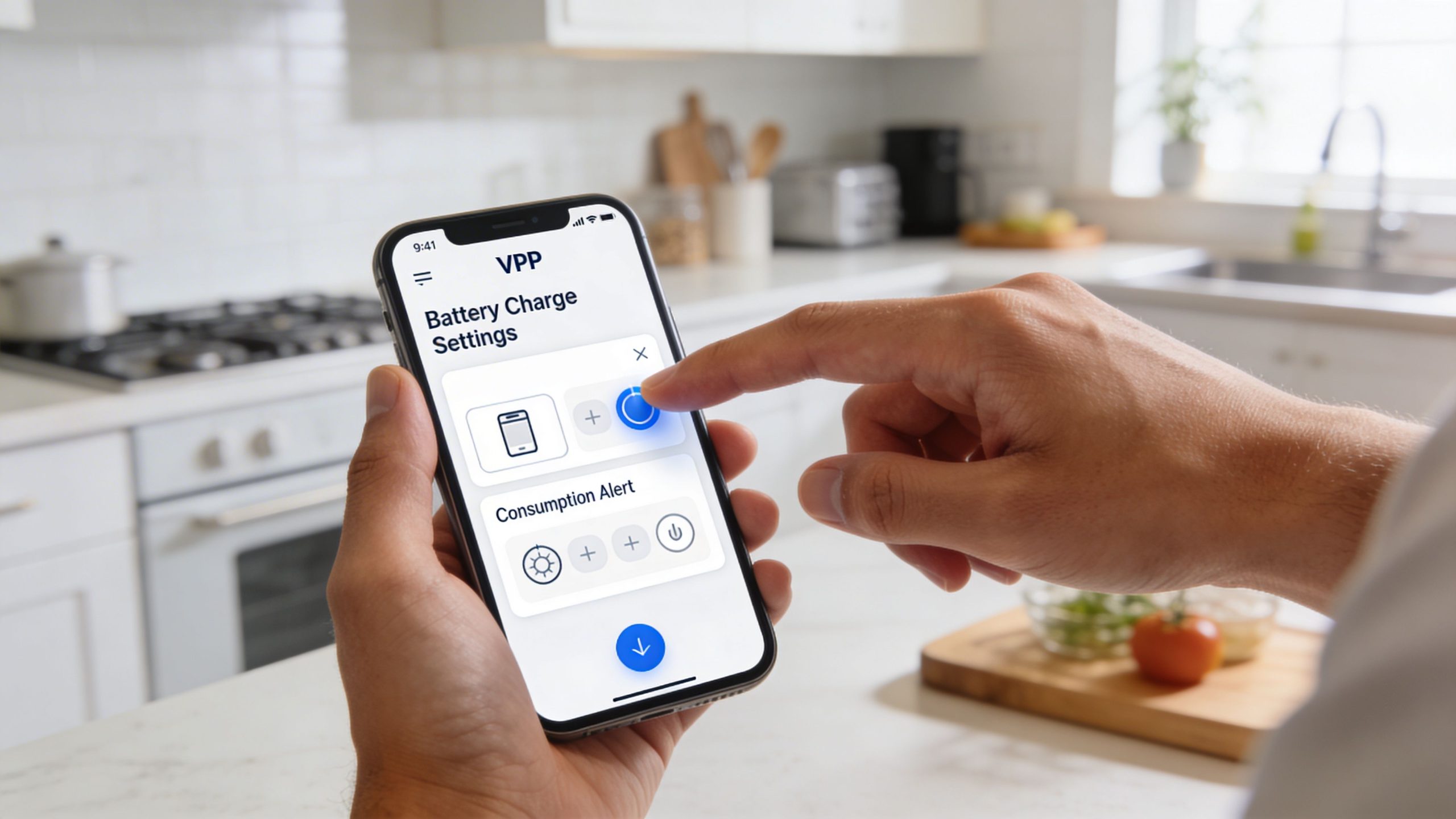
Focus on these screens first
Don’t try to master every chart at once. Start with the screens that affect decisions.
Battery schedule view
Check when the app expects to hold, charge, or discharge. If the schedule surprises you, that’s where questions start.Price or value forecast panel
Even if the app simplifies market data, you want to understand whether the software is reacting to a low-value or high-value period.Household reserve setting
This is the line between automation and comfort. If you want more backup confidence, this setting matters.
Use manual override sparingly
Manual override is important. Constant manual override usually isn’t.
Good reasons to intervene include:
- Storm risk or outage concern when you want to preserve charge
- A heavy evening load such as entertaining, pool use, or unusual cooling demand
- Testing behaviour if you’re learning how the app responds
Poor reasons include reacting emotionally to every battery movement. If you override too often, the optimisation engine can’t do its job.
Expect some friction points
A few issues are common:
Data lag
App views can occasionally trail what’s happening physically at the site.Notification fatigue
Too many alerts train people to ignore the important ones.Chart confusion
Import, export, solar generation, and battery discharge can look similar until you know the app’s visual language.
If a setting affects battery availability tonight, learn that setting first. The rest can wait.
A practical habit is to review the app briefly in the late afternoon and after a notable event. Not constantly. Just often enough to understand whether automation and household priorities are staying aligned.
Key Takeaways
Smart meter apps aren’t all doing the same job. Some monitor. Some optimise.
The distinction matters for battery owners in NSW and QLD because a passive app can help you understand your energy use, but it won’t necessarily improve the financial performance of your battery.
Key points:
- Tier 1 apps are mainly for visibility, usage tracking, and bill awareness.
- Tier 2 apps use software, forecasts, and automation to coordinate battery value.
- VPP-integrated apps rely on accurate interval data and compatible battery control.
- Household priority should remain central. Good optimisation uses spare capacity, not your essential reserve.
- Privacy and consent matter. Clear data handling is part of a credible VPP offering.
- App literacy is now part of asset performance. The battery may sit on your wall, but the financial logic sits in the software.
For many households, the biggest missed opportunity isn’t system size. It’s underusing the intelligence layer already available.
Why Choose High Flow Energy
Most battery owners focus on installation quality. Far fewer focus on ongoing performance and optimisation. High Flow Energy is an electricity retailer built around realizing the full value of your existing solar and battery system.
The model is built for BYOB households in Queensland and New South Wales that want more than passive monitoring. It combines retailer integration, VPP coordination, app-based control, and household-first battery management. The result is a clearer path to better battery economics, without requiring you to buy a new solar or battery system.
Check Your Eligibility
If you already own solar and a compatible battery, the right next step is to assess whether your current setup is financially underperforming. An eligibility check helps clarify compatibility, likely operating fit, and whether your battery is positioned for monitoring only or genuine optimisation.
If you’d like to understand whether your battery is underperforming financially, check your eligibility with HighFlow Energy.