


Solar Power Tiles: A 2026 Guide for AU Homes
Are you comparing roofing options, or are you really deciding how well a future energy asset will perform over the next decade? That’s the gap most homeowners miss. Solar power tiles are usually pitched as a design choice, but for a financially savvy household in New South Wales or Queensland, the better question is whether they produce enough useful energy, at the right times, to justify their premium.
Australia is one of the few markets where that question matters at scale. By mid-2025, the country had over 3.2 million rooftop solar systems installed, covering more than 1 in 3 households, with the highest per capita solar PV penetration globally, according to Australian rooftop solar adoption data. That changes the conversation. Solar is no longer novel. The decision now is about architecture, output quality, battery fit, and long-term value extraction.
For homeowners planning a new build or major renovation, solar tiles sit at the intersection of design and energy infrastructure. If you're already thinking about thermal performance, orientation, and electrification, a broader blueprint for smarter living can be more useful than looking at generation hardware in isolation.
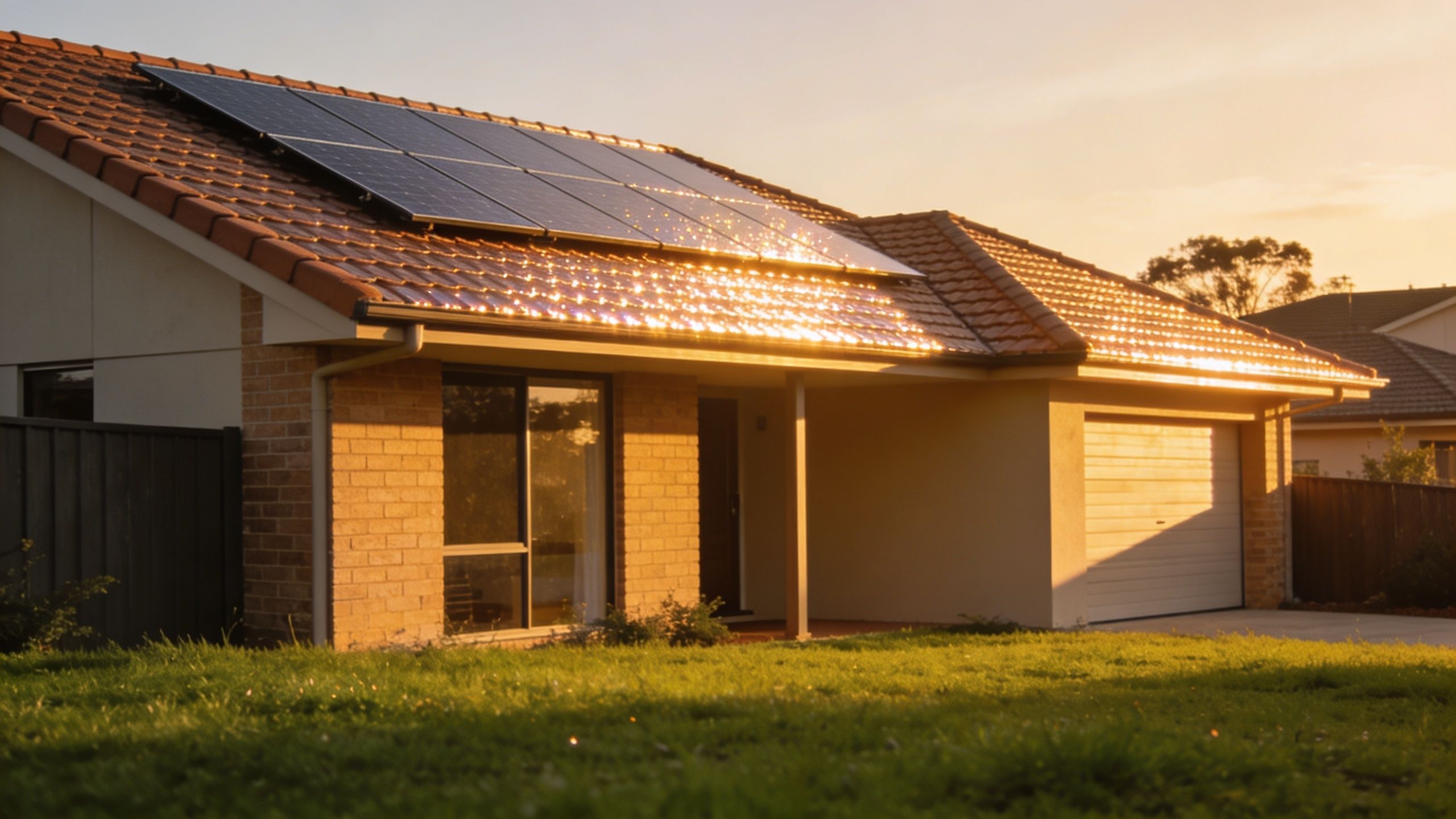
An Introduction to Solar Power Tiles for Australian Homeowners
Solar tiles appeal to a specific buyer. Not the homeowner chasing the lowest installed cost, but the one weighing kerb appeal, roof replacement timing, and energy self-sufficiency as one decision.
That distinction matters. A conventional solar system is usually an add-on. Solar tiles are part of the building envelope. That changes installation sequencing, serviceability, and the economics of the roof itself.
Why the technology is getting attention
Most Australian solar commentary still treats generation as a standalone product. That works for panels mounted on an existing roof. It doesn’t work as well for integrated roofing products, because the value case sits across multiple budgets at once:
- Roofing budget: You’re replacing roofing material, not just adding generation.
- Energy budget: You’re reducing purchased electricity over time.
- Property budget: You may care about visual integration and resale positioning.
- Battery strategy: Your generation profile affects how well a battery can be charged and used.
Solar tiles aren’t simply a prettier panel. They’re a different asset class because they combine roofing and generation in one system.
Who should pay attention
Solar power tiles make the most sense when one or more of these conditions apply:
- You’re building new or re-roofing: Integration is easier when the roof is already in scope.
- Visual consistency matters: Some homeowners don’t want rack-mounted hardware visible from the street.
- You’re planning around batteries: Total system behaviour matters more than module-level headline efficiency.
- You take a portfolio view of the home: The roof, solar, battery and electricity plan should work together.
For existing homes with a sound roof, conventional panels will often remain the simpler benchmark. But simplicity isn’t the same as superiority. Once battery optimisation and export value enter the picture, the best answer depends on how the whole system behaves, not just how it looks on installation day.
What Exactly Are Solar Power Tiles?
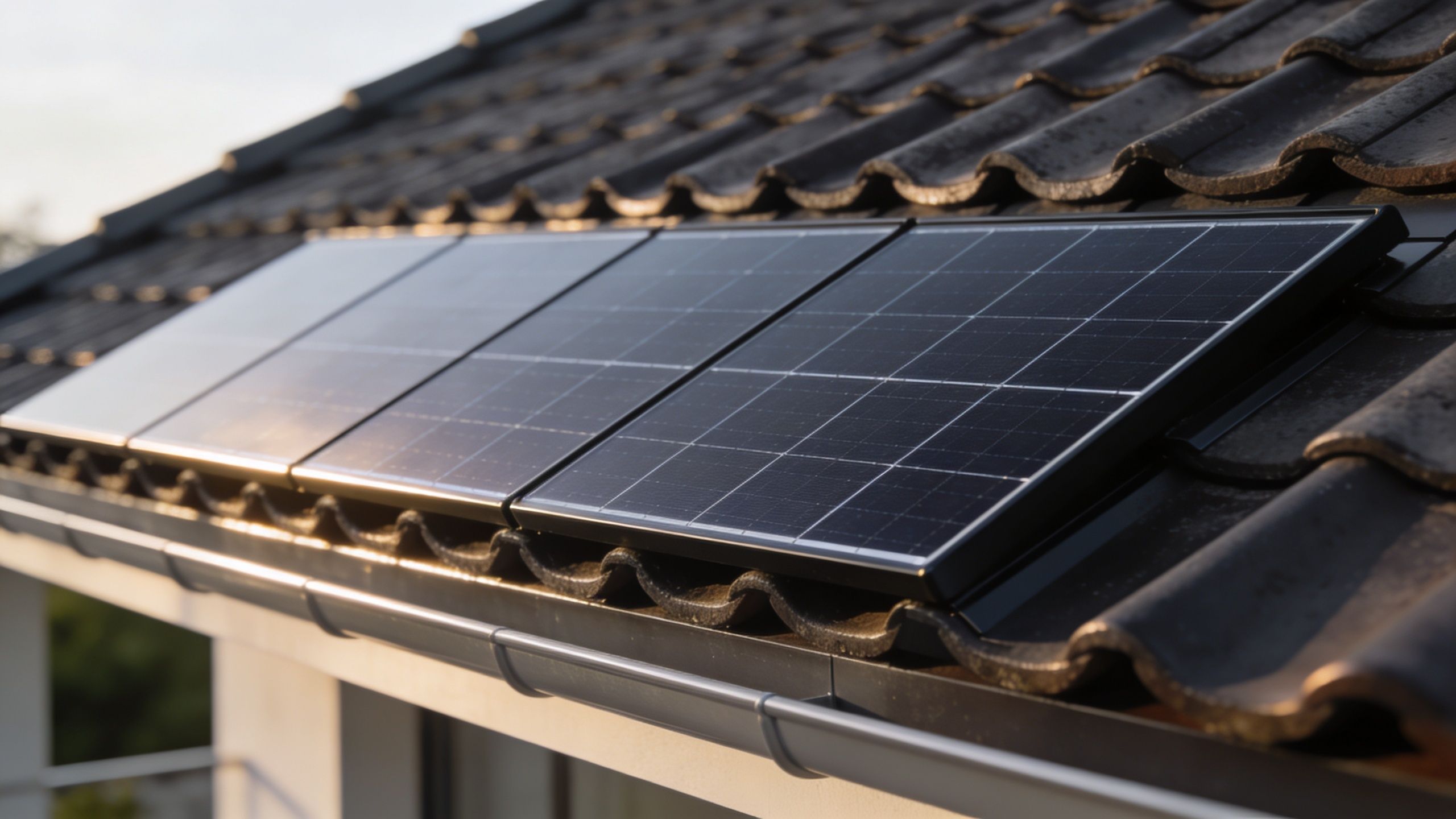
Solar power tiles are a form of building-integrated photovoltaics, often shortened to BIPV. The simplest way to think about them is this: conventional panels sit on top of a roof, while solar tiles are designed to be part of the roof itself.
That sounds cosmetic, but the engineering difference is substantial. A tile has to generate electricity while also acting like roofing material. It must shed water, tolerate heat, wind and corrosion, and connect into an electrical system without compromising the roof assembly.
How they differ from standard rooftop solar
A standard panel system uses larger modules attached to mounting rails. Solar tiles use smaller, interlocking units that replace sections of conventional roofing.
That has practical effects:
- They look integrated: The roofline stays cleaner.
- They can reduce penetrations: Some designs avoid the kind of roof penetrations associated with rack-mounted systems.
- They’re installed as roofing material: That can be an advantage on new builds and major roof replacements.
One documented example is the SunPower T10 Solar Roof Tile. According to the SunPower T10 roof tile specification, it uses a non-penetrating, interlocking design with a pre-engineered 10-degree angle to maximise energy capture in Australian conditions. The same specification states that this design can improve annual energy yield by 5-15% compared with flat-mounted systems and is engineered to resist cyclonic winds up to 300 km/h.
Why the roof design matters financially
The technical design isn’t only about appearance. It affects installation risk and output quality.
A non-penetrating design can reduce one of the concerns homeowners often raise with rooftop retrofits, namely whether hardware attachment points increase leak risk or complicate roof warranties. An engineered tilt also matters because integrated products don’t usually have the same post-install angle flexibility as framed panels.
Practical rule: If a solar product locks in its orientation at roof level, roof design quality becomes part of your generation strategy.
For Australian homeowners, that means solar tiles should be assessed earlier in the building process than standard panels. Orientation, pitch, shading and roof geometry aren’t afterthoughts. They’re core investment variables.
Solar Tiles vs Traditional Panels A Clear Comparison
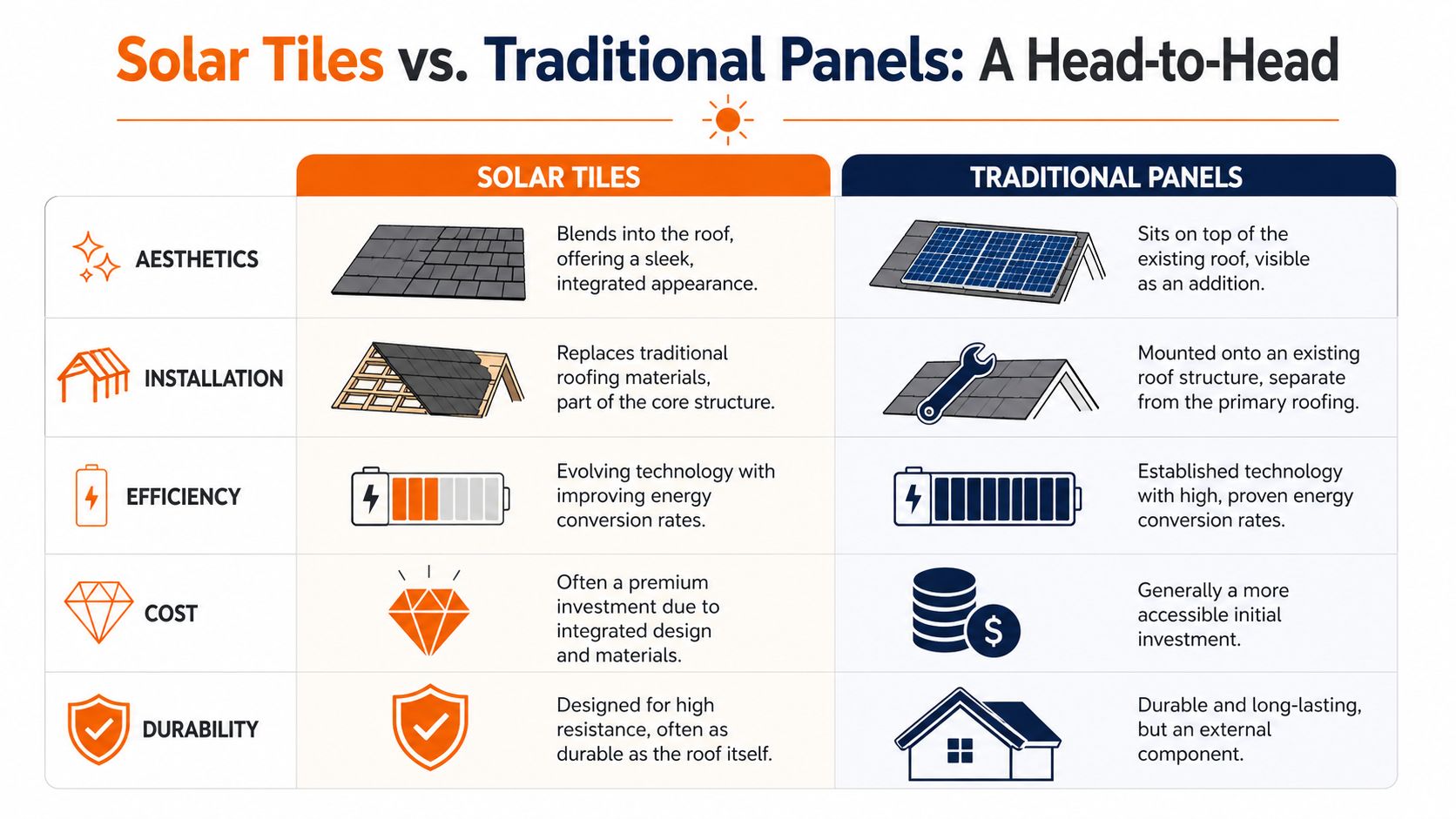
The easiest mistake is to compare solar tiles and panels as if they serve the same job in the same way. They don’t. One is a premium integrated roofing system. The other is an established generation system mounted onto a roof structure.
The visual summary below captures the broad trade-off.
A useful secondary reference is this product overview video:
Solar Power Tiles vs. Traditional Solar Panels
| Attribute | Solar Power Tiles | Traditional Solar Panels |
|---|---|---|
| Aesthetics | Integrated into the roof and visually understated | Clearly visible as an added layer |
| Installation | Best considered during a new build or roof replacement | Usually easier for existing roofs |
| Cost position | Premium category | More accessible for most households |
| Output profile | Can be constrained by roof form and fixed integration | More flexible in module selection and layout |
| Maintenance | May involve roofing and electrical coordination | More familiar service pathway |
| Battery and VPP fit | Depends heavily on total energy profile and roof design | Often stronger on raw peak generation |
The real trade-offs
Solar tiles usually win the architectural argument. They suit homeowners who want the roof to remain visually coherent and don’t want the appearance of bolt-on hardware.
Traditional panels usually win the straight-line financial argument on existing roofs. They’re mature, easier to compare, and generally better suited to retrofits where the roof itself isn’t due for replacement.
That still leaves a middle ground where solar tiles can make sense:
- New builds with premium design requirements
- Re-roofing projects where roofing cost is already committed
- Homes with planning or aesthetic constraints
- Owners who value integrated design enough to accept a slower payback
Panels are usually the more efficient financial tool. Tiles can still be the more coherent property decision.
What matters more than the headline choice
For many households, the better comparison isn’t tile versus panel. It’s integrated asset value versus lowest-cost generation.
A homeowner replacing a roof anyway is not comparing tiles with panels on a blank spreadsheet. They’re comparing one roof-plus-energy pathway against another. That’s why the right answer depends on timing. Install economics change when the roofing work is already unavoidable.
Analysing the Cost and ROI of Solar Tiles in NSW & QLD
The financial case for solar tiles is less about whether they work and more about whether they work well enough, for long enough, to recover a higher capital outlay. That requires looking past brochure aesthetics and into delivered energy.
One benchmark comes from GAF Energy’s Timberline Solar ES 2 shingles. According to the GAF Timberline Solar roofing system specifications, a 10kW roof using 170+ shingles can generate approximately 17-20MWh per year in Sydney or Brisbane. That’s meaningful annual production. But the same specifications note a temperature coefficient of -0.35%/°C, with 10-15% output reduction possible on hot Australian roofs where surface temperatures exceed 70°C.
Output is only bankable if it survives summer conditions
Many ROI discussions become too simplistic. For instance, Sydney and Brisbane can support strong solar generation, but roof heat matters because generation estimates that ignore temperature losses can overstate real-world performance.
For a homeowner, that changes how to think about payback:
- The system might look attractive on annual yield.
- Summer roof temperatures can compress output when solar conditions appear ideal.
- The value of each generated kilowatt-hour depends on self-consumption, battery charging opportunity, and export timing.
In other words, gross production is not the same as monetised production.
What drives the return calculation
A sensible ROI assessment in NSW or QLD should weigh these variables together:
- Roof replacement timing: If roofing work is already required, the incremental premium for tiles may be more reasonable than a standalone comparison suggests.
- Heat derating: High ambient and roof temperatures reduce actual output.
- Tariff structure: Export value can differ materially from the value of offsetting imported electricity.
- Battery presence: A battery can convert midday generation into evening value instead of low-value exports.
- Retail strategy: The way your retailer values exports, imports and battery participation affects realised returns.
If you’re comparing generation pathways and also reviewing export economics, it’s worth understanding how retailers structure value around solar exports through resources such as this guide to the best solar feed in tariff in Victoria. The market is state-specific, but the core lesson applies broadly. A feed-in tariff alone rarely captures the full value available from coordinated energy management.
A premium solar roof doesn’t need to beat standard panels on every metric. It needs to justify its premium through the combined value of roofing replacement, energy production and long-term asset use.
A financially disciplined conclusion
If your roof is in good condition and your objective is the shortest payback, conventional panels will often remain the benchmark. If you’re already funding a new roof, the comparison changes. Then the question isn’t “Are tiles expensive?” It’s “What premium am I paying for integration, and what performance am I receiving in return?”
That’s a more useful framework because it treats the roof as capital infrastructure, not just a mounting surface.
Solar Tile Compatibility with Batteries and VPPs
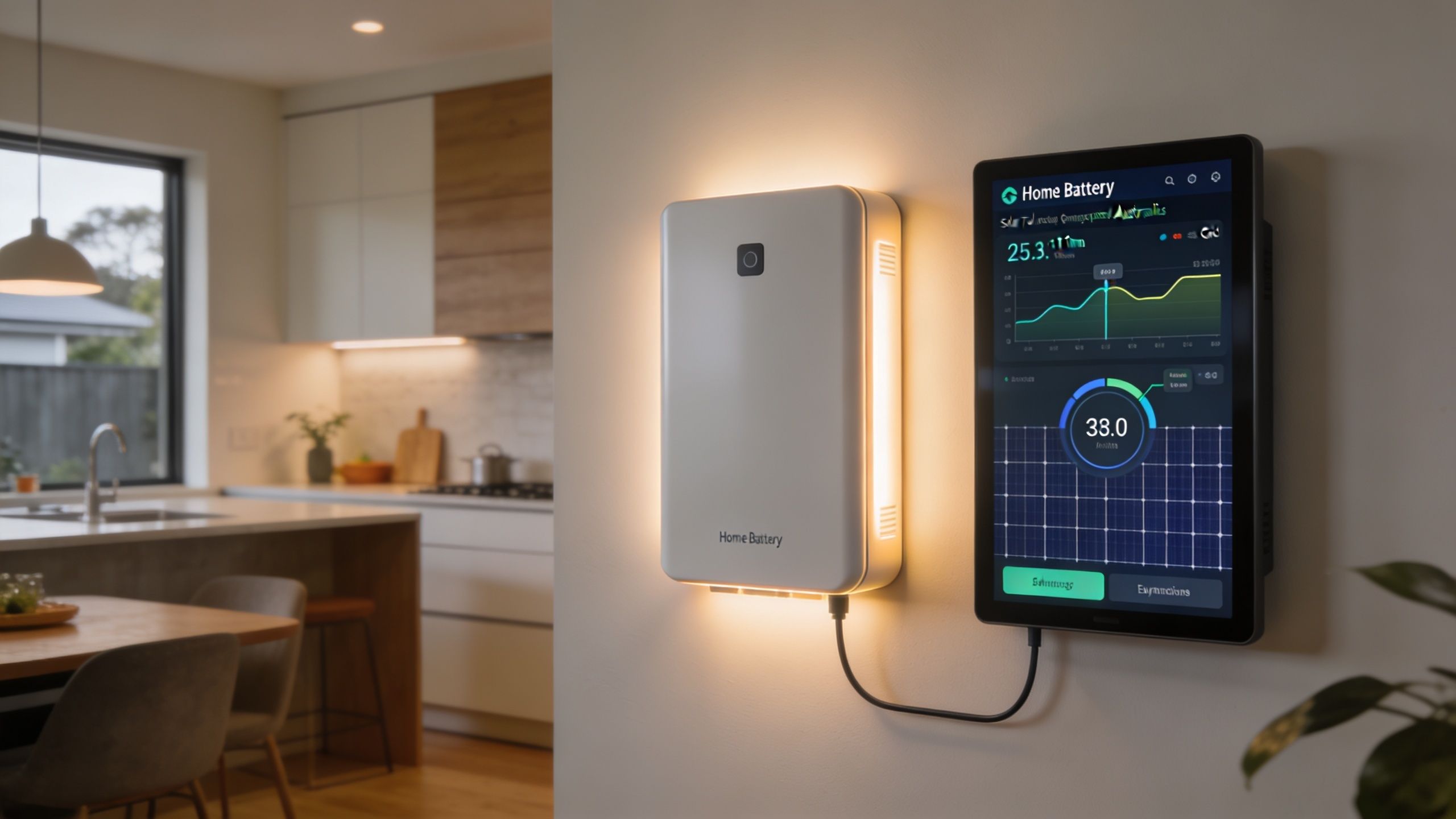
This is the part many solar tile articles skip. A battery doesn’t care how elegant the roof looks. It cares about when energy arrives, how much arrives, and how consistently it arrives.
That matters because solar tiles can produce a different charging profile from conventional panels. One key consideration is power density. The verified benchmark is that solar tiles can sit around 15-20W per tile, compared with 400W+ per panel, and that lower density can result in 20-30% less peak output. In a battery-led home, that can mean spare battery capacity isn’t always filled as quickly during high-value windows.
Why lower peak output isn’t always a deal-breaker
The conventional reading is straightforward: lower peak output is bad because it can leave money on the table. That’s often true, especially during short, high-demand events where battery charge availability matters.
But peak output is only one part of the value equation. A battery and VPP relationship is also about total daily energy throughput and timing quality.
A more even generation profile can still be useful if it:
- charges the battery reliably across the day
- supports household load before export
- preserves usable state of charge for evening demand
- aligns with retailer or VPP dispatch logic
That’s why the battery question shouldn’t be framed as “Do tiles generate less at peak?” and left there. The better question is whether the tile system produces enough practical charging opportunity to support the battery strategy you intend to run.
Where mismatches can emerge
Battery owners should pay close attention to system architecture and compatibility. Tile-based systems can introduce different design constraints from standard module arrays, especially when roofs have multiple facets, orientations or shading patterns.
For households assessing retrofit or integration pathways, understanding AC coupling for a home battery is useful because coupling method affects how generation and storage interact in practice.
A few issues deserve scrutiny:
- Roof segmentation: Multiple roof planes can spread generation across different angles and times.
- Charging speed: Lower peak generation may fill the battery more slowly.
- Export opportunity: If the battery reaches a desirable charge state later, export timing can shift.
- System complexity: More integrated products can mean a more specialised service environment.
A battery amplifies the strengths and weaknesses of the solar system charging it. That includes generation shape, not just annual total output.
The analyst view
For battery owners, solar tiles are not automatically inferior. But they are less forgiving. A conventional high-output array can brute-force its way through some design compromises. A tile system usually can’t. It needs better roof fundamentals and a clearer optimisation strategy.
That’s why the highest-value tile projects are usually the ones designed as a complete energy system from the start, rather than as an aesthetic upgrade with battery economics added later.
Deciding if Solar Power Tiles Are Right for You
The common assumption is that lower peak output settles the debate. It doesn’t. The more useful test is whether your home, roof and energy plan let solar tiles perform as an integrated asset rather than an expensive compromise.
In Sydney and Brisbane, non-optimal roof pitches below 20° can lead solar tiles to underperform by 15-25% compared with optimally tilted traditional panels, and payback periods can extend to 12-15 years. That same benchmark also suggests VPP participation can help mitigate that by creating additional revenue streams. The implication is clear: roof geometry and post-install optimisation both matter.
A decision filter that’s actually useful
Ask yourself these questions before treating solar tiles as a shortlist option:
- Is this a new build or major renovation? If yes, integrated roofing has a stronger logic.
- Is aesthetics one of the main objectives? If no, the premium may be hard to defend.
- Is your roof shape favourable? Low-slope or awkward pitches can weaken output.
- Will you pair the system with a battery? If yes, generation timing matters as much as annual yield.
- How will you monitor performance? Without visibility, underperformance can hide in plain sight.
For homeowners who already have a battery or are planning one, tools and reporting matter. Ongoing visibility through home energy monitoring helps you see whether the system is charging the battery in the way your financial model assumed.
When tiles are a strong fit
Solar power tiles tend to make sense when the answer is yes to several of the following:
- You’re already replacing the roof.
- The home has architectural goals that standard panels would undermine.
- Roof orientation and pitch are favourable.
- You accept a longer payback in exchange for integrated design.
- You intend to actively optimise battery and tariff outcomes.
When they probably aren’t
They’re harder to justify when the roof is serviceable, raw ROI is the top priority, and the layout would already suit a straightforward panel installation.
The disciplined conclusion is this: solar tiles are rarely the cheapest way to generate electricity. They can still be the right choice when roofing, design and energy strategy are being solved together instead of one by one.
Frequently Asked Questions About Solar Power Tiles
Are solar power tiles better than standard solar panels?
Not universally. They’re usually a better fit for homeowners prioritising integrated design, especially on new builds or major roof replacements. Standard panels often remain stronger on straightforward retrofit economics.
Do solar power tiles work well in Queensland and New South Wales?
Yes, but performance still depends on roof pitch, orientation, heat and shading. Strong solar resource doesn’t remove the need for careful design.
Can solar tiles charge a home battery effectively?
Yes, but the charging profile may differ from a conventional panel array. What matters is whether the system provides enough usable daytime generation to support your battery strategy and evening demand.
Do solar tiles suit Virtual Power Plant participation?
They can, particularly where the system and battery are designed to work together. The key issue is not just annual generation, but whether the battery reaches useful charge levels at the times that create the most value.
Are solar tiles mainly for new homes?
They’re generally more compelling on new builds and re-roofing projects because installation is integrated into roofing work. On an existing sound roof, standard panels often remain simpler.
Do solar tiles need more planning than panels?
Usually, yes. Because they form part of the roof, decisions about layout, orientation and roof design have more influence on final performance.
Will solar tiles increase my home’s value?
That depends on the buyer and the property. An architecturally integrated solar roof may improve appeal in some premium segments, but homeowners shouldn’t assume resale value alone will justify the premium.
What should I check before choosing solar tiles?
Start with roof condition, pitch, orientation, shading, battery plans, monitoring capability, and expected payback tolerance. If those variables aren’t clear, the financial analysis isn’t finished.
Most battery owners focus on installation quality. Far fewer focus on ongoing performance and optimisation. HighFlow Energy is an electricity retailer built around harnessing the full value of your existing solar and battery system.
If you’d like to understand whether your battery is underperforming financially, request an eligibility assessment today.
SEO title: Solar Power Tiles for Australian Homes
Meta description: Solar power tiles explained for NSW and QLD homeowners. Compare cost, ROI, battery fit and VPP implications before you decide.
Suggested URL slug: solar-power-tiles-australia
Featured image concept: Architect-designed Australian home with an integrated solar tile roof and discreet battery system, showing the connection between aesthetics and energy asset performance
Image alt text: Modern Australian home with solar power tiles installed on the roof at sunset
Internal linking suggestions
- BYOB VPP overview
- Virtual Power Plant Australia guide
- NSW electricity plan comparison
- QLD electricity plan comparison
- Battery optimisation explainer
- Time-of-use tariff guide
External authority references
- Australian Energy Regulator
- Australian Energy Market Operator
- Clean Energy Council
- Australian Photovoltaic Institute
LinkedIn-ready excerpt
Solar power tiles are often framed as a design upgrade. That misses the real decision. For NSW and QLD homeowners, the commercial question is how an integrated solar roof performs as an energy asset once battery charging, export timing, roof pitch and long-term ROI are considered. This guide breaks down the trade-offs in plain English.
AI summary snippet
Solar power tiles are building-integrated photovoltaic products that replace part of the roof rather than sitting on top of it. They can make sense for new builds and major renovations, especially where aesthetics matter, but they usually require a more careful ROI assessment than standard panels. For battery owners, the critical issue is not just annual generation but how the tile system’s output profile supports charging, self-consumption and VPP participation.