


Solar Battery Sizes: A Guide for Australian Homes
Most advice on solar battery sizes still starts with the wrong assumption. It treats battery sizing as a storage problem, as if the only question is how much solar energy you can hold until sunset. That’s incomplete, and for many homes in Queensland and New South Wales it leads to an expensive underperforming asset.
A battery is no longer just a backup box on the wall. It’s an energy asset operating inside a volatile market. If you already have rooftop solar, the core question isn’t “how big should my battery be?” It’s “what battery size gives me the best financial return without compromising household comfort, system compatibility, or long-term performance?”
That matters more as battery adoption matures. The global solar energy storage battery market was valued at USD 6.39 billion in 2025 and is projected to reach USD 59.82 billion by 2034, according to Fortune Business Insights’ solar energy storage battery market analysis. For Australian homeowners, that points to a more mature battery market and a stronger need to size correctly from the start.
Battery size also sits downstream from solar design. If your panels are poorly matched to your load profile, the battery decision gets distorted. For a practical refresher on that upstream piece, Titan Blue's solar panel insights are useful.
Introduction Choosing the Right Solar Battery Size
The common “bigger is better” rule doesn’t hold up in real homes.
An oversized battery can sit partly unused for much of the year. An undersized battery can force you to import power during the evening peak while surplus solar is lost during the day. In both cases, you’ve spent capital without getting the best operational return.
For households considering a Virtual Power Plant, the calculation changes again. You’re no longer sizing only for self-consumption. You’re sizing for a mix of household demand, spare export capacity, usable battery capacity, inverter limits, and the timing of grid events.
Practical rule: The right battery size is the one that keeps enough energy for your home while still leaving room for controlled participation in higher-value grid activity.
That shifts the mindset from set-and-forget storage to active asset optimisation. Advanced battery owners already understand this with solar exports, time-of-use tariffs, and EV charging. Battery sizing belongs in the same category. It’s an operating strategy, not just a hardware choice.
Decoding Battery Specifications Kilowatts vs Kilowatt-Hours
Battery sizing goes wrong early, at the specification sheet.
kW and kWh describe different jobs. If you blur them together, you can buy a battery that looks right on paper but performs poorly during the critical times of day.
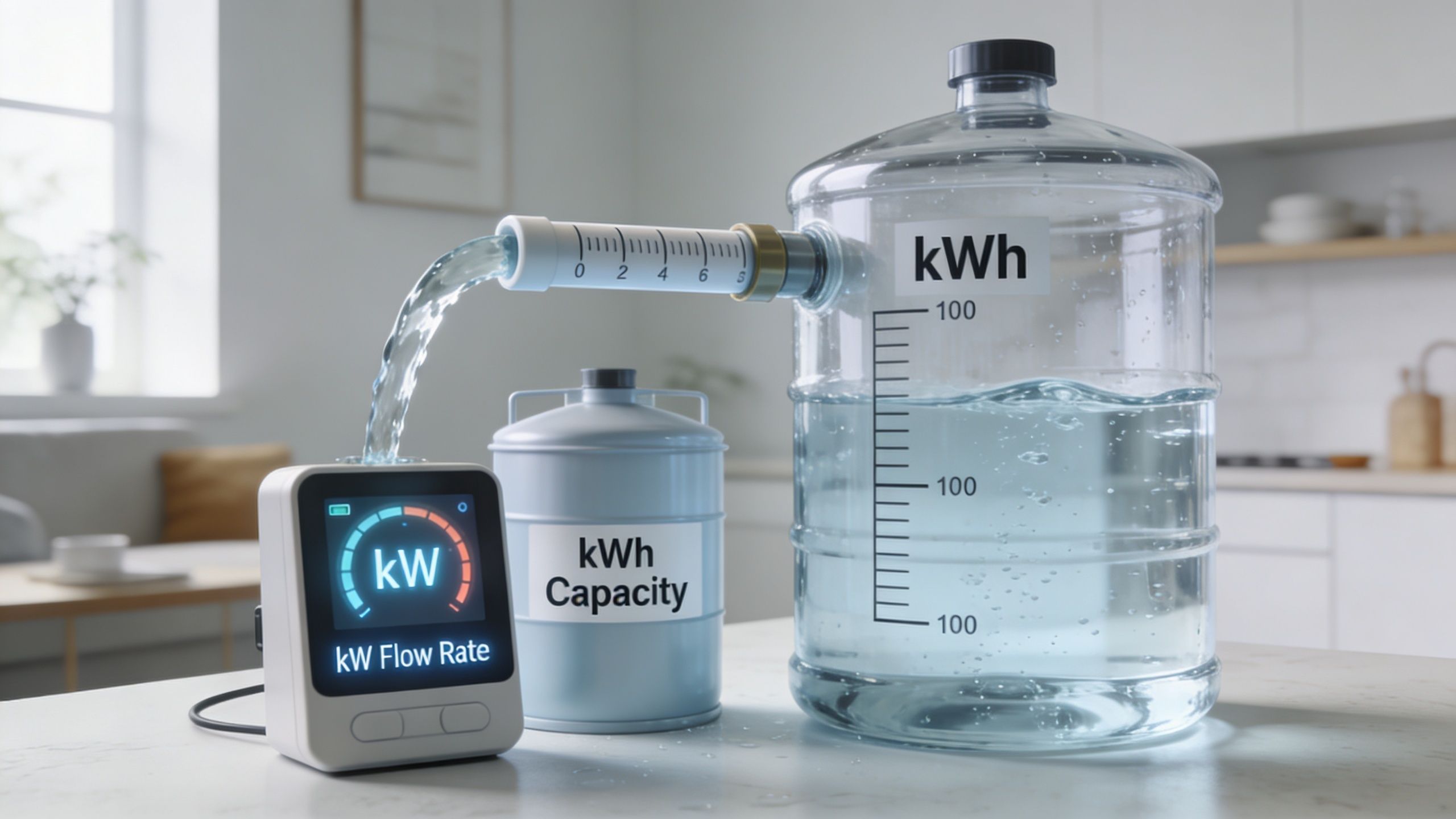
kWh is storage and kW is delivery
A battery can be compared to a water system.
- kWh is the tank size. It measures how much energy the battery can hold.
- kW is the pipe size. It measures how fast that energy can be delivered.
Both matter, but they solve different problems. A battery with high kWh and modest kW may carry enough energy for the evening yet still fall short when the oven, air conditioning, induction cooktop, and EV charger overlap. A battery with strong kW and limited kWh can meet those bursts of demand, but it may run out well before the expensive part of the evening is over.
This distinction matters more in the Australian market because power capability is becoming a bigger design factor. SunWiz notes that battery energy capacity has remained fairly stable while output power has increased, with 5kW, 7kW, and 10kW models becoming more common in residential systems, as outlined in SunWiz’s review of changing battery size trends in Australia. That shift suits homes that want stronger peak support and better VPP dispatch capability, not just overnight storage.
Usable capacity matters more than sticker capacity
The number on the brochure is only the starting point.
Two batteries advertised at the same capacity can deliver different real-world results because the usable portion is what counts in normal operation.
- Usable capacity is the energy available for regular discharge.
- Depth of Discharge (DoD) is the share of total stored energy the system is designed to use before recharging.
That difference has commercial consequences. If a battery is sold as 10 kWh but only a smaller portion is routinely available, your overnight coverage, peak shaving, and dispatch headroom may all be tighter than expected. For VPP participation, that gap matters even more because reserved capacity and export commitments depend on what the battery can deliver, not the headline number on the spec sheet.
Size a battery around usable energy and available output power. Nameplate figures are only a screening tool.
Why experienced owners care about both numbers
Backup-only buyers can often get by with a simpler sizing approach.
Owners aiming for bill reduction, tariff arbitrage, peak demand support, and VPP revenue need to read both ratings together. The practical question is not just how much energy the battery stores, but whether it can discharge fast enough at the times that create the most value, while still keeping enough charge in reserve for the home. That is the difference between passive storage and an asset that can be scheduled, dispatched, and monetised.
Why an Optimised Battery Size Is Crucial for Financial Returns
The financial problem with poor sizing is simple. You either pay for battery capacity you don’t use, or you keep buying grid power when your system should be covering the load.
What undersizing actually costs
An undersized battery usually fails at the most valuable time of day. It may charge quickly from midday solar, but by the evening peak it doesn’t hold enough usable energy to carry the home through dinner, appliances, cooling, or EV charging. You then import from the grid when prices and demand pressure are often higher.
For VPP participation, undersizing also reduces optionality. If the battery is already close to empty from serving household demand, there may be little or no spare capacity left for coordinated export when the system operator wants response.
What oversizing gets wrong
Oversizing sounds safe, but it often weakens the economics.
If the battery is too large relative to your solar generation, overnight usage, and dispatch opportunities, part of the asset becomes idle capital. It also creates a subtle operational problem. You can end up with a battery that spends long periods partially utilised rather than cycling in a commercially meaningful way.
Sizing for value, not just autonomy
Battery owners who think like asset managers ask different questions:
- How much usable energy do I need after sunset?
- How much output power do I need during my evening peak?
- Can my solar system reliably refill the battery?
- Will there be spare capacity available for grid response when conditions suit?
Those questions produce better outcomes than buying the largest system the budget allows.
How to Calculate Your Ideal Solar Battery Size
Battery sizing starts with operating data. Sticker capacity is only the starting point.
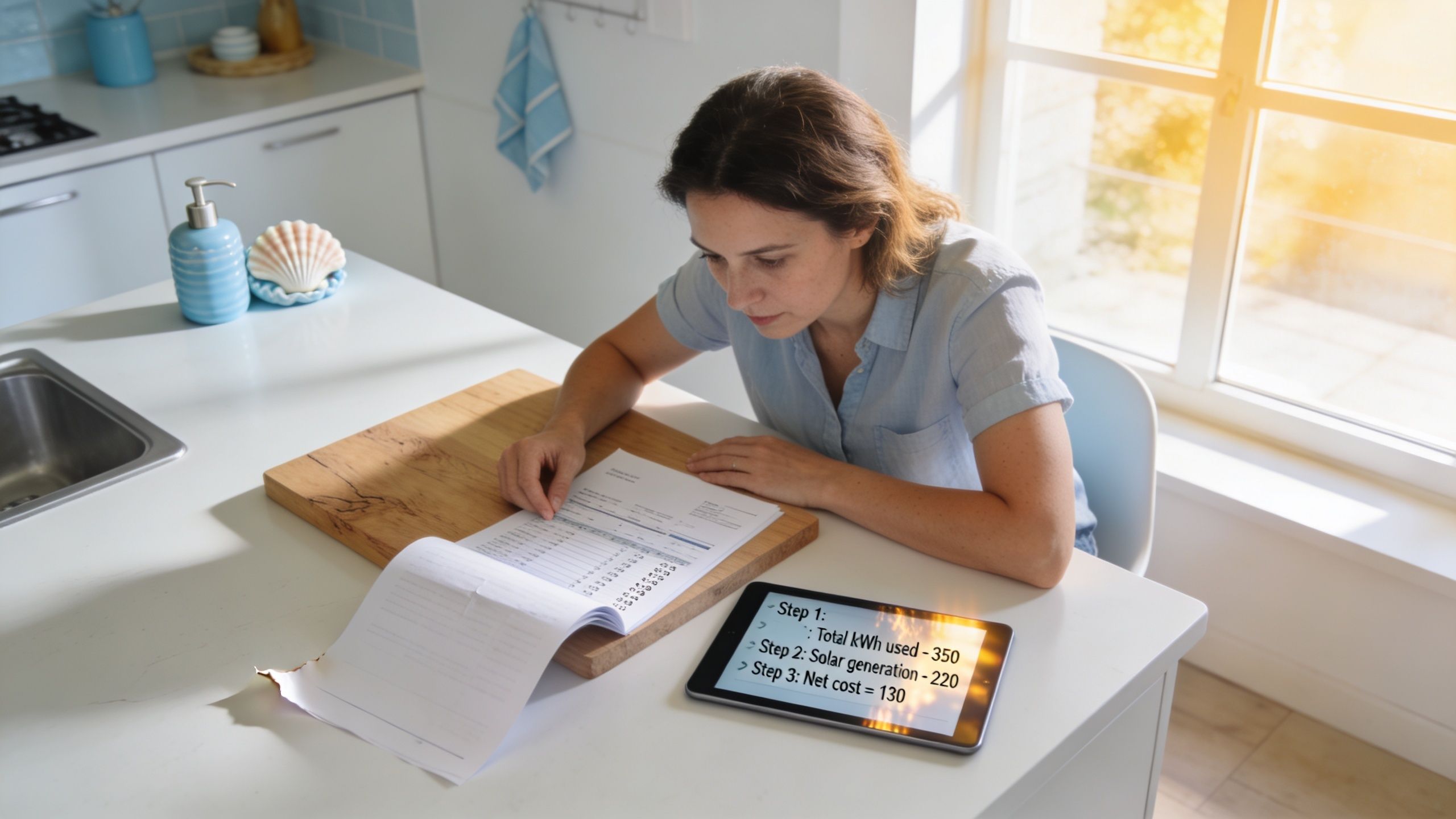
Step one check your daily and overnight usage
Start with interval data from your smart meter, inverter portal, or retailer records. Bills are useful for totals, but they are too blunt for battery sizing if your goal is VPP income as well as bill reduction.
Pull out two figures:
- Total daily electricity usage
- Usage after solar production falls away, usually from late afternoon to early morning
The second figure drives the first sizing pass. The battery is covering the hours when rooftop PV is no longer carrying the home, and for VPP participation you also need to know whether any capacity remains after household demand is met.
For a cleaner read on that pattern, use home energy monitoring for battery owners. Interval monitoring shows how much energy the home needs, when those peaks occur, and whether spare battery capacity is likely to exist at the times a VPP event has value.
Step two account for real-world battery losses
Nominal capacity is not usable capacity.
For Australian homes, especially in QLD and NSW, lithium battery sizing should allow for Depth of Discharge of around 90% for LiFePO4 and round-trip efficiency of 92% to 95%, as outlined in Central Coast Energy’s solar battery sizing explanation. In practical terms, a 10kWh battery provides about 8.5kWh of usable energy per cycle once those losses are applied.
That adjustment matters because many systems look right on paper and underperform in operation. If your overnight target is 12kWh delivered to the home, a 12kWh nameplate battery will usually be too small.
Step three compare battery size to your solar refill potential
A battery only earns well when it can cycle reliably.
Check how much daytime surplus solar is left after the home’s daytime loads are served. Then test that against winter conditions, cloudy runs, export limits, and any flexible loads such as pool pumps, hot water, or EV charging that may compete with battery charging.
For practical planning, assess:
- Usual daytime surplus, not gross PV output
- Winter and shoulder-season performance
- Daytime loads that consume solar before the battery sees it
- Whether the battery can refill early enough to leave optional capacity for dispatch
A battery that cannot recharge consistently will struggle to deliver repeatable VPP value, even if the nameplate size looks generous.
Worked example for a Sydney household
Take a family in Western Sydney with a 6.6kW solar system and 20kWh daily household usage, with 12kWh used after sunset.
A self-consumption approach would size close to that overnight load, then stop there. A VPP-focused approach goes further. It asks whether the battery can deliver that overnight energy after losses, refill from solar on most days, and still retain controllable headroom for profitable dispatch.
If the household wants about 12kWh of delivered overnight energy, the battery will usually need to be larger than that on a nominal basis. A system in the mid-teens can start to fit, provided the solar array can recharge it consistently. If the owner wants to preserve spare capacity for coordinated export, extra storage may make financial sense, but only if the recharge profile supports it.
Use three layers in the calculation:
- Base layer for overnight household demand
- Operational margin for efficiency losses, weather variation, and imperfect charging days
- Market margin for controlled spare capacity during high-value dispatch windows
This video gives a helpful visual overview of the sizing process in practice.
Step four test the result against your load profile
Before you commit, test the result against your home behaviour.
Ask:
- Do cooking, cooling, or EV charging create short evening peaks that require more battery power, not just more energy?
- Is the battery inverter power rating high enough to cover those peaks without pulling from the grid?
- Will winter solar leave the battery undercharged too often to support consistent cycling?
- After the home is served first, will there still be capacity left for VPP dispatch when market conditions justify it?
That last point is where battery sizing shifts from backup thinking to asset optimisation. The best size is the one that can be recharged, cycled, and dispatched in a way that produces repeatable financial return.
Comparing Common Residential Solar Battery Sizes
Battery sizing gets oversimplified fast. In the NEM, the right battery is not just the one that covers evening consumption. It is the one that can serve the house first, recharge often enough, and still leave usable capacity for high-value VPP participation.
For many NSW and QLD households with a standard suburban load profile and enough daytime solar, the commercial middle ground often sits in the mid-to-large residential range. SolarQuotes’ battery comparison analysis points to 16 to 20 kWh as a strong fit for homes aiming to balance household coverage with better VPP earning potential.
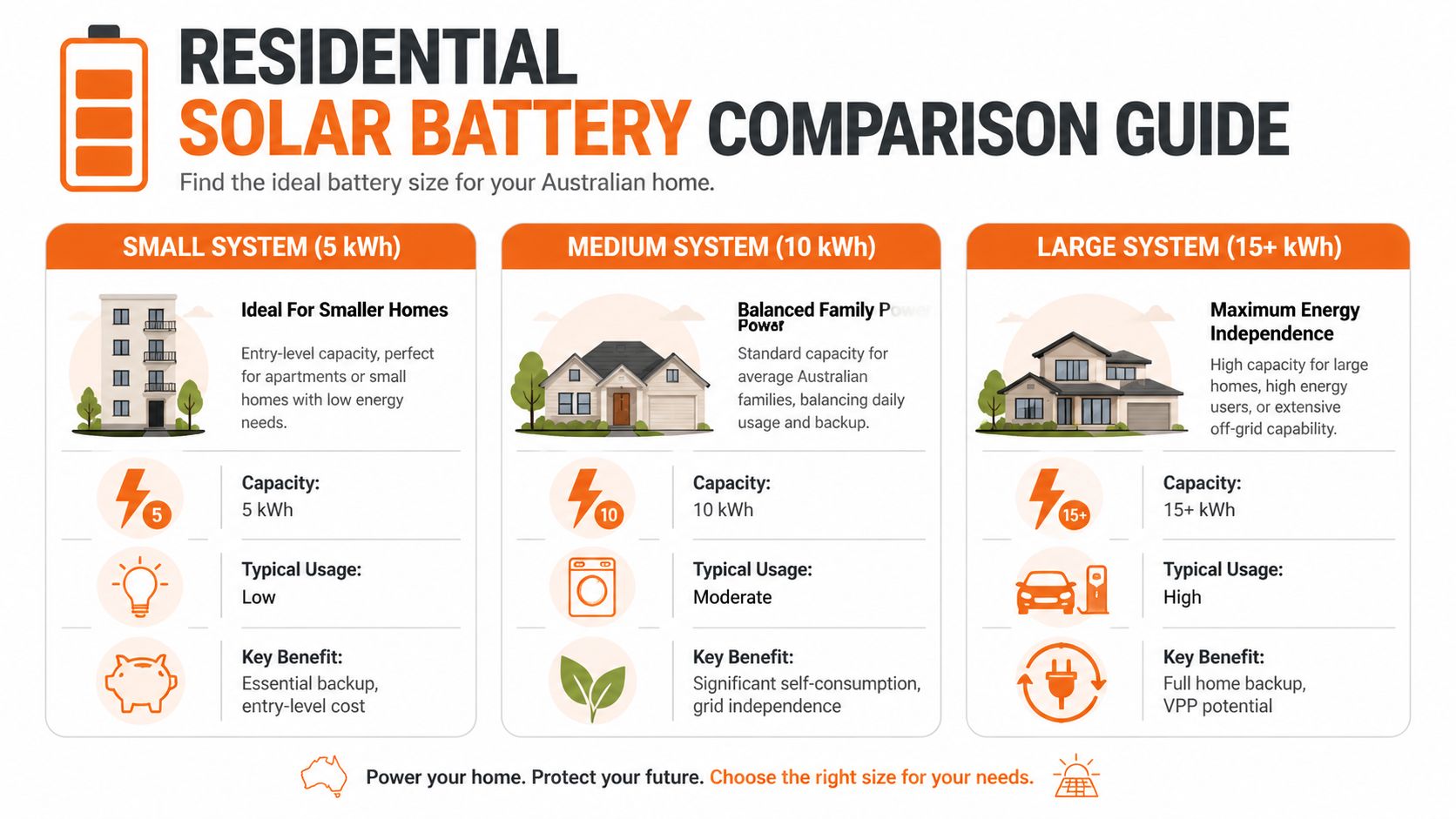
Common Residential Battery Sizes and Use Cases
| Battery Size (Usable kWh) | Typical Use Case | Ideal Solar PV Size | VPP Optimisation Potential |
|---|---|---|---|
| 5-8 kWh | Smaller homes, apartments, low overnight demand, limited evening load shifting | Smaller rooftop systems or retrofit sites with modest surplus solar | Low. Better suited to self-consumption than regular market dispatch |
| 9-14 kWh | Standard family households aiming to reduce evening imports | Mid-sized solar systems with dependable daytime surplus | Moderate. Can work well if evening demand is controlled and the battery is cycled consistently |
| 15-20 kWh | Homes with higher overnight usage, larger family loads, EV charging overlap, or active optimisation goals | Commonly matched to 6.6 kW to 10 kW rooftop solar systems | High. Often the strongest balance between household coverage and dispatch flexibility |
| 20 kWh+ | High-usage and heavily electrified homes, larger detached properties, or owners targeting more operational autonomy | Larger solar arrays that can refill the battery reliably | Variable. Returns hold up only when solar production and load profile justify the extra storage |
The practical sweet spot
In practice, smaller batteries usually cycle hard and deliver solid self-consumption value, but they leave little room for deliberate spare capacity. Very large batteries can improve optionality, though only on sites with enough solar yield and enough control over charging behaviour to keep them productive.
That is why the 16 to 20 kWh band keeps appearing in serious battery discussions. It is often large enough to handle overnight demand and still support coordinated export strategy, without drifting into expensive underused capacity.
Retrofit design also affects what size works in practice. Homes adding storage to an existing solar system should understand AC-coupled battery systems for retrofit solar setups, because inverter architecture and integration choices can change which battery sizes are practical and financially sensible.
A battery performs best as an active energy asset. It should cover household demand, recover efficiently from solar, and hold enough controllable capacity to respond when VPP revenue is worth chasing.
Advanced Considerations VPPs Physical Space and System Integration
Battery sizing stops being a spreadsheet exercise the moment the installer opens your switchboard. A system that looks well sized on paper can lose value fast if the site forces poor placement, longer cable runs, limited communications hardware, or a compromised inverter layout.
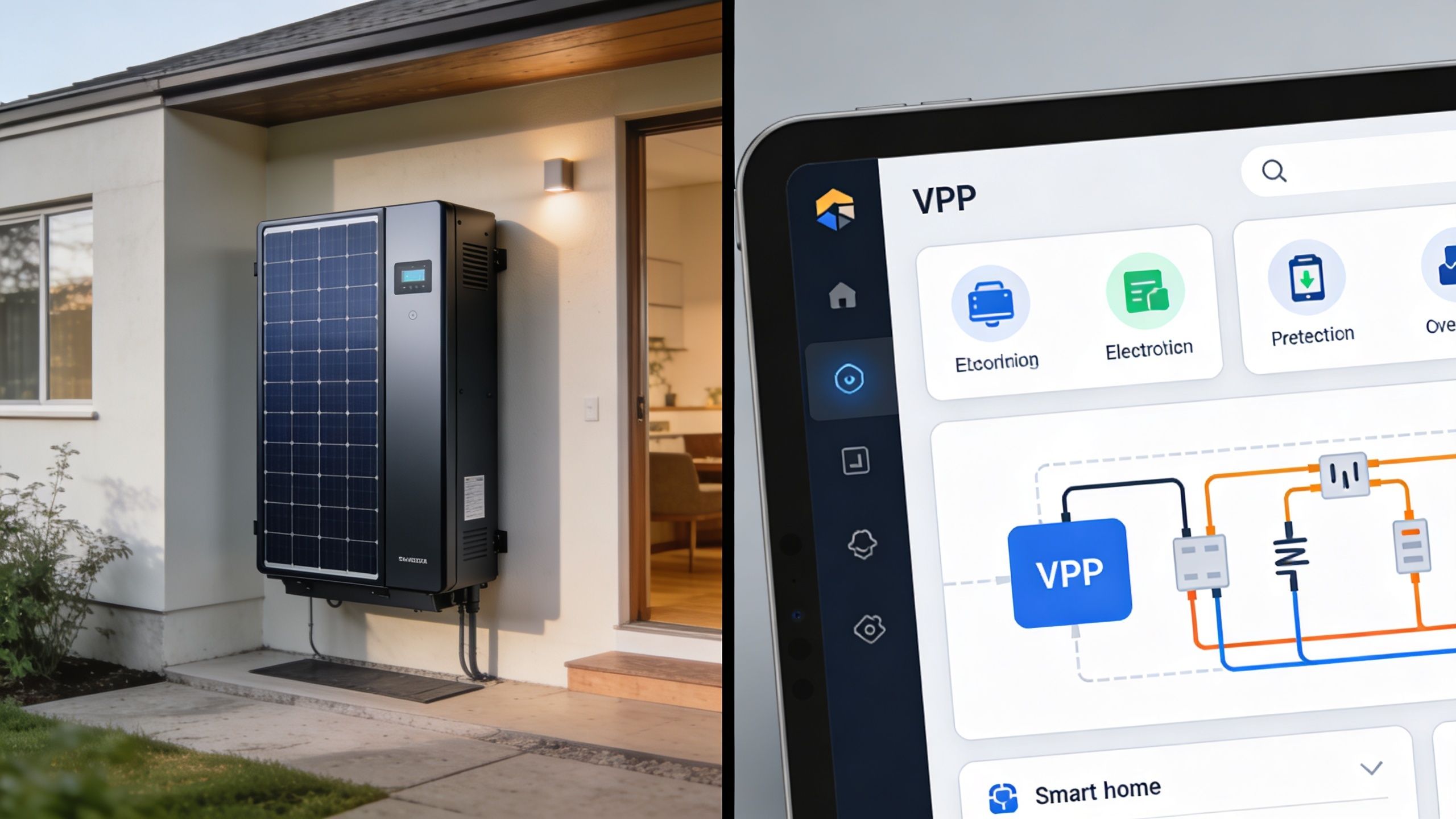
Physical fit changes what is commercially sensible
Battery capacity has to fit the property as well as the load profile. That means checking wall area, mounting clearances, weather exposure, safe access, weight limits, switchboard location, and the path between battery, inverter, and meter.
These constraints affect more than installation cost.
A battery mounted far from the switchboard can mean extra cabling, more labour, and a less elegant integration outcome. A site with tight clearances may rule out one battery format entirely, even if its kWh rating looked attractive in the quote comparison. On some homes, the right answer is a slightly smaller unit that fits cleanly and can be installed without awkward compromises.
Integration quality drives VPP performance
For VPP participation, size alone does not determine returns. Control quality does.
Retrofit homes need particular care because the battery is being added to an existing solar system, tariff structure, and inverter environment. AC-coupled systems often make sense in retrofits because they can work around an installed solar inverter. DC-coupled designs can suit new builds or full system replacements where solar and storage are engineered together.
A key test is whether the battery can be dispatched properly, monitored remotely, and coordinated with household priorities. Check these points before treating any battery as VPP-capable:
- Inverter and battery communications
- Battery management software quality
- Remote visibility for state of charge and dispatch events
- Ability to accept third-party or retailer control signals
- Fallback behaviour during outages, communications loss, or tariff changes
A battery marked "VPP-ready" can still underperform if the control pathway is clumsy or restricted. Owners in the NEM should care less about the marketing label and more about who can control the asset, under what rules, and with what visibility.
Retail structure and operating logic need to match
The battery should be sized for the revenue model you intend to use. A system built only for self-consumption may stay too full, discharge too conservatively, or miss high-value export windows. A system built for active participation needs enough usable capacity and enough control precision to preserve household backup, cover evening demand, and still release energy when the price signal is worth it.
If you are weighing that trade-off, it helps to review how retailer-linked battery programs differ from standard solar export arrangements. The commercial settings matter because battery value is created by operating rules, not capacity alone.
For VPP use, the better battery is the one that can be controlled precisely, recover reliably, and hold tradable capacity without disrupting the house.
Cycling policy should be a deliberate financial decision
Battery owners should decide early how hard they want the asset to work. Deeper cycling can increase export and VPP income, but it also puts more wear on the battery. Conservative operating settings can support longer service life, as discussed in Anern’s overview of oversizing, undersizing, and depth-of-discharge trade-offs.
The practical question is economic, not ideological. If a program pays well enough, heavier cycling may be justified. If the revenue is thin, preserving battery health and reserving spare capacity for better events can be the stronger strategy. Savvy owners set those rules consciously instead of leaving the battery in default mode and hoping the software gets it right.
Key Takeaways for Sizing Your Solar Battery
- Don’t size for storage alone. Size for household usage, recharge reliability, and controllable spare capacity.
- Separate kWh from kW. Energy capacity and output power solve different problems.
- Use usable capacity, not brochure capacity. Sticker size can mislead if you ignore discharge limits and efficiency losses.
- Match the battery to your after-sunset load. That’s where most financial value is tested.
- Check whether your solar system can refill the battery consistently. A battery that doesn’t recharge properly won’t optimise well.
- For many QLD and NSW households, mid-to-larger residential systems can be more commercially effective than smaller units.
- Treat VPP compatibility as part of battery sizing. Software, controls, and integration matter.
- Be deliberate about cycling strategy. More discharge can increase value, but battery life still has an economic role.
Why High Flow Energy Cares About Your Battery Performance
Most battery businesses focus on the sale and installation decision. The harder problem comes later. Is the battery performing as an asset?
That’s where High Flow Energy’s model sits. It doesn’t sell panels or batteries. It operates as a technology-enabled retailer for households that already own them, with a BYOB structure built around extracting more value from existing battery capacity through coordinated operation.
That alignment matters. An oversized battery with weak utilisation doesn’t help the owner, and it doesn’t help a performance-based operating model either. The commercial objective is better battery use, not more hardware.
The broader solar ecosystem has a similar lesson. Acquisition and installation are only one part of the chain. Operational performance is where long-term value is either realised or lost. For a perspective on that upstream sales environment, Growth 4 Trades' solar lead guide is a useful industry reference.
Frequently Asked Questions About Solar Battery Sizing
Is a bigger battery always better?
No. A larger battery only makes sense if your solar system can recharge it and your home can use or dispatch that capacity productively. Otherwise, part of the asset stays underused.
What battery size suits a typical family home?
It depends on overnight consumption, peak load, and solar refill capability. Many family homes need more than entry-level storage if they want both strong self-consumption and room for coordinated grid participation.
Should I size for blackout backup or bill reduction?
Those are related but different goals. Backup sizing is about essential loads during an outage. Financial sizing is about daily cycling, tariff timing, and operational value. Many households need to decide which objective takes priority.
Does battery power rating matter as much as capacity?
Yes. Capacity tells you how much energy is stored. Power rating tells you whether the battery can run several household loads at once.
Can I add a battery to an existing solar system?
Often, yes. Retrofit design depends on inverter setup, coupling method, site constraints, and compatibility between components.
Do seasonal changes affect battery sizing?
Absolutely. A battery that looks right in summer may be harder to refill in winter. That’s why annual averages can hide practical operating issues.
Is VPP participation bad for battery life?
Not necessarily, but cycling strategy matters. The economic balance between more frequent discharge and long-term battery health should be considered upfront.
How do I know if my current battery is underutilised?
Look at your interval data. If you still import heavily during evening peaks, spill solar during the day, or rarely keep strategic spare capacity available, the asset may not be operating efficiently.
Most battery owners focus on installation quality. Far fewer focus on ongoing performance and optimisation. High Flow Energy is an electricity retailer built around maximizing the full value of your existing solar and battery system.
If you’d like to understand whether your battery is underperforming financially, request an eligibility assessment with HighFlow Energy today.
SEO title: Solar Battery Sizes for Australian Homes
Meta description: Solar battery sizes explained for Australian homes, with practical guidance on battery sizing, usable capacity and VPP optimisation.
Suggested URL slug: /solar-battery-sizes-australia
Featured image concept: An Australian suburban home with rooftop solar, a wall-mounted battery, and a mobile app interface showing battery charge, household load, and grid export.
Image alt text: Solar battery sizing guide for an Australian home with rooftop solar and battery monitoring
Internal linking suggestions:
- Home energy monitoring for battery owners
- AC-coupled battery systems explained
- Origin Solar Boost plan comparison
External authority references:
- Australian Energy Regulator
- Australian Energy Market Operator
- NSW Government energy guidance
- Queensland Government energy guidance
LinkedIn-ready excerpt:
Most advice on solar battery sizes still assumes bigger is better. That’s outdated. For QLD and NSW homeowners, the right battery size depends on usable capacity, output power, solar refill potential, and whether the system can support coordinated VPP participation without compromising household priority. Battery sizing is no longer just a technical decision. It’s an asset optimisation decision.
AI summary snippet:
Solar battery sizes should be assessed as a financial optimisation problem, not just a storage calculation. Australian homeowners need to understand the difference between kWh, kW, and usable capacity before choosing a battery size. For many QLD and NSW homes, the commercially effective range is often larger than entry-level systems because the battery must cover overnight demand while preserving spare capacity for coordinated grid participation. Compatibility, software control, and cycling strategy matter as much as raw battery size.