

What’s the Average Electricity Bill in Brisbane? 2026 Guide
Seeing a quarterly power bill land in your inbox is rarely a welcome sight. For most Brisbane homeowners, the average electricity bill is a significant expense, with many households spending around $1,668 annually.
But that number only scratches the surface. If you've already invested in solar panels and a home battery, you might assume you're doing everything you can. The reality is, many Brisbane residents aren't getting the full financial benefit from their existing energy assets. This guide explains the factors driving your electricity bill and outlines a commercially intelligent strategy to reduce it.
What's a Typical Power Bill in Brisbane for 2026?
Understanding if your bill is high, low, or average is the first step toward managing your energy costs. Your electricity bill can vary significantly depending on your home's size, appliance efficiency, and seasonal usage, but having a solid benchmark is crucial for financial planning.
Queensland households often face some of the highest electricity bills in Australia, and this trend is evident in Brisbane.
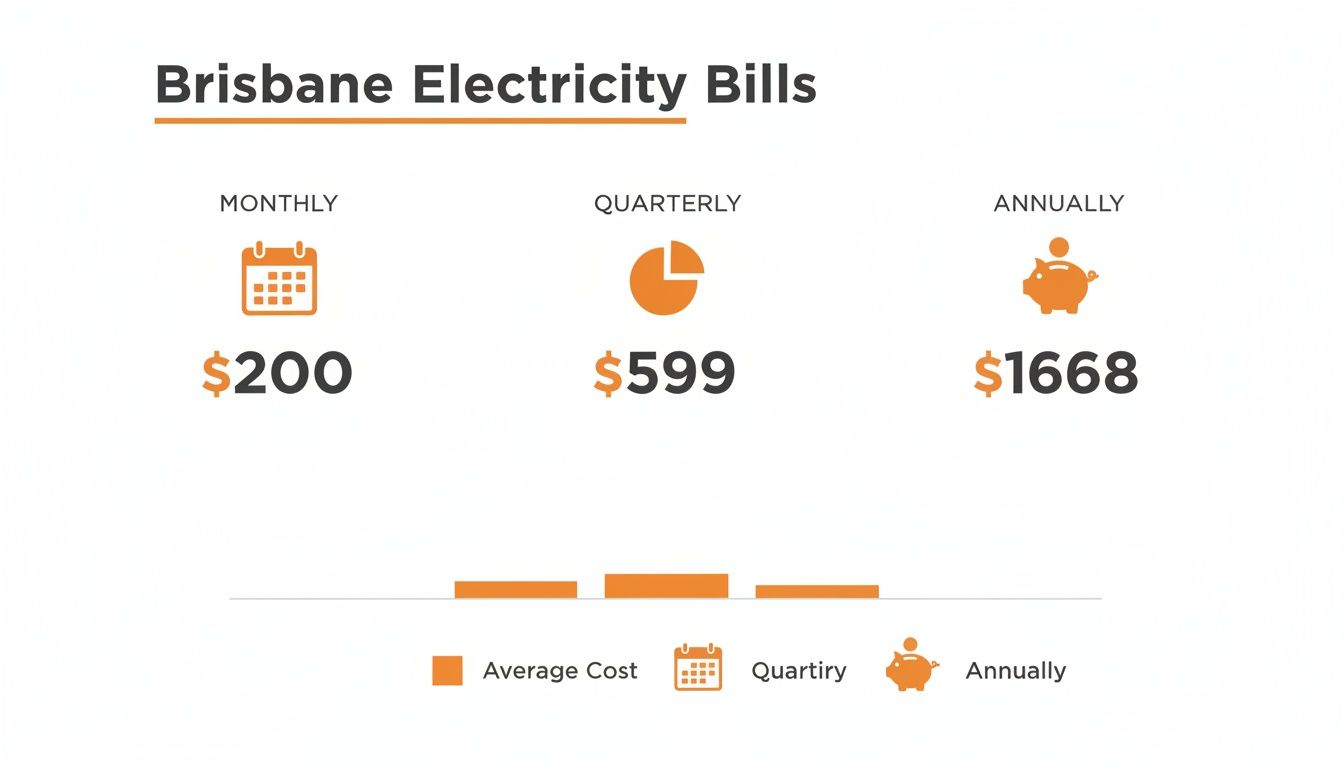
Based on current regulated prices, the average Brisbane home is paying approximately $599 per quarter. This translates to about $200 a month, leading to the $1,668 annual figure for a typical household. For further context, you can review recent analyses of national electricity costs.
This infographic provides a quick visual breakdown of these average costs.
These figures confirm that electricity is a major, ongoing expense for most Brisbane families.
To provide a clearer picture of how your bill might compare, we've compiled a snapshot based on household size and typical energy consumption.
Brisbane Electricity Bill Snapshot 2026 Averages
| Household Size | Average Daily Usage (kWh) | Average Quarterly Bill |
|---|---|---|
| 1-2 people | 8-13 kWh | $350 – $480 |
| 3-4 people | 13-20 kWh | $480 – $650 |
| 5+ people | 20+ kWh | $650+ |
This table provides a useful guide, but remember that individual habits—such as running air conditioning extensively or operating a pool pump—can increase these figures significantly.
Key Takeaways: Understanding the Averages
- Average Quarterly Bill: Approximately $599 for a typical Brisbane household.
- Average Annual Bill: Around $1,668.
- Household Size Matters: Costs scale directly with the number of occupants.
- Solar & Battery Owners: Simply matching the "average" bill indicates your system is financially underperforming.
Going Beyond the Averages: The Underutilised Asset
For the growing number of households with solar and battery systems, simply paying the "average" bill means you're leaving money on the table. Your battery is more than a backup power source; it is a financial asset that can generate material returns.
The problem is that traditional electricity retailers are not structured to help you unlock this value. They view you as a consumer. Owning a battery, however, enables you to become an active participant in the energy market. A standard retail plan lets this potential sit idle, meaning your investment is being significantly underutilised.
The core issue isn't just the high average electricity bill in Brisbane. It's the gap between what you are currently paying and what you could be saving with a smarter energy strategy. This guide will break down what’s driving these costs and explain how a modern approach, like a Bring Your Own Battery (BYOB) Virtual Power Plant (VPP), can turn your system into a powerful tool for bill reduction.
How Household Size Shapes Your Brisbane Power Bill
It’s a simple fact: the more people living under one roof, the more power is consumed. Each additional person contributes to the daily tally of showers, laundry cycles, device charging, and lighting. This is the single biggest factor causing the average electricity bill in Brisbane to vary so much between households.
What seems like a manageable bill for a single person can quickly become a significant financial pressure for a growing family. Understanding how these costs scale is a component of smart financial management, helping you assess your spending and identify when basic energy-saving tips are no longer sufficient.
The Financial Jump From One Person To a Full House
Let's break down how costs climb with each person in a typical Brisbane home. The increase is not minor; it's a significant jump in both daily energy use (measured in kilowatt-hours, or kWh) and the final bill amount.
A person living alone in Brisbane typically uses around 9.35 kWh a day, resulting in a quarterly bill of roughly $417. Adding a second person increases daily use to 14.04 kWh, pushing the quarterly bill to about $563. The data is clear—every new household member brings a predictable increase in energy demand.
You can review in-depth analyses of Brisbane energy consumption for more detailed figures and suburb-by-suburb comparisons. For a family of four, monthly bills can range from $128 to $303, demonstrating how significantly the energy footprint can expand.
Key Insight: The average Brisbane household of 2.6 people uses approximately 15.76 kWh per day, leading to a typical quarterly bill of around $617. If your bills are consistently higher, it’s a clear signal that your home’s energy usage or appliance efficiency requires closer examination.
Why Growing Bills Demand a Smarter Strategy
For homeowners with solar and battery systems, this scaling cost represents a major financial blind spot. As your family grows and power needs rise, the importance of optimising your battery increases in parallel. Relying on basic self-consumption—using stored solar power at night—is a passive approach that leaves significant financial value unrealised.
Consider these points:
- Increased Evening Demand: Larger households naturally consume more power during the evening peak (4 pm to 9 pm), which is when grid electricity costs are highest.
- Limited Solar Offset: Your solar panels generate power only during the day. They do very little to mitigate the rapidly growing evening power demand of a multi-person home.
- Underutilised Battery Capacity: A standard battery setup might cover some of this evening use, but it isn’t actively working to generate value that can offset rising supply and network charges from your retailer.
This is precisely where a technology-enabled electricity retailer offering a Bring Your Own Battery (BYOB) Virtual Power Plant (VPP) program becomes a strategic advantage. As your household’s consumption—and bills—climb, the need for a smarter, performance-based strategy becomes evident.
A VPP transforms your battery from a passive storage unit into an active financial asset. It generates tangible value by supporting the grid when it’s needed most. This creates a direct financial offset to the rising costs of a larger household—a benefit that traditional energy retailers are simply not structured to deliver.
Breaking Down Your Electricity Bill Charges
Opening an electricity bill can feel like trying to solve a puzzle. With various rates, fees, and technical jargon, it’s difficult to determine what you’re actually paying for. However, understanding these components is the first step toward taking control and identifying genuine cost reduction opportunities.
Most Brisbane electricity bills are structured with a fixed cost for being connected to the grid and variable costs that depend on your consumption.
A typical bill will always include:
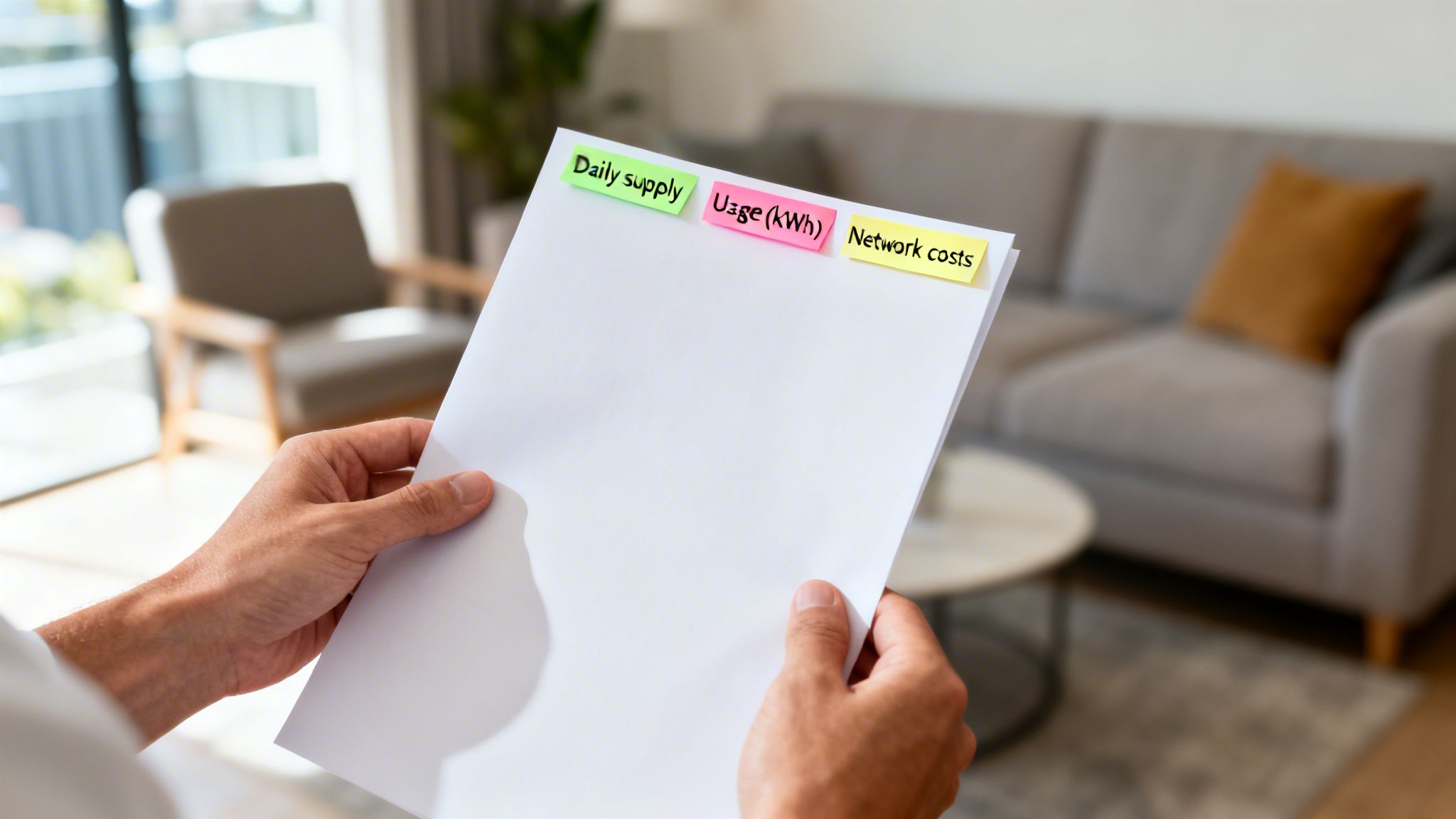
- Daily Supply Charge: This is a fixed fee you pay every day for connection to the electricity network. It is charged regardless of your energy usage.
- Usage Charge (per kWh): This is the variable component. It is the price you pay for each kilowatt-hour (kWh) of electricity you draw from the grid.
- Network Costs: These fees cover the construction and maintenance of the poles and wires delivering power to your home. They are usually bundled into your supply and usage charges.
This structure highlights why simply "turning off the lights" has limited impact. While it lowers your usage charges, it does nothing to reduce your daily supply charge, which is a fixed cost.
The Two Main Types of Charges Explained
To make a material impact on your average electricity bill in Brisbane, you need a strategy that addresses both fixed and variable costs. Let's examine them in more detail.
1. Fixed Charges (Daily Supply)
This charge applies before you use any electricity. Set by your retailer, the daily supply charge in the Energex network area (South East Queensland) typically sits between $1.00 and $1.30 per day.
Over a 90-day billing cycle, this single charge amounts to between $90 and $117 of your total bill. This is a significant portion that cannot be reduced through basic energy conservation.
Key Takeaway: A large part of your electricity bill is a fixed daily fee. Reducing your energy consumption alone will never eliminate this cost, highlighting the need for a more advanced strategy.
2. Variable Charges (Usage and Demand)
This is where your daily habits influence your bill. Usage charges are billed per kWh, and on a standard single-rate tariff in Brisbane, rates are typically between 29c and 41c per kWh.
However, tariff structures are becoming more complex. Many retailers are shifting customers to "time-of-use" or "demand" tariffs.
A demand tariff, for instance, penalises high electricity consumption during peak periods (usually 4 pm to 9 pm). If you operate the air conditioner, oven, and washing machine simultaneously during this window, your retailer can apply a demand charge based on that single moment of high usage and apply it for the entire month. It is designed to reduce strain on the grid but can easily inflate your bill.
You might also see other one-off costs, and you can learn more about these additional fees and charges that may apply. For battery owners, understanding this breakdown is critical. Your system is perfectly positioned to combat both charge types, but only if managed intelligently.
Why Do Brisbane Energy Bills Vary So Much?
It’s a common scenario in Brisbane: you discuss power bills with a neighbour in a nearly identical house, only to find their costs are worlds apart from yours. This isn't random luck; it demonstrates a fundamental principle of energy pricing. Your bill is not a fixed fee but a direct reflection of your specific habits, appliances, and retail plan.
The financial gap between a low-energy and a high-energy household can be substantial, even with the same number of occupants. This variance presents an opportunity. By understanding what drives these costs, you can transition from being a passive bill-payer to an active energy manager, especially if you own a solar and battery system.
The Real Reasons Your Bill Is Higher (or Lower)
While household size sets a baseline, the significant range in the average electricity bill Brisbane households receive boils down to three core factors.
Your Appliance Mix: An old, inefficient second fridge, a power-hungry plasma TV, or a decade-old air conditioner can quietly add hundreds of dollars to your annual costs compared to modern, energy-efficient models.
Seasonal Habits: In Brisbane's subtropical climate, air conditioning is a primary driver of electricity consumption. The frequency of use, thermostat setting (aim for 24-25°C), and home insulation levels can create large variations in your bill, particularly during summer.
Your Electricity Plan: This is a frequently overlooked factor. Being on a retail plan or tariff that is poorly matched to your lifestyle can be costly. For example, a demand tariff can be punitive if your family operates multiple large appliances during peak evening hours.
Just How Much Can Bills Really Vary?
The financial gap between low and high energy use is staggering. Recent analysis for households on standard single-rate plans demonstrates just how wide this chasm can be.
A one-person household could see a monthly bill ranging from $59 to $135. A two-person home's bill can range from $88 to $202, while a three-person household faces a range of $106 to $243. For larger families of five or more, the monthly bill can span from $151 to $347.
A high-use household can easily pay more than double what a low-use household does, even with the same number of people. For a deeper dive into these numbers, you can explore detailed breakdowns of Brisbane energy costs.
This massive difference proves your bill is not fixed. It is a direct result of your home's unique energy profile. For solar and battery owners, this is where the opportunity lies. Your system provides the tools not just to reduce grid power consumption but to actively generate value that offsets your costs—a strategic advantage that goes far beyond simple conservation.
A Smarter Strategy for Reducing Your Power Bills
Flicking off switches and shortening showers is a start, but these small savings barely make a dent in your total bill. A significant portion of your electricity cost is the fixed daily supply charge, which cannot be reduced by conservation alone. This limitation requires a more sophisticated strategy.
It’s time to consider the massive, often-ignored potential of your solar battery. For too long, batteries have been viewed as little more than a backup for blackouts. Their real power lies in their ability to transform you from a passive consumer into an active participant in the energy market.
From Passive Consumer to Active Participant
Your traditional electricity retailer views your home as a one-way street: you consume power, and they send you a bill. This relationship offers no reward for owning a sophisticated asset like a battery, guaranteeing your system is never used to its full financial potential.
The smarter approach is to partner with a modern, technology-focused retailer who can unlock that hidden value. By joining a Bring Your Own Battery (BYOB) Virtual Power Plant (VPP), your battery transitions from a simple storage unit into a financial tool.
A VPP is not a physical device to be installed. It is a coordinated network of residential batteries, all working together to help stabilise the electricity grid during periods of stress from high demand or wholesale price volatility. This grid support service is highly valuable.
Generating Value to Offset Costs
The concept is refreshingly simple: your battery’s spare capacity is used to support the wider energy network during critical moments. This is not about constantly draining your battery for someone else's benefit. It’s about smart, targeted participation that provides high-value services to the grid operator, for which you are financially rewarded.
- Move beyond basic savings: Instead of merely avoiding costs by using your own solar energy, your battery starts actively generating tangible value.
- Tackle fixed charges: The value generated from VPP participation can be used to directly offset your unavoidable daily supply charges—an outcome that energy conservation alone cannot achieve.
- Monetise your investment: A well-designed VPP program provides a genuine financial return on your battery hardware, fundamentally changing the economics of ownership.
This strategy directly addresses the core drivers of a high average electricity bill in Brisbane. It creates a new value stream that traditional retailers are not equipped to offer. You stop playing defence (trying to use less) and start playing offence (generating value).
For homeowners serious about reducing energy costs, the next step is understanding how to monitor and optimise this performance. Exploring tools for effective home energy monitoring is how you start to unlock this potential. This is how you redefine your relationship with the energy market, turning your home into a dynamic asset that actively works to reduce your bills.
How a VPP Slashes Your Power Bill
Using a solar battery solely to store daytime energy for nighttime use is a passive strategy. The real game-changer is actively using that battery to support the wider energy grid. This is precisely how a Bring Your Own Battery (BYOB) Virtual Power Plant (VPP) delivers material savings on your bill.
The High Flow Energy VPP model turns your battery from a passive backup into an active, value-generating asset. This process moves you from being just another energy consumer to an active participant in the energy market, finally unlocking the financial return you expected from your investment.
Turning Spare Capacity Into a Bill-Free Allowance
The core principle is grid balancing. The National Electricity Market (NEM) is in a constant state of balancing electricity supply and demand. During peak times—like a hot Brisbane afternoon when air conditioners across the city switch on—the grid operator requires extra capacity to maintain stability and prevent price spikes.
This is where your battery provides value. Along with hundreds of others connected to our VPP, your battery can provide that support by discharging a small amount of its spare energy. This service is incredibly valuable to the energy market.
- Smart Dispatch: Our proprietary software identifies these high-value moments and coordinates with your battery to export power when it’s most needed and most valuable.
- Value Creation: The grid support you provide creates real, tangible value in the wholesale energy market.
- Funded Allowance: We capture that value and use it to directly fund a monthly electricity allowance for your household.
This isn't just another small feed-in tariff or a vague credit. It's a substantial, dollar-for-dollar allowance designed to wipe out both your daily supply charge and your energy usage up to a generous monthly threshold. This approach directly targets the two biggest cost components of the average electricity bill Brisbane families face.
By joining our VPP, your battery isn't just saving you money—it's actively earning its keep. This completely changes the economics of owning a battery, turning it from a simple storage device into a revenue-generating asset for your home.
You Always Retain Control
A common concern is losing access to your own stored power. With High Flow Energy, this is not a risk. Your family’s energy needs always come first. You retain complete ownership and priority use of your battery.
We have built our system with clear, non-negotiable safeguards:
- Your Power First: The VPP only ever draws on spare capacity. You will always have the energy you need for your home, guaranteed.
- Total Transparency: Our companion app provides a clear, evidence-based view of exactly when, why, and how much energy your battery contributes to the VPP.
- You're in Control: You have the final say. If you anticipate a storm and want to reserve your battery’s full capacity, you can override VPP activity at any time.
This is a partnership built on performance and transparency. Your traditional power company has no incentive to help you maximise the value of your battery. Our entire business, by contrast, is structured around it. We are a technology-enabled electricity retailer focused on one goal: unlocking the maximum financial performance from the energy assets you already own. It's a key reason why virtual power plants are driving Australia's renewable energy revolution.
By joining, you are not just reducing your bill; you are finally realising the full return on your smart investment.
Frequently Asked Questions (FAQ)
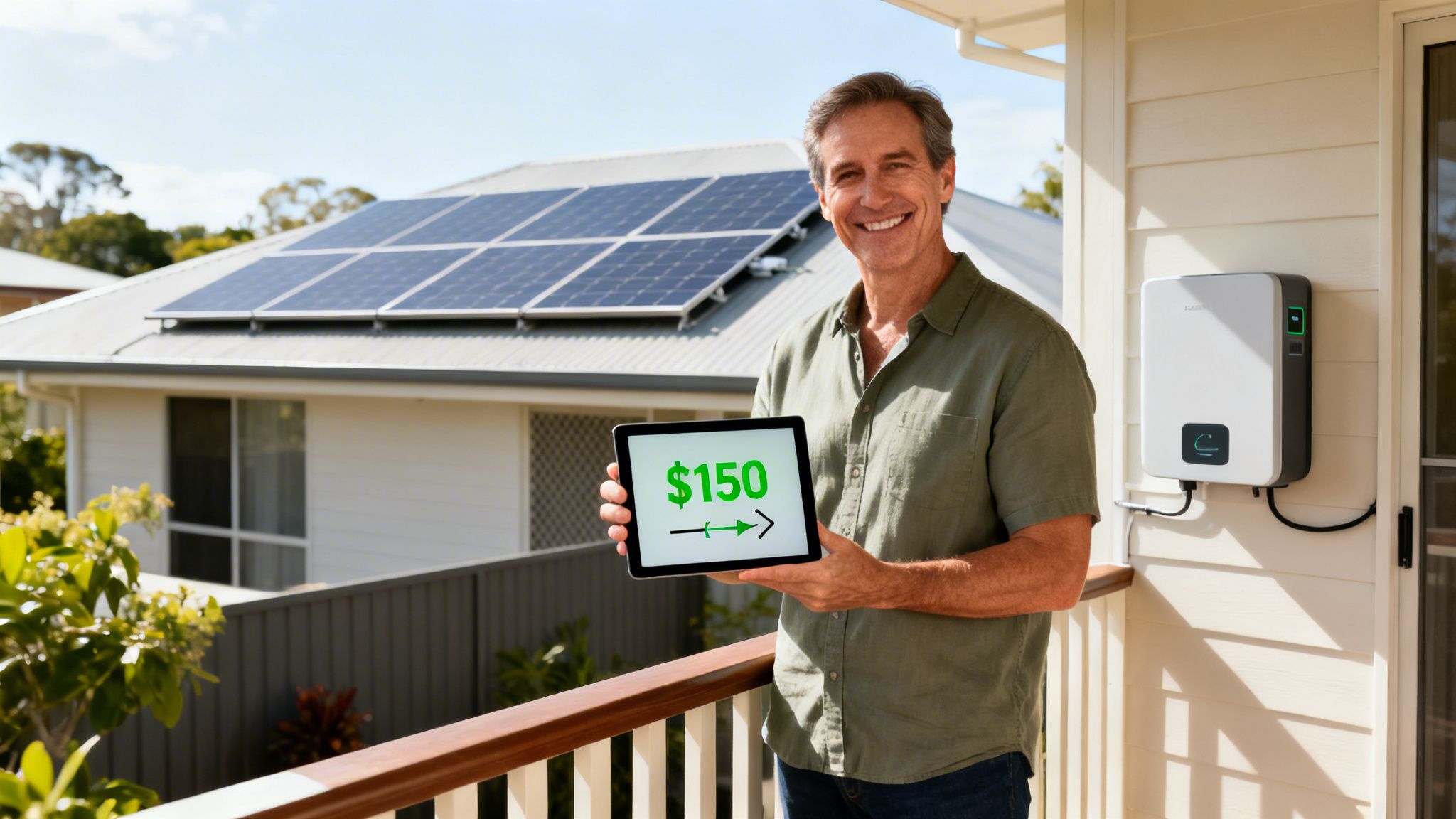
Navigating Brisbane’s electricity market can be complex, especially with new concepts like Virtual Power Plants. Here are direct answers to common questions from solar and battery owners.
What is a realistic electricity bill for a 4-person house in Brisbane?
A realistic monthly electricity bill for a typical four-person home in Brisbane can range from $128 to $303. This corresponds to an annual cost between $1,536 and $3,636. This wide range highlights how significantly your bill is influenced by your choice of retailer, tariff structure, and energy consumption habits—particularly air conditioner use in summer. This variance also represents the opportunity for optimisation.
Can joining a VPP really eliminate my entire electricity bill?
While some low-energy households may eliminate their bill, it is more accurate to view VPP participation as earning a significant bill-free allowance. High Flow Energy converts the value your battery generates for the grid into a monthly allowance, designed to cover your daily supply charge plus a generous amount of energy usage (a set kWh limit). If your consumption stays within this allowance, your bill for that month can be $0. If you use more grid power than the allowance covers, you simply pay for the excess at a standard rate.
Will participating in a VPP wear out my battery faster?
This is a critical and common question. A professionally managed VPP, like High Flow Energy's, uses intelligent software to keep all battery activity well within the manufacturer's warranty guidelines. Our system is designed to target high-value, short-duration grid events to generate maximum financial value from minimal cycling. The value generated is designed to far outweigh any negligible impact on the battery's long-term lifespan. Crucially, you retain control and can override VPP activity at any time.
Is my solar and battery system compatible with High Flow Energy's VPP?
Our Bring Your Own Battery (BYOB) platform is engineered to integrate with a growing list of leading home battery brands available in Australia. As a technology-focused company, we are constantly expanding our compatibility. The easiest way to confirm compatibility is to use the quick online eligibility checker on our website. It is a no-obligation tool that will verify if your system can join our VPP and start generating greater financial returns.
What is the difference between a VPP and a standard solar feed-in tariff?
A standard solar feed-in tariff (FiT) pays you a small, fixed rate (e.g., 5-8c/kWh) for any excess solar power you export to the grid during the day. A VPP is fundamentally different. It uses your battery's stored energy to provide high-value grid stabilisation services, often in response to wholesale price events. This can generate significantly more value than a standard FiT. High Flow Energy's model uses this value to fund a monthly bill allowance, a more direct and impactful way to reduce your costs.
Most battery owners focus on installation quality. Far fewer focus on ongoing performance and optimisation. High Flow Energy is an electricity retailer built around unlocking the full value of your existing solar and battery system.
If you would like to understand whether your battery is underperforming financially, request an eligibility assessment today.