

Solar Battery Group Reviews: A 2026 Guide for Australian Battery Owners
When you start digging into Solar Battery Group reviews, you'll find a common thread. The feedback is mostly positive, but it tells a very specific story—one that’s all about the initial installation and the first few power bills. This article provides a comprehensive analysis for Australian solar and battery owners.
Most customers are happy with the efficient installation and the quick wins on their energy costs. But that’s not where the story ends. To get the full picture, you have to look past the day-one setup and ask what happens next. Are you getting the absolute most financial value out of your new battery? That's a question most installer reviews just don't answer. A technology-enabled electricity retailer can provide a different perspective.
Analysing Solar Battery Group Reviews: What Are Customers Really Saying?
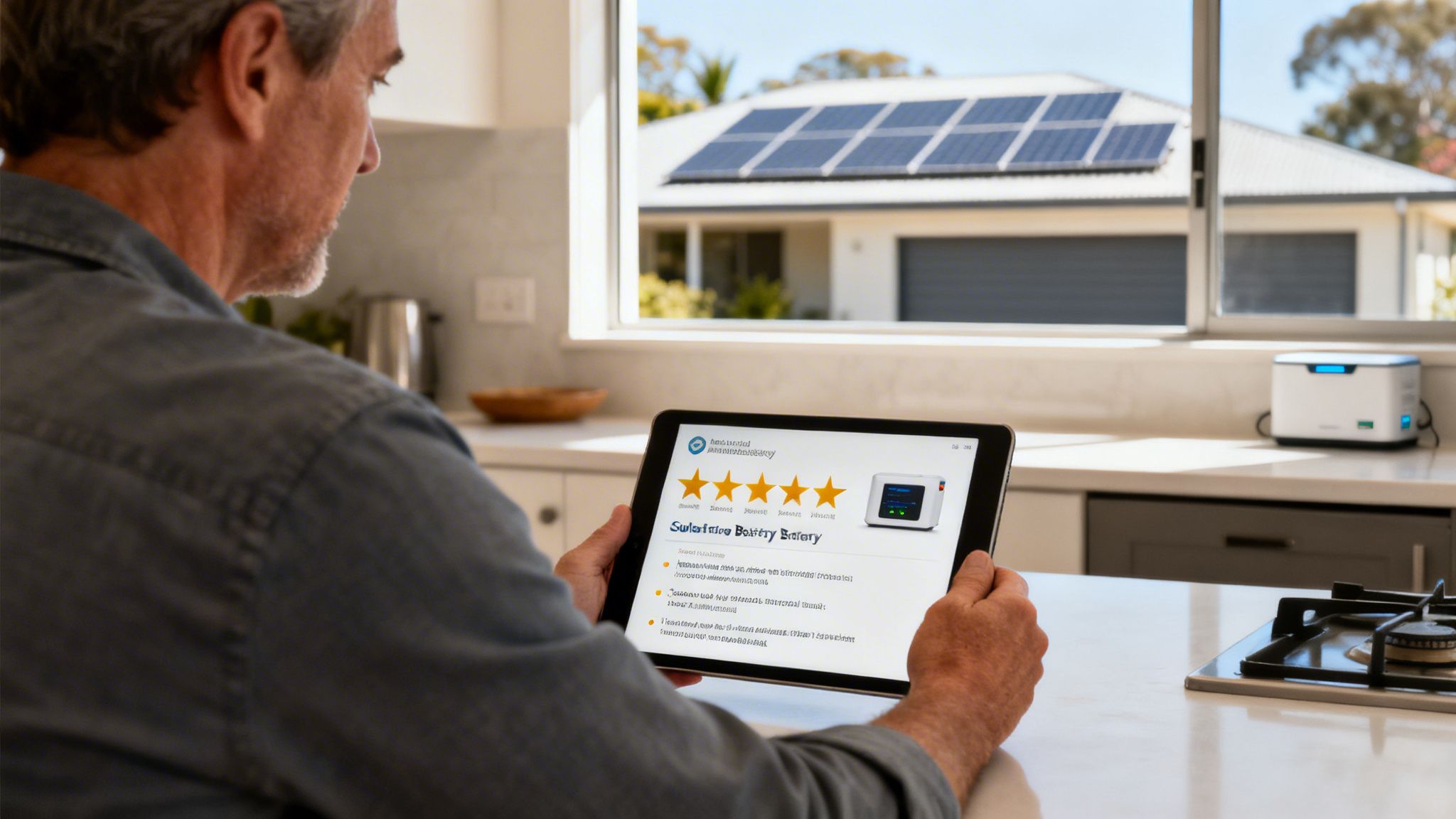
If you're an Australian homeowner looking into solar batteries, you’ve almost certainly come across Solar Battery Group. They are a large player in the market, and their business model is clear: they sell and install solar battery systems. Understanding this is key—their primary function is getting the hardware onto your wall and switched on.
Their core promise is helping you use the power you generate. By storing your excess solar power from the day, you can use it at night instead of buying expensive electricity from the grid. This is the basic, fundamental benefit of owning any home battery.
But when you dive deep into the solar battery group reviews across different platforms, you start to see a gap between that initial satisfaction and true long-term financial performance. This is where concepts like Virtual Power Plant Australia and battery optimisation become critical.
What the Ratings and Reviews Tell Us
On the surface, the numbers look solid. Solar Battery Group holds a 4.3/5 star rating from over 1,350 reviews on ProductReview.com.au. Homeowners in Queensland and New South Wales are particularly prominent in the feedback, with 65% of reviewers giving them 4-5 stars.
These reviews are filled with stories of bill reductions between 40-60% and praise for a smooth installation process. Over on SolarQuotes, the perspective is a little more granular, with a 3.8/5 average rating broken down by value, quality, and the install itself.
The theme is consistent: people are thrilled with the installation and the immediate relief of a lower power bill. But that’s only one part of the battery’s potential value.
The real takeaway from most positive reviews is the sheer relief from high energy bills. An installer's job is to get the hardware working, and it seems they do that well. The bigger, more important question is whether that hardware is working as hard as it financially could be for you.
Common Praise and Problems
Let’s break down the feedback into what people are actually discussing—the installation experience versus the ongoing financial results.
| Review Aspect | Common Customer Praise | Common Customer Issues |
|---|---|---|
| Installation & Sales | Professional and efficient installation crews. | Occasional scheduling or communication delays. |
| Clear explanation of the system at the start. | Patchy post-installation support experiences. | |
| Financial Outcome | Immediate, noticeable drop in electricity bills. | Confusion over feed-in tariffs vs. real solar battery value. |
| Satisfaction from using their own solar power. | System doesn't optimise for grid events or wholesale prices. |
The difference is stark. An installer's role is transactional. They set up the system, make sure it’s running, and their main job is done. This "install-and-forget" approach delivers on its promise of self-consumption, but it leaves significant financial value on the table.
A modern solar battery is more than just a storage tank for electricity. It's a dynamic financial asset. It has the power to interact with the grid, earning you credits and providing savings far beyond just avoiding peak-hour tariffs. And that’s precisely where the job of a Bring Your Own Battery (BYOB) Virtual Power Plant (VPP) operator like High Flow Energy begins.
Understanding Battery Installers Versus VPP Retailers
When you're digging through solar battery group reviews, it’s easy to get caught up in the details about installation quality and the initial relief from bill shock. But there's a crucial distinction that often gets overlooked—one that makes all the difference to your battery's long-term financial payoff.
You need to understand the fundamental difference between a battery installer and a technology-focused electricity retailer that runs a Virtual Power Plant (VPP). Getting this right is the key to unlocking your battery's true earning potential.
An installer, like Solar Battery Group, has a very specific job: they physically put the hardware on your wall and get it running. Their expertise is in the nuts and bolts of the installation, from the wiring to making sure the system is compliant and switches on. Their work is project-based, and once it's done, their job is largely over.
A VPP operator like High Flow Energy, on the other hand, is a different beast altogether. Our role starts exactly where the installer’s finishes. We aren’t a hardware company; we’re a performance-driven electricity retailer focused entirely on the ongoing financial optimisation of the battery you already own. We operate as a VPP retailer in NSW and QLD.
The Installer's Role: A Transactional Hardware Setup
The main goal for a battery installer is to provide a working piece of equipment that stores your solar power for you to use later. It’s a straightforward transaction.
This process typically involves:
- Consultation and Sales: Helping you pick a battery that fits your home’s energy needs.
- Physical Installation: Mounting the unit, connecting it to your solar panels and switchboard, and handling all the electrical work safely.
- System Commissioning: Activating the system and showing you the basics of how it works for self-consumption.
Once your battery is installed and working, their part in your solar journey is largely complete. It's also interesting to see the kinds of tools available to solar panel installers these days to manage their jobs and customer feedback.
The VPP Retailer's Role: Ongoing Financial Optimisation
A Bring Your Own Battery (BYOB) VPP retailer operates on a completely different model. We shift the focus from the hardware itself to how we can intelligently manage it to generate as much value as possible, day in and day out.
An installer helps you save money by using your own solar power instead of buying from the grid. A VPP retailer helps you generate value by putting your battery to work in the energy market. It’s the difference between passive savings and active optimisation.
This ongoing management means your battery does a lot more than just store leftover solar. A VPP operator like High Flow Energy orchestrates your battery to:
- Support the Grid: Discharge power to help stabilise the grid during peak demand events, earning you credits for doing so.
- Trade on the Market: Intelligently sell your stored energy back to the grid when wholesale prices spike.
- Dodge Peak Tariffs: Automatically power your home from your battery when electricity is most expensive, protecting you from high costs.
This is a continuous, dynamic process. It’s this active management that generates the value needed to fund a monthly electricity allowance, with the goal of material electricity bill reduction. To get a better feel for this, you can learn more about choosing the right solar battery installers and the questions you should be asking them.
Just remember, the installation is only step one. The real value lies in the long journey of financial optimisation that comes after.
Comparing Financial Models: Installer Savings vs. VPP Allowances
When you examine solar battery group reviews, one thing becomes crystal clear: people are happy to see their power bills drop. That's the core of a standard battery installer's financial model – a simple, proven way to boost your home’s self-consumption.
But there’s another model, one that isn't run by installers. It's offered by tech-savvy electricity retailers like us at High Flow Energy. This approach isn't about just shrinking your bill; it's about receiving a monthly electricity allowance by putting your battery to work in the energy market.
Let's break down what each of these models really means for your finances.
The Installer Model: Bill Reduction Through Self-Consumption
The proposition from a battery installer is straightforward. Your solar panels generate electricity during the day, and instead of exporting surplus power to the grid for a low feed-in-tariff, you store it in your battery.
Come nighttime, or on a cloudy afternoon, you draw from your own stored power. This means you avoid buying expensive electricity from the grid.
The financial win here is bill reduction. Your quarterly bill shrinks because you're buying less energy. The savings are direct, but you're still responsible for daily supply charges and any grid power you end up using.
Think of the installer model as a defensive play. It's all about dodging costs by keeping your grid interaction to a minimum. It works, but it doesn’t treat your battery like an asset that can actively earn its keep.
In this setup, your battery is your personal energy reserve. It's a passive approach where the financial upside stops at whatever grid costs you can avoid.
The VPP Retailer Model: Bill Reduction Through Allowances
A retailer-led Virtual Power Plant (VPP) completely changes the approach. Instead of just dodging costs, a VPP actively turns your battery into a value-creating asset. At High Flow Energy, our goals are aligned with yours: we use our intelligent platform to make your battery perform at its financial peak.
We deploy software that lets your battery interact with the National Electricity Market (NEM). This allows us to:
- Discharge your battery to help stabilise the grid when demand spikes.
- Sell stored power back to the market when wholesale prices are high.
- Smartly manage charging to ensure your home's needs are always met first.
The value we generate from these activities funds a monthly electricity allowance. This is a significant credit designed to cover your energy usage and those fixed daily supply charges you’d otherwise have to pay.
This chart highlights the different mindsets between the installer and the retailer-VPP models.
The installer is focused on the hardware sale. The VPP retailer, on the other hand, is focused on optimising the ongoing financial performance of that hardware for you.
Direct Financial Comparison
To see the real-world difference, let's put these financial outcomes side-by-side. A typical battery installation from an installer is about reducing what you owe. A VPP model is about changing the entire financial relationship you have with your electricity provider.
Financial Outcomes: Installer Model vs. VPP Retailer Model
| Financial Outcome | Standard Battery Installation (Installer Model) | Retailer-Based VPP (High Flow Energy Model) |
|---|---|---|
| Primary Goal | Reduce electricity bill by using your own stored solar power (self-consumption). | Generate a monthly electricity allowance by participating in the energy market. |
| Your Bill | Your quarterly bill is lower, but you still pay daily supply charges and for any grid usage. | Your monthly allowance aims to cover your energy usage and daily supply charges, for a material electricity bill reduction. |
| Battery's Role | A passive energy reserve used to avoid grid costs. | An active, dynamic asset that generates value by supporting the grid and trading energy. |
| Typical Benefit | Cost Avoidance: Saving money by not buying as much electricity. | Allowance Generation: Receiving a credit that offsets or eliminates most of your bill. |
While a standard installation cuts down your expenses, the VPP structure—like that seen in plans similar to the Origin Solar Boost plan—aims to fundamentally change your electricity bill. For a deeper look at these advanced plans, you can read our breakdown of the Origin Solar Boost Plan.
Ultimately, a VPP model elevates your battery from a simple cost-saving device to an active participant in the energy market. This unlocks a new level of financial opportunity that a standalone, offline battery simply can't access, moving you beyond basic savings and towards true value optimisation.
Reading Between the Lines of Solar Battery Group Reviews
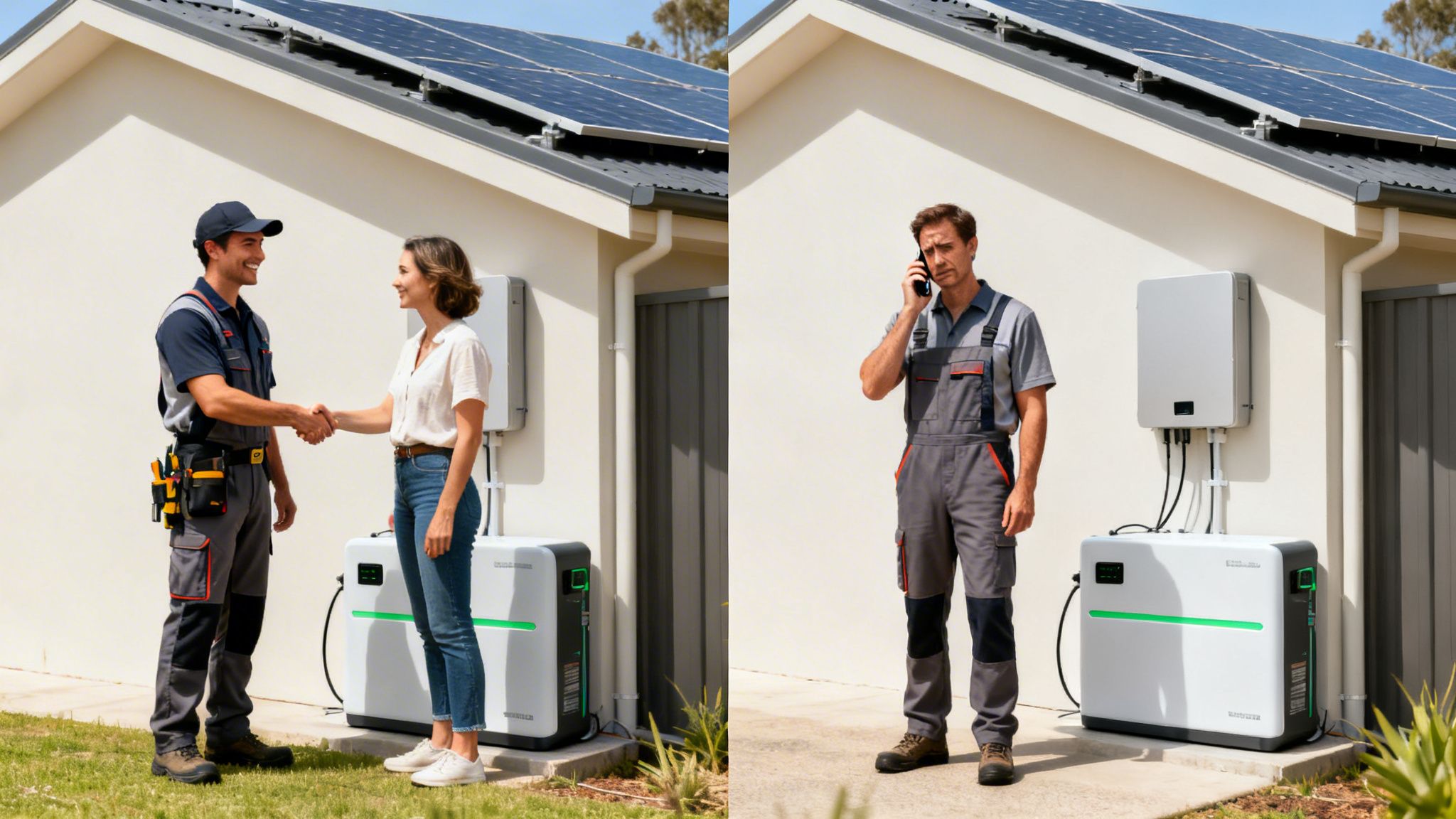
When you analyse the large volume of Solar Battery Group reviews, you start to see two very different stories emerge. It's crucial to understand both—the positive aspects of the initial install and the common issues that can arise later. This gives you a much more realistic picture of what to expect, not just on day one, but a year down the track.
First, let's talk about the positive feedback. A lot of it comes down to the company's sheer size and efficiency. As Australia’s largest battery installer, Solar Battery Group has a significant operational footprint, especially in Queensland and New South Wales.
Their numbers are notable, with over 26,000 customers nationwide and a solid 4.3 out of 5-star rating from more than 1,350 reviews on ProductReview.com.au. Homeowners in QLD and NSW often mention how quickly the installation happens. You can get a sense of their scale by exploring their customer milestones on solarbatterygroup.com.au.
What Customers Praise: The Installation
Most of the glowing reviews focus squarely on the installation day itself. For many people, this is the most hands-on part of the whole process, and it’s where Solar Battery Group often performs well.
Here’s what people consistently praise:
- Speedy Service: Many are surprised at how fast the team gets the system on the wall and running, meaning the savings can start almost immediately.
- Professional Crews: The installers are frequently described as professional, tidy, and good at explaining the hardware they're fitting.
- Wide Reach: Being a large company means they can service huge areas across NSW and QLD, which can translate to shorter waiting times for customers.
This feedback shows that if your main concern is getting the hardware installed quickly and professionally, they have a strong track record.
Where Issues Can Arise: The Post-Installation Gap
However, a different story appears when you look at the negative feedback. These problems almost always surface after the installation team has driven away.
The recurring issues tend to cluster around two main themes:
- Post-install support: Some customers find it hard to get a quick answer or a solution when they run into technical glitches or have questions about their system's performance.
- Warranty claim process: Trying to sort out a warranty claim for a faulty piece of equipment can sometimes become a drawn-out and frustrating experience. This is a common challenge for businesses that install hardware at scale.
This uncovers a fundamental difference in business models. An installer's job is primarily a one-off transaction: to get the hardware on your wall. A VPP operator, on the other hand, is in a continuous financial partnership with you, making your system’s performance their top priority.
This is exactly where a VPP retailer like High Flow Energy operates differently. We separate the ongoing financial performance of your battery from the one-time install. While an installer’s job is done once the system is commissioned, a VPP operator is financially tied to your system’s daily output. We have a vested interest in making sure your battery is working perfectly every single day to generate value for both you and the grid.
It’s a shift from a short-term project to a long-term partnership in optimising your investment.
Is Your Standalone Battery Financially Underperforming?
It's a great feeling seeing the numbers drop on the first power bill after your solar battery is installed. This is a fantastic win and a common highlight in many solar battery group reviews.
But what if that initial saving, while good, is just scratching the surface? The real question isn't just "Am I saving money?" but "Am I getting the absolute most financial value out of my battery?" For most owners, the answer is no. A standalone battery set up only for self-consumption is a significantly underperforming asset. It’s like owning a delivery truck but only ever using it for the weekly grocery run.
The Hidden Opportunity Cost of an Idle Battery
Your standard battery setup is defensive: store the sun's energy during the day, then use it at night so you don't have to buy from the grid. It works, but it also means your battery spends a lot of time just sitting there, waiting for you to use power.
It’s passive, oblivious to the dynamic energy market operating in the background. This "set and forget" approach means you're missing out on real financial opportunities.
- Wholesale Price Spikes: You miss the chance to export stored energy back to the grid when demand is high and wholesale prices skyrocket. These events can generate substantial credits, far beyond your standard feed-in tariff.
- Grid Stabilisation Services: You’re not being compensated for helping the grid. VPPs allow batteries to be paid for helping stabilise the National Electricity Market (NEM) during critical peaks.
- Intelligent Tariff Avoidance: Your system isn't smart enough to proactively charge from the grid during super cheap off-peak periods, nor is it perfectly timing its discharge to shield you from expensive time-of-use (TOU) rates.
A battery that only serves your home’s load is a wasted financial resource. It only reaches its full potential when it’s actively participating in the energy market.
Key Takeaways: Signs Your Battery is Underperforming
How can you tell if your battery is underachieving? If you're in Queensland or New South Wales, review your recent electricity bills against this checklist. If you answer "Yes" to any of these, it's a strong indicator your battery isn't being financially optimised.
Simple Financial Underperformance Checklist:
- Do you still pay a daily supply charge? A standard setup reduces your usage, but that fixed daily charge to stay connected to the grid almost always remains.
- Does your bill show any grid consumption during peak tariff hours? This is a clear sign that your battery isn't being managed intelligently enough to protect you from the most expensive power.
- Are your solar feed-in credits minimal (e.g., 5-10c/kWh)? This shows your battery isn't programmed to export power when it's most valuable. During price spikes, wholesale rates can be many times higher than your standard tariff.
- Is your electricity bill ever more than $0? If you are still paying for electricity, your solar and battery system is not being leveraged to its full financial potential.
If you’ve spotted these gaps in your own setup, it’s time to look at the next logical step. This is where a "Bring Your Own Battery" (BYOB) Virtual Power Plant (VPP) changes the game. A VPP partnership turns your passive battery into an active, value-generating asset. The first step is always getting a clear picture of what your system is actually doing. Effective home energy monitoring gives you the data you need to start unlocking that hidden potential.
Unlocking More Value from Your Battery with a BYOB VPP
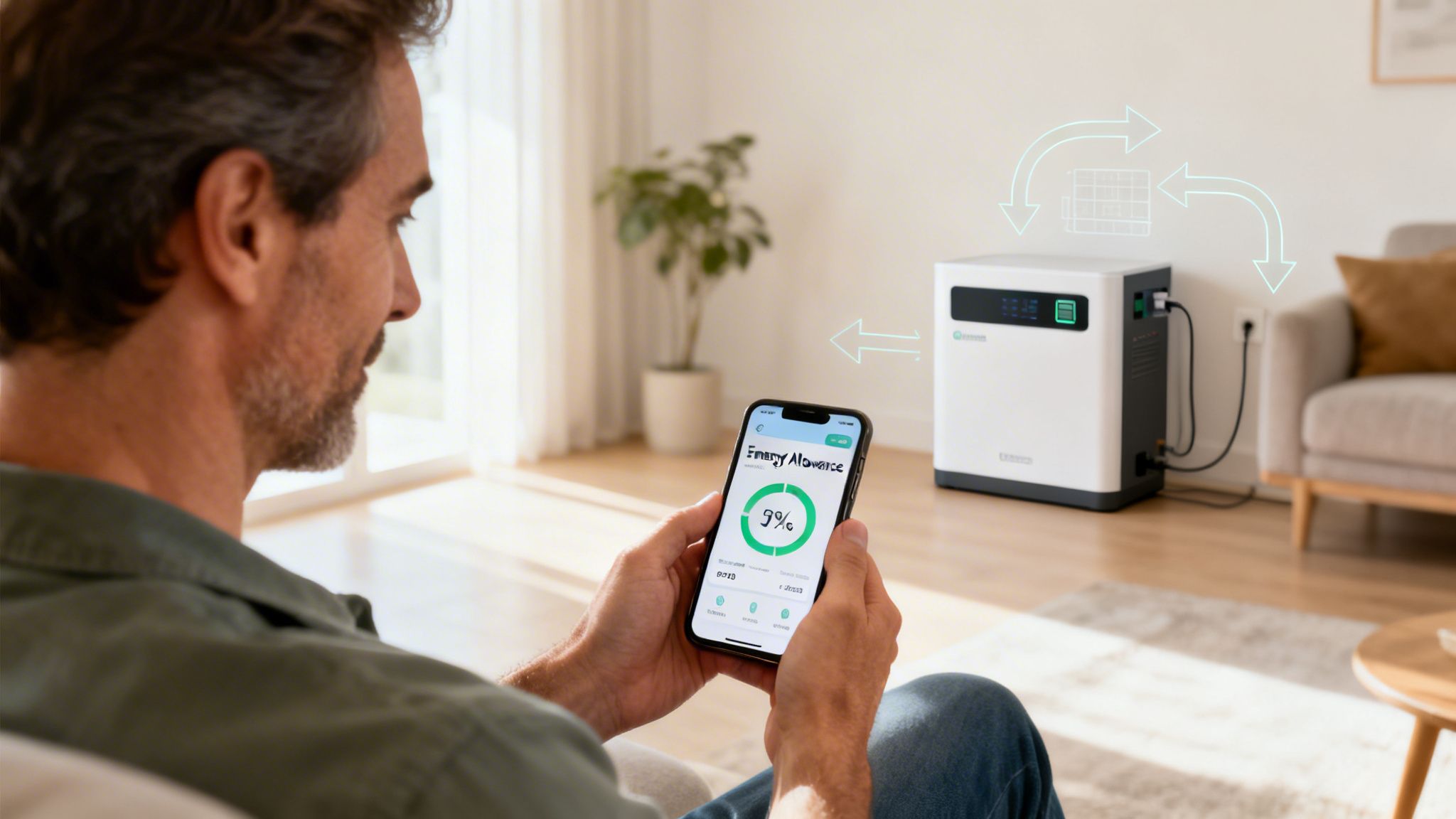
For many homeowners, the day the battery is installed feels like the end of the project. While getting the setup right is crucial—and reading solar battery group reviews is a smart way to check installer quality—the real work of making your investment pay off has only just begun.
Simply letting your battery sit there, catching excess solar, is an "install-and-forget" approach. It's safe, but it leaves a huge amount of financial value on the table.
This is where a different kind of electricity retailer, like High Flow Energy, comes in. We’re not in the business of selling or installing hardware. Our entire focus is on unlocking the full financial potential of the solar and battery system you already own, turning it from a simple storage tank into an active player in Australia's energy market.
From Cost Avoidance to Value Creation
The difference in approach is significant. A standard battery setup is all about cost avoidance—using your own solar power at night to avoid buying from the grid.
A Bring Your Own Battery (BYOB) Virtual Power Plant (VPP), on the other hand, is about value creation. It puts your battery to work through smart grid participation.
This allows your battery to do things a standalone system can't, like:
- Generating value by helping to stabilise the grid during peak demand.
- Exporting your stored energy back to the grid when wholesale prices spike.
- Charging intelligently from the grid when power is cheap, saving your solar for when it matters most.
The value generated from these smart actions is then shared back to you as a monthly allowance.
Instead of just chipping away at what you owe, our VPP model is designed to give you a substantial monthly allowance. The goal is to cover your entire energy bill—both usage and supply charges—fundamentally changing your relationship with your energy costs.
You Retain Ownership and Priority
Joining a VPP doesn't mean you lose control of your battery. With High Flow Energy, you always own it, and your household's needs always come first. Our platform is designed to make sure your home is fully powered before your battery is ever asked to help the grid.
It’s all built around performance you can see and control.
- Turn your battery into an asset that generates value, not just a device that saves money.
- Receive a structured allowance designed to materially reduce or even eliminate your electricity bills.
- Keep priority access to your own stored power, so your home's needs are always met.
- Get full transparency through our platform to see exactly how your system is performing.
Most battery owners get caught up in the quality of the installation. The savvy ones look past that and focus on the ongoing performance and financial return. High Flow Energy is an electricity retailer built for them—unlocking the true value of your investment, long after the installers have gone home.
Frequently Asked Questions (FAQ)
Do I Need a New Battery to Join a VPP?
No, you don't. The purpose of a 'Bring Your Own Battery' (BYOB) Virtual Power Plant is that it's designed to work with a compatible solar battery you already own. The service isn't about selling you new hardware. It's about getting the most financial value out of the asset you've already invested in. High Flow Energy partners with you to unlock the potential of your current system.
Can My Installer Also Manage My Battery in a VPP?
This is a common point of confusion, but typically, the answer is no. The roles are entirely different. An installer's expertise is in the physical setup, wiring, and commissioning of your solar and battery hardware. A VPP operator like High Flow Energy, on the other hand, is a licensed electricity retailer with the specific technology and market access needed to actively manage your battery within the National Electricity Market (NEM). They are fundamentally different business models requiring different skill sets and regulatory approvals.
Will Joining a VPP Void My Battery's Warranty?
This is a critical question. The answer is no, provided you're with a reputable VPP operator. High Flow Energy's platform is designed to work strictly within the operational guidelines set by battery manufacturers. Our goal is to manage your battery's charge and discharge cycles intelligently to maximise your return, always in a way that respects its warranty conditions. We focus on smart optimisation, not pushing the hardware beyond its limits. Your battery’s warranty remains protected.
What’s the Difference Between a VPP Allowance and a Feed-in Tariff?
A feed-in tariff (FiT) is the small credit—typically 5-10c per kWh—that your electricity retailer gives you for exporting leftover solar power to the grid. It’s a simple, passive, and low-value transaction. A VPP allowance is completely different. It's a structured monthly credit derived from actively using your battery to support the grid, such as discharging stored energy during high-priced peak demand events. This allowance is designed to be substantial, often enough to cover not just your energy usage but also your daily supply charges—something a simple FiT could never do.
What is a BYOB VPP?
BYOB stands for "Bring Your Own Battery". A BYOB Virtual Power Plant (VPP) is a program offered by an electricity retailer that allows owners of existing, compatible solar batteries to connect their systems to a network. This network is used to provide grid support services, and in return, the battery owner receives financial benefits, like a monthly allowance.
Most battery owners focus on installation quality. Far fewer focus on ongoing performance and optimisation. High Flow Energy is an electricity retailer built around unlocking the full value of your existing solar and battery system.
If you would like to understand whether your battery is underperforming financially, Request an eligibility assessment today.