


Your Guide to Solar Battery Installation in Australia
A quality solar battery installation is all in the planning. The real work happens long before a single tool comes out of the bag, setting the foundation for your system's long-term performance and financial return.
Getting this groundwork right is the difference between a smooth project and a costly problem. Good planning ensures your system is safe, compatible, and compliant from day one. However, the installation itself is only the first step. To maximise the value of your asset, you must also consider how it will be operated and optimised once it's on the wall.
Your Pre-Installation Planning Checklist
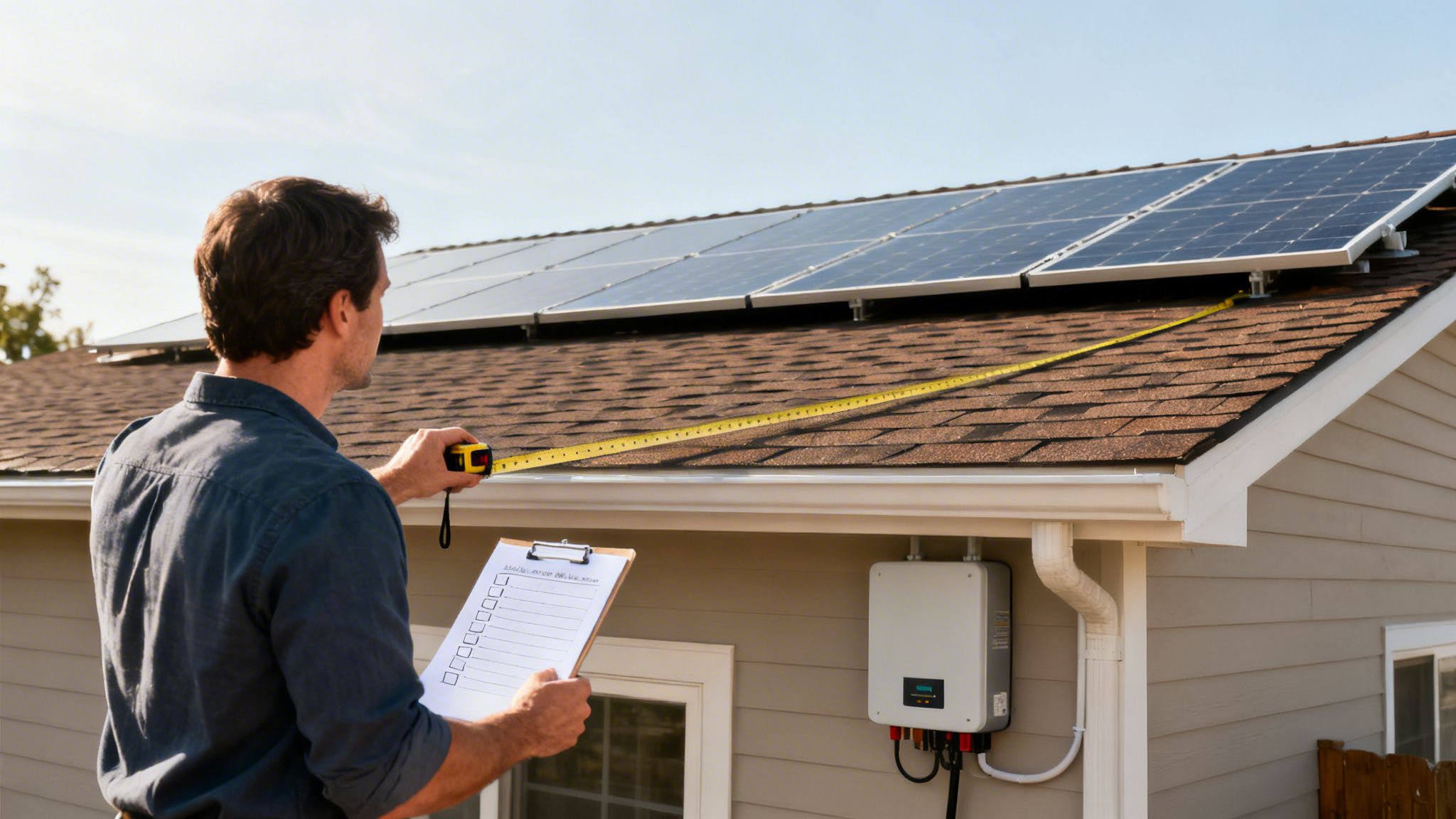
Before you engage installers, it pays to conduct your own assessment. Understanding the key requirements helps you ask intelligent questions and accurately evaluate quotes for your specific project. Think of it as the foundation for a commercially sound investment.
Site Assessment and Physical Location
First, where will the battery be physically located? This decision is driven by safety, performance, and regulatory compliance, not just available wall space.
Finding the Right Spot: Your battery requires a specific environment—not too hot, not too cold. It must be in a well-ventilated area, shielded from direct sunlight and extreme temperatures. Garages are a common choice, but they must comply with strict fire safety regulations (AS/NZS 5139) regarding clearance from doors, windows, and flammable materials.
Checking Your Switchboard: Inspect your home’s main switchboard. It is the central connection point for your electrical system. Older boards often lack the physical space or modern safety switches (like RCDs) required for a battery connection. An installer will provide the final assessment, but an initial check can prepare you for a potential switchboard upgrade—a common additional cost.
Solar Array Access: If you are installing a battery with a new solar system, your roof's condition and orientation are critical. For homeowners adding a battery to an existing setup, the main requirement is clear, safe access for the electrician to reach the relevant wiring.
System Compatibility and Inverter Check
This area is technical but crucial. Not all solar components are compatible, particularly when retrofitting a battery to an existing solar PV system. While your installer will manage the technical specifications, understanding the basics is beneficial.
The primary question is how the battery will integrate with your solar panels. This is achieved through either AC coupling or DC coupling.
AC Coupling: This is the standard method for most retrofits. The battery includes its own inverter and connects directly to your switchboard. It is a flexible configuration that works with almost any existing solar system.
DC Coupling: This is more common when installing solar panels and a battery simultaneously. The battery connects directly to a specialised hybrid inverter that manages the entire system—panels, battery, and the grid.
Understanding the difference is important for financial planning. If you are adding a battery to an existing system, you can learn more about AC coupling for solar batteries in our detailed guide.
Permits and Network Distributor Approval
This is a non-negotiable step and a frequent source of project delays. Before any work commences, your installer must obtain approval from your local electricity network distributor—such as Ausgrid in NSW or Energy Queensland in QLD.
This application verifies that your proposed system meets the network's technical and safety standards and will not negatively impact the local grid. Your installer manages the paperwork, but you should always request confirmation of submission and, critically, formal approval before finalising an installation date.
Installing a battery without this approval may result in it not being permitted to connect to the grid, turning your energy asset into an expensive, non-operational fixture.
How to Choose an Accredited Battery Installer
The success of your solar battery system is not determined by the brand alone. The performance, safety, and long-term financial return of your system are almost entirely dependent on the quality of the installation.
Selecting the right professional is the most critical decision you will make. It protects your property, your investment, and ensures compliance with Australian standards.
A general electrician, however skilled, is not a specialist battery installer. The technical knowledge and strict safety protocols required for energy storage systems are distinct. Taking shortcuts in this area can lead to a poorly performing system, voided warranties, or severe safety hazards like fires.
The Non-Negotiable CEC Accreditation
In Australia, the absolute minimum requirement is to hire a Clean Energy Council (CEC) Accredited Installer. This is mandatory for any solar or battery system connected to the grid.
A CEC-accredited professional has completed specialised training in the design and installation of these complex systems. Their accreditation confirms they adhere to stringent Australian Standards, particularly AS/NZS 5139, the definitive regulation for battery safety.
Without this accreditation, your system may be ineligible for grid connection or certain government incentives.
Your Installer Vetting Checklist
Finding a reputable professional requires more than verifying a single certificate. Due diligence is necessary to ensure you are partnering with an experienced and legitimate business.
Use this checklist to vet potential installers:
- Verify CEC Accreditation: Do not take their word for it. Use the CEC's "Find an Installer" tool online to check that their accreditation is current and specifically covers battery storage systems.
- Check Their Electrical Licence and ABN: The installer must hold a valid electrical contractor’s licence for your state (e.g., QLD or NSW). An ABN search confirms they are a legitimate, registered business.
- Review Their Insurance: Always request a copy of their Certificate of Currency for Public Liability Insurance. This protects you from liability for property damage during the installation.
- Examine Their Project Portfolio: Ask to see examples of similar battery installations, ideally with the same battery brand you are considering. This demonstrates practical, hands-on experience.
- Read Customer Reviews: Consult independent sources like Google Reviews. Look for detailed feedback on their communication, professionalism, and post-installation support.
A superior installer provides more than just technical work—they deliver confidence and peace of mind for the life of the system. For a broader perspective on selecting trades, this guide on how to hire contractors offers a useful framework for any major home project.
Key Questions to Ask Your Potential Installer
Once you have a shortlist, it is time to conduct interviews. Their answers to these questions will reveal their level of expertise and operational standards.
- "What is your direct experience with [Your Battery Brand]?"
Each battery model has unique installation requirements and software configurations. You need an installer who is intimately familiar with your specific model, not one who is learning on your project. - "What is your workmanship warranty?"
This is critical. It is separate from the manufacturer's product warranty and covers the quality of the installation itself. A five-year workmanship warranty is a solid industry standard; leading installers often offer longer terms. - "How do you manage the grid connection paperwork?"
The correct answer is: "We manage the entire process." A true professional will handle the complete application and approval process with your network distributor (like Ausgrid or Energy Queensland) on your behalf. You can learn more about the roles and responsibilities of solar and battery installers in our dedicated article.
What to Expect on Installation Day
With planning complete, the installation day marks an important milestone. Understanding the process ensures you know what to expect when the installation team arrives. A standard installation is a structured process designed to ensure your system is safe, compliant, and ready to deliver financial value.
Your installer will likely arrive early. Most residential battery installations are a full-day job, typically lasting six to ten hours. They will begin with a final site walk-through, confirming the agreed-upon locations for the battery and any associated switchboard equipment. This is your final opportunity to ask questions before work begins.
The Physical Installation Process
The first major task is physically mounting the battery unit. This is governed by strict compliance with the AS/NZS 5139 standard. This regulation dictates everything from wall clearances and fixing methods to ventilation requirements to ensure system safety.
Once the battery is securely mounted, the electrical work commences. This is a complex task that involves:
- Connecting to the Inverter: Dedicated, heavy-duty cables are run to connect your new battery to your solar inverter or switchboard.
- Upgrading the Switchboard: Your switchboard will be fitted with new hardware, including circuit breakers and isolation switches. This is a mandatory safety measure that protects your battery and your home.
- Running Data Cables: A smart battery requires communication. Data cables are run alongside power lines, enabling the battery to communicate with the inverter and your monitoring platform.
This is why your choice of installer is so critical. You need a professional who understands the standards implicitly and will not compromise on technical quality.
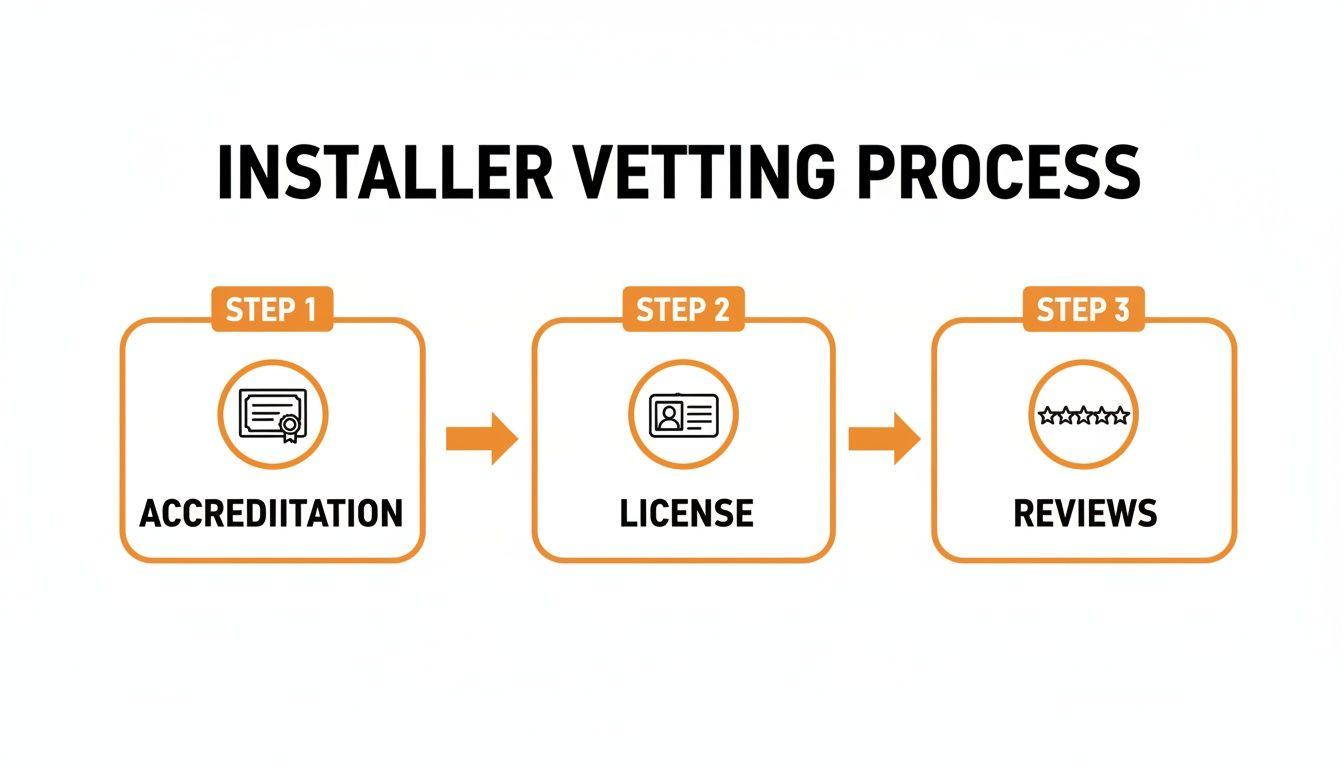
Ensuring your installer is properly accredited, licensed, and well-reviewed is the best assurance of a high-quality, safe, and compliant installation.
Commissioning and Handover
With all hardware in place, the installer proceeds to the commissioning phase. This is where they activate your battery, transforming it from a passive box on the wall into an intelligent energy asset. They will power up the system, configure the software, and set the initial operating parameters for charging and discharging.
A series of tests are then conducted to verify that all components are communicating correctly—confirming that it charges from your solar, discharges to power your home, and transmits data to the monitoring application.
The handover is your opportunity to learn. Ask your installer for a comprehensive tour of the monitoring app. Ensure you understand how to track your battery's performance and interpret the data provided.
This process is becoming increasingly common in homes across Australia, particularly in Queensland and New South Wales. Data shows a significant market shift; as noted in a 2024 Residential Solar & Storage Market Report analysis on pv-magazine.com, the attachment rate of batteries to new solar systems in Australia surged in recent years.
Before departing, your installer will provide a folder containing all essential documentation—warranties, user manuals, and the critical electrical safety certificate. They will also manage the final submission to your electricity network provider, officially registering your system with the grid. At this point, your battery installation is complete and ready to begin operation.
Understanding Installation Costs and Timelines
Let's address the two most common questions regarding a solar battery installation: what is the total cost, and what is the realistic timeframe?
It is a mistake to focus solely on the hardware price. To budget accurately, you must consider the total project cost, which includes installation labour, essential safety components, and potential switchboard upgrades.
Understanding the full financial and logistical picture from the outset allows for realistic planning and a clear view of when you can expect a return on your investment.
Typical Cost Components in Australia
A professional installation quote should itemise the total cost into several key areas. Understanding these components enables you to compare different offers on a like-for-like basis.
Here is what a comprehensive quote should include:
- Battery Hardware: This is the battery unit itself. The cost is determined by the brand, battery chemistry (e.g., Lithium Iron Phosphate – LFP), and its energy capacity, measured in kilowatt-hours (kWh).
- Installation Labour: This covers the time and expertise of a CEC-accredited electrician and their team. For a standard residential installation, this is often a full day's work, and the cost reflects the project's complexity.
- Additional Components: This includes all other required parts for a safe and compliant installation, such as circuit breakers, cabling, and isolation switches. If you are not using an AC-coupled battery, you may also need a new hybrid inverter.
- Switchboard Upgrades: This is a significant variable. If your home is older, your switchboard will likely require an upgrade to handle the new system and meet current Australian safety standards. It is a common additional cost and should be discussed upfront.
- Compliance and Paperwork: A reputable installer manages all administrative tasks, from submitting grid connection applications to certifying the final work. This fee covers their time managing this process.
Australia is experiencing a significant uptake in home energy storage. Market data from sources like Australian energy storage statistics at pv-magazine-usa.com show strong growth, particularly in Queensland and NSW, driven by decreasing hardware costs and state-based incentives.
So, what is the total expected cost? While every project is unique, the table below provides an indicative cost breakdown for a typical installation in QLD or NSW in 2026.
Estimated Solar Battery Installation Cost Breakdown 2026 (QLD/NSW)
| Cost Component | Estimated Cost Range (AUD) |
|---|---|
| Battery Hardware (e.g., 10kWh LFP) | $8,000 – $13,000 |
| Inverter (if required) | $2,000 – $4,000 |
| Installation Labour | $2,000 – $3,500 |
| Switchboard Upgrade (if required) | $800 – $2,500 |
| Additional Components & Cabling | $500 – $1,500 |
| Compliance & Grid Application Fees | $400 – $800 |
| Total Estimated Project Cost | $13,700 – $25,300+ |
Note: These are estimates. The final cost will depend on the specific battery chosen, the complexity of your home's electrical system, and the installer.
Realistic Project Timelines
A critical point to understand is that while the physical installation may only take a day, the entire process from contract signing to a fully commissioned system typically takes several weeks.
A typical solar battery installation project in Australia spans several weeks, not days. The timeline is dictated by approvals and logistics, not just the on-site work.
The project timeline generally follows these phases:
- Contract and Deposit (1-2 weeks): Time spent finalising quotes, selecting an installer, and signing the contract.
- Grid Connection Approval (2-6 weeks): This is often the longest phase. Your installer submits an application to your local electricity distributor (e.g., Ausgrid, Energy Queensland). The approval timeframe is outside the installer's control.
- Scheduling and Installation (1-2 weeks): Once network approval is received, the installer will schedule the installation day. The on-site work itself typically takes 6-10 hours.
- Final Commissioning (1 week): After installation, the installer submits completion paperwork to the network and issues your electrical safety certificate, officially connecting your system.
In total, a realistic project timeframe is 4 to 8 weeks from contract signing to system activation.
Getting the Most Out of Your Battery After Installation
A successful installation is a significant milestone, but it is not the end of the process. The real opportunity begins now. With the hardware in place, the focus must shift from physical setup to financial optimisation.
A standard battery configuration provides immediate value by allowing you to store solar energy generated during the day for use at night. This self-consumption model reduces your reliance on the grid and lowers your electricity bills. However, this only scratches the surface of your battery's potential.
Beyond Simple Energy Storage
Most battery owners in Australia are underutilising their asset. They operate in a simple 'store and use' cycle, missing a significant financial opportunity.
The untapped potential lies in enabling your battery to participate in the broader energy market. This requires moving beyond a standard retail electricity plan to a more dynamic, intelligent partnership with the grid.
To maximise your battery's long-term value, you must optimise its operational strategy from day one, much like considering the operational lifespan of solar hot water systems. This is the key to achieving the best possible return on your investment.
The Power of a Virtual Power Plant (VPP)
The mechanism for unlocking this additional value is a Virtual Power Plant (VPP). A VPP is a network of distributed home batteries, like yours, that are intelligently coordinated to provide services to the electricity grid, particularly during periods of high demand or network stress.
Instead of remaining idle, your battery’s available capacity can be used to provide grid stabilisation services. In return for this participation, you receive a financial benefit.
This transforms your battery from a passive energy storage device into an active, value-generating asset. The rapid growth of VPPs across the National Electricity Market (NEM) underscores this commercial opportunity.
How High Flow Energy Puts Your Battery to Work
This is our area of expertise. High Flow Energy is not a hardware company; we do not sell or install solar panels or batteries. We are a technology-enabled electricity retailer specialising in Bring Your Own Battery (BYOB) Virtual Power Plant solutions.
Our role is to provide the commercial and technological bridge between your compatible battery and the energy market, ensuring you extract the maximum financial value from your existing asset.
Our entire focus is on switching your battery from a cost-saving device to a value-generating asset, without ever getting in the way of your own household's energy needs.
Your Path to Optimisation
Connecting your battery to our VPP is a simple, digital process designed to get you earning as quickly as possible after your solar battery installation is complete.
- Eligibility Check: First, a quick online check confirms your battery and inverter models are compatible with our VPP platform.
- Switch Retailer: You then switch your electricity retail plan to High Flow Energy. This is the regulatory step that allows us to manage the energy flows and create value on your behalf.
- Connect to Platform: Finally, you connect your system to our platform via our app. The process is straightforward with no additional hardware required.
Once connected, our AI-driven platform begins optimising your system. It constantly analyses wholesale energy prices, weather forecasts, and your home's specific consumption patterns to create the optimal charge and discharge strategy.
The platform will automatically charge your battery when power is cheap (e.g., from your solar) and make its spare capacity available to the grid during high-priced wholesale events. You can learn more about the data behind this with our guide on home energy monitoring.
Critically, your household's energy needs always take priority. You have priority access to your stored energy, and our platform operates intelligently within your battery's warranty parameters to protect its long-term health.
Common Questions About Solar Battery Installation
Even with a chosen installer, questions often arise about the process and long-term ownership. The home energy sector is filled with technical terms, so clear, direct answers are essential.
Here are straightforward answers to questions we frequently hear from homeowners in Queensland and New South Wales, from installation day to post-installation optimisation.
How Long Does a Solar Battery Installation Take?
This has a two-part answer. The physical, on-site work is efficient. A standard residential battery installation is typically completed in one full day, involving 6 to 10 hours of labour.
However, the complete end-to-end process is significantly longer. From contract signing to having a fully commissioned and operational system, a realistic timeframe is 4 to 8 weeks.
This extended timeline is due to critical administrative and logistical steps:
- Network Approval: This is the primary variable. Your installer must submit an application to your local electricity distributor (e.g., Ausgrid in NSW, Energy Queensland in QLD), and their processing time can be several weeks.
- Scheduling: Once network approval is granted, your installer can book your project into their work schedule.
- Final Commissioning: After the physical installation, final paperwork is submitted to the distributor to officially register your asset on the grid.
What Ongoing Maintenance Does a Home Battery Need?
Modern home batteries, particularly those with Lithium Iron Phosphate (LFP) chemistry, are designed for minimal owner maintenance. There are no fluids to check or complex mechanical parts to service.
Your responsibilities are simple:
- Keep the Area Clear: Ensure the space around the battery unit remains free of obstruction. This allows for proper air circulation, which is crucial for thermal management and long-term performance.
- Monitor Performance: Familiarise yourself with your battery’s monitoring app. A periodic check is sufficient to confirm it is charging and discharging as expected. This allows for early detection of any performance anomalies.
While not mandatory, it is prudent to have a licensed electrician conduct a professional inspection of your entire solar and battery system every 5 years. They will verify that all connections are secure and the system continues to operate safely and efficiently.
The real "maintenance" for a modern battery isn't about hardware. It’s about performance. The work shifts to making sure the battery is operating smartly to maximise your financial return—a software and strategy challenge, not a hardware one.
Can I Add a Battery to My Existing Solar Panels?
Yes. Adding a battery to an existing solar PV system, often called a "retrofit," is a very common scenario. The most efficient and flexible method for this is AC coupling.
In an AC-coupled configuration, the new battery includes its own dedicated inverter and connects directly to your home's main switchboard. This design makes it independent of your existing solar inverter, ensuring compatibility with almost any solar panel system, regardless of its age or brand.
Your installer will need to assess your switchboard to ensure it has sufficient capacity and meets current safety standards to accommodate the new circuit.
Does Joining a VPP Void My Battery's Warranty?
No, joining a reputable Bring Your Own Battery (BYOB) Virtual Power Plant (VPP) does not void your manufacturer's warranty. This is a critical point that is often misunderstood.
Battery manufacturers provide a warranty based on time (typically 10 years) or energy throughput (measured in MWh). A professionally managed VPP, like the one operated by High Flow Energy, uses sophisticated software to control your battery.
Our platform is specifically designed to operate well within the performance and cycling limits defined by your battery’s warranty. We are focused on maximising your financial return while protecting the long-term health and operational life of your asset. Our business is built around optimising your existing, warrantied battery, not selling hardware.
Most battery owners focus on installation quality. Far fewer focus on ongoing performance and optimisation. High Flow Energy is an electricity retailer built around unlocking the full value of your existing solar and battery system.
If you would like to understand whether your battery is underperforming financially, request an eligibility assessment today.