

Solar EV Chargers: An Australian Homeowner’s Guide
Australia already has over 3.2 million rooftop solar systems installed by mid-2024, covering about 36% of households and delivering more than 20 GW of cumulative capacity, according to the Clean Energy Council data cited in the verified brief. At the same time, Australia had over 100,000 EVs registered by end-2024, with 80% of EV owners charging at home and solar-powered sessions accounting for 65% of total energy delivered, based on the ABS-linked verified data.
That combination changes the role of a home charger. A charger is no longer just a convenience device on the garage wall. In many Queensland and New South Wales homes, it has become part of a wider energy system that includes rooftop solar, a battery, time-based pricing, and increasingly, coordinated grid participation through a VPP.
That’s why solar ev chargers matter now. They sit at the point where transport electrification meets household energy optimisation. For homeowners who already have solar, and especially those with a battery, the question isn’t whether the car can charge. It’s whether the whole system is being orchestrated well enough to protect self-consumption, avoid poor export economics, and create additional value from spare capacity. For a broader look at how that coordination works at grid scale, this overview of Virtual Power Plants driving Australia’s renewable energy revolution is useful context.
The Convergence of Solar and Electric Vehicles in Australia
Queensland and New South Wales are the obvious focal point. They combine large installed solar bases with strong EV uptake and a household charging pattern that favours home energy optimisation over public charging dependence.
The key commercial insight is simple. If most charging happens at home, then the economics of the car increasingly depend on the economics of the home energy system.
Why home charging changes the equation
A petrol car has one fuel pathway. An EV has several.
A homeowner can charge from:
- Excess solar generation during the day
- Stored battery energy later in the evening
- Grid imports under a retail tariff
- A managed combination of all three
That flexibility is why solar ev chargers are more important in Australia than generic overseas articles often suggest. In a market with very high rooftop solar penetration, charging hardware is only one layer. Control strategy matters just as much.
Solar EV charging isn't just about using sunlight. It's about deciding whether each kilowatt-hour should go to the home, the battery, the car, or the grid.
The opportunity most households miss
Many homeowners still think in appliance terms. They ask whether the charger works with their car, whether the switchboard has capacity, and whether charging speed is good enough.
Those are necessary questions. They’re not the valuable ones.
The more strategic questions are:
- When should the car charge to protect solar self-consumption?
- Should the battery hold energy for evening household use or overnight vehicle charging?
- When is export more valuable than charging?
- How much flexibility can the household tolerate without compromising convenience?
Those decisions determine whether the EV becomes a low-cost extension of the solar system, or just another large evening load.
Understanding Solar EV Charger Types and How They Work
Australia’s rooftop solar fleet is large enough that charger design now affects more than household convenience. It affects whether surplus generation is exported at a low daytime value, stored for later, sent to the vehicle, or preserved for a battery or Virtual Power Plant program.
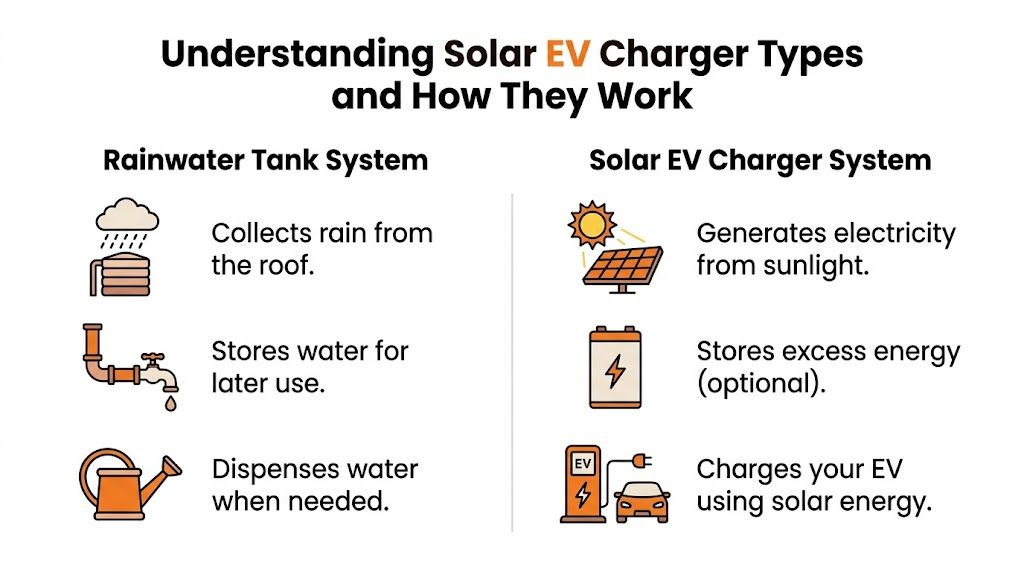
A solar EV charger is not a separate source of electricity. It is a control layer. The charger decides how aggressively the car draws power, whether charging should pause when household load rises, and how tightly the EV should be coordinated with the inverter and battery.
Two broad charger categories
For most Australian homes, the practical distinction is between chargers that are solar-aware and chargers that are integrated into the wider energy system.
| Feature | Standard 'Solar-Aware' Charger | Integrated Inverter-Charger |
|---|---|---|
| Solar use method | Uses settings or app logic to favour solar charging | Coordinates directly with inverter and energy flows |
| Control style | Scheduled or threshold-based | Dynamic and automated |
| Best fit | Homes wanting simple managed charging | Homes seeking tighter optimisation |
| Battery coordination | Often limited or indirect | Usually stronger system-level coordination |
| Export management | Basic solar diversion | Better real-time prioritisation |
Standard solar-aware chargers
A standard solar-aware charger is usually an AC wall charger with software rules. It can start charging during solar hours, limit charging to a set current, or only operate once exports rise above a chosen threshold.
That setup suits households with predictable daytime surplus and modest optimisation goals. It can still improve solar capture materially, especially in homes where midday load is low and the vehicle is parked at home often enough. If you’re comparing hardware formats and installation styles, this guide to residential EV chargers is a useful starting point.
The limitation is visibility. Many of these chargers respond to solar indirectly rather than coordinating at the inverter level. If cloud cover rolls through, the oven turns on, or the battery begins charging, the EV may continue drawing power unless the control logic is fast and accurate.
Integrated inverter-chargers
Integrated inverter-chargers operate closer to the centre of the home energy system. Instead of relying mainly on charger-side schedules, they use live data from the inverter, meter, and sometimes the battery management platform to adjust EV charging in real time.
That matters because household energy flows change minute by minute. The Australian Renewable Energy Agency’s work on EV charging points to the value of managed charging and system coordination, particularly where households are trying to increase solar utilisation rather than add charging speed (ARENA knowledge bank).gov.au/knowledge-bank/driving-innovation-in-ev-charging/)).
In practice, integration improves decision quality. The system can reduce EV load when household demand rises, increase charging when solar exports are building, or preserve battery energy for evening peaks if that delivers a better financial outcome. For homes that later join an advanced VPP, this architecture matters even more because the EV charger is no longer just following solar. It is operating within a broader optimisation stack that may also consider battery dispatch, tariff periods, and grid service events.
What homeowners should actually compare
Charging speed matters less than control quality in many solar homes. The better questions are operational and financial:
- Energy prioritisation: Can the charger respond to changing household load in real time?
- Battery awareness: Does it preserve stored energy when that energy has higher evening or VPP value?
- Control pathway: Is the charger coordinating natively with the inverter, or through a weaker app-based workaround?
- Tariff logic: Can it shift between solar charging and grid charging when off-peak imports are the better option?
- Future flexibility: Can the system participate in wider orchestration if the household adds a battery or joins a VPP later?
Practical rule: The best solar EV charger is the one that helps the whole energy system make better decisions, not simply the one with the highest charging rate.
The Financial Case for Solar-Powered EV Charging
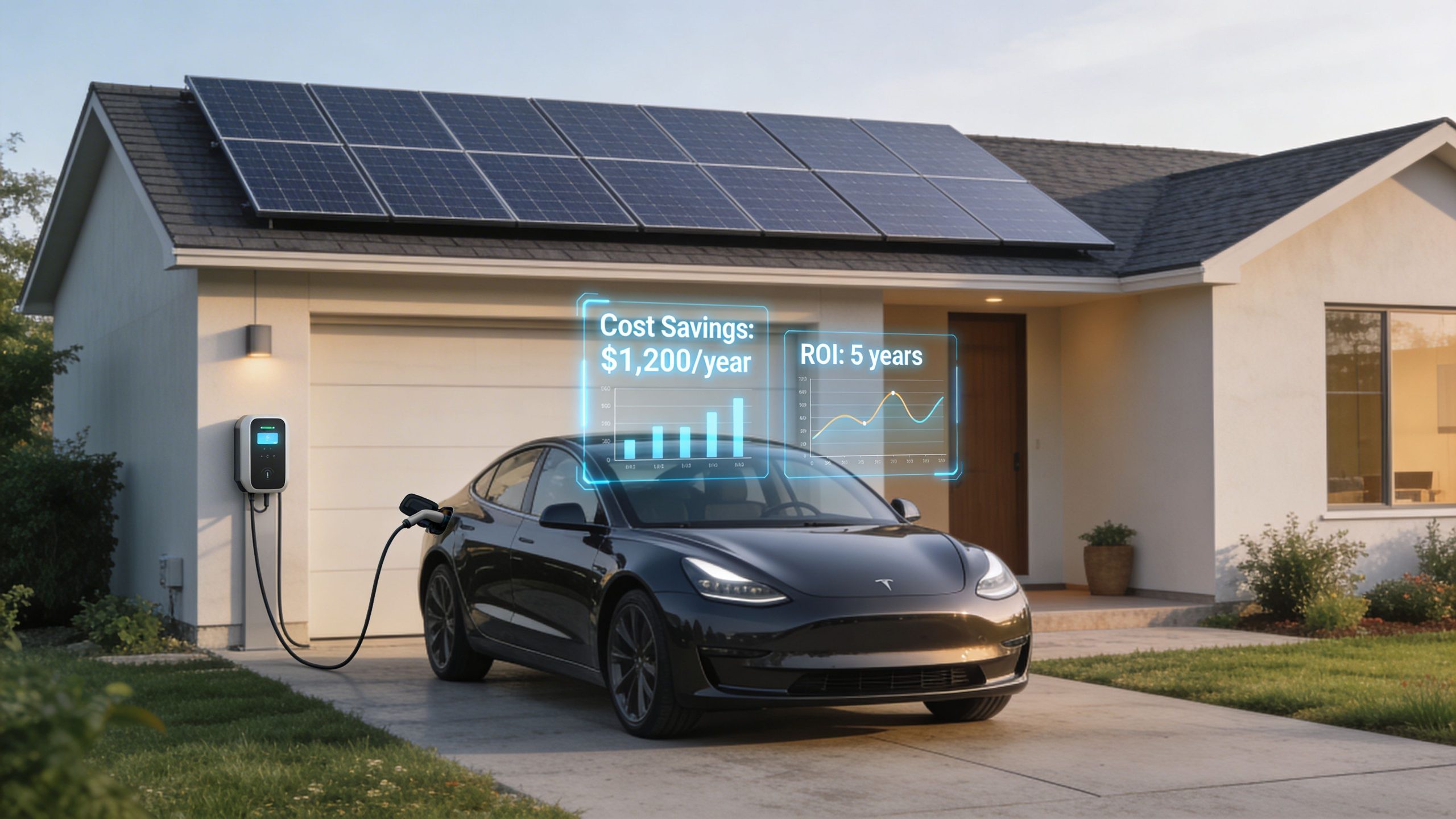
Charging an EV from rooftop solar changes the value of each kilowatt-hour. In Queensland and New South Wales, many households receive only modest feed-in credits for exported daytime solar, while imported electricity for evening charging costs materially more. That spread is the financial starting point.
A solar EV charger helps convert low-value exports into avoided grid purchases. For households that already have solar, the economic question is not whether solar energy is free. It is which use of that energy produces the highest return at that moment: household load, battery charging, EV charging, export, or later participation in grid services through a VPP.
The core savings mechanism is spread capture
The Australian Government’s Green Vehicle Guide explains that home charging from solar can reduce running costs because onsite generation displaces grid electricity that would otherwise be purchased for transport energy (Green Vehicle Guide EV charging advice). The point sounds simple, but the economics are stronger than many sales pages suggest.
If surplus solar would otherwise be exported at a low rate, diverting that energy into the car raises the realised value of your solar system. If the same household later charges the EV from the grid in the evening, the foregone value can be even larger because it has effectively sold low and bought high.
That is why charger control quality matters financially. A basic charger can fill the battery in the car. A well-integrated charger can improve the value captured from your rooftop generation.
Payback depends on timing, not just hardware cost
The Australian Renewable Energy Agency has funded multiple smart charging projects, and one consistent finding is that managed charging improves system efficiency and reduces pressure on the grid when charging is aligned with local generation and network conditions (ARENA smart charging projects overview). For a homeowner, that translates into a practical rule. The charger earns its keep when it regularly shifts EV demand into periods that would otherwise produce exports or inefficient battery cycling.
The variables that shape payback are straightforward:
- Daytime vehicle availability: Cars parked at home during solar hours can absorb more surplus generation.
- Export exposure: Homes with frequent midday exports have more energy available to redirect.
- Battery configuration: A battery can improve charging flexibility, especially in setups using AC-coupled battery storage systems where existing solar is being expanded without replacing the original inverter.
- Tariff structure: Time-of-use pricing changes the value of avoiding evening imports.
- Control sophistication: Automated charging logic usually outperforms manual scheduling over a full year.
These factors also explain why headline payback estimates vary so widely between households.
The higher-value opportunity is often missed
Many articles stop at self-consumption savings. That understates the upside. Once a battery, EV charger, and tariff logic are coordinated, the household can preserve solar or battery energy for periods when it has higher value than immediate vehicle charging. In an advanced VPP, that same stored energy may also earn revenue or bill credits through grid support events, which changes the charging decision again.
Viewed that way, a solar EV charger is part of an optimisation stack, not a standalone appliance. It can increase self-consumption, protect higher-value battery discharge windows, and leave more flexibility available for VPP participation. Competitors often treat these as separate value streams. In practice, they interact.
Homeowners also tend to compare charger economics with broader solar economics. If you’re trying to frame charger value inside the total household energy investment, this guide to the average cost of solar panels for home is one way to think about the wider capital context, even though charger returns should be assessed separately.
A solar EV charger makes the strongest financial case when it improves the value of every energy decision across the home, not only the cost of filling the car.
Optimising Value with Home Batteries and VPP Integration
The financially interesting question isn’t whether solar can charge an EV. It can. The harder question is whether the charger, battery, and household load can work together without cannibalising each other’s value.
That tension is real in Queensland and New South Wales homes. The car often arrives when rooftop production is falling. The battery may already be holding energy for evening household use. At the same time, a VPP may value spare stored energy for grid support.
The real conflict is timing, not technology
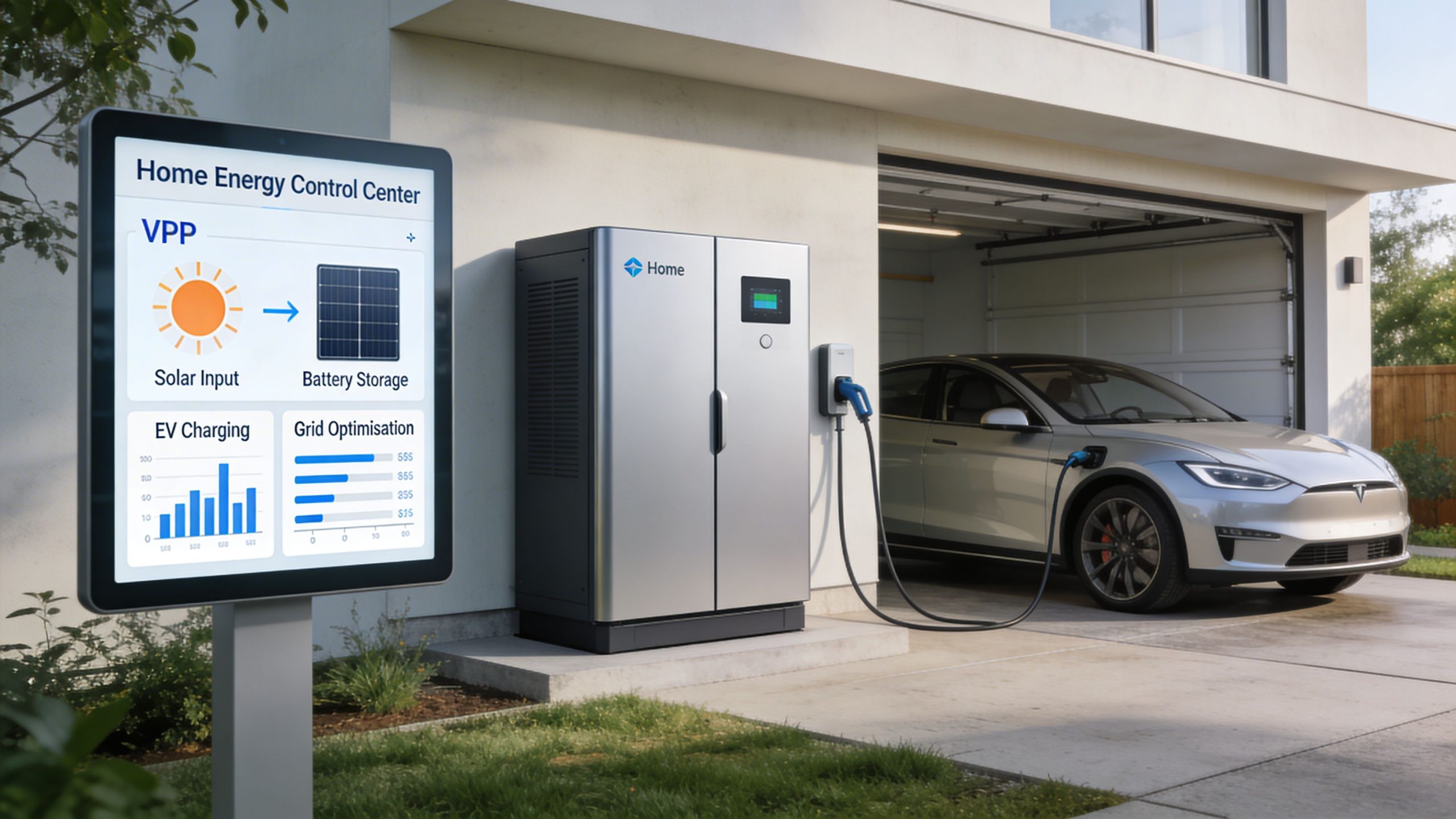
Homeowners in QLD and NSW often ask how to integrate solar EV chargers with VPPs because peak solar production from 10am to 2pm precedes evening EV charging peaks, which can reduce VPP earnings if unmanaged. Verified pilot findings indicate managed charging could boost synergies by 25% (verified source).
That single point explains why many systems underperform financially even when the hardware is sound.
A home might have:
- a good solar array,
- a capable battery,
- a suitable EV charger,
- and an EV that mostly charges at home.
Yet if the car charges at the wrong time, or the battery is drained before the highest-value moment, the household loses optionality.
What optimisation actually means
Optimisation is often misunderstood as “always charge from solar”. That’s too crude.
A better hierarchy is usually:
- Protect essential household supply
- Use excess solar where it avoids low-value export
- Preserve battery flexibility for the evening
- Respond to higher-value grid opportunities when they don't compromise the first three
That’s where coordinated control matters. The system needs to know whether the next useful kilowatt-hour should go into the battery, into the car, into the home, or out to the grid.
For homeowners trying to understand battery architecture before adding more control layers, this explainer on AC coupling battery setups is a relevant starting point.
Why unmanaged charging can destroy value
An unmanaged charger treats the EV as a priority whenever it’s plugged in. That seems harmless until you map the consequences.
If the car begins charging as soon as the driver arrives home:
- the battery may discharge too early,
- the home may shift into grid imports sooner,
- spare battery capacity may no longer be available for grid services,
- and the household gives up flexibility it could have monetised or used later.
The reverse can also happen. If the system over-prioritises export or battery retention, the vehicle may miss a low-cost charging window and force more expensive charging later.
Good home energy control doesn't maximise one asset. It balances several assets whose best use changes hour by hour.
The VPP layer changes the economics
A VPP adds a second value stream to the solar-plus-EV equation. Instead of thinking only about avoided import costs, the homeowner can think about asset orchestration.
The battery is no longer just a backup for the home. It can become a flexible trading and grid-support asset, provided household needs stay protected.
That introduces a decision framework many homeowners haven’t considered:
| Decision point | Poorly coordinated outcome | Better coordinated outcome |
|---|---|---|
| Midday solar surplus | Exported at low value | Diverted to EV or stored |
| Evening arrival home | Car starts charging immediately | Charging delayed or shaped intelligently |
| Battery state of charge | Drained too early | Preserved for household or higher-value use |
| Grid participation | Missed due to poor timing | Available when spare capacity exists |
Later in the evening, after the battery, charger, and household priorities are aligned, the coordination challenge becomes clearer in practice:
The overlooked conclusion
Most discussions of solar EV chargers stop at self-consumption. That leaves out the more valuable insight.
For a battery owner, the charger shouldn’t be treated as a standalone savings device. It should be treated as a dispatch decision point inside a broader energy portfolio. Once you look at it that way, the best outcome usually comes from coordination, not from maximising charging speed or plugging in as early as possible.
Installation and Compatibility in Queensland and New South Wales
Installation quality sets the ceiling on what a solar EV charger can earn. In Queensland and New South Wales, the technical fit between the charger, switchboard, solar inverter, battery, tariff, and DNSP rules matters as much as the hardware brand.

Single-phase and three-phase considerations
Many homes in QLD and NSW still run on single-phase supply, while some larger or newer homes have three-phase. That difference shapes charger choice, installation cost, and the degree of control available when solar, battery discharge, air conditioning, and EV charging all compete for capacity.
A high-rated charger is only useful if the rest of the system can support it. The practical constraint is rarely the charger alone. It is the interaction between:
- available circuit capacity
- vehicle onboard charging limits
- midday solar output
- battery operating rules
- network connection conditions
For households focused on cost control, charger sizing should reflect energy timing, not brochure speed. If the car is parked for long periods at home, a lower charging rate can still cover daily driving while making it easier to absorb solar surplus and avoid avoidable switchboard upgrades.
Three-phase can still be valuable. It gives installers more room to configure higher charging rates and can reduce the risk that one large load dominates the home’s electrical profile. That matters more in all-electric homes with ducted cooling, induction cooking, and a battery inverter already sharing the supply.
A practical compatibility checklist
Before installation, ask the installer to confirm both electrical fit and control fit.
- Supply type: Is the home single-phase or three-phase, and what charging rate is realistic on that supply?
- Switchboard capacity: Is there enough headroom for the charger alongside existing major loads?
- Dynamic load management: Can the charger reduce output automatically if household demand rises?
- Solar integration method: Will the charger respond to excess solar directly, or only through a schedule or app?
- Battery coordination: Will EV charging draw from rooftop solar first, from the battery, or from the grid under different conditions?
- DNSP requirements: Are there local approval, metering, or connection rules that affect the installation?
- Tariff compatibility: Will the charger work sensibly with controlled load, time-of-use, or demand-based pricing?
- Future software capability: Can the charger integrate with broader home control systems if the household later adds a battery, changes retailer, or joins a VPP?
The last point is often missed. A charger that cannot communicate well with the rest of the system may still charge the car, but it limits future optimisation. For households considering VPP participation, that software layer matters because EV charging can reduce the battery capacity available for higher-value grid events if priorities are not configured correctly.
Why QLD and NSW homeowners should test assumptions
Solar conditions are strong in both states, but good sunshine does not guarantee good charger economics.
Two houses with similar PV capacity can produce very different outcomes. One may have an EV at home during solar hours, a battery sized for evening peaks, and a tariff that rewards careful timing. Another may have the EV away all day, large overnight cooling loads, and little spare switchboard capacity. The same charger can perform well in one case and poorly in the other.
This is why installation should be treated as a system design decision. The commercial question is not only, "Can this charger work here?" It is, "Will this charger improve the value of the whole energy stack under the way this household lives?"
For that reason, visibility matters before hardware selection. Good home energy monitoring for solar, battery, and EV load patterns makes it easier to see whether the constraint is solar timing, battery reserve settings, phase capacity, or household demand spikes.
A well-matched installation preserves options. It supports low-cost charging today and leaves room for tariff optimisation, battery coordination, and VPP participation later.
Practical Charging Strategies for Maximum Financial Return
Once the charger is installed, the gains come from behaviour and control.
Most households don’t need to micromanage every charging session. They do need a strategy that matches the way their home uses energy.
Three workable charging approaches
The first is solar-first charging. If the car is home during the day, the charger can soak up excess rooftop generation before that energy is exported.
The second is battery-assisted evening charging. This can make sense when the battery has been charged well during the day and the household wants to avoid immediate grid imports after sunset.
The third is grid-aware charging. Sometimes the smart move isn’t to charge immediately. It’s to let software wait for a more favourable period based on the home’s broader energy position.
What to automate and what to override
Companion apps matter because real life is messy. Commutes change. School pickups run late. Visitors stay over. A rigid schedule often breaks as soon as the household becomes less predictable.
Useful controls include:
- Departure-based settings so the car is ready when needed
- Solar diversion thresholds so small surplus generation isn’t wasted
- Manual override options for urgent charging
- Battery reserve preferences so household resilience remains protected
For households that want clearer visibility into these patterns, home energy monitoring is central. If you can’t see when the home, battery and vehicle are competing, you can’t optimise them properly.
The strategic point
Smart charging is less about squeezing every possible solar kilowatt-hour into the car. It’s about choosing the charging pattern that produces the best total household outcome over time.
That includes convenience. A financially efficient system that constantly leaves the vehicle undercharged isn’t efficient for the owner.
Key Takeaways for Solar and EV Owners
- Solar ev chargers matter most when they’re part of a whole-home energy strategy, not treated as standalone hardware.
- Integrated charger control can lift solar self-consumption materially compared with basic unmanaged charging.
- The strongest financial outcomes usually come from coordination between solar, battery storage, household load and charging schedules.
- In QLD and NSW, timing matters because midday solar production and evening vehicle demand often don’t naturally align.
- Three-phase charging can be powerful, but compatibility and real household need matter more than headline speed.
- A battery owner should think in terms of optimisation, not just charging.
Why High Flow Energy
Most battery owners focus on installation quality. Far fewer focus on ongoing performance and optimisation. High Flow Energy is an electricity retailer built around maximizing the full value of your existing solar and battery system.
For homeowners with rooftop solar, a compatible battery, and increasingly an EV charger, that matters. A coordinated retailer-based VPP can help turn spare battery capacity into additional value while keeping household needs first. If you’d like to understand whether your battery is underperforming financially, request an eligibility assessment today.
Frequently Asked Questions
Can solar ev chargers work without a home battery
Yes. A battery improves flexibility, but it isn’t required. A solar-compatible charger can still use excess rooftop generation when the car is plugged in during solar hours.
Is a faster charger always a better financial choice
Not necessarily. A faster charger may add convenience, but the better investment depends on your supply type, vehicle, switchboard, and whether your main objective is speed or solar optimisation.
Will charging my EV reduce the value of my solar exports
It can, but that’s often the point. If exported energy would otherwise earn a relatively low return, diverting that electricity into your vehicle may create better household value than exporting it.
Can a solar EV charger and a VPP conflict with each other
They can if the system is unmanaged. The common issue is timing. Solar production peaks earlier in the day, while many vehicles are plugged in later. Coordinated charging reduces that conflict.
Do I need three-phase power for a solar EV charger
No. Many homes use single-phase charging successfully. Three-phase can support higher charging power, but it only makes sense where the home and vehicle can use it safely and economically.
What should I ask an installer before choosing a charger
Ask about supply type, switchboard capacity, inverter compatibility, battery interaction, app controls, and how the charger will behave during normal household peak periods.
Will smart charging make the system harder to use
Usually the opposite. A good app should automate most decisions and still let you override when your plans change.
Does the best charger depend on the car or the house
Both, but many homeowners underweight the house. The charger must suit the vehicle, yet the bigger performance difference often comes from how well it fits the solar, battery, and electrical setup.
Most households with solar, a battery, and an EV charger already own the core assets needed for better energy performance. The gap is usually coordination, not hardware.
HighFlow Energy is an Australian electricity retailer focused on helping battery owners in Queensland and New South Wales get more value from the systems they already have. If you want to assess whether your current setup is underutilising your battery, check your eligibility and review how your home energy system is performing today.
SEO title: Solar EV Chargers for Australian Homes
Meta description: Solar EV chargers can do more than cut charging costs. Learn how solar, batteries and VPPs work together for better household energy value.
Suggested URL slug: /solar-ev-chargers-australia
Featured image concept: Modern Australian home with rooftop solar, home battery interface, and EV charging in driveway during late afternoon.
Image alt text: Electric vehicle charging at a solar-powered Australian home with rooftop panels and battery integration.
Internal linking suggestions:
- Virtual Power Plants driving Australia’s renewable energy revolution
- AC coupling battery
- Home energy monitoring
- Eligibility or battery performance assessment page
- NSW and QLD VPP service pages
External authority references:
- Australian Bureau of Statistics
- ARENA
- AEMO
- Australian Energy Regulator
- Clean Energy Council
LinkedIn-ready excerpt:
Australia’s solar and EV boom has created a new optimisation challenge for homeowners. A solar EV charger can do far more than shift charging away from petrol. Value comes when the charger, battery, household load and VPP participation are coordinated as one system. This analysis explains where the financial upside sits for QLD and NSW households.
AI summary snippet:
Solar EV chargers are most valuable when they’re integrated into a broader home energy system. In Australia, the main financial gain comes from improving solar self-consumption, reducing low-value exports, and coordinating charging with battery storage. For battery owners, VPP integration adds another layer of value, but only if charging is managed to avoid timing conflicts. The best outcome comes from optimisation across the home, not from charger speed alone.