


Maximize Savings with Solar Power Hervey Bay
If you already have panels on the roof, solar power Hervey Bay is no longer just about generating energy. It is about what happens to that energy after lunch, after sunset, and during the evening peak when your retailer starts charging real money again.
That is the point many households in Hervey Bay run into. The system works. The inverter is producing. The app says you exported plenty during the day. Yet the quarterly bill still lands with supply charges and grid usage attached. For a lot of homes, the issue is not installation quality. It is that the system is only doing the basic job.
Hervey Bay is one of the best places in the country to own rooftop solar. But in a suburb where many neighbours are also exporting at the same time, sending excess power back to the grid is not the highest-value strategy. The better approach is to treat your setup like an asset that needs active management, not a set-and-forget appliance.
Your Guide to Solar Power in Hervey Bay
A common Hervey Bay setup looks good on paper. Panels generate strongly through the day, the battery charges by mid-afternoon, and the home still pulls from the grid during the evening peak while excess solar leaves the property at a modest feed-in rate.
That gap is where performance is won or lost.
For homeowners who already have solar, the key question is no longer whether the roof can produce. It is whether the system is being operated to capture the highest-value use of each kilowatt-hour. In Hervey Bay, that means looking past basic self-consumption and asking how stored energy, export timing, and retailer structure affect the return from the system you already own.
A solar system can save money. An optimised system can produce stronger returns.
Many households stop at the first stage. They install panels, watch daytime bills drop, and accept whatever export credit the retailer offers. That approach still works, but it leaves part of the asset underused, especially for homes with a battery sitting idle after it covers the evening load.
The commercial trade-off is straightforward. Exporting surplus solar in the middle of the day is simple, but it is rarely the highest-value outcome in a suburb with heavy rooftop solar penetration. Storing that energy, shifting when it is used, or participating in a virtual power plant can improve the economics, provided the tariff, battery warranty, and control settings stack up.
Where value is commonly missed
In practice, underperformance usually comes from operating rules rather than hardware faults.
- Daytime exports are too cheap: Excess solar is sent out when network-wide supply is high and feed-in rates are weak.
- Battery use is too narrow: The battery is reserved for backup or basic evening support instead of being used as an earning asset.
- Retail plan settings are ignored: A poor tariff can wipe out part of the benefit from a good system.
- System controls stay on default: Inverter and battery settings are often left in a safe but low-value mode.
A well-run solar and battery system does more than trim bills. It can improve cash flow, reduce exposure to peak pricing, and create a new revenue stream from equipment already installed.
That is the focus here. The opportunity in Hervey Bay is no longer limited to getting solar onto the roof. It is getting more financial output from the solar and battery system already there.
Hervey Bay's Solar Potential A Local Snapshot
Hervey Bay gives solar owners a good starting position, but good production alone does not guarantee good returns. In this market, the bigger question is what happens after the panels have covered the daytime load and the battery reaches its usual evening cycle.
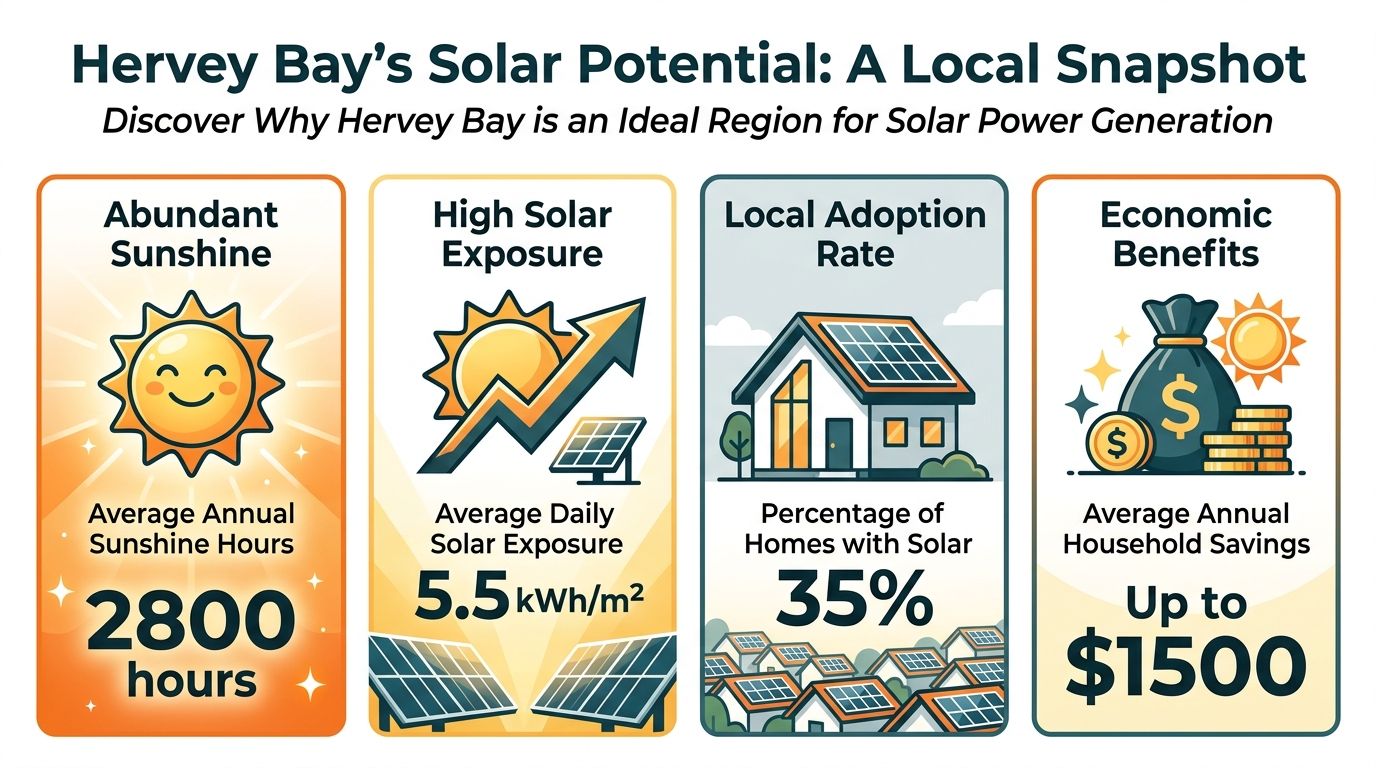
A market with strong generation and tighter export economics
Hervey Bay homes generally have the roof types, solar resource, and ownership profile that suit rooftop PV well. That part is well established.
What matters now is market behaviour. In suburbs with heavy solar uptake, a large share of households is producing surplus power at roughly the same time. That pushes many owners into the same low-value pattern. Strong midday generation goes out to the grid when export prices are weakest, then the home buys power back later at a much higher retail rate.
That gap is where system performance is won or lost.
Why location still matters after the install
A Hervey Bay system should be judged on cash flow, not just output. Two homes with similar panel capacity can produce similar energy over a week and still deliver very different financial results. The difference usually comes down to tariff structure, battery settings, evening demand, and whether the system is set up to respond to market signals instead of following factory defaults.
The smaller average system size noted earlier is significant because it often reflects practical roof sizing and household demand rather than aggressive overbuilding. That can be an advantage. A right-sized system paired with a battery and good control logic often performs better financially than a larger array that spills too much cheap daytime export.
Where Hervey Bay owners can improve value
The strongest systems in this region usually do four things well:
- Match generation to household load: Pool pumps, hot water, EV charging, and air conditioning are scheduled to absorb midday solar where possible.
- Use the battery with purpose: Storage is reserved and dispatched based on tariff timing, backup needs, and earning potential.
- Limit low-value exports: The home keeps more solar on site instead of relying on a weak feed-in tariff to carry the economics.
- Stay upgrade-ready: Older systems are assessed for battery compatibility, tariff changes, and available Queensland solar and battery rebates.
| Local solar factor | Practical implication |
|---|---|
| Strong daytime generation | Good production is common, but timing drives value |
| High rooftop saturation | Midday export income can be weaker than expected |
| Family-home roof profiles | Many properties suit balanced solar and battery sizing |
| Retail tariff complexity | Plan selection and control strategy affect returns |
In Hervey Bay, the missed opportunity is usually not generation. It is failing to control when and how that generation is used, stored, or sold.
For homeowners who already have solar, the local opportunity is straightforward. Treat the system as an operating asset. A battery that only covers part of the evening peak is doing one job. A battery configured for tariff arbitrage or future VPP participation can do several.
Analysing Costs Rebates and Payback in 2026
A Hervey Bay homeowner with solar already on the roof usually faces a different question in 2026. The issue is no longer whether solar works. The issue is whether the next dollar should go into more hardware, a battery upgrade, or better control of the system you already own.
That decision gets clearer if you split it into three parts. Upfront cost, available support, and operating value after installation.
The cost side
A standard rooftop solar quote in Hervey Bay still needs to be judged on design quality, not headline price. For a typical single-storey home, smaller systems sit at the lower end of the market, while larger family homes often price up with bigger arrays, more panel positions, or switchboard work.
However, not every quote will fall neatly into that range.
Roof pitch, panel orientation, shade, meter changes, cable runs, and switchboard upgrades all shift the final number. Installer quality does too. A cheap quote can still cost more over time if the layout is poor, the inverter is undersized, or post-install support disappears once the job is finished.
For existing solar owners, the more commercial question is whether extra panels will improve returns. In many cases, they will not. If midday surplus is already being exported at a low rate, adding generation without adding storage or smarter control often increases low-value exports rather than household savings.
The rebate side
Policy support matters most when it changes the economics of an upgrade that already makes operational sense.
For battery buyers, that means checking current Queensland solar and battery rebates before signing a contract. A rebate is significant because it can reduce the gap between a battery that looks marginal on paper and one that starts to stack up under real household usage.
That is particularly relevant in Hervey Bay, where many homes installed solar years ago and are now assessing whether the next stage should be storage. If the home already produces plenty of daytime energy, a supported battery upgrade can shift the system from simple bill reduction to stronger load shifting and better tariff performance.
The payback side
Payback is not one number. It depends on the operating model.
A household that self-consumes a high share of its solar will usually recover value faster than one that exports most of its generation. A battery can improve that position, but only if it is sized and configured around tariff timing, evening demand, and the limits of the existing solar setup.
A practical assessment usually starts with four questions:
How much solar is used on site during the day?
Higher daytime self-use usually improves returns without adding complexity.How much grid power is bought after sunset?
Heavy evening usage increases the value of stored energy.Can the current or proposed battery be controlled properly?
Compatibility matters. The battery needs to charge and discharge in a way that matches the tariff structure and the household load profile.Is the system relying too heavily on exports?
If the financial model depends on sending large midday volumes back to the grid, returns are often weaker than expected.
What usually improves returns
Usually helpful
- Adding a battery where midday surplus is already high
- Choosing equipment that supports smarter charge and discharge control
- Reviewing the retail tariff alongside the hardware
- Sizing the system around actual usage, not a generic package
Often overrated
- Adding more panels without a plan for the extra energy
- Judging performance mainly by feed-in credits
- Assuming every battery delivers the same result
- Using a fixed payback estimate without checking usage patterns
A solar system becomes more valuable when it is treated as an operating asset, not a static install.
In Hervey Bay, the strongest financial result in 2026 usually comes from combining sensible system design with a battery strategy that keeps more value on site and prepares the home for higher-value dispatch options later.
Navigating Local Council and Grid Connection Rules
Plenty of solar advice skips the operational reality. In Hervey Bay, network rules and connection conditions shape the value of your system almost as much as panel output.
Why approvals matter more in high-solar areas
A rooftop system only becomes financially useful when it can operate within local connection rules. That means homeowners need to pay attention to both physical installation requirements and network approval conditions. In practice, that usually involves installer-led paperwork, but the homeowner still benefits from understanding what is being approved and why.
Council and compliance requirements are part of that process. So are the network settings that affect exports, inverter configuration, and any later battery integration.
The export issue most homeowners underestimate
The practical limit in many solar-heavy areas is not sunshine. It is what the grid will accept, when it will accept it, and under what settings.
For Hervey Bay homeowners, that creates a simple trade-off:
| Approach | Likely outcome |
|---|---|
| Solar only, export-focused | More exposure to low-value midday surplus exports |
| Solar plus battery | More control over when energy is used or released |
| Solar plus battery plus coordinated dispatch | Better chance of converting stored energy into higher-value use |
That is why battery storage becomes more compelling in a market with strong rooftop density. The battery is not just backup. It is a way to reduce dependence on the weakest part of the solar-only model, which is overreliance on daytime export.
Practical checks before making changes
Before adding or changing anything, ask your installer or retailer to confirm:
- Connection status: Make sure the existing system records match the equipment on site.
- Inverter compatibility: Some inverters are easier to integrate into battery and VPP models than others.
- Battery export settings: Control capability matters if you want more than simple self-consumption.
- Tariff structure: Your retailer arrangement affects whether battery dispatch is worth more than passive exports.
In a high-penetration market, the household that stores and controls energy is usually in a stronger position than the household that exports it.
The key lesson is straightforward. Compliance is not just about getting permission to install hardware. It is about preserving future flexibility. A setup that satisfies local rules but leaves no room for effective storage or optimisation can still be a poor commercial outcome.
Beyond Panels Adding a Battery to Capture Full Value
The biggest shift in household solar economics happens when you stop treating midday exports as the end game.
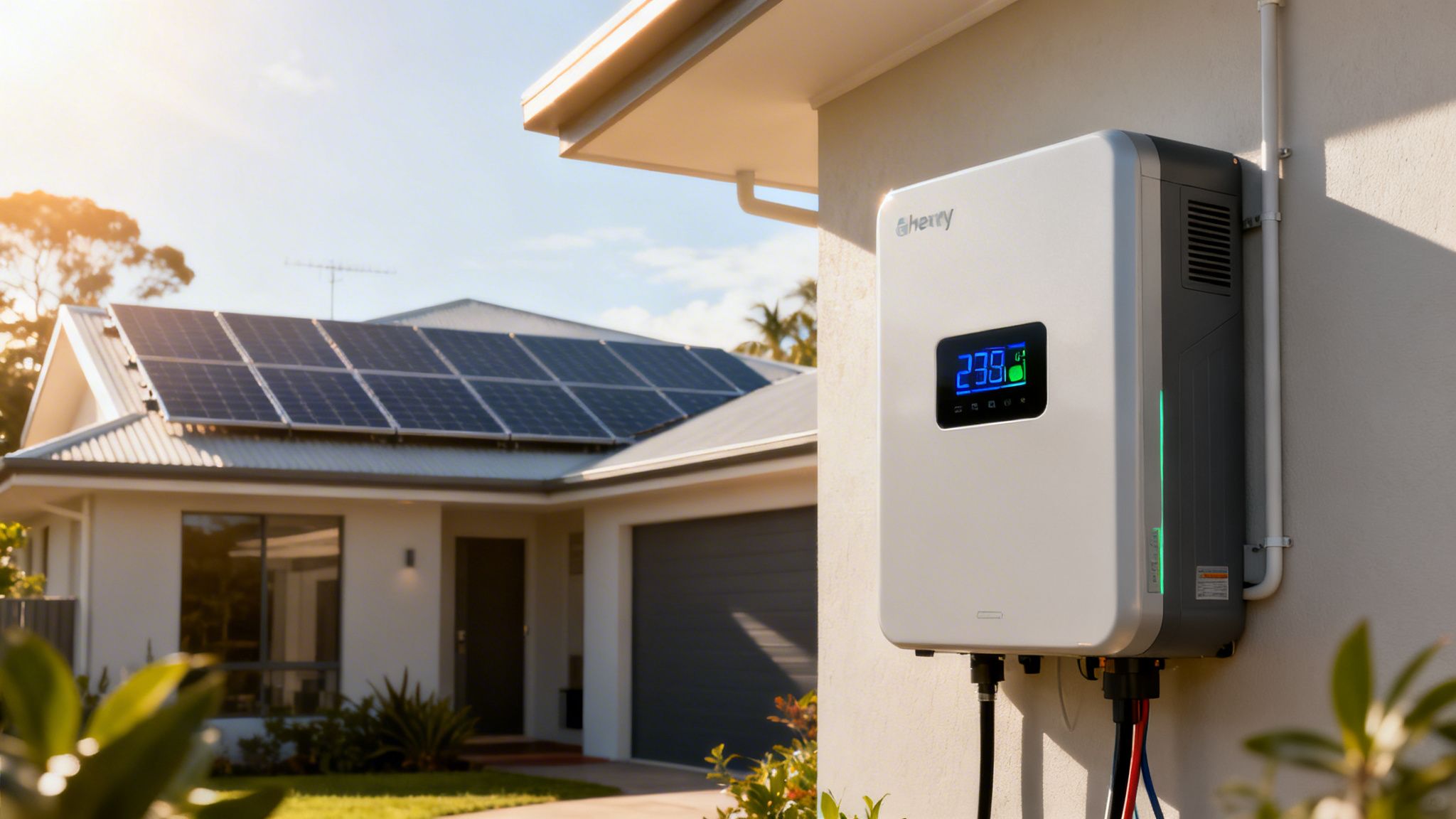
Why solar-only systems hit a ceiling
In Hervey Bay, a solar-only setup can perform well on generation and still underperform financially. The reason is timing. Solar production is strongest in the middle of the day, but many households need more power in the late afternoon and evening.
That creates the classic mismatch. You export when energy is abundant, then import when you need it most.
The local data on self-consumption makes the issue clear. In Hervey Bay, a solar-only system might only achieve 30% self-consumption. Pairing it with a battery can lift that to 70% to 80% by capturing surplus midday energy, according to Solar Choice’s Hervey Bay analysis.
What the battery changes
A battery improves value in three practical ways.
- It shifts energy into the evening: You keep more of your own generation for the period when grid electricity is more painful to buy.
- It reduces forced exports: Instead of dumping surplus into the grid by default, you store it.
- It creates optionality: Once a battery is installed and compatible, the household can choose more advanced operating models.
For homeowners comparing setup pathways, understanding AC-coupled battery configurations is useful, especially when retrofitting storage to an existing solar system rather than rebuilding the entire setup.
What works and what does not
A battery works well when the home already has regular solar surplus and meaningful evening demand. That is common in Hervey Bay.
It works less well when homeowners expect the battery alone to solve every pricing problem without any thought to tariffs, dispatch, or control settings.
Usually effective
- Retrofitting storage to an established solar system
- Using the battery to cover evening household load first
- Choosing compatible systems that allow future optimisation
Often disappointing
- Buying storage without checking actual solar surplus
- Assuming every battery setup is financially equal
- Leaving the battery in a passive mode that never responds to price signals or grid value
A battery earns its keep by moving energy through time. If it is not doing that intelligently, part of its value stays locked up.
The battery is the first real step beyond basic rooftop generation. But it is not the final step. Once storage is in place, the bigger opportunity is learning how to use spare battery capacity more strategically rather than only for household self-consumption.
The VPP Advantage From Passive Savings to Active Earnings
A battery can do more than store your surplus solar. It can also become a controlled grid asset when spare capacity is available.
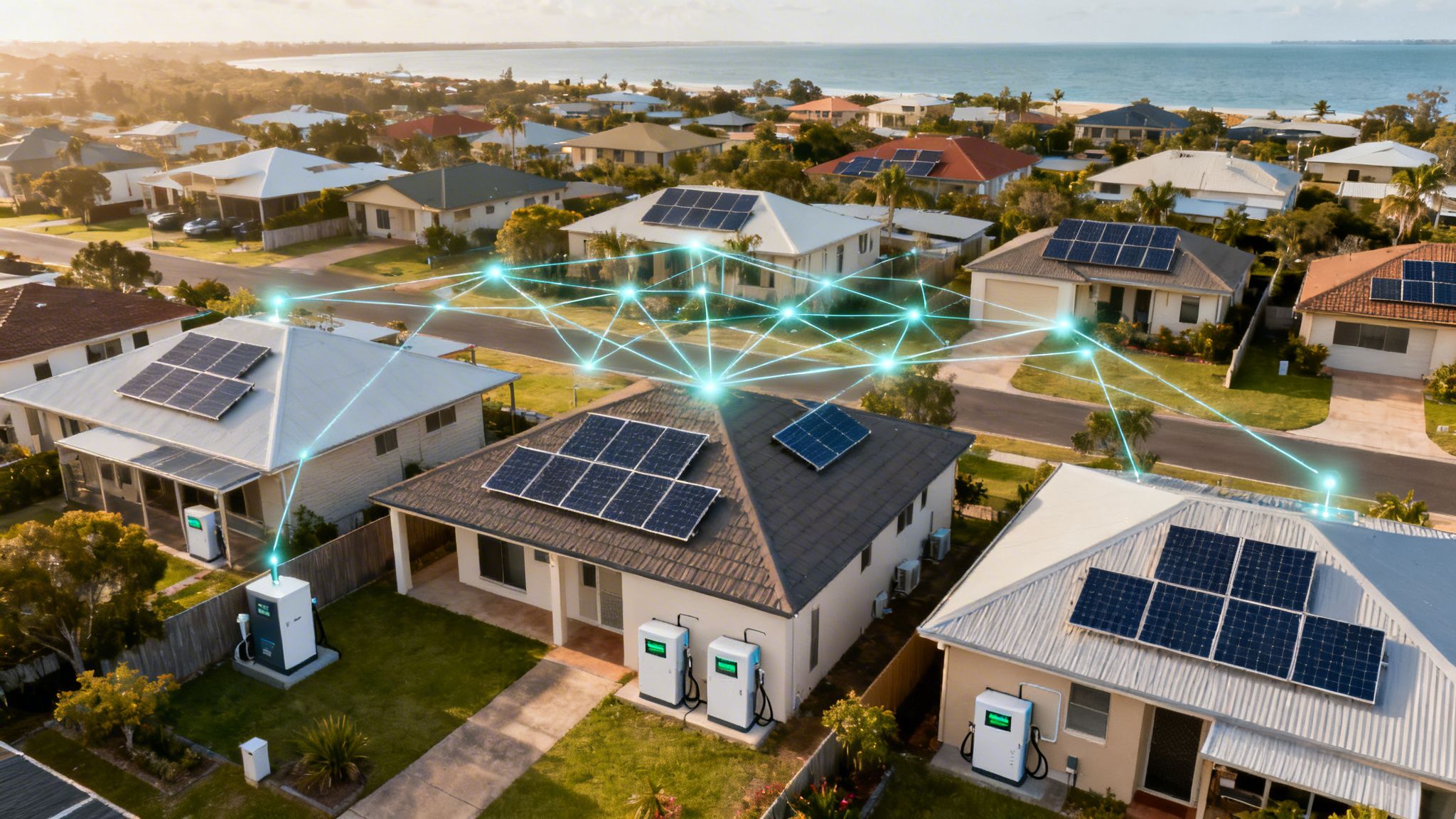
What a VPP means in plain English
A Virtual Power Plant links many home batteries together through software so they can respond in a coordinated way. Each household still owns its own battery. The difference is that spare capacity can be dispatched in a controlled manner when the grid needs support or when market conditions make that dispatch useful.
For the homeowner, the important shift is this. The battery stops being only a private storage device and starts acting as a small, flexible energy asset.
Why that matters in Hervey Bay
Hervey Bay already has a lot of rooftop solar and a growing battery base. But participation in coordinated battery programs remains low relative to installed hardware.
Over 10,000 home batteries have been installed in the Fraser Coast region since 2023, yet less than 5% participate in VPPs. Ergon Energy trials in the Wide Bay-Burnett area showed VPP participants achieved an average of 40% higher ROI on their battery investment than those using batteries for self-consumption alone, according to this Hervey Bay battery and VPP summary.
That is the underused opportunity. Many households have already paid for the asset but are still operating it in the simplest possible way.
Feed-in tariff logic versus VPP logic
The distinction is easier to understand in a side-by-side view.
| Model | How value is created | Main limitation |
|---|---|---|
| Traditional solar export | Surplus energy goes to the grid during the day | Value is tied to passive export rather than active control |
| Battery for self-consumption | Surplus energy is stored for later household use | Stronger than export-only, but still limited to home demand |
| Battery in a VPP | Spare battery capacity supports grid needs as well as household needs | Requires compatibility, software control, and the right retailer model |
A standard feed-in structure rewards volume sent out. A VPP rewards flexibility and timing.
How a BYOB retailer model works
A Bring Your Own Battery model is built for households that already have compatible hardware. No new panel sale is required. No battery sale is required. The focus is on operating the battery more intelligently within an electricity retail structure.
That matters because not every retailer is designed to optimise distributed storage. Traditional retailers mainly bill consumption and may offer a basic solar export arrangement. A retailer-based VPP has a different job. It coordinates battery behaviour, monitors performance, and directs discharge when conditions justify it, while still preserving household priority.
This short explainer gives a simple overview of how VPP participation works in practice.
VPP trade-offs
A VPP is not magic, nor is it suitable for every battery owner.
What usually works
- Homes with compatible batteries and solid daytime solar surplus
- Households that want stronger value from an asset they already own
- Owners comfortable with app-based oversight and software-managed operation
What needs checking
- Battery compatibility and communication capability
- The retailer’s operating terms and customer priority settings
- How transparent the dispatch model is
- Whether the arrangement protects household access to stored energy first
The commercial advantage of a VPP is not that it replaces self-consumption. It layers extra value on top of self-consumption when the battery has spare capacity.
In practical terms, that is the main upgrade path for a Hervey Bay homeowner who already has solar and storage. The system moves from passive savings to active participation.
How High Flow Energy Unlocks Your Battery's Potential
Most battery owners focus on charge level. The more useful metric is financial performance.
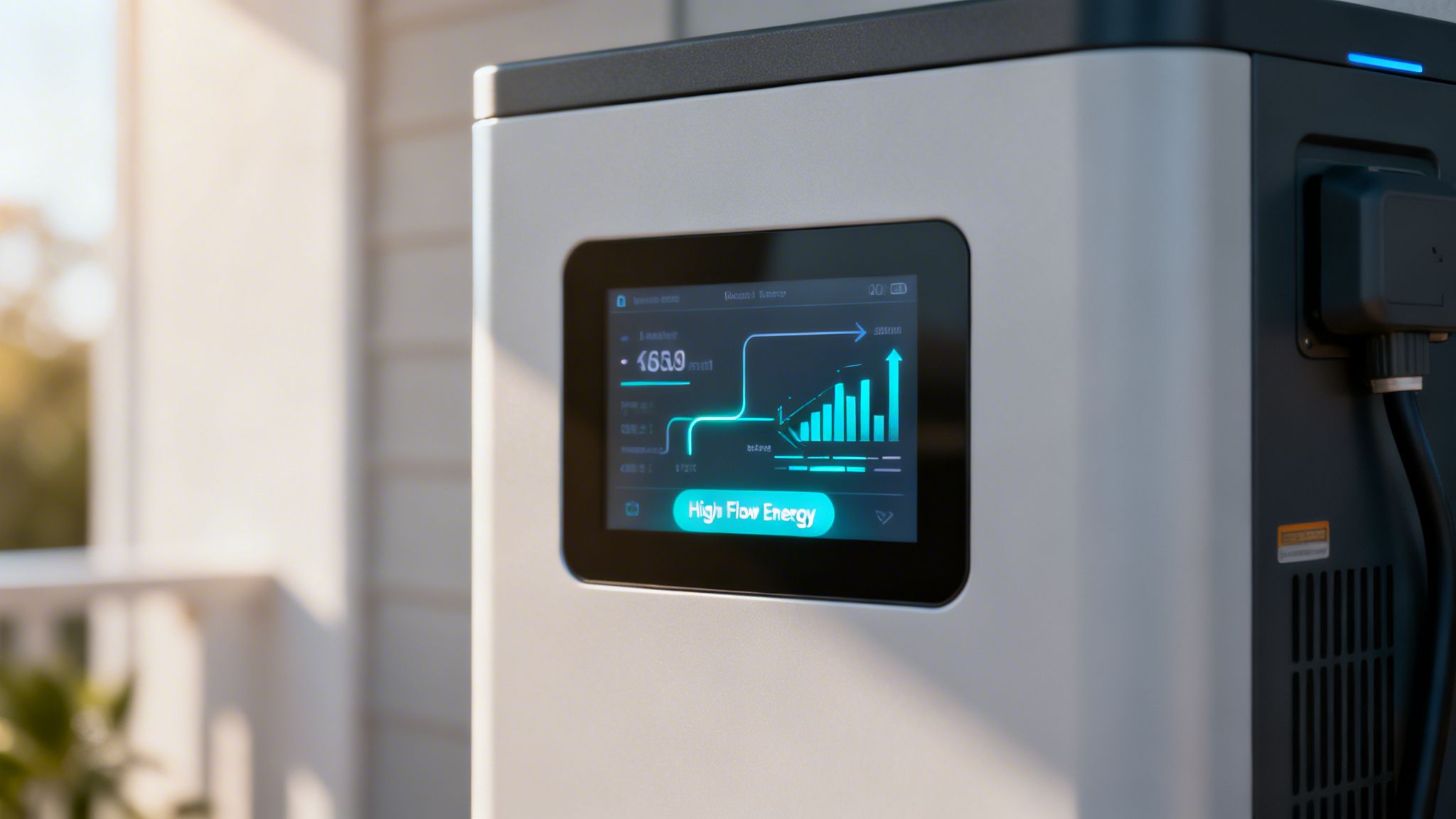
What this model changes
For a Hervey Bay household with compatible solar and battery hardware, the opportunity is to move from simple bill reduction to coordinated optimisation. That means the battery is not left sitting in a default mode. It is managed with household priority first; spare capacity is then used for grid-support value where available.
One example of that retailer-based approach is High Flow Energy’s explanation of how the model works. The structure is built for homeowners who already own the hardware and want more value from it without replacing their existing system.
The practical benefits battery owners usually care about
This kind of setup tends to appeal for operational reasons, not marketing reasons.
- Existing hardware stays in service: The focus is on using compatible systems better.
- Household priority remains central: Stored energy should still serve the home first.
- Software does the coordination: The owner can see what is happening rather than guessing from a basic inverter app.
- Retail and battery strategy are aligned: That closes the gap that often exists between a good battery and an ordinary retailer plan.
What to check before joining any VPP arrangement
The right questions are straightforward.
Ask whether the battery remains available for household needs first. Ask what visibility the customer gets through the app. Ask how dispatch decisions are made. Ask what happens if the household uses more electricity than any included allowance. Ask whether there are lock-in terms or exit complications.
Those details matter more than slogans.
A more commercial way to think about your battery
A solar-and-battery system has two jobs. It should reduce your own grid consumption. It should also make the most of spare capacity when market conditions justify it.
When those two jobs are coordinated properly, the battery stops being just a backup box on the wall. It becomes part of the home’s broader energy strategy.
Good hardware matters. Ongoing operational discipline matters just as much.
That is the shift many Hervey Bay households are now ready for. The easy decision was installing solar. The more valuable decision is making sure the battery is not underused after installation.
Key Takeaways and Your Next Steps
Hervey Bay is already one of Australia’s strongest rooftop solar markets. The easy part is generating daytime power. The harder part is turning that production into the best possible financial outcome across the whole day.
If you only have panels, your system may still be too dependent on passive exports. If you already have a battery, the next question is whether it is merely storing energy or being used with a smarter operating strategy. In a high-solar region, that distinction matters.
A practical next step is to review four things. Your daytime surplus. Your evening imports. Your battery compatibility. Your current retailer structure. That tells you whether your setup is reducing bills or whether it is ready to perform like a better-managed asset.
Most battery owners focus on installation quality. Far fewer focus on ongoing performance and optimisation. High Flow Energy is an electricity retailer built around unlocking the full value of your existing solar and battery system.
If you would like to understand whether your battery is underperforming financially, request an eligibility assessment today.
Frequently Asked Questions About VPPs in Hervey Bay
Can I join a VPP if I already have solar and a battery
Yes, if your battery and inverter are compatible with the VPP platform. Compatibility matters more than brand recognition alone.
Will I still be able to use my battery for my own home
That is the key issue to confirm before joining any program. A well-structured arrangement should keep household energy needs as the first priority.
Is a VPP only useful for new battery owners
No. In many cases, the stronger use case is the homeowner who already owns a battery and wants better financial performance from it.
Does joining a VPP mean giving up control
Not necessarily. The more transparent models give customers app visibility and the ability to understand how the battery is being managed.
Is a battery still worth it without joining a VPP
A battery can still improve self-consumption and reduce evening imports. A VPP is the next layer. It may create additional value from spare capacity, but the battery should still make operational sense on its own.
What should Hervey Bay homeowners check first
Start with actual usage patterns. Look at when your solar system exports most, when your home imports most, and whether your current setup has compatible hardware for more advanced optimisation.
Do I need new hardware to get more value from my battery
Not always. Some households already have the required hardware and only need the right retailer and software model.
If you already have rooftop solar and a compatible home battery, HighFlow Energy offers a way to assess whether that battery is being fully utilised. The focus is not on selling new hardware. It is on understanding your current system, checking eligibility, and seeing whether a BYOB VPP structure could improve the financial performance of the asset you already own.