

Vehicle to Grid Australia: Your 2026 Guide to V2G Energy
Imagine your electric vehicle doing more than just getting you from A to B. What if it could power your home during a blackout or even earn you an allowance while parked in the garage? This is the core idea behind vehicle-to-grid (V2G) technology, a concept that could turn your EV into a powerful home energy asset.
As more Australians make the switch to electric cars, the conversation is shifting from just charging them to how they can actively support our homes and the wider electricity grid. V2G flips the script on the traditional one-way flow of power, where your car simply draws electricity. With vehicle to grid in Australia becoming a reality, your car has the potential to become a "battery on wheels"—storing energy and sending it back to power your home or exporting it to the grid when it’s needed most.
This guide is for Australian homeowners, especially in Queensland and New South Wales, who are curious about what V2G really means for them. We’ll break down how it works, what the financial upside could be, and where things currently stand in the market.
What is Vehicle-to-Grid (V2G)? A Plain English Explanation
At its heart, Vehicle to Grid (V2G) technology turns an electric vehicle into an active part of the energy ecosystem. Instead of only drawing power from the grid to charge, a V2G system allows the EV to send a small amount of its stored electricity back to the grid during periods of high demand.
This two-way flow of energy is made possible by three key components working together:
- A V2G-Compatible Electric Vehicle: Not every EV has this capability. The vehicle’s internal battery management system must be specifically designed to allow bidirectional power flow.
- A Bidirectional Charger: This is the critical piece of hardware. Unlike a standard charger that only sends power one way (into the car), a bidirectional charger can reverse the flow, managing both charging and discharging.
- A VPP Operator or Energy Retailer: An intelligent software platform, usually managed by a specialist energy retailer, determines the optimal times to charge the EV (when power is cheap) and when to export power back to the grid (when wholesale prices are high), based on market signals and your driving needs.
When plugged in, the VPP operator can instruct the vehicle to export a controlled amount of energy to support the grid, typically during evening peak demand when wholesale electricity prices are highest.
Key Takeaways: V2G Fundamentals
- V2G enables two-way energy flow: Your EV can both charge from and discharge to the grid.
- It requires specific hardware: You need a V2G-compatible car and a bidirectional charger.
- It's managed by software: A VPP operator optimises charging and discharging to create value.
- It supports grid stability: V2G helps balance the electricity grid as more renewables come online.
While V2G is an exciting glimpse into the future, it's crucial to understand how it differs from mature, ready-to-go options that are already delivering financial benefits to homeowners. We'll compare it to existing Bring Your Own Battery (BYOB) Virtual Power Plant (VPP) programs, like those operated by High Flow Energy, which thousands of Australians with solar and home batteries are using right now to materially reduce their electricity bills.
By the end of this guide, you’ll have a clear, commercially-minded view of how to make your energy assets—whether a home battery today or an EV tomorrow—work much harder for you.
How Vehicle-to-Grid Technology Actually Works
Vehicle to Grid (V2G) technology transforms your electric vehicle from a simple mode of transport into an active, intelligent asset for the energy market. It allows your EV to function as a 'battery on wheels', not just drawing power from the grid but also feeding a small amount of its stored electricity back when it’s most valuable.
This two-way energy exchange breaks from the traditional one-way model of power consumption. It is enabled by a specific combination of the right vehicle, the right hardware, and a sophisticated software platform.
The Essential V2G Components
For a homeowner in Australia to enable V2G, more than a standard EV charger is required. The system relies on three core elements:
- A V2G-Compatible Electric Vehicle: The car's internal battery management system must be designed to allow power to flow both in and out.
- A Bidirectional Charger: This is the critical hardware. Unlike a standard charger, a bidirectional unit manages both charging the vehicle and discharging power from its battery.
- A VPP Operator or Energy Retailer: This is the 'brains' of the operation. An intelligent software platform, managed by a retailer like High Flow Energy, optimises when to charge your EV and when to sell power back to the grid based on wholesale market prices, grid stability needs, and your pre-set preferences.
Your vehicle effectively acts as a small, mobile power station. When it's plugged in, the VPP operator can instruct it to export a controlled amount of energy to support the grid, usually during evening peak demand when wholesale electricity prices can be extremely high.
Analogy: Your EV as a Smart Energy Trader
Imagine you’re trading on the stock market: you buy when the price is low and sell when it's high. V2G operates on the same commercial principle. Your EV can be set to charge when electricity is cheap and abundant—like from your own solar panels mid-day—and then sell a small amount of that stored power back to the grid when demand spikes and wholesale prices are at a premium.
The Real-World Impact on the Grid
V2G technology plays a crucial role in maintaining the stability of Australia's National Electricity Market (NEM). As we integrate more intermittent renewable sources like solar and wind, the grid requires flexible resources to balance supply and demand fluctuations.
With Australia’s EV uptake accelerating, V2G is perfectly positioned to provide this flexibility. The combined storage capacity of millions of EVs represents a massive, distributed battery that can be orchestrated to support the grid. This capability is a game-changer for homeowners in Queensland and NSW, helping to smooth out grid volatility and reduce the reliance on fossil fuel "peaker" plants.
This is the same principle that allows High Flow Energy to use spare capacity in stationary home batteries within its VPP to generate bill reductions for customers—all without needing new hardware or lock-in contracts. You can read more about the road ahead for V2G at Sydney EV Chargers.
Unlocking the Financial Potential of V2G in Australia
The primary appeal of vehicle-to-grid (V2G) in Australia is its potential to turn your electric vehicle into a revenue-generating asset. This is not simply about offsetting charging costs; it’s about providing high-value services to the electricity network and being compensated accordingly.
This financial opportunity exists because Australia's National Electricity Market (NEM) is undergoing a structural transformation. As traditional coal-fired power stations are decommissioned, they are being replaced by variable renewable energy sources like wind and solar. This transition creates a commercial need for new, fast-acting services to maintain grid stability, and batteries are the ideal solution.
Participating in High-Value Grid Services
The main mechanism for V2G to generate income is through participation in Frequency Control Ancillary Services (FCAS) markets. These are specialised markets managed by the Australian Energy Market Operator (AEMO) that pay for services to keep the grid's frequency stable at 50 Hz.
- When a large generator unexpectedly trips offline, the grid frequency can drop.
- When a massive amount of solar power floods the grid on a sunny day, the frequency can rise.
An EV battery, managed by a VPP operator, can react in milliseconds to either feed power into the grid (a "raise" service) or draw power out (a "lower" service), helping to correct these imbalances. Because this rapid response is critical to preventing blackouts, the payments are significantly higher than standard energy arbitrage (buying low and selling high).
Your EV transitions from being a passive load to an active, earning participant in the grid. To better understand how timing energy use impacts costs, see our guide on off-peak electricity strategies.
The diagram below shows how the key components enable this two-way flow of value and energy.
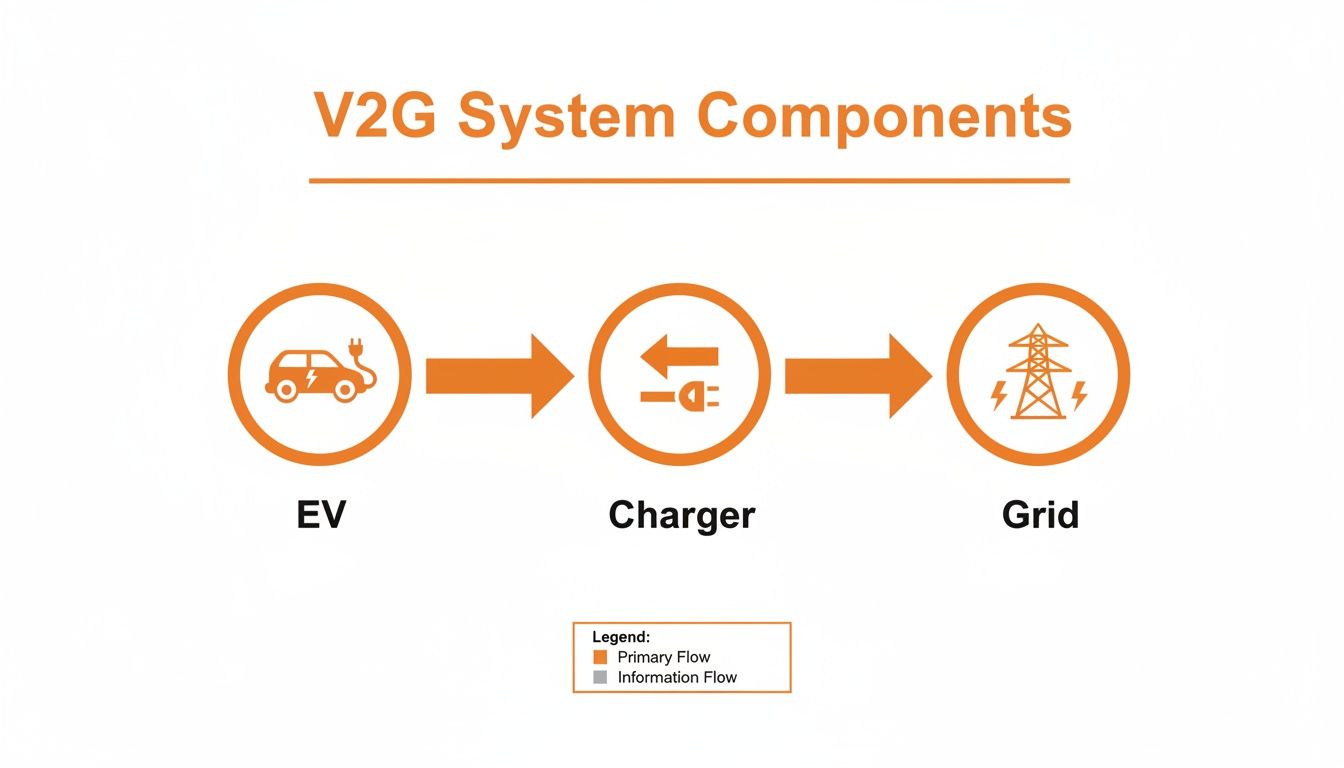
As shown, the bidirectional charger is the crucial link, enabling the EV to not only charge but also discharge energy back to support the wider electricity grid.
Real-World Earning Potential
While still in early stages, Australian V2G trials are demonstrating significant financial potential based on actual market data.
Australian pilot programs have analysed the potential revenue from participating in various FCAS markets. The results confirm that a single EV could generate a material financial return.
Potential V2G Annual Revenue per Vehicle (Based on NSW FCAS Market Data)
| FCAS Market Service | Potential Annual Revenue (per EV) |
|---|---|
| Raise Regulation FCAS | ~$12,000 |
| Lower Regulation FCAS | ~$9,000 |
| Contingency FCAS | ~$2,000 – $2,600 |
Source: Analysis based on 2022 NSW FCAS market data from an ARENA-funded report.
These figures highlight that the value is derived not from the volume of energy exported, but from the speed and reliability of the service the EV battery provides. A report for the Australian Renewable Energy Agency (ARENA) detailed these findings, confirming that an EV's rapid response capability is precisely what the modern grid requires and is willing to pay a premium for.
Ultimately, this financial potential stems from solving a real commercial problem for the electricity network. Owners of flexible assets—like a V2G-enabled car or a stationary home battery in a VPP—are positioned to benefit by providing these essential grid support services.
V2G vs. Stationary Battery VPPs: What's the Difference?
The growing conversation around vehicle-to-grid (V2G) in Australia raises a practical question for homeowners: how does it compare to a stationary home battery participating in a Virtual Power Plant (VPP)? While both use a battery to support the grid and generate financial value, they differ fundamentally in availability, maturity, and suitability for the average solar owner today.
Understanding these differences is key to making an informed decision about your home energy strategy. For most Australians, one is an exciting future prospect, while the other is a proven, commercially-ready solution available now.
Primary Function and Availability
The most significant difference is the asset's primary purpose. A stationary home battery is designed for one job: storing and dispatching energy for your home and the grid. It is permanently installed, always connected, and engineered to handle the regular charge and discharge cycles of VPP participation.
An electric vehicle's primary function is transportation. Its V2G capability is an ancillary feature, and its availability to the grid is entirely dependent on it being parked at home and plugged into a bidirectional charger.
This distinction is critical. Stationary battery VPPs, such as the Bring Your Own Battery (BYOB) model from High Flow Energy, are a mature technology. Homeowners in Queensland and New South Wales with a compatible battery can enrol today and see financial benefits almost immediately. V2G, however, is still in its early stages in Australia, with a limited number of compatible vehicles and required chargers.
Asset Mobility and Reliability
A stationary battery’s immobility is its greatest strength for a VPP. It offers predictable availability. An energy retailer or VPP operator knows it will always be there, ready to respond to grid signals. This reliability is what makes it so valuable for maintaining the stability of the National Electricity Market (NEM).
An EV is, by nature, mobile. It may be at the office, on the school run, or away for the weekend. This unpredictability presents a challenge for VPP operators who need to aggregate reliable capacity to participate in energy markets. While smart scheduling can work around a daily commute, the battery is unavailable to the grid whenever the vehicle is not at home and plugged in.
Comparison: V2G vs. Stationary Battery VPP
| Feature | Vehicle-to-Grid (V2G) | Stationary Battery VPP (e.g., High Flow Energy) |
|---|---|---|
| Current Availability | Limited trials, few compatible models in Australia. | Widely available for compatible battery systems. |
| Primary Asset Use | Transportation. | Dedicated home energy storage and grid support. |
| Grid Availability | Intermittent (only when parked and plugged in). | Continuous (always connected at home). |
| Hardware Required | V2G-compatible EV and expensive bidirectional charger. | Standard solar and home battery installation. |
| Market Maturity | Emerging, with developing standards and regulations. | Mature, with established market participation models. |
For homeowners seeking an immediate and reliable return on their energy asset investment, a stationary battery VPP is the clear choice in 2026. It is a solution that utilises an asset designed specifically for home energy management. You can learn more about how Virtual Power Plants are driving Australia’s renewable energy revolution in our detailed guide.
While V2G holds immense promise, stationary battery VPPs offer a proven, effective way for solar and battery owners to reduce electricity bills and maximise the value of their investment today.
The Current State of V2G in Australia for 2026
While the concept of an EV powering your home and earning an allowance is compelling, the reality on the ground in 2026 is that vehicle to grid in Australia remains an emerging technology. It is in an early-adopter phase, with several practical hurdles slowing widespread residential adoption.
The main roadblocks are the high cost of hardware, limited vehicle compatibility, and regulatory frameworks that are still under development.
The High Cost of Bidirectional Chargers
The single biggest financial barrier to residential V2G is the specialised hardware. A bidirectional charger is required to enable two-way power flow, and these units remain significantly more expensive than standard one-way EV chargers.
Homeowners can expect to pay several thousand dollars more for the charger, plus installation. This is a substantial upfront investment, particularly when compared to the established and more affordable ecosystem of stationary home batteries. While prices are expected to decrease as the technology matures and manufacturing scales, the current cost is a major consideration holding back mass-market adoption.
Limited EV Model Compatibility
Not every electric vehicle is V2G-capable. The vehicle requires specific internal power electronics and a battery management system designed for bidirectional energy flow.
As of 2026, the list of V2G-compatible EVs available for purchase in Australia is still very short. While more models are being released each year, many of the most popular EVs on Australian roads are only engineered for one-way charging. This hardware limitation means that even if a homeowner invests in a bidirectional charger, their current EV may not support the feature.
Key Takeaway: The state of V2G in Australia is one of rapid development but limited accessibility. The high cost of chargers and a small pool of compatible vehicles mean it remains a technology for early adopters, while established solutions like stationary battery VPPs offer immediate value for most homeowners with existing assets.
Regulatory and Market Development
Significant work is underway to build the rules and standards necessary for V2G to become a mainstream technology. Organisations like the Australian Energy Market Operator (AEMO) and the Australian Renewable Energy Agency (ARENA) are leading this effort, funding trials and designing the technical frameworks to integrate V2G into the National Electricity Market (NEM) safely and effectively.
The Australian Government's National Electric Vehicle Strategy has provided a clear policy direction. This is supported by initiatives like the national V2G trial network, which is working to accelerate technical integration. You can read more about the development of Australia’s V2G network on zecar.com. This foundational work is crucial for creating a scalable and secure V2G market, particularly in states like New South Wales and Queensland where grid strain is most acute.
How to Maximise Your Home Energy Assets Today
While vehicle to grid in Australia holds significant future promise, homeowners with solar and battery systems do not need to wait to make their energy assets work harder. Right now, thousands of Australian battery owners are underutilising their investment because their electricity plan isn't designed to optimise its value.
Most people rightly focus on a quality installation for their solar panels and battery. However, the ongoing financial performance of that system is where the real value is unlocked.
Turning Your Dormant Battery into an Active Asset
High Flow Energy is an electricity retailer built to unlock the true financial power of your existing home battery. We achieve this by connecting your system to our performance-driven Bring Your Own Battery (BYOB) Virtual Power Plant (VPP).
Instead of your battery just sitting there for backup, it becomes an active participant in the energy market. Here’s how it works:
- Grid Support: Your battery provides valuable services to help keep the National Electricity Market (NEM) stable during times of stress.
- Financial Return: We pass the value created from these grid services back to you in the form of bill reductions or allowances, which can materially reduce your energy costs.
- You Remain in Control: You always retain priority use of your own stored solar power. Your home's energy security is never compromised.
Our focus is on transparently maximising the return on the hardware you have already invested in. By putting your existing battery to work through a VPP, you can start generating greater value from it today.
You can learn more about how we track performance in our guide on home energy monitoring.
Frequently Asked Questions About V2G in Australia
As a new technology, vehicle-to-grid raises many important questions for Australian homeowners and EV drivers. Here are clear, evidence-based answers to some of the most common queries.
Will Using V2G Harm My EV Battery Warranty?
This is a critical consideration. While trials indicate that intelligently managed V2G cycling has a minimal impact on modern battery degradation, the vehicle manufacturer's warranty is the definitive source of truth. Before using any V2G system, you must confirm that it is compliant with the specific warranty policy for your vehicle's make and model. A reputable VPP operator will only manage your battery within its manufacturer-approved parameters to protect the asset.
How Much Does a Bidirectional V2G Charger Cost in Australia?
The hardware for V2G represents a significant investment. As of 2026, a bidirectional charger costs several thousand dollars more than a standard one-way EV charger, before installation costs. This high upfront price is a primary barrier to widespread residential adoption in Australia. Prices are expected to decline as manufacturing scales, but for now, the payback period must be considered as a long-term calculation.
What is the difference between V2G, V2H, and V2L?
These terms are often used interchangeably but describe distinct functions:
- Vehicle-to-Load (V2L): The most basic function. It allows you to use your EV's battery to power individual appliances (e.g., a laptop or power tool) via a standard outlet on the car.
- Vehicle-to-Home (V2H): This enables your EV to power your entire house, typically during a grid outage. It acts as a backup generator but does not export power to the wider electricity grid.
- Vehicle-to-Grid (V2G): The most advanced function. V2G facilitates a two-way connection between your car and the electricity grid, allowing you to export stored energy back to the network to provide grid services and generate revenue.
Can I Participate in V2G if My Car Is Not at Home?
No. To participate in a residential V2G program, your vehicle must be physically connected to its bidirectional charger at your home. This physical connection is what allows it to import and export power. This is a fundamental difference between V2G and a stationary home battery VPP, as a home battery is always connected and available. A V2G operator will use smart scheduling to dispatch the battery when it is most likely to be parked at home, such as overnight.
Most battery owners focus on installation quality. Far fewer focus on ongoing performance and optimisation. High Flow Energy is an electricity retailer built around unlocking the full value of your existing solar and battery system.
If you would like to understand whether your battery is underperforming financially, request an eligibility assessment today.