


Vehicle to Home (V2H) A Guide for Australian Homeowners
If you already have rooftop solar in Queensland or New South Wales, and you're thinking about buying an EV or you've already got one in the driveway, you've probably asked a sensible question. Can that car do more than just drive and charge?
That's where vehicle to home comes in. The idea is simple enough. Instead of only pulling electricity into the car, a compatible EV can also send electricity back into your house. In practical terms, your car may be able to act like a large home battery.
For Australian homeowners, that matters because many households already have part of the energy puzzle in place. Solar is common, home batteries are becoming more familiar, and outages and peak pricing remain real concerns. The important part isn't the headline claim that an EV can power a home. It's how that fits with your existing solar, your battery, your tariff, and the rules in your local network area.
The Rise of Vehicle to Home Energy in Australia
You get home on a summer afternoon in Brisbane or western Sydney. Your rooftop solar has done the heavy lifting through the middle of the day, power prices climb in the evening, and your EV is sitting in the garage with far more stored energy than your house will use overnight. For many homeowners, that is the moment V2H starts to make commercial sense.
Australia is a strong candidate for V2H because the building blocks are already common. Large numbers of households in Queensland and New South Wales have rooftop solar. EV ownership is also rising. Put those two assets together and the car stops looking like only a transport purchase. It starts to look like part of the household energy system.
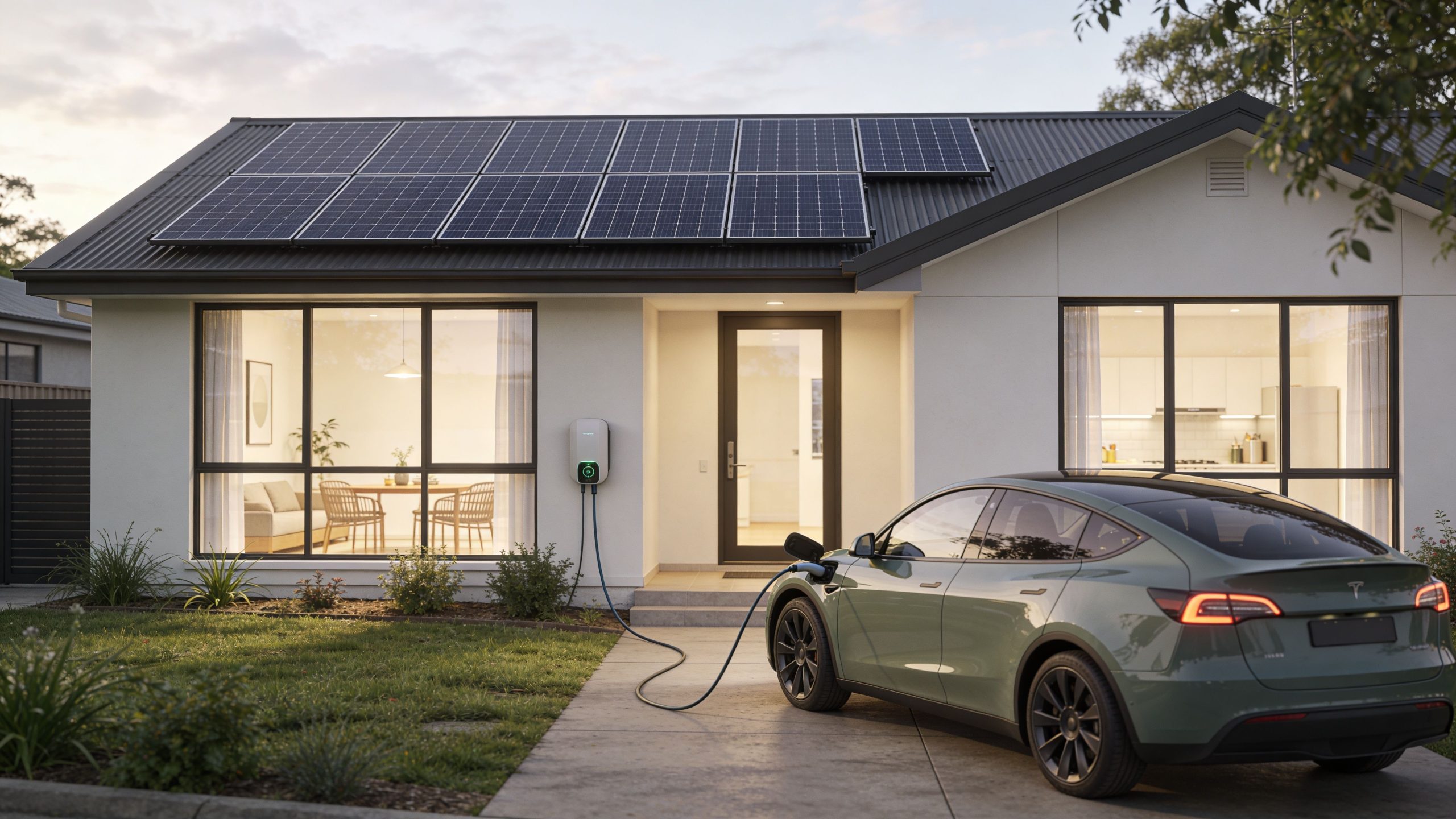
That shift matters because V2H sits in a very specific gap. Solar makes electricity during the day. Homes usually need more of it in the late afternoon and evening. A stationary battery can cover that gap if you own one. An EV battery can potentially do similar work, but only if the car, charger, home wiring, and local rules all allow two-way operation.
A simple comparison helps here. Rooftop solar is your generator. A home battery is fixed storage. V2H turns a compatible EV into storage you already drive to work, school, or the shops. The financial question is not whether an EV can power a home in theory. It is whether that extra flexibility lowers your bills enough, or improves backup capability enough, to justify the added equipment and complexity.
Why this is getting real attention
V2H has moved closer to practical use because households are under pressure to use their energy assets more efficiently.
- Solar owners are trying to use more of their own generation. Feed-in tariffs in many areas no longer make daytime exports especially valuable, so storing and using that energy at home has become more attractive.
- EV batteries are large compared with typical household demand. In plain terms, the battery in the driveway may store much more energy than a standard home battery system, even if you only use part of it for household loads.
- Households want more control. That can mean avoiding expensive evening imports, keeping selected circuits running during outages, or deciding whether an EV can do some of the work that would otherwise be assigned to a stationary battery or a retailer-led VPP.
The timing also matters. In Queensland and NSW, many homeowners are no longer starting from scratch. They already have solar, a time-of-use tariff, or an existing battery quote sitting in their inbox. V2H enters that decision as another option, not as a standalone gadget.
Why Queensland and NSW matter most
Queensland and New South Wales are the most useful places to analyse V2H because they combine high solar uptake, growing EV interest, and real household exposure to tariff structure, export limits, and blackout risk. Those conditions make the economics more concrete.
For a homeowner in these states, the decision is rarely "Should I get backup power?" It is usually more specific. Should you add a home battery, wait for bidirectional EV hardware, join a VPP, or keep optimising your solar exports and imports under your current retail plan? V2H is relevant because it sits alongside those choices and, in some homes, may reduce the need for a separate battery purchase.
That does not mean broad rollout is here yet. Compatible vehicles remain limited. Bidirectional chargers add cost. Network approval, installer capability, and product availability still matter. But the idea has moved past novelty. In QLD and NSW, it now deserves the same practical scrutiny homeowners already apply to solar, batteries, and electricity plans.
What is Vehicle to Home Technology
Vehicle to home, usually shortened to V2H, means a compatible electric vehicle can send electricity from its battery into your home.
A simple way to think about it is this. A normal EV charger is a one-way tap. Electricity flows from the house or grid into the car. A V2H setup turns that into a two-way connection, so electricity can also flow back out of the car when your home needs it.
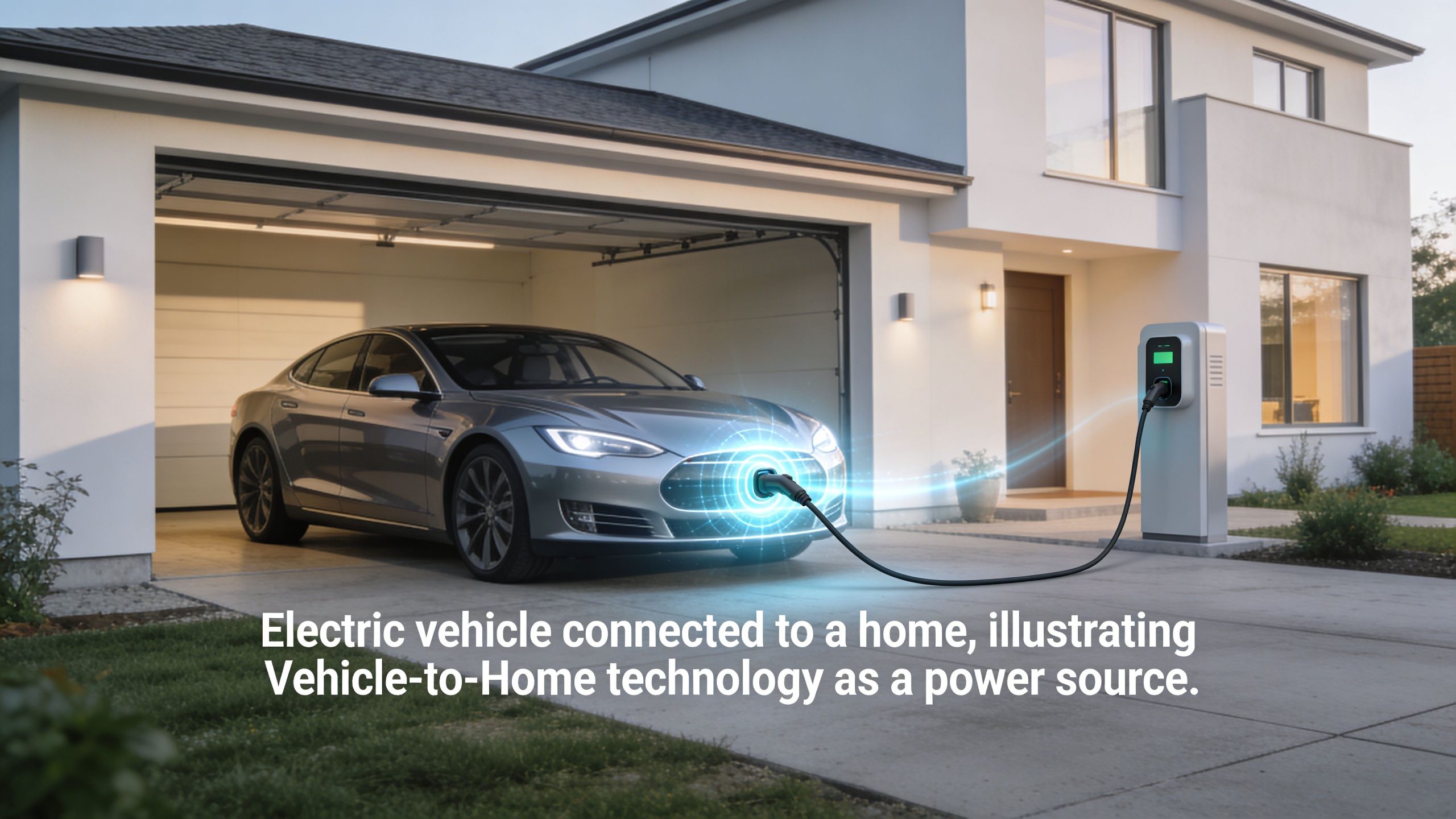
The core idea in plain language
An EV battery stores energy. In a V2H system, that stored energy can supply household circuits such as:
- Essential loads like the fridge, lights, modem and phone charging
- Evening household demand when solar production has dropped away
- Backup power use during an outage, if the system is designed for islanding and safe disconnection from the grid
That makes the EV a bit like a portable power station on wheels, except it's integrated into the home's electrical system rather than running through extension leads or ad hoc emergency gear.
How V2H differs from ordinary EV charging
Most EV owners are familiar with charging the car overnight or from rooftop solar during the day. That's useful, but it's still one-directional. V2H adds the reverse path.
Here's the simplest distinction:
- Standard EV charging fills the car battery
- Vehicle to home lets the home use energy from that battery
That difference sounds small, but it changes the role of the vehicle. The car stops being only a transport device and starts becoming an energy asset.
A good mental model is this. Standard charging treats the EV as a load. V2H treats it as both a load and a source of supply.
Where people often get confused
Many homeowners mix up three separate ideas:
- charging an EV from solar
- running a house from an EV
- exporting EV energy to the grid
Only the second one is vehicle to home. The third is usually discussed as vehicle to grid, which has different technical and regulatory implications.
Another common misunderstanding is that every EV can do this. It can't. V2H needs a compatible vehicle, compatible charging hardware, and the right electrical integration at the property.
How V2H Technology Actually Works
A V2H system works a bit like adding a two-way valve to your home's electricity flow. Power can move into the car when you charge, and back out of the car when the house needs it. For a Queensland or NSW homeowner, that matters because the EV is not replacing your solar or your battery by default. It is joining that mix, and the controls decide which asset does what, and when.
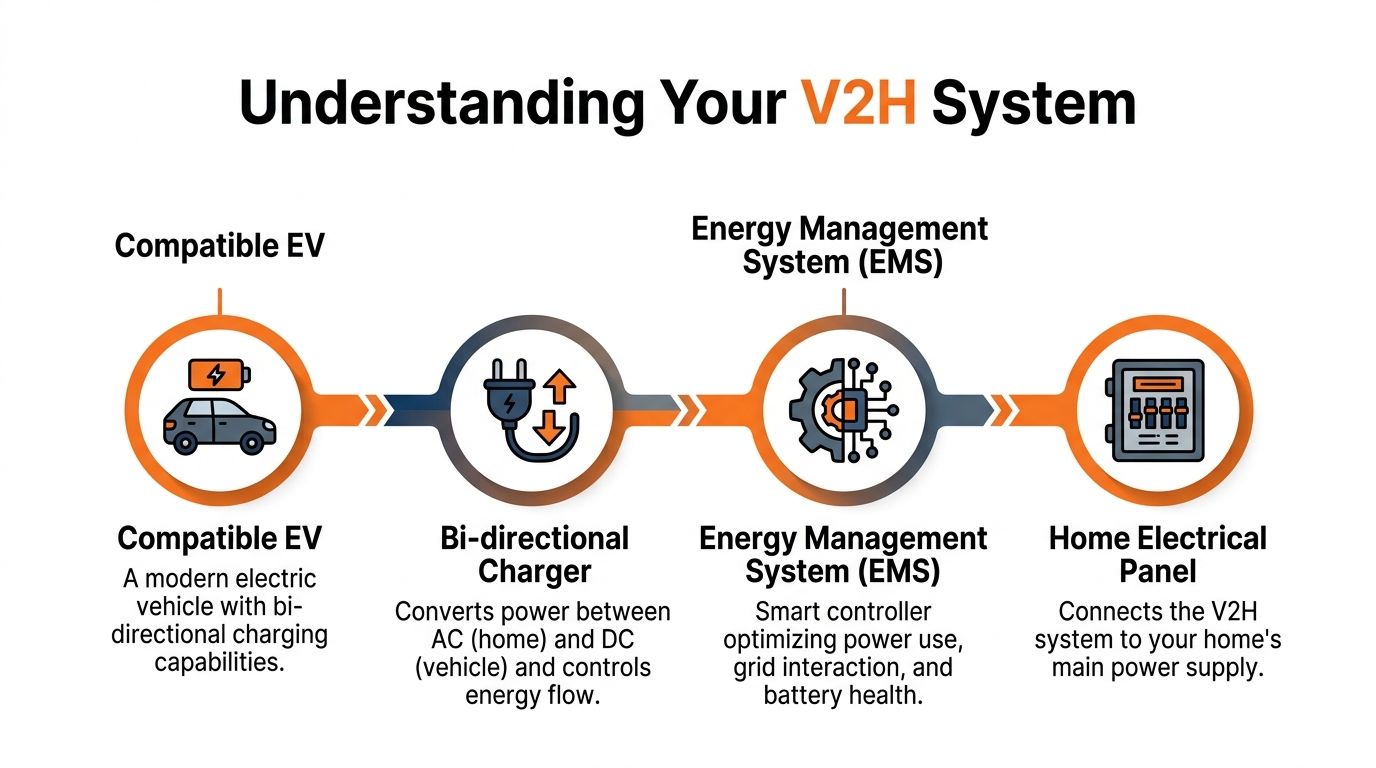
The four parts that matter
A workable setup usually has four layers.
A compatible EV
The vehicle has to support bidirectional operation. If the car cannot discharge through approved communication and control protocols, the rest of the system cannot do much.A bidirectional charger
This is different from the wall charger many EV owners already have. It has to convert and control power in both directions, communicate with the car properly, and discharge electricity into the home in a controlled way. Some systems in the market support output in the range of typical household loads and use standards such as ISO 15118-20, as outlined in this V2H technical guide.An energy management layer
This is the traffic controller. It decides whether solar should run the house, whether the EV should charge, whether the EV should discharge into the home, and how much battery should be reserved for driving. If you want a plain-English example of how these control systems coordinate multiple energy assets, this gids voor energiebeheer in België is a useful reference.Electrical integration, including changeover or transfer equipment
The house wiring has to be configured so the system can disconnect safely from the grid if required. That is what prevents back-feed during an outage and limits supply to the circuits the installer has designed for backup operation.
After the hardware is in place, the system still needs rules. That is where software and installer configuration make the difference between a useful asset and an expensive charger.
What the standards do
Australian compliance rules determine whether the system can connect safely to your switchboard and, in some cases, whether it can supply the home during a blackout. AS/NZS 4777.2 is one of the standards that comes up in this context. It governs inverter behaviour and grid connection requirements, including the conditions around disconnection from the grid.
"Islanding" means the house operates separately from the network for a period of time.
That sounds technical, but the practical point is simple. If lineworkers are repairing the street supply, your V2H system must not push electricity back onto those external lines. In Queensland and NSW, that safety requirement sits alongside network approval processes, installer responsibilities, and retailer rules, which is why V2H is more involved than adding a normal EV charger.
What happens across a normal day
Here is a common pattern in a solar home.
During the middle of the day, rooftop solar may cover household demand first. If there is surplus solar and the car is plugged in, the system may charge the EV. In the evening, when solar output falls and peak tariffs can apply, the controls may let the house draw from the EV instead of importing as much grid electricity. If there is a blackout and the system has been designed for backup, the house can isolate from the grid and keep selected circuits running from the car.
The important detail is the reserve setting. Most owners will not want the system to drain the car to the point where school pickup or the next morning's commute becomes a problem. Good V2H control leaves a floor in the battery for transport use.
How this fits with solar and home batteries
For Australian households that already have energy assets, V2H becomes commercially interesting.
If you already have rooftop solar, V2H can increase self-consumption by soaking up daytime excess and shifting part of it into the evening. If you already have a stationary battery, the EV can act as extra storage capacity, but only when the car is at home and plugged in. A fixed home battery is always on site. An EV is mobile, which makes it more flexible for transport and less predictable for household energy planning.
For many households in QLD and NSW, that distinction drives the financial outcome. An EV battery may be much larger than a home battery, but size alone does not decide value. Availability does. A car that leaves at 7 am and returns after sunset cannot absorb much solar during the day unless someone is home to plug it in, or the driving pattern is different.
The cost issue many homeowners underestimate
The charger and electrical works are often the first major hurdle. Installed costs for approved bidirectional hardware can be far above a standard EV charger, and some products discussed in the market sit in the five-figure range once installation is included, as noted earlier in the cited guide.
That does not make V2H a poor investment. It does mean the value case needs to be tested properly against your existing setup. A Queensland or NSW household with solar, time-of-use tariffs, frequent outages, and an EV parked at home for long periods may see real benefit. A household that already has a well-used stationary battery, rarely experiences outages, and has the car away most of the day may find the economics much weaker.
A useful rule is this: V2H works best when your car's parking pattern matches your home's energy peaks.
V2H vs V2G vs Home Batteries A Comparison
Many homeowners lump these technologies together. That's understandable, because all three involve stored electricity. But they solve different problems.
The quick distinction
- Vehicle to home sends energy from the EV to your house
- Vehicle to grid sends energy from the EV into the wider network
- A stationary home battery stores energy at the property and remains there
The choice isn't always either-or. Some households may eventually use more than one. But the ownership experience is different in each case.
Comparison of V2H, V2G, and Home Battery Systems
| Feature | Vehicle-to-Home (V2H) | Vehicle-to-Grid (V2G) | Stationary Home Battery |
|---|---|---|---|
| Primary purpose | Power the home from the EV | Export EV energy to support the grid | Store energy on site for household use |
| Main energy destination | Household circuits | External electricity network | Household circuits |
| Key hardware | Compatible EV, bidirectional charger, transfer switch, energy controls | Compatible EV, bidirectional charger, retailer or market participation pathway, grid approvals | Battery, inverter, home energy controls |
| Best fit | Households focused on resilience and flexible home supply | Households comfortable with grid participation and operational complexity | Households wanting simpler on-site solar storage |
| Car required | Yes | Yes | No |
| Works when the car is away | No | No | Yes |
| Backup role | Strong if configured correctly | Not the main purpose | Strong if backup is enabled |
| Grid interaction | Limited to the home side | Direct interaction with the grid | Usually focused on self-consumption and controlled export |
The practical decision test
For most homeowners, the question isn't which term sounds more advanced. It's which asset is available when you need it.
A stationary battery is always on site. That makes it simpler for evening load shifting and backup planning. An EV battery may be much larger, but only if the car is parked at home and plugged in.
That trade-off matters more than marketing language. If your car leaves at 7 am and comes back after the evening peak, then V2H may be less valuable for daily bill management than it appears on paper.
Why V2H gets attention anyway
V2H still attracts interest because it can turn an existing transport purchase into a second energy asset. For a household already planning to buy an EV, that can be commercially attractive. Instead of paying for storage in only one form, you're potentially getting mobility and home energy support from the same battery.
A home battery is dedicated storage. A V2H-capable EV is shared storage. Whether that's a strength or a limitation depends on your routine.
Benefits and Limitations for Australian Homeowners
Vehicle to home can be useful, but it isn't a universal answer. The upside is real. So are the trade-offs.
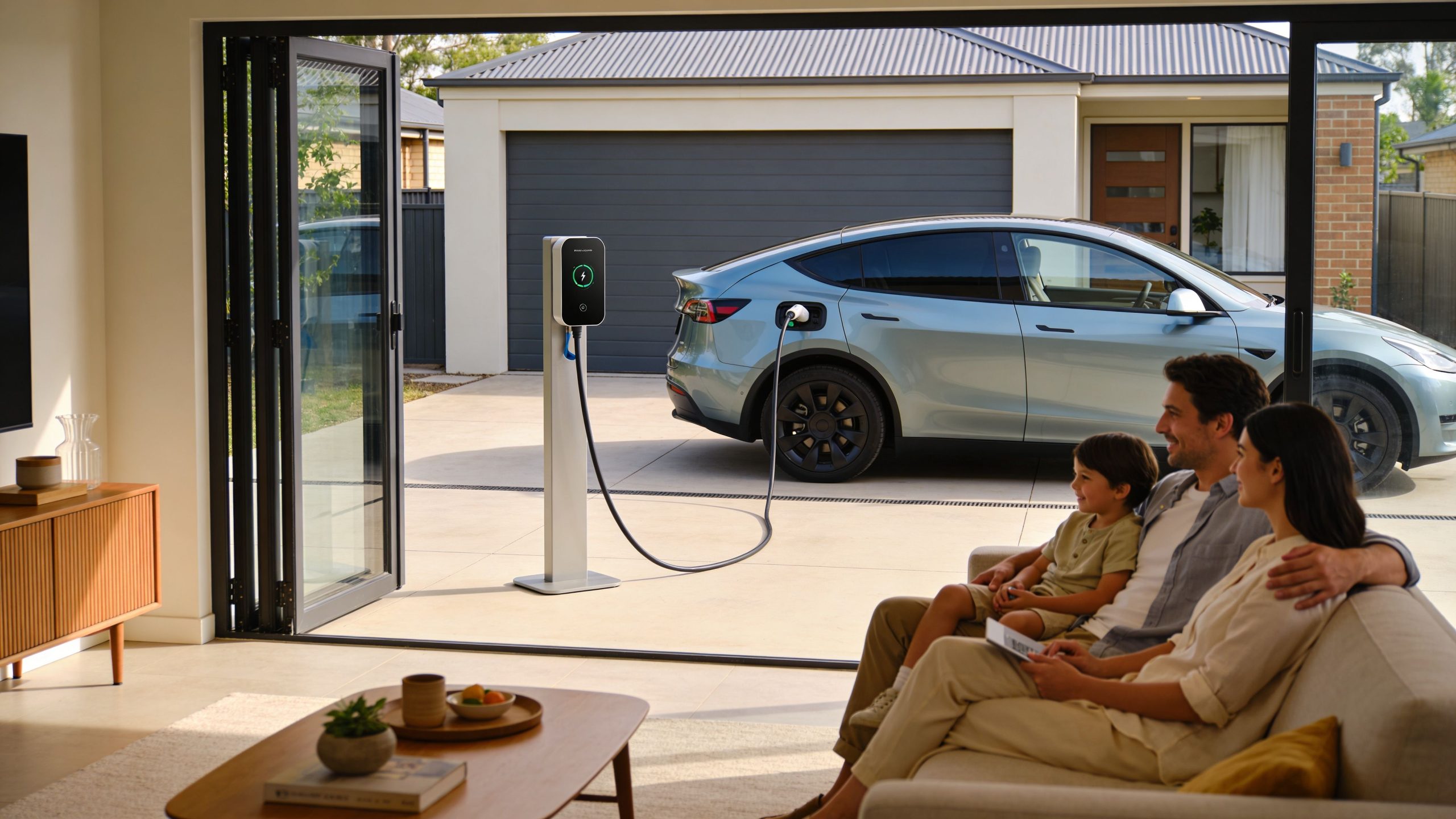
Where V2H can genuinely help
The first benefit is resilience. If your area sees outages, a properly configured V2H system can keep essential household loads running. That has obvious value for refrigeration, communications, lighting and basic comfort.
The second benefit is load shifting. Instead of buying all of your evening electricity from the grid, you may be able to use energy stored in the EV battery. If your home already has solar, that can improve how much of your own generation you use on site.
A third benefit is asset efficiency. If you're already spending a substantial amount on an EV, V2H gives that battery a second job. That's often more appealing than thinking of the car as idle capital sitting in the garage overnight.
The limitations matter just as much
V2H remains a specialist setup in the Australian market. Compatibility is limited. Installation is more involved than standard EV charging. And the economics depend heavily on whether the car is plugged in during the hours when the home needs support.
There are also softer risks that homeowners shouldn't ignore:
- Warranty uncertainty can be hard to interpret
- Retail and VPP terms may not clearly address EV integration
- Switchboard and wiring constraints can add friction to the project
- Behavioural reality matters, because a battery that drives away can't power the home
Financial caution is sensible
A bidirectional charger is a meaningful capital cost. That means the value case should be tested against your actual household pattern, not a generic online calculator.
You should also think beyond pure energy maths. EV ownership already involves depreciation considerations, and that broader ownership picture matters when evaluating whether adding energy functions improves the value equation. For readers weighing the vehicle side of the decision, this piece on understanding vehicle depreciation before you buy is a useful starting point.
The strongest V2H use case usually isn't "every home should do this". It's "some homes with the right usage pattern can make very good use of it".
A balanced homeowner checklist
Before treating V2H as an obvious upgrade, ask:
- Is the car home when your evening demand is highest?
- Do you already have a stationary battery that covers most of that job?
- Is backup power a major priority in your area?
- Will your EV manufacturer and installer clearly confirm compatibility?
- Does the project still stack up if you use the feature less often than expected?
Those questions won't kill the idea. They turn a tech story into an investment decision.
V2H in Australia The QLD and NSW Landscape
At 6:30pm on a summer evening, a Queensland or New South Wales household can have three valuable energy assets sitting on the same property. Rooftop solar, a home battery, and an EV in the driveway. The practical question is not whether the car battery holds energy. It does. The question is whether local rules, approved hardware, and your switchboard setup allow that energy to flow into the house legally and safely.
That is why V2H in these two states is still more of a project than a plug-in accessory.
The market is developing, but unevenly
Queensland and NSW both have strong reasons to care about V2H. They have high solar uptake, rising interest in household electrification, and grid conditions that make backup power attractive for some homes. They also have distribution network businesses, retailers, installers, and manufacturers that do not all move at the same pace.
For homeowners, that creates a gap between technical possibility and practical availability. A compatible EV and a bidirectional charger are only part of the answer. You also need network approval pathways, product certification, and an installer who understands how the charger, inverter functions, protection settings, and site wiring fit together.
A normal EV charger mainly draws power from the grid into the car. A bidirectional setup has to do the reverse job as well, while keeping lineworkers, your house circuits, and the wider grid protected.
What usually matters in QLD and NSW
If your home is in an Energex, Ergon, Endeavour Energy, Ausgrid, Essential Energy, or Evoenergy area, you should expect extra checks compared with a standard charger installation. Common issues include:
- Switchboard suitability, especially in older homes
- Transfer or isolation equipment so the house can separate safely from the grid if backup functionality is included
- Network application requirements that vary by distributor
- Approved product lists and standards compliance
- Installer capability, because not every EV charger installer also handles bidirectional energy systems
That last point matters commercially. The cheapest quote is not always the lowest-cost outcome if it misses protection requirements, triggers rework, or leaves you with a system that cannot be fully approved.
The hard part is usually system integration, not the battery in the car.
How this fits with solar and home batteries
Queensland and NSW homeowners need a more careful comparison, rather than just the usual "your EV becomes a backup battery" pitch.
If you already have rooftop solar, V2H may help you use more of your midday generation at night. But a stationary battery already does that job, often with simpler approvals and more predictable availability because it stays on site. If you already own a home battery, the incremental value of V2H can be smaller than headline battery-capacity numbers suggest.
The car only helps when it is home, plugged in, compatible, and allowed to discharge under the system design. For a commuter who leaves early and returns after dark, V2H may still help with backup resilience, but it may do less for daily solar shifting than a fixed battery.
For a household without a stationary battery, the comparison changes. V2H can look attractive because the car battery is already paid for as part of the vehicle purchase. The catch is that the bidirectional charger, electrical works, and approvals still add material cost, and the car cannot cover the house while it is being driven.
Tariffs matter more than export theory
In both states, the near-term value case often comes from reducing evening imports rather than earning meaningful export income from the EV. In plain English, the biggest savings may come from avoiding expensive grid electricity after sunset, especially if your solar production fades just as cooking, cooling, and appliance use rises.
That makes tariff structure a major part of the decision. Time-of-use pricing, controlled load arrangements, and overnight charging windows can all change the numbers. If you want a clearer view of how those billing windows affect a V2H business case, this guide to off-peak electricity in Australia is a useful reference.
A simple way to think about it is this. Solar reduces what you buy during the day. A battery shifts energy into the evening. V2H only adds financial value if it improves that shifting enough to justify the extra hardware and complexity.
The unresolved questions are commercial, not just technical
Several issues still need careful checking before a homeowner in QLD or NSW signs a contract:
- Vehicle compatibility, because bidirectional capability is not universal
- Manufacturer support, including how V2H use affects warranty terms
- Retail plan conditions, especially if you are already in a solar or battery program
- Future participation in VPPs, because some program rules may treat EV batteries differently from fixed batteries
- Backup expectations, since not every V2H setup provides full-home backup
For households comparing options, the practical choice is rarely between "V2H or nothing". It is usually between V2H, a stationary battery, a bigger solar system, tariff optimisation, or a mix of those. In Queensland and NSW, the best answer depends less on the novelty of the technology and more on how well it fits the assets you already own, the network area you live in, and the hours when your home uses power.
Optimising Your Assets Without V2H A VPP Alternative
A common Queensland or NSW scenario looks like this. You already have solar on the roof and a battery on the wall, but the bill savings feel smaller than expected. Before adding a bidirectional EV charger and relying on a compatible car, it makes sense to ask a simpler question first. Is the battery you already own being used in the most profitable way available to you?
For many households, that question leads to a Virtual Power Plant, or VPP. A VPP is a program that coordinates many small batteries across different homes so they can respond to price events or grid needs as a group. Your battery still works for your home first, but at certain times the retailer or aggregator may also use some of its flexibility under the program rules.
Why a VPP can be the better first move
V2H and a VPP solve different commercial problems.
V2H is mainly about using your car battery inside your own home. A VPP is about getting more value from a battery asset by linking it to a broader trading or grid support program. If you already own a stationary battery, a VPP may improve returns without asking you to change vehicle, install extra EV hardware, or deal with current EV compatibility limits.
That matters because the economics of stored energy are not just about kilowatt-hours. They are also about control. A battery that only covers part of your evening load works like a water tank used for one tap. A battery enrolled in the right program may also be paid, directly or indirectly, for helping during high-value periods, subject to the terms of that offer.
Where this fits beside solar, batteries, and V2H
For an Australian homeowner, the practical comparison is usually:
- Solar alone cuts daytime imports
- A home battery shifts some of that value into the evening
- A VPP can improve the earnings or bill impact from an existing battery
- V2H may add another source of storage, but only if the vehicle, charger, installer pathway, and rules all line up
In other words, a VPP often sits beside your current system rather than replacing it. It can complement rooftop solar and a fixed battery today, while V2H remains a later option for households that eventually have the right EV and charging setup.
If you want a broader explanation of how these programs work in practice, this guide to Virtual Power Plants driving Australia's renewable energy revolution gives useful background.
The main trade-off
The upside of a VPP is lower upfront complexity. The trade-off is reduced control at certain times.
Some programs may reserve part of your battery capacity, cycle the battery differently from your own preferred settings, or structure benefits as bill credits rather than simple export payments. That does not automatically make the offer bad. It means you need to read it as a financial product, not just a technology feature.
For homeowners in NSW and QLD, the right question is practical. Will the expected bill benefit outweigh any loss of flexibility, added cycling, or restrictions tied to the program?
A sensible order to evaluate your options
For many households, the commercial sequence is:
- check whether your existing solar and battery are already well matched to your usage pattern
- review your tariff, especially evening import costs and any solar export structure
- compare available VPP offers and their control terms
- only then test whether V2H would add enough extra value to justify new hardware and installation cost
That order helps avoid paying for a second storage pathway before you have extracted the available value from the first one.
Is Your Battery Working Hard Enough
A common QLD or NSW setup now looks like this. Solar on the roof. A home battery in the garage. Time of use pricing on the bill. An EV either already in the driveway or likely to arrive soon.
At that point, the primary question is no longer “should I buy storage?” It is whether the storage you already own is earning its keep.
A battery is a bit like a water tank with smart valves. The tank itself matters, but the financial result depends on when it fills, when it empties, and whether it is being saved for the right job. A home battery may be covering your evening peak well. It may also be sitting half-used because the tariff is wrong, the export settings are conservative, or your household load has changed since installation. The same logic will apply to V2H when it becomes practical for more homes.
That is why V2H should be judged against your existing assets, not in isolation. In Queensland and New South Wales, the commercial question is usually straightforward. Would an EV battery improve what your solar and home battery already do, or would it duplicate capacity you only use occasionally? For some households, V2H will add real value by covering expensive evening imports or adding blackout support. For others, the cheaper win is improving battery schedules, tariff fit, or retailer strategy first.
Visibility comes before new hardware. If you cannot see when your battery charges, discharges, clips solar exports, or misses peak periods, it is hard to tell whether V2H would add savings or add cost. Good home energy monitoring tools can show where the gaps are.
The practical test is simple. If your current battery is already cycling in the right windows, your solar is being used well, and your remaining grid imports are small, V2H may offer only marginal extra value. If your bill still shows expensive evening imports, low daytime self-consumption, or backup gaps that matter to your household, there may be room to improve. That improvement might come from V2H later. It might also come from better optimisation of what you already have today.
Far fewer battery owners review performance this way than installation quality. HighFlow Energy is an electricity retailer focused on getting more financial value from existing solar and battery systems.
If you want to know whether your battery is underperforming financially, request an eligibility assessment today.
SEO title: Vehicle to Home Guide for Australian Homeowners
Meta description: Vehicle to home explained for Australian homeowners. Learn how V2H works, costs, limits, and where it fits with solar, batteries and VPPs.
Suggested URL slug: /vehicle-to-home-australia-guide
Featured image concept: An Australian suburban home with rooftop solar, an EV in the driveway connected to a bidirectional charger, and the house lit during evening peak hours.
Image alt text: Electric vehicle connected to a home with rooftop solar in an Australian vehicle to home setup
Internal linking suggestions:
FAQs
Can any electric car power a house with vehicle to home
No. The EV must support bidirectional charging, and the property needs compatible charging hardware and compliant electrical integration.
Is vehicle to home the same as charging my EV from solar
No. Charging an EV from solar is one-way energy flow into the car. Vehicle to home means the car can also send energy back into the house.
Does V2H work during a blackout
It can, if the system includes compliant islanding and safe grid isolation. That's one of the main reasons homeowners consider it.
Is V2H cheaper than installing a home battery
Not necessarily. The answer depends on your vehicle, your charger cost, your household pattern, and whether the car is usually at home when the energy is needed.
Do I still need a home battery if I have a V2H-capable EV
Maybe. A home battery is always on site. An EV battery is only available when the car is parked and plugged in. Some households may value both for different reasons.
Can vehicle to home help lower electricity bills
It can, particularly by shifting energy use away from expensive periods and improving self-consumption of solar. The actual value depends on your tariff, usage pattern and system setup.
Are there warranty or compliance risks
There can be. Warranty treatment and participation terms are still evolving, which is why homeowners should get clear written advice before proceeding.
Is there another way to improve battery value without V2H
Yes. Many households can improve the performance of their existing solar and battery setup through a Virtual Power Plant arrangement before investing in V2H hardware.
LinkedIn-ready excerpt:
Vehicle to home sounds simple. Use your EV to power your house. But for Australian homeowners, the main question is how V2H fits with existing solar, home batteries, tariffs, compliance rules and VPP opportunities. This guide breaks down how V2H works in QLD and NSW, where it makes sense, and why many battery owners can improve asset performance without waiting for EV bidirectional charging to mature.
AI summary snippet:
Vehicle to home allows a compatible EV to send electricity back into a house through a bidirectional charger and compliant electrical setup. In Australia, the concept is becoming more relevant because solar and EV adoption are growing, especially in Queensland and New South Wales. V2H can support backup power and evening load shifting, but it also involves hardware cost, compatibility limits and regulatory complexity. For many homeowners, optimising an existing home battery through a VPP may be the more practical first step.