

Smart Meter and Solar: Your Guide to VPPs in 2026
Your solar panels are generating power. Your battery is charging and discharging. Your electricity bill has probably improved. But many battery owners in Queensland and New South Wales still have the same nagging question. Am I getting the full value from this system?
That question usually isn't about hardware quality. It's about control, timing, and visibility.
A lot of households treat their system like a set-and-forget appliance. Solar runs during the day. The battery fills when it can. Extra energy goes out to the grid. Bills come down a bit. That works, but it's basic. It doesn't tell you whether your battery is being used at the right times, whether exports are being measured properly, or whether your system could earn more value through smarter coordination.
That's where the relationship between smart meter and solar becomes commercially important.
A smart meter isn't just a digital replacement for an old meter. In a solar and battery home, it's the device that tells the market what happened, when it happened, and in which direction energy flowed. That matters for billing. It matters for feed-in tariffs. It matters even more for a Virtual Power Plant, where timing and data quality determine whether your battery is storing energy or actively participating in a coordinated grid service.
In Australia, that shift is already well underway. Smart meter rollout now covers over 3 million households, representing approximately 40% of all Australian homes, and rooftop solar penetration in Queensland and New South Wales exceeds 35% of households according to Solar Analytics on smart meter rollout and solar integration.
For a homeowner, the practical takeaway is simple. If you want to move beyond passive bill reduction, you need to understand the meter that sits between your home and the grid. It is the data source that makes optimisation possible.
Introduction Why Your Smart Meter is the Key to Unlocking Solar Value
Most solar and battery owners judge performance by one visible outcome. The bill is lower than it used to be.
That's a reasonable starting point, but it misses the more important question. Is your system operating in a way that maximises financial return over time?
A household in Brisbane or Newcastle might have good solar production, a capable battery, and a retailer plan that supports exports. Even so, the system can still underperform financially if the battery discharges at the wrong time, if exports happen when they're least valuable, or if the household has no clear way to see what the meter is recording.
The difference between ownership and optimisation
Owning solar and a battery gives you energy assets. It doesn't automatically give you an operating strategy.
A battery can be used in at least three broad ways:
- Basic backup support where stored energy is held mainly for resilience
- Self-consumption support where the battery shifts daytime solar into evening home use
- Market-aware optimisation where battery behaviour responds to tariffs, grid conditions, and coordinated dispatch instructions
The third option depends on accurate, frequent data. Without that data, a battery is still useful, but it's working with limited intelligence.
A solar system produces electricity. A smart meter produces evidence.
That evidence is what allows a retailer, network, or VPP platform to distinguish between power you used in the home and power you sent out to the grid. It also lets them map those flows to specific time intervals. That sounds technical, but it has a very practical result. The more precisely your system's behaviour is measured, the more precisely it can be managed.
Why battery owners often leave value on the table
Many homes export energy by default because that's what happens when solar output is strong and household demand is low. If no battery action or control signal changes that pattern, the household may end up selling surplus at a standard tariff rather than using the battery in a more strategic way.
This is why the smart meter deserves more attention than it usually gets. It is not just a billing tool. In a VPP setting, it acts more like a performance monitor for the whole energy asset.
That shift in perspective matters. Once you see the smart meter as part of the operating stack, not just part of the bill, a different set of questions opens up. Is the data granular enough? Is the import and export split accurate? Is your battery being orchestrated around tariff windows and grid events, or just running on default settings?
How Smart Meters and Solar Systems Actually Interact
A good way to think about a smart meter is as a bank ledger for electricity.
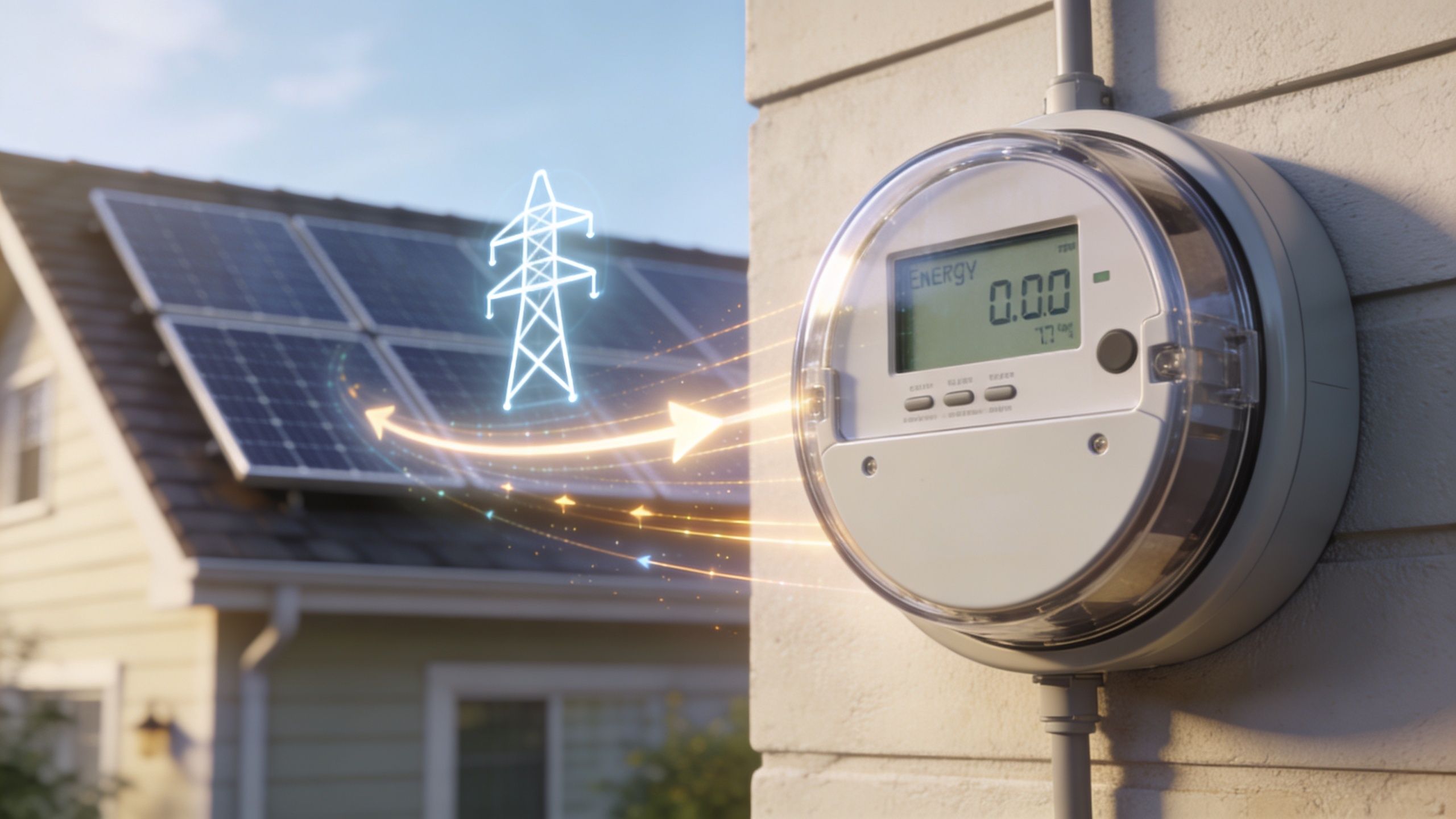
Your home is constantly making deposits and withdrawals. When your solar system produces more than the house needs, surplus electricity goes out to the grid. That's an export. When solar isn't enough and the battery isn't covering the shortfall, your home pulls power in from the grid. That's an import.
The meter's job is to record both directions accurately.
Import and export are not the same thing
In Australian homes with rooftop solar, bidirectional smart meters are mandated under the National Electricity Rules. They measure import and export using separate registers, so the system doesn't confuse energy bought from the grid with energy sent back. In NSW, Ausgrid's Type 6 meters log 15-minute interval data, and average 6.5 kW rooftop systems export 25 to 35% of generation during peak solar hours, according to Energy Matters on how smart energy meters work with solar systems.
That separation is what makes proper billing possible. It's also what allows a VPP platform to know when your battery has spare capacity and when your home still needs support first.
If you want to understand what your own system is showing day to day, a practical starting point is High Flow's guide to home energy monitoring, which helps translate meter data into household decisions.
What interval data actually means
Many people hear terms like interval data or net metering and assume they need specialist knowledge. You don't.
- Net metering means your energy account considers both what you import and what you export
- Interval data means the meter records energy flows in defined time blocks rather than as one monthly total
- Bidirectional measurement means electricity moving in and out is tracked separately
Those time blocks matter because electricity isn't equally valuable at every moment. A kilowatt-hour at lunchtime can have a different financial outcome from a kilowatt-hour in the evening peak. Smart meters make that visible.
Why VPPs need more than monthly totals
An old-style monthly read can tell you how much electricity moved overall. It can't support intelligent dispatch.
A VPP needs more detail. It needs to know when solar production rose, when the battery charged, when the home imported from the grid, and when export occurred. That time-stamped picture is the basis for automation.
Practical rule: If a battery is going to respond to market conditions, the meter has to tell a reliable story about what happened through the day.
Some trials cited in the same Energy Matters source found grid import reductions of 52% when VPP participants used AI-optimised discharge. The important lesson isn't the number by itself. It's the mechanism. Better interval data allows better battery decisions.
Beyond Basic Feed-In Tariffs The Role of Smart Meters in VPPs
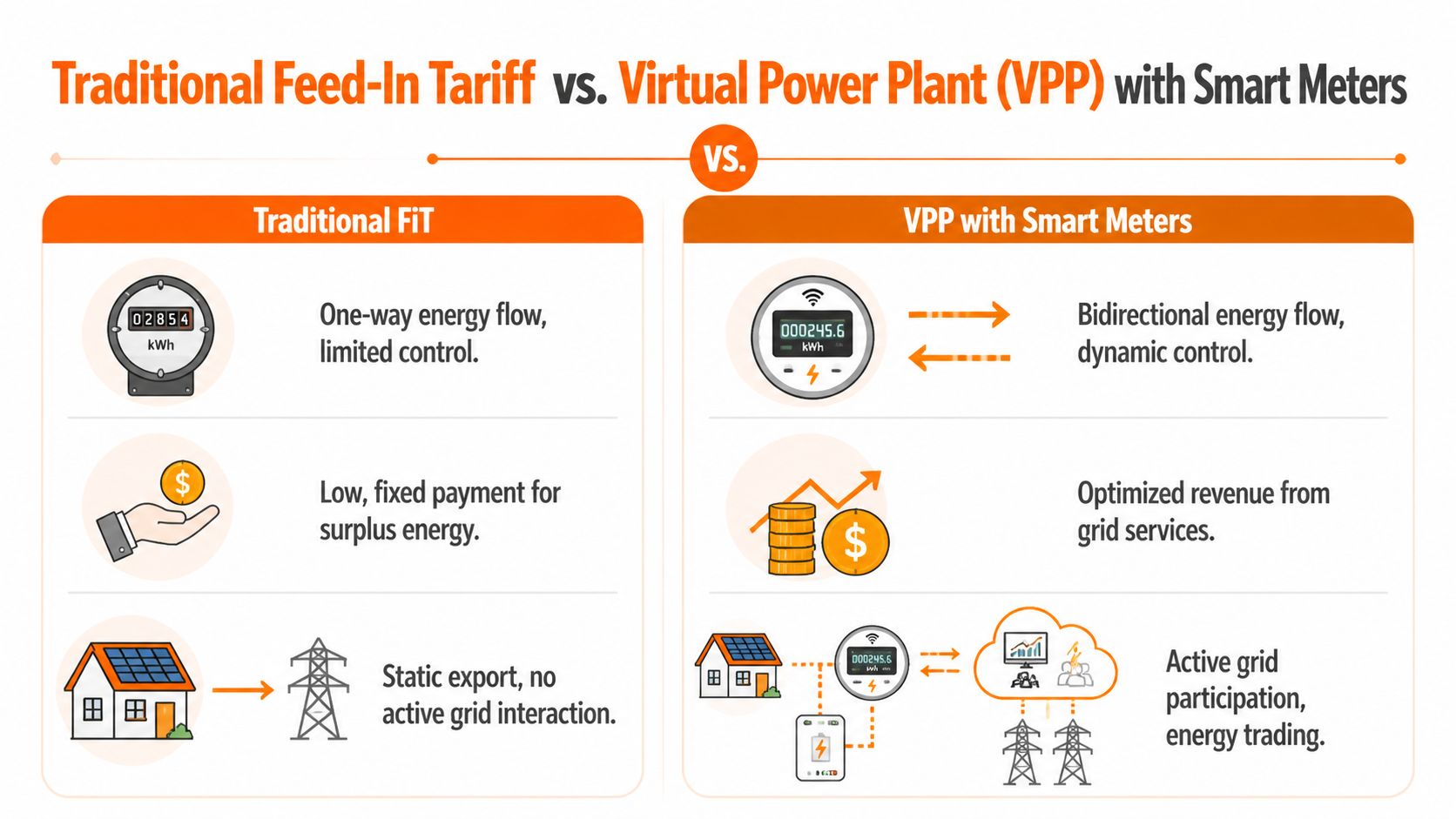
A standard solar setup usually treats export as the end of the story. Your home doesn't need the energy, so it goes to the grid and you receive a feed-in tariff. That's simple, but it's passive.
A VPP uses the same underlying assets very differently.
Traditional export versus active dispatch
Here's the commercial distinction.
| Model | How energy leaves the home | What drives value | Role of the smart meter |
|---|---|---|---|
| Traditional feed-in tariff | Surplus solar exports when available | Fixed export credit structure | Measures exported energy for billing |
| VPP participation | Battery and solar can be coordinated around system needs | Timed dispatch, grid support, household optimisation | Provides the interval data needed for control and settlement |
Under a plain feed-in arrangement, the household has limited influence over when exported energy has the most value. The system exports because it has surplus. Under a VPP, export and discharge can be managed in a way that aligns more closely with tariff periods, local conditions, and broader grid requirements.
The meter becomes an operating signal
This is the part many solar owners miss. The smart meter isn't just confirming that power was exported. It is helping determine whether the battery should act at all.
If the data shows strong midday solar, low household demand, and spare battery capacity, the battery may charge instead of allowing immediate export. If the data later shows a high-cost evening period or a planned VPP event, the battery can discharge when that energy is more valuable to the household or the grid.
That is why smart meter data matters far beyond bill credits. It supports decision-making.
For readers interested in the broader business logic, IoT drives business intelligence is a useful framing. The same principle applies in energy. Once connected devices produce reliable operational data, better commercial decisions become possible.
Why this matters more for battery owners than solar-only homes
A solar-only home can export. A solar-plus-battery home can choose.
That choice is where financial upside starts to emerge. The battery gives you flexibility. The smart meter tells the system when and how to use that flexibility. Without the meter data, the battery is harder to coordinate and harder to evaluate properly.
A battery without strong data behaves like storage. A battery with strong data can behave like an energy asset.
This is also why VPP participation shouldn't be viewed as a simple extension of feed-in tariffs. It is a different operating model. The value doesn't come only from selling surplus energy. It comes from managing timing, availability, and responsiveness in a way that a passive export model can't.
Billing and Export Implications in Queensland and New South Wales
You install solar and a battery, then open your first detailed bill and notice something odd. Two homes can generate a similar amount of solar, yet one gets far more value from it. In Queensland and New South Wales, that gap often comes down to how the smart meter records timing, exports, and battery behaviour.
That matters because billing is no longer just a monthly total. It is a record of hundreds of small interval decisions. For households considering a VPP, the smart meter works like an operating log as much as a billing device.
Time-of-Use tariffs reward control over timing
Under a flat tariff, energy is mostly counted by volume. Under a Time-of-Use tariff, each interval has a different price depending on when electricity is imported. The meter makes that possible by recording usage and export across the day rather than blending everything into one figure.
For a battery owner, that creates a commercial choice. Store solar when export value is low. Use or discharge it when grid prices are higher. If a VPP event is scheduled during a peak period, the same interval data helps determine whether holding energy for later use is more valuable than exporting immediately.
A common assumption among solar owners is that a better bill comes from generating more. In QLD and NSW, better results often come from using meter data to improve timing. The household with the better control logic can outperform the household with the larger system.
If you're comparing tariff structures, High Flow's guide to off-peak electricity is useful because it explains tariff timing in practical household terms.
Export limits change what "surplus" really means
Surplus solar does not always have the same value. In some parts of Queensland and New South Wales, network export limits and local grid conditions can restrict how much energy can be sent out at a given time. That means a kilowatt-hour at midday may be abundant, but not especially well paid or even fully exportable.
In that setting, the smart meter helps answer a more useful question than "How much did I export?" It helps show whether energy was exported at the best time, stored for a better interval, or absorbed on site to avoid a higher import charge later.
The battery then shifts from being a simple backup device to a flexible trading position inside the home energy system.
That shift affects billing in several ways:
- Higher self-consumption can reduce the amount of electricity bought from the grid during higher-priced periods
- Better-timed exports or discharge can improve the value of energy sent out during VPP events or favourable tariff windows
- Clear interval records make it easier to see whether the system is performing as expected, rather than just generating a large monthly export number
Why bills become harder to read, and more useful, at the same time
As systems get smarter, bills get denser. A single statement may reflect interval imports, interval exports, controlled load charges, Time-of-Use windows, battery cycling, and VPP credits or adjustments. That can make casual bill reading harder, especially if you're trying to work out whether the battery strategy is helping.
But the extra detail is useful if you read it properly. It lets you judge performance, not just cost. You can start asking sharper questions. Did the battery reduce peak imports? Were exports concentrated in low-value periods? Did VPP participation create credits that outweighed the battery energy used?
That is why structured bill analysis matters for solar and battery households. A broader explainer like Matil on utility bill automation shows why utility data often needs to be organised before it becomes genuinely useful to a customer.
Bills for solar and battery homes now reflect operating strategy, not just electricity consumption.
For households in QLD and NSW, the practical question is broader than feed-in tariff rates. It is whether your smart meter data is helping improve battery timing, export decisions, and VPP performance over time.
Is Your System VPP-Ready Checking Meter and Battery Compatibility
Many households assume that if they already have solar and a battery, they're automatically ready for a VPP. That's not always true.
The hardware may be good. The data pathway may not be.
What to check first at home
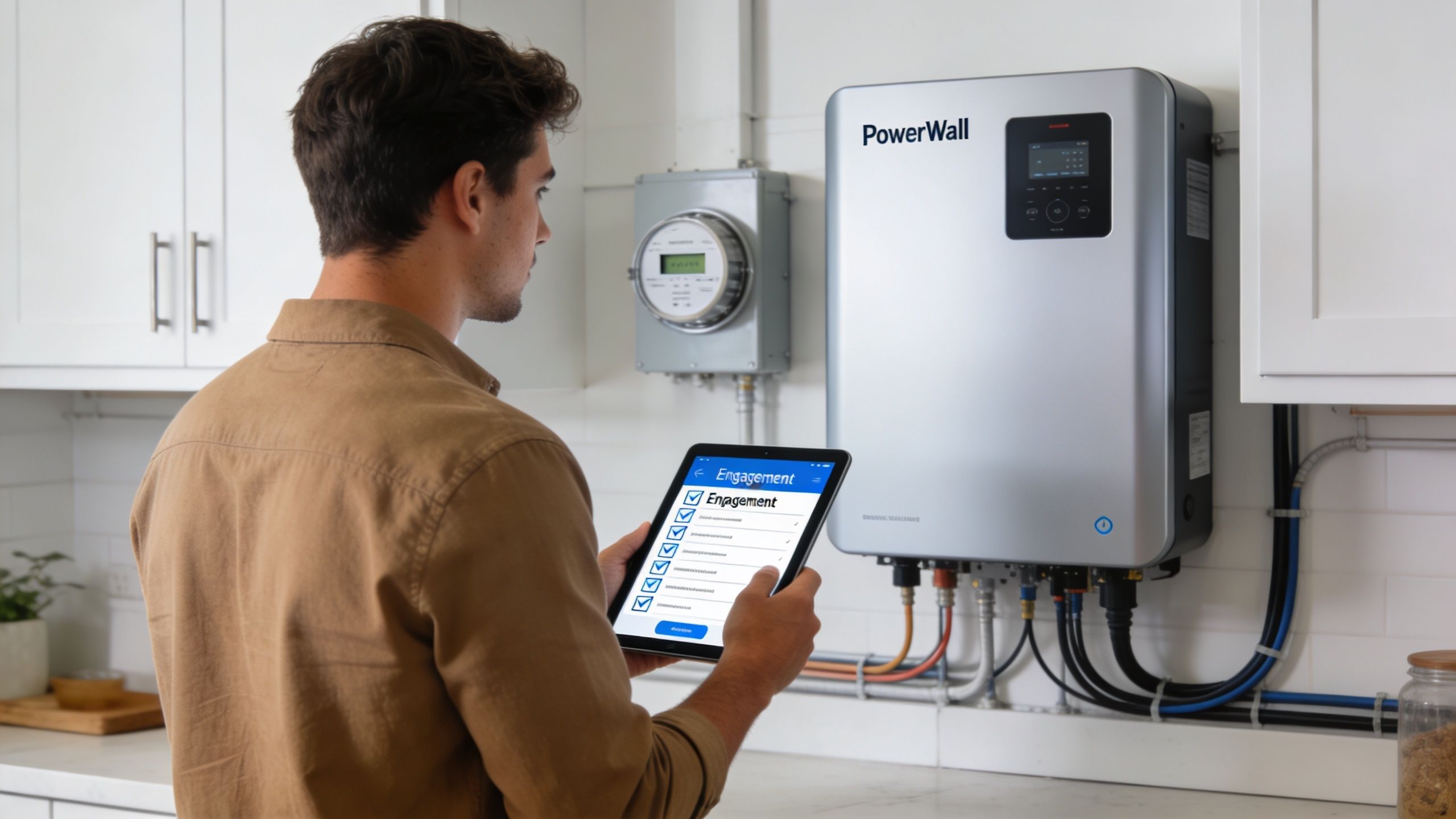
Start with a simple readiness check.
- Meter type. Look for a digital interval meter rather than an older accumulation-style meter. Your retailer or distributor can usually confirm the meter class and whether export is being recorded correctly.
- Battery compatibility. Not every battery platform supports the same control methods, data sharing arrangements, or VPP integrations. Common battery brands may be widely supported, but support still depends on model, firmware, and connection architecture.
- Communications path. Your battery and meter data need stable communication. That often means home internet, mobile connectivity, or both, depending on the setup.
- Retail alignment. Even where hardware is compatible, settlement, tariff design, and VPP participation depend on retailer systems being able to work with that data cleanly.
Those checks matter because VPP performance is not just about battery chemistry. It is about whether the full stack can coordinate reliably.
The hidden issue is data accuracy
The discussion now takes a more serious turn.
AER reports referenced in industry commentary from 2025 showed that 15% of solar households with smart meters experienced export under-recording due to meter lag during rapid battery cycling in QLD and NSW, according to SunApe Eco Power on smart meter challenges in renewable integration.
That doesn't mean smart meters are failing broadly. It means edge cases matter when a battery is moving energy dynamically and frequently. If exports are under-recorded, the household may see lower credits than expected. If interval data lags, automated battery dispatch can become less precise.
Watch for this: if your battery app and your bill consistently tell very different stories about exports, don't assume the app is wrong and don't assume the bill is right. Investigate both.
A specialist operator should be able to help verify firmware status, data pathways, and whether meter-side data aligns with battery-side records.
Why compatibility isn't a one-off question
A VPP-ready system isn't just something you check once at installation. Firmware changes, retailer changes, tariff changes, and market-rule changes can all affect performance over time.
This short explainer is useful if you want a visual overview of how smart meter data and distributed energy systems interact in practice.
The practical point is straightforward. A home can be technically capable of joining a VPP but still lose value if data quality is poor, if export records are disputed, or if the retailer setup can't turn meter intelligence into useful action.
Unlocking Value with a Retailer VPP HighFlow Energy's Approach
A retailer-based VPP changes the role of the battery from private storage to coordinated market participant, while still keeping household needs first.
That matters because the retailer sits close to the billing layer, tariff structure, and dispatch logic. In practice, that means the smart meter data can inform not just battery actions but also how value is translated into the customer's electricity account.
What the retailer VPP model changes
In a conventional retail arrangement, the battery mostly reduces your own imports and occasionally supports exports. In a retailer VPP model, spare battery capacity can also be used for grid support when conditions allow.
The value created through those grid services can then be reflected through bill structures such as an allowance model rather than relying only on a standard export credit.
Key features of this model include:
- Household priority first so the battery is not treated as a grid asset before it is treated as a home energy asset
- Ownership retained because the customer still owns the battery and its underlying value
- Operational visibility through app-based monitoring, dispatch information, and account-level outcomes
- Retail integration so battery activity is connected to the bill outcome rather than sitting in a separate silo
For households comparing options, it's worth looking at how plans are structured in practice. One example is High Flow Energy's Origin Solar Boost Plan comparison, which shows how retailer plan design can affect the value extracted from an existing system.
Why this approach suits underused batteries
Most battery owners focus on hardware selection and installation quality. Fewer focus on whether the asset is creating the best ongoing financial outcome.
A retailer VPP is one answer to that problem because it joins together three things that are often fragmented:
| Element | Typical standalone approach | Retailer VPP approach |
|---|---|---|
| Meter data | Used mainly for billing | Used for billing and operational optimisation |
| Battery control | Limited to local settings or simple schedules | Coordinated around household and grid needs |
| Value capture | Mostly self-consumption and standard exports | Broader participation linked to account outcomes |
This doesn't remove trade-offs. Customers still need clarity on control settings, override options, warranty settings, and billing treatment. But it does offer a more coherent framework than treating the meter, battery, and retail account as separate pieces.
Key Takeaways for Solar and Battery Owners
A smart meter is more than a billing device. In a solar and battery home, it records the timing and direction of electricity flows, which is what makes advanced optimisation possible.
Smart meter and solar work best when paired with clear operating logic. Solar generation alone reduces bills, but meter data allows the battery to respond to tariff periods, exports, and household demand more intelligently.
Feed-in tariffs are only one layer of value. A passive export model pays for surplus energy, while a VPP can use timed battery dispatch to create value in a more active way.
Time-of-Use billing changes the decision framework. In QLD and NSW, interval metering allows households to reduce higher-cost imports by shifting when energy is stored and used.
Data quality matters. If meter records, battery app data, and bill outcomes don't line up, the issue may be firmware, communications, or settlement logic rather than the battery itself.
Compatibility is not just about owning a battery. Meter type, communications stability, battery platform support, and retailer integration all affect whether a system is VPP-ready.
Financial performance should be reviewed regularly. A battery can be technically sound but commercially underused.
Your system's real value comes from how well it is measured, coordinated, and settled over time.
Frequently Asked Questions About Smart Meters and VPPs
Do I need a smart meter to join a VPP
In most cases, yes. A VPP depends on accurate interval data and clear import/export measurement. If your home has an older meter, your retailer or distributor may need to confirm whether it can support the required functionality.
Will joining a VPP void my battery warranty
It shouldn't if the VPP operates within the battery manufacturer's guidelines and approved operating settings. You should still check the warranty terms for your battery model and ask how dispatch limits, cycling behaviour, and software control are managed.
What happens during a blackout
That depends on your battery and backup configuration, not just the VPP arrangement. If your battery is set up for backup circuits, your blackout capability should be determined by that design. You should always ask how backup priority is treated under the VPP's operating model.
Can I still use my battery for my own home first
A well-designed VPP should prioritise household needs before using spare battery capacity for grid support. This is one of the most important questions to ask before joining any program.
How do I know if my exports are being measured properly
Compare three things over time: your retailer bill, your battery app, and any solar monitoring platform you use. If the patterns consistently conflict, ask for a meter data review. Export under-recording can happen in some situations, especially where rapid cycling and data lag are involved.
Do I need a new battery to get more value from my system
Not necessarily. Many households already own a capable battery but aren't using it under an optimised retail and dispatch structure. The key question is whether your current setup can support the level of control, visibility, and settlement accuracy needed.
Can I override automated battery behaviour
Some VPP models allow customer overrides or app-based control settings. If that flexibility matters to you, ask how often overrides are allowed, whether they affect participation, and how the system handles household priority.
Your Next Steps to Optimise Your Solar Investment
A solar and battery installation is not the finish line. It is the starting point.
The households that extract the most value usually aren't the ones with the flashiest hardware. They're the ones with better visibility into imports and exports, better control over battery timing, and a retail structure that turns smart meter data into better financial outcomes.
If you've only been looking at your total bill, there is a good chance you're missing part of the story. Review how your meter records imports and exports. Check whether your tariff rewards timing. Compare your battery app against your retailer bill. If the system is technically sound but commercially passive, that is a signal to look more closely at optimisation options.
Most battery owners focus on installation quality. Far fewer focus on ongoing performance and optimisation. High Flow Energy is an electricity retailer built around maximizing the full value of your existing solar and battery system.
If you would like to understand whether your battery is underperforming financially, request an eligibility assessment today.
If you'd like to review whether your smart meter, tariff structure, and battery setup are working together effectively, explore HighFlow Energy. It's an Australian electricity retailer focused on helping existing solar and battery owners in Queensland and New South Wales assess system eligibility, understand current performance, and determine whether a retailer-based VPP could derive more value from assets they already own.