

How Much Does It Cost to Run Aircon? A 2026 AU Guide
You run the aircon because the house is unbearable, the kids can't sleep, and the humidity sits in the walls. Then the bill arrives and you wonder whether comfort just cost a few hundred dollars more than expected.
That's why so many homeowners ask how much does it cost to run aircon. In Queensland and New South Wales, that question matters more than is commonly understood because cooling often becomes one of the biggest pressure points on a household electricity bill. The good news is that the maths is simple. The better news is that cost calculation is only the starting point. If you already have solar and a battery, there are ways to reduce aircon costs sharply and, in some cases, offset most of them.
The Summer Bill Shock Every Australian Knows
It is 6:30 pm, still over 30 degrees outside, and the house has been soaking up heat since lunch. The aircon has already been running for hours. Then the peak tariff window hits, everyone is home, and the meter starts spinning fastest right when you need cooling most.
That pattern is what drives summer bill shock in NSW and Queensland. Cooling load stacks up late in the day, retail rates are often higher in the evening, and older ducted systems can stay on for long stretches once the house fabric is hot. If you want a clearer view of what your home is using during those hours, start with how to read your electricity meter properly.
The practical problem is not comfort. It is paying peak retail prices for long runtime.
Older systems, poor insulation, western-facing rooms, and low thermostat settings all push costs up. So does a common habit in summer. Households pre-cool too late, the system works hard through the hottest part of the day, and then keeps pulling grid power into the evening.
If you're trying to reduce your aircon energy bills, the useful question is bigger than cost per hour. It is whether that cooling is coming from peak-rate grid power, daytime solar, stored battery energy, or a battery strategy that can offset part of the bill altogether.
That last point matters. Many articles stop at trimming usage. Battery owners have a better option. The strongest result is not shaving a few cents an hour off aircon running costs, but cutting those costs at the source and, in some cases, using Virtual Power Plant participation to turn the battery into an asset that helps pay for summer cooling.
The Core Formula for Calculating Aircon Costs
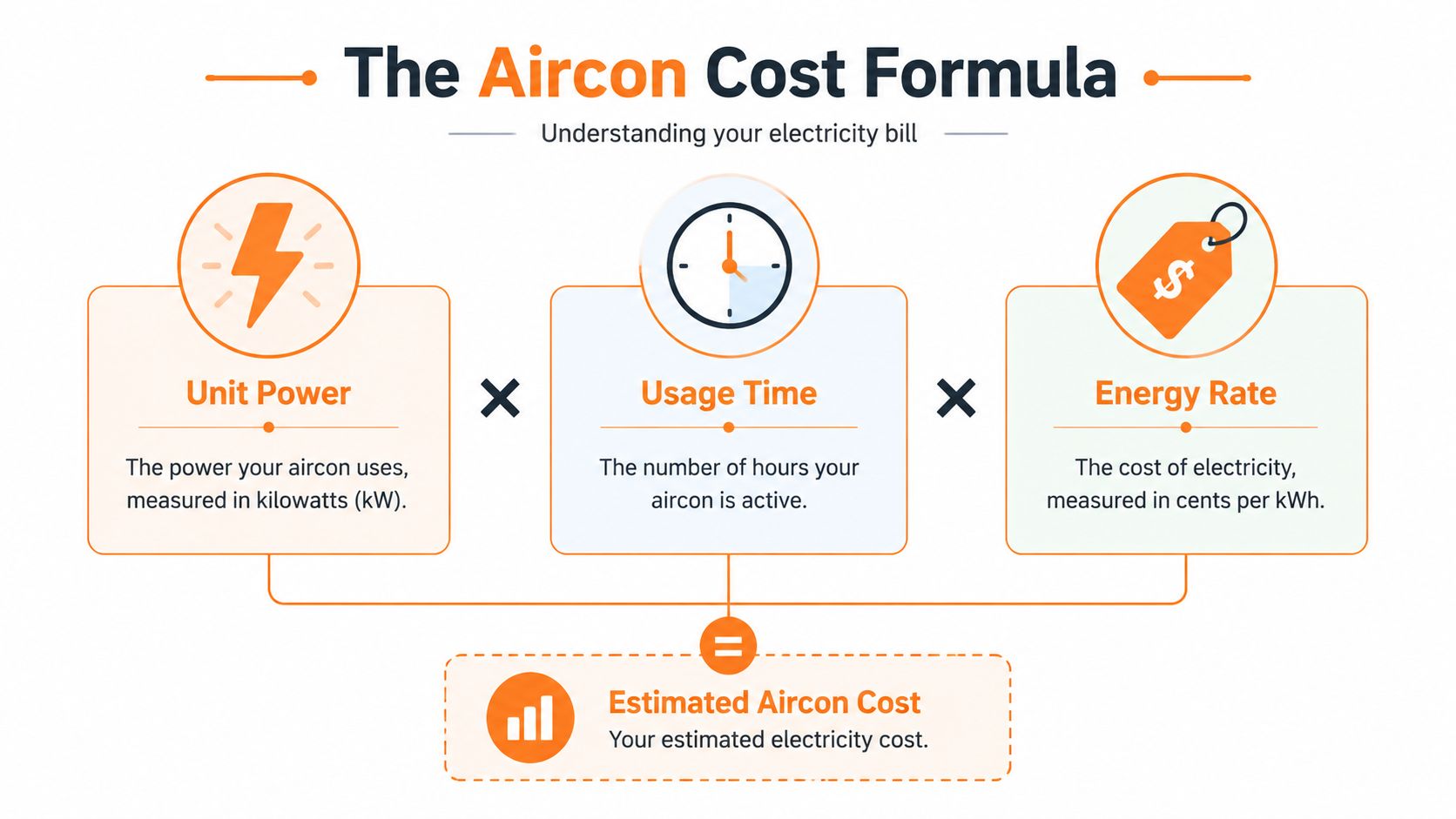
Aircon costs confuse people because bills mix together energy use, tariffs, and supply charges. Strip that away and the core formula is straightforward:
Power (kW) × Time (hours) × Rate ($/kWh) = Cost
What the terms actually mean
Think of kilowatts (kW) as the speed electricity is being used. A larger aircon system usually has a higher draw.
Think of kilowatt-hours (kWh) as the amount consumed over time. If a system draws electricity for longer, total kWh rises even if the unit itself doesn't change.
Your tariff is what your retailer charges per kWh. That can be a flat rate or a time-of-use rate, where daytime, shoulder, and peak periods cost different amounts.
A simple example
If an aircon draws 5kW while operating, runs for 4 hours, and your electricity rate is $0.30 per kWh, the usage cost is:
- 5 × 4 × 0.30 = $6.00
That doesn't always mean the unit pulls 5kW every minute it's switched on. Inverter systems ramp up and down. Ducted systems also cycle according to heat load, thermostat settings, insulation, and humidity. But the formula still gives you a sound working estimate.
Where homeowners usually go wrong
It is common to underestimate one of three things:
- Actual runtime. The system may be “on” for far longer than expected.
- Tariff timing. Evening use can cost more than midday use.
- Whole-home consumption. The aircon may be the main driver, but not the only one.
A practical place to check your real household consumption pattern is your meter data. High-resolution usage data often shows exactly when cooling is driving the bill. If you want to understand that side properly, it helps to know how to read your electricity meter.
Practical rule: If you don't know your tariff and your usage window, your aircon cost estimate is only half complete.
Real-World Aircon Running Costs in NSW and QLD
A typical NSW or QLD summer pattern is easy to recognise. The aircon goes on in the late afternoon, stays on through dinner, then keeps running into the evening when tariffs are often highest. That is how a system that feels manageable day to day turns into a bill problem.
For many households in Queensland and New South Wales, reverse-cycle ducted air conditioning systems cost an average of $0.45 to $0.75 per hour to run, and a 10kW system can cost $3.50 to $8 per day at typical daytime electricity rates, adding over $500 to a bill across a 4-month summer period, based on this NSW and QLD ducted aircon cost reference.
Worked examples for a 10kW ducted system
A 10kW ducted reverse-cycle system is a useful benchmark for larger homes in NSW and QLD because it sits in the range many 4-bedroom family homes use.
| Scenario | Running cost |
|---|---|
| Hourly cost | $0.45 to $0.75 |
| Daily cost | $3.50 to $8 |
| 4-month summer impact | Over $500 |
| Annual running cost benchmark | Varies materially by usage pattern and tariff |
That yearly total can swing hard for one practical reason. A 10kW ducted system rarely runs under identical conditions from house to house. Runtime changes with outdoor temperature, setpoint, zoning, insulation quality, and whether the system is covering the whole home or only the rooms that are occupied.
Why one home pays far more than another
The tariff matters, but it is only one part of the picture.
A well-zoned inverter system in a sealed home can stay relatively controlled on cost. The same size system in a drafty house with poor duct insulation, low afternoon shading, and long evening runtime can cost much more because it works harder for longer. Humidity also matters in coastal Queensland. Even when the thermostat setting looks reasonable, the unit may keep drawing power to remove moisture and maintain comfort.
Timing is the part many homeowners miss. If most cooling happens in the late afternoon and evening, the aircon is often running during the most expensive window on a time-of-use plan. Households trying to trim summer costs should check how off-peak electricity options in Australia line up with their actual cooling hours, not just their retailer's headline rate.
What this means if you have solar or a battery
The practical lesson is not just that aircon costs vary. It is that the same cooling load can be funded in very different ways.
If your system runs mainly after solar production drops away, grid imports do the heavy lifting and the bill rises fast. If you have a battery, the question shifts from simple cost calculation to cost removal. A battery can cover part of that evening cooling load. A battery in the right virtual power plant setup can go further and help offset aircon costs by turning stored energy into bill credits or revenue at the times the grid values it most.
A ducted system becomes expensive when high runtime, poor home performance, and costly tariff windows stack up together. Battery owners have more room to fix that than many realise.
Comparing Costs Grid vs Solar vs Virtual Power Plant
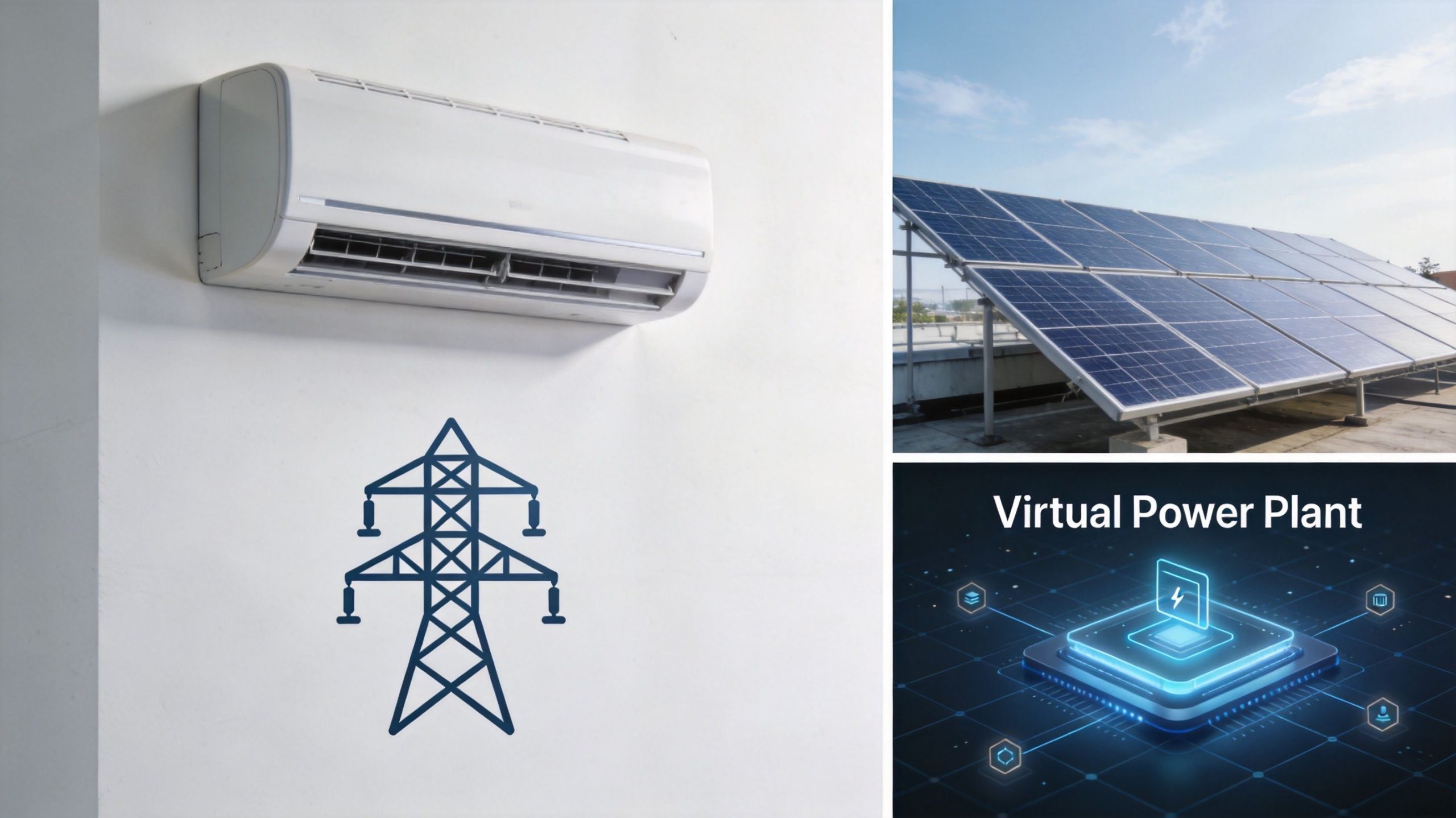
A homeowner with a ducted system can see three very different outcomes from the same cooling load. The aircon might be funded by full-price grid imports, by daytime solar that would otherwise be exported cheaply, or by a battery strategy that cuts imports and earns credits through a Virtual Power Plant.
Grid-only
Grid-only is the expensive baseline because every kilowatt-hour for cooling is bought from your retailer.
The formula stays simple:
Aircon cost = kWh used × import tariff
If a system uses 3kWh over an evening block and your tariff is 35c/kWh, that cooling session costs $1.05 before daily supply charges. Stretch that across a long hot spell and the bill climbs quickly. You also wear the full risk of peak pricing and tariff timing.
Rooftop solar only
Solar cuts that cost well when cooling lines up with solar production.
The formula changes to:
Aircon cost = grid imports × tariff, after solar covers part of the load
If the same 3kWh cooling session happens while rooftop solar is producing and 2kWh is supplied on site, only 1kWh needs to be bought from the grid. At 35c/kWh, the direct running cost drops to 35 cents. That is why pre-cooling in the middle of the day often makes financial sense, even if comfort is needed later.
The limitation is obvious in practice. Many NSW and QLD households need the most cooling from late afternoon into the evening, right as solar output fades. Solar-only homes still fall back to grid imports when the expensive hours start.
Solar, battery, and VPP
A battery changes the funding source again. Instead of exporting surplus solar for a modest feed-in credit and then buying power back later at a much higher rate, you can store that solar and use it for evening cooling.
The working formula becomes:
Aircon cost = remaining grid imports × tariff, minus any battery and VPP credits
That final part matters. A battery is not just there to shift solar into the evening. Under the right plan, it can also earn bill credits or revenue by supporting the grid during high-value periods. That is the step many aircon cost guides miss. They stop at reduction. Battery owners should also look at elimination.
For households trying to work out whether their battery is doing that, home energy monitoring for solar and battery performance is the fastest way to see when cooling load hits, when the battery discharges, and whether expensive imports are still slipping through.
The real trade-offs
This approach only works if the battery is managed well. A battery that empties too early on general household load may have little left for the evening aircon peak. A battery reserved too aggressively for backup may save less than expected. VPP participation also needs to be weighed against battery size, export limits, household usage patterns, and plan design.
In practical terms, the best setup usually does three things:
- uses solar first during the day
- saves battery capacity for the expensive cooling window
- lets spare capacity participate in a VPP when the economics stack up
Efficiency still matters because every kilowatt-hour you avoid needing is one you do not have to buy, store, or replace later. If you want a good checklist, this guide on how to improve hvac efficiency covers the mechanical side well.
The cheapest aircon is not always the most efficient unit on paper. It is the system whose cooling load is covered by your own solar, timed battery discharge, and VPP credits instead of late-day grid imports.
Practical Strategies to Reduce Your Aircon Bill
A typical summer blowout goes like this. The house heats up all afternoon, the aircon gets hammered from 4 pm onwards, and the expensive imports start right when solar output is fading. The cheapest fix is usually not a new unit. It is cutting the cooling load early, then covering more of the remaining demand with lower-cost energy.

Start with the parts that change runtime fast. Heat entering through western windows, dirty filters, poor zoning, and leaky doors all force longer compressor cycles. Every extra kilowatt-hour your aircon needs is one you must buy from the grid, supply from solar, or discharge from the battery. If you own a battery, reducing that demand does more than save energy. It preserves stored capacity for the evening peak or for higher-value use through a VPP.
What works for almost every home
The first job is reducing heat gain before the system has to deal with it.
- Shut curtains and external blinds early on hot-facing windows, especially western glass.
- Clean or replace filters on schedule so airflow stays within spec.
- Use zoning properly and cool the rooms people are using.
- Seal obvious gaps around doors, windows, and exhaust penetrations.
- Check duct condition if you have ducted air. Lost conditioned air is paid-for cooling that never reaches the room.
A lot of households skip the basics because they do not feel technical. They still matter. Poor airflow, duct losses, and solar heat gain can add hours of unnecessary runtime across a hot week. For a practical maintenance checklist, this guide on how to improve hvac efficiency is useful.
For homes with rooftop solar
Solar changes the timing strategy.
Pre-cooling works best when the house is still reasonably stable and rooftop generation is strong. If a severe afternoon is coming, running the system a bit earlier can lower the indoor temperature and the building fabric temperature before tariffs hurt most. The aim is not to make the house cold. The aim is to reduce the late-day recovery load that usually drives the highest-cost imports.
A simple rule helps. Use your solar window to remove heat from the house before the evening peak asks the aircon to do the hardest work.
You also need visibility. A good home energy monitoring setup for solar and battery performance shows when the aircon load starts pushing you back onto grid power and whether your timing changes are working.
For battery owners
Battery owners can go further than bill reduction. They can aim for cost elimination on part of their cooling load.
The practical order is straightforward:
- pre-cool while solar production is high
- reserve battery capacity for the late-afternoon and evening cooling window
- avoid draining the battery too early on low-priority household loads
- use spare battery value through a VPP if the plan economics stack up
That last point is where many articles stop too early. Fans, filters, and thermostat tweaks help. They do not change the fact that evening aircon can still land in an expensive tariff window. A well-managed battery can cover that window. A battery participating in the right VPP can also create credits or revenue that offset cooling costs more aggressively than efficiency measures alone.
Manual control can work, but hot days punish guesswork. Automated battery and tariff-aware control is usually more consistent because it can respond to forecast solar, household demand, and the periods when stored energy is worth the most.
Here's a practical explainer on operating air conditioning more efficiently in real homes:
What usually does not work
Some habits keep bills high even when the aircon itself is decent:
- Cooling the whole house without zoning discipline
- Waiting until the home is already heat-soaked
- Ignoring duct leakage and airflow problems
- Setting the battery aside only for blackout backup
- Using solar passively instead of timing cooling around production
The common thread is poor timing. Aircon costs drop fastest when you reduce the load first, shift cooling into cheaper energy windows second, and then use the battery as an active financial asset rather than a passive storage box.
Why Most Battery Owners Underutilise Their Asset
A lot of battery owners make a reasonable but incomplete assumption. They see the battery as a way to store daytime solar and use it later, or as a backup source during an outage. Both uses matter. Neither captures the full economic opportunity.
A battery is an energy asset. If it sits full, partially idle, or is only used reactively, the household isn't extracting its full value. That's especially true in the National Electricity Market, where demand conditions and peak periods create windows in which stored energy is far more valuable than it looks on a standard bill.
The passive battery mindset
The passive view says:
- charge from solar,
- discharge for the house,
- hold the rest.
That approach improves self-consumption, but it often leaves spare capacity underused. In practical terms, the household may still import power at expensive times on some days while the battery's broader earning potential remains untapped.
The performance view
The stronger view is to treat the battery like a managed asset that can serve two jobs at once:
| Battery role | Household impact |
|---|---|
| Store solar for later use | Lowers reliance on late-day grid imports |
| Support grid demand when spare capacity exists | Creates financial value that can offset bills |
That second role is what many owners never build into their decision-making. They think only about stored electricity. They don't think about coordinated discharge, demand response, or retailer structures that can convert battery participation into bill relief.
Most battery systems are installed well enough. Far fewer are operated well enough.
Why this matters for cooling costs
Aircon is one of the clearest examples of battery underuse because cooling demand often arrives when grid prices are least forgiving. If your battery only passively follows household load, you may reduce some costs. If it's actively optimised within a broader strategy, it can do much more work for the same household.
That's the difference between owning hardware and running it for financial performance.
Key Takeaways
- The basic formula is simple. Aircon cost comes down to power × time × electricity rate.
- Ducted systems can add serious cost. In NSW and QLD, a reverse-cycle ducted system commonly runs at $0.45 to $0.75 per hour, with a 10kW system costing $3.50 to $8 per day in typical daytime conditions.
- Large systems can become a major annual expense. Verified benchmark data places a standard 10kW ducted reverse-cycle system at $1,200 to $2,200 per year in NSW and QLD, depending on runtime and tariff conditions.
- Solar helps, but timing limits it. Rooftop solar reduces daytime cooling costs best when aircon use aligns with generation.
- Battery storage changes the equation. It lets households shift some solar value into later hours when cooling demand is still high.
- A VPP can go further than simple self-consumption. For qualifying battery owners in QLD and NSW, participation can offset 70% to 90% of running costs associated with aircon.
- Building performance still matters. Better insulation, tighter ducts, and smarter runtime planning can materially lower operating cost before any VPP benefit is added.
- The biggest mistake is treating a battery as idle insurance. A battery can be a performance asset, not just a backup device.
- The practical goal isn't just to calculate aircon costs. It's to reduce them by changing when the system runs, what powers it, and how your existing energy assets are used.
Unlock Your Battery's Full Value with High Flow Energy
Most battery owners focus on installation quality. Far fewer focus on ongoing performance and optimisation. High Flow Energy is an electricity retailer built around realizing the full value of your existing solar and battery system.
That matters because battery value doesn't come from ownership alone. It comes from how intelligently the battery is coordinated across household demand, solar generation, and grid support opportunities. A standard retailer won't usually optimise that for you. A retailer-built BYOB VPP is designed to.
High Flow Energy works with homeowners in Queensland and New South Wales who already have rooftop solar and a compatible battery. The focus is simple. Improve battery utilisation, create financial value through coordinated participation, and turn an underused asset into a stronger electricity outcome for the household. Customers retain ownership of their system and household needs remain the priority.
If you would like to understand whether your battery is underperforming financially, request an eligibility assessment today.
Your Questions About Aircon Costs Answered
Is a higher star rating really worth it?
Yes, especially if your aircon runs hard through summer. Verified Australian data indicates inefficient units below 4 stars can inflate costs by 25% to 40%, while SEER ratings above 5 can reduce this by 30%, according to the verified source material provided earlier. If you're replacing an older unit, efficiency should be one of the first filters, not an afterthought.
Is it cheaper to leave aircon on all day or turn it on only when needed?
Usually, neither extreme is ideal. Leaving it on unnecessarily increases runtime. Waiting until the home is heat-soaked can force the system to work much harder. In practice, controlled pre-cooling and targeted operation tend to work better than all-day continuous use or last-minute heavy cooling.
Does humidity make aircon more expensive to run?
Yes. Humidity increases the cooling burden because the system has to remove moisture as well as heat. That's why some humid parts of NSW and QLD can feel more expensive to cool even when the temperature reading doesn't look dramatically different.
Will VPP participation wear out my battery faster?
Battery cycling is a real consideration and should be assessed properly, but well-structured participation is designed around compatible systems, operating limits, and controlled dispatch. The important question isn't “does the battery cycle?” Batteries are built to cycle. The better question is whether the value created outweighs the operational use and whether the program respects household priority and warranty settings.
Are all batteries compatible with a VPP?
No. Compatibility depends on the battery brand, inverter environment, communications capability, and the operator's platform. Some systems integrate cleanly. Others don't. Eligibility needs to be checked before assuming a battery can participate.
Can insulation really make a meaningful difference?
Yes. Poor insulation increases heat gain and forces longer runtime. For ducted systems, the house and the ductwork matter almost as much as the machine itself. A strong aircon in a weak building envelope will still produce a weak bill outcome.
Does duct leakage matter if the aircon seems to cool fine?
Yes. A system can still appear to cool while wasting conditioned air in the roof space or through poorly sealed runs. Leakage reduces delivered performance and increases cost. It's one of the most overlooked causes of disappointing summer bills.
If you already have solar and a compatible battery, HighFlow Energy can help you assess whether that asset is delivering its full financial value. Check your eligibility to see whether a BYOB Virtual Power Plant could reduce your electricity costs, offset aircon usage, and improve overall battery performance.