

Solar Battery for Power Outage: 2026 Australian Home Guide
When the street goes dark in the middle of dinner, most homeowners learn the same lesson fast. Rooftop solar on its own usually doesn't keep the house running. If your system is a standard grid-tied setup, it shuts down when the grid fails. The panels may still be sitting in full sun, but your home won't have usable power.
That's why so many people start searching for a solar battery for power outage protection. In Queensland and New South Wales, that search usually comes from a practical place. Keep the fridge on. Keep the internet up. Keep phones charged. Keep a medical device running. Maybe keep work from stopping if the outage stretches into the next day.
A battery can solve that problem, but only if the system is configured properly. The battery needs to isolate from the grid safely, support the right circuits, and manage stored energy sensibly. A poor setup gives false confidence. A well-designed one gives control.
There's also a second question that matters more than many homeowners expect. If you've already invested in solar and battery hardware, is that asset doing anything useful when the grid is operating normally?
For many households, the answer is no. The battery sits there as insurance for a blackout that may or may not happen soon. A more intelligent approach is to protect outage reserve and optimise the battery financially the rest of the time. That's where VPP participation becomes relevant, provided the homeowner stays in control.
Introduction
A grid outage changes how your home's electrical system behaves. Under normal conditions, your home is synchronised with the wider network. Your inverter expects that network to be present, stable, and safe. When that reference disappears, standard solar systems shut off.
The reason is safety. Utilities and installers call this anti-islanding. If a normal solar inverter kept exporting power into damaged network lines during an outage, it could create a risk for lineworkers and for equipment on the street.
A battery-backed system works differently. It can disconnect from the grid and form its own local power supply for the home. That's often called islanding. A simple way to think about it is a boat untying from the dock. While the dock is unavailable, the boat can still move because it carries what it needs to operate independently.
Practical rule: If your goal is blackout protection, don't ask only “Do I have solar?” Ask “Can my system isolate and keep selected circuits running safely?”
For homeowners in NSW and QLD, that distinction matters more than the panel count on the roof. A home with solar only may still go dark in a blackout. A home with a battery, the right inverter, and the right switching hardware can continue powering essentials.
That represents the starting point for outage resilience. The next step is making sure the system is sized for your loads and managed in a way that protects both household security and long-term value.
How a Solar Battery Provides Power During an Outage
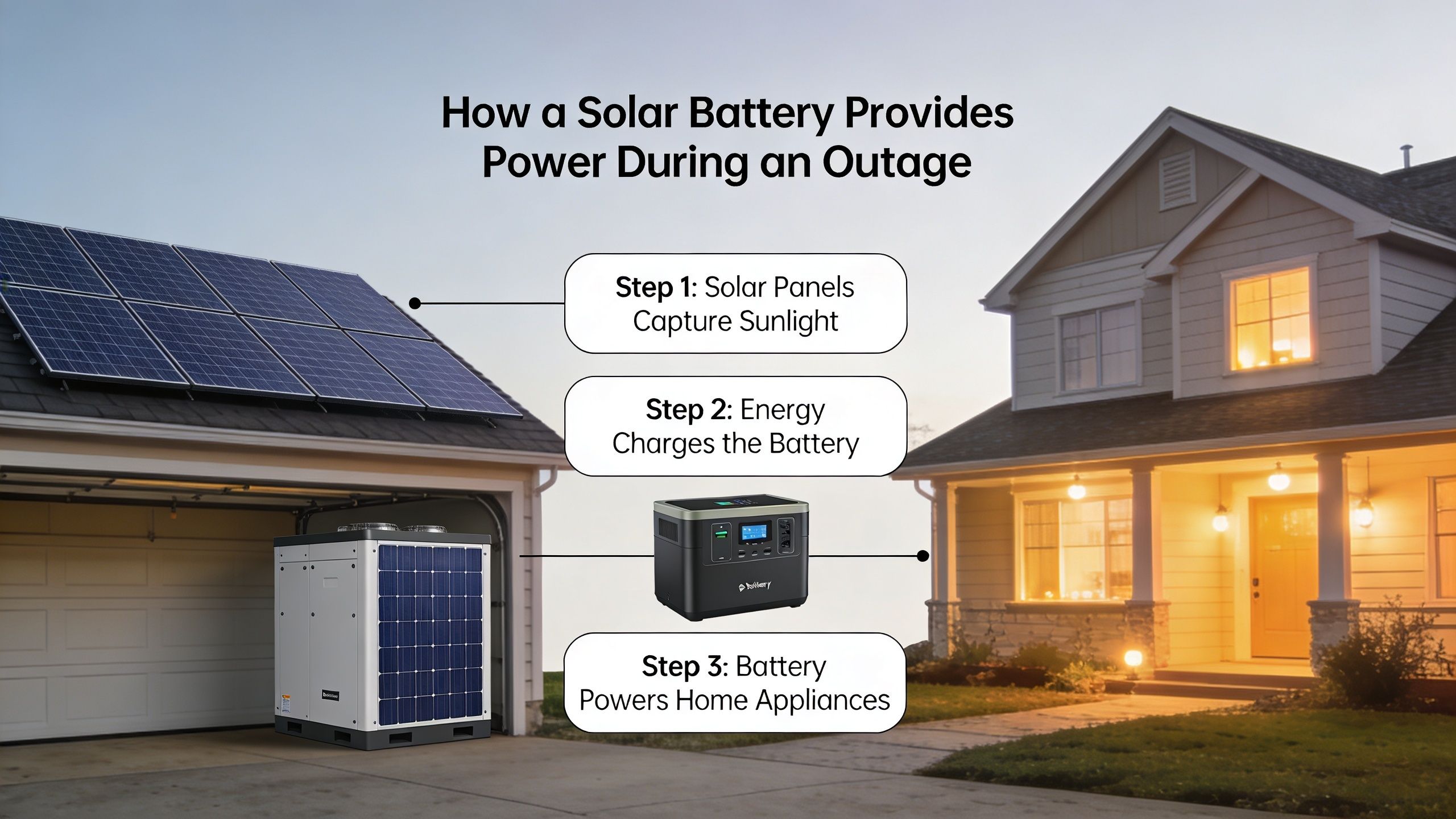
The practical test happens a few seconds after the street goes dark. If the system is designed for backup, the battery and inverter separate the home from the grid, hold voltage and frequency locally, and keep power flowing to the circuits assigned for backup. If it is not designed that way, the whole house shuts down even if the roof is covered in solar panels.
What changes the moment the grid fails
In a blackout, a backup-capable system stops following the grid and starts supplying the home directly. The battery inverter becomes the source that your backed-up circuits synchronise to. That operating mode lets the home keep running safely while the network remains offline.
A standard grid-tied solar inverter cannot do that on its own. It is built to shut down when the grid reference disappears, which is why solar-only homes usually lose power during an outage.
For homeowners, the difference is operational, not cosmetic:
- Solar only means the system shuts off during a standard outage
- Solar plus battery with backup configuration means selected circuits can keep operating
- Solar plus battery plus daytime solar production means the battery can recharge while the house is islanded, which can extend backup time materially
Backup performance depends on load control
Battery capacity matters, but outage performance is really a match between stored energy, inverter output, and the loads left running. A fridge, lights, router, garage door and a few power points are a realistic backup plan. Whole-home air conditioning, electric resistance heating, ovens and EV charging change the equation fast.
The U.S. Department of Energy explains that solar panels can continue to support the home during an outage only when paired with battery storage and controls that allow the system to operate independently from the grid: https://www.energy.gov/eere/solar/homeowners-guide-going-solar. That technical point matters commercially. The battery is not just a box of stored energy. It is part of a controlled backup system, and the value of that system depends on which circuits it is asked to carry.
According to Solar.com's outage backup guide, a 10 kWh battery can often cover critical household loads for about a day, and in some scenarios longer, if heating and cooling are excluded and solar generation is available during the outage. The same guide notes that homeowners usually do not get the full nameplate capacity in practice because a small reserve is commonly held back for battery health and system restart requirements.
A battery performs well in a blackout when the backup loads are planned around it, not when the house treats it like an unlimited grid replacement.
Solar makes the backup system far more useful
A battery-only backup plan is finite. A battery paired with solar can recover energy through the day and carry essential loads into the evening, provided the inverter, switching hardware and backup circuits are configured for islanded operation.
That is also where the financial side starts to matter. A battery bought only for rare outages can feel like an insurance expense. A battery enrolled in a well-structured VPP can earn value through normal operation while still preserving a homeowner-defined backup reserve for blackouts. That shifts the system from a pure resilience purchase to an asset that supports both outage security and return on investment.
For outage protection, the right question is not whether the home has a battery. It is whether the system can isolate safely, supply the right circuits, recharge from solar during the day, and hold back enough stored energy to protect the household when the grid is down.
Estimating Your Battery Size and Runtime for Outages
At 7:30 pm in a blackout, battery size stops being a brochure number. It becomes a simple question. How many hours can the house keep the loads that matter alive?
Most households get better outage protection by sizing for selected circuits rather than trying to carry the whole home. Refrigeration, internet, lighting, communications, garage access, a home office and any medical equipment usually make the cut. Large resistive and motor loads usually do not, unless the budget and system design were built around them from day one.
Start with loads, not battery brand
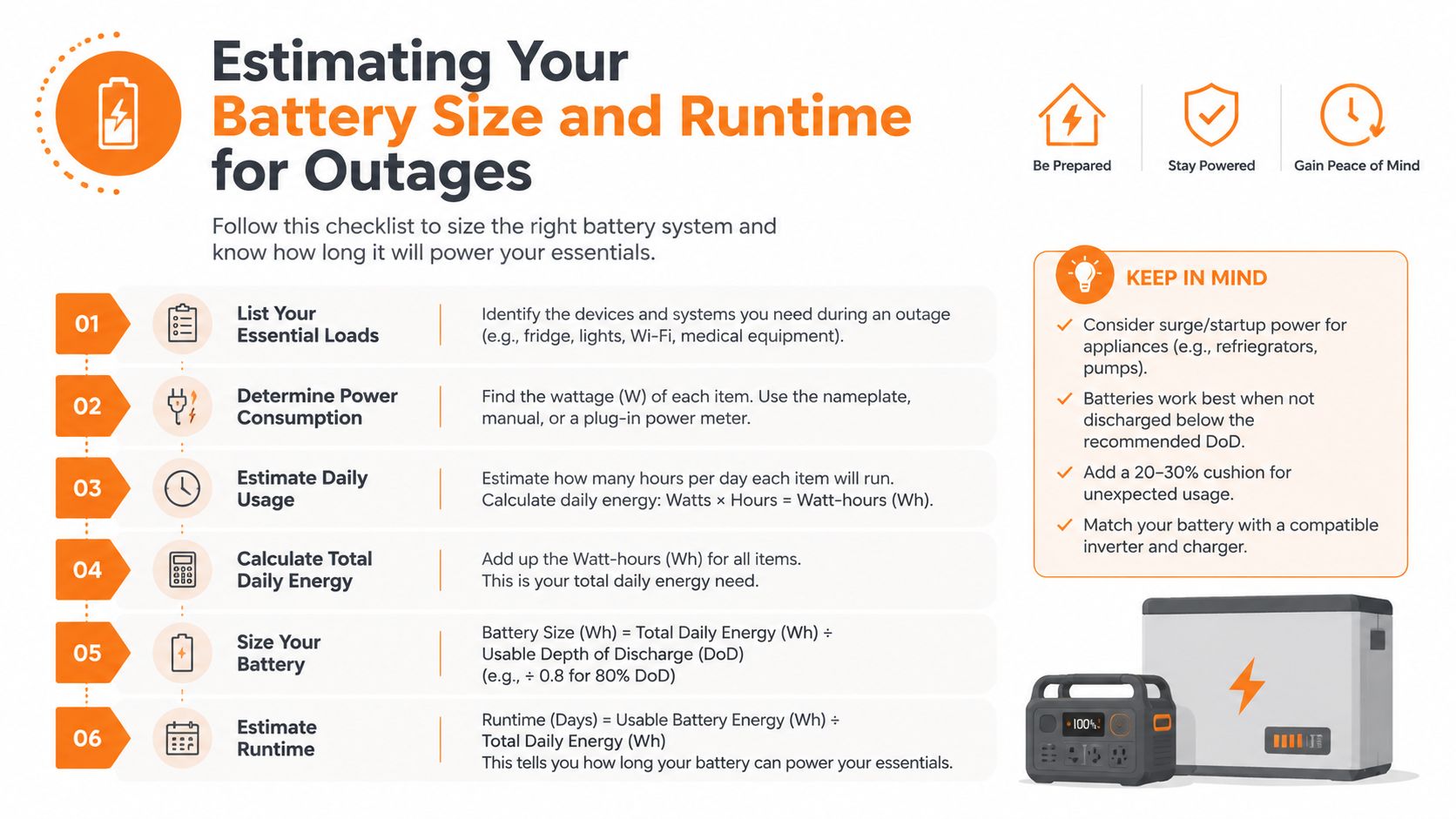
A sound outage plan starts with an energy audit. Go circuit by circuit and sort demand into two groups.
Critical loads
Fridge, internet, a few lights, phone charging, garage door, home office essentials, medical equipment.Deferred loads
Air conditioning, electric heating, ovens, pool pumps, EV charging, electric hot water boosters, large workshop tools.
That exercise does two jobs. It shows how much storage you need for backup, and it often shows where a homeowner is paying for battery capacity that will rarely be used well.
Two measurements drive the estimate:
- kW is instantaneous power. It shows what an appliance draws while operating.
- kWh is energy over time. It shows how much battery capacity that appliance uses across the outage.
A fridge is a good example. Its running power is modest, but it cycles all day. That makes it a small kW load and a meaningful kWh load. Backup sizing usually goes wrong when people focus on appliance wattage and ignore runtime.
A simple way to estimate daily backup needs
Use a basic worksheet:
- List the appliance or circuit
- Estimate its power draw in watts
- Estimate how many hours per day it will run during an outage
- Convert to kWh by multiplying watts by hours, then dividing by 1,000
Here is a simple planning table:
| Appliance | Power (Watts) | Hours of Use per Day | Daily Energy (kWh) |
|---|---|---|---|
| Refrigerator | |||
| Wi-Fi and modem | |||
| LED lighting | |||
| Laptop charging | |||
| Medical device | |||
| Garage door use | |||
| Phone charging |
Use the equipment label, product manual, monitoring data or installer measurements where possible. Generic averages are fine for a first pass, but they are a poor basis for a resilience investment.
One more practical point matters. Starting surges can be far higher than normal running load for appliances with motors or compressors. Runtime is a kWh question. Whether the system can start and carry that load is a power electronics question.
Usable capacity matters more than headline capacity
Nameplate storage is only the starting point. What matters in an outage is usable capacity after the system's operating limits, reserve settings and chemistry constraints are applied.
Depth of Discharge, or DoD, describes how much of the stored energy can be used routinely. Battery University's explanation of depth of discharge and battery cycle life is a useful reference point here. In practical residential terms, a battery with a 10 kWh nameplate and 90% usable capacity gives roughly 9 kWh to work with before any backup reserve policy is considered.
That difference is commercially important. Two systems can both be sold as “10 kWh” and still deliver materially different outage performance once usable capacity and reserve settings are applied.
Compare usable kWh in backup mode, not just the battery size on the quote.
Runtime depends on battery size, load discipline and solar recovery
A straightforward estimate looks like this:
Usable battery capacity (kWh) ÷ backup load (kW) = approximate runtime (hours)
If the backed-up circuits are averaging 1 kW and the battery has about 9 kWh available to those circuits, runtime is about 9 hours. If the average load falls to 0.5 kW, the same battery can cover much longer. If someone turns on a kettle, heater or ducted cooling on the backup board, runtime drops quickly.
Solar changes the equation. In daylight, the PV array can support live loads and recharge the battery, which can extend backup well beyond what the battery alone could supply. That is one reason system architecture matters. Homes adding storage to an existing solar system often need to understand whether an AC-coupled battery setup will support the intended backup strategy and operating mode during an outage.
For VPP participants, reserve settings deserve the same attention as battery size. A well-structured VPP should let the homeowner define a minimum state of charge for outages, so the battery can earn value in normal operation without turning blackout protection into an afterthought. That is the point where resilience starts making financial sense. The asset is not sitting idle waiting for a rare event, but it is also not being run down in a way that leaves the household exposed.
Size for the outage you want to ride through
The right battery size depends on what the household is trying to protect.
A short-duration outage plan can be built around food safety, lighting, communications and basic access. A longer-duration plan usually needs tighter load selection, daytime solar recovery, and realistic expectations about heating, cooling and hot water. The trade-off is simple. Bigger batteries can cover more load for longer, but they cost more, and the return improves only when the system is also configured to earn intelligently between outages.
That is why battery sizing should be done from the homeowner's priorities upward. Start with the loads, convert them into daily energy, apply usable capacity, then decide how much reserve should be protected from normal VPP dispatch.
Essential Hardware for Seamless Blackout Protection
The fastest way to misunderstand outage protection is to think the battery does all the work. It doesn't. The battery stores energy, but the rest of the system decides whether that energy is available, where it flows, and how smoothly the home transitions when the grid fails.
The three components that determine whether backup actually works
Hybrid inverter or battery-ready inverter
This is the control centre. It manages power from the roof, battery, grid and household circuits. In normal operation, it decides when to charge, discharge or export. In an outage, it must support islanded operation safely.
Automatic Transfer Switch
This is what separates the home from the grid when there's a fault. According to this discussion of emergency solar operation, post-2025 NEM reforms in QLD and NSW allow compatible VPP batteries to legally operate in island mode during an outage, and systems with an Automatic Transfer Switch such as a Tesla Powerwall can isolate from the grid in under 10 seconds. The same source notes that daytime solar can then power essentials and recharge the battery, extending backup from hours to potentially days.
Critical loads panel
This prevents the battery from being wasted on low-priority circuits. It's usually the quiet hero of a good backup design. By isolating essential circuits, it turns limited stored energy into practical runtime.
The VPP objection usually points at the wrong problem
Some homeowners assume that joining a VPP weakens blackout protection. In practice, outage security is more often compromised by poor system design than by intelligent battery participation.
If the hardware cannot isolate cleanly, if the backup circuits were never configured properly, or if the inverter is not suited to islanded operation, a VPP is not the issue. The issue is that the system was never fully blackout-ready.
This is also where AC-coupled retrofit questions matter. If you already have solar and are evaluating battery integration pathways, AC-coupling battery configurations are worth understanding because coupling method affects how existing solar, inverters and backup behaviour work together.
What works and what doesn't
What works
- Selective backup of essential circuits
- Fast isolation from the grid
- Daytime solar recharge during an extended outage
- User-defined reserve logic combined with compatible hardware
What doesn't
- Assuming all batteries provide blackout capability by default
- Expecting whole-of-home operation from a system designed for essentials only
- Ignoring switchboard and inverter compatibility
- Treating outage protection as a battery purchase rather than a system design question
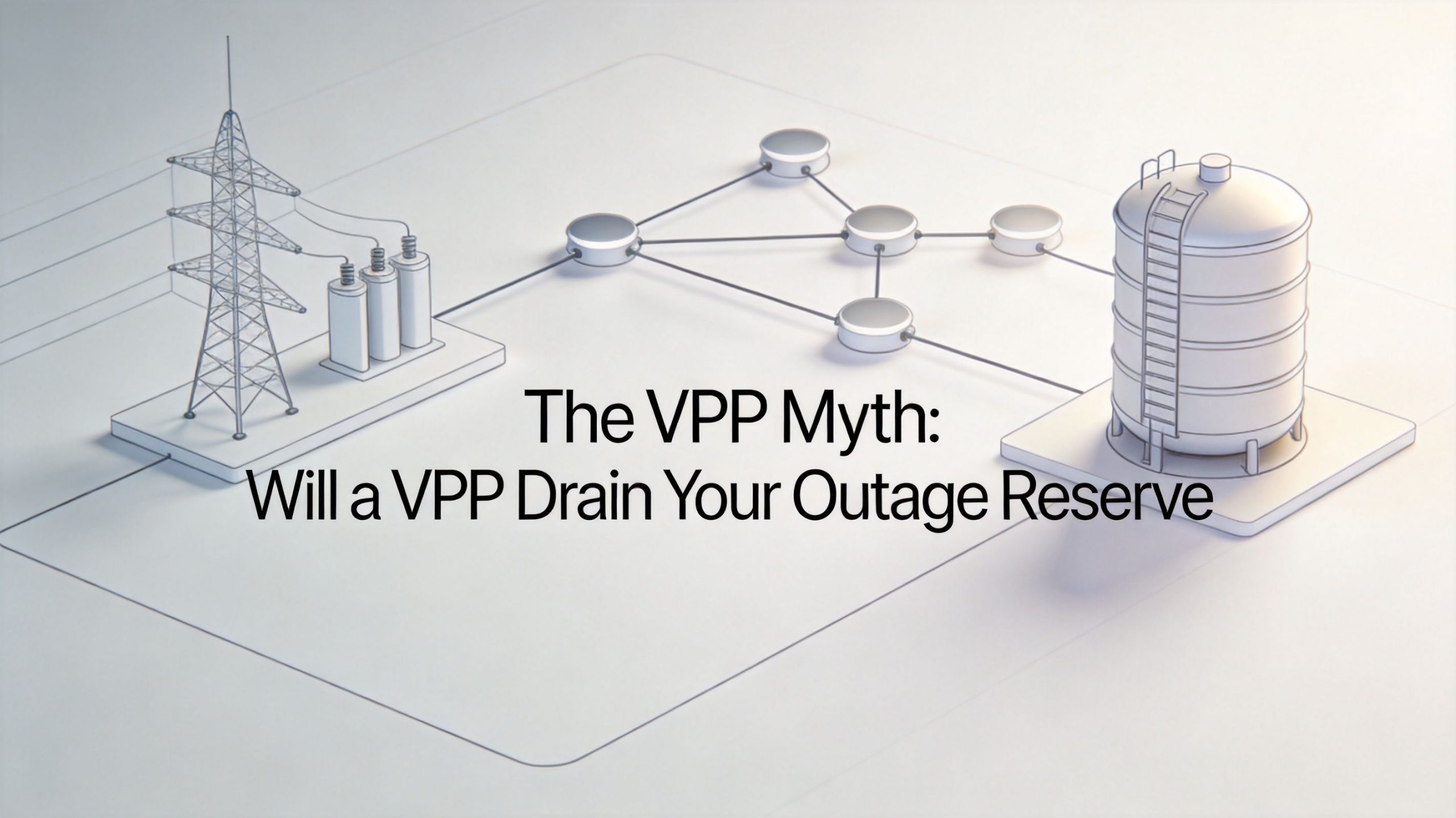
The VPP Myth Will a VPP Drain Your Outage Reserve
This is the objection that matters most to cautious battery owners. If the battery is participating in grid services, will it be empty when the lights go out?
For a properly managed setup, the answer is no. A VPP should use spare capacity, not the portion of stored energy you've reserved for your household.
Why the myth persists
Battery owners often picture a VPP as a remote operator draining the battery whenever the grid wants support. That concern is understandable because backup power feels personal. No homeowner wants to find out during a storm that their reserve has been traded away.
The more accurate model is operational hierarchy. The house comes first. Reserve settings define what stays protected. Grid support uses the energy above that line.
According to this review of outage behaviour and VPP reserves, a common misconception is that VPPs drain batteries and leave them empty for outages. The same source notes that VPPs like High Flow Energy prioritise homeowner needs, and that AGL's VPP trials reduced peak demand by up to 25% while using reserve settings such as 20 to 30% minimum charge to guarantee homeowners retain priority access to stored energy for personal use or outage protection.
Reserve settings are the control point
A reserve floor changes the economics and the resilience profile of the battery at the same time.
- Lower reserve gives the VPP more room to optimise around price and demand events
- Higher reserve keeps more energy available for outages
- The right reserve depends on local outage risk, household load profile and your tolerance for interruption
That's why VPP participation should never be discussed without talking about reserve management, app visibility and user override.
A battery owner who can see reserve settings and change them before storm season is in a stronger position than one who owns hardware but never reviews how it operates.
Financial optimisation and outage readiness can work together
The strongest reason to consider VPP participation isn't just the export opportunity. It's that the battery becomes actively managed instead of passively owned.
That means the household can use forecasting, event logic and reserve rules as part of one operating framework. In practical terms, your system can support the grid when spare capacity exists, then preserve your outage position when conditions change.
If you want a broader view of how these programs fit into the energy system, this overview of Virtual Power Plants driving Australia's renewable energy revolution is useful background.
Optimising Your System From Backup Asset to Financial Asset
The battery economics change once the system is configured to do more than sit full and wait for a blackout.
For a homeowner considering VPP participation, the better question is not whether the battery can provide backup. It is whether the system can protect the house during an outage and still earn its keep across the rest of the year. That is the difference between a resilience purchase and an energy asset.
Why battery chemistry affects the business case
Frequent cycling only makes sense if the battery chemistry can handle it without burning through useful life too quickly. LiFePO4 is commonly preferred for this reason. Battery University's explanation of lithium iron phosphate characteristics is a good reference point. In practical terms, this chemistry is generally well suited to repeated charge and discharge, which matters if the battery is going to support self-consumption, tariff optimisation and occasional VPP events as well as outage protection.
That shifts the decision from simple backup sizing to operating strategy. A battery with suitable chemistry and controls can hold a homeowner-defined reserve, cycle the usable portion for savings, and still remain ready for interruption risk.
What practical optimisation looks like
Good optimisation starts with visibility, not guesswork. If the homeowner cannot see state of charge, solar production, household demand and discharge timing, it is very hard to tell whether the battery is preserving value or missing it. Detailed home energy monitoring helps expose those patterns and makes reserve settings, load shifting and VPP participation easier to judge on actual performance.
Solar input also matters more than many people expect. If the array is underperforming because of dirt, pollen or dust, the battery has less energy to work with the next day. That reduces bill savings and can leave less margin before an outage. In some regions, practical advice on maintaining solar panels in dusty climates will improve outcomes more cheaply than adding extra storage.
The VPP layer should sit on top of those basics, not override them. A BYOB VPP can create additional value from spare battery capacity, but only if the operating rules preserve homeowner priority. In engineering terms, that means the control logic needs to respect reserve floors, site load requirements and user overrides. In commercial terms, it means the household gets both protection and a path to bill reduction.
High Flow Energy is one example of a BYOB VPP retailer in NSW and QLD for households with compatible solar and battery hardware already installed.
A well-configured battery system does two jobs at once. It supports outage security, and it produces financial value during normal operation. That makes the investment easier to justify, because resilience is no longer a sunk cost sitting idle for most of the year.
Key Takeaways and Practical Steps
The main mistake homeowners make is assuming outage protection is a battery checkbox. It isn't. It's a system design and operating strategy question.
Key points to keep in mind:
- Solar panels alone usually won't power your home in an outage. Standard grid-tied systems shut down when the network fails.
- A solar battery for power outage protection needs proper islanding capability. The inverter and switching hardware matter as much as the battery itself.
- Critical load design is usually more practical than whole-home backup. Protect the circuits that matter.
- Usable energy matters more than headline capacity. Battery chemistry and DoD affect what you can rely on in a blackout.
- VPP participation doesn't have to compromise backup. Reserve settings can protect household priority while spare capacity supports the grid.
- Financial optimisation changes the value equation. A battery that contributes during normal operation is a better asset than one that sits idle.
A practical next-step checklist looks like this:
Audit your critical circuits
Write down what must stay on and what can stay off.Review your hardware configuration
Confirm whether your inverter, transfer switching and switchboard setup are blackout-ready.Check your reserve settings
If your battery participates in any optimisation program, understand the minimum charge logic.Assess operating visibility
If you can't see what the battery is doing, you're making decisions blind.Vet any installer or contractor carefully
Outage protection depends on system integration quality, so basic Home Project Services contractor hiring tips are worth applying before making changes to switchboards, backup circuits or inverter arrangements.
The households that get the best outcomes usually aren't the ones with the biggest battery. They're the ones that know exactly what the battery is meant to do.
Unlock Your Battery's Full Potential with High Flow Energy
Most battery owners focus on installation quality. Far fewer focus on ongoing performance and optimisation. High Flow Energy is an electricity retailer built around accessing the full value of your existing solar and battery system.
For homeowners in Queensland and New South Wales, that means looking beyond simple self-consumption and asking whether your battery is protecting the house properly, responding intelligently to grid conditions, and creating financial value when spare capacity is available. It also means keeping homeowner priority front and centre, especially when outage protection matters.
If you would like to understand whether your battery is underperforming financially, request an eligibility assessment today.
Frequently Asked Questions
Do solar panels work during a blackout without a battery
Usually, no. A standard grid-tied solar system shuts down during an outage for safety reasons. The panels may still generate DC electricity, but without the right inverter and backup configuration, that power won't run your home.
Can a battery run the whole house during an outage
Sometimes, but that depends on system design, not just battery size. Most residential backup systems are configured for critical loads rather than whole-home operation because large loads such as ducted air conditioning and electric heating can drain stored energy quickly.
What's the difference between kW and kWh
kW measures power at a moment in time. kWh measures energy used over time. For outage planning, kWh usually matters more because it determines how long your backed-up circuits can keep operating.
Is a 10 kWh battery enough for outage backup
For many homes, it can be enough for essential circuits when managed properly. The exact result depends on what you're running, how efficiently those loads operate, and whether daytime solar can recharge the battery during the outage.
Do all batteries support blackout protection
No. Some batteries are installed mainly for energy shifting or tariff optimisation and don't provide full backup capability. You need compatible inverter behaviour, switching equipment, and backup circuit configuration.
Will joining a VPP stop me using my battery in an outage
Not if the program is structured properly. The critical issue is whether homeowner reserve settings are protected and whether household needs stay ahead of grid services.
What battery type is usually preferred for frequent cycling
LiFePO4 is commonly preferred in residential settings because of its high usable depth of discharge and strong cycle life, which makes it well suited to both backup use and more active energy management.
What should I check before storm season
Review battery reserve settings, confirm backup circuits are still configured the way you expect, make sure the system is visible in your monitoring app, and check that solar production isn't being held back by avoidable maintenance issues.
If you already have rooftop solar and a compatible battery, HighFlow Energy can help you assess whether that system is being used only as backup insurance or whether it could also be delivering stronger day-to-day financial performance through a BYOB VPP structure that keeps homeowner needs first.