

What Is Controlled Load? Maximize Your Energy Savings
You open your electricity bill, scan past usage and supply charges, and spot a separate line that says Controlled Load. For many homeowners in Queensland and New South Wales, that line item feels half familiar and half obscure. It sounds like a discount, but also like something the network controls for you. Both are true.
What is controlled load? In simple terms, it's a separate electricity tariff for specific high-energy appliances that can run when the grid is quieter. Those appliances are put on their own dedicated circuit and billed separately from the rest of the home. In return for giving the network control over when that circuit receives power, you usually get a cheaper rate for that appliance.
That sounds straightforward until you add rooftop solar, a home battery, smart meters, and Virtual Power Plant participation. Then the confusion starts. Many households assume controlled load is just another off-peak tariff, or that their battery can power a controlled-load hot water system whenever they want. In practice, controlled load works quite differently.
The decision to keep, remove, or reconfigure a controlled load circuit affects bill structure, appliance behaviour, and the value you can extract from your energy assets. A tariff that made perfect sense in an older home can become more nuanced in a battery-equipped one.
Introduction What Australian Homeowners Need to Know
Controlled load is one of the most misunderstood parts of an Australian electricity bill. It isn't your main household tariff. It sits beside it.
A home can have a standard tariff for lighting, appliances and power points, while a separate controlled load tariff applies to one or two specific heavy-use appliances. In Queensland, that may appear under tariff names such as Tariff 31 or Tariff 33. In New South Wales, it often appears as Controlled Load 1 or Controlled Load 2.
The reason it exists is practical. Some appliances don't need continuous power. An electric storage hot water system, for example, can heat water during a network-approved window and store that heat for later use. A pool pump can also run during scheduled periods rather than at any random time of day. That gives distributors a way to shift demand away from busier periods on the grid.
Controlled load is best thought of as a separate lane for heavy appliances. It still uses the same broader road network, but it runs on a different schedule and under different traffic rules.
For battery owners, the main point isn't just whether controlled load is cheaper. It's whether that lower tariff works with the way your solar, battery and retailer arrangement are set up. If you don't understand that interaction, it's easy to make the wrong optimisation decision.
The Core Mechanics of a Controlled Load Circuit
A controlled load circuit is a network-managed electricity circuit for specific appliances. It is not a cheaper rate that applies to anything you plug in. The appliance must be physically connected in a way that lets the network and retailer measure and control that usage separately.
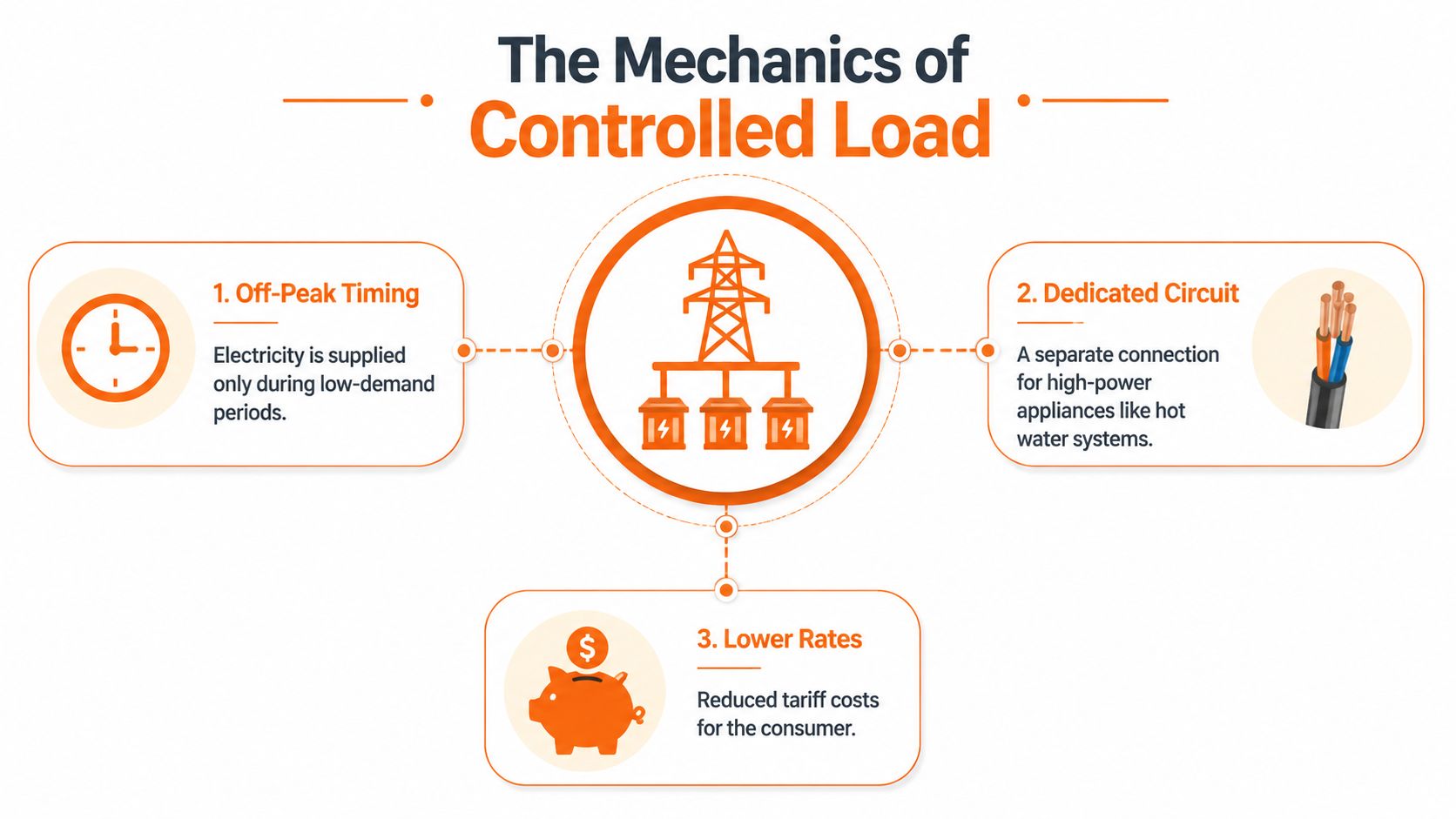
According to Automised Energy's explanation of controlled load, controlled load operates through a dedicated circuit hardwired to a separate meter that is physically controlled by the Distribution Network Service Provider, or DNSP. The DNSP uses ripple control signalling to remotely switch these circuits on during off-peak periods, typically between 11 pm and 7 am or during solar soak afternoons. In states like NSW and QLD, controlled loads operate for 6 to 18 hours daily depending on tariff type, with rates often 30% to 50% cheaper than standard peak electricity.
Why networks use it
From the grid's perspective, controlled load is a demand management tool.
If every household heated water, ran pool equipment and used every major appliance at the same time in the late afternoon or early evening, local networks would face more strain. Controlled load reduces that pressure by shifting certain predictable, high-energy tasks into lower-demand windows.
That benefits both sides:
- The network gets flexibility. It can move some load away from busy periods.
- The customer gets a lower rate for that separate circuit.
- The household doesn't lose core power access. Only the controlled appliance is affected, not your lights or kitchen outlets.
What sits on a controlled load circuit
Not every appliance is suitable. Controlled load is usually reserved for equipment that can tolerate scheduled operation.
Common examples include:
- Electric hot water systems that store heated water for use later
- Pool pumps that can run in designated windows
- Underfloor or slab heating in some homes
The core principle is simple. The appliance doesn't need unrestricted, on-demand power in the same way a fridge, oven or general power circuit does.
Controlled Load 1 and Controlled Load 2
Many individuals find this concept confusing. "Controlled load" isn't one universal product.
Two broad classifications are common in Australia:
| Type | Typical behaviour | Trade-off |
|---|---|---|
| Controlled Load 1 | Cheaper supply for a shorter period, usually in stricter off-peak windows | Lower rate, less flexibility |
| Controlled Load 2 | Supply available for longer windows, often spanning overnight and some daytime periods | More flexibility, usually not quite as cheap |
The difference matters most for hot water systems. A larger storage system may cope perfectly well with a tighter overnight window. A smaller system or a household with more variable demand may need broader supply times.
Practical rule: Controlled load is about when the network allows power to flow, not when you decide to use the appliance.
That single idea explains most of the confusion people have with this tariff.
How to Identify Controlled Load in Your Home
The easiest way to confirm controlled load is to check both your bill and your metering setup. One tells you how you're being charged. The other shows how the property is physically configured.
Start with the bill
Your bill is usually the fastest clue. Controlled load is billed separately from general household usage.
As outlined in Canstar's guide to controlled load tariffs, controlled load requires independent metering, allowing retailers to bill it separately. Queensland uses specific codes like Tariff 31 and Tariff 33, while other states use equivalent naming. This tariff operates in addition to a home's primary tariff and often includes its own small daily supply charge.
Look for these signs:
A separate usage line
You may see controlled load listed apart from general usage, sometimes under a dedicated tariff name.A second tariff code
In Queensland, Tariff 31 or Tariff 33 are common indicators.An extra daily charge
Because it is a separate metered service, there may be a small daily supply charge attached.
If your bill only shows one broad usage category and no secondary tariff reference, you may not have controlled load. Or you may need to ask your retailer how the meter channels are being presented.
Check the meter box and circuits
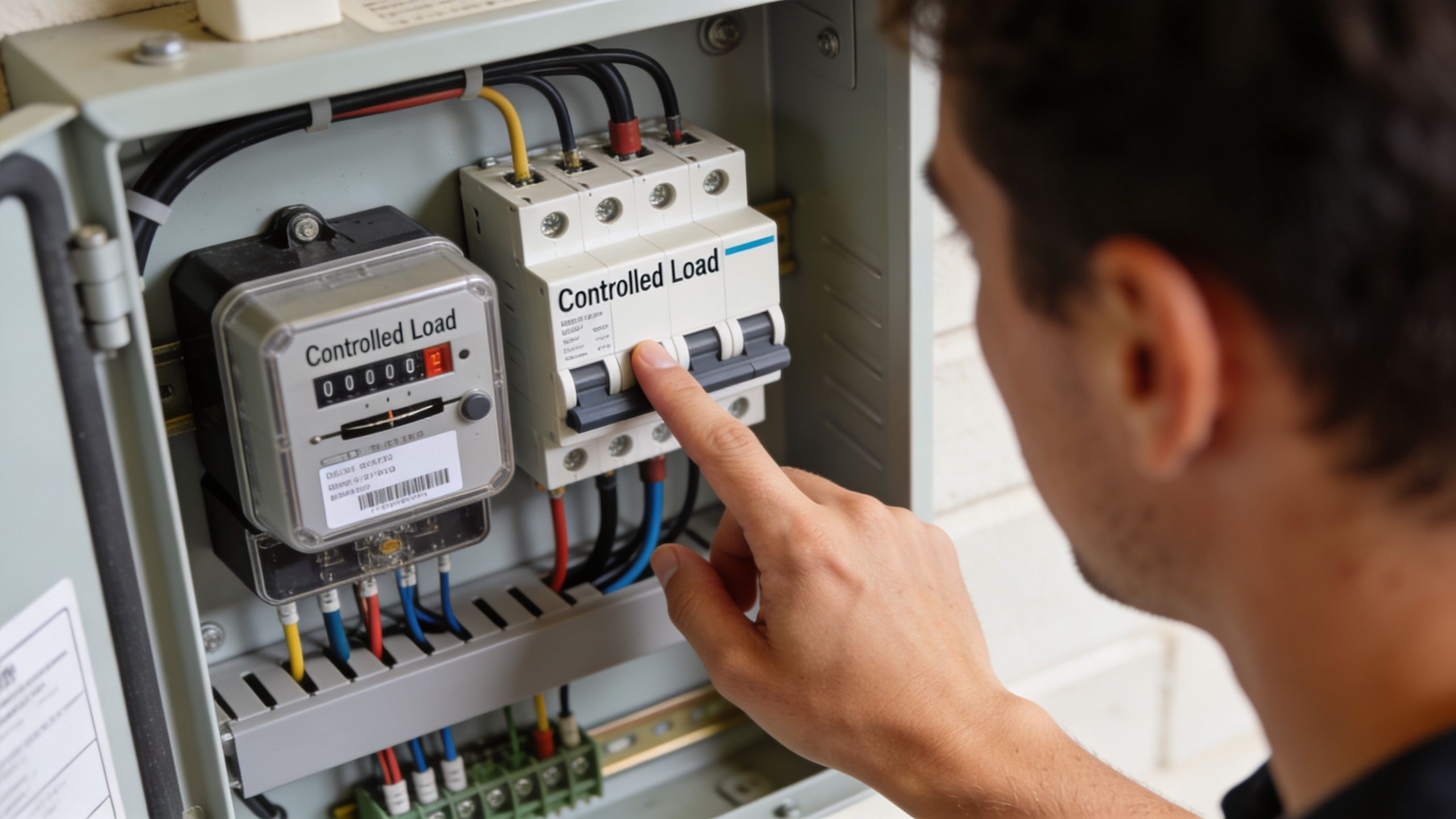
Physical inspection gives you the second half of the answer. A controlled load arrangement often shows up as one of the following:
- A separate meter, particularly in older setups
- A smart meter with multiple registers or channels
- A dedicated breaker or circuit label for hot water, pool equipment, or another fixed appliance
You won't always be able to confirm the full billing arrangement just by looking. But if you see a separately identified hot water circuit in the switchboard, that's a strong sign the property was designed for load separation.
If your switchboard is crowded, outdated, or hard to interpret, it's worth reading a practical guide on upgrading your home electrical panel before making any metering or tariff changes. In many homes, the billing question and the switchboard question are linked.
Ask one specific question
If you're still unsure, don't ask your retailer, "Am I on off-peak?" That's too broad.
Ask this instead:
"Do I have a separately metered controlled load circuit, and which appliance is connected to it?"
That wording gets to the actual issue. You want to know whether the home has a dedicated, network-controlled appliance circuit, not just a cheaper overnight rate on general usage.
Controlled Load with Rooftop Solar and Home Batteries
The old tariff structure meets the modern energy system in this context.
A household with rooftop solar and a battery often assumes that all electricity in the home is now part of one smart, flexible ecosystem. That isn't how a controlled load circuit behaves. Controlled load remains a separately metered and network-switched path.
The common misunderstanding
The most common mistake sounds logical at first: "I have solar and a battery, so my battery should be able to run the hot water system whenever I choose."
That can be true for some general circuits in some home configurations. It is not automatically true for an appliance that remains on a DNSP-controlled load circuit.
A controlled load circuit is separated for billing and control purposes. The network determines when power is available to that circuit. So even if your battery is full, that does not mean your controlled-load appliance can draw from it on demand.
How the energy pathways differ
Think of the house as having two operating layers:
| Home energy layer | What usually happens |
|---|---|
| Main household circuits | Solar generation, battery discharge, and normal retail billing interact here |
| Controlled load circuit | Network-controlled appliance supply operates on its own schedule and metering arrangement |
This is why battery owners often feel puzzled when a hot water system doesn't behave like the rest of the house. The battery may support general loads, but the controlled load circuit follows separate operating logic.
The practical result is that solar and battery systems often work in parallel with controlled load, not through it.
Why this matters for optimisation
If your appliance remains on controlled load, you may benefit from the lower dedicated tariff. But you also give up direct timing control.
That trade-off matters more in homes with strong daytime solar production. Some owners would prefer to heat water in the middle of a sunny day using self-generated energy rather than wait for a network-controlled window. Others prefer the simplicity and tariff advantage of leaving the appliance where it is.
There isn't a universal answer. The right setup depends on your hardware, metering configuration, and the way your household uses hot water or pool equipment.
For battery owners, visibility is essential. Without clear monitoring, people often assume an appliance is benefiting from solar when it is operating on a separate tariff path. A good home energy monitoring setup helps distinguish those flows and makes optimisation decisions far more grounded.
A battery can only optimise what it can actually influence. Controlled load sits partly outside that control.
The key strategic takeaway
Controlled load can still be financially sensible in a solar-and-battery home. But it isn't a free-floating smart load you can dispatch at will.
If you want an appliance to align tightly with solar production or battery strategy, the circuit arrangement matters as much as the appliance itself. Many households focus on panel size and battery capacity, then overlook the fact that one of their largest electrical loads may still be running under older network logic.
That doesn't make controlled load obsolete. It just means you need to evaluate it as part of the whole system, not as an isolated discount.
Impact on Virtual Power Plant Participation
From a Virtual Power Plant perspective, controlled load is predictable but not dispatchable.
That's a useful distinction. A VPP wants to understand what the home can do, when the battery is likely to be available, and which loads can be actively influenced. A controlled-load appliance doesn't give the VPP much direct control because the homeowner doesn't control it either.
Why controlled load is different from flexible demand
Some home loads are flexible. Dishwasher cycles can be shifted. EV charging can often be scheduled. Batteries can charge or discharge according to optimisation logic, within system and customer constraints.
Controlled load is different because the DNSP controls the operating window. The homeowner can't freely dispatch that load, and neither can the VPP operator. In practice, that makes controlled load a relatively fixed part of the household profile.
That might sound like a drawback. It isn't always one.
The forecasting advantage
A large appliance on general usage can create noisier demand patterns from the retailer's perspective. A large appliance on controlled load is more structured. The circuit activates within known network windows, and its behaviour is less random than fully discretionary consumption.
That predictability can help energy optimisation in several ways:
- Battery availability becomes easier to estimate because one major load is partially separated
- Grid support planning is cleaner because the VPP isn't guessing as much about one heavy appliance
- Household demand modelling improves because fixed and flexible loads are easier to distinguish
For modern VPP operations, that distinction matters. Participation isn't just about having a battery. It's about knowing when spare battery capacity is available for grid support events without compromising household needs.
Where the limitations show up
The downside is straightforward. If a hot water system sits on controlled load, the VPP generally can't use that appliance as an actively managed demand-response lever. The circuit's timing belongs to the network, not the household optimisation platform.
That means the VPP can't decide to pause, advance or re-time that appliance in response to a market event in the way it might with another controllable asset.
So the trade-off looks like this:
| VPP consideration | Effect of controlled load |
|---|---|
| Direct appliance control | Limited |
| Battery forecasting clarity | Improved |
| Demand response flexibility | Reduced for that appliance |
| Whole-home optimisation accuracy | Often improved |
Why battery owners should care
Many battery owners focus only on battery size, feed-in rates, or app features. Those matter, but tariff structure matters too.
A household with controlled load may be easier to optimise at the whole-home level because one of the biggest intermittent loads is already isolated. That doesn't increase control, but it can improve planning quality. In energy strategy, predictability has value.
If you're comparing retailer-based battery programs or trying to understand how orchestrated battery participation works, it's worth reading a broader explanation of Virtual Power Plants in Australia. Controlled load doesn't stop VPP participation, but it changes the optimisation environment around it.
The best VPP outcomes don't come from controlling every device. They come from understanding which parts of the home are controllable, which are fixed, and how those pieces interact.
Is a Controlled Load Tariff Still Worth It
For many households, yes. For some battery-equipped homes, not automatically.
The case for keeping controlled load is still strong when a qualifying appliance uses a lot of energy and works well within network-controlled windows. According to Jackery's overview of controlled load usage, households can potentially save $200 to $400 annually depending on appliance type and usage. For electric hot water systems, savings can be about $200 to $300 per year, while pool pumps can save about $200 to $400 annually. The same source states that controlled load rates can be 30% to 50% cheaper than standard peak rates.
The harder question is whether that tariff still suits a home that now has solar, battery storage and more advanced optimisation goals.
Controlled Load with a Solar Battery System Pros vs Cons
| Aspect | Pro (Keeping Controlled Load) | Con (Keeping Controlled Load) |
|---|---|---|
| Running cost | Lower tariff for eligible appliances can reduce annual costs | Separate daily supply charges can reduce the net benefit |
| Simplicity | Set-and-forget billing for hot water or pool equipment | Less direct control over when the appliance runs |
| Grid timing | Network manages off-peak scheduling for you | Timing may not align with your preferred solar or battery strategy |
| Battery integration | One large load may stay isolated from general household demand | That appliance may not be able to follow battery-led optimisation logic |
| Household fit | Works well for appliances designed to store energy or operate in windows | May be less attractive if you want all major loads on one smart, flexible system |
When keeping it often makes sense
Controlled load often remains sensible if:
- Your hot water system is well suited to scheduled heating
- Your pool equipment already performs well in fixed windows
- You value lower appliance-specific rates over timing flexibility
- Your current metering setup already works cleanly and cheaply
When rethinking it may be worth exploring
A review may be worthwhile if:
- You want tighter alignment with daytime solar production
- You want more direct battery-led control over major loads
- The extra supply charge weakens the value of the separate tariff
- You are already considering circuit or switchboard changes
A useful comparison point is how off-peak electricity tariffs differ from controlled load. They can sound similar on a bill, but they don't behave the same way operationally.
The best answer is rarely ideological. Controlled load isn't old-fashioned just because your home has a battery. But it also isn't automatically the best setup forever. The right configuration is the one that matches the physical wiring, tariff design, and the way you want your assets to work together.
Key takeaways
- Controlled load is a separate tariff and circuit, not just a cheaper rate on general usage.
- The DNSP controls when that circuit receives power using ripple control signalling.
- Common appliances include electric hot water systems and pool pumps.
- Billing is separate from your main household tariff, often with its own usage line and a small daily charge.
- Solar and batteries don't automatically control a controlled-load appliance, because that circuit follows network rules.
- For VPP participation, controlled load is usually predictable but not directly dispatchable.
- The tariff can still be worthwhile, especially where appliance usage and circuit setup suit scheduled operation.
Frequently asked questions
What is controlled load on an electricity bill?
It's a separate tariff for specific hardwired appliances that are metered apart from the rest of the home. It usually applies to appliances that can run during network-controlled off-peak windows.
Is controlled load the same as off-peak electricity?
Not exactly. Both relate to lower-cost periods, but controlled load is tied to a dedicated circuit and network control. General off-peak tariffs may apply more broadly depending on the tariff structure.
What appliances usually go on controlled load?
The most common examples are electric hot water systems and pool pumps. Some homes also use it for underfloor or slab heating.
Can my home battery run a controlled load hot water system whenever I want?
Not necessarily. If the hot water system remains on a DNSP-controlled circuit, the operating window is still determined by the network arrangement, not only by battery state of charge.
How do I know if I have controlled load?
Check your bill for a separate tariff line, such as Tariff 31 or Tariff 33 in Queensland, or Controlled Load 1 or 2 in New South Wales. You can also inspect the meter box for separate metering or a dedicated appliance circuit.
Does controlled load have a separate supply charge?
It often does. The daily charge is typically small, but it still matters when you assess the overall value of the tariff.
Is controlled load good for solar homes?
It can be, but it depends on your priorities. If you want lower appliance-specific rates, it may still be attractive. If you want full timing flexibility to align with solar or battery behaviour, the arrangement may need review.
Can I join a VPP if I have controlled load?
Yes. Controlled load doesn't prevent VPP participation. It means one part of the home's demand profile is fixed by network scheduling rather than household optimisation.
SEO elements
SEO title
What Is Controlled Load and Is It Worth It
Meta description
Learn what controlled load means, how it works in Australia, and how it affects solar batteries, tariffs and VPP participation.
Suggested URL slug
/what-is-controlled-load
Featured image concept
A residential switchboard, smart meter and solar inverter shown together to illustrate the relationship between controlled load, metering and modern home energy systems.
Image alt text
Residential energy setup showing controlled load metering, switchboard circuits and solar battery equipment.
Internal linking suggestions
- Controlled load vs off-peak electricity
- Home energy monitoring for battery owners
- Virtual Power Plant participation in NSW and QLD
- How battery optimisation works in a retailer-based VPP
- Electricity tariff comparison for solar battery households
External authority references
For further reading, consider linking readers to:
- Australian Energy Regulator
- AEMO
- Relevant state DNSP tariff information pages
LinkedIn-ready excerpt
Many Australian homeowners see “Controlled Load” on their bill without really knowing what it means. The tariff can still deliver meaningful value, but it behaves very differently from general household electricity, especially once solar and batteries are involved. This article breaks down how controlled load works, why it exists, and what battery owners need to understand before making optimisation decisions.
AI summary snippet
Controlled load is a separate electricity tariff for specific hardwired appliances such as electric hot water systems and pool pumps. The circuit is controlled by the network distributor, not the homeowner, and usually operates during off-peak periods at a lower rate. In homes with solar and batteries, controlled load often runs alongside the main energy system rather than being directly managed by it. For VPP participation, it is generally a predictable but non-dispatchable load.
Most battery owners focus on installation quality. Far fewer focus on ongoing performance and optimisation. HighFlow Energy is an electricity retailer built around accessing the full value of your existing solar and battery system.
If you'd like to understand whether your battery is underperforming financially, request an eligibility assessment today.