


Battery Sizes Australia: 2026 Home Energy Guide
You installed solar, added a battery, and expected the economics to be straightforward. Store excess solar during the day, use it at night, buy less from the grid. That logic still matters, but for many homeowners in Queensland and New South Wales it's no longer the whole story.
The better question isn't just what battery size covers your evening load. It's what battery size gives you the strongest financial return from the asset you already own. In battery sizes australia discussions, that distinction matters because the ideal size changes once you factor in usable capacity, tariff structure, and Virtual Power Plant participation.
A battery that looks adequate on a brochure can feel small in real operation. A battery that seems oversized under old self-consumption logic can become commercially sensible once spare capacity can support grid services. That's where many generic sizing guides fall short.
The Fundamentals of Battery Capacity in Australia
Battery sizing starts with two terms people regularly mix up: kW and kWh.
A kilowatt (kW) measures power. It tells you how much electricity the battery can deliver at a moment in time. A kilowatt-hour (kWh) measures stored energy. It tells you how much electricity the battery can hold and supply over time.
A simple analogy helps. Think of a water tank. The pipe size is like kW. It determines how fast water can flow out. The amount of water in the tank is like kWh. It determines how long that flow can continue.
Rated capacity and usable capacity
For battery sizes australia comparisons, the more important number for homeowners is usually usable capacity, not the headline capacity printed on marketing material.
According to Gridless guidance on choosing the right home battery size, most batteries typically discharge only 80-90% of their rated capacity to protect longevity. The same source notes that a Tesla Powerwall rated at 13.5 kWh provides approximately 12 kWh of usable energy in practical operation.
That gap matters. If you assume a 13.5 kWh battery gives you the full 13.5 kWh every evening, you'll overshoot your expected bill reduction and may undersize the system for your actual needs.
Practical rule: Size your battery around the energy you can actually use, not the number printed on the label.
Why usable capacity matters financially
The financial outcome follows directly from this technical point. If your household relies on stored energy for the evening peak, every shortfall pushes you back onto grid imports. If you're also trying to leave some energy available for grid support, the margin gets tighter again.
That's why battery owners should think in three layers:
- Household demand: Your evening and overnight usage.
- Usable storage: The portion of the battery you can draw on without compromising battery health.
- Operational reserve: Energy left available for backup preferences or coordinated dispatch.
If you skip layer two, your sizing decision is already off.
One battery number never tells the whole story
A 13.5 kWh unit may be perfectly suitable for one home and limiting for another. The difference often comes down to load shape, not just daily total consumption. A home with modest daytime use and concentrated evening demand will feel battery constraints faster than a home with flatter usage.
That's also why newer battery chemistries keep attracting attention. If you're following broader storage trends, this look at sodium-ion batteries and renewable energy storage is useful background. But regardless of chemistry, the core sizing principle stays the same. Usable energy is the number that drives the bill outcome.
A Guide to Common Residential Battery Sizes
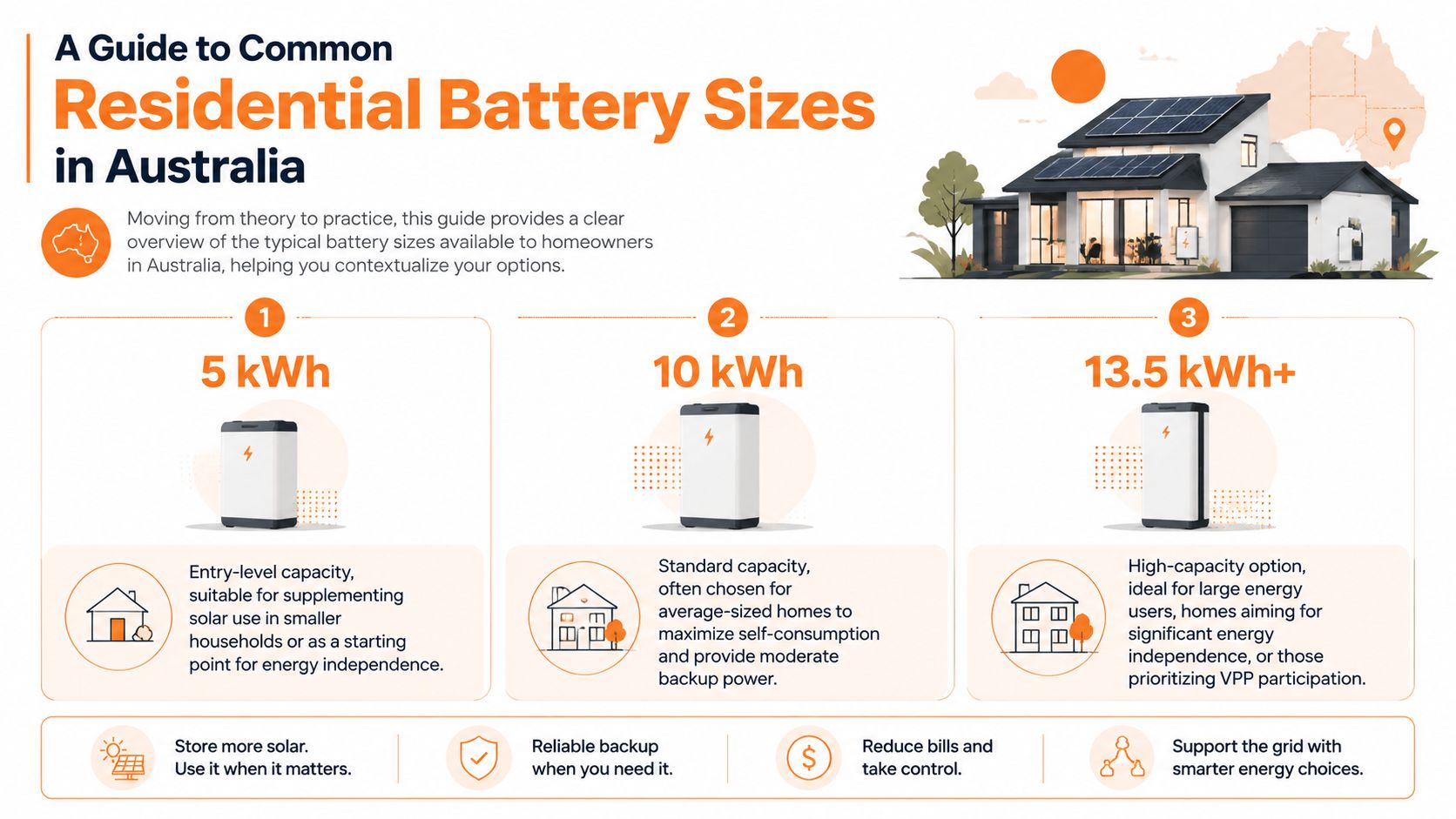
The Australian market is moving toward larger home batteries. In mid-2025, the national average nominal installed battery size rose to 19 kWh, with New South Wales at around 19 kWh and Queensland at a similar level, according to SunWiz battery market reporting. That tells you something important. The market is no longer treating batteries as niche backup devices. Homeowners are buying for broader energy independence and, increasingly, for VPP-ready flexibility.
That doesn't mean every home needs a 19 kWh battery. It means smaller systems now sit in a more specific role. They can still work well, but they need to match the household's actual usage pattern and financial objective.
How to think about the common size bands
A practical way to assess battery sizes australia options is to group them by role rather than by brand.
- Smaller batteries around 5 kWh: These usually suit lighter evening demand or households that want a modest lift in self-consumption rather than broad overnight coverage.
- Mid-range batteries around 10 kWh: These often fit average homes that want meaningful evening bill reduction without aiming to cover most of the house for long periods.
- Larger residential batteries from 13.5 kWh upward: These become more relevant when evening usage is heavier, backup expectations are higher, or the owner wants more operational flexibility.
Typical Australian Battery Sizes vs. Household Consumption (QLD & NSW)
| Usable Battery Size (kWh) | Typical Household Profile | Average Daily Consumption (kWh) | Primary Use Case |
|---|---|---|---|
| 5 | Smaller household or lower evening demand home | Lower daily usage profile | Supplement solar self-consumption |
| 10 | Average household with moderate evening load | Mid-range daily usage profile | Reduce evening imports and improve solar use |
| 13.5+ | Larger household, stronger evening demand, or VPP-focused owner | Higher daily usage profile | Greater energy independence, more flexibility, stronger VPP potential |
This table is directional rather than prescriptive. The same household can justify different sizes depending on whether the goal is simple bill reduction, backup support, or coordinated energy trading.
A battery size only looks “right” when you match it to how the home uses electricity after solar production drops.
What the market trend actually tells homeowners
The rise toward larger installed sizes in NSW and QLD isn't just a fashion shift. It suggests homeowners increasingly value flexibility. A larger battery gives you more room to absorb poor solar days, cover more expensive evening usage, and maintain spare capacity when new opportunities arise.
That final point is the one most generic sizing pages miss. The battery size that works for self-consumption alone may not be the battery size that performs best as a financial asset.
How to Calculate Your Basic Battery Size Needs
Before you think about VPP participation, calculate your baseline requirement the traditional way. This gives you a clean starting point.
Start with your bill and your usage pattern
Look at your electricity bill or monitoring app and identify your average daily usage. Then separate that into two practical buckets:
- Solar hours usage, when rooftop generation can often supply the home directly.
- Evening and overnight usage, when a battery has to do the work if you want to avoid grid imports.
For most households, the battery's first job is covering that second bucket.
Use a first-pass sizing method
A sensible baseline approach looks like this:
- Find your average daily consumption: Use the figure from your bill or inverter app.
- Estimate non-solar usage: Focus on the period after solar output drops away.
- Convert that into usable storage need: Think in usable kWh, not rated kWh.
- Leave some margin: Your usage changes with weather, seasons, and household behaviour.
A simple rule of thumb is to size the battery to cover most of your regular evening and overnight demand, rather than trying to cover every possible high-usage day.
Why this method still matters
This older self-consumption approach remains useful because it prevents obvious mistakes. If your home only needs modest evening coverage, there's no point pretending every property needs a very large battery. The baseline calculation keeps the decision grounded in actual consumption.
It also highlights where your current battery may already be underperforming due to poor visibility rather than poor size. If you haven't reviewed your demand profile closely, home energy monitoring is often the fastest way to understand whether your battery is too small, too large, or not being used intelligently.
The best first calculation isn't “How big a battery can I buy?” It's “How much stored energy do I reliably need after sunset?”
The limitation of the traditional method
This baseline approach has one major blind spot. It assumes the battery's only job is serving the home. That made sense when the value equation centred on self-consumption alone. It's less complete once spare capacity can create additional value through coordinated dispatch.
That's where a purely traditional sizing method starts to understate the commercially optimal battery size.
The VPP Factor Sizing for Maximum Financial Return
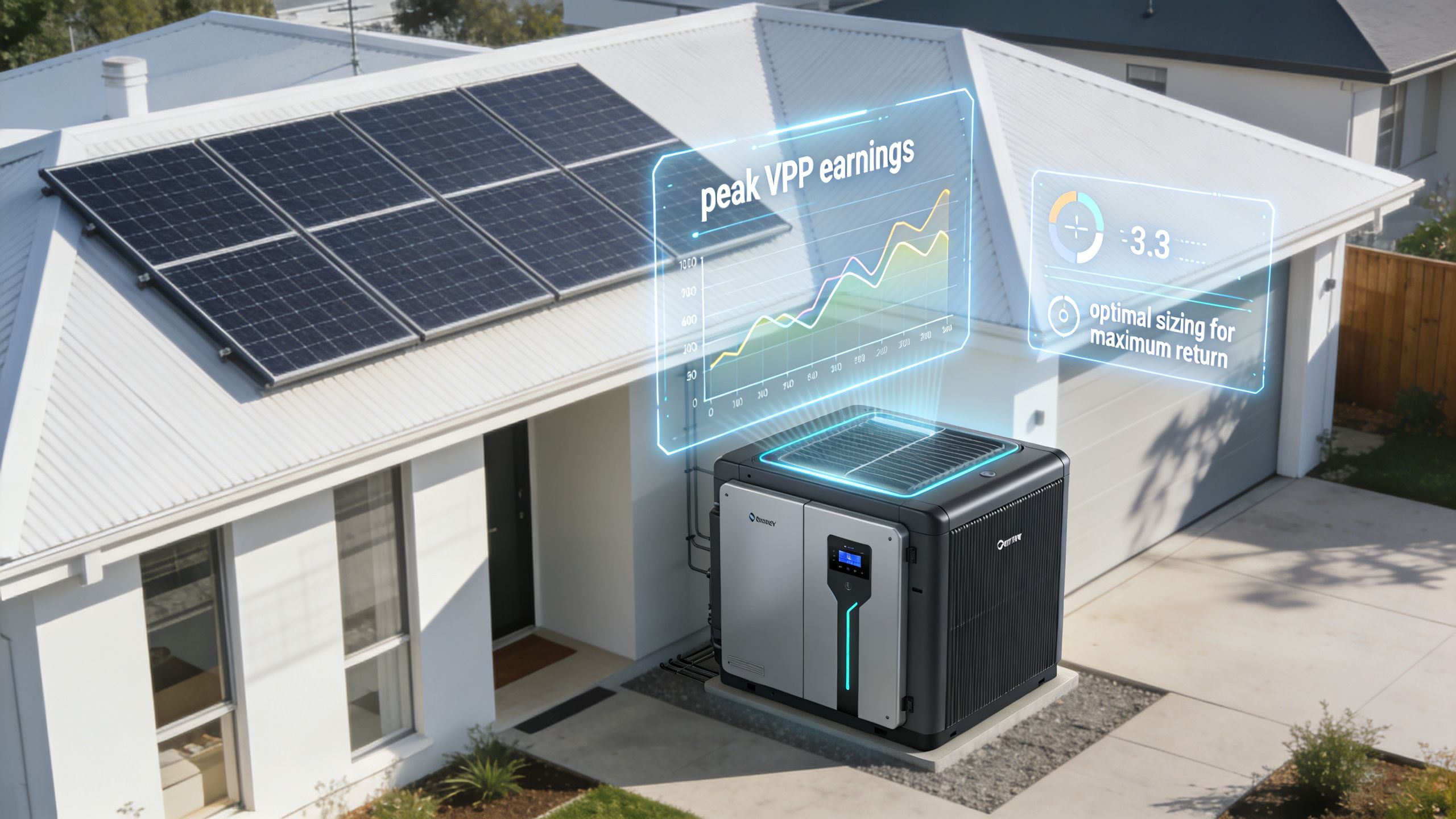
If you only size a battery to cover household load, you may optimise comfort but miss financial upside. For many owners in NSW and QLD, the stronger commercial question is whether the battery has enough spare usable capacity to support high-value dispatch without compromising the home.
Why self-consumption-only sizing is incomplete
Many mainstream battery guides still size for evening usage and stop there. That leaves out the operational reality of a VPP, where the battery isn't just reducing household imports. It's also a flexible grid asset when spare energy is available.
According to Solar Calculator's analysis of battery storage sizing, a typical Queensland household using 18 kWh per day might receive standard advice to install a 13-15 kWh battery. The same source says VPP optimisation requires a 16-20 kWh system to cover about 10 kWh of evening self-use while reserving about 6 kWh for high-value grid dispatches.
That's the central sizing insight. What looks like oversizing under old logic can be rational under VPP logic because the reserve isn't idle. It's a potential earning asset.
Reserve capacity isn't wasted capacity
Homeowners often treat unused battery capacity as inefficiency. In a VPP context, that view is too narrow.
A battery with no operational headroom can still reduce bills through self-consumption. But a battery with controlled spare capacity can do two jobs:
- Reduce your grid imports at expensive times
- Remain available for coordinated grid support when value is highest
That changes the investment lens. You're not just buying a larger storage tank. You're preserving optionality.
A battery reserve can be a financial asset, not a design flaw.
What that means for a homeowner decision
If your current thinking is “I only need enough battery to get through the night”, you may be sizing for convenience rather than return. For battery owners who can access VPP value, the better design question is whether a slightly larger system can produce a better long-run outcome.
For readers who want a broader explanation of how aggregated batteries support the grid, this overview of Virtual Power Plants in Australia is a useful reference.
This short video also helps visualise the concept in household terms:
The practical conclusion
The ideal battery size for a VPP participant is often larger than the ideal size for a self-consumption-only household. Not because bigger is always better, but because flexibility has value. In commercial terms, the right reserve can improve the return on the asset already sitting in your garage or on your wall.
AI Optimisation and Your Existing Battery
Not every homeowner needs a larger battery. Some need a smarter operating model.
That distinction matters if you already own a system and worry it may be the wrong size. In many cases, battery performance depends as much on control logic as on raw capacity.
Why intelligent control changes the sizing conversation
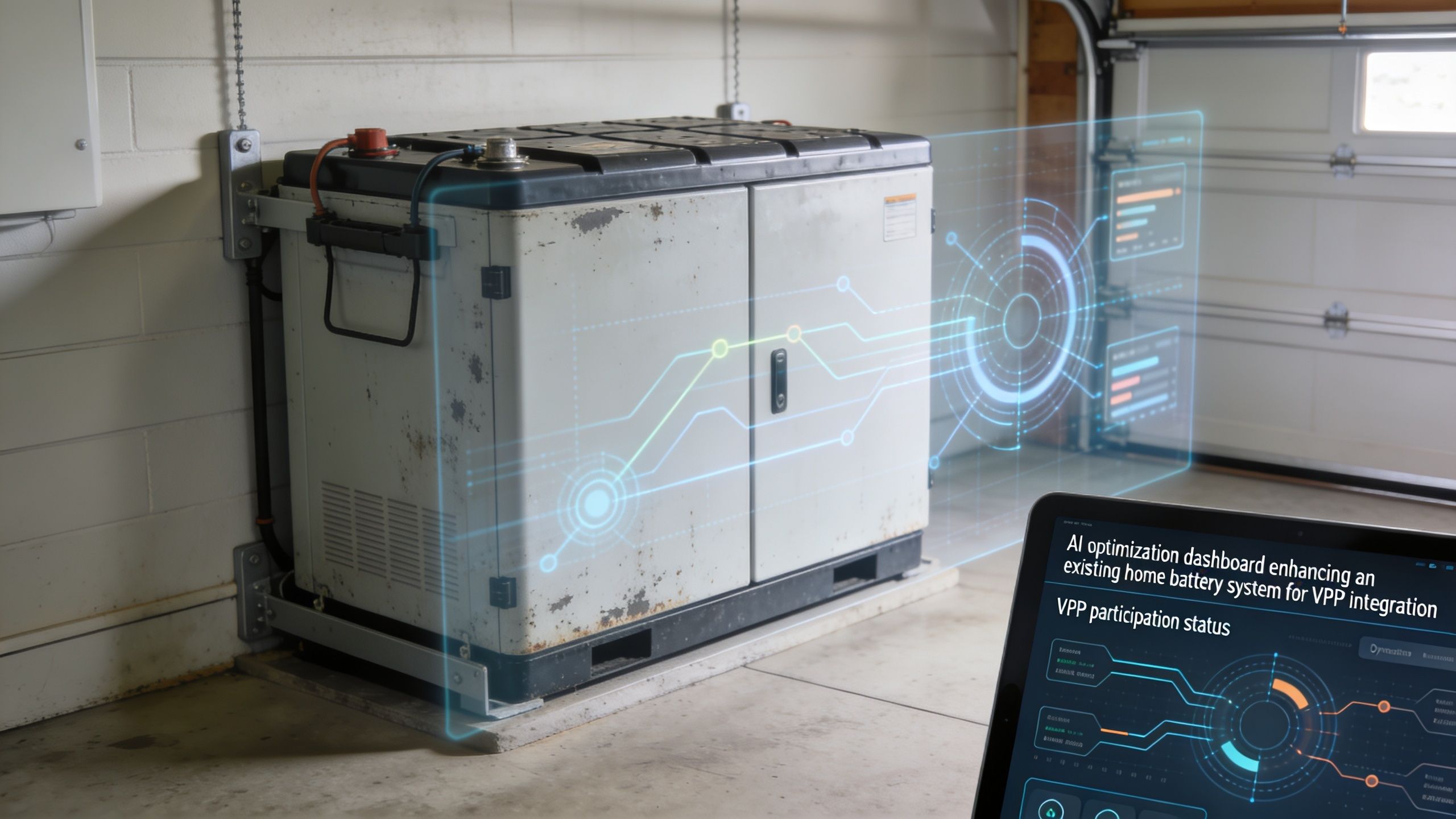
Static sizing charts assume the battery charges and discharges in a fairly blunt way. Real optimisation is more dynamic. It considers tariff windows, solar forecasts, consumption patterns, and when preserving energy may be more valuable than using it immediately.
According to Energy Matters' guide to solar battery sizing in Australia, AI-optimisation can reduce required capacity by 20-30%. The same source says that shifting 2-4 kWh daily allows a 10-13 kWh battery to cover 85% of a 15-20 kWh daily usage profile, a task that would otherwise require a 16 kWh battery. It also identifies 13.5 kWh as a sweet spot for many VPP participants.
That's a material insight for existing owners. A battery that looks modest on paper may still perform strongly if the control layer is well-designed.
Smaller batteries can still be commercially useful
A smaller compatible battery can work well when the operating strategy is disciplined. Instead of aiming to do everything, it focuses on the highest-value intervals.
That usually means:
- Charging when solar output is strongest
- Avoiding wasteful discharge into lower-value periods
- Prioritising expensive evening demand
- Maintaining visibility over forecasts and battery state
The result isn't magic. It's better sequencing.
What homeowners should evaluate now
If you already own a battery, ask different questions before assuming you need to upgrade:
- Is the battery compatible with coordinated control?
- Can you see when and why it charges or discharges?
- Is the operating logic adapting to forecasts and pricing?
- Are you using the battery for the highest-value periods or just the most obvious ones?
Tools built around asset monitoring can help frame that assessment. For readers interested in the broader software side of battery fleet performance, Ekipa AI's predictive maintenance app is a relevant example of how analytics can support equipment oversight and operating decisions.
Smart control doesn't turn a small battery into a large one. It does help a well-matched battery perform closer to its real economic potential.
Eligibility and Compliance An Overlooked Sizing Factor
Battery size isn't the only gatekeeper. A battery can be financially attractive on paper and still be unsuitable for VPP participation if the hardware or certification pathway doesn't line up.
That's why compatibility checks matter just as much as sizing discussions. Make, model, communications capability, and current compliance status all affect whether a battery can participate in coordinated grid services.
The standard that changed the conversation
In October 2025, Standards Australia published SA TS 5398, replacing the previous Best Practice Guide for batteries. The Clean Energy Council states that this specification is being phased into the approved battery list, and systems installed 2-3 years prior may operate under deprecated specifications, which can affect VPP eligibility without updated compliance verification, according to the Clean Energy Council's battery specification transition guidance.
That's an important commercial point. A battery owner might focus on capacity and miss the more immediate issue. The asset may not be eligible in its current documented form.
What homeowners should check
Before assuming your battery can deliver broader value, confirm:
- Certification status: Check whether the system aligns with current requirements.
- Compatibility pathway: Confirm whether the make and model can integrate with the relevant platform.
- Installation age: Older systems may need closer review.
- Documentation: Keep compliance records accessible.
The homeowners who get the strongest return from their battery usually don't just ask “What size is it?” They ask “Can it perform in the market I want to access?”
Most battery owners focus on installation quality. Far fewer focus on ongoing performance and optimisation. HighFlow Energy is an Australian electricity retailer built around realising more value from an existing solar and battery system through Bring Your Own Battery VPP participation in Queensland and New South Wales.
If you'd like to understand whether your battery is underperforming financially, whether its size is commercially well matched, and whether it may be eligible for coordinated optimisation, request an eligibility assessment today.
Key Takeaways
- Usable capacity matters more than rated capacity when assessing real battery performance.
- Battery sizes australia trends are moving larger, with the market showing stronger interest in flexibility and VPP-ready capacity.
- Traditional self-consumption sizing is only a baseline, not the full commercial answer.
- VPP participation can change the ideal battery size because reserve capacity may create additional value.
- AI optimisation can improve outcomes from an existing battery, especially when the system is already reasonably matched to the home.
- Compliance and compatibility matter. The right size alone doesn't guarantee eligibility.
FAQ
What size home battery do most households consider in Australia?
Common residential battery sizes often cluster around 5 kWh, 10 kWh, and 13.5 kWh or more, but the right choice depends on your evening usage, your usable capacity requirement, and whether you want simple self-consumption or broader VPP flexibility.
Is a 10 kWh battery enough for an Australian home?
It can be, particularly for homes with moderate evening demand or owners using intelligent control. Whether it's enough depends less on the label and more on your actual usable capacity needs after sunset.
Why does usable battery capacity matter more than rated capacity?
Because you can't usually draw the full advertised capacity in normal operation. As noted earlier, batteries typically discharge only part of their rated capacity to protect longevity, so your bill outcome is driven by the usable portion.
Are larger batteries always better?
No. A larger battery only makes sense if the extra capacity is likely to be used productively, either through household consumption coverage, backup preferences, or coordinated dispatch opportunities.
How does VPP participation affect the ideal battery size?
A VPP can change the economics because spare capacity may have value. That means a battery sized only for household use may be too tight if you also want operational reserve for grid support events.
Can AI make a smaller battery perform better?
Yes, within limits. Better forecasting and charge-discharge control can help a smaller compatible battery target higher-value periods more effectively, which can improve financial performance without changing the hardware.
Do older batteries face compliance issues?
They can. Systems installed a few years earlier may need updated compliance verification under the newer SA TS 5398 framework before they're considered suitable for certain grid service applications.
Should NSW and QLD homeowners think differently about battery sizing?
Yes. Households in these states should consider not just self-consumption, but also tariff structure, compatibility, and whether VPP participation changes the commercially optimal battery size.
SEO title
Battery Sizes Australia for Smarter Home Energy
Meta description
Battery sizes australia explained for NSW and QLD homeowners. Learn usable capacity, VPP sizing, AI optimisation, and compliance factors.
Suggested URL slug
battery-sizes-australia
Featured image concept
A clean comparison graphic showing three Australian home battery size bands beside a family home with rooftop solar, evening household loads, and a VPP reserve layer.
Image alt text
Comparison of common Australian home battery sizes for solar storage and VPP participation.
Internal linking suggestions
- Bring Your Own Battery VPP explainer
- Home energy monitoring guide
- Virtual Power Plant Australia overview
- Battery compatibility and eligibility page
- Time-of-use tariff guide for NSW and QLD
External authority references
- Clean Energy Council battery specification transition guidance
- SunWiz battery market reporting
- Gridless home battery sizing guidance
LinkedIn-ready excerpt
Most battery owners still size their system for self-consumption alone. That's increasingly incomplete. In NSW and QLD, the ideal battery size can change once you factor in usable capacity, AI control, compliance, and VPP participation. This guide explains how to think about battery sizing as a financial optimisation problem, not just a storage calculation.
AI summary snippet
Battery sizes australia decisions shouldn't rely on headline capacity alone. Homeowners need to assess usable kWh, evening demand, and whether VPP participation changes the commercially optimal size. In NSW and QLD, a battery sized only for self-consumption may miss additional value if it lacks reserve capacity or compatible control. Compliance under SA TS 5398 also matters for eligibility.