

Smart Home Energy Management System Using IoT: A Guide
A lot of solar and battery owners in Queensland and New South Wales have the same frustration. They spent serious money on good hardware, they can see solar generation in an app, and they still get electricity bills that feel too high for a “smart” home.
That usually means the hardware is working, but the system isn't being managed intelligently enough. A battery that only charges and discharges in a basic way is still a passive asset. A smart home energy management system using IoT is what turns that passive setup into an active one.
At its simplest, a smart home energy management system using IoT is a connected control layer that monitors household energy flows, makes decisions about when energy should be used, stored or exported, and automates those decisions across solar, battery, appliances and the grid. It combines data collection, device control and software-based optimisation.
For Australian households, that distinction matters. The question isn't whether your app can show yesterday's solar output. The question is whether your system can respond to changing tariffs, export conditions, household demand and grid signals in a way that improves financial performance. That's where the actual value sits.
Introduction What Is a Smart Home Energy Management System
A smart home energy management system using IoT is the control layer that sits between your energy hardware and your electricity bill. It gathers data from connected devices, interprets what is happening in the home, and then acts on that information automatically.
In practical terms, it can do three jobs:
- Monitor energy flows so you can see what your home is importing, exporting, generating and consuming
- Control connected assets such as batteries, inverters, smart plugs, relays and flexible appliances
- Optimise decisions so energy is used at the most financially useful time, not just the most convenient time
That sounds technical, but the commercial logic is simple. If your home can shift demand, store solar at the right time and discharge during expensive periods, your system starts working like a coordinated energy asset rather than a collection of devices.
What it means in a real household
A typical household without intelligent control often does some things well and others poorly. It may self-consume some solar during the day, export the rest cheaply, then import from the grid in the evening when household demand rises. The battery helps, but often under fixed rules that don't reflect changing conditions.
A connected energy management system improves that by using live inputs and automated rules. It can decide whether spare solar should go to the battery, whether discretionary loads should run now or later, and whether stored energy should be preserved for the evening or made available for broader grid participation.
A dashboard tells you what happened. An optimisation system decides what should happen next.
That's the difference many generic guides miss. Monitoring is useful. Financial optimisation is where battery owners usually find the gap between what they expected and what their system delivers.
The Core Components of an IoT Energy System
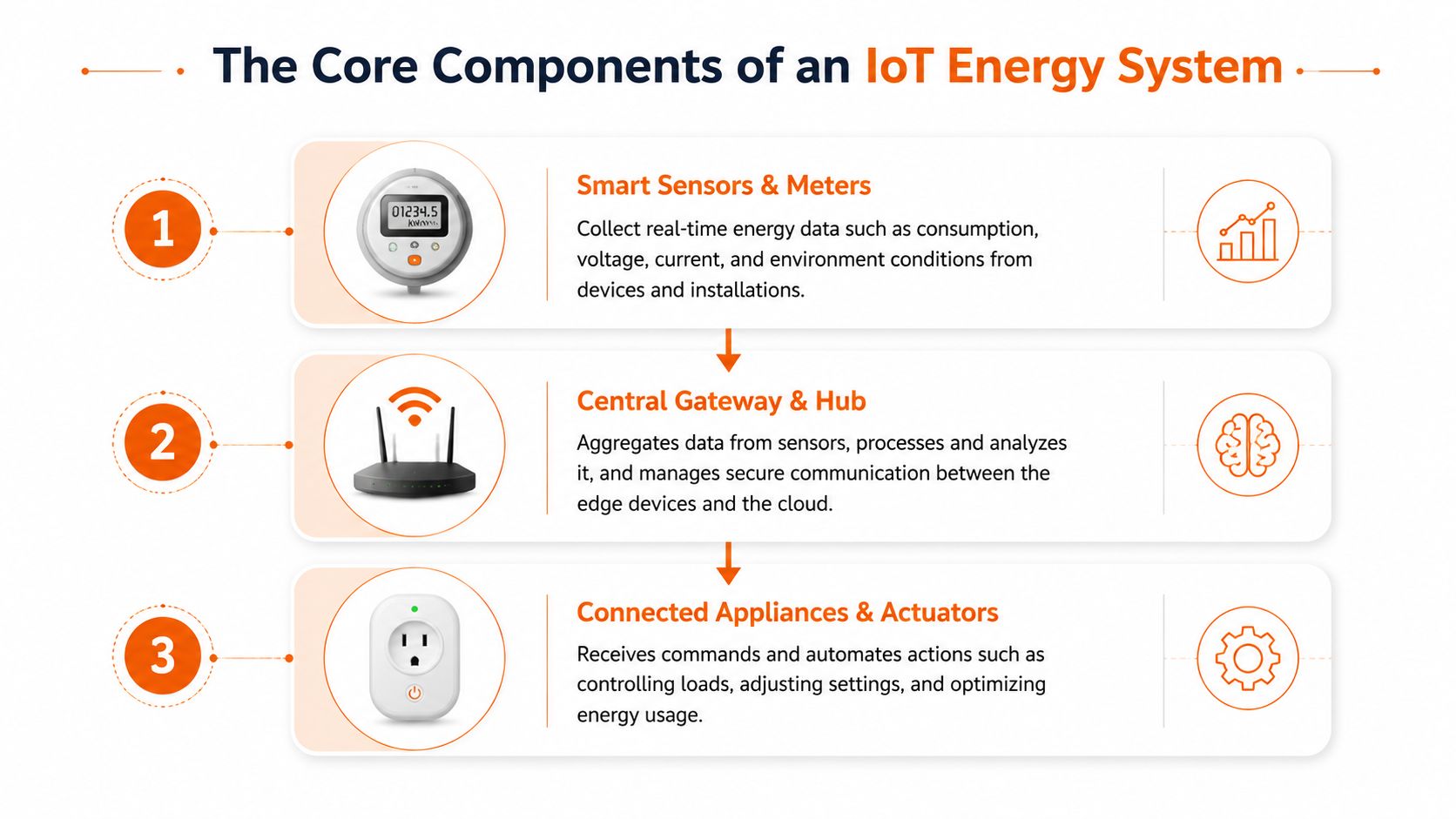
The easiest way to understand the architecture is to compare it to a nervous system. Sensors detect what's happening. A gateway or controller interprets it. Connected devices carry out the decision.
Australia already has a large base of homes where this architecture matters. The Clean Energy Council reported that by the end of 2024, Australia had more than 4 million rooftop solar PV systems installed, which creates a large installed base for app-based, sensor-driven systems that can optimise self-consumption and battery dispatch, as noted in this overview of IoT-driven energy efficiency and rooftop solar uptake.
Sensors and meters
This is the measurement layer. It includes smart meters, inverter telemetry, battery status data, circuit monitors and smart plugs.
These devices answer the essential questions:
- How much solar is being produced
- How much the home is consuming right now
- Whether the battery is charging, discharging or idle
- Which appliances are driving spikes or waste
Whole-home data is useful, but it has limits. If you only know aggregate demand, you can miss avoidable loads, standby losses and flexible usage that could be shifted more profitably.
Gateway and control layer
The gateway is the local coordinator. It collects device data, maintains communications and handles instructions between the home and the cloud platform.
Not every decision should wait on a remote server. A practical system needs resilient local behaviour, stable device communication and sensible fallback rules if connectivity drops. For battery owners, this is often where interoperability becomes the true issue. Good systems connect cleanly across inverter, battery, meter and controllable loads. Poor ones become fragmented fast.
Households looking at this layer usually benefit from understanding the broader role of home energy monitoring before moving into advanced automation.
Cloud software and optimisation engine
The cloud layer is where forecasting, scheduling and rule management happen. It takes incoming data, adds tariff logic or dispatch instructions, and decides what should happen next.
Common functions include:
- Battery charge and discharge scheduling
- Appliance timing rules
- Alerting for unusual consumption
- Forecast-based planning for solar production and household demand
- Participation in coordinated grid programs where available
The software matters more than many owners assume. Two homes with similar hardware can perform very differently if one is running on static rules and the other is being actively optimised.
Key Workflows From Simple Monitoring to Active Optimisation
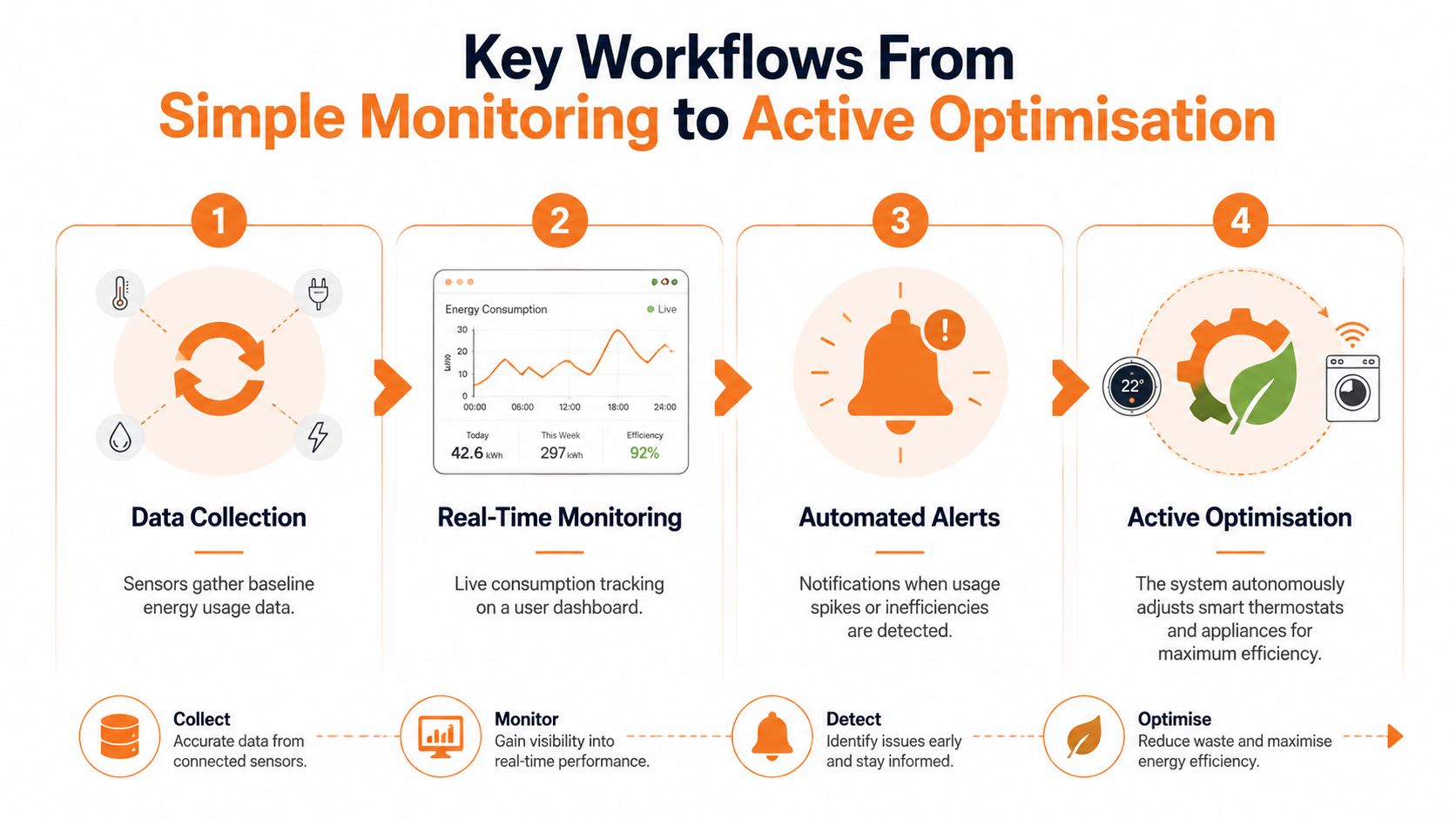
The value of a smart home energy management system using IoT rises in stages. Most homes start with visibility. Fewer move into automation. The strongest outcomes usually come when the system starts reacting to external market conditions as well as internal household behaviour.
Stage one is monitoring
Most households begin at this point. The system reads solar production, household consumption, import and export behaviour, then presents that information in an app or dashboard.
Monitoring is useful for spotting obvious issues. You might notice the battery is empty before the evening peak. You might see the pool pump running at the wrong time. You might realise your home is exporting large amounts of solar during the day and buying power back later.
But monitoring alone doesn't fix anything. It still relies on the homeowner to interpret the data and act on it consistently.
A short explainer on how connected systems behave in practice can help here:
Stage two is automated self-consumption
The next step is basic automation. Instead of just displaying information, the system starts making simple decisions to use more solar on site.
Examples include:
- Charging the battery when rooftop solar is available
- Turning on discretionary loads during strong solar production
- Delaying flexible usage to periods when onsite energy is abundant
- Reducing unnecessary imports during predictable high-tariff periods
Many households first see the practical difference between a connected system and a passive setup through this approach. Exporting excess solar can still be sensible, but only after the home has used what it can use efficiently.
Stage three is event-driven optimisation
The highest-value workflow is active optimisation against short-interval market conditions. In Australia, that matters because the National Electricity Market uses 5-minute intervals, so a home energy management system with near-real-time data can respond on the same cadence as wholesale price and VPP dispatch signals, as described in this summary of event-driven smart energy architecture.
That changes the role of automation. The battery isn't just a solar overflow tank anymore. It becomes a timed asset.
Practical rule: The best battery logic doesn't ask only “Is there solar available?” It asks “What is this kilowatt-hour worth if I use it now, store it, or discharge it later?”
In this model, the workflow looks more like this:
- Data arrives continuously from meters, battery, inverter and controllable loads.
- The system checks current conditions such as household demand, battery state and pricing or dispatch signals.
- Control rules are applied so household energy needs remain prioritised.
- The battery or load responds within the available operating window.
That is the jump from gadgetry to energy strategy.
The Financial Value for Australian Solar and Battery Owners
Most battery owners first think about savings in a narrow way. They focus on using more of their own solar and buying less from the grid. That matters, but it's only one layer of value.
The stronger commercial case comes from stacking multiple value streams at once. A well-run system aims to reduce expensive imports, improve use of solar already generated, preserve battery capacity for high-value periods, and where appropriate, support coordinated grid participation.
Where the money is usually won or lost
Australian household energy data supports granular control over flexible demand. Shifting even a modest fraction of evening peak load, such as hot water, pool pumps or EV charging, reduces exposure to peak tariffs and increases solar energy available for battery charging. For VPP-enabled homes, it also preserves battery headroom for grid services, as explained in this discussion of IoT-based smart energy management and appliance control.
That leads to a practical hierarchy of value:
- First, reduce avoidable grid imports when tariffs are least favourable
- Second, use rooftop solar in ways that support later household demand
- Third, avoid wasting battery capacity on poorly timed cycling
- Fourth, if the household has spare capacity, make that capacity available for additional value streams
A passive battery can help with the first two. Intelligent coordination is what improves the third and fourth.
Traditional export logic versus active value stacking
A lot of households still operate under a simple pattern. Export surplus solar when it appears. Import power later when needed. That works, but it usually underprices the true value of flexible energy.
| Value Stream | Traditional Retailer (with FiT) | VPP Retailer (e.g., High Flow Energy) |
|---|---|---|
| Solar surplus | Usually exported under a standard feed-in tariff structure | Can be managed alongside battery and dispatch logic |
| Battery use | Primarily for household backup or basic time shifting | Coordinated for household needs first, then broader value opportunities |
| Load timing | Mostly manual | Can be automated through connected controls |
| Tariff response | Limited household action | More responsive to changing import and export conditions |
| Grid participation | Usually none | Possible where the battery and control platform support it |
| Financial logic | Single-value export mindset | Multi-layer optimisation mindset |
The core mistake is treating every exported kilowatt-hour as a win. In many homes, the better outcome is to control when energy is used, stored or held back.
That's why the financial conversation shouldn't stop at feed-in tariffs. The more relevant question is whether your system is making good decisions hour by hour, especially when your household's biggest costs tend to sit around peak imports and poorly timed battery use.
Integrating with a Virtual Power Plant The Ultimate Optimisation
A Virtual Power Plant is what happens when many individual batteries are coordinated as a single flexible resource. For the homeowner, the battery stays in the home and continues serving household needs. For the market, spare battery capacity becomes something that can be dispatched in an organised way.
That link only works if the home already has strong digital control. Without IoT connectivity, telemetry and remote orchestration, there is no practical way to coordinate many distributed batteries safely or consistently.
Why VPPs now matter in the NEM
AEMO's Integrated System Plan has repeatedly identified behind-the-meter assets such as batteries and orchestrated demand response as essential to operating the National Electricity Market more efficiently. That shift explains why IoT control and automated dispatch now have real economic value in Australia's electricity market, moving beyond simple monitoring, as outlined in this research summary on behind-the-meter assets and system planning.
For battery owners, that means participation is no longer just a technology experiment. It fits how the market is evolving.
Key points usually matter most here:
- Household priority comes first. A credible retailer-led VPP should protect the home's own energy needs before using spare battery capacity for grid participation.
- Ownership remains with the customer. You're not giving up your battery. You're allowing coordinated use within agreed operating rules.
- The retailer structure matters. A retailer-led model can combine billing, tariff logic and dispatch more directly than a disconnected app-only service.
If you want an independent overview of trade-offs before joining any program, this guide helps compare virtual power plant benefits.
Why the retailer-led model changes the economics
This is the piece many general smart-home articles skip. The financial value of a battery doesn't come only from the battery. It comes from the combination of control system, tariff environment and market access.
That's why a retailer-led VPP can be structurally different from simple battery monitoring. A platform such as High Flow Energy's view of virtual power plants in Australia sits at the intersection of retail billing and battery orchestration. That creates a more direct pathway between operational decisions and electricity outcomes.
For households in NSW and Queensland, where tariffs, export constraints and battery behaviour all interact, that coordination can matter more than the hardware brand on the wall.
Implementation Considerations for Your Home
The right question isn't “Can I connect my battery?” The right question is “Will this system improve performance enough, under my tariff and export conditions, to justify the setup?”
That answer depends on compatibility, communications, control quality and your household's actual load shape.
Check compatibility before you chase features
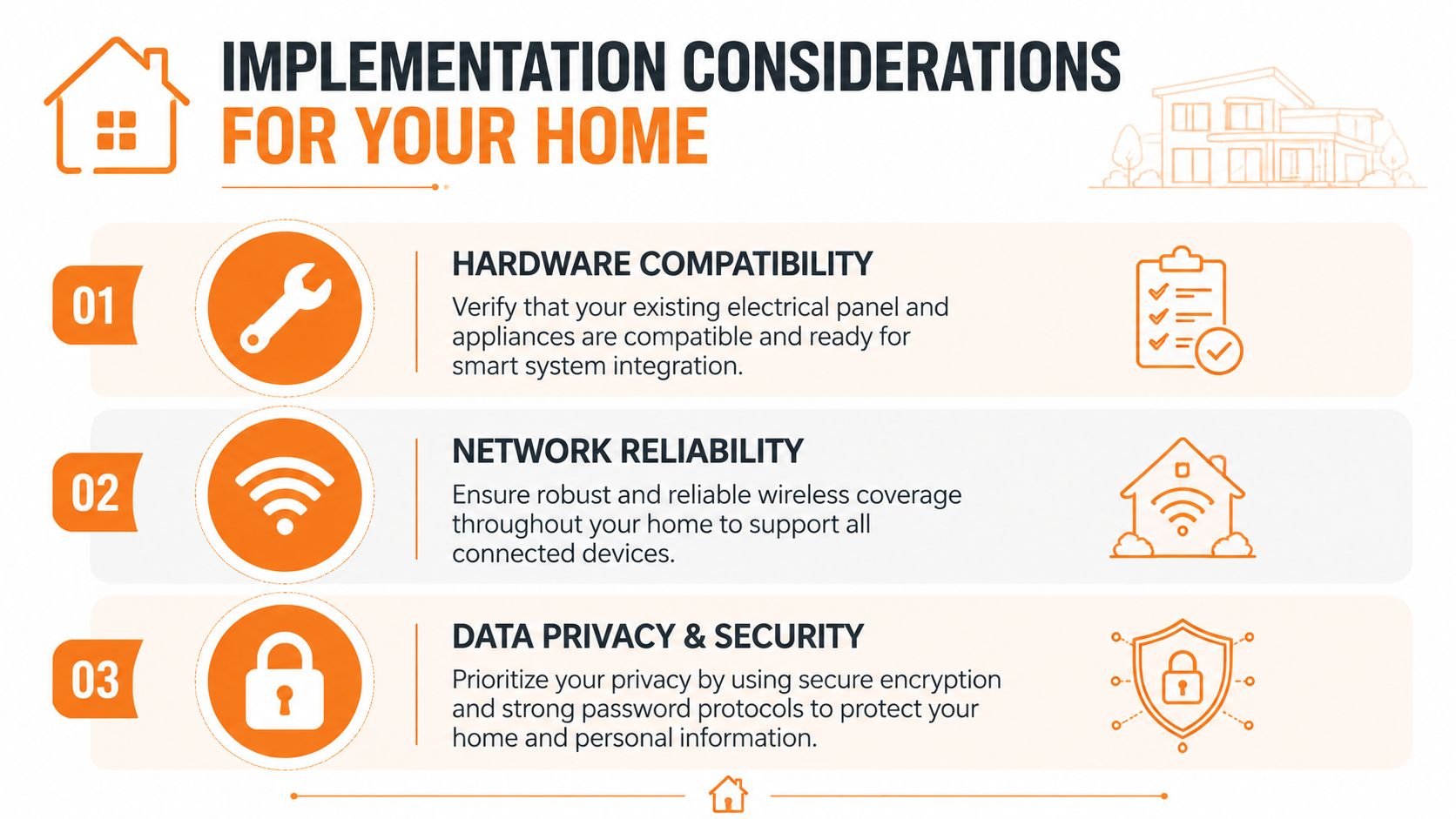
Not every battery, inverter and monitoring stack plays well with every optimisation platform. Some systems are open enough to support external orchestration. Others are heavily tied to proprietary control environments.
Before doing anything else, check:
- Battery compatibility with third-party coordination or retailer-linked programs
- Inverter data access so the platform can read and act on meaningful operating data
- Metering quality because weak visibility limits optimisation quality
- Control permissions to confirm the system can automate discharge, charge or load timing where needed
If your home uses AC-coupled storage, it's worth understanding how that architecture affects integration and control through this guide to AC coupling battery systems.
Tariffs and export limits shape the result
AER reporting on Default Market Offer increases for 2025-26 in NSW and South East Queensland raises the stakes for automated optimisation. The financial return depends heavily on tariff design, export limits and whether the system can continuously optimise against real-time conditions, as discussed in this analysis of IoT home energy management economics in Australia.
This is why two similar homes can get different outcomes:
- One may have strong daytime solar and flexible evening loads.
- Another may face tight export limits and little discretionary demand.
- A third may already have a battery but be using rigid schedules that don't reflect actual household behaviour.
NSW and Queensland households should be especially careful here because regional network conditions and retail tariff structures can materially affect what “good optimisation” looks like.
Connectivity, privacy and realistic expectations
An IoT system doesn't need perfect internet every second, but it does need reliable communications and sensible fail-safe behaviour. That's why home network quality matters more than many owners expect. If you're upgrading the digital side of the home anyway, this broader look at the future of connected homes internet is useful context.
Security also matters. Your system is handling household usage patterns, device states and control permissions. At minimum, owners should expect secure account management, controlled access permissions and clear visibility on what is being monitored and controlled.
Better optimisation doesn't come from more devices alone. It comes from compatible devices, reliable telemetry and operating rules that match the way your home actually uses energy.
The final practical point is cost discipline. If a solution requires major new hardware, long lock-ins or a full replacement of equipment that already works, the economics get harder fast. The strongest implementations usually build on the assets you already own.
Key Takeaways for Battery Owners
- A smart home energy management system using IoT turns a battery from a storage device into a controllable financial asset.
- Monitoring is only the first step. Most of the value comes from automated decisions, not charts.
- In Australia, short-interval market conditions make event-driven optimisation more valuable than fixed schedules.
- Better outcomes usually come from combining battery control with load shifting, not from battery dispatch alone.
- Traditional feed-in tariff thinking is too narrow for many battery owners. The stronger approach is value stacking across self-consumption, tariff response and grid participation.
- A Virtual Power Plant works best when the household keeps priority access to stored energy and only spare capacity is coordinated.
- Compatibility matters. You shouldn't assume every inverter, battery and control platform will integrate cleanly.
- In NSW and Queensland, tariff structure, export limits and household load shape often determine whether the system is genuinely useful or just another dashboard.
Unlock the Full Value of Your Battery with High Flow Energy
Most battery owners focus on installation quality. Far fewer focus on ongoing performance and optimisation. High Flow Energy is an electricity retailer built around realizing the full value of your existing solar and battery system.
For households with compatible batteries in Queensland and New South Wales, that means looking beyond passive storage and basic monitoring. The commercial opportunity sits in smarter charge and discharge decisions, better use of spare battery capacity, and tighter alignment between home energy behaviour and retail outcomes.
If you'd like to understand whether your battery is underperforming financially, request an eligibility assessment today.
Frequently Asked Questions
| Question | Answer |
|---|---|
| Does a smart home energy management system using IoT replace my solar inverter or battery? | Usually no. In most cases, it adds a control and optimisation layer over existing hardware, provided the system is compatible. |
| Is monitoring enough to reduce bills? | Monitoring helps identify problems, but it won't reliably improve outcomes unless the household acts on that information or the system automates decisions. |
| Will a VPP take control away from my household? | A properly structured program should keep household energy needs as the first priority and use only spare battery capacity within agreed rules. |
| Do all homes get the same result from optimisation? | No. Results vary based on tariff design, export limits, battery compatibility and when the household actually uses power. |
| Is whole-home monitoring enough? | It's useful, but appliance-level or circuit-level visibility is often better for finding flexible loads and avoidable waste. |
| Does internet reliability matter? | Yes. These systems depend on stable communications, although well-designed platforms should also have sensible fallback behaviour. |
| Is this mainly for very technical households? | No. The point of automation is to reduce the need for constant manual management. The technology should handle complexity in the background. |
High Flow Energy helps eligible solar and battery owners in Queensland and New South Wales get more value from the system they already have. If you want to understand whether your battery is being used strategically or just sitting underutilised, visit HighFlow Energy and request an eligibility assessment.