


What Is a kW Hour? A Practical Guide for Australians
You're probably looking at an electricity bill, a battery app, or a solar quote and seeing the same unit over and over: kWh. It sits next to your usage, your import charges, your export figures, and often your battery capacity. Yet for many homeowners, it still feels abstract.
That confusion matters. If you want to know what is a kw hour, you're really asking a more useful question: what does this number mean for my bill, my solar system, and my battery? In Australia, households are billed on energy consumption, and that energy is measured in kilowatt-hours. Once you understand that, your bill starts to make sense.
For homeowners in New South Wales and Queensland, this is more than a technical definition. It's the basis for reading meter data, judging whether your battery is helping, and understanding why some stored energy is worth more at certain times than others.
Decoding Your Australian Electricity Bill
A common scenario goes like this. You open your latest electricity bill, skim past the account number and billing period, and land on the part that really matters: usage charges. There it is again, kWh. Maybe your bill says you imported a certain number of kWh from the grid. Maybe your solar app says your system generated more. Maybe your battery app shows charge and discharge in the same unit.
That's where many people get stuck. They can see the number, but they can't tell whether it's high, low, expensive, or well managed.
In Australian homes, kWh is the standard billing unit for electricity. It measures the amount of energy you used over time, not just how powerful an appliance is at one moment. If you've ever wanted to make sense of usage charges, compare one bill to the next, or understand why your battery seems to empty quickly in the evening, kWh is the number to focus on.
What your bill is really telling you
Most bills separate electricity into a few simple ideas:
- How much energy you imported from the grid
- What rate applies to that imported energy
- Whether you exported any solar back to the grid
- What fixed supply charges were added regardless of usage
If you want a better handle on the meter side of that equation, High Flow Energy's guide to reading your electricity meter is a practical place to start.
Your bill isn't charging you for appliance size. It's charging you for the total energy your home used over time.
Once that clicks, the rest becomes easier. A kWh isn't just a technical unit on a statement. It's the core number behind how your retailer calculates much of your electricity cost.
Power vs Energy What Is the Difference Between kW and kWh
People often mix up kW and kWh because the words look almost identical. They are related, but they are not the same thing.
A kilowatt or kW measures power. That means the rate at which electricity is being used or delivered at a given moment.
A kilowatt-hour or kWh measures energy. That means the total amount of electricity used, generated, stored, or discharged over time.
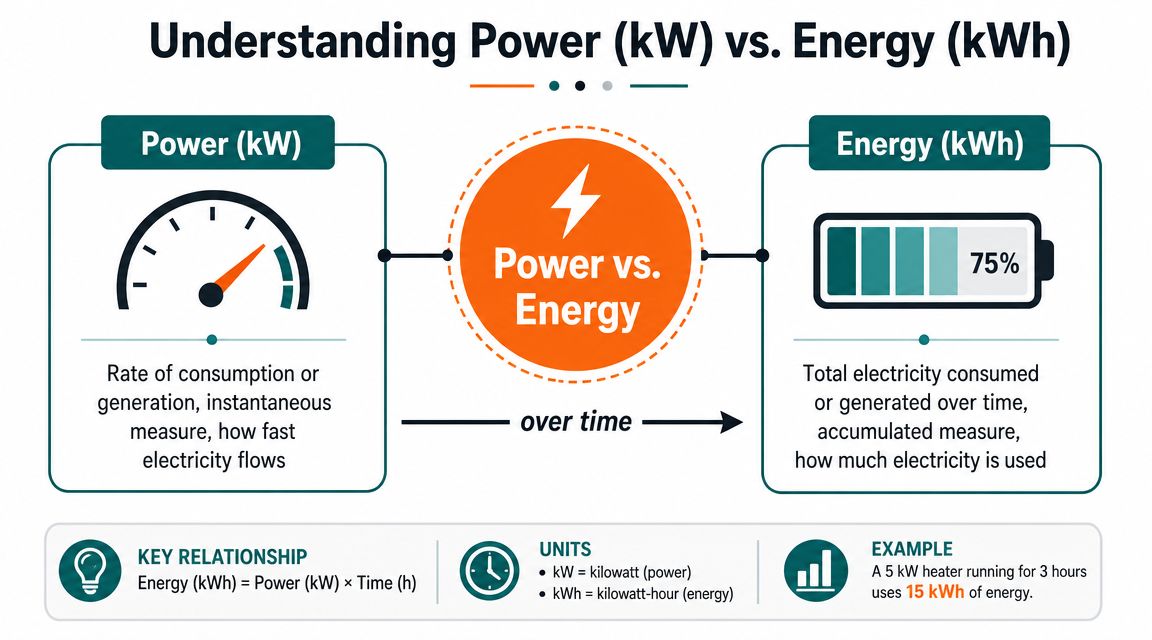
According to Power Sonic's explanation of kW vs kWh, in Australia a kilowatt-hour is the standard billing unit for household electricity, and it is defined as the energy used when a device drawing 1 kilowatt runs for 1 hour. The same source notes that 1 kW = 1,000 watts.
A simple way to picture it
The easiest analogy is water.
- kW is like the speed of water coming out of a tap
- kWh is like the total amount of water collected in a bucket over time
A tap can run fast or slow. That's power. But your water bill depends on how much water you used. Electricity works the same way.
kW tells you how fast electricity is moving.
kWh tells you how much electricity you used in total.
Why homeowners get confused
Appliance labels, battery specs, and electricity bills often mix these units together.
A few examples make the distinction clearer:
| Term | What it means | Practical question |
|---|---|---|
| kW | Rate of use or output | How fast is this appliance or battery drawing or delivering power right now? |
| kWh | Total energy over time | How much electricity did it use, store, or deliver overall? |
A useful rule is this:
- A 1 kW appliance running for 10 hours uses 10 kWh
- A 2 kW appliance running for 5 hours also uses 10 kWh
The appliances have different power ratings, but they consume the same total energy over time.
The quotable version
A kilowatt is speed. A kilowatt-hour is quantity.
That distinction is the foundation for understanding your bill, your solar production, and your battery performance. If you only remember one thing, remember that your electricity retailer charges for the quantity.
How Kilowatt-Hours Determine Your Energy Costs
Once you understand the unit, the billing logic becomes much more straightforward. Your usage charge is built around a simple relationship:
kWh used × rate per kWh = usage cost
That's why the question what is a kw hour matters so much in practice. The answer sits directly inside the biggest variable part of most household electricity bills.
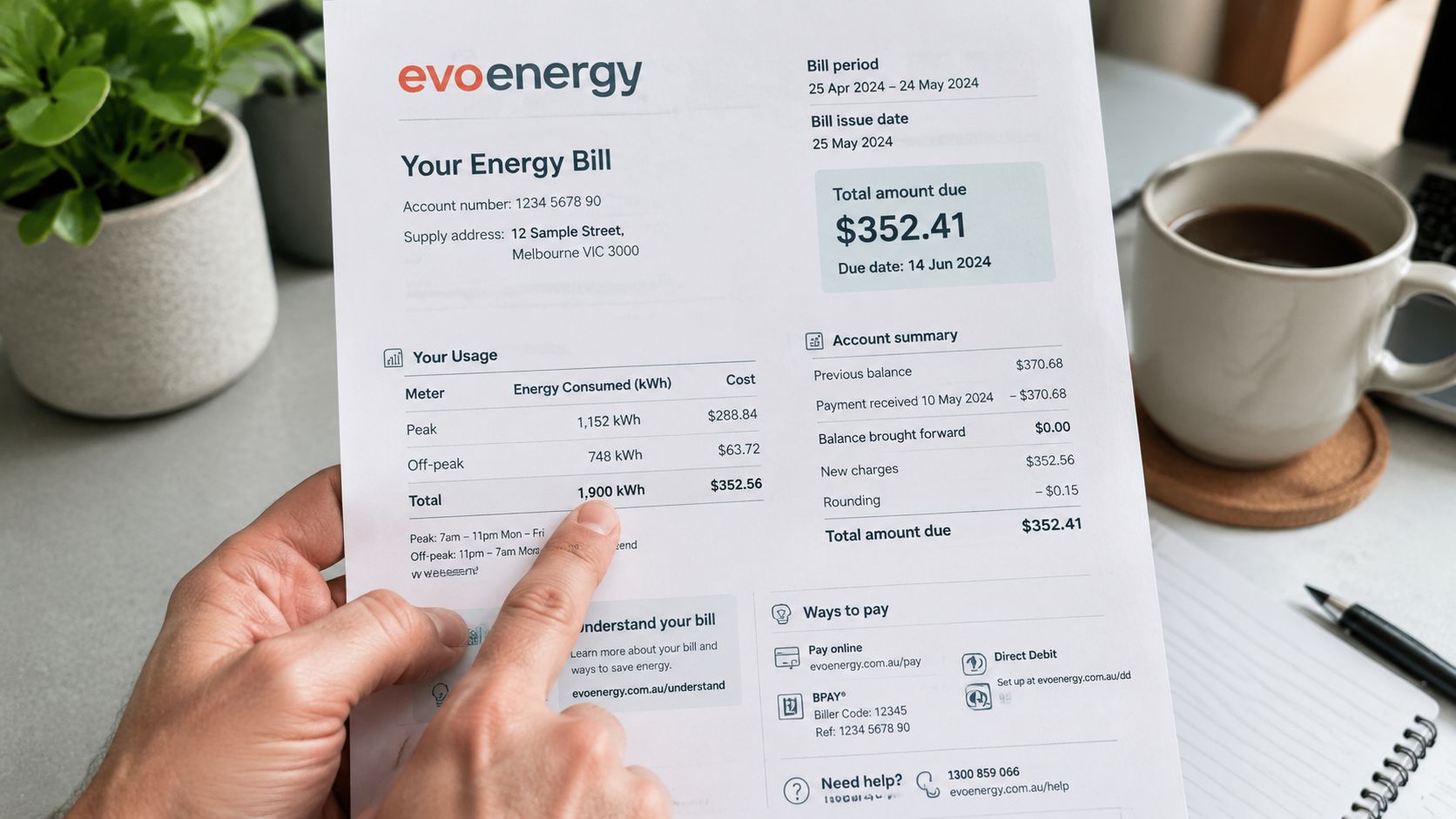
For Australian households, the financial importance of each unit is significant. The kilowatt-hour reference notes that the national average residential electricity price in Australia was about 33.1 c/kWh in 2024. That turns each kWh into a direct money metric, especially for battery owners trying to reduce grid imports in NSW and QLD.
Reading the bill line by line
A typical bill usually includes these moving parts:
- Usage charge. This is based on how many kWh you imported from the grid.
- Supply charge. This is a daily fixed charge and doesn't depend on how much energy you used.
- Export or feed-in credit. If your solar sent energy back to the grid, that may appear as a credit.
- Tariff structure. Some households are on flat rates, while others face time-varying pricing.
That means one extra kWh imported from the grid isn't just a number on a meter. It's an extra unit that may increase your bill.
Why the same household can have very different costs
Two homes can use similar appliances and still end up with different bills. Timing matters. Tariff type matters. Solar self-consumption matters. Battery behaviour matters.
If you're trying to connect annual usage thinking with system planning, this external resource on a 10,000 kWh solar sizing guide from Solar Energy Management's Florida sizing guide is useful as a planning example, even though local Australian outcomes depend on your own tariff, usage pattern, and network conditions.
Practical rule: Every kWh you don't need to import from the grid is a unit you don't pay retail rates on.
That's why reducing, shifting, or replacing imported kWh is central to bill management. For solar and battery owners, the next question is even more important: which kWh can your battery cover?
The Critical Role of kWh for Solar and Battery Owners
You get through dinner, the lights are on, the air con is running, and the oven is finishing up. Your battery app says the battery is well charged, yet your home still pulls power from the grid. For many Australian homeowners, that is the moment the difference between kWh and kW stops being technical and starts affecting the bill.
A battery's capacity is measured in kWh. That tells you how much energy it can store for later use. A battery's power output is measured in kW. That tells you how fast it can deliver that stored energy into your home.
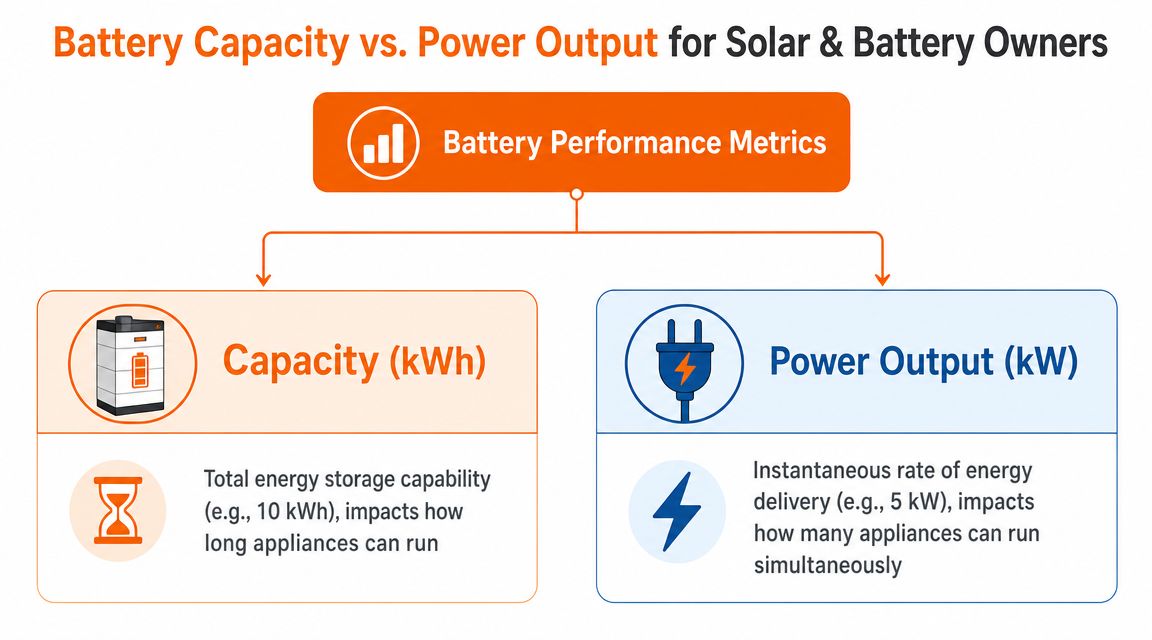
The easiest way to separate the two is to treat kWh as the size of the tank and kW as the width of the pipe. A large tank helps if you want power to last through the evening. A wide pipe helps if several appliances switch on at once. You need both to get good battery performance in real homes.
Sunhub's explanation of kilowatt-hours and battery planning makes this distinction clearly. 1 kWh equals 1,000 watts used for 1 hour. It also explains that kW describes the rate a battery inverter can charge or discharge, while kWh describes the usable energy stored. A 10 kWh battery does not mean 10 kW of power, because the inverter rating controls how quickly those stored kWh can be used.
Capacity affects duration
More kWh capacity usually means the battery can cover household demand for longer after sunset. That matters most if your expensive grid imports happen across several hours, not just in short bursts.
A battery with plenty of capacity can be valuable for evening cooking, lighting, entertainment, and overnight background loads. For bill reduction, the question is simple. How many grid kWh can that battery replace during the hours you would otherwise pay for them?
Power affects what the battery can handle at once
Power output answers a different practical question. Can the battery keep up when multiple appliances run together?
If the cooktop, kettle, and air conditioner start around the same time, the battery may have enough stored energy in total but still be limited by its inverter. In that case, part of your demand spills back to the grid. You still import electricity, even with energy left in the battery.
A battery can hold plenty of kWh and still miss high-value bill savings if its kW output is too low for your peak evening loads.
That is why battery value is tied to your actual load profile, not just the number printed on the brochure.
To make this easier to visualise, this video walks through the practical distinction between power and stored energy in home systems:
What this means for bill reduction and battery value
For solar and battery owners, kWh is the unit that connects system design to money. Each stored kWh has a job. It can offset a retail-priced import, sit unused until later, or be exported at a lower value than self-use. The better your battery matches your household demand, the more often those stored kWh work in your favour.
Here's what usually matters most:
- Your evening usage pattern. A battery creates more value if it covers the hours when solar output has dropped and household demand is still high.
- Your inverter limits. Stored energy only helps if the system can deliver it fast enough to replace grid imports in real time.
- Your control and visibility. Households with better data can spot avoidable imports, see whether the battery is covering the right loads, and judge performance more accurately.
For homeowners who want to measure those patterns properly, High Flow Energy's guide to home energy monitoring shows how to track imports, exports, and battery behaviour in more detail.
A useful cross-market comparison is this Fort Worth solar panel guide, not because the local market is the same, but because it shows how often homeowners confuse system size, output, and real consumption patterns in their thinking about solar and storage.
The practical takeaway for battery owners
If you focus only on battery size in kWh, you can overestimate how much money the system will save and undervalue how it could participate in higher-value uses later. Good battery economics depend on having enough stored energy to cover valuable periods and enough power to serve the loads that matter in those periods.
That is the primary role of kWh for battery owners. It is not just a storage number. It is the unit that helps you judge bill reduction, system fit, and whether each unit of stored energy is being used in the most valuable way.
Maximising the Value of Every kWh with a VPP
At 6 pm, your battery has 5 kWh left. The question is not only whether that energy will cover part of your evening use. A key question is what those 5 kWh are worth if they stay in your home, go out to the grid for a low feed-in credit, or are dispatched during a higher-value event through a Virtual Power Plant.
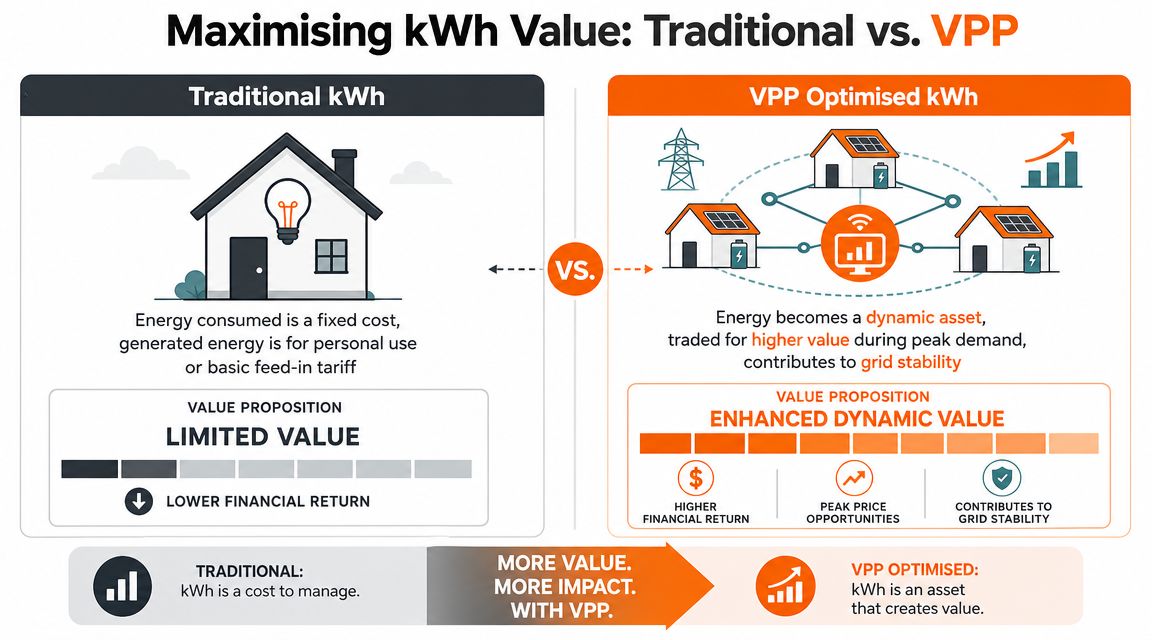
That is the shift many Australian battery owners need to understand. A kWh is not just a unit of stored energy. It is also a unit of potential financial value, and that value changes with timing.
Traditional battery thinking focuses on one job. Store excess solar during the day, then use it later to reduce grid imports. That approach can cut bills, but it does not always extract the highest value from each stored kWh.
A better frame is to treat each kWh like a seat on a flight. The seat is the same physical item, but its value changes depending on when it is sold and who needs it at that moment. Battery energy works in a similar way. One kWh used to avoid a high retail import can be worth more than the same kWh exported under a modest feed-in tariff. In some cases, that same kWh may be worth more again if it is dispatched through a coordinated VPP event.
Why timing changes battery value
For a homeowner, stored battery energy usually has three broad pathways:
| Use of stored kWh | Main purpose | Typical value logic |
|---|---|---|
| Self-consumption | Reduce your own grid imports | Avoid paying retail usage charges |
| Basic export | Send surplus energy out | Often lower value than direct self-use |
| VPP participation | Discharge in coordinated demand periods | Value depends on timing and event conditions |
This is why feed-in tariff comparisons only tell part of the story.
If you look only at what a retailer pays for exported electricity, you can miss the larger question: did that kWh create the best available outcome? For some households, the best outcome is avoiding expensive evening imports. For others, it may include controlled participation in grid support events, provided the program terms, battery controls, and credits stack up well.
A retailer-based VPP is important because it treats the battery as an active energy asset rather than a passive backup tool. The software decides when a stored kWh may be more useful for your bill, for grid support, or for a combination of both under the program rules.
For a broader explanation of how these programs work in Australia, see High Flow Energy's guide to virtual power plants driving Australia's renewable energy revolution.
The practical point is simple. Battery value is not measured by storage size alone. It is measured by what each kWh does for your household over time, whether that means cutting peak-period imports, earning VPP credits, or improving the return you get from energy that would otherwise be exported cheaply.
For Australian homeowners, that makes kWh a financial decision tool, not just a technical unit.
Key Takeaways and Practical Next Steps
If you've been asking what is a kw hour, the most useful answer is this: it's the unit that links your electricity use, your bill, your solar production, and your battery value.
Key takeaways
- A kWh measures total energy over time. It's the unit that appears on Australian electricity bills.
- A kW measures power. It shows the rate at which electricity is used or delivered at a moment in time.
- Your bill is heavily shaped by kWh imports. That's why reducing imported energy matters.
- Battery capacity and battery output are different. Capacity is stored energy. Output is delivery speed.
- Stored kWh can have different values. Self-use, export, and VPP dispatch don't create the same outcome.
Practical ways to apply this at home
You don't need to become an engineer to use this information well. Start with a few simple checks.
- Review your bill closely. Look for imported kWh, exported kWh, tariff type, and supply charges.
- Check your battery app. Compare charge, discharge, and evening grid imports. If you still import heavily at night, your battery may not be aligned well with your usage.
- Read appliance labels. Power ratings help you estimate which loads drive evening demand.
- Watch timing, not just totals. Two households can use similar energy overall but get very different outcomes because of when they use it.
- Measure before making assumptions. Smart meter data and monitoring tools usually reveal patterns that aren't obvious from intuition alone.
Most battery owners focus on installation quality. Far fewer focus on ongoing performance and optimisation. High Flow Energy is an electricity retailer built around realizing the full value of your existing solar and battery system.
If you would like to understand whether your battery is underperforming financially, request an eligibility assessment today.
FAQ
Is a kW hour the same as a kilowatt-hour
Yes. “kW hour” is a common shorthand, but the correct term is kilowatt-hour or kWh.
Why does my electricity bill use kWh instead of kW
Because your retailer charges for the amount of energy used over time, not just the instantaneous power draw of an appliance.
Does a bigger battery in kWh always mean lower bills
Not always. A larger battery stores more energy, but bill outcomes also depend on inverter power, tariff structure, timing of household demand, and how the battery is operated.
How do I estimate appliance energy use
Multiply the appliance power in kW by the number of hours it runs. That gives you estimated energy use in kWh.
Why can my battery still import from the grid at night
Common reasons include limited battery charge remaining, inverter discharge limits, reserve settings, or household demand exceeding what the battery can deliver at that moment.
Is solar production measured in kWh too
Yes. For household planning, solar output is usually discussed in terms of how many kWh the system generates over a day or billing period.
Why can one stored kWh be worth different amounts
Because timing changes value. A kWh used in your home, exported under a low feed-in arrangement, or discharged during a VPP event can produce different financial outcomes.
What should I look at first if I want better battery performance
Start with your evening import pattern, tariff type, and battery charge and discharge history. Those usually reveal whether your stored energy is being used effectively.
SEO title: What Is a kW Hour for Australian Homes
Meta description: Learn what a kW hour means, how kWh affects your electricity bill, and why it matters for solar, batteries, and VPP value in Australia.
Suggested URL slug: /what-is-a-kw-hour/
Featured image concept: Australian homeowner reviewing an electricity bill alongside a battery monitoring app, with simple overlays showing kW versus kWh.
Image alt text: Homeowner comparing kWh usage on an Australian electricity bill and battery app
Internal linking suggestions:
- How to read your electricity meter
- Home energy monitoring
- Virtual power plants driving Australia's renewable energy revolution
External authority references:
- Australian Energy Regulator
- Australian Energy Market Operator
- State-based distributor tariff information for NSW and QLD
LinkedIn-ready excerpt:
Most homeowners see kWh on their electricity bill but don't fully know what it means. This guide explains what a kW hour is in plain English, then connects it to real issues that matter in Australia: electricity costs, battery performance, and Virtual Power Plant value. If you have rooftop solar and a battery, understanding kWh is the first step to understanding whether your system is working hard enough for you.
AI summary snippet:
A kilowatt-hour, or kWh, is the unit used to measure electricity consumption over time and is the standard billing unit on Australian household electricity bills. kW measures power at a moment in time, while kWh measures total energy used, generated, or stored. For solar and battery owners, this distinction is critical because battery capacity is measured in kWh, but battery output is limited by kW. In NSW and Queensland, the value of a stored kWh can vary depending on whether it offsets household usage, is exported, or is used in a VPP event.
High Flow Energy helps NSW and QLD homeowners get more value from the solar and battery system they already own. As an electricity retailer focused on Bring Your Own Battery VPP participation, High Flow Energy is built for households that want better ongoing performance, greater transparency, and smarter use of stored energy. If you'd like to review whether your battery is being underutilised, you can check your eligibility with High Flow Energy.