

Smart Home Energy Savings for Australian Battery Owners
Achieving genuine smart home energy savings involves more than just installing a few smart plugs. For Australian homeowners who have already invested in solar and a home battery, substantial financial benefits come from actively managing your energy assets, not just passively consuming power.
Beyond the Basics: Unlocking Real Energy Savings
Your home battery is more than a backup for blackouts; it is a financial asset. Unlocking its full value requires an intelligent approach to what is home automation in 2026. This intelligence enables savings far beyond simply scheduling appliances.
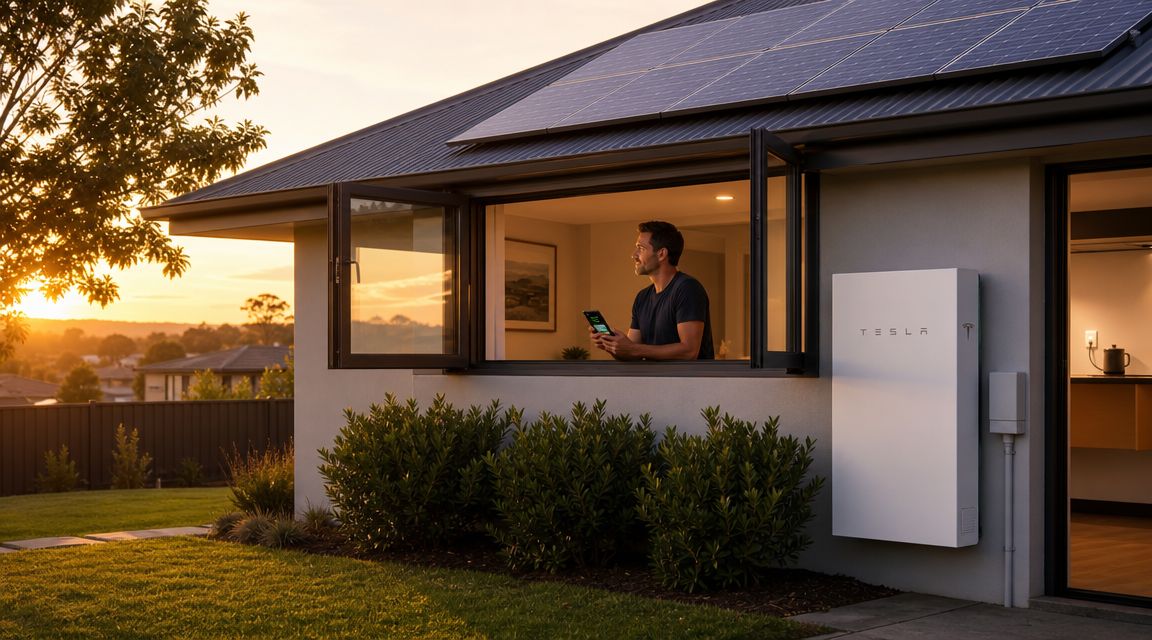
This guide provides practical strategies to transform the hardware you already own into a high-performing system. We will explain how to reduce electricity bills by shifting from being a simple energy consumer to an active participant in Australia’s dynamic energy market. This begins with a detailed review of your smart home energy consumption to identify opportunities for financial optimisation.
Identify Your Largest Energy Consumers
Before implementing savings strategies, it is critical to identify where your energy is being used. This data-driven audit focuses on high-consumption appliances that have the most significant impact on your electricity bill.
Your energy retailer’s portal and solar monitoring app are the best tools for this task. Use them to identify your home's main energy consumers, such as air conditioners, pool pumps, or electric vehicle (EV) chargers.
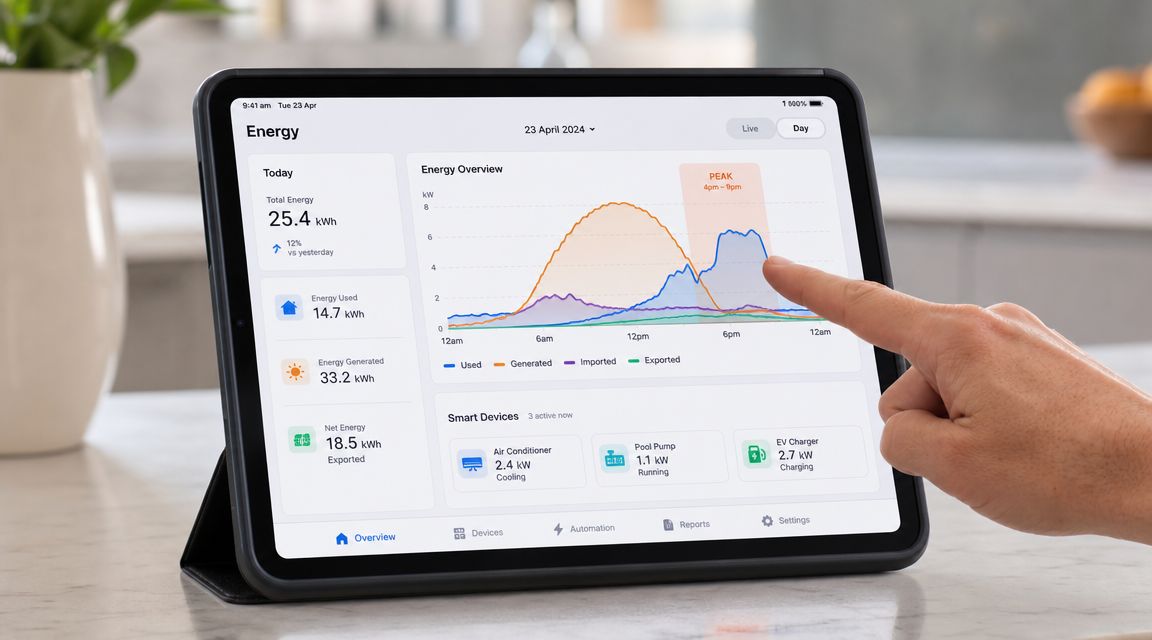
The primary goal is to map when these devices operate. Compare their usage times against your solar generation curve and your electricity tariff periods. For many households in NSW and QLD, this means paying close attention to the expensive evening peak period. This analysis provides a clear, evidence-based picture of your household’s energy rhythm, informing which appliances to automate for maximum financial benefit.
Automate Appliances to Align with Solar and Tariffs
Once you have audited your energy use, you can implement automation to reduce costs. This is where technology delivers tangible smart home energy savings by ensuring your appliances operate in a financially optimal way.
The fundamental goal for solar owners is to run high-energy appliances during the middle of the day when solar generation is at its peak and electricity from your panels is effectively free.
For example, instead of running an air conditioner at 6 p.m. during the peak tariff period, an automated system can pre-cool the house at 2 p.m. using 100% self-generated solar power. This simple adjustment directly reduces reliance on expensive grid electricity. Further insights are available on how smart home HVAC systems are revolutionising energy spending.
Setting up these automations is straightforward. Most modern appliances have built-in schedulers, but dedicated smart home platforms offer more sophisticated control. For those with a technical interest, it is possible to build a comprehensive smart home energy management system using IoT.
The objective is to establish a 'set-and-forget' strategy that consistently maximises solar self-consumption and minimises grid electricity costs.
Optimise Your Battery for Market Conditions
For battery owners, a critical mindset shift is required to unlock further value. A basic setup that stores excess solar for evening use is effective, but it leaves significant financial opportunities unrealised. To maximise your smart home energy savings, a more dynamic, market-aware approach is necessary.
This strategy involves actively participating in the energy market. A common example is time-of-use tariff arbitrage: charging the battery from the grid when electricity prices are low (overnight off-peak) and using that stored energy during high-priced peak periods.
These are not theoretical savings. In Australia, programs like the Peak Demand Reduction Scheme in New South Wales financially reward consumers for reducing grid strain during peak times. This means your battery can generate revenue through grid support participation, moving beyond simple bill offsetting. It signals a future where home energy is about becoming an active, flexible participant in the broader energy ecosystem. This concept is central to how smart home technology is revolutionising home energy management.
Level Up: Join a 'Bring Your Own Battery' VPP
If you have audited your energy use and automated key appliances, the next step is to unlock your battery's full financial potential by joining a ‘Bring Your Own Battery’ (BYOB) Virtual Power Plant (VPP).
A VPP, such as the one operated by High Flow Energy, enables your battery to do more than store solar energy. It allows your system to participate in the National Electricity Market (NEM), providing grid stabilisation services during periods of high demand or price volatility. The financial credits earned from these services can significantly exceed what is possible from a standard solar feed-in tariff.
This approach transitions your battery from a passive storage model to an active, market-aware strategy that generates value.
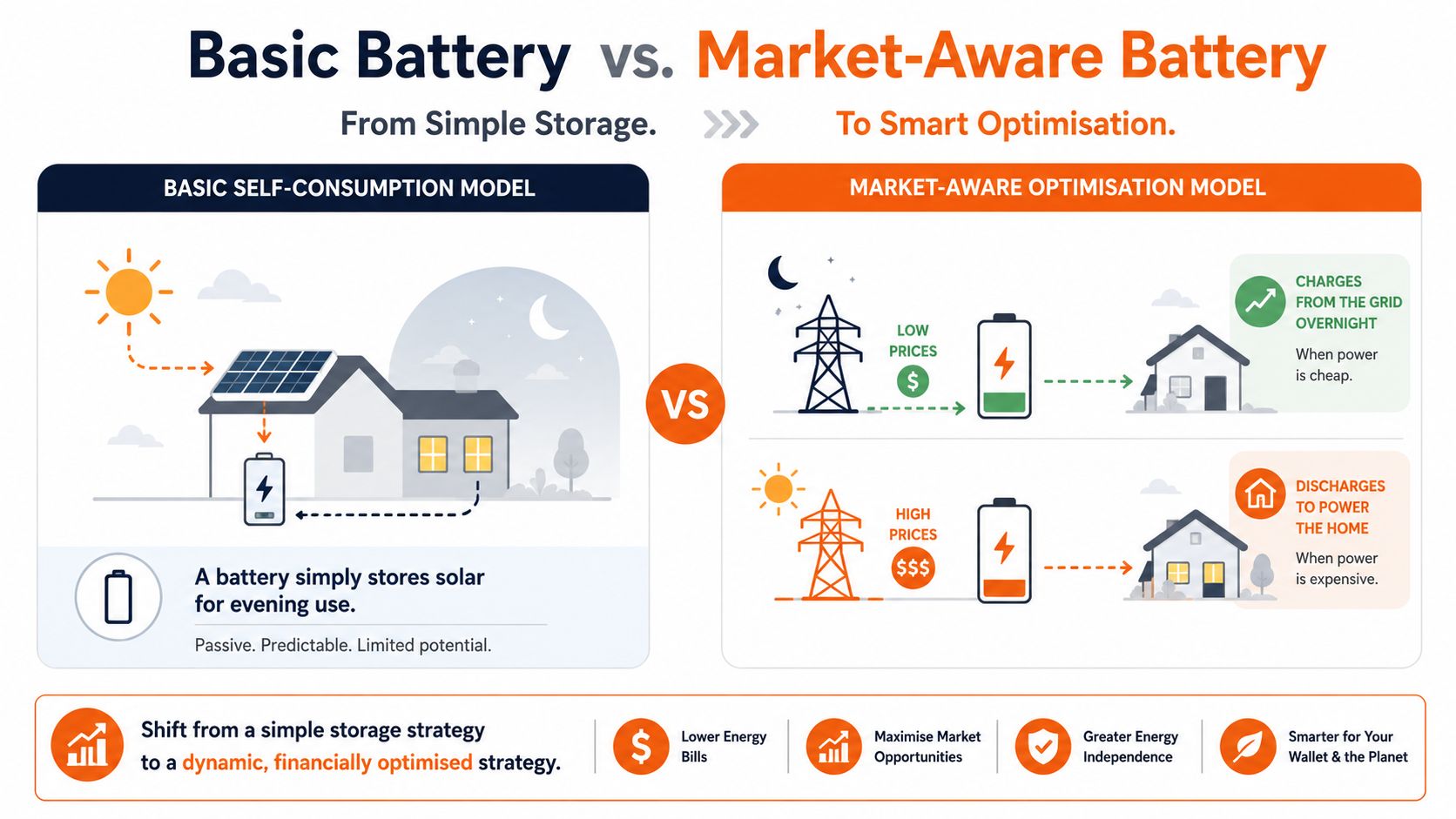
This shift from passive storage to an active, financially optimised asset is a fundamental change. The table below illustrates the difference in value between a standard setup and VPP optimisation.
Traditional Solar Value vs. VPP Optimisation
| Value Component | Traditional Solar & Battery Setup | High Flow Energy VPP Optimisation |
|---|---|---|
| Solar Self-Consumption | High. Offsets grid costs by using self-generated energy. | Maximised. Intelligent control ensures your energy needs are met while optimising for other value streams. |
| Grid Exports | Low value. Earns a standard, often low, feed-in tariff. | Strategic. Exports are timed to coincide with high wholesale price events, generating significant credits. |
| Grid Support Payments | $0. The battery does not participate in grid services. | High. Earns payments for helping stabilise the grid during demand or price events. |
| Bill Outcome | Good. Reduces reliance on the grid and lowers bills. | Superior. Can lead to significant bill reductions or net credits through multiple, optimised value streams. |
The VPP model introduces powerful value streams that a standalone system cannot access, transforming your battery from a cost-saving device into a revenue-optimised asset. A common concern is loss of control over the battery, but this is unfounded. You retain priority access. The system ensures your household's energy needs are met first, only interacting with the grid when there is spare capacity and a clear financial benefit.
This coordinated approach is a key part of the broader strategies to grow renewables in 2026, allowing individual homeowners to contribute to a more stable and resilient grid. To understand the specifics, you can learn more about how a Virtual Power Plant in Australia operates.
How a Performance-Focused Retailer Unlocks Value
Many homeowners focus on the quality of their battery installation but overlook the ongoing financial performance of their asset. Most battery owners are underutilising their investment.
This is where a specialist retailer like HighFlow Energy provides a distinct advantage. As a technology-enabled electricity retailer, our entire model is built to maximise the financial return from your existing solar and battery system. We put the advanced smart home energy savings strategies discussed in this guide into practice on your behalf.
Our platform uses sophisticated algorithms to manage the complex optimisation process, ensuring your battery is always operating to reduce your electricity bill. This transforms your system from a simple appliance into a productive financial asset.
Key Takeaways
- Audit First: Identify your largest energy-consuming appliances and when they operate.
- Automate Smartly: Schedule high-energy devices to run on free solar power during the day.
- Think Beyond Storage: A battery is a financial asset that can be optimised against market prices.
- Join a VPP: A 'Bring Your Own Battery' VPP unlocks grid service payments and market-based earnings that are inaccessible to standalone systems.
- Partner with a Specialist: A performance-focused retailer ensures your battery is being optimised correctly to deliver maximum financial value.
- You Retain Control: VPP participation uses only your battery's spare capacity; your home's energy supply and blackout protection remain the top priority.
Why High Flow Energy?
Most battery owners focus on installation quality. Far fewer focus on ongoing performance and optimisation. High Flow Energy is an electricity retailer built around unlocking the full value of your existing solar and battery system.
We are a performance-driven VPP operator and a transparent alternative to traditional electricity retailers. Our focus is on maximising the return on your energy assets. If you would like to understand whether your battery is underperforming financially, request an eligibility assessment today.
Frequently Asked Questions
Will a VPP stop my battery working in a blackout?
No. Your home's energy security is the highest priority. A Bring Your Own Battery (BYOB) VPP, such as the program from High Flow Energy, is designed to use only your battery’s spare capacity for grid events. It does not compromise the energy stored for your household use or the backup reserve you have allocated for an outage. You always retain priority use of your stored energy.
Is a VPP better than a high feed-in tariff?
For most battery owners, a VPP offers a superior financial outcome compared to a standard feed-in tariff (FiT). A FiT provides a small, fixed rate for exporting excess solar power. A well-structured VPP, by contrast, allows your battery to earn revenue from multiple streams, including participating in high-value grid support events where payments can be substantially higher than any FiT rate. This value is used to deliver a significant monthly allowance that directly reduces your electricity bill.
How does AI actually improve energy savings?
AI is the core intelligence behind modern battery optimisation. It is practically impossible for a person to manually track the multiple variables required to achieve the best financial return from a battery. An AI-driven platform, like that used by High Flow Energy, constantly analyses thousands of data points in real time, including wholesale electricity prices, local weather forecasts, and your home’s unique energy usage patterns. Based on this data, the AI creates a dynamic charge and discharge plan for your battery each day, ensuring it charges when energy is cheap or free and discharges or exports to the grid when it is most valuable to do so.
Do I lose control of my battery if I join a VPP?
No, you do not lose control. With a High Flow Energy VPP, you retain priority access to your stored energy. Our system is configured to ensure your household needs are always met first. The VPP only accesses your battery's surplus energy to participate in grid events when it is financially beneficial for you, and it will not drain your battery below a pre-agreed reserve level.
Is my battery compatible with a VPP?
Most modern residential batteries from leading brands are compatible with BYOB VPP programs. High Flow Energy partners with a wide range of battery manufacturers. The best way to confirm is to complete an eligibility check, which will assess your specific system configuration and location to determine its suitability for our VPP.