


Solar Battery Virtual Power Plant: An Australian Guide
A solar battery Virtual Power Plant is already big enough in Australia to matter at grid scale. During one measured period, aggregated behind-the-meter batteries sent an average of 539 MW back to the grid, which is why battery owners should think beyond “earn a few credits” and focus on how a VPP changes the economics of their electricity bill.
Most solar and battery owners still judge performance too narrowly. They look at self-consumption, feed-in tariffs, and whether the battery covers the evening peak. That misses the larger opportunity. A solar battery Virtual Power Plant is a network of home batteries linked by smart software so they can operate like one large power plant, and that creates a second layer of value from an asset you already own.
For households in Queensland and New South Wales, that distinction matters. Rooftop solar is common, evening demand remains commercially important, and a battery that only shifts your own usage may still be underused. The better question isn't whether a battery stores solar. It's whether the battery is being operated in a way that captures the highest-value moments in the market without undermining your own household priorities.
What Is a Solar Battery Virtual Power Plant
A useful way to think about a VPP is an orchestra. Each battery is a single instrument. On its own, it can do useful work inside one home. Connected through software and coordinated at the right time, thousands of batteries can respond together like a single, dispatchable resource.
The Australian definition is precise. The Clean Energy Regulator says a VPP is a network of small distributed energy resources, such as solar batteries, linked by smart software so they act like a single power plant. It also states that enrolled batteries can support the grid during high-demand or peak periods, with benefits including improved grid reliability, better use of renewable energy, and potential financial benefits for participants, as set out on the Clean Energy Regulator's VPP guidance.
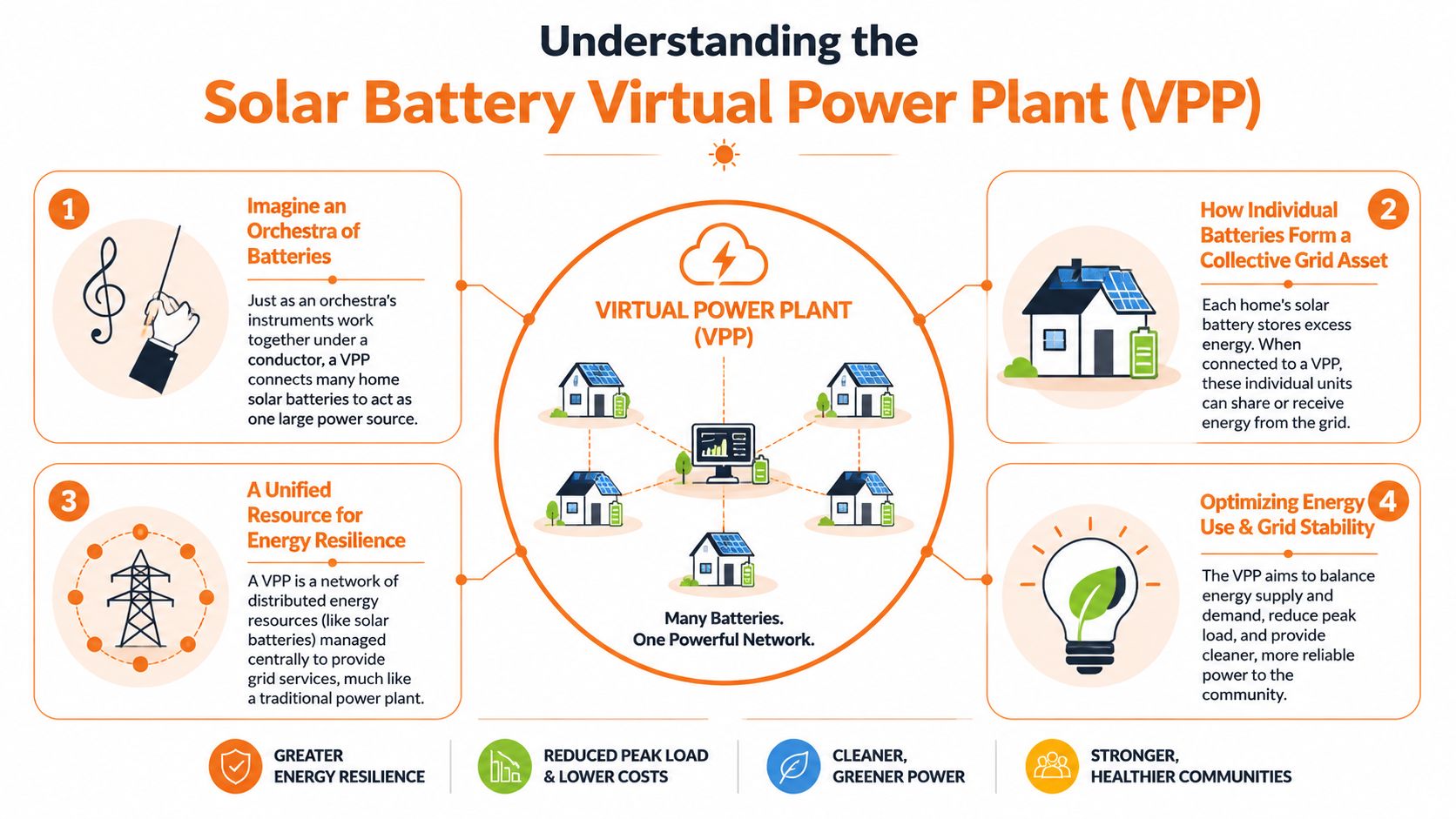
The three parts that make a VPP work
A VPP only works if three elements line up.
- The battery: Your battery stores energy that can be used by your household first and, when spare capacity exists, can also be made available for coordinated grid support.
- The software layer: This is the operating system of the VPP. It monitors battery state, dispatch settings, grid needs, and program rules.
- The grid connection: The battery isn't acting in isolation. It's participating in a wider electricity system that values energy differently depending on time, demand, and local constraints.
That last point is where many homeowners underestimate the concept. A battery doesn't become more valuable merely by existing. It becomes more valuable when someone can coordinate it intelligently.
Why VPP readiness matters in Australia
In Australia, VPP readiness isn't just a nice extra feature. The Clean Energy Regulator links VPP capability directly to the Small-scale Renewable Energy Scheme for on-grid solar batteries. For batteries to claim Small-scale Technology Certificates, the inverter must be VPP-capable at installation, which effectively makes VPP readiness part of mainstream battery design rather than a fringe add-on.
Commercial insight: In the Australian market, VPP capability has shifted from optional feature to infrastructure assumption.
That has a practical consequence for existing owners and new buyers. If your system was installed with communication capability and compatible controls, you may already own a market-responsive asset rather than just a household backup device. That's the lens through which distributed energy resources should be assessed.
How VPPs Operate in the Australian Energy Market
The Australian electricity market doesn't reward exported energy evenly. A kilowatt-hour sent to the grid in a quiet period doesn't carry the same system value as stored energy dispatched when demand is high and conditions are tight. That spread is what makes VPP operation commercially interesting.
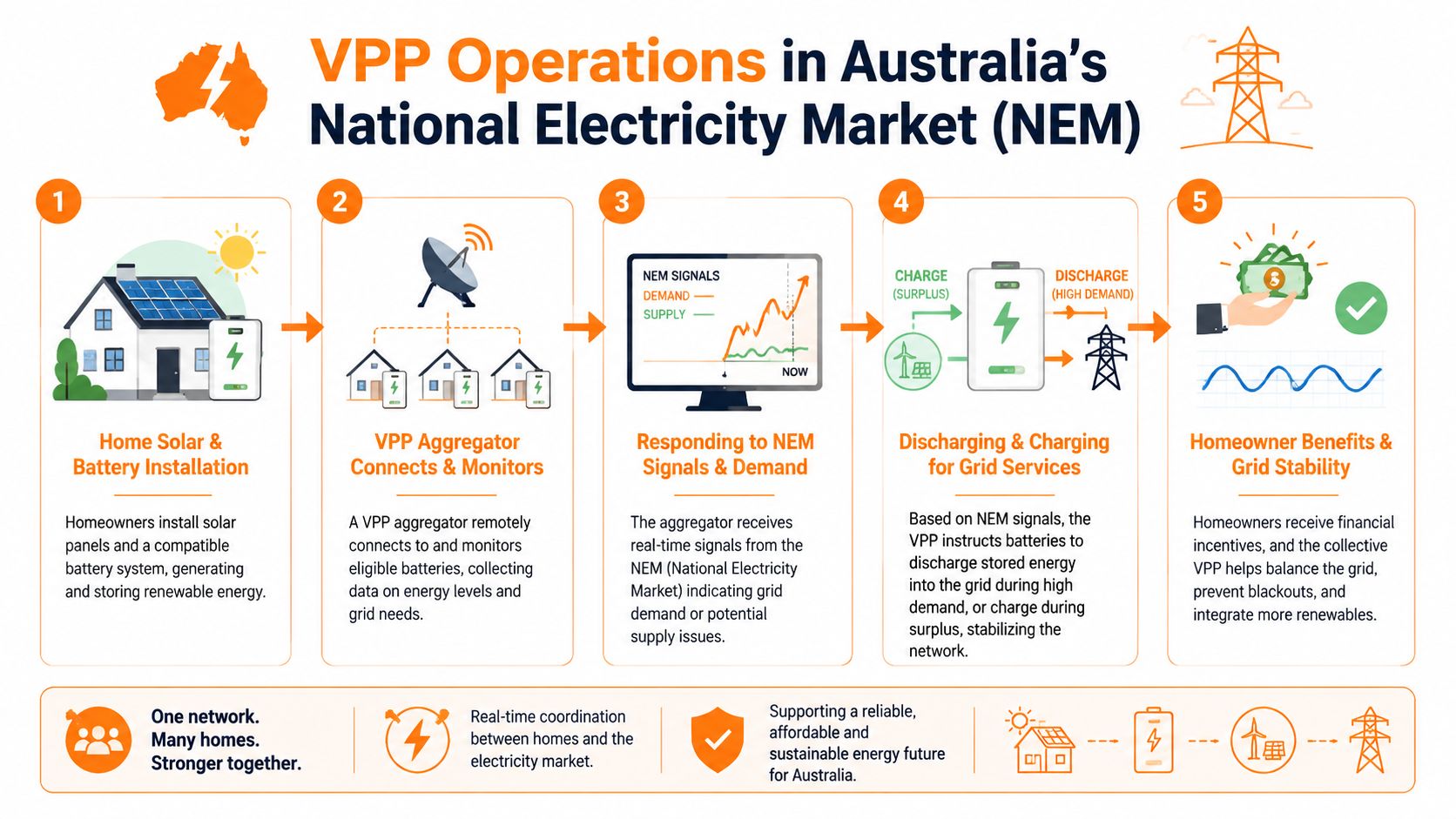
What actually happens during a VPP event
A retailer or aggregator monitors signals across the National Electricity Market. When demand is high or other market conditions make battery dispatch valuable, the system can call on many enrolled batteries at once. Each home contributes a small amount. In aggregate, the fleet behaves like a single flexible plant.
That's the practical meaning of demand response for battery owners. It doesn't usually mean your battery is constantly emptied into the grid. It means the battery is strategically used during specific intervals when the system values fast, distributed energy.
Here's a simple way to understand it:
- Solar charges the battery during the day, subject to the household's usage and system settings.
- The software monitors conditions and determines whether a grid event is worth participating in.
- Only available capacity is dispatched according to the program rules.
- The household still retains priority use, so the battery isn't supposed to be treated as a grid asset first and a home asset second.
The operational logic is more selective than many consumers assume.
Why this is no longer a niche model
Australia has already moved past the “interesting pilot” stage. The Institute for Energy Economics and Financial Analysis reported that behind-the-meter batteries in Australia sent an average of 539 MW back to the grid during one measured period, equal to about 1.9% of total market generation during that time, according to the IEEFA case for virtual power plants.
That matters for two reasons.
First, it shows that aggregated home batteries can act as a meaningful dispatchable resource rather than a symbolic one. Second, it changes how households should assess their own system. If thousands of batteries can collectively behave like a utility-scale participant, then the owner of one compatible battery isn't just choosing a retail product. They're deciding whether to enrol an asset into a functioning market mechanism.
Aggregation changes the commercial identity of a household battery. It stops being only a bill-management tool and starts operating as a market-facing energy asset.
That's why the conversation around Virtual Power Plant market dynamics should focus on dispatch quality, software intelligence, and access to value pools, not just on whether a program offers a participation reward.
The Real Financial Value for QLD and NSW Homeowners
Most VPP marketing undersells the core issue. The key question isn't whether a program pays credits. It's whether those credits interact with the actual structure of an Australian electricity bill in a useful way.
For the typical household, the answer depends heavily on charges that don't disappear just because you export solar. The Australian Energy Market Commission notes that network and distribution costs make up a significant portion of the total bill, and that a VPP's value comes from generating revenue during wholesale price events that can then be structured to offset these fixed charges. It also stresses that VPP economics are program-specific rather than a generic bill-reduction promise, as outlined in the AEMC residential electricity price trends review.
Why a feed-in tariff usually solves the wrong problem
A standard feed-in tariff pays for exported solar. That can be helpful, but it doesn't directly solve the hardest part of household electricity economics.
The problem is structural:
- Supply charges still apply regardless of whether your solar exports are strong on a given day.
- Network and distribution costs remain embedded in the bill framework.
- Daytime exports may be lower value than energy dispatched during high-price periods.
- Battery value can remain trapped if it's only used for self-consumption and passive export.
A retailer-based VPP can approach the bill differently. Instead of treating exports as the sole source of value, it can monetise participation in high-value market intervals and apply that value in a way that addresses charges a basic FiT doesn't touch.
Financial Outcome Comparison
| Financial Aspect | Standard Solar & Battery (with FiT) | Retailer-Integrated VPP (e.g., HighFlow Energy) |
|---|---|---|
| Primary value stream | Self-consumption plus passive export payments | Self-consumption plus coordinated grid-service value |
| Relationship to peak market events | Limited | Active participation can capture value during selected wholesale events |
| Ability to offset fixed bill components | Usually indirect and limited | Can be structured to offset charges that remain stubborn under standard retail arrangements |
| Dependence on daytime export | High | Lower, because stored energy can be used more strategically |
| Economic outcome | Simpler, but often leaves battery value underused | Potentially stronger, but highly dependent on program design, access, and dispatch settings |
That doesn't mean every VPP produces the same result. It doesn't. The economics depend on program rules, market access, customer settings, and how the provider translates event value into a retail outcome.
Decision rule: If a VPP explanation only talks about rewards and never explains how those rewards interact with supply charges, network costs, and residual usage, it's incomplete.
What this means in practice for NSW and QLD
In Queensland and New South Wales, the practical test is straightforward. Ask whether your current setup is only reducing imported energy, or whether it is also converting spare battery capacity into value that can be applied against the parts of the bill that typically remain.
That's a better comparison framework than “FiT versus VPP credits”. It is really a question of passive export versus active optimisation.
Households comparing offers should review energy tariff comparisons with that lens. The issue isn't only tariff level. It's whether the tariff, battery controls, and VPP structure are aligned to reduce the bill components that matter most.
Benefits Trade-offs and Common Misconceptions
Battery owners are right to be cautious about VPP participation. A program that extracts value from your battery also changes how that battery is used. The important question isn't whether there are trade-offs. It's whether the trade-offs are controlled, transparent, and commercially sensible.
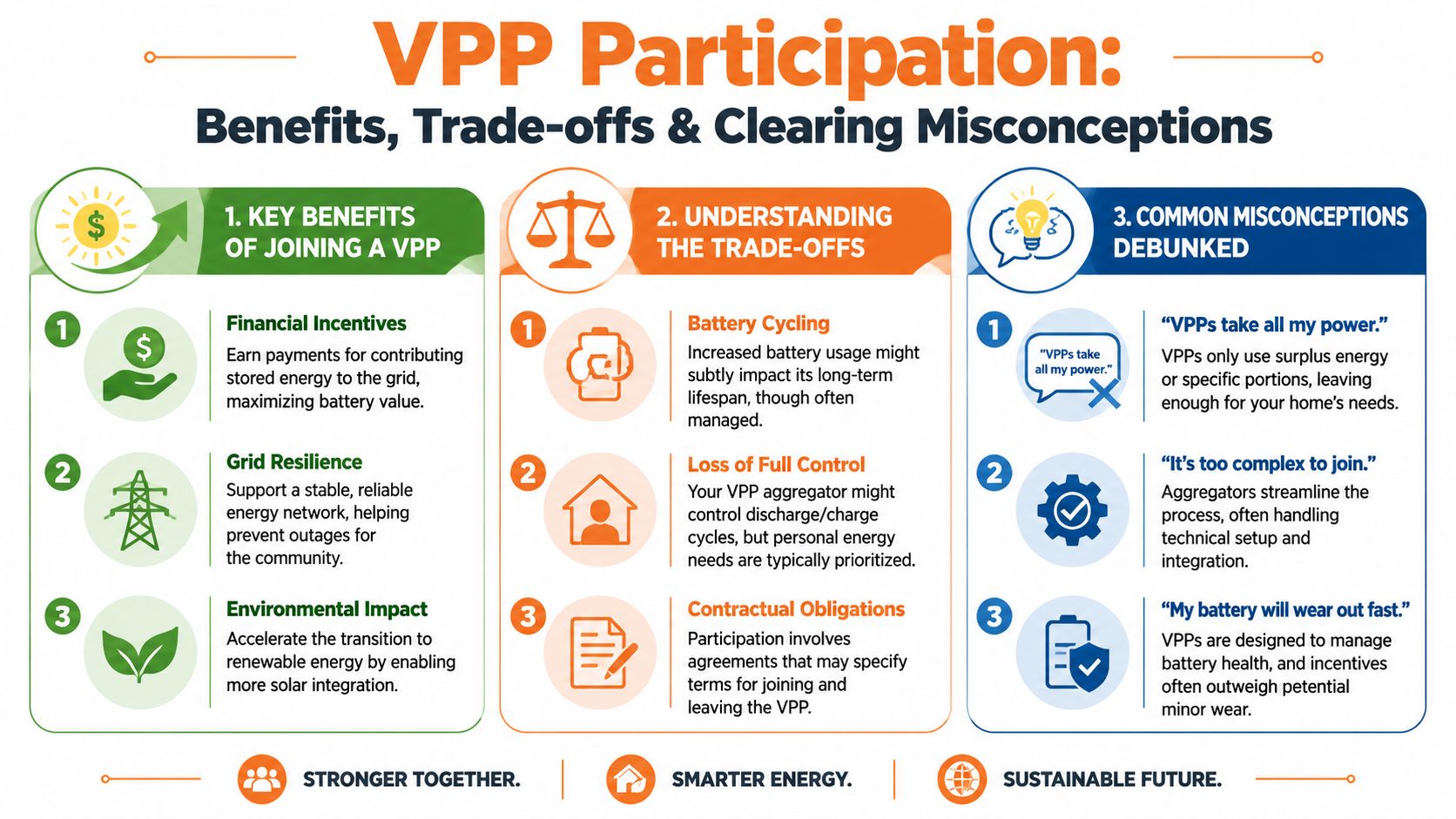
Battery degradation is a real issue, but not a simple one
One of the most common concerns is battery wear. That concern is legitimate. Battery warranties are typically tied to cycles or energy throughput, so extra dispatch activity has to be evaluated against warranty terms and battery management settings.
The useful distinction is between uncontrolled cycling and managed cycling. According to the US Department of Energy VPP blueprint, a well-designed VPP uses intelligent software to limit the depth and frequency of discharge for grid events so that the financial benefit outweighs any marginal impact on battery lifespan, while the customer retains priority use.
That means the commercial quality of the program matters as much as the existence of the program.
Three misconceptions that deserve a harder look
“The VPP will take all my stored power.”
A properly configured program shouldn't operate that way. Customer-priority settings matter because the battery still needs to serve the home first.“Any VPP payment means the deal is worthwhile.”
Not necessarily. If extra cycling is poorly managed, or if the retail structure doesn't apply value to the charges you pay, the headline benefit can look better than the net outcome.“Battery control means loss of ownership.”
Operational control for dispatch isn't the same as transfer of ownership. The owner still holds the asset. The relevant issue is how much control is delegated, under what rules, and with what override or reserve settings.
The wrong way to assess a VPP is to ask only what it pays. The right way is to ask what it changes in battery usage, warranty exposure, and bill structure.
Where the trade-off usually lands
For many technically literate owners, the balanced view is this:
- Upside exists when the battery has spare capacity and the operator can capture value from selected market events.
- Risk exists if program settings are opaque or too aggressive.
- Net benefit depends on matching dispatch intensity to battery capability, warranty conditions, and household usage patterns.
That's why generic VPP explainers often fall short. They describe the grid-service story well, but they rarely explain the edge case where the owner still faces meaningful residual charges or where additional cycling changes the economics over time.
Is Your System Ready for a VPP Eligibility and Compatibility
Not every battery can join a Bring Your Own Battery program, and compatibility is more than a brand checklist. The system needs the technical ability to communicate, respond to instructions, and operate within the rules of the relevant retail and network environment.
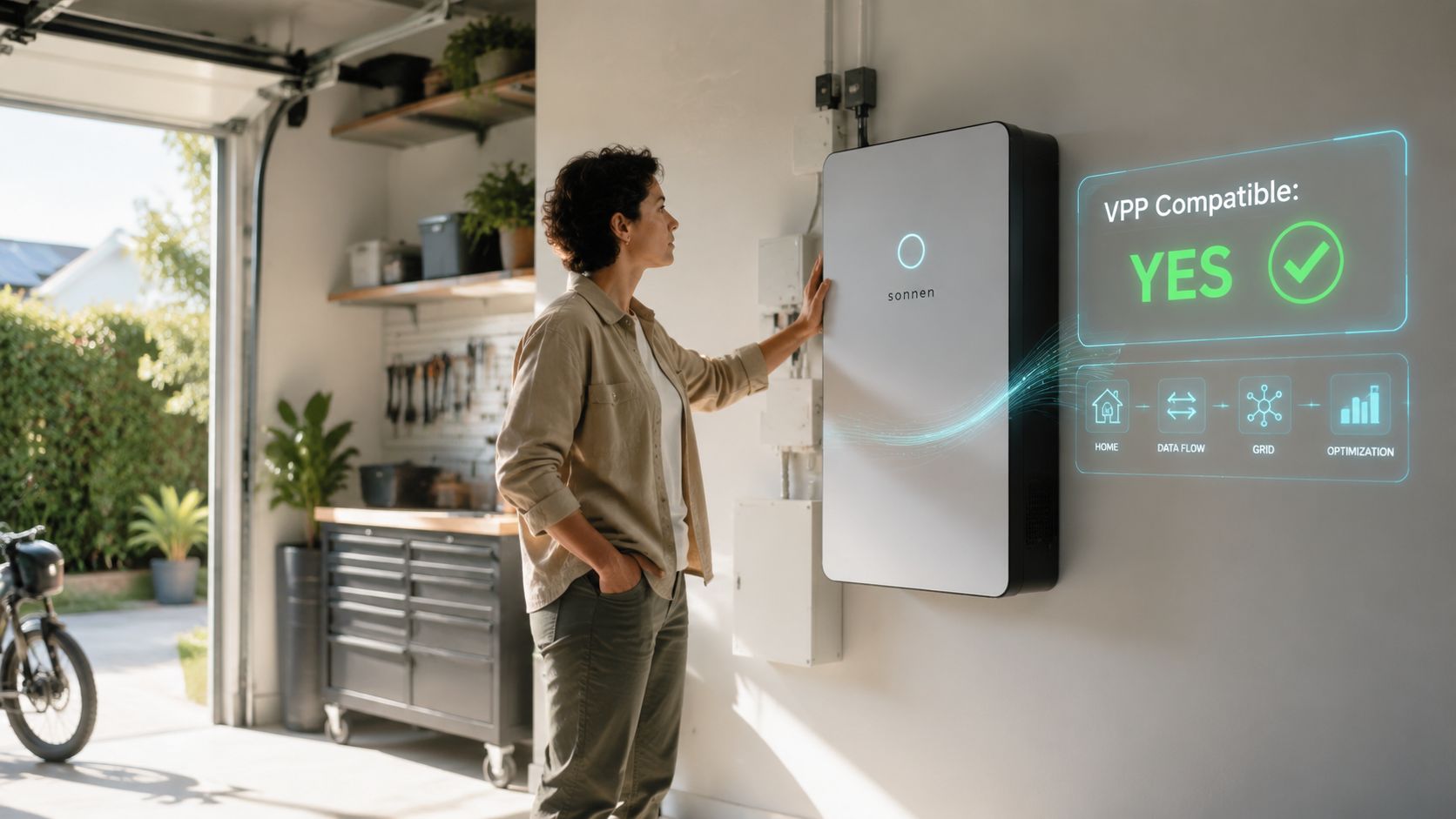
What BYOB actually means
Bring Your Own Battery means the household already owns the hardware and wants to connect it to a compatible VPP service. You're not buying a new battery through the retailer. You're testing whether your existing system can be enrolled and optimised.
In Australia, VPP readiness starts with compatibility at installation, particularly where inverter capability is concerned. If your system was built with remote communication and VPP-capable controls in mind, the path is usually simpler. If not, eligibility may depend on whether the battery and inverter can support the required software integration.
A practical compatibility checklist
Use this short checklist before requesting an eligibility review:
Battery and inverter compatibility
Check the exact battery and inverter models, not just the manufacturer name.Communication capability
Confirm whether the system can be monitored and controlled remotely under approved settings.Retail location
Verify that the service operates in your state and network area. For many BYOB offers, Queensland and New South Wales are the focus.Warranty terms
Review whether the warranty refers to cycles, throughput, retained capacity, or operating limits.Household usage pattern
Consider whether you usually have spare battery capacity available for dispatch after your own evening needs are covered.
Ask your installer for the exact model numbers and communications setup. “Compatible battery” is too vague to make a serious eligibility decision.
A strong eligibility check should test technical fit and commercial fit together. A battery can be technically compatible and still be a poor VPP candidate if the household uses most stored energy internally or if the program rules don't align with the owner's priorities.
Why Choose a Retailer-Based VPP Like HighFlow Energy
The most important structural choice isn't just whether to join a VPP. It's whether the VPP operator and the electricity retailer sit in the same model.
When those roles are separate, value can fragment. One company controls battery dispatch. Another issues the bill. The customer then has to work out whether battery activity is improving the retail outcome or merely generating a disconnected stream of credits.
A retailer-based VPP is cleaner because incentives are more closely aligned. The same business can see the wholesale opportunity, the tariff structure, and the customer billing outcome. That creates a better basis for optimisation.
Why integration changes the customer experience
A combined retailer-VPP model can simplify several problems at once:
- Billing clarity because the energy supply arrangement and battery value mechanism can be reflected in one customer relationship
- Operational alignment because battery dispatch can be designed around household priority and retail bill performance together
- Support simplicity because customers don't have to mediate between separate providers with different commercial objectives
That doesn't remove the need for scrutiny. Transparency still matters. Customers should still ask how dispatch works, what happens if usage exceeds an allowance structure, how priority settings are handled, and whether they can leave without friction.
The strategic case is straightforward. If the point of a VPP is value optimisation, then the model with the clearest line between market activity and bill outcome usually gives the customer the most understandable result.
Frequently Asked Questions and Your Next Steps
Does a VPP mean I lose control of my battery
No. Operational participation doesn't remove ownership. The important point is how the program sets household priority, reserve levels, and override options.
Will a VPP remove my electricity bill completely
It can reduce bills significantly in some structures, but it should never be presented as automatic or universal. Actual outcomes depend on your usage, your system, and the program design.
Is a feed-in tariff still useful if I join a VPP
It can be, but the core economic comparison is whether passive export or active dispatch creates more usable value in your retail arrangement.
What should I check in the warranty
Look for references to cycles, throughput, retained capacity, and any conditions tied to charging and discharging behaviour.
Is every battery eligible for a BYOB VPP
No. Compatibility depends on the battery, inverter, communications capability, and the provider's approved device list.
Why do network charges matter so much
Because they remain a meaningful part of household electricity costs. A VPP is most compelling when it helps address charges that ordinary solar export doesn't effectively reduce.
What is the right next step
Request a proper eligibility assessment that reviews both technical compatibility and the likely financial fit for your household.
Most battery owners focus on installation quality. Far fewer focus on ongoing performance and optimisation. High Flow Energy is an electricity retailer built around realizing the full value of your existing solar and battery system.
If you'd like to understand whether your battery is underperforming financially, request an eligibility assessment through HighFlow Energy.