


Car with Solar Panel Roof: 2026 Australian Buyer’s Guide
The most common advice about a car with solar panel roof is also the least useful for an Australian homeowner with serious energy assets. People talk about “free driving from the sun” as if the vehicle roof is a mobile version of rooftop solar. It isn't.
For a household in Queensland or New South Wales that already has rooftop solar and a battery, the better question isn't whether a solar-roof car is clever. It is. The better question is whether it's the best place to look for marginal energy value. In most cases, it isn't. The economics point back to your home battery first, and only then to experimental vehicle-integrated generation.
That doesn't make the technology irrelevant. It makes it strategically misunderstood. On the road, solar roofs are a small supplementary input. Parked at home, and eventually connected into smarter grid participation models, they may become something more interesting: another optimisable energy asset.
The Reality of a Car with a Solar Panel Roof
A car with solar panel roof integrates photovoltaic cells into the vehicle's roof surface so the car can harvest sunlight directly. In practice, that energy is used for battery maintenance, auxiliary loads, or modest range extension. It is not a substitute for conventional EV charging.
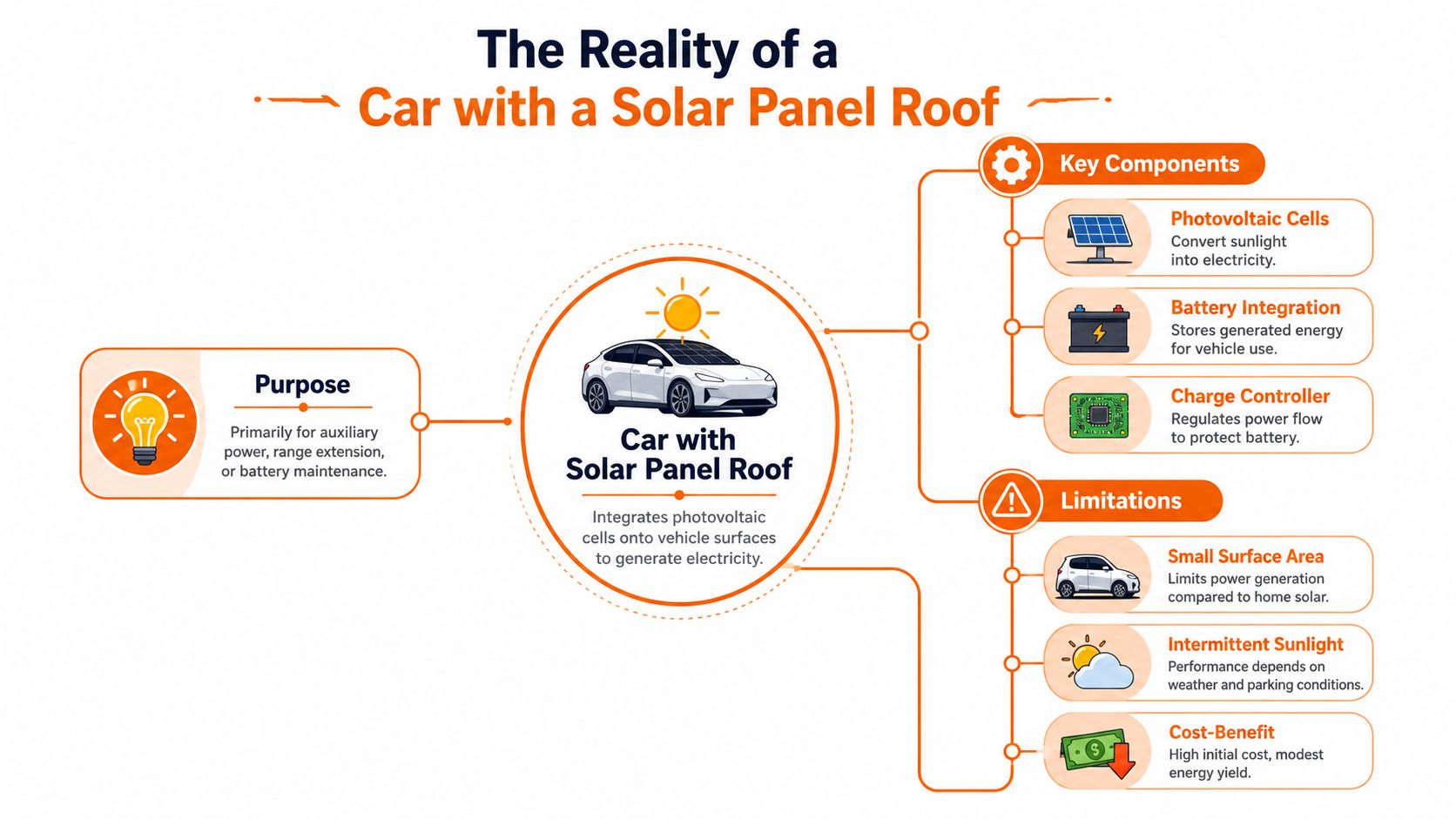
Why the roof size matters
Think about the difference between a sedan roof and the roof of an Australian house. One is a compact curved surface with strict design constraints. The other is a fixed platform built to carry a meaningful solar array. That difference in surface area drives almost the entire commercial outcome.
In Australia, a typical sedan or hatchback roof offers about 2 square metres of space. Under ideal Sydney conditions, that size can generate about 1.5 kWh per day, which is enough to add roughly 10.5 km of EV range per day, according to SolarQuotes' analysis of solar roofs on electric cars.
That's useful, but it's not transformative. It also comes with strict physical limits. The same analysis notes that, even using commercially available cells at 22% efficiency, capacity is capped at 440 watts on a standard vehicle roof. Once you understand that cap, the rest of the conversation becomes more realistic.
Practical rule: Vehicle solar works best when you treat it as a top-up source, not a primary charging system.
Why manufacturers haven't made it standard
The engineering challenge isn't just generation. Car roofs are exposed to shade, dust, heat, impact risk, and awkward parking angles. Cars also don't last in service the same way buildings do, which changes the economics of a solar installation.
That's one reason major manufacturers haven't standardised solar roofs across mainstream EV fleets. The return from a tiny onboard array is modest relative to the cost and complexity. For an Australian homeowner comparing asset value, there's also a broader ownership issue. If you're already thinking hard about total cost, resale and lifecycle value, it helps to compare car depreciation rates alongside any discussion about optional technology packages.
A disciplined buyer should treat a solar roof option as a convenience feature with niche value, not as the centrepiece of their energy strategy.
Real-World Performance in QLD and NSW
Australian conditions matter. A solar roof that looks marginal in one city can look more compelling in a high-sun region. Even then, the gains sit firmly in the “supplementary” category rather than the “self-charging car” category.
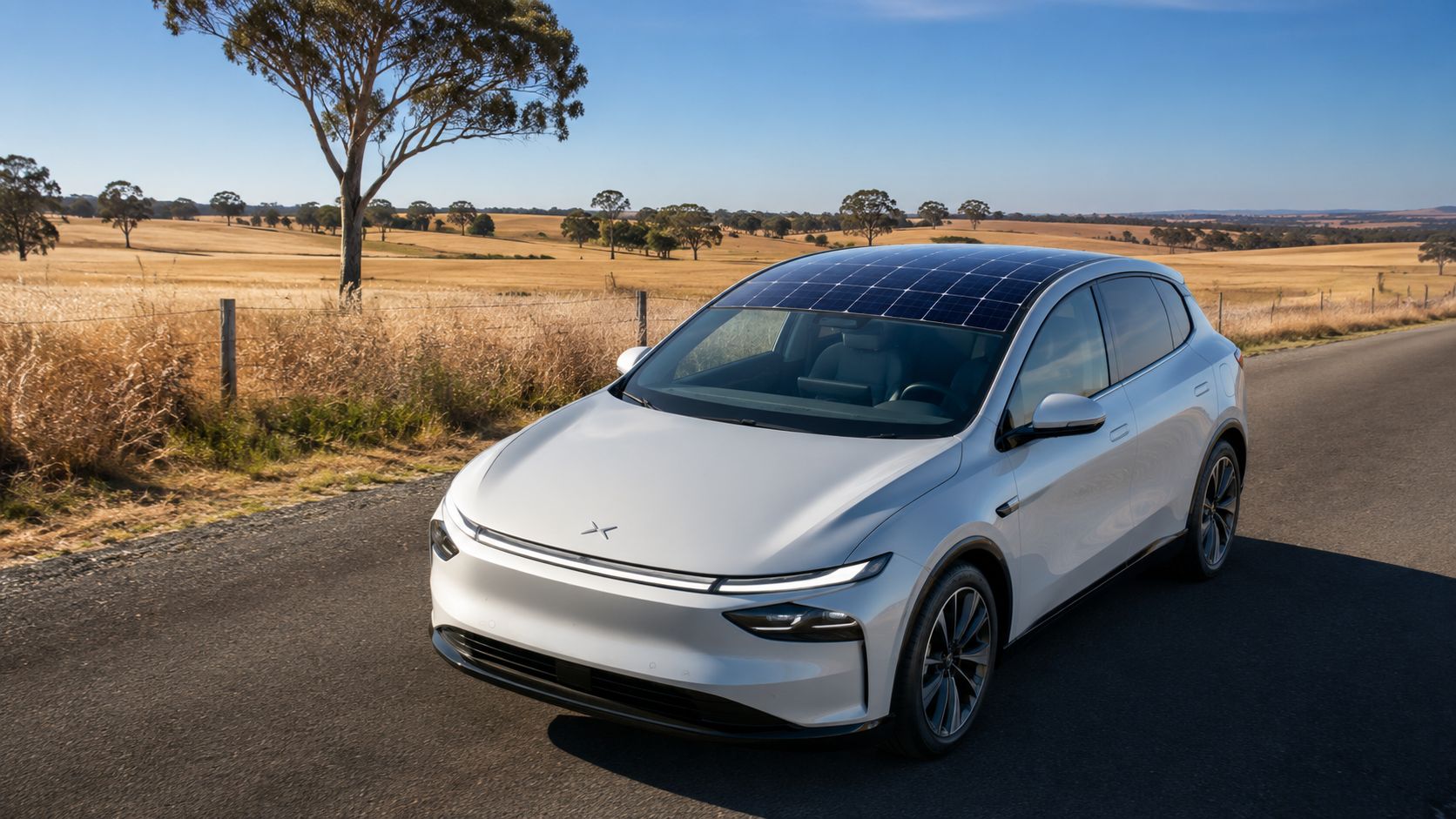
Best case in high-sun Australian locations
Nissan's local testing gives the clearest reference point. In Perth and northern Queensland, its solar-equipped Ariya demonstrated up to 23 km of range per day, while the same concept delivered 10 km in London, according to EV Central's reporting on the solar-powered Nissan Ariya.
For Queensland buyers, that matters because the upside case is better in strong sun. For New South Wales buyers, especially those around Sydney or coastal areas with more variable weather and more shaded urban parking, actual performance is likely to be less flattering than the headline examples from sunnier test conditions.
What this means in a household context
For a homeowner, vehicle solar shouldn't be assessed in isolation. It should be compared against the cost of charging the car using your existing solar, battery, tariff structure and retailer settings. If you want a practical benchmark, it helps to review the broader electricity cost to charge an electric car rather than focusing only on the novelty of onboard generation.
A few variables shape real-world output more than marketing suggests:
- Parking conditions: A car in a garage, under a carport, beside a tree, or in office basement parking won't behave like a test vehicle in open sun.
- Daily driving pattern: Small solar gains matter more for short commutes and less for households that drive longer distances.
- Season and weather: Queensland's higher solar exposure can improve the result. NSW households may see more variation across seasons and locations.
- Vehicle usage timing: If the car is parked in the sun during the middle of the day, the roof has a chance to contribute. If it's on the road, in shade, or undercover, it doesn't.
The performance story is location-sensitive. The investment story is still asset-sensitive.
A more commercial reading of the data
The optimistic way to read 23 km per day is that a solar roof can cover some low-distance urban travel in excellent conditions. The conservative way to read it is that the feature helps trim charging demand but doesn't materially change the household's energy architecture.
For a discerning energy user, that distinction matters. The car roof might save a charging session here and there, but it won't outperform a well-managed home system. In Queensland and NSW, the larger financial lever remains how the household stores, times and exports energy through fixed assets already connected to the meter.
Solar Car Roof vs Home Rooftop Solar A Financial Comparison
For a homeowner who already has rooftop solar, a battery, and time-based tariffs, the relevant question is yield. Where does the next dollar of energy capital produce the best return?
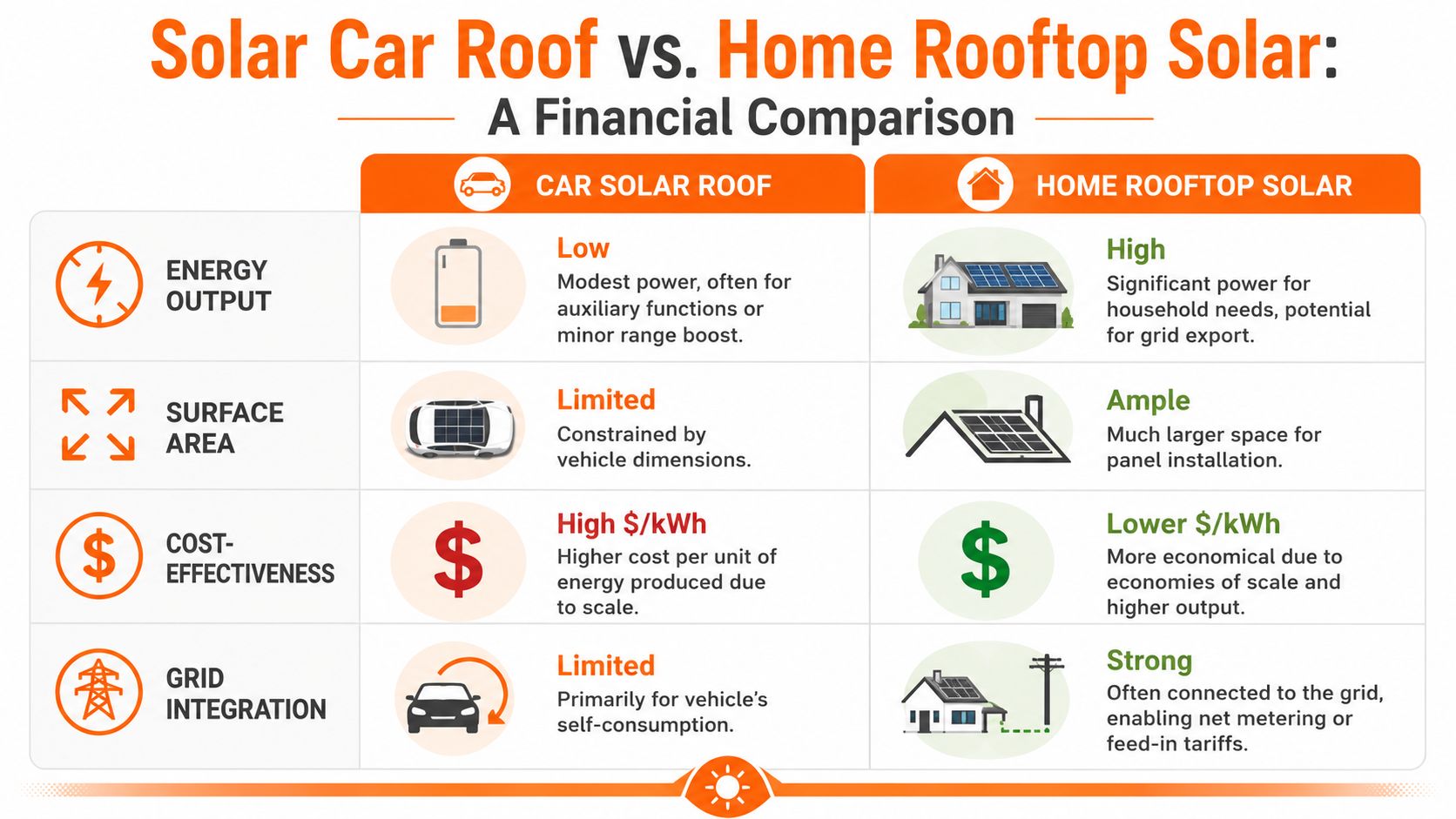
The car roof is constrained by surface area and control
A vehicle roof can generate useful energy. It cannot match the economics of a larger, fixed system that is designed around solar exposure, inverter efficiency, and battery integration.
The limitation is not the concept. It is asset design. A car offers only a small collection area, inconsistent orientation, and uncertain access to full sun across the day. A house has the opposite profile. It is larger, predictable, easier to optimise, and already connected to the meter where financial value is settled.
For bill reduction, controllability matters as much as raw generation. A home system can be configured to serve household load, charge a battery, avoid peak imports, and export when tariffs justify it. A solar car roof usually offsets only a small share of vehicle charging demand, and only when parking conditions cooperate.
The home system is the higher-value asset
The commercial comparison is straightforward:
| Asset factor | Car solar roof | Home rooftop solar |
|---|---|---|
| Available surface | Limited to vehicle body geometry | Far more roof area to work with |
| Operating conditions | Often shaded, moving, dirty, or parked unpredictably | Fixed, designed for solar exposure |
| Role in bill strategy | Mainly offsets a small portion of EV charging | Supports self-consumption, battery charging, and grid export |
That last row matters most.
A home solar and battery system participates directly in household cash flow. It can reduce grid imports at expensive times, improve self-consumption, and in some cases capture value through controlled exports. If you want a practical method for testing where that value is being missed, review how to calculate solar savings across self-consumption, battery charging and export timing.
Optional vehicle solar can still have a place
There are cases where a solar roof on a car makes sense.
- Short urban driving patterns: Small daily generation can cover a portion of low-kilometre weekday use.
- Auxiliary load support: Some systems help maintain vehicle electronics and reduce idle battery drain.
- High-exposure parking: Households with regular all-day outdoor parking in strong sun may see more consistent output.
Those benefits are real. They are also narrow.
For a strategic energy user, the bigger issue is opportunity cost. If the same budget could improve home battery controls, tariff strategy, or participation in a Virtual Power Plant, the fixed asset usually offers more measurable value because it operates inside the billing system every day.
The investment lens most buyers miss
A solar car roof is usually sold as a technology feature. It is better assessed as a low-yield generation asset attached to a depreciating vehicle.
That framing changes the decision. A premium vehicle option with modest energy output may still appeal on convenience, product differentiation, or owner preference. But for electricity bill reduction and asset performance, the stronger play remains the home system already sitting behind the meter.
The less obvious conclusion is this. Solar-roof cars become more interesting only when they stop being judged as miniature power stations for driving and start being considered as future flexible grid assets. Until then, the financial hierarchy is clear. For most solar and battery owners in QLD and NSW, optimising the house beats adding generation to the car.
The Untapped Potential Grid Integration and VPPs
The stronger case for a car with a solar panel roof is not energy generation. It is controllability.
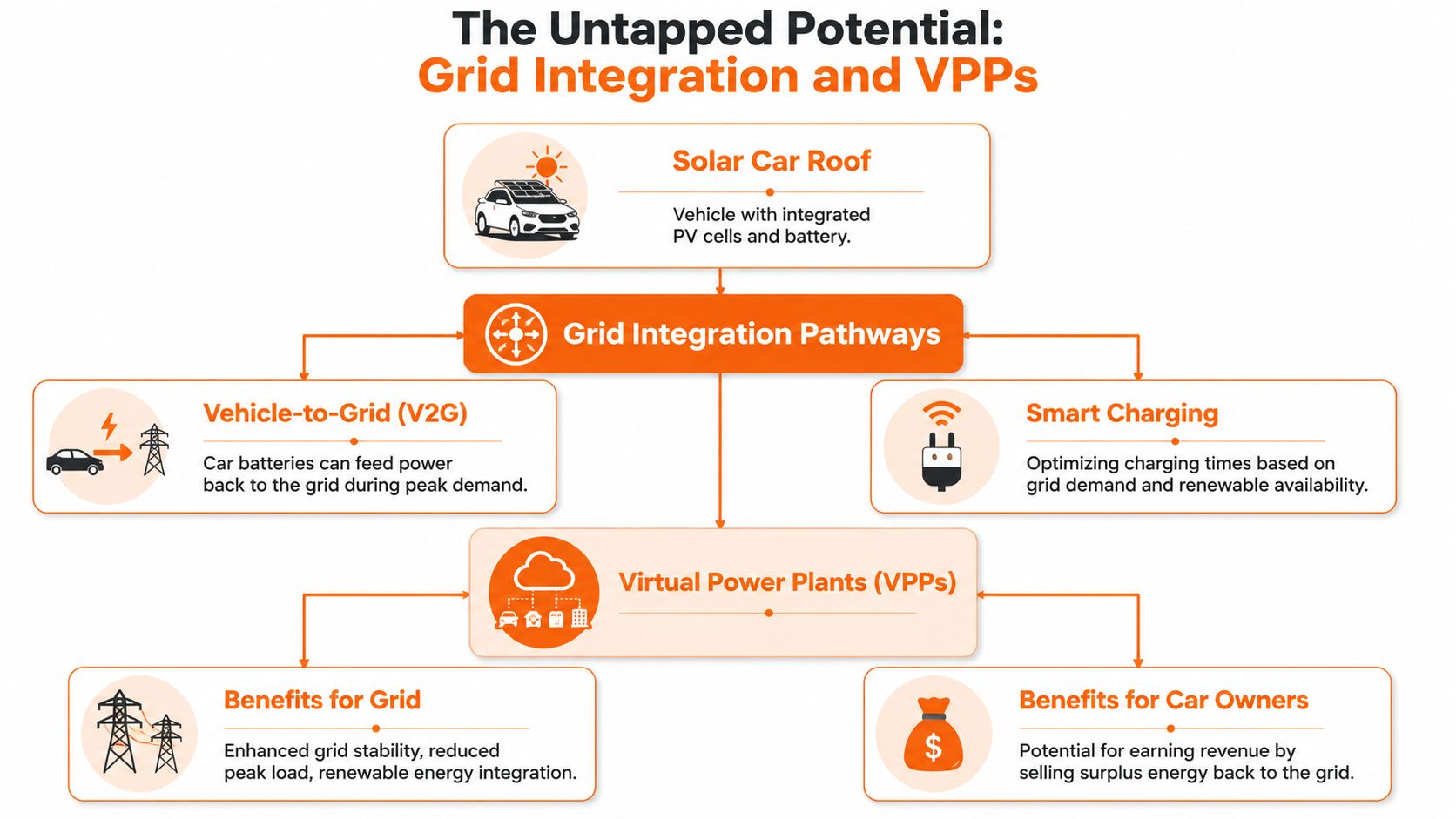
For a household that already has rooftop solar, a battery, and tariff-aware charging habits, the question is not whether the car roof adds a few extra kilometres. The real question is whether the vehicle can join the rest of the home energy stack and improve total asset returns. A useful plain-English primer on how a Virtual Power Plant works for home batteries and distributed energy devices sets up that idea well.
A VPP is a coordination layer. It aggregates many small devices, usually batteries first, so they can respond to price spikes, local network needs, or broader grid events. For a savvy owner, that matters because value in the National Electricity Market is often driven by timing, not just annual kilowatt-hours. One kilowatt-hour dispatched at the right moment can be worth far more than one generated passively at the wrong time.
That framing shifts the role of a solar-roof car. The roof itself remains a low-output generator. The vehicle becomes more interesting if it can store, shift, and export energy as part of a controlled system when parked at home.
To visualise that shift from transport feature to grid tool, watch this explainer.
Why VPP value is more credible than solar-roof hype
Australian VPPs are still early. By the end of the Australian Energy Market Operator demonstration program in 2021, only 31MW of VPPs were enrolled, well below the earlier 700MW by 2022 expectation cited in the Institute for Energy Economics and Financial Analysis review of Australian VPP progress.
That shortfall matters commercially. It shows that technical capability alone does not create household value. Product design, customer trust, dispatch rules, and settlement mechanics decide whether flexibility becomes bill savings or remains a marketing concept.
Operational standards matter as well. In South Australia, just under 12% of total VPP program installations went through formal Health, Safety and Environment audits during the VPP-SA project, according to ARENA's South Australia VPP report. For homeowners, that is not a side issue. If a distributed asset is going to trade grid value, compliance, control quality, and program governance affect its bankable value.
What changes if vehicles join the stack
A vehicle with onboard solar only becomes strategically interesting when it participates in a layered system:
- Transport value: the roof contributes a small amount of energy directly to vehicle use.
- Charging value: the vehicle charges when household solar output is high or tariffs are low.
- Grid value: stored energy is available for coordinated response if standards, tariffs, and hardware support it.
The third layer is where the economics can change. A low-yield roof on its own does little for a household that already optimises fixed solar and storage. The same vehicle, connected to managed charging and future bidirectional programs, could become a mobile battery with optional trickle generation. That is a different asset class.
Some Australian development work points in that direction. As noted earlier, specialist solar EV projects have reported much higher solar contribution than mainstream passenger vehicles, but those examples sit outside normal ownership conditions and should not be used as a proxy for current household economics. The practical takeaway is narrower. Vehicle integration matters more than roof output.
For homeowners in Queensland and New South Wales, that leads to a clear commercial conclusion. Today, the solar roof is usually the least important part of the value stack. The higher-value path is still optimising the home battery and any VPP participation already available. The car becomes more compelling later, if it can join that stack as a dispatchable asset rather than a novelty generator.
Guidance for Solar and Battery Owners
If you already have rooftop solar and a home battery, the priority order is straightforward. Optimise the fixed asset first. Consider the vehicle feature second.
A better decision framework
Use this sequence when assessing a solar-roof car purchase or upgrade:
- Check your existing battery performance: If your battery mainly shifts your own solar but isn't participating in higher-value coordination, there may be untapped value already sitting in your garage.
- Review tariff and charging behaviour: EV charging cost depends heavily on timing, not just energy volume.
- Treat vehicle solar as a bonus, not a business case: It can improve convenience and trim charging demand, but it usually won't be the strongest financial lever in the household.
- Assess future compatibility: If vehicle-to-grid and coordinated charging become more available, today's niche feature may have a larger strategic role later.
Where current bill value is more tangible
For households focused on electricity bill reduction, VPP participation is already a more direct pathway than relying on a solar car roof. In Australia, VPP participants typically earn $200 to $500 in yearly bill credits, with wholesale payouts exceeding $1.00/kWh during rare price spikes, according to EcoFlow's Australian guide to Virtual Power Plants.
That doesn't mean every household will capture the same outcome. It does mean the market already recognises and pays for coordinated battery behaviour in a way that onboard car solar generally does not.
What to do next if you're in QLD or NSW
- Start with your meter, not your next vehicle option list: Your home battery is already connected to a value stream.
- Look at export constraints and peak periods: These often shape actual returns more than solar generation alone.
- Be sceptical of feature-driven buying: A technically elegant add-on can still be commercially secondary.
For an astute homeowner, the test is simple. Ask which asset gives you more controllable value against your electricity bill. Today, that answer is usually the home battery.
Unlock the Value of Your Existing Energy Assets
A car with solar panel roof is a genuine technology, not a gimmick. But for most Australian homeowners with a serious home energy setup, it's a small-yield asset with a niche role. It can add convenience, reduce a fraction of charging demand, and point toward a more distributed transport-energy future.
The stronger commercial case sits elsewhere. A home battery has better controllability, clearer integration with retail outcomes, and a much more direct path to bill optimisation. That's the distinction many buyers miss. They focus on whether a solar roof can generate power. They should focus on where that power creates the most value.
Most battery owners focus on installation quality. Far fewer focus on ongoing performance and optimisation. High Flow Energy is an electricity retailer built around maximizing the full value of your existing solar and battery system.
If you would like to understand whether your battery is underperforming financially, request an eligibility assessment today.
Key takeaways
- Vehicle solar is supplementary: It helps at the margin, not as a primary charging method.
- Australian location matters: Queensland conditions can improve output, but the feature remains limited by surface area.
- Home systems deliver stronger economics: Fixed rooftop solar and battery optimisation usually create more bill value.
- Future upside may come from grid integration: The long-term relevance of solar-roof vehicles may be as coordinated grid assets, not just transport assets.
Frequently asked questions
Is a car with solar panel roof worth buying in Australia
It can be worth considering if you value innovation, drive short distances, and regularly park in full sun. But if your main goal is reducing electricity costs, your home solar and battery setup will usually offer stronger returns.
How much range can a solar roof add in Australia
Under ideal Sydney conditions, a typical solar roof on a sedan or hatchback can add about 10.5 km per day from around 1.5 kWh of generation, based on the SolarQuotes analysis linked earlier.
Do solar roofs work better in Queensland than in New South Wales
Yes, stronger sun exposure can improve output. Nissan's Australian testing showed higher daily range gains in northern Queensland and Perth than in lower-sun overseas locations. Real-world NSW results will depend more heavily on parking conditions and weather.
Can a solar roof fully charge an EV
Not practically in normal household use. As noted earlier, a solar roof typically needs about 90 hours of full sunlight to recharge a standard EV battery.
Is a solar car roof better than home rooftop solar
No, not as a pure energy asset. Home rooftop solar has more surface area, more stable operating conditions, and better integration with battery storage and retail energy outcomes.
Could solar-roof EVs become part of a Virtual Power Plant
Potentially, yes. That's one of the most interesting future pathways. If vehicles gain the right charging and export capabilities, they may support households and the grid as flexible distributed assets.
What should battery owners optimise first
Start with your existing home battery, tariff settings, charging behaviour and VPP options. Those levers are more likely to affect your electricity bill than a solar-roof vehicle option.
External authority references
For broader context on the Australian market, readers should also monitor updates from the Australian Energy Market Operator and the Australian Energy Regulator. Those institutions shape the operating environment for batteries, tariffs, and distributed energy participation across the National Electricity Market.
Internal linking suggestions
- An explainer on BYOB VPP eligibility in Queensland and New South Wales
- A guide to battery optimisation under time-of-use tariffs
- A comparison of feed-in tariffs versus VPP value streams
- A practical article on export limits and how they affect battery owners
- A retailer comparison page for VPP households in NSW and QLD
SEO title
Car With Solar Panel Roof Guide for Australia
Meta description
Car with solar panel roof explained for Australian homeowners. Learn the actual value, limits, and VPP relevance in QLD and NSW.
Suggested URL slug
/car-with-solar-panel-roof-australia
Featured image concept
A premium electric vehicle parked in a sunny Australian driveway beside a home with rooftop solar and a battery system interface on screen.
Image alt text
Electric car with solar panel roof parked outside an Australian home with rooftop solar panels
LinkedIn-ready excerpt
A car with solar panel roof sounds like the next logical step for energy-smart households. In reality, its value is modest for driving and much more interesting in future grid participation. For homeowners in QLD and NSW with rooftop solar and a battery, the bigger financial opportunity still sits in optimising the assets already connected to the meter.
AI summary snippet
A car with solar panel roof can add small amounts of energy, but it won't replace normal EV charging in Australia. The technology is constrained by surface area, which is why home rooftop solar remains the stronger asset for bill reduction. For battery owners in Queensland and New South Wales, the more important opportunity is optimising existing home storage and preparing for future VPP-style integration.
If you already own rooftop solar and a compatible battery, the biggest missed opportunity usually isn't hardware. It's performance. HighFlow Energy is an Australian electricity retailer built for BYOB Virtual Power Plant participation, helping homeowners in Queensland and New South Wales access more value from the battery they already own. If you'd like to understand whether your current setup is underutilised financially, request an eligibility assessment and review how your battery is performing against its real market potential.