

Grid Forming Inverters: Your 2026 Guide to Australian Solar
If you already own a solar battery, the key question isn't just how much energy it stores. It's whether your system can follow the grid, or help lead it.
That distinction matters more than most homeowners realise. A battery with the right inverter behaviour can do more than soak up daytime solar and cover evening use. It can respond to grid disturbances, support stability, and become more useful inside an advanced Virtual Power Plant. For homeowners in Queensland and New South Wales, that shifts the conversation from simple backup and self-consumption to performance, flexibility, and asset value.
Australia isn't treating this as a niche engineering topic. As of late 2025, Australia's National Electricity Market had ten operational grid-forming battery energy storage systems delivering approximately 1,070 MW of grid-forming capable capacity, according to Enertis Applus' analysis of grid-forming inverter deployment. That scale places Australia among the most advanced markets globally for grid-forming inverter adoption.
For a homeowner, that tells you something important. Grid-forming capability is moving from specialist utility projects into the mainstream logic of how modern battery systems are designed, connected, and valued.
Introduction Is Your Battery a Follower or a Leader
Most home battery owners think in familiar terms. Store solar during the day. Use it after sunset. Maybe keep some reserve for a blackout. That's sensible, but it's incomplete.
Your inverter decides how your battery behaves electrically. In simple terms, it determines whether your system waits for the grid to provide the signal it needs, or whether it can create and hold that signal itself. That's where grid-forming inverters come in.
A traditional inverter is often a good exporter of energy. A grid-forming inverter is something more. It helps establish the voltage and frequency conditions that let an electrical system remain stable.
A battery is only as capable as the inverter control behind it.
For households, that sounds abstract until you connect it to outcomes that matter. A system with stronger technical capability is often better placed for advanced orchestration, outage resilience in the right setup, and participation in higher-value grid support roles. Those roles are a big part of why the topic matters financially, not just technically.
The Core Difference Grid-Forming vs Grid-Following Inverters
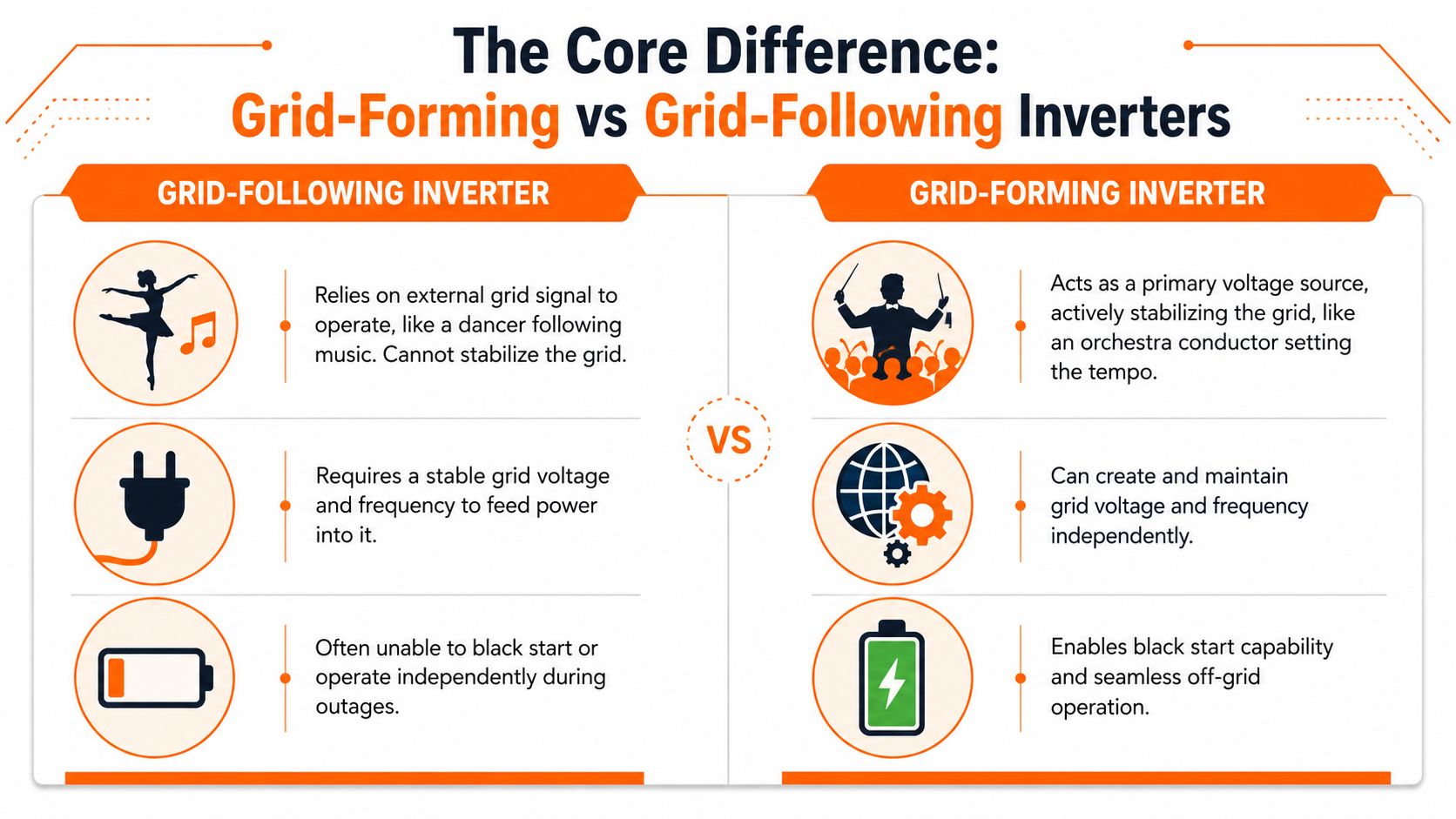
The easiest way to understand this is to compare a dancer with a conductor.
A grid-following inverter is the dancer. It listens for the beat, matches it, and moves in time. A grid-forming inverter is the conductor. It sets the tempo so others can follow.
What a grid-following inverter does
Most conventional solar inverters and many battery inverters are built to synchronise with an existing grid signal. They look for voltage and frequency already present on the network, then inject power into that framework.
That works well when the grid is strong and stable. In normal suburban conditions, a grid-following inverter can export energy very effectively. The limitation appears when the grid becomes weak, unstable, or unavailable.
If the system needs an external reference to operate, it can't independently create one. That's why grid-following hardware usually can't support an islanded network by itself unless it's paired with specific control arrangements.
What a grid-forming inverter does
A grid-forming inverter behaves more like a voltage source. Instead of waiting for the grid to provide the waveform, it can establish and regulate the electrical conditions that other devices use.
In plain English, it can hold the line when conditions are messy.
That doesn't mean every home battery with advanced controls can suddenly run an entire neighbourhood. It means the inverter architecture is designed for a more active role in system stability. That capability is especially valuable where the grid is weak, where inverter-based resources dominate, or where a battery system needs to transition into off-grid or restoration modes under the right configuration.
The three electrical signals people get confused by
Homeowners often hear terms like voltage, frequency, and phase and switch off. They're simpler than they sound.
- Voltage is the electrical pressure.
- Frequency is the speed of the alternating current rhythm.
- Phase is the timing alignment of that rhythm.
A grid-following inverter needs those signals to already exist in a usable form. A grid-forming inverter can actively set and support them.
That difference is why engineers care so much about control behaviour, not just battery size.
Why response speed matters
Fast response isn't a bonus feature. It's central to grid support.
Under the Australian Energy Market Operator specification, the response time to 90% of the initial change in instantaneous active power must occur within 50 milliseconds, as set out in AEMO's voluntary specification for grid-forming inverters. For non-engineers, that means the inverter must react extremely quickly when the system changes suddenly.
Practical rule: The faster and more stable the inverter response, the more useful the battery becomes in demanding grid conditions.
Side-by-side comparison
| Feature | Grid-following inverter | Grid-forming inverter |
|---|---|---|
| Basic role | Synchronises to an existing grid | Establishes and maintains electrical reference |
| Dependency | Needs a healthy external waveform | Can operate as a voltage-setting source |
| Best suited to | Strong, stable grids | Weak grids, advanced battery control, restoration roles |
| Behaviour in disturbances | More dependent on external conditions | Better suited to active stabilisation |
| VPP relevance | Useful for basic dispatch | Better aligned with advanced grid support functions |
| Off-grid capability | Limited unless specially configured | Better foundation for autonomous operation in the right setup |
A simple way to remember it is this. A grid-following inverter delivers power into the grid you already have. A grid-forming inverter helps hold together the grid you need.
Why This Matters for Your Home and the National Grid
Australia's power system is changing fast. More electricity now comes from inverter-based resources such as solar, wind, and batteries. At the same time, older synchronous generators that traditionally supplied system strength are retiring.
That creates a practical engineering problem. The grid still needs stable voltage, stable frequency, and a strong electrical reference. Those qualities used to come naturally from large spinning machines. In a modern grid, they increasingly have to be delivered by power electronics and control systems.
System strength in plain language
System strength is one of those terms that sounds more complicated than it is. Think of it as the grid's ability to stay electrically steady when something changes suddenly.
A strong system gives inverters a clear signal to work with. A weak system is more prone to instability, poor power quality, and connection challenges. That matters in parts of the National Electricity Market where renewable penetration is high or network conditions are already stretched.
The shift from pilot concept to formal market tool happened quickly. Australia's voluntary grid-forming inverter specification was formally scheduled to proceed from November 2022 to March 2023, marking a move from experimentation to risk mitigation in grid connection approvals, as outlined in CSIRO's work on grid-forming inverters in Australia.
Why homeowners should care
This isn't only about utility-scale batteries. The same underlying logic affects how distributed energy resources are valued over time.
If the grid increasingly rewards devices that can support stability, then inverter capability becomes part of the economics of battery ownership. A battery that can only shift your own household load has one value profile. A battery that can also support orchestrated grid services has another.
That's one reason battery owners should pay attention to network limits, export constraints, and the changing role of distributed assets in the NEM. High renewable penetration creates both technical friction and commercial opportunity. If you want a useful backgrounder on those broader pressures, High Flow Energy's overview of renewable energy integration challenges is a practical place to start.
The direct line to VPP value
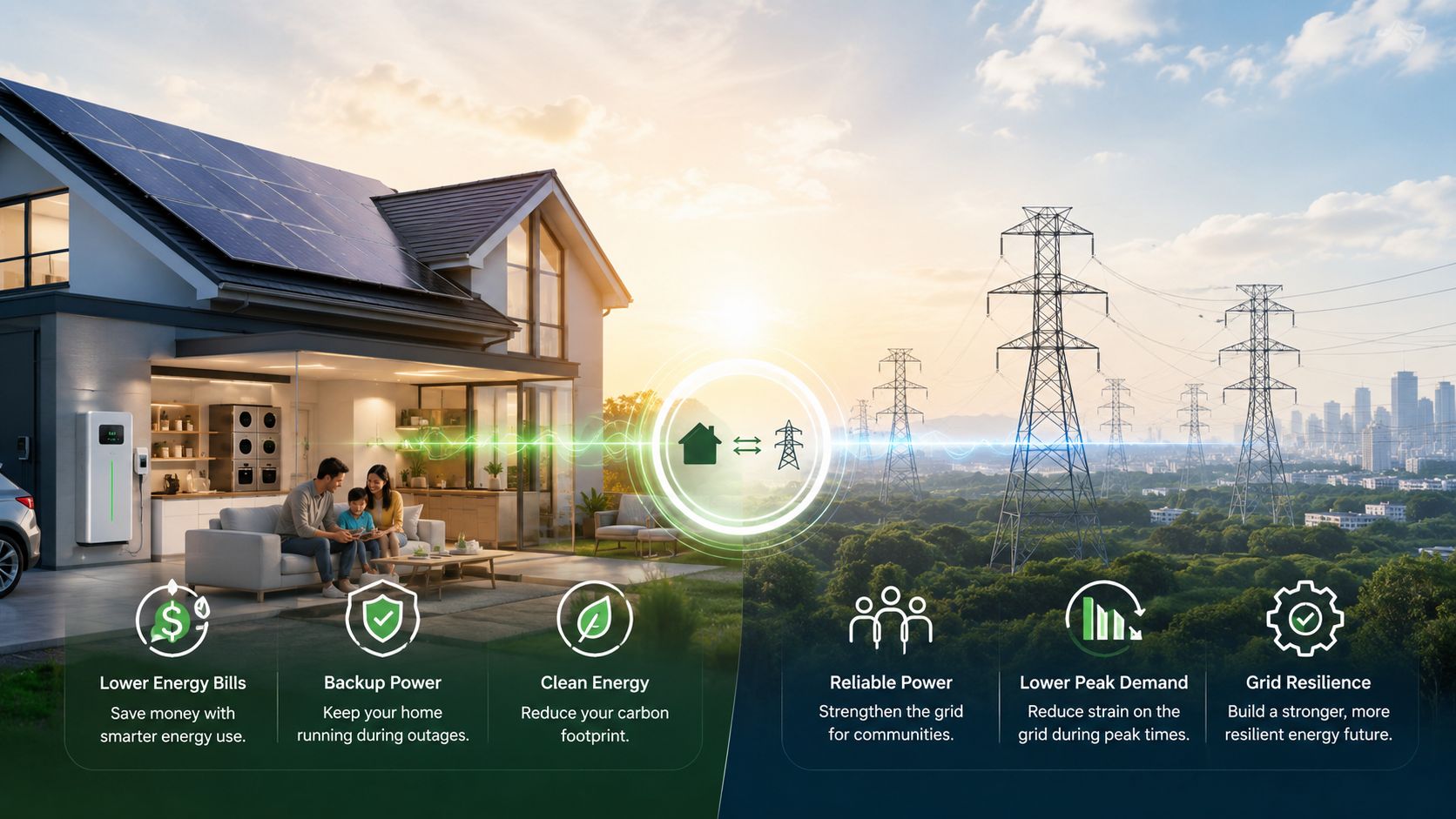
For a homeowner, the link is straightforward. Advanced VPPs work best when they can coordinate batteries that respond predictably, rapidly, and safely under changing grid conditions.
Grid-forming behaviour doesn't automatically guarantee better financial outcomes on its own. But it does expand what a battery may be able to do within a managed fleet. That can matter during demand events, wholesale price spikes, constrained export periods, or other moments when flexible batteries become especially valuable.
The technical upgrade is only meaningful because it changes what your battery can be asked to do, and what value it can potentially earn.
Unlocking Value Benefits and Risks in a VPP Context
For homeowners, this is the section that matters most. If your battery has stronger inverter capability, what difference does that make?
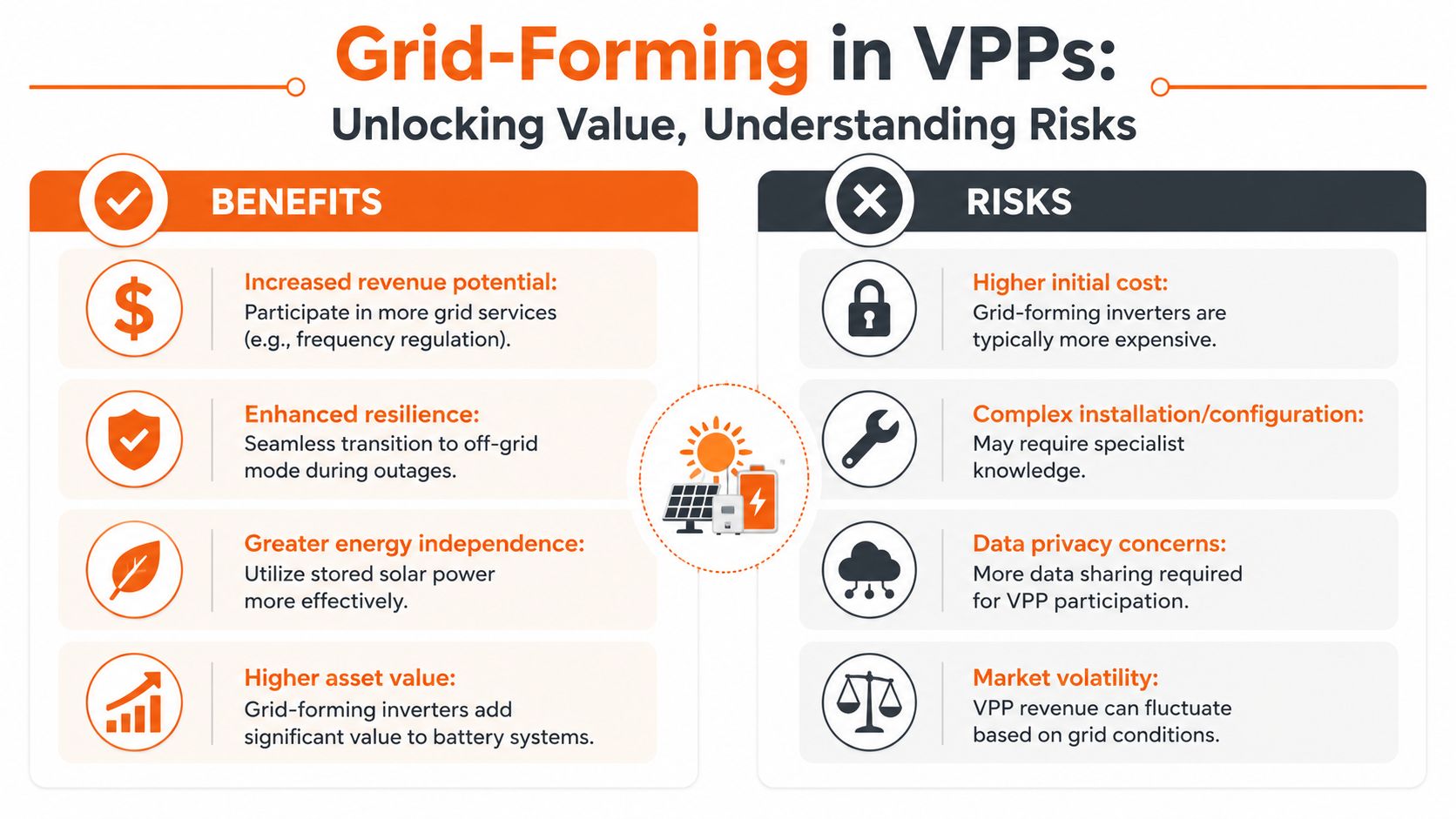
The short answer is optional value pathways. A battery that can contribute to more advanced grid support is potentially more useful to a VPP operator than one limited to basic import-export timing. Usefulness matters because VPP economics depend on coordinated battery response, not just the presence of storage.
Where the upside comes from
In a modern VPP, battery value can come from several layers at once:
- Household optimisation. Your battery can still prioritise self-consumption, time-of-use arbitrage, and protection against expensive evening imports.
- Fleet coordination. A VPP operator may dispatch spare battery capacity during high-value periods or system events.
- Grid support roles. More technically capable systems may be better suited to services tied to fast response and stable operation.
At utility scale, the market is clearly moving this way. Roughly 74% of the 33 GW battery storage pipeline in Australia's National Electricity Market is confirmed to be equipped with grid-forming inverters, according to Energy-Storage.news reporting on the NEM battery pipeline. That doesn't tell a homeowner exactly what any single battery will earn, but it does show where design standards are heading.
The risks deserve a plain answer
There are trade-offs, and battery owners should insist on a straight explanation.
- Cycling matters. More dispatch opportunities can mean more battery use. That has to be managed within battery operating limits and warranty conditions.
- Control quality matters. A poorly designed VPP can chase short-term events without respecting customer priorities.
- Revenue can vary. Grid support value depends on market conditions, device compatibility, and operational strategy.
- Data handling matters. Participation usually requires more telemetry and coordination than a standard retail plan.
A useful VPP should treat the battery as a long-term asset, not a disposable trading tool.
Your battery should first serve your home, then the grid with spare capacity.
Here's a helpful explainer if you want the broader operating model before looking at inverter specifics: what a Virtual Power Plant is and how it works.
A better way to judge VPP suitability
Don't ask only, “Can my battery join a VPP?”
Ask these instead:
| Better question | Why it matters |
|---|---|
| Will my household reserve settings always take priority? | Home energy security should come first |
| How does the operator manage cycling against warranty conditions? | Battery lifespan and compliance matter |
| What data does the operator need from my inverter and battery? | Visibility and privacy should be clear |
| How transparent is dispatch logic and bill treatment? | Owners need to understand how value is created |
| Can my system's inverter control support advanced services? | Technical capability affects future flexibility |
A short technical walkthrough can also help if you want to see how grid-forming ideas are discussed visually in practice.
The main point is simple. Grid-forming capability can make a battery more strategically useful. But the commercial outcome still depends on the quality, transparency, and discipline of the VPP structure around it.
Your Practical Guide to Grid-Forming Capability
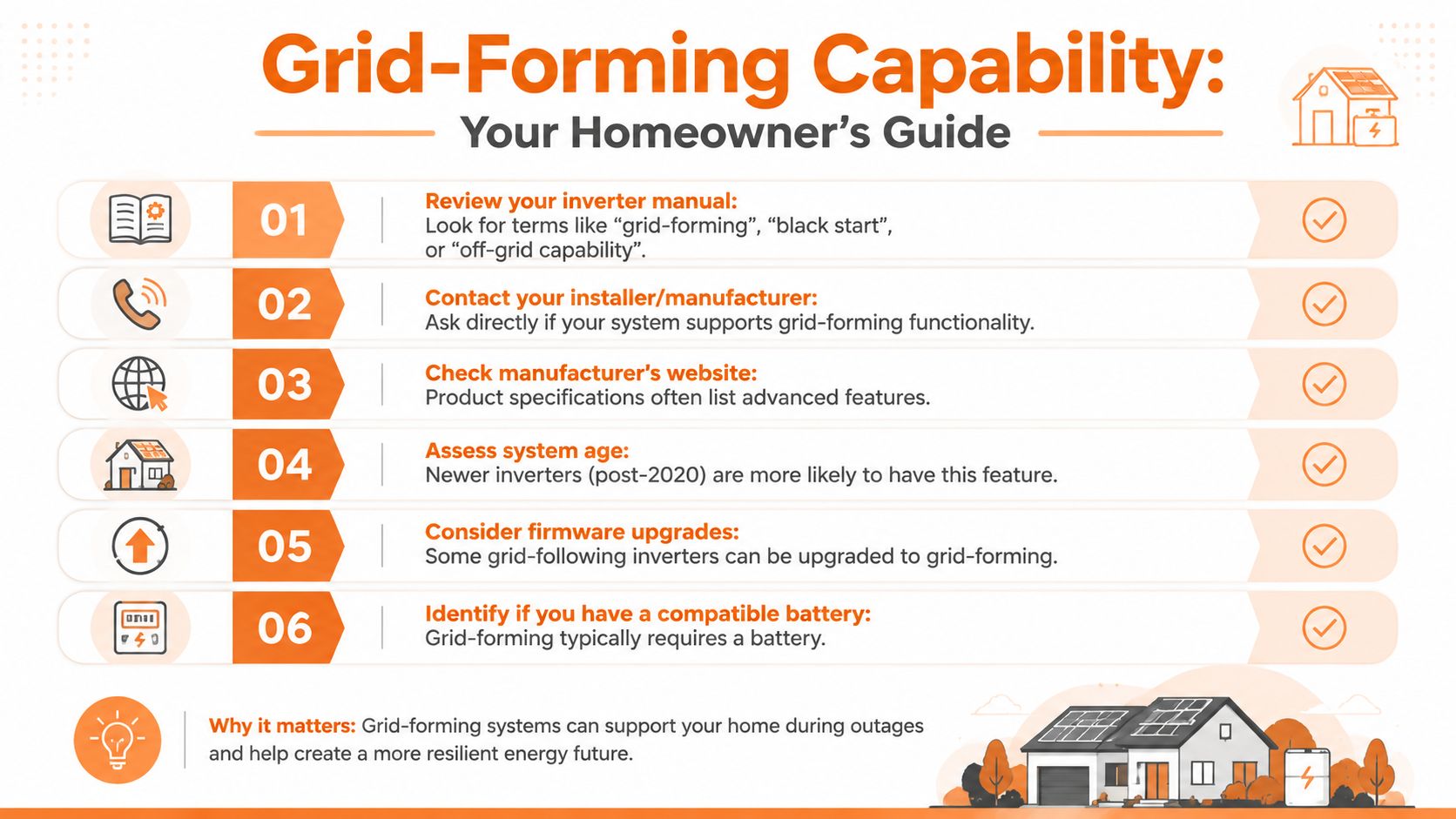
You don't need to be an inverter engineer to check whether your system may have grid-forming capability. You do need to know where to look, and what to ask.
Start with your inverter documentation
Open the inverter datasheet, installer handover pack, or manufacturer manual. Search for terms such as:
- Grid-forming
- Black start
- Off-grid capability
- Virtual Machine Mode
- Island mode
- Microgrid support
Not every manufacturer uses the same language. Some describe the behaviour without using the exact phrase “grid-forming”. Others reserve the feature for certain firmware versions, battery pairings, or specific installation topologies.
If you want an example of how detailed inverter guides can help decode technical specs, DLG Electrical's inverter guide is a useful homeowner-friendly reference.
Then ask better questions
Don't ask your installer only whether the battery is “good for backup”. Ask more precise questions:
- Can this inverter establish voltage and frequency in islanded operation, or does it only synchronise to the grid?
- Is grid-forming capability native, firmware-enabled, or unavailable on my model?
- Does the feature depend on a particular battery brand or configuration?
- If my system joins a VPP, what operating modes are used?
- Will enabling advanced modes affect warranty terms or export settings?
Those questions get you closer to the truth than generic sales language.
Why this is worth checking now
This is no longer a fringe feature. Roughly 74% of the 33 GW battery storage pipeline in the NEM is confirmed to be equipped with grid-forming inverters, showing a clear market shift toward this design choice in new utility-scale projects, as noted earlier in the article from Energy-Storage.news.
For a homeowner, that matters because future-proofing isn't only about battery capacity. It's also about inverter intelligence, firmware support, and compatibility with advanced energy programs.
Older hardware can still be valuable, but newer control capability often determines whether a battery can do more than basic load shifting.
If you're unsure what inverter model you have, your original compliance documents, monitoring app, or installer invoice usually list it. You can also compare your setup against practical installation guidance such as High Flow Energy's solar inverter installation resource to identify the right technical details before speaking with a provider.
Conclusion Optimising Your Asset with High Flow Energy
Key takeaways
- Grid-following inverters rely on an existing grid signal. Grid-forming inverters can actively establish and support voltage and frequency.
- This distinction is significant as Australia's grid is shifting toward inverter-based resources, where system strength and fast response are increasingly valuable.
- For homeowners, the practical significance is not just technical elegance. It's whether a battery can support more advanced optimisation and VPP participation.
- Better inverter capability can expand opportunity, but value still depends on transparent operating rules, customer priority settings, and warranty-aware battery management.
- If you already own solar and a battery, understanding your inverter is one of the most useful steps you can take to assess whether your asset is underutilised.
Most battery owners focus on installation quality. Far fewer focus on ongoing performance and optimisation. High Flow Energy is an electricity retailer built around realizing the full value of your existing solar and battery system.
For homeowners in Queensland and New South Wales, that means looking beyond a basic feed-in tariff or passive battery operation. It means understanding how your system performs under real market conditions, whether your battery has spare value that isn't being captured, and whether a retailer-led VPP structure could improve how your asset works for you.
A well-run Bring Your Own Battery model should be clear about customer priority, transparent about bill treatment, and disciplined about battery control. It should help you understand whether your current retailer is leaving value on the table.
If you would like to understand whether your battery is underperforming financially, request an eligibility assessment today.
Frequently Asked Questions
Can an older home battery system be upgraded to grid-forming operation
Sometimes, but not always. It depends on the inverter model, firmware, battery compatibility, and installation design. Some systems can gain additional functionality through software and configuration changes. Others are limited by hardware architecture.
Does grid-forming operation automatically mean my home has blackout backup
No. Grid-forming and backup are related, but they aren't identical. A system may have grid-forming control features while still requiring the right switchgear, battery configuration, and site design for backup operation.
Will joining a VPP with a technically advanced inverter void my battery warranty
It shouldn't if the program is designed properly and stays within manufacturer operating conditions. The important issue isn't the label “VPP”. It's how the battery is controlled, how often it cycles, and whether reserve settings and operating limits are respected.
Do all VPPs require grid-forming inverters
No. Many VPPs can operate with systems that don't have grid-forming capability. The difference is that more advanced inverter behaviour may improve flexibility and make a battery more useful in certain grid support contexts.
How can I tell if my inverter supports black start or island operation
Check the technical manual and product datasheet first. Look for terms such as black start, backup mode, off-grid operation, microgrid mode, or islanding capability. If the wording is unclear, ask the manufacturer or installer to confirm the exact supported operating mode for your model.
Is a grid-forming inverter always the best choice for a homeowner
Not automatically. The best choice depends on your existing hardware, how you use your battery, your network conditions, and whether you want future VPP flexibility. For many homeowners, the right question isn't whether the feature sounds advanced. It's whether it improves the long-term value of the system you already own.
What should I ask a retailer or VPP provider before signing up
Ask how your battery reserve is protected, how dispatch decisions are made, what visibility you'll get through the app or portal, how billing works when usage exceeds any allowance, and whether your specific inverter and battery combination is supported.
Most battery owners don't need more hardware. They need a clearer view of whether their existing system is being used well. HighFlow Energy helps eligible solar and battery owners in Queensland and New South Wales assess whether their battery is underutilised, whether a Bring Your Own Battery VPP is a better fit than a traditional retailer plan, and what performance upside may be available through smarter coordination. If you want to review your current electricity performance and check eligibility, start with an assessment.