

What Is a Kilowatt? kW vs kWh Explained for 2026
A kilowatt (kW) is a measure of power, or how fast energy is used at a single moment, and 1 kW equals exactly 1,000 watts. That's different from a kilowatt-hour (kWh), which measures the total amount of energy used over time, and understanding that distinction is what helps solar and battery owners get more financial value from their system.
You've probably seen both terms already. They're on solar quotes, battery specs, inverter labels, apps, and electricity bills. Most new battery owners quickly learn that kWh relates to storage and usage. Far fewer get a clear explanation of why kW is the number that determines how much power your home, solar system, or battery can deliver right now.
That matters more than it seems.
If you have rooftop solar and a battery in Queensland or New South Wales, your battery isn't just a backup box or a way to use more of your own solar. It's also a controllable energy asset. Its commercial value depends heavily on its ability to respond at the right time and at the right rate. That rate is measured in kilowatts.
A household might care about kWh when checking how much energy it used overnight. The grid cares about kW when thousands of homes switch on cooking, air conditioning, lighting, and charging at once. That's where network strain, wholesale price pressure, and Virtual Power Plant value start to appear.
Introduction Why 'Kilowatt' Is a Key You Need to Turn
A common situation looks like this. You've got solar on the roof, a battery on the wall, and an app showing live flow data. One screen says your battery has energy left. Another says it can only discharge at a certain rate. You can see the numbers, but not yet the commercial meaning.
That's the gap.
A common starting point is a simple mental model. Solar generates electricity, the battery stores it, and lower grid usage should mean lower bills. That part is true, but it's incomplete. A battery's value doesn't come only from how much energy it stores. It also comes from how much power it can supply at the exact moment your home or the grid needs support.
The practical definition that matters
A kilowatt is the speed of electricity use or supply. It answers questions like:
- How hard is your home pulling from the grid right now
- How quickly is your solar system generating
- How fast can your battery discharge
- Whether your battery can cover a peak demand event without importing extra power
A kilowatt-hour answers a different question. It tells you how much electricity accumulated over a period of time.
A simple rule: kW tells you the rate. kWh tells you the total.
That distinction affects more than technical understanding. It affects how you read system specs, how you interpret your battery app, and how you think about value in a VPP environment. If you only focus on stored energy, you can miss the part of the equation that creates value during high-demand periods.
Why Australian battery owners should care
In the Australian market, especially across the National Electricity Market, peak demand matters. Homes don't all draw electricity evenly through the day. Demand clusters in predictable windows, especially in the evening. For battery owners, that means a battery's discharge power can matter just as much as its storage capacity.
“What is a kilowatt” shifts from being a textbook question to a financial one.
What Is a Kilowatt in Plain English
A kilowatt is a unit of power. In formal terms, it's the SI-derived unit equal to 1,000 watts, and one watt equals one joule per second. In plain English, it measures how fast electricity is being used or produced at a given moment. In the Australian energy market, that rate-of-flow matters because peak demand measured in kW influences network infrastructure costs and demand-related pricing, as explained in Carbon Collective's kilowatt overview.
The easiest way to understand it is with a water analogy.
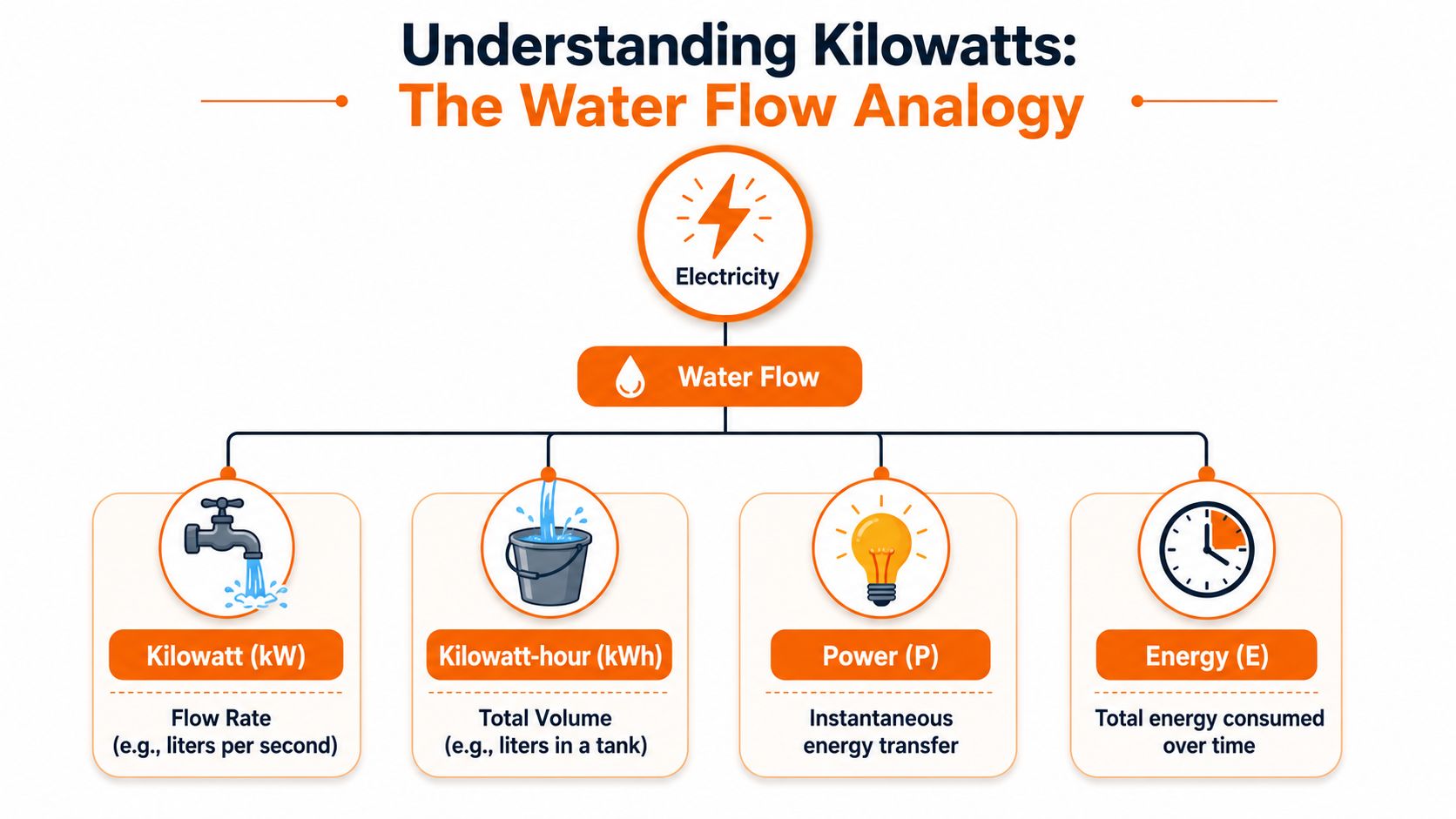
The water pipe analogy
Think of electricity like water moving through a pipe.
- Kilowatt kW is the flow rate. It's how quickly water is moving through the pipe.
- Kilowatt-hour kWh is the amount collected in the bucket over time.
- Power is the live flow.
- Energy is the total volume that has passed through.
If the pipe is delivering water quickly, the flow rate is high. If it keeps flowing for a long time, the bucket fills up. Electricity works the same way. A device with a higher kW rating uses or supplies electricity faster. If it runs longer, total energy use in kWh rises.
Why the distinction feels confusing at first
People often mix the two because both units are connected. They use the same base word, and one leads directly to the other through time.
Here's the clean relationship:
- 1 kW = 1,000 watts
- 1 kW used for 1 hour = 1 kWh
- 1 kW = 1,000 joules per second
- Over one hour, that becomes 3,600,000 joules, which equals 1 kWh
That's not just physics language. It's the basis for reading every solar, battery, and appliance specification correctly.
If you want the plainest possible version, kW is the speedometer and kWh is the odometer.
Once you see kW as an instant rate, system labels become easier to decode. A solar system rated in kilowatts tells you its power capacity. A battery inverter rated in kilowatts tells you its maximum discharge rate. Neither number, by itself, tells you how long that output can be sustained. That's where kWh comes in.
Kilowatts (kW) vs Kilowatt-Hours (kWh) The Crucial Difference
A lot of battery owners understand their battery size, then get caught out by what the battery can provide at 6 pm when the oven, air conditioner, and lights are all on.
That gap usually comes down to kW versus kWh.
kWh tells you how much energy is stored or used over time. kW tells you the rate of delivery at any given moment. For a home battery, that distinction affects more than technical specs. It shapes whether the battery can cover a sharp evening spike, whether it can respond properly in a Virtual Power Plant event, and whether you capture the financial value available from that response.
Comparison of Kilowatt (kW) and Kilowatt-Hour (kWh)
| Attribute | Kilowatt (kW) | Kilowatt-Hour (kWh) |
|---|---|---|
| What it measures | Power | Energy |
| What it means | How fast electricity is used or supplied | How much electricity is used or stored over time |
| Best analogy | Speed | Distance |
| In your home | Instant appliance load | Total consumption |
| For solar | Peak generation rate | Total energy generated over time |
| For batteries | Max charge or discharge rate | Total storage capacity |
| On your bill | Linked indirectly to peak demand and network stress | The unit commonly used for consumption billing |
| In a VPP | Determines response capability during a grid event | Determines how much total energy is available to dispatch |
A battery example
Say your battery stores 10 kWh and its inverter can discharge at 5 kW.
That means the battery has a decent energy reserve, but it can only push electricity into your home, or back to the grid if allowed, at a maximum rate of 5 kW. If your house suddenly needs more than that, the battery cannot supply the full load on its own, even if the battery is still half full. If it delivers 5 kW continuously for one hour, it will supply 5 kWh of energy. Keep that up for two hours and the 10 kWh battery is empty.
This is why a battery can look generous on paper but still underperform in the moments that matter most financially.
Why battery owners often misread app data
Battery apps usually show both live power and stored energy. One number is about pace. The other is about quantity. If you mix them up, you can overestimate what your system can do in a short peak period.
A common example is a battery sitting at a high state of charge while the home still imports from the grid. Owners sometimes assume the battery is failing. In many cases, the battery has a discharge ceiling. The energy is there, but the kW limit is stopping it from covering the whole spike.
That same limit matters in a VPP. Grid events are often about response at the right rate and at the right time, not just having stored energy available. A battery with plenty of kWh but modest kW may contribute for longer, yet miss some of the value tied to fast, high-output support.
If you want a clearer explanation of the energy side of the equation, see High Flow Energy's guide to what a kilowatt-hour means.
One more practical parallel helps. A reflective roof coating lowers heat entering a building over time, while a battery inverter rating determines how quickly stored electricity can be delivered at a given moment. For a building-envelope example, see Commercial Roofers' guide on reflective coating.
For battery owners, the takeaway is simple. kWh tells you how much electricity you have to work with. kW tells you how much financial value you can access in the moments that drive bill savings and VPP performance.
Kilowatts in Your Home and On Your Roof
You see kilowatts every day, even if you never call them that. At 6:30 pm, the air conditioner is running, someone starts dinner, lights are on, and the EV may be charging. In that short window, your home is asking for electricity at a certain rate. That rate is the kW number that decides whether solar can keep up, whether the battery can cover the gap, and whether your meter still records grid import.
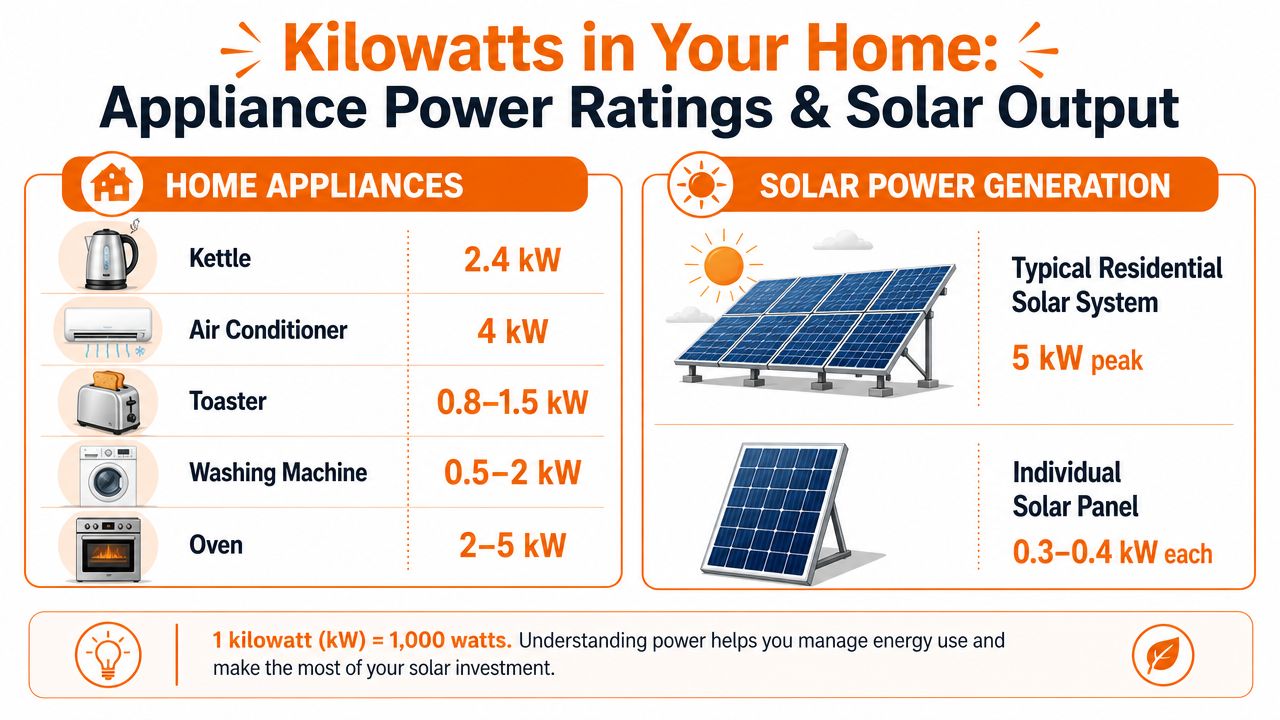
A practical way to read your house is to split devices into steady loads and burst loads. Your fridge and lights usually add smaller ongoing demand. A kettle, oven, ducted cooling, or EV charger can push demand up quickly. Those overlaps matter more than owners often expect, because batteries and inverters are judged by how fast they can respond in that moment, not by how much stored energy they still have sitting in reserve.
A quick tour of where kW shows up at home
The exact numbers vary by appliance and model, but the pattern is consistent across Australian homes:
- Kettle creates a brief but high power draw
- Air conditioning often drives the evening peak, especially in summer
- Oven and cooktop can stack on top of cooling and lighting loads
- EV charging adds a large flexible load that can be timed or throttled
- Battery inverter limits how much stored power can be supplied at once
- Solar inverter limits how much rooftop generation can be converted and used or exported at any point in time
That last point is where the financial angle starts to become real. If your home briefly demands more power than the battery inverter can deliver, the grid supplies the remainder. If your solar system could produce more than the inverter can process, some potential output is clipped. Both situations affect bill outcomes. In a VPP, they can also affect how much useful support your system can provide during high-value events.
Roof performance also feeds into this picture from the other side. A hotter roof can increase indoor heat load, which pushes air conditioning demand higher and raises your evening kW spike. Reducing that heat before it reaches the living space can lower the load your battery has to cover. For a building-envelope example, see Commercial Roofers' guide on reflective coating.
What a solar system rating really means
A rooftop solar rating in kW is a maximum output rate under suitable conditions. It is closer to the size of the tap than the total water collected over a day. A 6.6 kW solar system does not produce 6.6 kW every hour from sunrise to sunset. Output rises and falls with sunlight, panel temperature, orientation, shading, and inverter limits.
That matters on your roof because the timing of solar kW is not always the timing of household demand. Midday generation can be strong while evening demand is higher. The battery sits between those two patterns. Its job is not only to store energy, but to release power fast enough to reduce imports during the expensive and busy parts of the day.
Your battery has a power ceiling
Battery owners often focus on storage size because it is easy to picture. Power is the harder part, but it is often the deciding factor in real homes. A battery may have plenty of charge left and still fail to carry the whole house if the inverter has hit its discharge limit.
A simple example helps. If your home load jumps because the oven, cooling, and kettle overlap, the battery can only contribute up to its rated output. Any demand above that level still comes from the grid. For VPP participation, the same ceiling can shape revenue. Programs that reward rapid export or fast response care about available kW at the event time, not only stored kWh.
If you want to see how those short bursts appear in interval data, meter readings, and usage graphs, High Flow Energy explains how smart meters work in practice.
A short explainer can help tie the hardware together:
Why Kilowatts Directly Impact Your Energy Bills and VPP Value
At 6:30 pm, your solar output is fading, the air conditioner is still on, dinner is cooking, and someone starts the shower. In that half hour, the number that matters most is not how many kilowatt-hours your home used across the day. It is how many kilowatts your home needs right now, and how much of that your battery can cover.
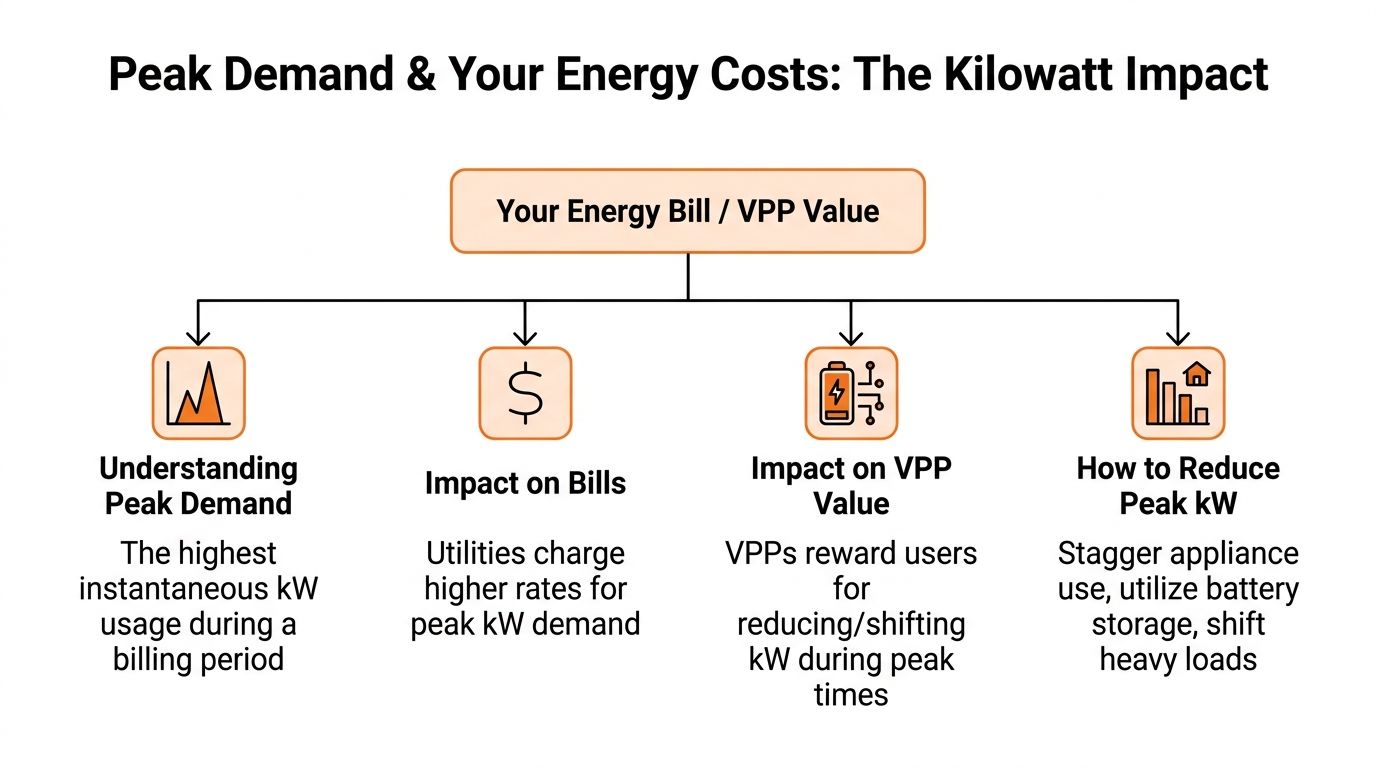
That single idea connects physics to money. A kilowatt is the speed of energy use or delivery. Your bill reflects energy consumed over time, but prices and system costs are shaped by short periods when demand surges across many homes at once. Synergy's discussion of units of energy is useful background here because it helps separate the rate of use from the amount used.
Peak demand is expensive because the grid must be built for it
Networks are sized for busy periods, not quiet averages. If thousands of households draw heavily on hot summer evenings, distributors need enough poles, wires, transformers, and capacity to serve that peak safely.
For a household, that means a sharp evening spike can matter more financially than a gentle spread of usage across the day. You may not always see a neat line item labelled "peak kW", but peak demand still feeds into wholesale stress, network planning, and the tariff structures retailers build into offers.
That is why kW has real commercial weight.
Why VPPs care about kilowatts
A Virtual Power Plant does not pay attention only to how full your battery is. It also cares about whether your system can push out useful power during a dispatch window.
A battery with plenty of stored energy but a modest discharge rate is like a large water tank connected to a narrow pipe. The water is there, but the flow may be too limited to make much difference when demand jumps. By contrast, stronger discharge capability can help your home avoid costly imports during peak periods and can make your system more valuable when a VPP calls for support.
The hardware match matters here too. Your battery can only perform as well as the inverter and control setup allow, which is why it helps to understand how battery and inverter sizing affects real-world power delivery.
Bill reduction and VPP revenue both depend on timing
Owners often look at stored energy first because it feels tangible. Financial performance often depends on power at the right moment.
If your battery can cover a larger share of the evening spike, grid imports fall during the periods that are often the most expensive. If your battery is enrolled in a VPP, that same ability can also support exports or grid services when the market places a premium on fast, available power. In other words, kWh determines how long the battery can help, while kW determines how much value it can create in each live interval.
That is the part kWh-only thinking misses.
Household loads still shape the outcome
Battery performance does not sit in isolation. Your demand profile decides how hard the battery has to work and whether its available kW is enough to change the result.
Some of the biggest evening loads are heating, cooling, cooking, hot water, and EV charging. Hot water is easy to overlook because it can feel routine rather than energy-intensive, so this guide to hot water energy usage is a practical reference if you want to reduce the loads that drive short, expensive spikes.
The main point is simple. kWh measures quantity. kW measures pressure. For Australian battery owners in a VPP, that pressure often determines both bill savings and grid-service value.
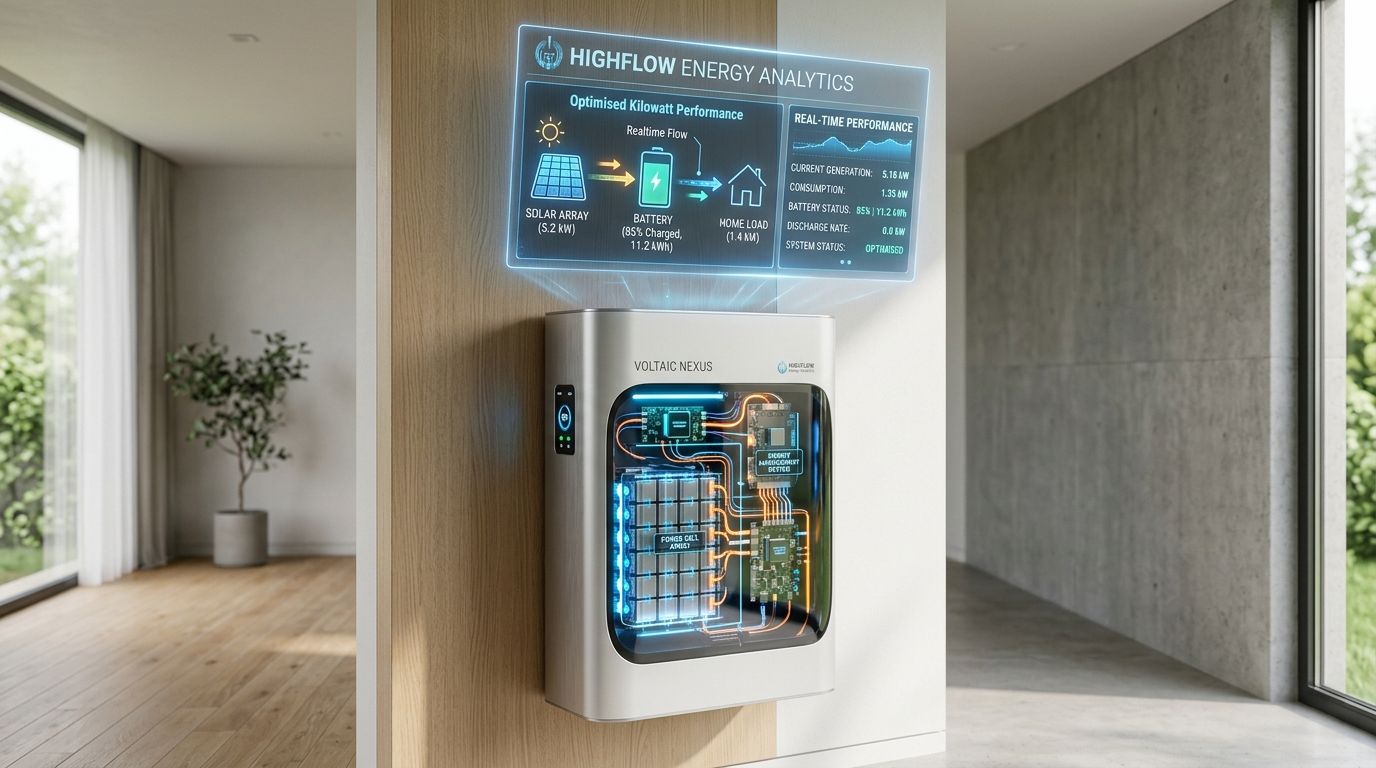
Optimising Your Battery's Kilowatt Performance
A battery owner in an Australian VPP can have plenty of stored energy and still miss the best financial result. The reason is simple. Revenue and bill savings are often decided by how hard the battery can work in a short window, not just by how much energy sits in the pack.
A basic setup usually charges from rooftop solar, then discharges later to cover household use. That is a solid starting point, but it treats the battery mainly as storage. Better optimisation treats the battery as a controlled power asset whose kW output can be directed to the moments that matter most.
Storage alone does not set the outcome
Two batteries with the same kWh capacity can perform very differently financially. If one can discharge faster, it may cover more of a sharp evening spike, reduce costly imports more effectively, and respond better when a VPP calls for support.
That changes the operating questions:
- At what time is your battery's discharge power worth the most
- Should the battery hold energy for the evening peak instead of using it earlier
- How do export limits cap the value of available discharge power
- How should forecasts, tariffs, and household demand shape dispatch
- How much battery power should stay available for your home rather than being committed elsewhere
A helpful comparison is water pressure. kWh is the size of the tank. kW is how quickly the water can flow through the pipe. Financial performance often improves when the flow rate matches the expensive or high-value interval.
Peak kW management shapes the commercial result
The bill does not only respond to total energy shifted across the day. It also responds to whether your battery has enough discharge power at the exact time your home load jumps.
That matters in real homes, where demand often rises quickly as cooking, air conditioning, heating, hot water, and EV charging overlap. If your battery can only supply part of that spike, the grid still covers the rest. If it can supply more of it, the financial outcome improves because less electricity is imported when prices and system stress are often higher.
For VPP participants, the same principle applies on the export side. A battery with useful available kW can do more in a short dispatch interval than a larger battery that is power-constrained. That is the commercial angle many kWh-first explanations leave out.
What good optimisation looks like
Good optimisation is usually automated. It depends on forecasts, control settings, tariff logic, and a clear view of household priorities. The goal is not to empty the battery as early as possible. The goal is to use discharge power where it creates the strongest return.
A well-managed setup often includes:
- Visibility into live charging and discharging rates
- Controls that protect household backup or evening needs
- Awareness of tariff periods and VPP dispatch conditions
- Settings that avoid wasting available power under inverter or export limits
Hardware also matters. Your battery may store enough energy to help, but the inverter often sets the ceiling on how much power can move in or out at once. If you want a practical explanation of that limit, this guide to how a battery and inverter work together is useful.
Battery owners who get the strongest financial return are often the ones whose system delivers the right kW at the right time, not the ones with the biggest storage number alone.
Unlock the Full Value of Your Battery
A common battery-owner story goes like this. The battery looks healthy, it charges from solar, and the app shows plenty of stored energy. Yet the bill is still higher than expected, or the VPP payments feel modest. The missing piece is often power, not storage. If your system cannot deliver enough kW at the moments that matter, part of the battery's financial value stays on the table.
That is why the idea of a kilowatt matters beyond definitions. kWh tells you how much energy your battery can hold. kW tells you how much work it can do right now. In an Australian home with evening peaks, controlled loads, export limits, and time-based tariffs, that difference affects both savings and VPP earnings.
Key takeaways
- A kilowatt is power. It measures the rate of electricity use or supply at a given moment.
- A kilowatt-hour is energy. It measures the total amount of electricity used or stored over time.
- Your battery's kW rating affects financial performance. It shapes how much load the battery can cover during expensive periods or VPP dispatch events.
- Peak demand influences value even when bills focus on kWh. Fast, well-timed battery output can reduce imports when electricity is most costly or commercially important.
- Battery performance is about delivery, not just capacity. A system with ample stored energy can still underperform if its available kW is too low.
Installation quality still matters. So does ongoing control. High Flow Energy is an electricity retailer built around helping battery owners get stronger financial performance from the solar and storage they already own.
If you want to know whether your battery is doing enough useful work for your household and tariff, request an eligibility assessment.
Frequently asked questions
Is 1 kilowatt a lot of power
It depends on the job. 1 kW equals 1,000 watts, which is meaningful for many household loads, but several appliances running together can push home demand well above that level.
Why does my electricity bill show kWh instead of kW
Bills usually display kWh because retailers charge for total energy consumed over time. kW still matters because your battery's power output affects how much grid energy you avoid during higher-value periods.
What does a 5 kW battery mean
It usually refers to the battery or inverter's maximum discharge rate. It tells you how quickly the system can deliver electricity at one point in time.
What does a 10 kWh battery mean
It refers to storage capacity. It shows how much total energy the battery can hold, not how fast it can release that energy.
Why do solar systems use kW ratings
Solar systems are rated in kW because that expresses peak generation rate under suitable conditions. It is a measure of output speed, not total daily production.
Why does kW matter in a Virtual Power Plant
VPP events depend on response. A battery with higher usable kW can export or support the home more effectively during short dispatch windows, which is often where commercial value is created.
Can a battery have enough energy but still not cover my whole house
Yes. Your battery may still have kWh available, but if the discharge rate in kW is below live household demand, the grid supplies the shortfall.
Are VPP incentives based on battery size
In some state programs, yes. For example, the New South Wales Government explains that battery eligibility for VPP incentives depends on program rules and battery size, as outlined by the NSW Government VPP program page.
External authority references
- Australian Energy Regulator
- Australian Energy Market Operator
- NSW Government Virtual Power Plants information
SEO title
What Is a Kilowatt for Australian Battery Owners
Meta description
Learn what a kilowatt is, how kW differs from kWh, and why kW drives battery and VPP value for NSW and QLD homeowners.
Suggested URL slug
what-is-a-kilowatt
Featured image concept
A clean Australian home energy dashboard showing solar generation, battery discharge in kW, and household load during an evening peak.
Image alt text
Home battery dashboard showing live kilowatt flow, solar output, and household demand in Australia
LinkedIn-ready excerpt
Many homeowners understand battery capacity. Fewer understand battery power. This guide explains what a kilowatt is, why kW is different from kWh, and how that difference shapes electricity bills, peak demand, and the financial value of a home battery in Australia.
AI summary snippet
A kilowatt is a measure of power, not total energy. For Australian solar and battery owners, kW determines how much electricity a system can generate, consume, or discharge at any moment, while kWh measures total energy over time. That distinction matters because battery power affects bill savings, household coverage, and Virtual Power Plant performance. Understanding kW helps homeowners judge whether their system is storing energy or turning that stored energy into real financial return.
If you already have rooftop solar and a compatible battery, High Flow Energy helps you assess whether that asset is being used to its full financial potential. Check your eligibility, review your current electricity performance, and see whether your battery's available kW could be doing more than sitting idle between charge and discharge cycles.