


Excess Power Equipment: A 2026 Guide for Solar Owners
SEO title: Excess Power Equipment for Australian Solar Owners
Meta description: Learn how excess power equipment, smart controls and VPPs can turn surplus solar into greater battery and bill value in NSW and QLD.
Suggested URL slug: /excess-power-equipment-australia-guide
Featured image concept: A Queensland or NSW home with rooftop solar, a wall battery, hybrid inverter and an overlay showing solar generation flowing to household loads, battery storage and grid export.
Image alt text: Home solar battery system showing how excess power equipment manages storage, exports and VPP participation in Australia.
Australian solar owners often think the hard part was installing panels and a battery. In practice, the harder question comes later. How do you extract the most value from the energy you can't use immediately?
That's where excess power equipment matters. In simple terms, it includes the hardware and control systems that decide whether surplus solar is stored, diverted into a useful household load, limited at the inverter, or coordinated with the grid through a Virtual Power Plant.
This isn't a niche issue. The Australian Energy Council notes that, once state renewable targets are fully met, the National Electricity Market is projected to have nearly 12 gigawatts of excess generation capacity during midday on an average day, with energy often spilled because it can't be delivered to consumers, according to the Australian Energy Council's analysis of emerging excess supply. For a homeowner in Queensland or New South Wales, that changes the commercial logic of owning solar and a battery. The question is no longer whether excess energy exists. It's whether your system is organised to capture value from it.
The Hidden Value in Your Excess Solar Power
The phrase “excess power” sounds like a technical inconvenience. For a solar household, it's, rather, an asset allocation problem.
When your system produces more than your home is using, you have four broad outcomes. You consume it on site, store it, export it, or lose the opportunity because the grid can't absorb it when you want to send it. The last outcome matters more than most homeowners realise, particularly as midday solar production keeps intensifying across eastern Australia.
Why midday surplus changes the economics
The projection of nearly 12 GW of excess midday generation isn't just a grid planning statistic. It signals that surplus solar is becoming abundant at the very time many households are producing the most. Abundant supply usually weakens the value of a simple “export whatever you can” approach.
That's why excess power equipment shouldn't be viewed as a pile of components. It's a decision system for surplus energy. The value comes from choosing the right hierarchy:
- Use first: Direct solar into loads you'd otherwise buy from the grid.
- Store next: Hold surplus in a battery for later household use or controlled discharge.
- Export strategically: Send energy out when the price signal or program rules make that worthwhile.
- Protect the asset: Stay inside network and inverter constraints.
Practical rule: A solar household doesn't improve returns by exporting more energy at any time. It improves returns by exporting, storing or consuming energy at the right time.
The homeowner's real optimisation problem
Most battery owners don't need more generation. They need better coordination of the generation they already have.
That's especially true in NSW and Queensland, where solar output can be strong while demand in the home is low during the middle of the day. If nobody is home, the dishwasher isn't running, the hot water system isn't timed properly, and the battery is already full, surplus energy quickly turns from an advantage into a poorly monetised export or a missed opportunity.
The commercial question is straightforward. If you already own the solar and battery, which mix of controls, storage strategy and retailer structure gives the highest ongoing value from the same physical asset?
Understanding Excess Power Management Systems
A home energy system works best when you think of it as a chain, not a product. Solar generation creates the energy. Hardware directs it. Software decides when each option makes financial sense.
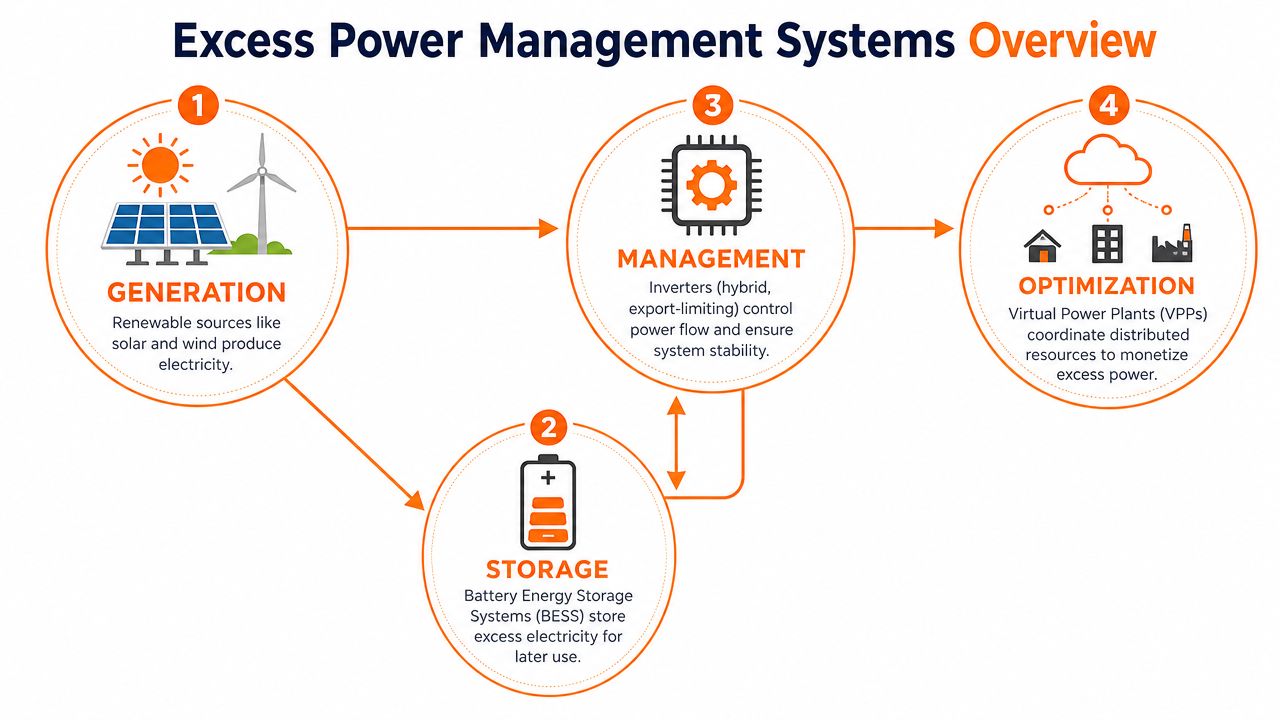
Generation storage management optimisation
A useful way to understand excess power equipment is to separate it into four categories.
Generation
Your rooftop solar produces electricity when the sun is available. That part is simple. The complication is timing. Production peaks when household demand may be low.
Storage
A battery acts like a reservoir. Instead of letting solar leave the property immediately, the system holds it for later use. That increases flexibility, but storage on its own doesn't decide the best moment to charge or discharge.
Management
Inverters, export controls and related devices govern the direction and conditions of power flow. They handle conversion, enforce export limits and respond to grid conditions. If the battery is the tank, the inverter is the valve assembly.
Optimisation
A VPP or advanced control layer adds market awareness. It can decide whether surplus should remain available for household use, discharge later into a higher-value period, or respond to a grid event.
For homeowners looking at this broader coordination layer, High Flow Energy's guide to a smart home energy management system using IoT is a useful reference point because it shows how connected controls can turn separate devices into one operating system.
Why categories matter more than brand names
Homeowners often compare products before they've defined the role the product needs to play. That leads to poor buying decisions.
A diverter, for example, can be very effective if your main goal is to move excess solar into hot water. It's not a substitute for a battery. A battery can improve self-consumption and grid flexibility, but it won't automatically monetise grid support unless the control and retail structure exist around it.
The highest-value home energy systems are usually not the ones with the most hardware. They're the ones where each layer has a clear job and the control logic matches the household's usage pattern.
Hardware Solutions to Capture Surplus Energy
Discussions of excess power equipment often refer to one of three things. A home battery, an inverter with export management, or a load-diversion device.
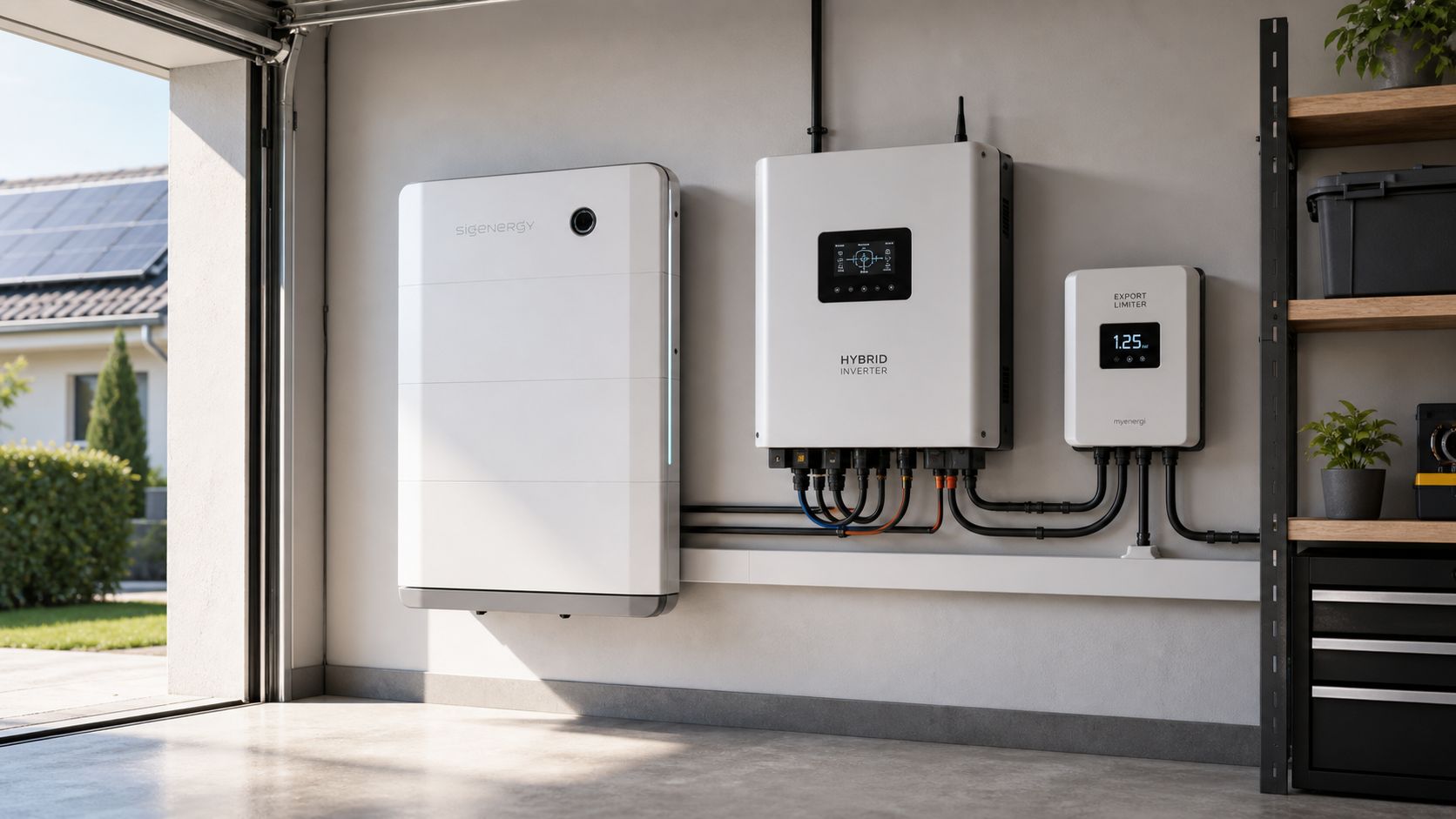
Each serves a different financial purpose. The right choice depends less on technical enthusiasm and more on where your household currently loses value.
Batteries and storage hardware
A battery is the most flexible hardware option because it changes the timing of consumption. Instead of accepting whatever value the export market offers at noon, you can hold energy for evening use or controlled grid participation later.
That flexibility is why battery ownership can outperform a pure export model. But batteries don't create value automatically. The result depends on tariff structure, battery size relative to solar production, charging strategy and whether the battery is participating in a coordinated program.
The physical setup matters too. AC-coupled and DC-coupled arrangements behave differently in retrofit situations, and homeowners with existing systems often need to understand which architecture best suits an upgrade path. High Flow Energy's explanation of AC coupling for battery systems is a practical starting point for that assessment.
Inverters and export-limiting equipment
An inverter is more than a converter. In many homes, it is the gatekeeper for export behaviour.
Some systems use export limiting to prevent the home from exceeding network export constraints. That can be essential for connection approval, but it can also force a commercial trade-off. If export is capped and the battery is full, extra generation may have nowhere useful to go. In that case, the household needs either better timing of flexible loads or a more advanced optimisation layer.
Australian compliance settings are not optional here. For DER connections from 200 kW to 5 MW, AEMO's technical requirements state that LV-connected systems must cease generation if voltage exceeds 260 V or falls below 180 V under AS/NZS 4777.2-2020, as outlined in AEMO's technical requirements for 200 kW to 5 MW DER connections. For homeowners, the key point is simple. Excess power equipment has to prioritise grid-safe behaviour before it can chase value.
Diverters and controlled loads
Load diverters send surplus solar into a controllable appliance, most commonly hot water. Their appeal is straightforward. They can convert midday excess into avoided consumption later, without requiring battery storage.
They are, however, narrow tools. A hot water diverter can be highly effective for homes with predictable water heating demand, but it won't support the broader revenue options that battery coordination can enable.
A practical way to think about the hardware options is this:
- Battery systems suit households that want flexibility across time.
- Export-limiting inverters solve network compliance and flow control problems.
- Load diverters work when there's a reliable daytime load to absorb surplus.
Homeowners often benefit from seeing how these devices are installed and integrated in real homes. This overview gives a helpful visual context:
Equipment standards shape financial outcomes
There's another technical detail that rarely appears in marketing copy. In Australia, external power supplies in the AU region must be tested at 230 V AC or 240 V AC depending on the nameplate marking, with no testing required at 115 V AC, according to the Australian Government's external power supplies requirements. That matters because compatibility and compliance settings define the operating envelope of any system that manages surplus energy.
A financially good setup is usually the one that does three things at once:
- Captures surplus reliably
- Operates inside Australian technical rules
- Leaves room for future optimisation rather than locking the home into one narrow use case
The Intelligence Layer Smart Controllers and EMS
Hardware moves energy. Intelligence decides when movement creates value.
A modern Energy Management System (EMS) sits above the inverter and battery logic and turns a passive energy setup into an active one. It watches solar production, household demand, battery state, tariff periods and sometimes forecasts, then makes rule-based decisions that a homeowner would struggle to manage manually every day.
What the controller is actually doing
At a practical level, an EMS can coordinate decisions such as:
- Charge timing: Hold battery capacity for expected solar production rather than filling too early from the grid.
- Load shifting: Start compatible appliances when surplus solar is available.
- Reserve management: Keep some battery capacity available for evening consumption or a planned event.
- Override logic: Allow the homeowner to prioritise comfort or backup preferences over pure optimisation.
This is the difference between owning a battery and operating a battery as an asset.
Why automation matters for bill outcomes
Most households don't have a stable daily load profile. Work-from-home days, school holidays, weather shifts and air-conditioning use all change how much solar can be self-consumed. A fixed schedule quickly becomes inefficient.
Smart controllers reduce that mismatch. Instead of assuming the same pattern every day, they can adapt. That improves the chance that surplus power is directed into the highest-value outcome available at that moment.
A battery without an intelligence layer often behaves like storage. A battery with an EMS starts behaving like a managed portfolio of household energy decisions.
The practical limit of hardware-only control
Basic automation can still leave value on the table. A system may be excellent at self-consumption but poor at responding to broader grid conditions or retailer structures. That matters because some of the best value from a battery doesn't come from avoiding your own grid imports alone. It comes from coordinated participation in a larger market framework.
That's the point where a standalone EMS starts to overlap with VPP logic. The homeowner still cares about comfort, backup and bill reduction, but the system also starts recognising when battery availability has value outside the household boundary.
Unlocking Grid Value with Virtual Power Plants
A battery by itself stores energy. A BYOB VPP turns that stored energy into a grid-responsive asset.
The National Electricity Market has historically carried a surplus of 7.5 to 9 gigawatts of generation capacity, much of it in NSW and Queensland, according to The Conversation's fact check on excess electricity in Australia. That historical surplus matters because it explains why coordination has value. The grid doesn't only need more generation. It needs flexible timing, local balancing and controlled discharge when conditions change.
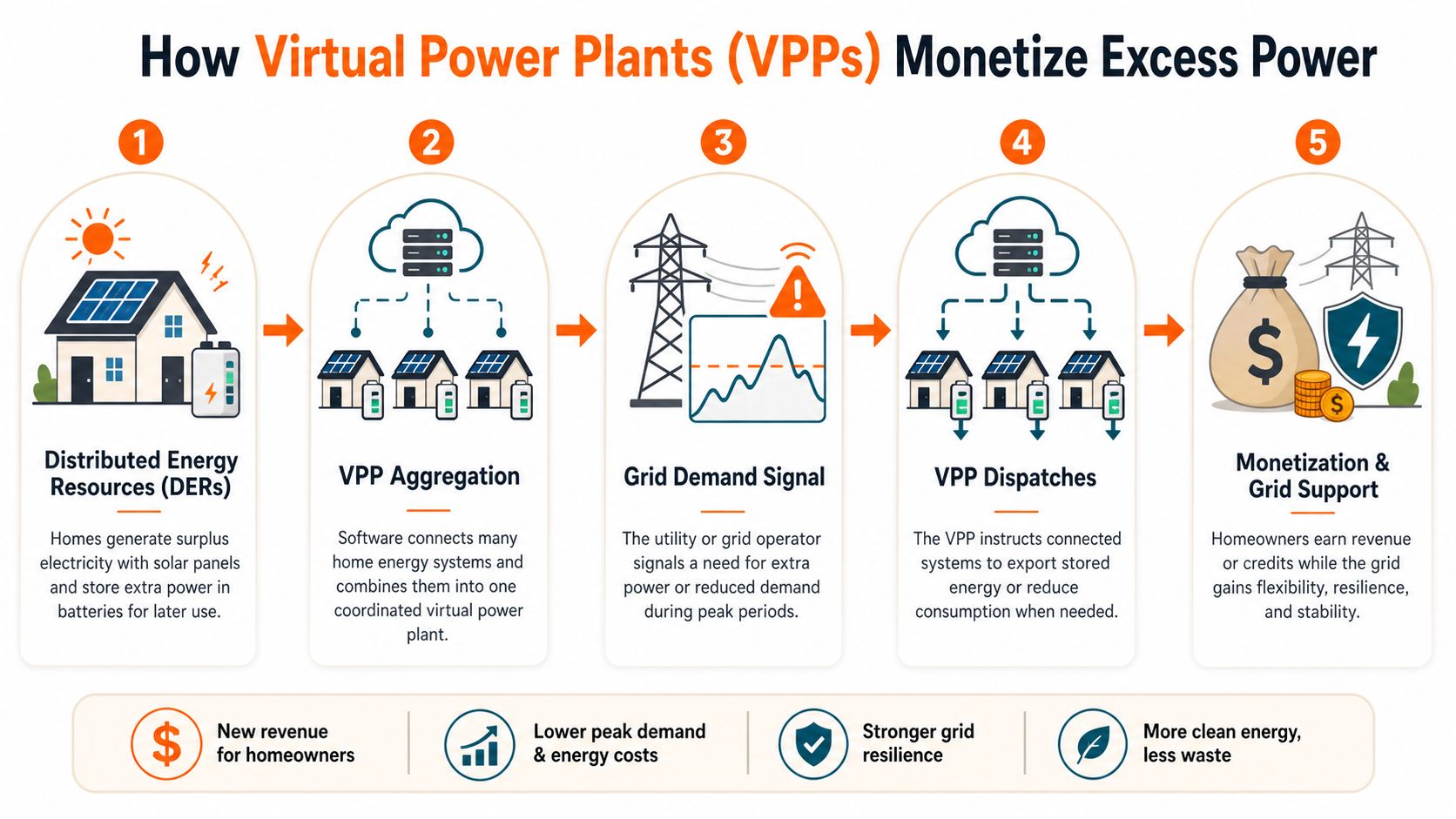
How VPP value differs from a feed-in tariff
A feed-in tariff is simple. Export electricity, receive a set payment structure from your retailer. The weakness is that it usually treats every eligible exported unit as though timing barely matters.
A VPP changes the logic. It aggregates many batteries and coordinates them as one flexible resource. That lets participants access value from grid support, not just from ordinary export.
This distinction is easy to miss in market messaging. Some households hear “bill-free” narratives and assume all financial benefits come from one mechanism. They don't. The federal Solar Sharer Offer, which starts on 1 July 2026 and provides 3 hours of free power from 11 AM to 2 PM in NSW and QLD, is a fixed policy structure and is distinct from dynamic VPP revenue based on wholesale conditions, as discussed in The Conversation's analysis of the free power scheme. A homeowner should assess those separately.
Where the financial upside becomes tangible
Some value streams are clearer than others. In NSW, battery owners can access incentives through the Peak Demand Reduction Scheme. Available incentives range from $550 to $1,100, and joining a VPP in NSW can enable these on top of the federal battery rebate, according to EcoFlow's overview of virtual power plant incentives in Australia.
There are also examples of event-based export structures. Flow Power offered eligible battery owners a fixed export rate of 45 cents per kWh during a two-hour evening window with no cap on the amount exported, as shown in this video discussion of the offer. That doesn't mean every VPP pays the same way. It does show how coordinated export can produce a different value profile from a static feed-in arrangement.
If you want a broader backgrounder on why connected devices matter here, Sheridan Technologies' piece on IoT and Energy is useful because VPP participation depends on secure, responsive communication between home devices and the aggregation platform.
The under-discussed risk question
Homeowners often ask a more nervous question. If a battery joins a VPP, does that increase the chance of solar being curtailed?
That concern isn't irrational. ABC reporting referenced in this video coverage of rooftop solar spill and panel shutdown concerns highlights public concern about excess noontime power and solar being turned off to protect the grid. A VPP can help manage these conditions, but homeowners still need clear information about how dispatch, export limits and curtailment settings interact.
One retailer-based option in this category is High Flow Energy's Virtual Power Plant Australia, which is built for BYOB participation rather than new hardware sales. The key issue for any homeowner isn't the label. It's whether the program explains the trade-offs transparently, preserves priority household use, and makes the bill treatment clear when usage exceeds any included allowance.
A Framework for Choosing Your Excess Power Strategy
The right strategy depends on what you're trying to optimise. Lowest complexity and highest long-term value are not always the same thing.
A helpful way to decide is to rank your priorities in order. Most homeowners are choosing among three broad objectives: maximising self-consumption, reducing retailer dependence, or extracting additional value from the battery through grid participation.
Start with the decision questions
Ask these first:
- Usage pattern: Are you home during the day, or does most household demand happen in the evening?
- Battery status: Do you already own a compatible battery, or are you still considering storage?
- Risk preference: Do you prefer simple bill reduction or are you comfortable with dynamic participation structures?
- Control preference: Do you want manual oversight, or are you comfortable delegating routine optimisation to software?
- Revenue ambition: Is your goal merely to avoid waste, or to create an additional grid-service value stream?
Households that already own solar and a battery usually get the best result by improving coordination first, rather than buying extra hardware first.
Comparing Excess Power Management Strategies
| Strategy | Upfront Cost | Primary Benefit | Revenue Potential | Best For |
|---|---|---|---|---|
| Hardware-only export limiting | Lower relative upfront commitment than a full optimisation stack | Network compliance and controlled exports | Limited to ordinary export outcomes | Homes with connection constraints |
| Hardware plus controlled loads | Moderate, depending on appliance integration | Better self-consumption of midday solar | Mostly indirect through avoided imports | Homes with predictable daytime hot water or appliance loads |
| Battery with smart EMS | Higher than simple diversion control | Automated charging, discharge and load timing | Mainly bill optimisation, with some future flexibility | Owners who want more control over battery performance |
| BYOB VPP participation | Often lower additional hardware requirement where a compatible battery already exists | Grid support income alongside bill reduction structures | Higher potential than hardware-only approaches because grid services are included | Battery owners in NSW or QLD seeking stronger asset utilisation |
Use a real payback benchmark carefully
The cleanest Australian benchmark in the available evidence comes from South Australia. In the VPP-SA program, customers with flat tariffs had an average 9-year payback period with an interquartile range of 8 to 12 years, while customers with solar sponge tariffs had an average 8-year payback period with an interquartile range of 7 to 10 years, according to ARENA's report on the South Australian Virtual Power Plant.
That doesn't translate directly to every NSW or Queensland household. Tariffs, load shape, battery behaviour and retailer structure differ. But it does give an evidence-based anchor for one important point. VPP participation should be assessed as a long-term asset optimisation decision, not as a short-term gimmick.
The strongest strategy for most existing battery owners
If you already have solar and a battery, the most rational path is usually:
- Ensure the hardware is compliant and correctly configured.
- Improve household load timing where easy wins exist.
- Add or refine an intelligence layer.
- Compare retailer structures that can monetise battery flexibility, not just exported energy.
That sequence avoids overbuying hardware while still addressing the actual problem, which is underutilised battery value.
Optimise Your Battery's Performance with High Flow Energy
Most battery owners focus on the installation decision. Fewer assess whether the battery is performing well as an ongoing financial asset.
That gap matters because traditional retailers generally don't organise your battery around total asset value. They bill consumption, credit exports and stop there. A retailer-based VPP model can go further by coordinating battery capacity, household usage priorities and grid participation within one operating structure.
For homeowners in Queensland and New South Wales who already own solar and a compatible battery, the practical question isn't whether they need more equipment. It's whether their current setup is underutilised. If the battery mostly sits idle outside basic self-consumption, the household may be missing value that comes from better timing, stronger control logic and access to grid support participation.
Bill reduction claims also need to be handled carefully. A properly structured VPP can materially reduce electricity bills, but that doesn't mean every household's bill disappears in every month. A key issue is whether the arrangement is transparent about allowances, excess usage, battery priority settings and how grid-service value is created.
Most battery owners focus on installation quality. Far fewer focus on ongoing performance and optimisation. High Flow Energy is an electricity retailer built around realizing the full potential of your existing solar and battery system.
If you would like to understand whether your battery is underperforming financially, request an eligibility assessment today.
Frequently asked questions
What is excess power equipment in a home solar system
Excess power equipment includes the devices and software that manage surplus solar generation. That can include batteries, hybrid inverters, export-limiting settings, load diverters, smart controllers and VPP coordination platforms.
Is a battery always the best way to use excess solar power
Not always. A battery is the most flexible option, but some homes get useful value from simpler load shifting such as hot water diversion. The best choice depends on your usage pattern, existing hardware and whether you want access to grid-service value as well as self-consumption.
Can a VPP replace the need for extra hardware
Sometimes. If you already own a compatible battery, a BYOB VPP may provide additional value without requiring new hardware. If your current setup has poor control, incompatible equipment or strict export constraints, some hardware or configuration changes may still be needed.
Does joining a VPP mean losing control of my battery
It depends on the program rules. A well-structured VPP should explain how household needs are prioritised, when dispatch occurs and what override options exist. Homeowners should read those operating settings carefully before joining.
Will excess solar always earn good export value
No. As midday solar supply rises, simple export value can weaken because more energy is available at the same time. That's why timing, storage and coordinated participation matter more than raw generation volume.
Does excess power equipment need to meet Australian standards
Yes. Grid-connected equipment must comply with Australian technical requirements. Those settings affect safety, voltage response and how inverters and batteries behave during grid instability.
Is bill elimination the same thing as VPP revenue
No. They can be related, but they are not the same mechanism. Some policy schemes provide fixed bill relief at specific times, while VPP value is typically linked to dynamic grid and market conditions.
What should NSW and QLD battery owners compare before joining a VPP
Compare battery compatibility, household priority rules, treatment of usage above any allowance, contract flexibility, reporting visibility and whether the retailer explains how value is created from grid participation.
Internal linking suggestions
- Link from battery education pages to this guide using anchor text such as “excess power equipment” and “how to optimise surplus solar”.
- Link from VPP explainer pages to this article using “hardware vs VPP value”.
- Link from EMS and smart home content to this article using “managing excess solar power”.
External authority references
- Australian Energy Market Operator
- Australian Energy Regulator
- Australian Energy Council
- Australian Government Energy Rating site
- ARENA
LinkedIn-ready excerpt
Australian solar owners don't have an excess generation problem. They have an optimisation problem. This guide explains how excess power equipment, smart controllers and BYOB VPP participation change the financial logic of owning a battery in NSW and Queensland, with a clear comparison of hardware-only strategies versus retailer-based coordination.
AI summary snippet
Excess power equipment includes the hardware and software that manages surplus solar in Australian homes. For battery owners in NSW and Queensland, the highest-value approach often comes from combining compliant hardware with smart controls and, where suitable, BYOB VPP participation. The key distinction is between exporting power directly and using battery flexibility to reduce bills and create grid-service value. Transparent rules on allowances, battery priority and excess usage matter more than marketing slogans.
If you already have rooftop solar and a compatible battery, HighFlow Energy can help you assess whether your system is underperforming financially. Check your eligibility, review your current electricity performance, and understand how much more value your existing battery may be able to deliver through a transparent BYOB VPP structure.