


Carbon Footprint Reduction: Homeowner Solar Guide 2026
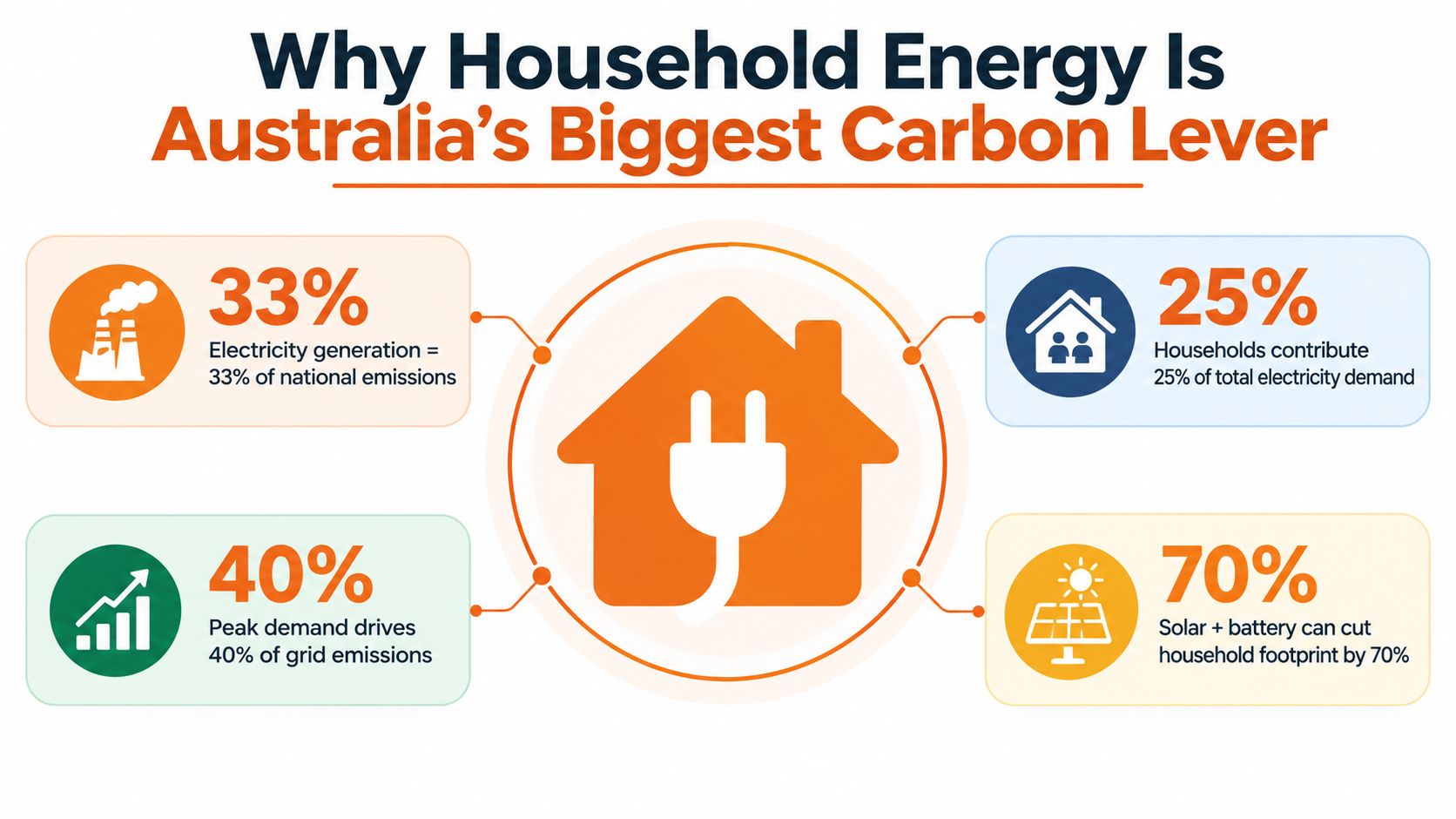
Australia's electricity system is still the country's biggest emissions lever, with electricity the largest emitting sector in 2022–23 at about 182 Mt CO2-e, or roughly 33% of national emissions (Australian Government National Greenhouse Accounts context). That matters for homeowners because the fastest path to carbon footprint reduction usually runs through the meter box, the rooftop, and the battery wall, not through vague lifestyle tweaks.
The catch is that many households stop at installation. They buy the solar, add the battery, then leave most of the emissions benefit sitting unused because the system isn't being actively scheduled, measured, or coordinated. In Queensland and New South Wales, where rooftop solar uptake is already high, the true opportunity is no longer just owning the hardware, it's using that asset to displace the dirtiest grid energy at the right time.
Why Household Energy Is Australia's Biggest Carbon Lever
Household energy sits at the centre of Australia's emissions challenge because grid electricity is such a large slice of the national footprint. When households draw from a coal-heavy grid, they're indirectly tied to the emissions profile of that supply. When they shift demand into solar self-consumption, battery discharge, or coordinated VPP support, they reduce the emissions intensity of that same household load.
That's why home energy is not a side issue. It's the place where thousands of small decisions add up to meaningful carbon reduction, especially in states with strong rooftop-solar penetration. The national trend has also changed the economics of household action, because electricity emissions have been falling over time as renewable generation has grown and coal generation has declined.
The hardware is common. The optimisation isn't.
Australia has already built the household infrastructure for distributed decarbonisation. The Clean Energy Regulator reports more than 3.9 million small-scale solar PV installations nationwide by 2024 (Clean Energy Regulator scale context). That scale matters because it means a huge number of homes already have generation capacity sitting on the roof, and many of them now also have storage.
Practical rule: The emissions win doesn't come from owning solar alone. It comes from making sure solar and battery output replaces grid electricity when that grid electricity is most carbon intensive.
What's still missing is active use. A lot of batteries are installed to increase self-consumption, but not all of them are programmed to maximise emissions reduction or grid support. In practice, that means a household can have the right equipment and still underdeliver on carbon savings because the dispatch strategy is too passive.
Why batteries change the emissions equation
A battery is not just a backup device. It's a timing tool. It lets a household hold midday solar and release it later, when the grid is typically serving evening demand from more emissions-intensive sources.
That timing shift is the key point. If a home can move consumption away from the grid and into stored solar, it avoids buying electricity at the dirtiest times of day. If that same battery is part of a VPP, the home can also support the grid when demand spikes, which makes the emissions benefit more system-wide.
For deeper context on how distributed resources fit into the wider network, see High Flow Energy's overview of distributed energy resources in Australia.
Reducing Baseline Consumption Before Optimising Your Battery
The first mistake many homeowners make is treating the battery as a cure for waste. It isn't. A battery works best when the home behind it is already efficient, because every unnecessary kilowatt-hour the house uses is a kilowatt-hour the battery must cover later.
Start with the load, not the storage. Efficient appliances, better insulation, and reduced standby demand all lower the amount of energy the home needs in the first place. That makes the battery last longer through the evening and leaves more room for displacing grid electricity at the times that matter most.
Cut the easy waste first
The fastest wins are usually behavioural and low-cost. Running heavy appliances when the sun is up is a simple way to use solar directly instead of asking the battery to fill the gap later. The same applies to avoiding standby loads that continuously drain energy across the day.
A useful household checklist looks like this:
- Lighting: Move to LED bulbs wherever you still have older fittings.
- Standby loads: Unplug devices or switch off power boards when they're not being used.
- Appliance choice: Replace ageing appliances with efficient models when the timing makes sense.
- Heating and cooling: Use a smart thermostat or schedule so the system doesn't run longer than needed.
- Building fabric: Seal gaps and improve insulation so the home holds temperature better.
High Flow Energy's household energy audit is a useful reference point if you want to understand where the biggest avoidable loads are showing up in a typical home.
Shift usage into solar hours
The simplest operating change is often the most effective. Dishwasher, washing machine, and pool-pump cycles can be shifted into the middle of the day, when rooftop solar is producing. That reduces both grid imports and unnecessary battery cycling.
If a family in Brisbane or Newcastle runs those loads after dark, the battery has to step in. If those loads run in the middle of the day, the battery can stay available for later evening demand or grid support. The emissions outcome is better because the system is doing more with direct solar and less with stored energy.
A battery should cover the hard-to-shift demand, not the demand you could have moved for free.
Battery Charge and Discharge Strategies for Maximum Emissions Impact
Battery strategy matters more than most owners realise. A battery set up only around price can still reduce bills, but it won't always deliver the best emissions result. The cleanest outcome usually comes from aligning discharge with the dirtiest part of the household's demand profile and the grid's evening stress window.
For homes in NSW and QLD, the evening peak is the obvious place to focus. That is when grid demand often rises, solar output falls, and imported electricity is more likely to come from higher-emissions generation. The practical objective is to make the battery cover those hours first, then use excess capacity for other purposes only when it makes sense.
Use discharge to replace evening grid imports
A battery that discharges into evening household use avoids grid imports at exactly the time they're hardest to decarbonise. If the home has air conditioning, cooking loads, or entertainment loads in the early evening, that's usually the best place to send stored solar first.
The two settings that matter most are simple:
- Prioritise self-consumption when the battery should cover household use before any export decision.
- Reserve capacity for late-afternoon and evening discharge when imported electricity is most likely to be emissions intensive.
Automation helps. Manual control works for motivated owners, but most households won't keep adjusting schedules through the seasons. A good system should track household load patterns and let the battery do the right thing without constant intervention.
Don't ignore seasonal behaviour
Summer and winter are not the same battery problem. In summer, solar generation is usually stronger and household cooling demand can also be stronger. In winter, solar production drops and evening demand can last longer, which changes how fast the battery should be used and how much reserve to keep.
The trade-off is straightforward. If you discharge too early, you may empty the battery before the household's evening peak is over. If you hold too much back, you leave grid imports on the table. Good scheduling is really about making those competing needs explicit instead of guessing.
Midway through the day, the battery should often be doing nothing fancy. It should be waiting. The point is not constant motion, it's the right discharge at the right time.
How Virtual Power Plant Participation Accelerates Grid Decarbonisation
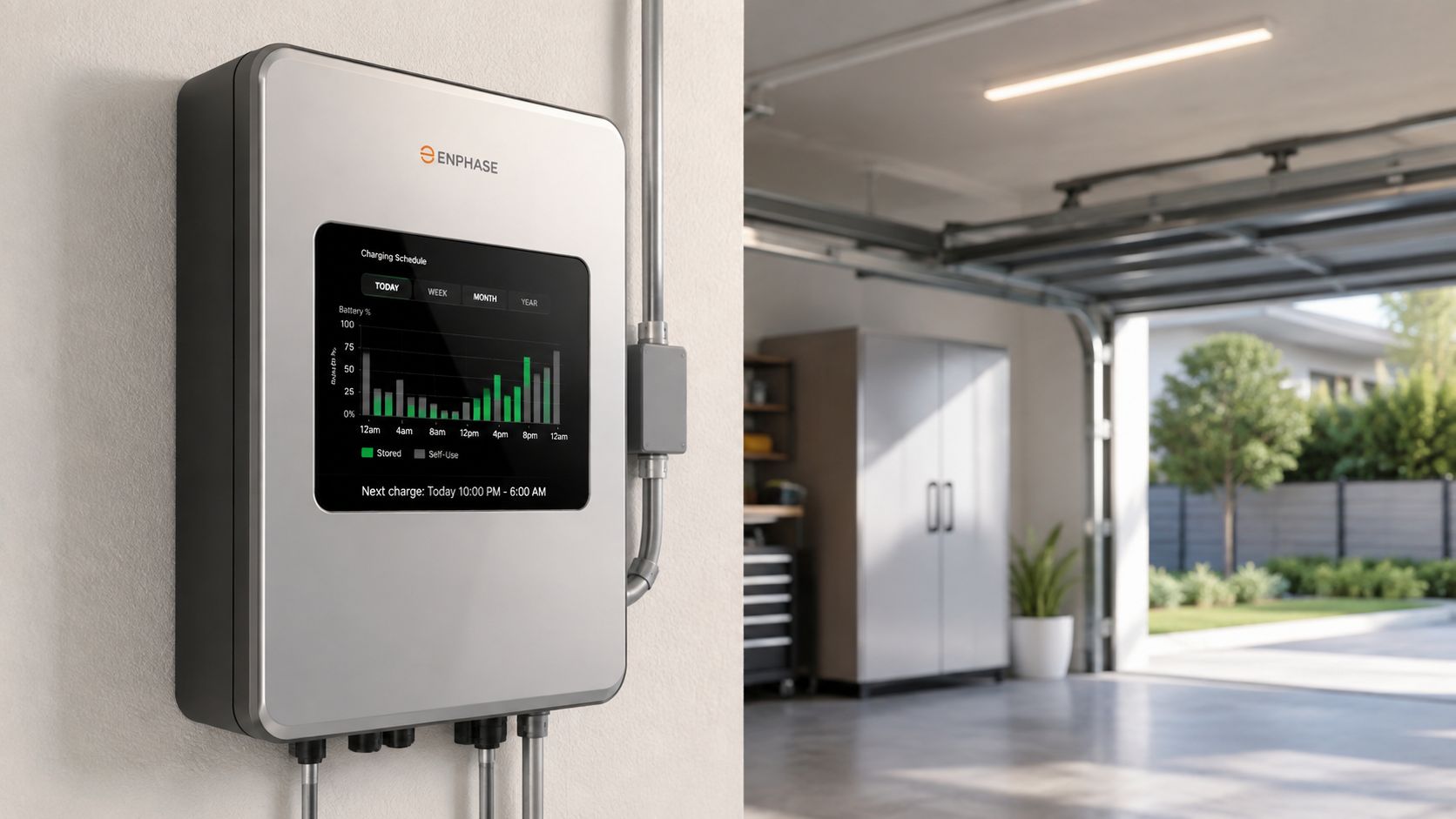
A battery creates more emissions value when it stops behaving like a single-house appliance and starts operating as part of a coordinated fleet. That is the basic logic behind a Virtual Power Plant, or VPP. Instead of every home responding on its own timetable, the operator coordinates many batteries so the grid gets support when it needs it most.
What coordinated dispatch changes
A BYOB, or Bring Your Own Battery, VPP lets existing battery owners take part without replacing the hardware they already have. The battery still serves the home first, and spare capacity can be dispatched into the VPP when the grid calls for it. That structure matters because it avoids forcing households to choose between comfort and grid support.
High Flow Energy's solar battery virtual power plant uses the same basic model, coordinating existing solar and battery assets rather than asking the homeowner to start from scratch. The emissions benefit comes from dispatch during grid stress, when local support can reduce the need for higher-emissions generation elsewhere in the system.
The strongest VPPs do not ask a household to surrender control. They make spare battery capacity useful without turning the home into a passenger.
Why this helps the grid, not just the bill
When thousands of batteries respond together, the grid gains a flexible resource that can help smooth demand spikes. That can reduce the need for peaker-style generation during periods of stress, which is where household batteries can have an outsized system effect.
For homeowners, the point is practical. A battery that would otherwise sit idle in the early evening can be dispatched in a way that helps the grid absorb more renewable energy and rely less on fossil generation. That closes a gap many Australian battery owners never address, because installing solar and storage does not automatically mean the system is being used for maximum carbon reduction.
The key trade-off to understand
Battery wear, control rights, and compensation still matter. A household should know when the battery can be called, how much reserve is protected for the home, and what the dispatch rules are. Clear VPP design is the difference between a useful optimisation layer and an opaque contractual add-on.
If the rules are clear, the VPP becomes a carbon reduction tool as well as a financial one. If the rules are unclear, the owner is taking on risk without knowing what the battery is doing.
Measuring and Verifying Your Actual Carbon Savings
Good carbon reduction only counts if you can verify it. Too many programs rely on assumptions, generic averages, or attractive before-and-after stories that don't hold up under measurement. That's a real problem, because a systematic review found that less than 16% of issued carbon credits in the investigated sample corresponded to real emission reductions, and earlier synthesis work reported especially weak outcomes in some project types, including 0% offset achievement for renewable energy and only 0.4% for cookstoves (Nature Communications review).
For homeowners, the lesson is simple. Don't trust carbon claims that can't be traced back to actual energy data. The strongest household approach is to compare metered grid imports, battery discharge behaviour, and household load before and after each change.
Build a baseline before you optimise
A baseline is just the starting point. You need to know what your home imported from the grid before you changed schedules, before you changed battery settings, and before you joined any coordinated program. Without that, you can't tell whether a reduction is real or just seasonal noise.
The most useful household metrics are the ones tied to metered behaviour. App data from your retailer or battery platform can show how much energy is being imported, exported, and discharged. That gives you enough evidence to compare month to month and see whether the battery is doing more work in the right hours.
| Carbon Savings Tracking Framework | How to Measure | Target Trend |
|---|---|---|
| Grid imports | Check retailer or app data each billing cycle | Down over time |
| Evening discharge | Review when the battery empties | More aligned with evening demand |
| Solar self-consumption | Compare daytime solar use against export | Up where loads are flexible |
| Battery reserve use | Track how often backup reserve is preserved | Stable for household security |
| Household load shape | Note changes in appliance scheduling | Flatter, more solar-aligned |
Measure the change, not just the intention
A lot of households make one good change and assume the job is done. It usually isn't. Solar generation varies, weather shifts, and household routines drift. The only way to know whether the plan still works is to keep checking the data.
Useful standard: If you can't show the before-and-after meter readings, you don't really know whether the emissions fell.
That's why verification matters more than broad sustainability language. A battery strategy that looks clever on paper can still underperform if it cycles at the wrong time or leaves evening grid imports untouched.
Your Next Steps for Ongoing Carbon Footprint Reduction
The right sequence is straightforward. Reduce baseline waste first, then tune battery schedules, then test whether a VPP can improve both emissions performance and asset value. That order matters because storage works best after the home's underlying demand has already been tightened.
A lot of households treat solar and battery installation as the end of the process. It isn't. The gains come from ongoing optimisation, because the grid, tariff structure, and household load all change over time. A system that was well set up last year can drift out of alignment quickly if nobody is reviewing it.
Solar owners also need to keep the physical system clean and performing properly. Routine maintenance such as panel cleaning can matter, and Aloha Window Bros has a practical guide on solar panel cleaning and maximising output that highlights why output consistency matters to total system performance.
If you want to know whether your battery is underperforming financially or carrying untapped carbon reduction potential, the next step is an eligibility check. HighFlow Energy works with existing rooftop solar and compatible battery owners to assess whether a BYOB VPP setup fits the home, the load profile, and the existing system behaviour.
Most battery owners focus on installation quality. Far fewer focus on ongoing performance and optimisation. HighFlow Energy is an electricity retailer built around accessing the full value of your existing solar and battery system. If you want to understand whether your setup is underutilised for carbon footprint reduction, visit HighFlow Energy and request an eligibility assessment.