


Thermal Management System Guide for Aussie Homes
On a 38 degree Brisbane afternoon, the air conditioner is running hard, the roof is soaking up heat, and the battery cabinet on the wall is doing its own job. Most homeowners never think about what's happening inside that box until they hear the fan, see a warning in the app, or notice the battery isn't holding up the way it should. In a hot-climate home, thermal management is what keeps that battery from turning a good solar setup into a stressed one.
For Queensland and New South Wales battery owners, this matters because the battery is not just a storage device. It's part of a system that has to survive ambient heat, charge and discharge cycles, and long summer afternoons when the whole house is already working hard. A thermal management system is the quiet control layer that decides whether the battery stays within its safe operating envelope or starts giving up performance, lifespan, and in some cases safety margin.
Why Your Home Battery Gets Hot on a Queensland Afternoon
The battery on a hot afternoon is dealing with more than sunshine on the wall. It's dealing with the heat coming through the surrounding air, the heat produced by its own internal resistance, and the extra stress of cycling when the household is using power and the grid may be under pressure. If the cabinet is in a garage, shed, or exterior alcove, the temperature inside that space can climb far beyond what the weather app says.
A lot of owners assume the battery only works harder when it's discharging. In practice, heat builds during both charging and discharging, because energy is never moved perfectly efficiently. That's why the cooling method matters. A battery that's fine on a mild morning can behave very differently when it's sitting beside a western wall in full afternoon sun.
Heat is part of the operating environment
Home batteries in Australia must endure a climate that's tougher than many generic product brochures assume. The practical issue isn't just comfort, it's control. If the battery can't shed heat fast enough, the system may throttle output, reduce charging, or spend more energy keeping itself cool than the owner expects.
That's also why the word thermal management belongs in the battery conversation, not just in EVs or data centres. The same logic applies, measure the heat, move it away, and reject it to the environment before it harms the cells.
Practical rule: if the battery enclosure feels hot to the touch on the outside, the cells inside are usually working harder than the installation team wanted them to.
For readers who want a quick visual check of whether a unit is already showing signs of heat stress, a thermal scan inspection can help reveal hot spots around cabinets, roof cavities, and nearby surfaces without opening the system itself.
The point is simple. In a Queensland or NSW home, heat isn't an edge case. It's a design condition. That's why the rest of the battery system, from cabinet placement to the VPP schedule, has to treat temperature as a live constraint rather than a background detail.
What a Thermal Management System Actually Does
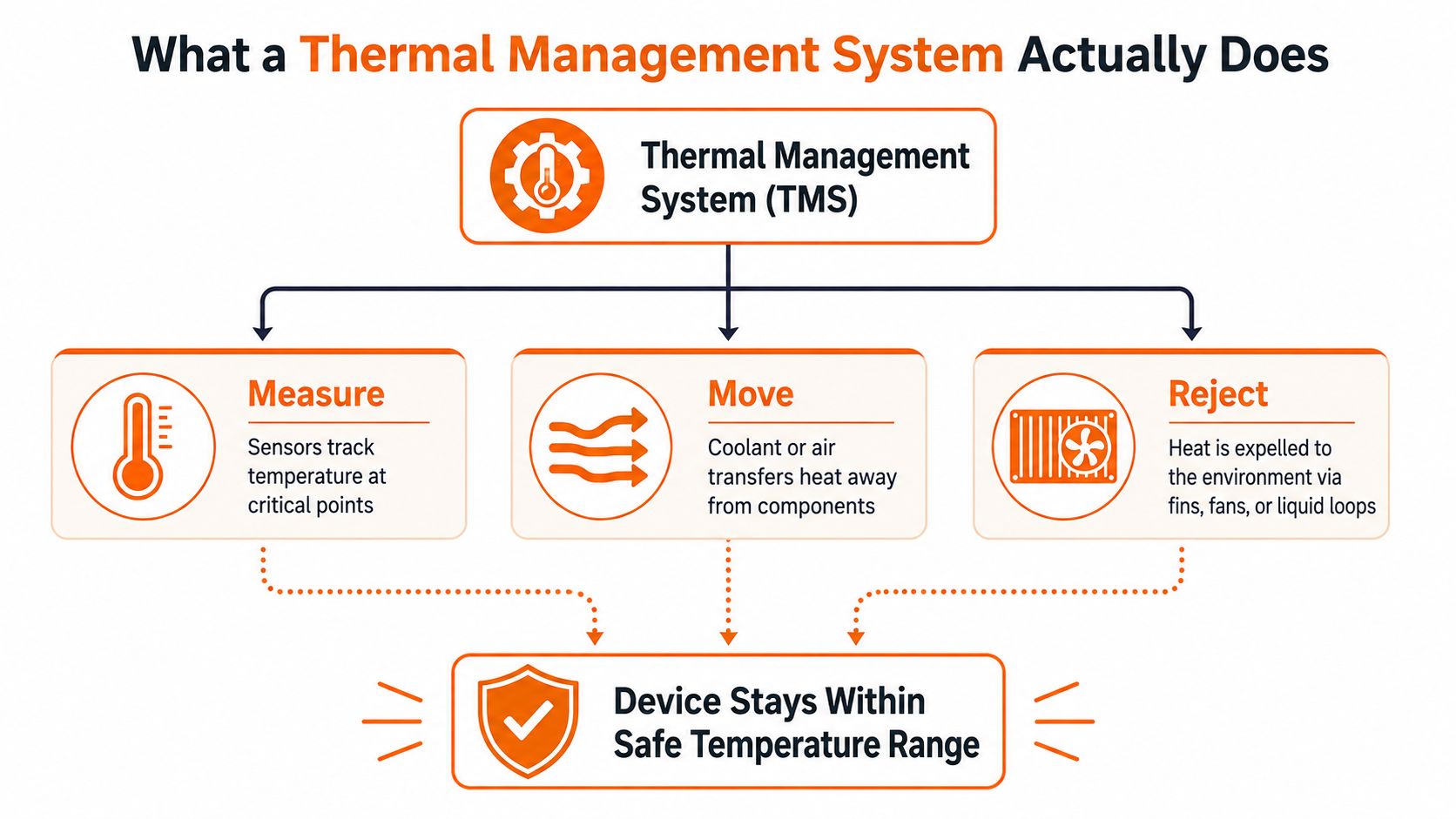
A thermal management system is the set of parts that keeps a device inside a target temperature band. In plain terms, it does three jobs. It measures temperature, it moves heat away from the source, and it rejects that heat to the outside environment. It functions much like a home air conditioner, except it's been tuned to protect a battery pack, not a lounge room.
The main cooling approaches
The first approach is air cooling. Fans push air across fins or through vents, and heat leaves the cabinet by convection. This is common in smaller systems because it's simple and relatively low cost, but it depends heavily on ambient conditions and airflow around the unit.
The second is liquid cooling. A glycol or refrigerant loop carries heat away from the pack much more effectively than air alone can. That's why high-power systems often use liquid circuits, pumps, and compressors, especially where the heat load is high or the climate is harsh.
The third is phase change materials, often called PCM. These materials absorb heat when they melt, which helps buffer short spikes. The thermal logic here is different from a fan or pump, because the material itself stores heat instead of just moving it away.
The fourth is hybrid cooling, where air, liquid, sensing, and control work together. In real installations, this is often the practical answer. It gives engineers more control over where heat goes, how fast it moves, and how the system responds when the weather changes.
A useful way to think about it is this, air cooling is a breeze, liquid cooling is a pipeline, and thermal mass or PCM is a buffer.
That last point matters because heat can be handled in two ways. Sensible heat changes temperature. Latent heat is absorbed during a phase change, such as melting. Materials like concrete and paraffin show up in thermal conversations because they can absorb and release heat without the same rapid temperature swing you'd see in a thin metal enclosure.
For a broader engineering view of heat recovery and integrated thermal systems, the thermal management systems overview from Trane Technologies gives a useful background on how modern systems treat heat as something to be controlled, reused, and redirected rather than discarded.
Active Versus Passive Cooling in Real Installations
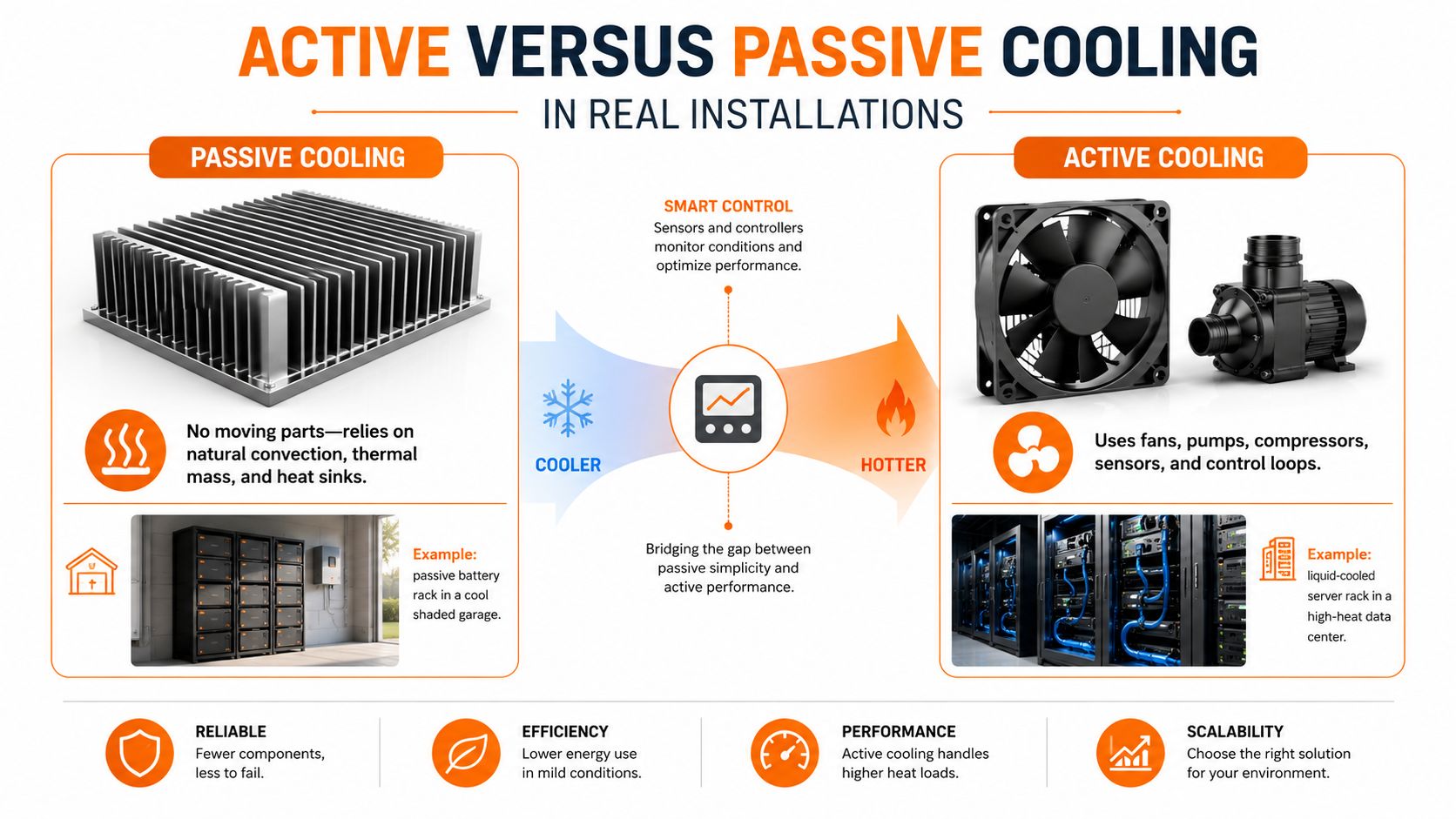
Passive cooling relies on the environment and the material around the battery. Active cooling uses powered components to force heat out. That's the cleanest way to separate the two, but real installations often blur the line. A battery cabinet might use passive heat sinking for everyday load and active fans when temperatures rise.
What passive systems do well
Passive systems are quiet, simple, and low maintenance. A battery mounted near a shaded wall with generous airflow may only need natural convection and a well-designed cabinet to remain stable through much of the year. Concrete and other high thermal mass materials can also help buffer temperature swings around the unit.
Passive systems struggle when heat density rises. They also struggle when the room or enclosure itself is hot. If the air around the battery can't carry heat away fast enough, the battery has nowhere to dump it.
What active systems do well
Active systems are more capable when the heat load rises. Fans, pumps, compressors, sensors, and control loops can move heat far more aggressively than passive surfaces can. That's why active liquid cooling shows up in larger or higher-power packs, and why many commercial battery thermal systems use closed loops rather than just vents.
The trade-off is that active systems add noise, consume some power, and introduce extra points of failure. A fan can clog with dust. A pump can wear. A sensor can drift. That doesn't make active cooling bad, it just means the installer has to think about reliability, not only temperature.
The right choice depends on the job. A small battery in a cool, shaded garage may be well served by passive support and a fan. A high-capacity cabinet in a hot Queensland yard will usually need something more substantial. For a practical comparison of how HighFlow Energy structures battery participation around system constraints, the solar battery Virtual Power Plant page shows the retailer-side coordination model.
The Temperature Targets That Protect Your Battery
Home batteries don't like wide temperature swings. In the battery and EV world, a common design target is to keep cells in roughly the 20°C to 40°C range, with temperature differences inside the pack kept below about 5°C when possible, because uneven heat is just as important as peak heat for performance and safety. Those figures come from established technical explanations of thermal design for batteries, including MIT's roadmap on heat management in electronics and battery systems (MIT thermal management paper).
Why the band matters
When temperatures run high, the battery ages faster and the risk profile gets less forgiving. When temperatures run low, usable capacity falls temporarily and fast charging can become less comfortable for the chemistry. The owner doesn't usually see those mechanisms directly, but the result shows up in reduced performance over time.
Australian summer conditions make this harder. On hot afternoons in Brisbane and western Sydney, the air around an exposed cabinet can sit well above the comfort band even before the battery starts moving energy. If the enclosure is poorly ventilated or in direct sun, the problem compounds quickly.
Thermal sensing is how the control system keeps up. NTC thermistors placed at pack and cell level act as the system's eyes. They tell the controller where the heat is building, not just whether the average temperature looks acceptable.
| Thermal Stress Outcomes by Temperature Zone | What happens inside the battery | What it means for the owner |
|---|---|---|
| Below the preferred operating band | Usable capacity drops and charging can slow | The battery may feel less responsive in cold weather |
| Within the target band | Cells stay in a stable working range | Better cycle life, steadier output, more predictable performance |
| Above the preferred band | Heat accelerates ageing and raises stress on materials | The system may derate, use more cooling, or lose longevity |
| Uneven temperatures across the pack | Some cells work harder than others | Performance becomes less consistent, and faults are easier to trigger |
Engineering rule: temperature uniformity often matters more than the coldest number on the screen. A pack that is evenly warm is usually healthier than one cell that is icy and another that's cooking.
For owners trying to judge whether their current setup is respecting those limits, a simple battery health check can help identify whether the unit is operating in a sensible thermal range before summer puts it under more strain.
How a VPP Schedules Around Heat, Not Just Price
A retailer-led Virtual Power Plant shouldn't treat the battery like a switch that only responds to wholesale prices. It also has to respect the battery's thermal envelope. That means charge and discharge plans need to account for weather, household load, and the actual temperature behaviour of the asset.
What smart scheduling looks like
A practical scheduling system forecasts temperature and demand, then chooses windows that avoid unnecessary thermal stress. If the day is already hot and the battery cabinet is exposed, the platform should be more selective about how hard it cycles the pack. Aggressive discharge at the wrong time can create short-term value but shorten the useful life of the asset.
That's where retailer discipline matters. A good VPP operator doesn't chase every spike. It balances grid support, battery health, and household availability so the owner's backup reserve and long-term performance aren't sacrificed for one event.
Homeowners also need override control. If a heatwave is running hard or the family wants extra backup through the evening, the battery should be able to hold its reserve. That flexibility keeps the system practical, especially for households in Queensland and New South Wales where summer conditions can change quickly.
HighFlow Energy's VPP approach is built around this kind of coordination, using app-based scheduling and owner override options to keep battery use within sensible limits while still participating in grid services. The principle is straightforward, thermal management is a constraint, not an afterthought.
A battery can't earn sustainably if it's being pushed through temperature stress every time the market gets exciting.
The value is not only in bill outcomes. It's also in preserving warranty confidence, reducing wear, and making sure the battery still performs well when the household really needs it. That's why battery optimisation and VPP participation should be designed together, not treated as competing goals.
The House Around the Battery as Part of the System
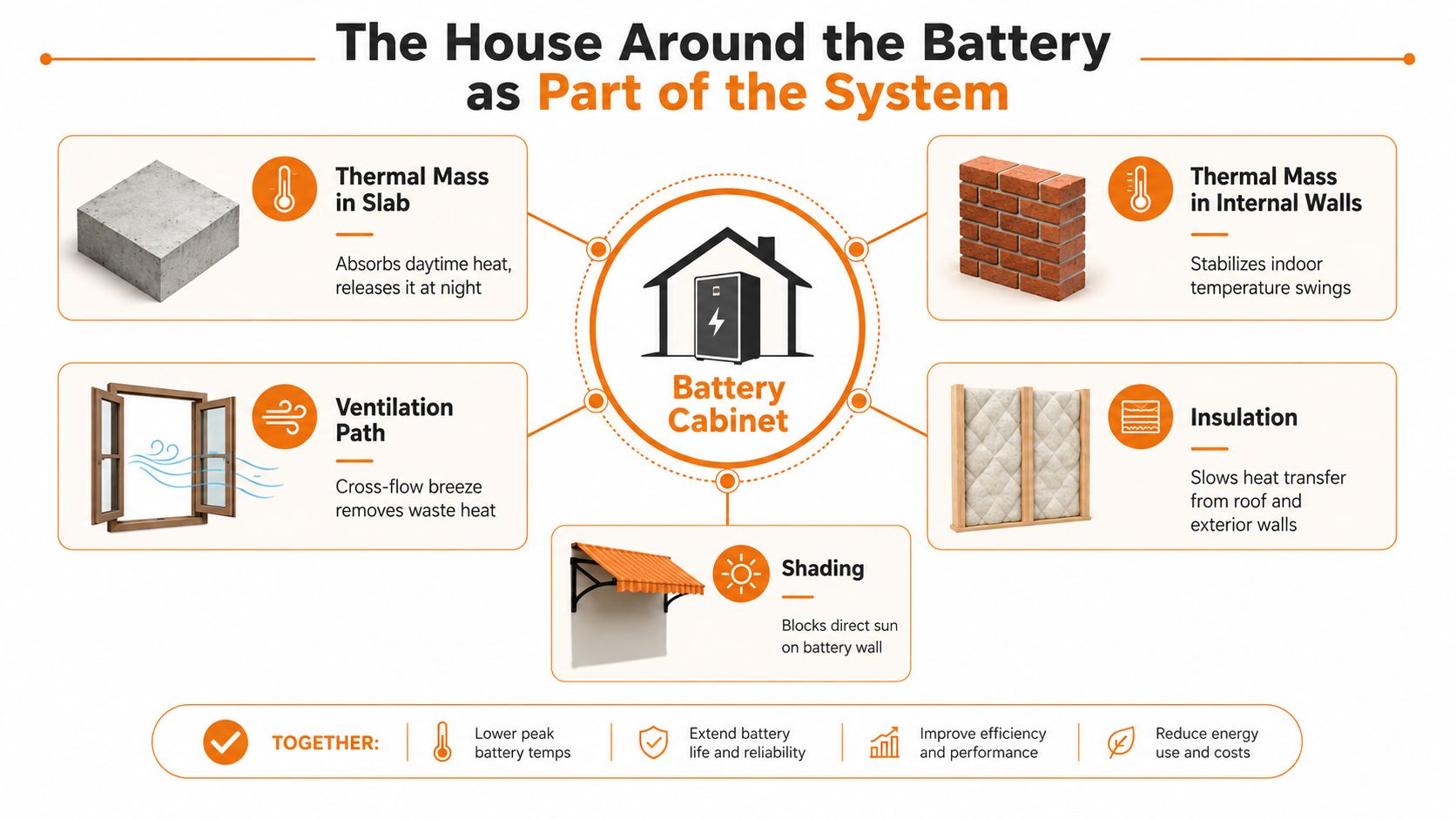
A battery cabinet does not sit by itself. The room, wall, roof, and airflow around it all shape how hard the thermal system has to work. On a Queensland rooftop garage or in a NSW shed, the building fabric can decide whether the battery sees a steady environment or a hot, uneven one.
Why building fabric changes the result
Australian passive-design guidance from YourHome's thermal mass resource explains thermal mass as the ability of a material to absorb, store and later release heat. In a house, that means a slab or internal masonry wall can flatten the temperature swing across the day. The same idea helps a battery room stay calmer, so the cooling hardware is not fighting every short burst of heat.
A brick garage in Brisbane behaves differently from a light-framed Colorbond shed in western Sydney. The brick space can absorb heat more slowly and release it later. The lightweight shed can heat up and cool down faster, which may sound useful until the battery is exposed to sharper spikes and weaker insulation.
The practical choices are ordinary ones. Shade the western wall. Allow airflow around the cabinet. Reduce radiant heat from the roof. Do not trap the battery in a dead corner where warm air sits all afternoon. A simple household energy audit can help identify where heat builds up in the broader home, which makes it easier to see whether the battery space is part of the problem or part of the solution.
For a local design reference that connects building fabric and thermal performance in Australian homes, the YourHome thermal mass guidance is a useful point of reference for the broader building side of the problem.
Three Myths Worth Letting Go
A lot of battery advice online sounds confident but skips the detail that matters. That's a problem, because thermal management is one of those areas where a shallow rule of thumb can lead to the wrong installation choice.
Myth one, all home batteries are air-cooled
That's not true. Many higher-capacity systems use liquid loops or hybrid designs, especially when ambient temperatures are tough or the load is high. The cooling method matters because it affects noise, maintenance, and sometimes warranty conditions.
Myth two, more cooling is always better
Not really. Overcooling can waste energy, and poor control can create unnecessary condensation risk. A battery doesn't get healthier just because it's cold, it gets healthier when the temperature is held evenly inside a suitable band.
Myth three, thermal management doesn't matter in a mild climate
It still matters. Direct sun, roof cavities, garages, and repeated VPP cycling can create local heat problems even when the regional climate doesn't look extreme on paper. In other words, the installation environment often matters more than the postcode.
A few practical details help separate marketing from reality:
- Ask about the cooling method: Air, liquid, or hybrid systems behave differently under load.
- Check the ambient rating: The battery should be specified for real Australian conditions, not just lab conditions.
- Look for temperature control detail: If the spec sheet never mentions sensing or derating, that's a warning sign.
- Read the installation context: Shaded, ventilated, and clear of direct sun is not optional in a hot climate.
Practical Recommendations for Australian Battery Owners
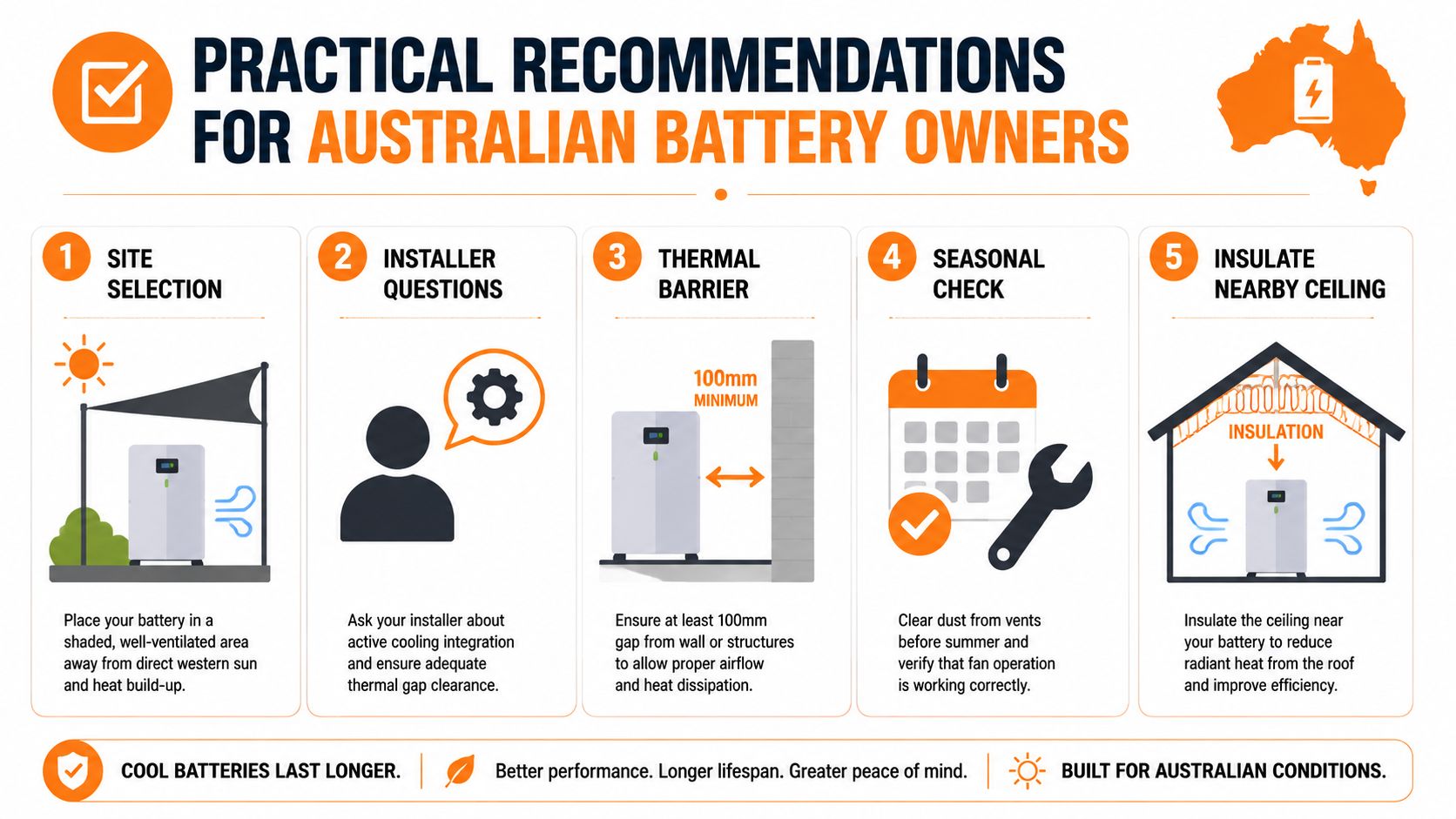
If you own a battery in Queensland or New South Wales, the most useful thermal decisions are the boring ones you make before summer arrives. Site it well, ask sharper questions during installation, and keep an eye on what the system is telling you once it's live.
The questions worth asking now
What ambient temperature rating does the battery carry? Ask the installer for the operating range and what happens when the room gets hotter than that range. If the unit derates above a certain point, usable capacity may fall temporarily, which is normal in engineered systems but should be understood before purchase.
How loud is active cooling likely to be? In suburban settings, fan noise is usually manageable if the battery is placed away from bedrooms and boundary walls. A shaded service area, ventilated garage, or screened external wall usually works better than a tight corner with no airflow.
Will VPP participation affect the thermal warranty? The answer depends on the battery manufacturer's terms, so check whether thermal protection, cycling limits, or operating temperature conditions are tied to warranty coverage. The owner should know whether override settings and battery reserve levels stay within those terms.
How does scheduling change on extreme-heat days? A retailer-led VPP should factor temperature into charge and discharge decisions, not just market price. If the app allows override, use it when the battery needs to prioritise cooling or backup reserve over participation.
What should you monitor after install? Watch for repeated fan activity, unexplained derating, warning messages, or unusually hot cabinet surfaces. Those are the clues that the thermal design may need review before summer gets serious.
A short checklist for notes app
- Site selection: Choose a shaded, ventilated location away from western sun.
- Clearance: Leave enough space around the cabinet for airflow.
- Installer questions: Ask how the system manages heat on very hot days.
- Seasonal maintenance: Clear dust from vents before summer and confirm the fan is operating.
- House context: Reduce roof and wall heat gain near the battery room.
A practical battery system is one that stays stable without demanding constant attention. That's also the logic behind High Flow Energy's retailer-led VPP model, where battery performance and dispatch planning are coordinated rather than treated as separate problems.
Most battery owners focus on installation quality. Far fewer focus on ongoing performance and optimisation. High Flow Energy is an electricity retailer built around achieving the full value of your existing solar and battery system.
If you'd like to understand whether your battery is underperforming financially or being pushed too hard thermally, visit High Flow Energy and request an eligibility assessment today.