

Energy Storage House: What It Is and How It Works
An energy storage house is a home with a battery that stores rooftop solar power for later use and can connect to a virtual power plant to earn bill credits from grid services. By the end of 2024, Australia had approximately 185,798 home-battery units installed, while 28.4% of rooftop-solar installations in the second half of that year included a small-scale battery.
If you have rooftop solar but still buy electricity in the evening, you may be using only part of what your system can offer. A battery can shift some daytime solar into the evening, and a well-designed Virtual Power Plant (VPP) can coordinate spare battery capacity to support the grid while keeping your household's needs in view.
What Is an Energy Storage House
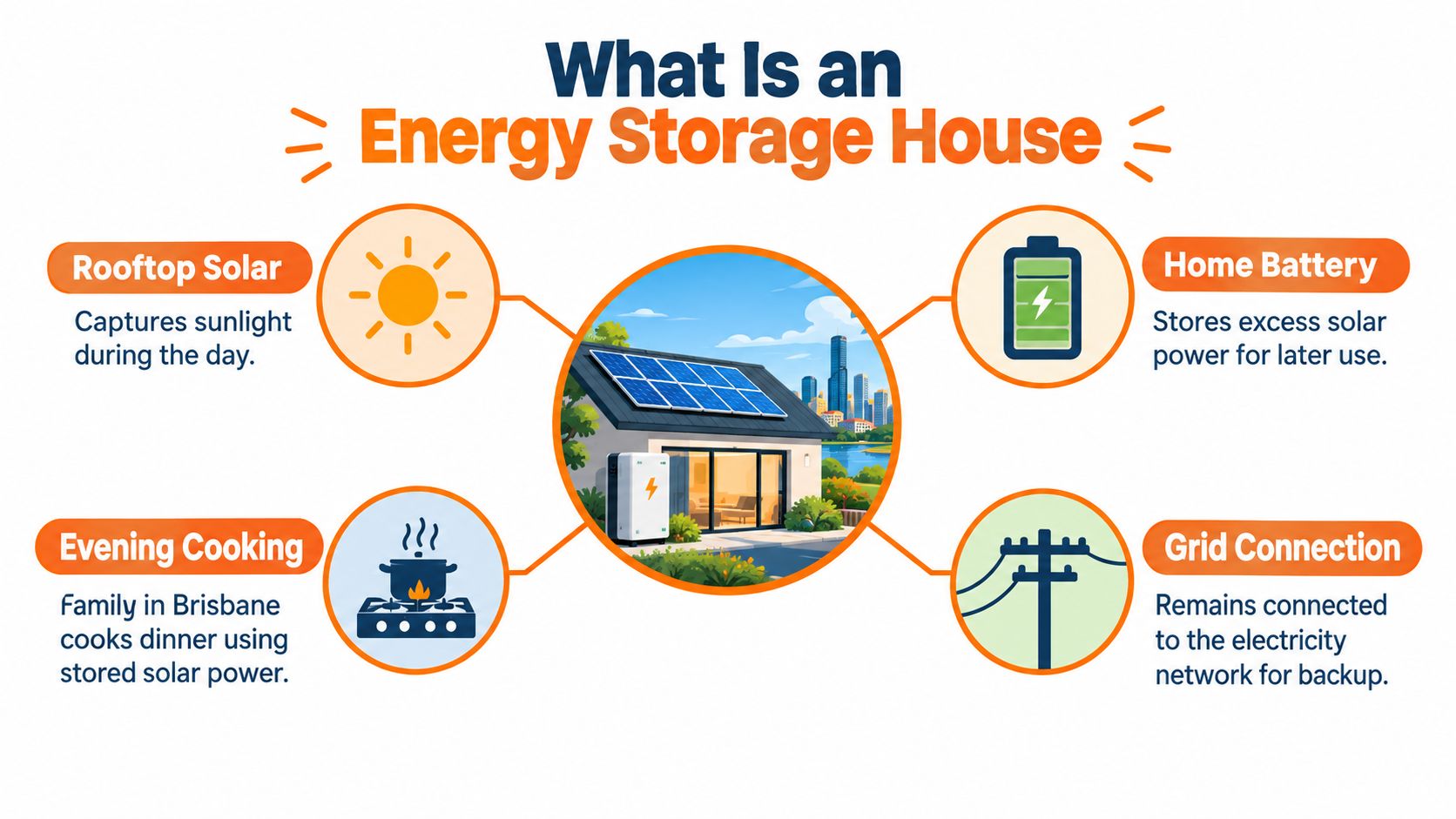
In Brisbane, a family might run the cooktop and lights at dinner time using electricity their rooftop panels generated earlier. The panels aren't producing much after sunset, but a home battery can store surplus daytime generation and supply it later. That simple change turns solar from a resource used mainly while the sun is shining into energy the household can use at a different time.
An energy storage house is a home with rooftop solar, a battery, an inverter and a connection to the electricity network. Solar panels generate electricity. The inverter manages the flow between the panels, battery, home and grid. The battery stores some surplus generation for later use, subject to the system's capacity and operating settings.
Solar-only and solar-plus-storage homes
A home with solar but no battery generally uses solar power as it's generated, with any surplus exported to the grid under its retail plan. After generation falls, the household draws electricity from the network. A home with storage can hold some surplus generation and use it later, reducing the amount of energy it needs to buy at that time.
That distinction matters in Australia because rooftop solar is already widespread. More than 300,000 rooftop-solar systems were added during 2024, taking the national fleet beyond 4 million systems. In the second half of that year, 28.4% of rooftop-solar installations included a small-scale battery, according to the Clean Energy Council's rooftop solar and storage report.
A battery can do more than shift solar
A battery doesn't have to serve only as a household store. If the system is compatible and the owner chooses to participate, a VPP can coordinate available battery capacity with other distributed energy resources. That can allow batteries to respond to grid needs or market conditions, while the household continues to use its own system.
The key is deciding what energy remains reserved for the home and what, if anything, can be made available for grid services. An energy storage house remains connected to the electricity network; the battery adds flexibility rather than replacing the grid connection.
Home Battery Types and System Architectures
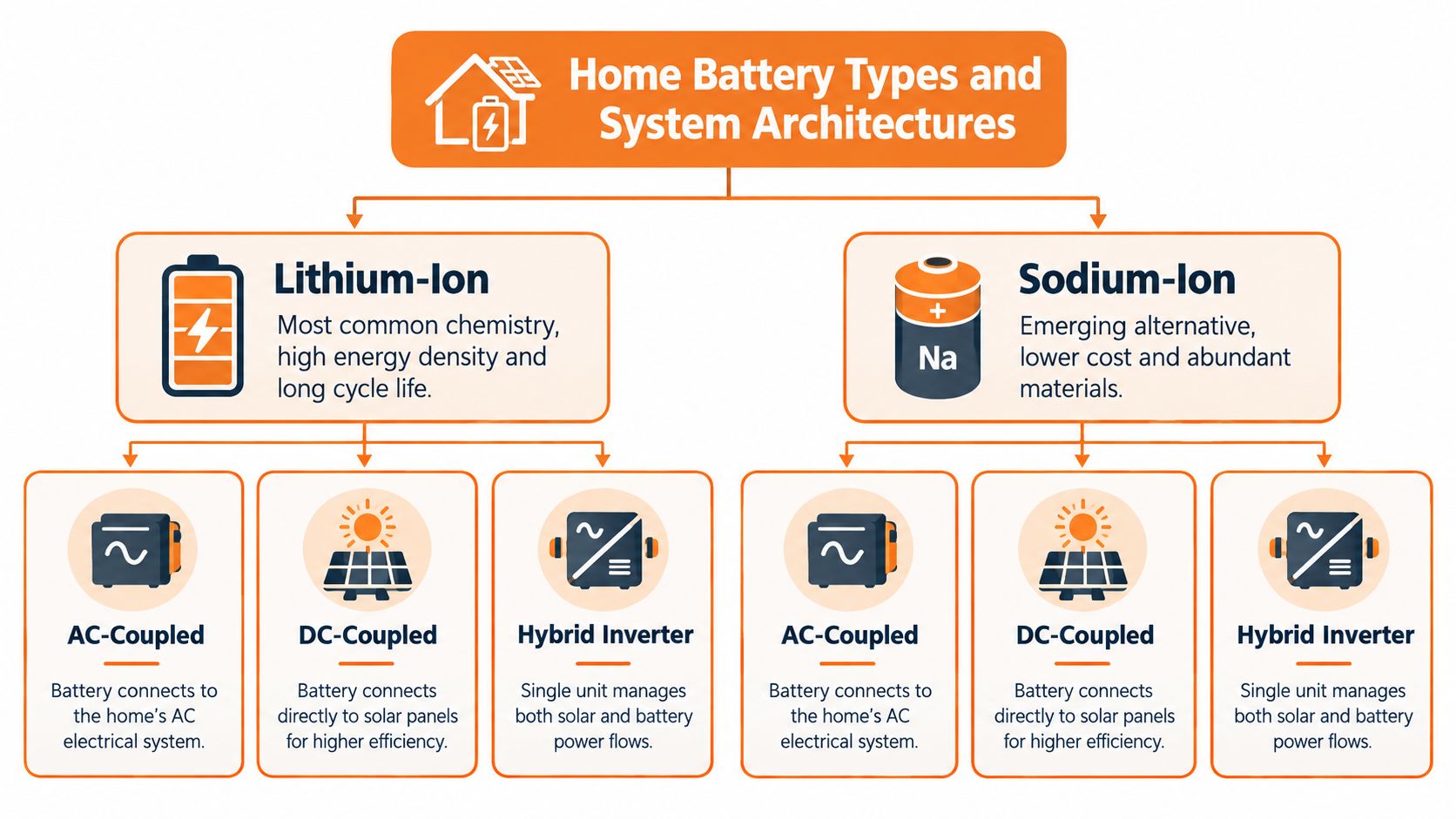
A battery's chemistry describes how it stores energy. Its system architecture describes how the battery connects to solar panels, the inverter and the rest of the home. These are separate questions, and both matter when you're checking whether a system suits your household or can participate in a VPP.
Lithium-ion batteries are common in residential storage systems. Sodium-ion is an emerging alternative. The exact characteristics of any system depend on its product design, inverter and approved configuration, so homeowners should compare manufacturer documentation rather than assume that chemistry alone predicts suitability.
AC-coupled, DC-coupled and hybrid systems
In a DC-coupled system, the battery connects on the direct-current side of the solar installation. An AC-coupled battery connects through the home's alternating-current electrical system. A hybrid inverter manages both solar and battery power flows in one unit. Each arrangement has different compatibility and installation considerations, especially when adding storage to existing rooftop solar.
For a plain-language comparison of the two main layouts, see High Flow Energy's guide to DC-coupled versus AC-coupled battery systems.
A battery-only inverter can be used in a retrofit. It charges the battery from an existing solar system and later releases the stored energy when it's useful or economical. The Australian Government's YourHome rooftop solar guidance also notes that local networks commonly set limits on inverter size and electricity exports.
Why power limits matter
Think of the battery as a water tank and the inverter as the pipe. A larger tank can hold more, but the pipe determines how quickly energy can flow in or out. That means a battery's storage capacity alone won't tell you how much power it can supply at a particular moment.
YourHome states that solar inverters are typically rated at approximately 75–85% of total installed PV-panel capacity. A large panel array therefore doesn't automatically mean the battery can charge at the same rate as the panels generate. Before assessing system performance, check inverter continuous and peak power, AC or DC coupling, phase configuration and the approved export capacity.
Australian inverter requirements are evolving. AS/NZS 4777.2:2020 Amendment 2:2024 includes updates such as generation-limit-control parameters and regional set points. Those settings can affect how a system exports electricity, so a VPP's software must respect the system's approved connection limits.
Benefits of an Energy Storage House
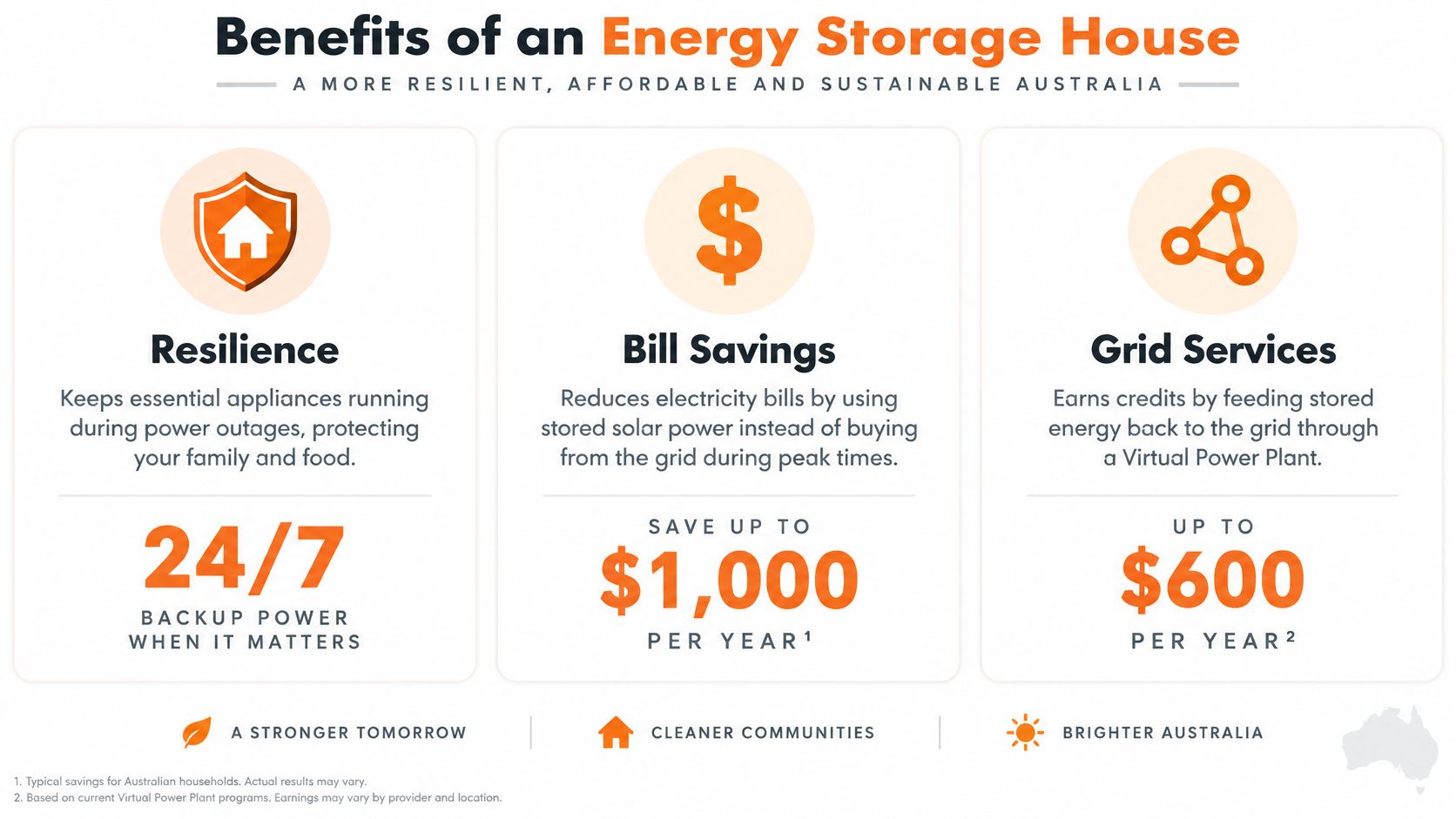
A home battery can create value in several ways, but the results depend on the system, household consumption, electricity plan and operating settings. The main benefits to consider are using stored energy at home, retaining a backup reserve where the system supports it, and making spare capacity available for grid services.
Use more of your own solar
When a battery stores surplus solar power, the household can use some of that energy later instead of buying electricity from the grid. The effect on bills depends on when the home uses electricity, how much solar is available to store, the retail tariff and how the battery is operated. A battery doesn't guarantee a particular bill outcome.
The Australian Competition and Consumer Commission reported that households with solar and batteries had annual bills approximately $329–$909 lower than grid-only customers. It reported savings of about $762–$1,093 for VPP participants, equivalent to 57–63% lower bills, while also noting that fewer than one-quarter of battery customers participated in a VPP. These figures describe reported outcomes, not a guaranteed result for an individual household. The ACCC's findings on battery savings and consumer protections also underline why operating rules and customer protections matter alongside financial incentives.
Keep a household reserve
A battery may support selected household loads during a blackout if the system is designed and configured for backup. That depends on the equipment, the circuits connected for backup and the amount of energy held in reserve. A VPP agreement should make clear how the household reserve is set and how the system behaves when the network is unavailable.
Practical rule: Treat backup capacity as a setting to verify, not an automatic feature of every battery.
Consider grid-service value
A VPP can coordinate batteries to respond to network requirements or electricity-market conditions. Participating households may receive bill credits or direct payments under the program's terms. The value depends on what the retailer offers, how the battery is controlled and what capacity is available after household needs are prioritised.
A useful comparison is not “battery or no battery”. Ask how your system performs under ordinary self-consumption, then compare that with a VPP offer's reserve rules, compensation method and customer controls.
How Solar, Batteries and VPPs Work Together
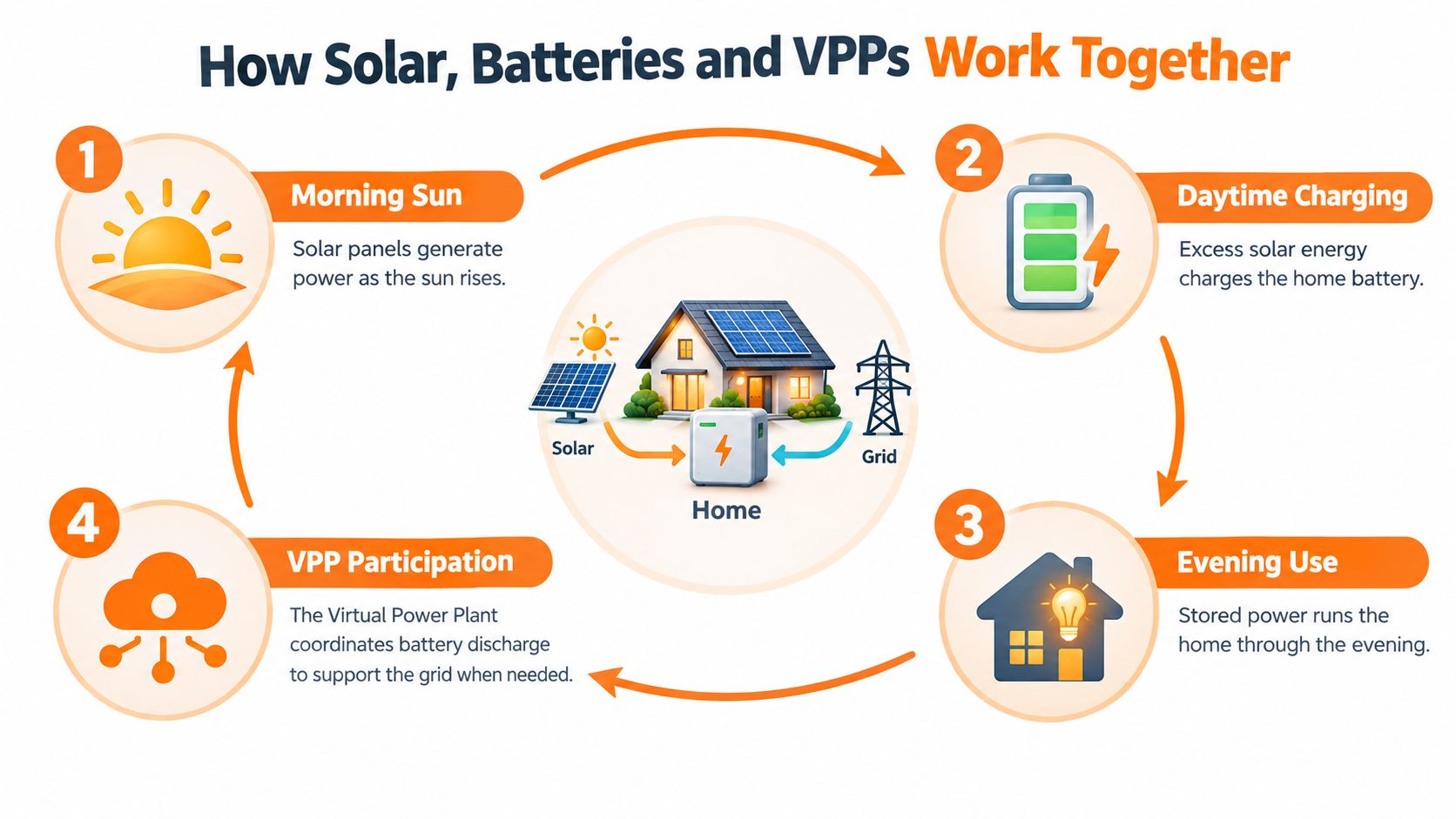
During the day, rooftop panels generate electricity. The home uses what it needs at the time, and the battery can store some surplus. Later, when solar generation falls and household demand continues, the battery can supply some of the home's electricity. What remains available depends on battery charge, system limits and the household's chosen reserve.
A Virtual Power Plant is a network of connected energy resources, such as household batteries, coordinated by software. Instead of relying on one large asset, a VPP can manage many smaller systems as a fleet. The Australian Energy Market Operator's VPP demonstrations tested how aggregated batteries could provide contingency frequency control services, respond to wholesale-price signals and support local networks.
The household-first operating model
A VPP doesn't need to take priority over the home. A household-first arrangement defines a reserve floor for the customer, then makes only eligible spare capacity available for coordinated operation. Software can adjust charging and discharge in response to forecasts, prices or grid instructions, within the system's limits and the customer's settings.
Before joining, check whether you can change the reserve, override automated decisions and see why a charge or discharge occurred. Those details help distinguish an understandable operating plan from a black box.
ARENA reports that more than 73,000 Australian home-battery systems were storing almost 1.1 GW of power when its VPP explainer was published. Its explanation of how VPPs coordinate home batteries describes aggregation as a way to respond to frequency and voltage imbalances, local disruptions and other disturbances. That figure represents home-battery systems, not a claim that every system was enrolled in a VPP.
A separate Australian example is the AGL VPP demonstration in Adelaide. It connected solar-battery systems across 1,000 residential and business premises and used cloud-based control to coordinate them as a 5 MW solar-power equivalent. The AGL VPP project description reports that the systems provided demand-management and voltage-management services to the local network. It demonstrates the technical model, not a guaranteed outcome for a Queensland or New South Wales customer.
For a fuller explanation of the concept, read this guide to what a virtual power plant is.
Cost and Sizing Considerations for Homeowners
Battery sizing starts with household use, not the size of the solar array. Review how much electricity the household typically uses in the evening and overnight, then consider how much solar surplus is available to charge a battery. A system that stores more energy than the home can use or export effectively may not deliver the value its capacity suggests.
Government support has helped increase storage uptake. By January 2026, the Australian Government's Cheaper Home Batteries program, launched in 2025, had supported approximately 200,000 households, small businesses and community organisations, representing about 4.7 gigawatt-hours of battery capacity. The government also reported average battery sizes of 19.6 kWh in New South Wales and 20.7 kWh in Queensland. Its program update provides further detail.
| State | Average battery size | Installations from July to August 2025 |
|---|---|---|
| New South Wales | 19.6 kWh | 15,418 |
| Queensland | 20.7 kWh | 8,572 |
Match the system to the home
Use this sequence when assessing an existing battery or considering a system:
- Review evening demand. Look at when the household uses electricity after solar generation drops.
- Check available solar surplus. The battery can only store energy that reaches it, subject to system design and settings.
- Verify power limits. Confirm the battery's usable capacity and inverter charge and discharge capability.
- Read the network conditions. Distributor export settings can limit how much electricity the system sends to the grid.
- Compare operating options. Self-consumption and VPP participation may use spare capacity differently, so compare the terms and expected operation rather than focusing on battery size alone.
For additional context on capacity and household use, see this guide to solar battery sizes. No sizing estimate should ignore inverter capability, export approvals or the home's actual usage profile.
Regulatory and Compatibility Issues to Understand
A battery doesn't automatically qualify for every VPP. Participation depends on the battery and inverter combination, the system's communications, its response capability and the connection settings approved for the property. The distributor's export limits also matter. A system may need to reduce exports during network constraints, even if the battery itself could otherwise discharge more quickly.
Australian requirements, including AS/NZS 4777.2:2020 Amendment 2:2024, affect inverter settings and generation-limit control. A VPP operator must work within those requirements and the household's connection conditions. Ask how the service handles export limits, system communications and inverter response before agreeing to participate.
Make control and compensation clear
Reported bill savings alone don't explain why a household should trust a VPP with battery control. The ACCC's report, cited earlier, noted that fewer than one-quarter of battery customers were participating despite reported savings. That gap makes the practical terms important: reserve capacity, compensation, privacy, outage behaviour and the ability to override the system.
Before signing up, ask the retailer or VPP operator:
- What stays reserved for the home? Ask how the minimum reserve is set and whether you can change it.
- When can the battery export? Clarify whether dispatch can occur during high-price periods and how your household's needs are prioritised.
- How is compensation calculated? Check whether credits or payments depend on availability, actual dispatch or another defined measure.
- What happens in a blackout? Confirm how backup works for your specific equipment and whether VPP operation changes its settings.
- Can you review or override decisions? Ask what monitoring is available and how you can pause or adjust automated operation.
Ask for the operating rules in writing. A clear explanation of reserve settings, dispatch, compensation and overrides is more useful than a broad promise of savings.
Next Steps for Your Energy Storage House
Start with your current setup. Do you have rooftop solar and a compatible battery, and do you use the battery only for household self-consumption? Review your electricity plan and recent bills alongside your evening usage. That gives you a practical baseline for assessing whether a different operating arrangement could make better use of spare capacity.
Then check the battery and inverter's VPP compatibility, the distributor's connection settings and the retailer's offer. Look for a defined household reserve, transparent compensation, clear export and blackout rules, and the ability to override automated decisions. Don't assume that joining a VPP means surrendering control; confirm exactly what the agreement allows.
High Flow Energy is an Australian electricity retailer offering eligible solar and battery owners a Bring Your Own Battery VPP in Queensland and New South Wales. Its service coordinates spare capacity for grid support while prioritising household needs, with app-based monitoring and controls described by the retailer. Compare the terms with your current plan and system settings before deciding whether it suits your home.
Key Takeaways
- An energy storage house uses a battery to shift some rooftop solar generation to a later time.
- Battery capacity is only part of system performance. Inverter power, connection settings and export limits matter too.
- A VPP coordinates eligible spare battery capacity for grid services, but the household reserve and control rules should be clear.
- Savings and backup outcomes depend on the household, system, retailer plan and operating conditions. Neither is guaranteed by the battery alone.
Frequently Asked Questions
What does an energy storage house mean?
It's a home with a battery that stores electricity, commonly surplus rooftop solar, for use later. If the system is compatible and the owner opts in, it may also participate in a VPP.
Does a home battery mean I can go off-grid?
No. A battery usually works alongside the electricity network. Backup during an outage depends on the system's design, settings and the circuits it can supply.
Does joining a VPP mean the operator controls all my stored energy?
Not necessarily. VPP arrangements differ. Check how much capacity is reserved for your home, when the operator can dispatch spare capacity and whether you can override automated decisions.
Can any solar battery join a VPP?
No. Compatibility depends on the battery, inverter, communications and connection settings. Ask the operator to assess your specific system rather than relying on the battery brand or capacity alone.
What affects how quickly a battery charges?
The available solar surplus, the battery's charge capability, inverter limits and system configuration all affect charging. A large rooftop array doesn't guarantee that the battery can absorb all its output at once.
How do I compare a VPP with ordinary self-consumption?
Compare the operating rules, household reserve, compensation, export conditions and any applicable fees or contract terms. Then assess how each option fits your usage and current electricity plan.
Can a VPP battery help stabilise the grid?
Aggregated batteries can be coordinated to respond to grid and market requirements, subject to technical capability and operating rules. AEMO's demonstration work and ARENA's VPP explanation describe these services, but a particular household's participation depends on its system and program.
If you already have rooftop solar and a compatible battery in Queensland or New South Wales, review whether your current plan is making full use of your system's spare capacity. Visit HighFlow Energy to check eligibility and assess how its household-first VPP operates alongside your existing battery and electricity plan.