

Advantages of Green Energy for Australian Homes
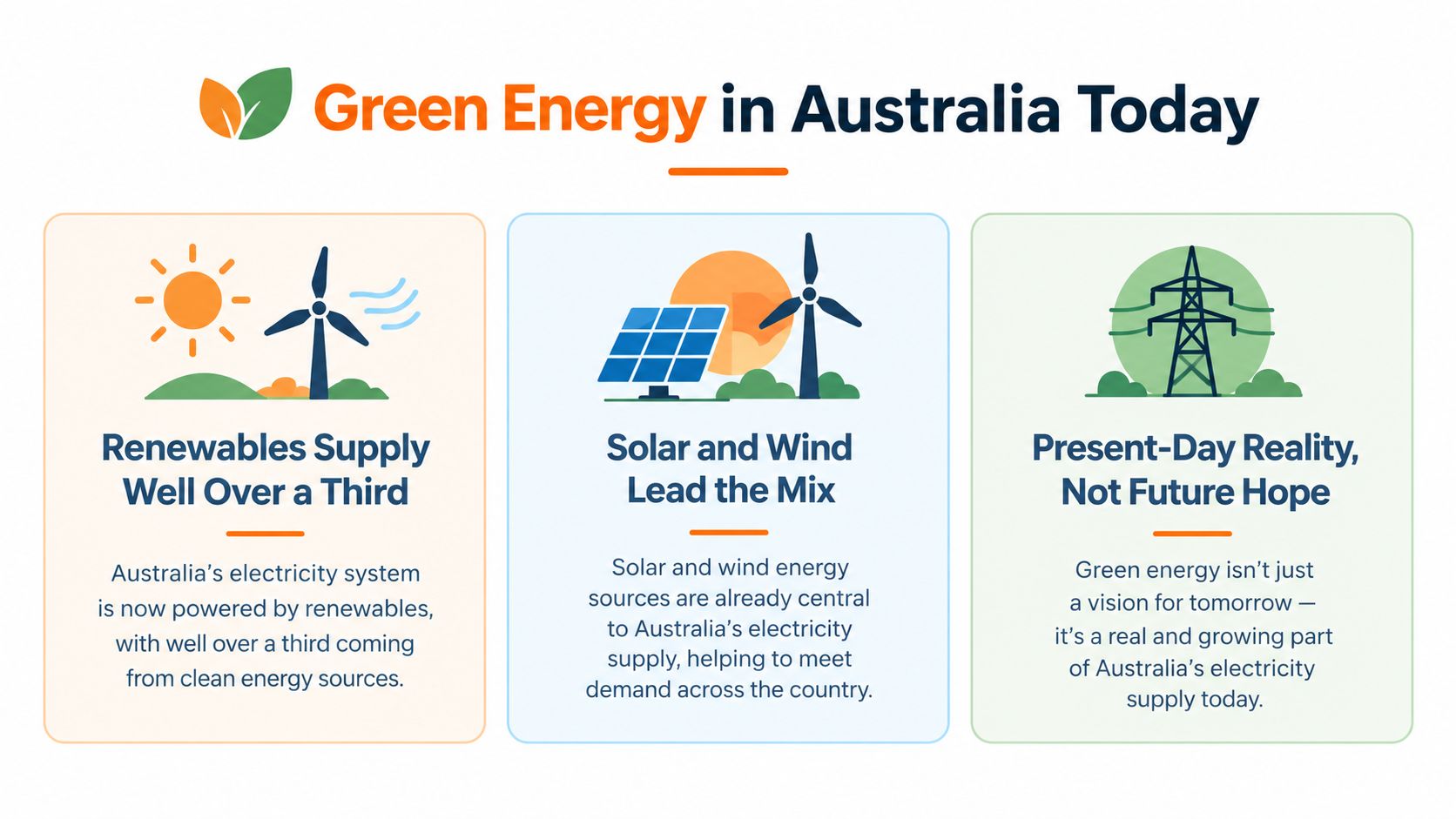
Renewable sources supplied 39.6% of Australia's electricity in 2025, the highest share on record. Solar provided 19.7%, wind 14.0% and hydroelectricity 4.7%, and Queensland and New South Wales each consumed roughly one-quarter of national energy in 2024–25, according to Australian government renewables statistics. Those figures are why the advantages of green energy are no longer a brochure topic. They show up in daytime supply, evening prices and the value of a battery that can shift energy between the two.
Green Energy in Australia Today
Green energy is electricity from sources that replenish and produce very low emissions while they run. In Australia that mainly means solar, wind and hydroelectricity, plus rooftop systems on the same wires as large power stations.
The 2024 volumes show the climb behind the latest record. Renewable sources generated an estimated 102,403 gigawatt-hours (GWh), equal to 36% of national generation, one percentage point above 2023. Total generation rose 3% to about 283,920 GWh. Renewables were already 35% in 2023, against 29% in 2020. Queensland and New South Wales each accounted for about 24.5% of Australia's energy consumption in 2024–25, so both states weigh on emissions and on renewable demand (electricity generation statistics).
Stored renewable electricity can move toward higher-demand hours instead of being curtailed or exported when it is worth little. The useful question is how much value that creates, and where a household fits.
Four advantages follow, and each needs Australian evidence.
- Environmental. Solar and wind avoid fuel combustion while they generate. Siting and land use still decide a large part of the harm.
- Health. Less coal burn means less of the local air pollution that comes with combustion. The gain tracks what is displaced.
- Economic. No fuel cost means less exposure to coal and gas price swings, at system level and, indirectly, on bills.
- Grid. Variable supply needs flexibility. Batteries and coordinated demand turn surplus midday solar into evening capacity.
A rooftop array and a battery don't replace transmission planning. They change how much of the clean generation already on the roof is used when the system needs it.
The Environmental and Health Advantages of Green Energy
Solar and wind have no fuel burn while they generate. Every hour that displaces coal-fired output avoids the stack emissions that hour would have produced. Sulphur compounds, nitrogen oxides and fine particles don't appear as a line on a bill, but they're why air quality belongs beside climate in any serious account of the advantages of green energy.

Cleaner air is a health advantage only to the extent coal and gas run less. New South Wales still carries a historically coal-heavy fleet, so displacing a share of that output reduces combustion pollution at the source. That isn't a count of avoided hospital visits. Overseas studies make those claims. They aren't the dataset used here.
Siting is part of the environmental account
Green projects aren't automatically low impact. Where they're built, and how transmission crosses farms and habitat, decides much of the damage.
A 2025 University of Melbourne and Australian Conservation Foundation analysis found that avoiding development on just 30% of Australia's highest-biodiversity-value land could protect 70–90% of habitat for the most endangered plants and animals, while still leaving substantial land for renewable projects (renewables and nature reporting).
Practical rule: Treat "green" as an operating claim, not a full environmental assessment. Ask where the project sits, what habitat it crosses, and who shares the benefit.
Distributed rooftop solar is the lower land-footprint path because it uses roofs that already exist. New South Wales had about 7.5 GW of rooftop-solar capacity and Queensland about 7.2 GW. In the first half of 2025, Queensland added 326 MW and NSW 321 MW. That scale is why cutting a household carbon footprint starts with the array already on the roof.
Batteries don't remove the need for responsible transmission planning. They bring mineral supply, manufacturing emissions and recycling. Rooftop generation plus storage lifts renewable use without requiring every benefit to come from a new large site. It doesn't certify every project as harmless.
A short explainer on how renewable generation changes a power system's emissions profile is worth the time before the cost argument.
The Economic Advantages of Green Energy
Solar and wind have no fuel cost. Coal and gas plants pay for fuel every hour they run, and those prices move. Each extra renewable gigawatt-hour cuts exposure to that volatility. That's a system fact before it's a household story.
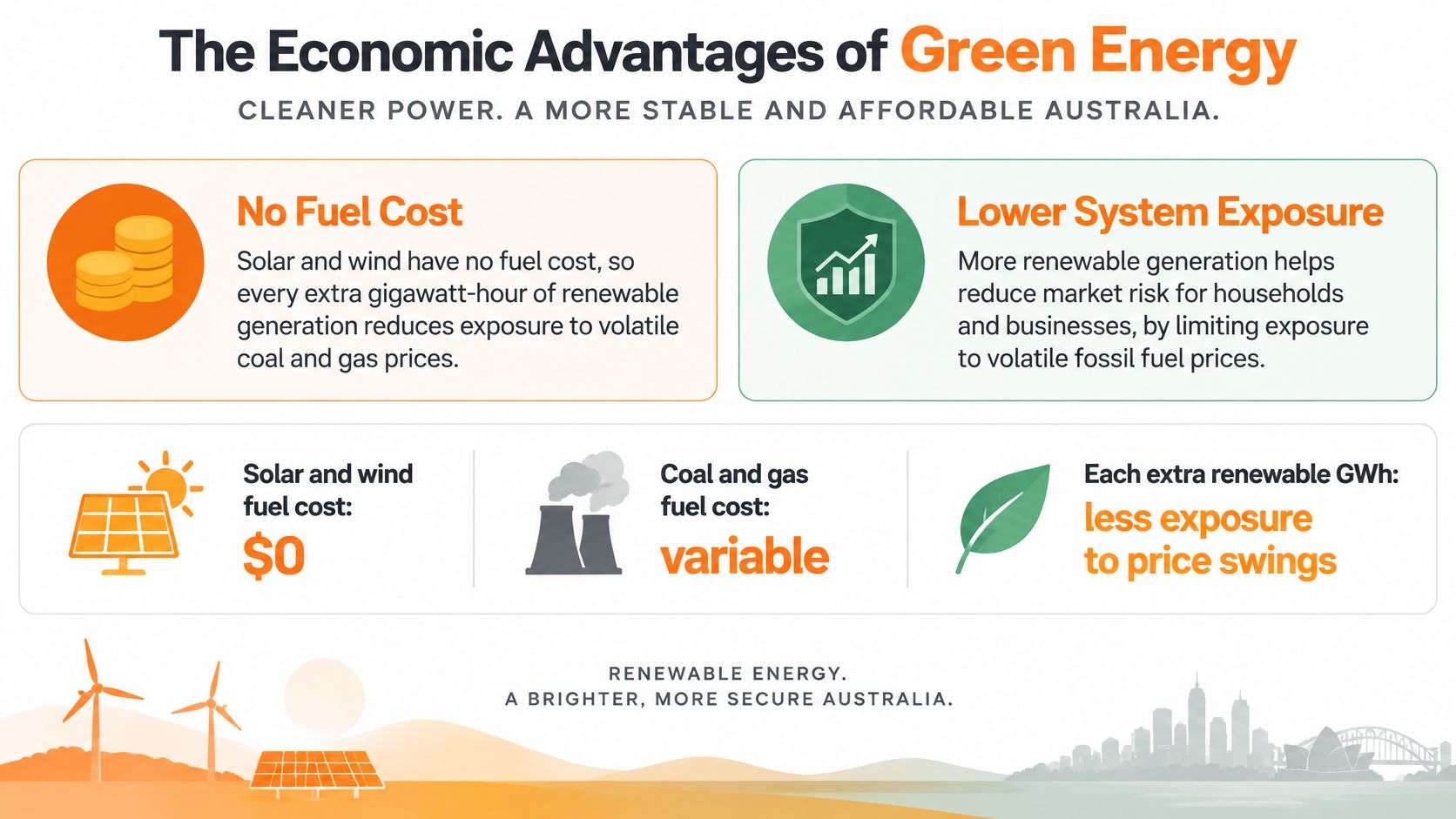
AEMO's 2024 Integrated System Plan identifies renewable generation, connected through transmission and distribution and backed by storage and limited gas, as the lowest-cost pathway for homes and businesses on the way to net zero. The National Electricity Market includes both Queensland and New South Wales, so that pathway is the planning context for both states.
CSIRO's final 2024–25 GenCost report found the same combination remained the lowest-cost option for new-build electricity. Large-scale battery costs fell 20% during 2024–25. Large-scale solar photovoltaic costs fell 8% in each of the two years before that (GenCost final report).
What households actually feel
Wholesale pressure doesn't map one-for-one onto a retail bill. Network charges, retail margins and the tariff sit in between. Two household effects are still real. Self-generated solar offsets imports while you're using power. A battery extends that offset into the evening, when wholesale prices and grid stress are often higher.
A green tariff isn't the same thing as a flexible battery. Generation cuts fuel exposure. Storage decides whether cheap midday energy is still there at 7pm.
- Fuel exposure: More renewable generation means less of the system's energy is priced off coal and gas.
- New-build cost: On CSIRO's comparison, renewables plus storage and transmission beat other new-build options.
- Timing: A battery moves rooftop solar toward the hours when imports cost more.
- Limits: Export limits, tariff design and cycle count all change the result. Solar battery payback is a calculation, not a slogan, and no single figure fits every home.
Falling storage costs make the evening shift cheaper to own than it was recently. They don't promise a bill will disappear.
How Green Energy Strengthens the Electricity Grid
More renewables don't automatically mean a weaker grid. Uncoordinated solar can. Coordinated storage changes the engineering.
Queensland and New South Wales show the pattern. High rooftop penetration produces local export congestion and low daytime net demand, then a sharp evening ramp as solar falls and household load rises. A battery on an orchestrated platform can respond in seconds to price, forecast and grid conditions. A new central generator can't.
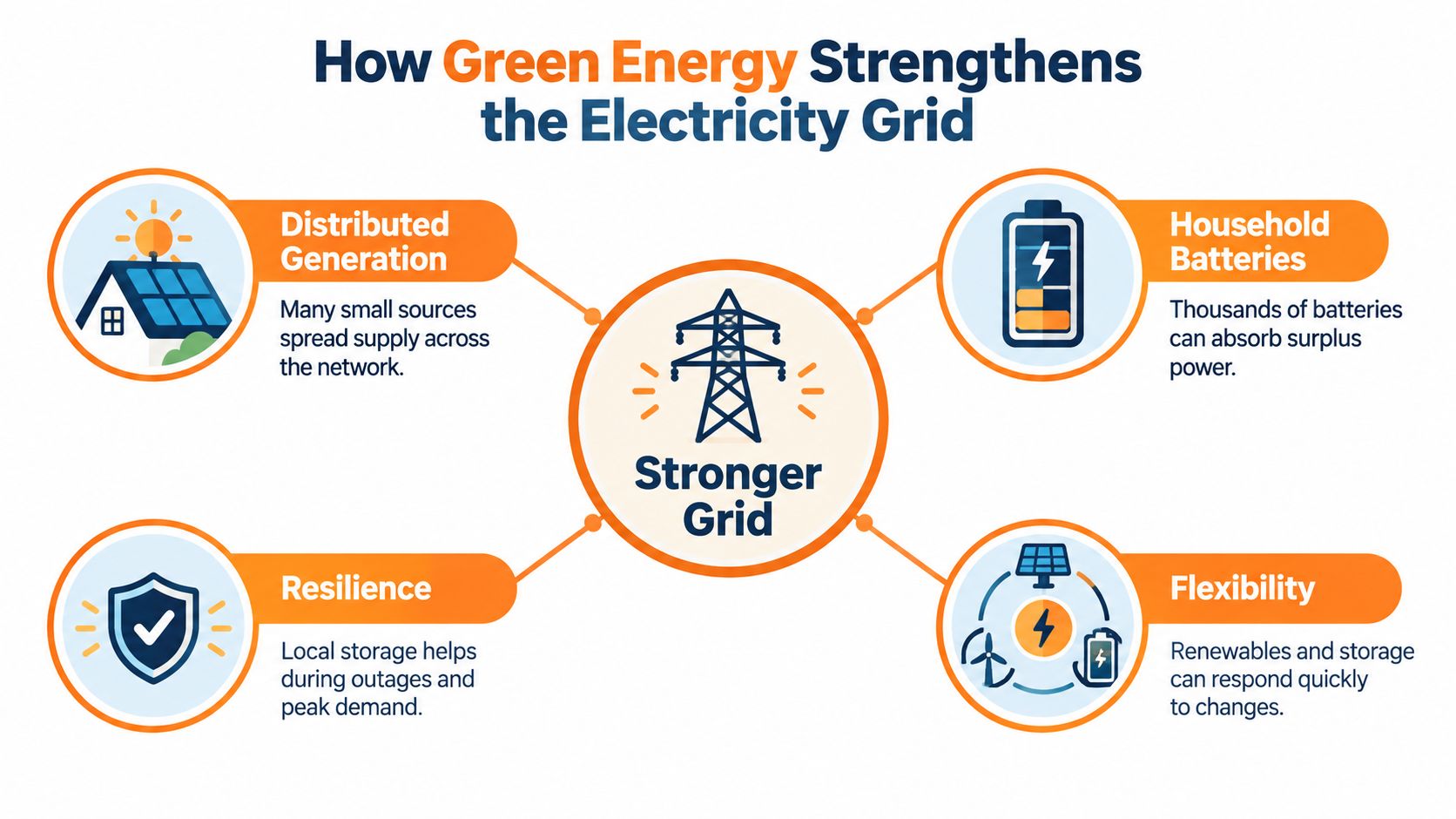
Consumer energy resources are the equipment behind the meter that can be coordinated: rooftop solar, household and community batteries, electric vehicles, hot-water systems and pool pumps. Aggregation means those devices are scheduled together so they behave like one fast fleet, while each home keeps operating limits and a state-of-charge floor.
AEMO estimates that well-orchestrated consumer energy resources could avoid up to A$4.12 billion in extra utility-scale storage spending across the NEM (ISP social licence appendix). Thousands of batteries absorb surplus midday solar, cut imports on the evening peak, and offer controlled export or reserve when the network asks. That can defer reinforcement and large storage. It doesn't require another generator in the driveway.
What coordination changes on a normal day
- Midday: Solar that would have been constrained can charge batteries instead of pushing a congested feeder.
- Evening: Discharge covers household load first. Spare capacity can then support the ramp.
- A tight interval: The fleet moves in seconds. Traditional plant investment moves in years.
Spare capacity only helps the grid if the house still has a reserve. Coordination that drains the battery before dinner isn't flexibility. It's a bad contract.
AEMO describes coordinated consumer resources as able to support reliability and security, lower costs and cut emissions. How local network planning affects export shows why feeder limits decide what a battery is allowed to send out. The grid advantage is an operating result, not an opinion.
Green Energy Advantages in Action
It's 11am in a Brisbane suburb. The array is covering the fridge, a laptop and the pool pump, and it's still producing more than the house uses. Without storage, that surplus leaves through the export limit at whatever the feed-in rate is. With a battery, the same kilowatt-hours stay on site.
By 6:30pm the panels are done. Cooking and cooling pull the load up. The battery discharges into the house, so the home imports less while the NEM is usually tightest. The emissions gain is the coal or gas that didn't cover that slice. The bill gain is the import that didn't happen. The air-quality gain is shared and indirect: less combustion somewhere on the Queensland system, not a private filter.
When the fleet is asked to move
On a high-demand evening the same battery still holds spare charge above the reserve the household set. A coordinated program discharges a portion across thousands of homes. The street doesn't go dark. The owner keeps the reserve. The grid sees a fast cut in peak draw, which a battery used only for self-consumption never provides on its own.
NSW has a different backdrop. Its fleet has long been coal-heavy, and rooftop solar now sits beside it as a large parallel supply. A Western Sydney home on a bright day does the same physical job as the Brisbane house. It diversifies afternoon supply, then uses stored energy when coal units would otherwise ramp.
Emissions, cost, air and grid all show up inside that ordinary day. None of them requires a new panel on a new paddock. The household that can see the sequence, surplus at midday, stored energy at dusk, a reserve held back for the house, can judge whether its own battery is doing all three or only the first.
How Solar and Battery Owners Amplify the Advantages
The financial advantage now sits in flexibility, not in generation alone. Once daytime demand is met, leftover solar is only worth the feed-in tariff unless something stores it and releases it when prices and grid stress are higher.
Rooftop solar supplied 15,463 GWh, or 12.8% of Australia's electricity, in the first half of 2025. More than 14,200 battery systems were installed with rooftop solar in that period. After batteries joined the Small-scale Renewable Energy Scheme on 1 July 2025, 43,517 batteries totalling 825 MWh had been installed or recorded by the end of August, including 15,418 in NSW and 8,572 in Queensland (Australian Energy Council solar report, Q2 2025). A large share of that capacity sits idle after dark if it only chases self-consumption.
Three setups, three uses of the same roof
| Setup | How Your Energy Is Used | Grid Contribution | Typical Bill Impact |
|---|---|---|---|
| Solar only | Daytime loads covered, surplus exported at the feed-in rate | Uncontrolled export, which can add to midday congestion | Daytime import savings, full evening imports |
| Solar plus battery, self-consumption | Surplus charges the battery, discharge covers evening home load | Little coordinated support | Lower imports and backup if it's sized for it, no grid-service income |
| Solar plus battery in a VPP | Home load first, spare capacity scheduled for peaks | Fast, aggregated response within export limits | Self-consumption plus a share of grid-service value, if the contract passes it through |
A virtual power plant is a retailer or aggregator controlling many batteries under agreed limits. A bring your own battery model doesn't sell hardware. It enrols the system you already own.
HighFlow Energy runs that model as an electricity retailer for existing solar and battery owners in Queensland and New South Wales. Spare capacity supports the grid, and the value from those services funds a monthly bill-free electricity allowance. Household use stays first. There's no lock-in contract and no exit fee. Results still depend on how you use power, battery compatibility, export limits and the share of value the contract pays you. Read the control rights, minimum reserve, fees and exit terms before you enrol, and get warranty treatment in writing.
Roof work can interrupt the strategy. The Commercial Roofers guide to solar removal sets out what has to happen to panels before a roof is repaired, which matters if the battery plan assumes the array stays in place.
Judge a battery on more than backup. If self-consumption is the only metric, the flexibility value stays with the market, not the household.
The Bottom Line on Green Energy Advantages
Key takeaways
- Green energy already supplies well over a third of Australian electricity. It isn't a side supply.
- On Australian cost modelling, renewables backed by storage and transmission are the lowest-cost way to build new generation.
- Paired with coordinated batteries, that supply can firm the evening ramp instead of worsening it.
- At household level, the extra value is flexibility: stored solar used when imports and grid stress cost more, not only while the sun is out.
Most battery owners focus on installation quality. Far fewer focus on ongoing performance and optimisation. The asset can be technically sound and still financially underused if it never responds to price or to a demand event.
If you already have rooftop solar and a compatible battery in Queensland or New South Wales, an eligibility assessment is the practical next step. It shows whether grid participation could add an allowance on top of self-consumption, with household priority kept, and with no lock-in and no exit fees. HighFlow Energy is an electricity retailer built around that job. It doesn't sell panels or batteries. It works with the system already on the wall.
Common Questions About Green Energy
Can green energy run a home at night or on a cloudy day?
Not from the panels alone. At night the array is idle, and cloud cuts output. A battery covers part of that gap from energy stored earlier, and the grid covers the rest. Reliability comes from the combination, not from treating solar as firm power on its own.
Does joining a VPP mean you lose control of the battery?
No, not in a properly governed program. Household loads stay first. You should have a minimum reserve and the right to override a scheduled discharge. If the contract doesn't say who controls the battery, when, and what charge level is protected, don't sign it.
Are bill savings from green energy guaranteed?
No. Savings depend on your usage, your tariff, export limits and how the battery is cycled. A feed-in rate, a self-consumption battery and a VPP allowance are three different mechanisms. None of them removes a bill by default if you use more than the allowance or the stored energy.
How do feed-in tariffs compare with VPP value?
A feed-in tariff pays for exports, often at a low daytime rate. A VPP tries to earn by shifting spare battery capacity into higher-value intervals and sharing that value. For an owner who already has a battery, the feed-in tariff ignores most of the battery's flexibility. The VPP only helps if the contract is clear on control, fees and the share you keep.
Do I need new hardware to take part?
A retailer bring-your-own-battery VPP uses the solar and battery you already own, if the battery is compatible and the site's export limits allow it. You still want installer details and the warranty position checked before anyone sends control signals to the inverter.
HighFlow Energy is an Australian electricity retailer for homeowners in Queensland and New South Wales who already have rooftop solar and a compatible battery. Its bring-your-own-battery virtual power plant uses spare stored energy for grid support and applies that value as a monthly bill-free electricity allowance, with household needs kept first and no lock-in or exit fees. If you want to see whether your battery is earning what it could, check your eligibility at HighFlow Energy.