


Energy Retailers Australia: Who They Are and How to Switch
Residential rooftop solar capacity in the National Electricity Market exceeded 20 gigawatts in 2024, about 25% of registered generation capacity, according to the Australian Energy Regulator's market overview. Households are no longer only buying electricity. Many now generate it, store it and decide when to draw from the grid.
For homeowners comparing energy retailers in Australia, that changes the question. The best offer isn't necessarily the one with the biggest export credit. It's the one that produces the strongest overall result after supply charges, network costs, tariff timing and battery access are accounted for.
Who the Major Energy Retailers Are in Queensland and NSW
Origin Energy, AGL Energy and EnergyAustralia are classified by the AER as Tier 1 retailers. Together, they held 73% of residential electricity market share in NSW and South Australia combined, compared with 50% in Queensland in 2023–24, according to the AER's Annual Retail Market Report. The report records 68 authorised electricity retailers, of which 52 actively sold electricity to 6,895,249 residential customers across the jurisdictions it covered.
The 73% figure combines NSW and South Australia, so it does not represent NSW's share alone.
Major energy retailers and their market position
The market shares below describe the Tier 1 group collectively, not each retailer individually.
| Retailer group | AER tier | Residential position (2023–24) | First check |
|---|---|---|---|
| Origin Energy | Tier 1 | Part of Tier 1 group: 50% in Queensland; 73% in NSW and South Australia combined | Plan type and network area |
| AGL Energy | Tier 1 | Part of Tier 1 group: 50% in Queensland; 73% in NSW and South Australia combined | Plan type and network area |
| EnergyAustralia | Tier 1 | Part of Tier 1 group: 50% in Queensland; 73% in NSW and South Australia combined | Plan type and network area |
| All other authorised retailers | Tier 2 | Other authorised retailers | Whether they offer a VPP or battery program |
A retailer's brand does not tell you how its offer will work with a battery. Check whether the plan coordinates battery use, pays for grid support or reserves stored energy for your household.
A battery-compatible electricity plan and an actively managed Virtual Power Plant, or VPP, are different arrangements. Review the specific plan and program terms before comparing offers.
Retail choice is also a location question
Your distributor is separate from your retailer. Queensland households are served by Energex or Ergon Energy, while NSW network areas include Ausgrid, Endeavour Energy and Essential Energy. Network area affects the charges and offer terms relevant to your account.
Most feed-in tariffs are set voluntarily by retailers. Regional Queensland's government-set tariff was 8.66 cents per kilowatt-hour from July 2025, according to the CSIRO solar and battery projections published by AEMO. The report also discusses dynamic pricing and connection trials involving Energex and Ergon Energy, and export-related pricing affecting Ausgrid customers through retailer arrangements.
Customer portals can help households track accounts and usage. Kogifi's resource on digital experiences for utility customers offers context for assessing those tools, though interface quality alone does not establish the value of a battery offer.
Practical rule: Compare a retailer's total annual cost against your network, consumption pattern and battery dispatch terms. The size of the retailer does not determine the value of the offer.
What Your Electricity Bill Actually Pays For
Cost layers in a retail bill
| Bill component | Approximate share of the 2025–26 DMO bill | What the retailer controls |
|---|---|---|
| Wholesale energy | 33%–41% | Hedging and contract purchasing |
| Network charges | 33%–48% | Retail treatment of regulated charges, not the underlying network determination |
| Retail costs and margin | Included in the remaining balance; not separately quantified here | Operating costs and margin |
| Environmental schemes | Included in the remaining balance; not separately quantified here | Compliance arrangements and recovery through offers |
The AER's retail energy markets chapter puts wholesale costs at approximately 33%–41% and regulated network costs at approximately 33%–48% of 2025–26 Default Market Offer prices, and reports network-component changes ranging from a 6.8% reduction for Energex to an 11.1% increase for Endeavour Energy.
Those ranges describe different cost settings. Don't add their upper bounds together or treat them as the composition of one household's bill.
The cost breakdown illustrates why wholesale electricity is only part of what you pay.
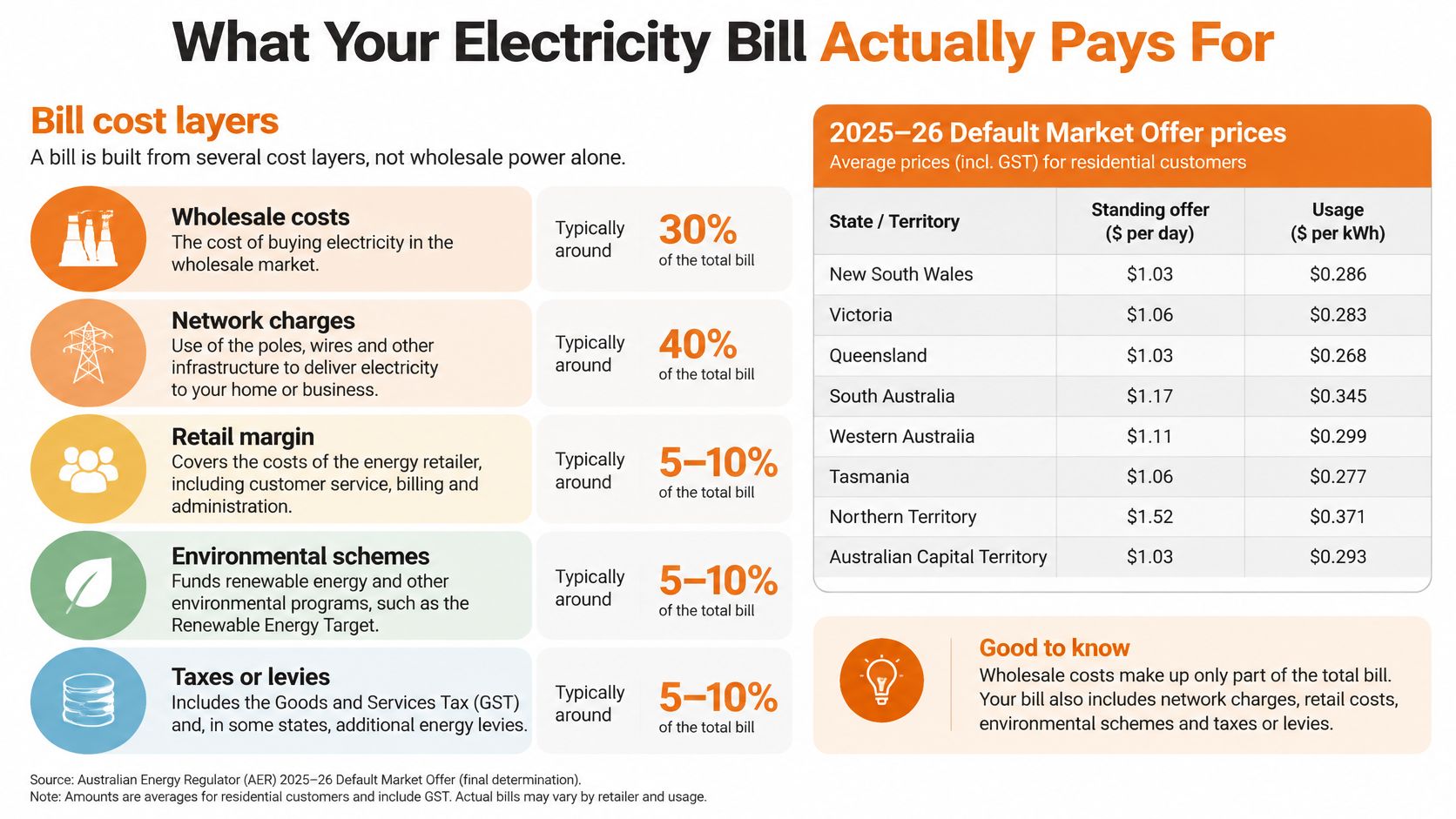
Network costs fund poles, wires, operation, maintenance and regulated network returns. Retailers incur these costs on customers' behalf and recover them through electricity offers.
A retailer can change how it packages those costs, including whether an allowance absorbs them. It can't make the underlying network obligation disappear by advertising cheap wholesale energy.
Why the same credit produces different outcomes
The Energex and Endeavour contrast shows why a uniform allowance needs location-specific modelling. Two households with similar annual consumption can face different underlying costs because their network areas, tariff assignments and timing of imports differ.
Network cost components also aren't necessarily displayed as separate lines on a retail bill. They may be embedded in usage rates, daily charges or demand charges.
Pull these inputs from your bill and tariff documentation:
- Daily supply charge: Record the cents-per-day amount, even if grid imports are low.
- Usage rates: Capture each applicable time band, not just an average price.
- Network tariff code: Request it if it isn't printed on the bill.
- Distributor and NMI: Use these to identify the connection and network area.
- Allowance exclusions: Identify excess-usage rates and any charges outside the allowance.
Our guide to the cost of electricity provides further context for reading these components.
Compare total annual cost using the same household usage for every offer. A credit only improves the result by the amount it offsets after all applicable charges are included.
Tariffs and Offers That Change Battery Value
| Tariff type | How it charges | Battery optimisation priority |
|---|---|---|
| Flat tariff | The same usage rate throughout the day | Replace grid imports with stored solar |
| Time-of-use tariff | Different usage rates across specified periods | Preserve energy for expensive import periods |
| Demand tariff | Adds a charge linked to maximum recorded demand during a defined period | Limit qualifying import peaks |
The NSW retail electricity tariff reforms consultation paper explains these tariff structures and the relationship between distributor-assigned network tariffs and retailer billing.
The distinction changes how you should assess battery dispatch. Under a flat tariff, moving grid purchases between hours doesn't itself create a usage-rate saving. Under time-of-use pricing, preserving stored energy for an expensive period can be more valuable than discharging it earlier.
Avoided retail charges versus wholesale arbitrage
Wholesale arbitrage means buying or storing energy when wholesale prices are lower and selling when they're higher. That can create value for a VPP operator, but the household outcome must also account for the electricity the battery could otherwise supply at home.
Suppose a battery exports during a dispatch event, then the household imports during an expensive evening period. The export payment isn't the net benefit. The replacement import cost must be deducted.
Demand tariffs add another complication. Battery capacity helps only if the controller can limit imports during the intervals used to calculate the demand charge.
A profitable grid dispatch isn't automatically a profitable household dispatch.
Read the offer and the control strategy together
A standing offer provides a default retail arrangement, with the Default Market Offer acting as a price cap where applicable. A market offer has retailer-specific prices and conditions, so review its feed-in terms, discount requirements and any applicable exit provisions.
Our explanation of electricity tariff structures can help you identify which charging mechanism applies.
A capable control strategy should consider load forecasts, solar output, battery power limits, usable capacity, export constraints and minimum state of charge. Wholesale price volatility is only one input, particularly where network congestion or connection limits restrict exports.
Before accepting an offer, establish:
- Cheap periods: When can the battery charge economically, including all applicable charges?
- Demand exposure: Which measured import peak determines any demand charge?
- Household reserve: What energy remains available for evening consumption?
VPP and Battery Checks Before You Switch
The trade-off headline rewards can leave out is the value of battery access surrendered by the household. Payments can be offset by lost self-consumption, changed tariffs, additional cycling or reduced energy available later.
An IEEFA submission to the AEMC raises concerns about insufficient VPP transparency and batteries being operated for the operator's benefit rather than the consumer's. Those concerns make written dispatch terms central to an energy retailer comparison.
A connected battery needs both technical compatibility and clear operating permissions.

What participation requires
A Virtual Power Plant coordinates behind-the-meter batteries so they can respond to grid conditions. The Clean Energy Regulator's VPP guidance explains that participation requires an ongoing internet connection, communication with an operator or aggregator, and suitable technical access, which can include site-controller hardware or software.
Owning a battery doesn't establish eligibility. Nor does VPP capability mean every program can communicate with that battery.
The Australian Government's Consumer Energy Resources Roadmap update%20Roadmap%20Implementation%20Plan%20Update%20August%202025.docx) reported more than 320,000 battery installations, approximately one for every 30 households, and stated that VPP capability became a requirement for batteries subsidised through the Cheaper Home Batteries Program, launched on 1 July 2025. Capability and actual participation remain separate questions.
Battery and VPP checks before switching
| Check | Why it matters | Question to ask |
|---|---|---|
| Inverter and site compatibility | Participation requires compatible communications and controls | Is my inverter on your compatible list? |
| Internet connection | Remote dispatch needs an ongoing connection | What happens if the connection drops? |
| Reserve for household use | Dispatch can reduce energy available later | What minimum state of charge do you hold? |
| Override rights | Household priorities need enforceable controls | Can I override dispatch at any time? |
| Dispatch frequency | Additional cycling can affect wear and warranty conditions | How many dispatch events are expected, and does my warranty still apply? |
| Net value | Grid payments can be offset by lost self-consumption | Is the allowance shown net of lost self-consumption? |
An outage reserve is useful only if the installation has the equipment and configuration to supply backup loads. Don't confuse stored energy with confirmed backup capability.
Physical safety is a separate assessment from financial performance. Knight Tek's explanation of why lithium-ion batteries explode offers safety context, while your manufacturer's instructions remain the reference for your equipment.
This video provides additional context for considering VPP participation.
Know who provides the regulated service
VPP participation doesn't transfer ownership of your battery to the grid. A well-structured arrangement documents household priority, reserve settings and override rights rather than leaving them to assumption.
The Energy Innovation Toolkit's VPP regulatory guidance identifies applicable electricity laws, rules, authorisation requirements and market participation obligations. Commercial rewards don't replace these responsibilities.
HighFlow Energy is a customer-facing electricity brand. Electricity retail, billing, compliance and market services are provided by ERC Energy Pty Ltd, an authorised Australian electricity retailer trading under the HighFlow Energy brand.
Feed-in Tariffs Versus VPP Value and Common Misconceptions
A feed-in tariff compensates exported electricity. A VPP arrangement can combine export income, grid-service value and changes to household electricity costs, but those benefits need to be separated before they're added together.
The AEMC's wholesale demand-response review consultation paper describes a framework for aggregated resources, including VPPs, to offer dispatchable demand response into the National Electricity Market. That creates a potential revenue pathway, not a promise about what any particular household will receive.
| Comparison point | Traditional feed-in offer | VPP arrangement |
|---|---|---|
| Main value measure | Credit for eligible exported energy | Contractual rewards or allowances plus changes to import costs |
| Battery control | Assess separately from export pricing | Operator access governed by participation terms |
| Main hidden trade-off | Higher import or supply charges can offset export credits | Dispatch can displace household use and add cycling |
| Best test | Annual bill after export credits | Annual bill after rewards and dispatch consequences |
Calculate household value without double counting
Use a complete year of interval data to capture seasonal differences. Model the battery's behaviour, not just annual export volume.
- Establish the baseline. Estimate imports, exports and solar self-consumption under your current arrangement.
- Apply the alternative terms. Recalculate usage charges, supply charges, export credits and any allowance under the proposed offer.
- Deduct displaced benefits and added costs. Include replacement imports after dispatch, changed network exposure and a reasonable allowance for incremental battery wear.
Don't count the same stored energy as both a household saving and an export earning. It can only be used once.
Common misconceptions
- A higher feed-in rate always wins. It can be outweighed by less favourable import rates, supply charges or export conditions.
- A VPP means the grid owns the battery. Ownership remains with the customer; operational access is a contractual permission.
- A VPP eliminates every bill. An allowance can leave excess usage or excluded charges payable.
- Every battery earns the same return. Usable capacity, discharge power, tariff, household load and permitted exports affect the result.
The useful comparison is therefore net household value, not the largest advertised payment. A modest reward with protective operating terms can be preferable to a larger reward that causes expensive replacement imports.
How to Choose and Switch Energy Retailers
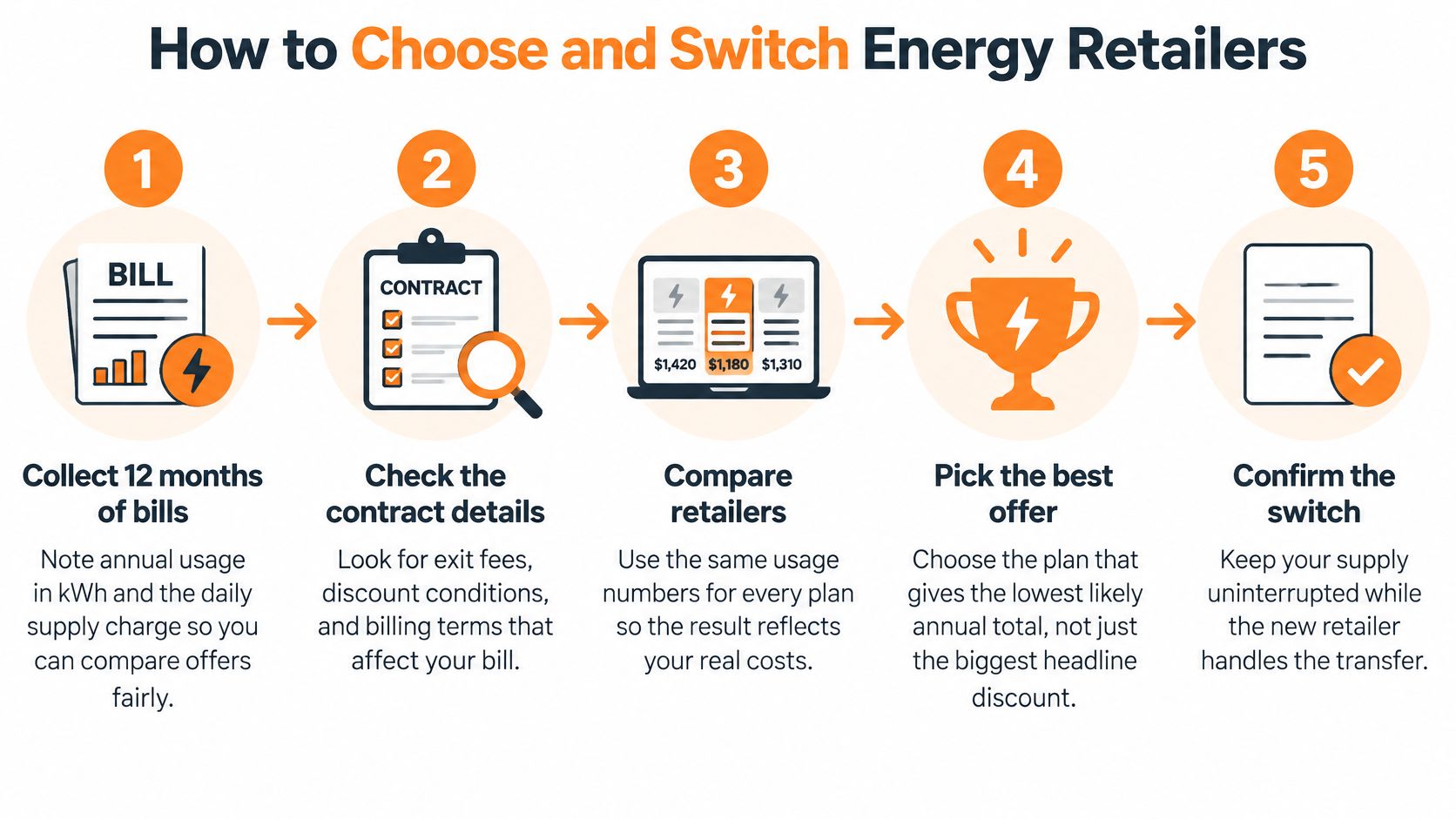
A disciplined switch starts with a reproducible comparison. Save the offer documents and assumptions so you can check the first bill against what you accepted.
The process graphic summarises the decision, while the checks below cover the battery-specific details.
Complete the financial and contractual checks
Collect a full year of bills and interval data. Record annual usage in kilowatt-hours, daily supply charges and the distributor. Seasonal coverage prevents a sunny month from becoming an unrealistic annual forecast.
Confirm the network area and tariff code. Match the proposed offer to your connection, not just your postcode. This avoids comparing prices built for a different network cost base.
Calculate a like-for-like annual total. Use identical consumption assumptions and include credits, allowances and charges outside them. Keep a separate scenario for changed battery behaviour.
Read the contract conditions. Check contract length, exit provisions, discount conditions and whether the offer is a standing or market offer. Our contract cancellation policy is relevant when reviewing the exit position.
Verify battery permissions. Obtain written dispatch limits, reserve settings, override rules and warranty implications. This protects against accepting an electricity price that depends on unsuitable battery access.
Check payment support. At HighFlow Energy, we offer support under our Hardship Policy, along with payment plans and government concessions or rebates. Understanding these options helps you prepare for affordability difficulties rather than responding only after debt develops.
Identify the accountable parties. We manage customer communications, eligibility and the Bill-Free Allowance program, while ERC Energy provides regulated retail services in accordance with Australian energy laws. Keep billing and complaint contact details with your contract documents.
Confirm the transfer arrangements. Ask the new retailer to manage the transfer and confirm the start date, final billing arrangements and treatment of the existing VPP connection. Don't separately cancel essential services without understanding how the transfer will proceed.
Decision standard: A good switch has a defensible annual-cost estimate, understood operating permissions and a clear exit path.
Check the result after transfer
Review the first bill for the agreed tariff, supply charge and credits. Also check that battery monitoring and dispatch permissions match the accepted terms.
If the outcome differs from the model, identify whether the cause is changed household usage, seasonal solar output or an incorrect billing assumption. That makes the review actionable rather than concluding that the battery isn't performing.
Frequently Asked Questions About Energy Retailers in Australia
Who are the major energy retailers in Australia?
Origin Energy, AGL Energy and EnergyAustralia are the AER's Tier 1 retailers. Other authorised retailers fall into Tier 2, which includes businesses with different service models and areas of coverage.
Does switching retailer affect my battery?
It can affect how the battery is operated and rewarded, even though ownership doesn't change. Check whether an existing VPP agreement must end and whether new dispatch permissions affect warranty conditions.
What is a Virtual Power Plant?
A Virtual Power Plant is a coordinated group of distributed energy resources, such as home batteries, operated to respond to grid conditions. The operator communicates remotely with participating equipment under agreed permissions.
Is a higher feed-in tariff always better?
No. Calculate the complete annual bill using your actual imports and exports, including daily supply charges and applicable tariff conditions.
A higher export credit is only useful if the overall result improves.
Do Queensland and NSW retailers offer the same VPP terms?
Not necessarily. Network coverage, equipment compatibility, export permissions and program conditions can differ between offers.
At HighFlow Energy, residential availability covers Queensland and New South Wales, with eligibility assessed for the household and its equipment.
Can a retailer guarantee my bill will be zero?
Don't treat a bill-free label as an unconditional guarantee. A responsible assessment identifies the allowance, included charges, excess-usage treatment and assumptions needed to reach a zero-payable outcome.
Your actual usage and operating conditions can differ from the forecast.
Does VPP capability mean I have to join a particular program?
Capability means the equipment can support suitable coordination, not that every operator must accept it. Confirm the program's compatible equipment and participation conditions before granting access.
Confirm Your Battery Value Before You Switch
Retailer choice changes how your battery interacts with electricity prices and bill credits. Compare the full annual cost using your own usage, exports and tariff details, rather than judging performance by how often the battery charges or discharges.
Key Takeaways
- Retailer size does not show whether an offer suits you. Compare its terms and how battery access is managed.
- Your network area affects the charges on your bill. Check which costs an offer covers and which remain payable.
- Annual totals give a clearer comparison than headline credits. Use your household's interval data and consistent assumptions.
- Battery access has value. Check the written terms for household priority and your ability to override battery settings.
- Bill-free offers have conditions. Usage above an allowance and offer exclusions may leave an amount payable.
Before switching, estimate your total annual cost, check how the offer prioritises household use, and confirm that it covers your connection. Keep your assumptions so you can compare the estimate with your bills after joining.
Why HighFlow Energy
HighFlow Energy's Bring Your Own Battery VPP is for residential homeowners in Queensland and New South Wales who have solar, a compatible battery and ongoing electricity bills. Your household's energy use is prioritised before the battery supports the grid.
The Bill-Free Allowance uses value generated when spare battery capacity supports the grid. It can cover daily supply charges, usage up to the allowance, and network and distribution charges on that portion. Usage above the allowance remains payable under the applicable terms, so eligibility does not mean every future bill will be zero.
HighFlow Energy focuses on connecting existing household batteries to its Virtual Power Plant. Electricity retail services are provided through the authorised framework described above.
For market context, consult the AER on retail markets, AEMO on electricity-system operation and the Clean Energy Regulator on VPP participation. Bring recent bills and equipment details to an eligibility assessment, so the discussion can use your actual electricity performance.
HighFlow Energy connects eligible solar and battery households with a way to earn value from spare battery capacity. Visit HighFlow Energy to request an eligibility assessment and understand how a potential allowance would apply to your household.