


Electricity Spot Price Explained for NSW and QLD Homes
Two cents per kilowatt-hour is roughly what an average negative wholesale interval is worth, before network charges and retail costs reach the meter. AEMO's quarterly energy dynamics reporting puts the average negative interval in the order of -A$20/MWh, about -2c/kWh at the wholesale level, and the phrase "paid to charge" overstates what such an interval delivers to a battery owner. A household on a flat retail tariff does not see that signal at all.
A spot price is a five-minute dispatch signal, not a rate. The value a home battery can capture from it is what remains after charging losses, network charges, tariff terms and the reserve a household keeps for the evening peak. For solar and battery owners in NSW and Queensland, that residual figure decides whether battery optimisation or a Virtual Power Plant suits an existing system, and it is the number worth comparing across electricity plans.
Recent Spot Prices in NSW and Queensland
A$133/MWh was the NEM average spot price in Q2 2024, equal to 13.3c/kWh before network, retail and environmental charges. An electricity spot price is the wholesale price for a single five-minute dispatch interval in the National Electricity Market, quoted in Australian dollars per megawatt-hour. It is not a household electricity rate. To convert A$/MWh into cents/kWh, divide by 10. The Q2 2024 quarterly energy dynamics figures put NSW at A$173/MWh and QLD at A$101/MWh, leaving NSW about 71% higher.
| Period | NEM average | NSW | QLD |
|---|---|---|---|
| Q2 2024 wholesale average | A$133/MWh | A$173/MWh | A$101/MWh |
| Q4 2024 wholesale average | A$88/MWh | A$143/MWh | A$127/MWh |
AEMO's Q3 2025 quarterly report puts the Q2 2023 NEM average at A$108/MWh, the Q4 2024 state averages at A$143/MWh in NSW and A$127/MWh in QLD against A$88/MWh for the NEM, and the Q4 2024 monthly NEM averages at A$51, A$124 and A$92/MWh for October, November and December. In Q4 2025, 31.0% of all NEM regional intervals cleared at zero or below. Within the 09:00 to 17:00 daytime window, negative prices occurred in 60% of NSW intervals and 66% of QLD intervals.
A lower Queensland average does not mean Queensland households avoided expensive intervals. A state can post a lower quarterly average and still have sharp five-minute spikes that hit a household importing at the wrong time. That is why a regional average is background, not a battery dispatch instruction. Your import timing and available battery capacity determine which intervals matter.
Practical rule: Read a quarterly average as context. Check your region, your tariff and the intervals when your household actually imports.
The negative-price shares use different denominators. A share of daytime intervals and a share of all regional intervals describe different windows, so compare them with care.
How the NEM Sets the Spot Price Every Five Minutes
A wholesale electricity auction works like a fruit market with one unusual rule: the last crate needed sets the price for every crate before it. The NEM runs a more complex version of that process across five-minute dispatch intervals, with demand, transmission limits and system security built into the clearing outcome.
The infographic below shows the basic auction logic.
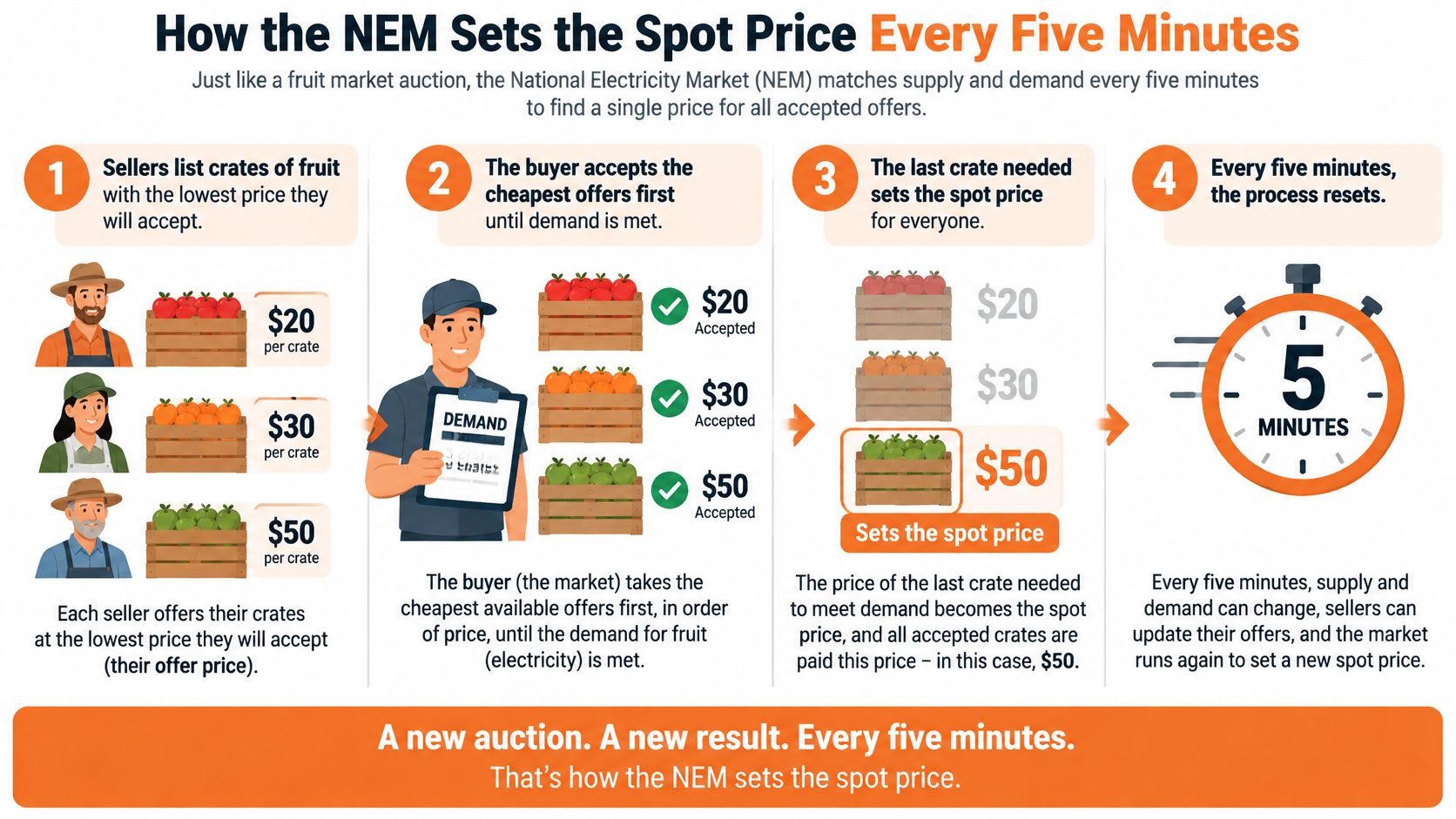
From generator offers to regional prices
The dispatch engine solves the same problem every five minutes: meet forecast demand at the lowest feasible cost without violating network or security limits.
- Generators and batteries offer supply. Coal, gas, hydro, wind, solar and batteries submit offers describing the prices and quantities at which they are prepared to supply. Batteries can also submit offers as electricity consumers when charging.
- AEMO forecasts demand and checks available supply. It also accounts for operating conditions, including transmission availability and the technical limits of generating equipment.
- The dispatch engine selects a feasible supply mix. The cheapest available offers generally enter first, often described as the merit order. Network constraints mean AEMO cannot accept the cheapest offers everywhere.
- The marginal supply requirement helps determine the regional reference price. In an unconstrained, simplified example, that is the price of the last offer needed to meet demand.
Interconnectors allow electricity to move between NSW and Queensland. When transfer capacity is constrained, additional cheaper supply in one region may not be available to meet demand in the other. That is why the two states can post different five-minute prices even when the NEM-wide supply stack looks similar.
Administered pricing isn't the ordinary market ceiling
AEMO's guide to administered pricing specifies an administered price cap of A$600/MWh for energy and market ancillary services, and an administered energy floor of -A$600/MWh. These are administered-pricing limits, not a description of the ordinary spot-price range at all times.
That distinction matters when assessing exposure. A spot-linked household plan can still encounter a wholesale interval above the administered cap outside an administered-pricing period, so the cap is not a household price ceiling.
Negative prices can occur when available supply is abundant relative to demand and suppliers offer electricity below zero. Strong renewable generation and low operational demand can create those conditions.
The video below shows wholesale market operation from another angle.
The core principle is balance: the interval price changes as available supply, demand and feasible network flows change. For a battery, the five-minute price is a signal to act on, not the rate the household receives. Its value depends on what remains after charging and discharging losses, network charges, tariff terms and reserve needs are counted.
What Drives Price Spikes and Negative Prices
Prices move for physical reasons, and the reason behind an interval shapes what a battery can usefully do about it. Extra solar, a failed generating unit and a constrained interconnector all shift the spot price, but each leaves a different amount of time to react. Duration often matters more than magnitude, since a five-minute spike and a long expensive block can carry the same peak price and call for opposite responses.
Price drivers and their usual effect
| Driver | Typical effect on price | When it shows up |
|---|---|---|
| Midday rooftop and utility solar surplus | Prices can fall to zero or below | Daytime, often the 09:00 to 17:00 window |
| Evening demand peak after solar output fades | Prices can rise sharply as supply tightens | Late afternoon into the evening |
| Low demand with strong wind or solar | Negative or near-zero prices become more likely | Mild seasons and mild weekends |
| Generator outage or unplanned plant failure | Potentially sharp, short price spikes | Unpredictably, including within minutes |
| Interconnector or network constraint | Prices can diverge between NSW and Queensland | When transfers between regions are limited |
| Seasonal demand rise as cooling load builds | Monthly NEM averages can step higher | Spring into early summer |
Treat these as mechanisms rather than guarantees. A warm evening produces no spike if enough competitively priced supply and transfer capacity remain available to meet demand.
Why the same average can hide different opportunities
Solar surplus reduces the electricity households collectively need from other generators. AEMO's 2024 Integrated System Plan reported that rooftop systems supplied 13% of total NEM generation in the summer first quarter of 2024. That gives household solar a role in regional pricing, not just in individual bills.
Then the sun sets. Generators and storage must cover the remaining demand, and prices rise if the next available supply costs more. The clock alone doesn't decide the outcome; available capacity does.
An outage is a different problem. Supply disappears without warning, and a battery that has already discharged has little left to sell into the interval, however valuable that interval becomes.
For context on operational events, HighFlow's AEMO market notices page can help distinguish a supply disruption from an ordinary daily pattern. A notice is not a household trading instruction.
Check whether expensive imports cluster in sustained evening blocks, isolated spikes or particular seasons. A battery needs different reserve and discharge settings for each pattern.
A short spike rewards patience, holding discharge capability for the interval that pays. A sustained expensive evening rewards a different approach: spreading stored energy across household demand rather than exhausting the battery in the first expensive hour.
How Batteries Respond to Spot Price Signals
At the -A$19.4/MWh average negative-interval price reported in AEMO's Q4 2025 report, a 10 kWh charge represents roughly A$0.19 of wholesale-price benefit, before network tariffs, retailer pass-through rules, battery losses and degradation. For a battery with 90% round-trip efficiency, the subsequent discharge must provide enough value to cover the full cycle's net costs.
That's why a negative price isn't an automatic instruction to charge. A controller must compare the actual charging cost with the expected value of the energy that can later be delivered.
Charge selectively: Charge when the forecast net value justifies losses, wear and tariff costs.
Preserve useful reserve: Hold energy or spare capacity when forecast household demand, evening prices or backup needs make that more valuable.
Calculate the cycle, not just the charging price
Energy arbitrage means storing electricity when its effective cost is low and using or selling it when its value is higher. For a household, the higher-value use may be avoiding retail imports rather than exporting at a wholesale-linked price.
The calculation needs to include:
- Charging cost: The amount your plan charges, not just the displayed wholesale price.
- Deliverable energy: Conversion and storage losses reduce what you can use later.
- Discharge value: Avoided imports and export payments may have different rates.
- Battery wear: Extra cycling uses part of the battery's operating life and may affect warranty throughput limits.
- Capacity opportunity cost: Charging now can leave less room for surplus solar later.
The same AEMO report recorded a 57% fall in the NEM-wide battery price spread, from A$243/MWh in Q4 2024 to A$104/MWh in Q4 2025. That market-level measure isn't a household savings estimate, but it shows why assuming a constant arbitrage margin is unsafe.
Coordinate the battery with household loads
Battery optimisation also depends on what appliances will run later. Say a household expects significant evening demand: retaining energy for that use may be worth more than an immediate export.
Flexible hot-water demand is another scheduling consideration. Ring Hot Water's explanation of heat pump benefits for Melbourne homes offers background on that appliance choice, although NSW and Queensland households still need to evaluate their own equipment, tariffs and operating schedule.
A VPP can also combine energy shifting with grid-support participation. In AEMO's VPP demonstration, aggregated batteries helped increase operational demand by approximately 5 MW during South Australia's record minimum-demand event on 11 October 2020.
That example demonstrates coordinated capability, not a promised payment for an individual battery. The household benefit depends on how the VPP agreement allocates value and protects priority use.
Why Spot Prices Rarely Match Your Bill and How to Check Exposure
Pricing structures and how much spot risk reaches the customer
| Structure | How the energy rate is set | Exposure to spot moves |
|---|---|---|
| Fixed retail tariff | Agreed rates for the specified fixed-rate period | Low direct exposure; retailer carries most wholesale risk |
| Market or variable offer | Retailer sets rates and may change them under the offer's terms | Partial and delayed, influenced by procurement and hedging |
| Time-of-use tariff | Published rates for defined time blocks | Indirect; doesn't track each dispatch interval |
| Spot-linked or wholesale pass-through | Interval energy pricing linked closely to wholesale outcomes | High direct exposure, subject to fees and settlement terms |
| Battery or VPP-supported plan | Retail tariff combined with battery control, credits or an allowance | Agreement-specific; a VPP label alone doesn't define exposure |
A household bill combines several costs. These include wholesale energy procurement, retailer costs, network and distribution services, environmental obligations, metering and a daily supply charge, although the bill may bundle several into its displayed rates.
Only some plans pass interval wholesale movements directly into the customer's energy rate. Network charges are established separately, so a low wholesale price doesn't automatically remove the cost of using the network.
This invoice image illustrates the retail document you need to examine alongside any live-price app.
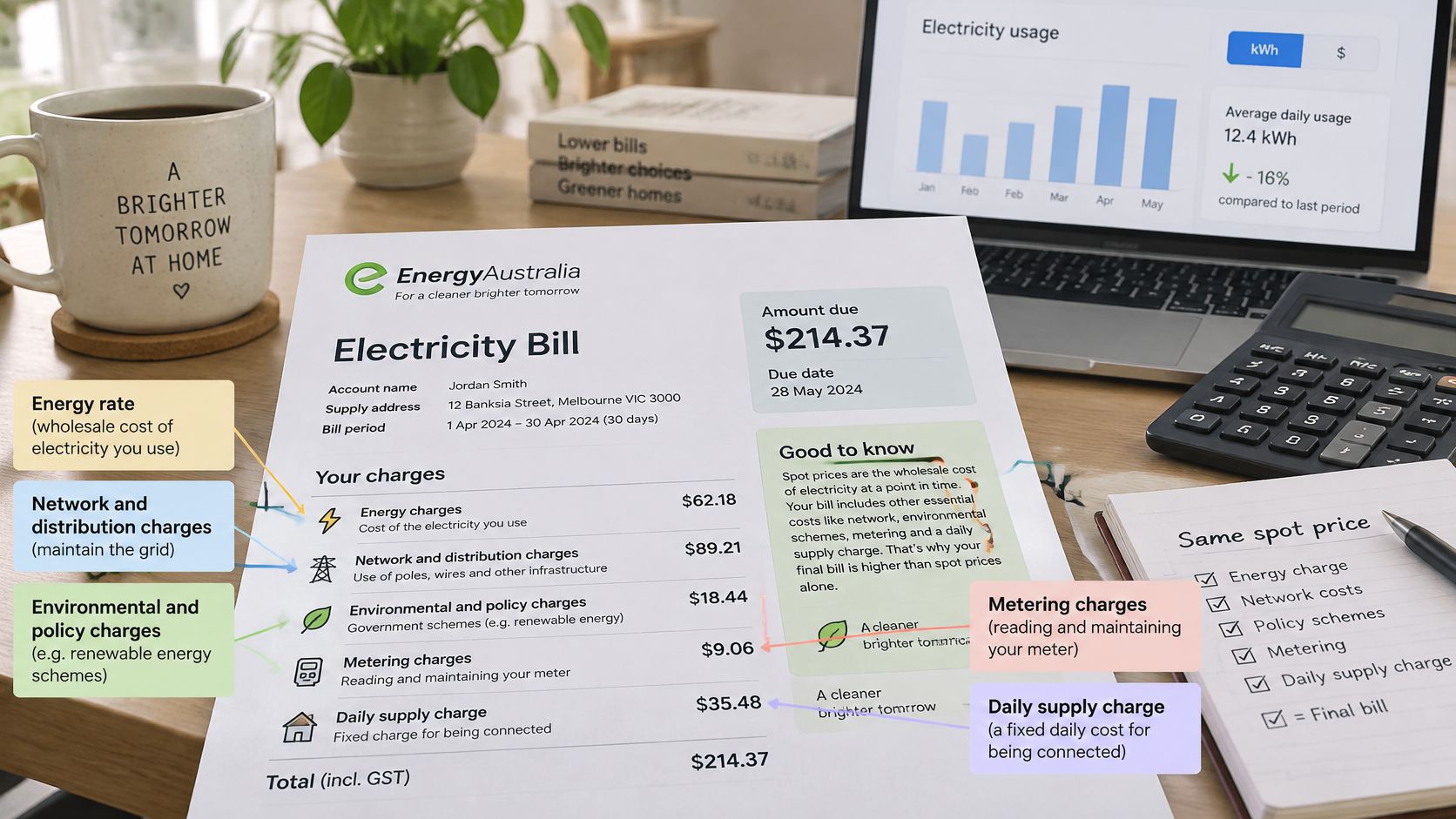
Four misconceptions that distort comparisons
- My bill follows every spot-price change. That only applies where the plan passes interval prices through. A conventional time-of-use tariff uses scheduled price blocks.
- The quarterly average tells me what I pay. Your consumption-weighted outcome depends on when you import, not just the average across all intervals.
- Negative wholesale prices determine every export payment. Export compensation follows your agreement, and network or inverter limits can restrict exports.
- Network charges fall whenever wholesale prices fall. Their charging arrangements are separate, even where a retailer bundles them into a usage rate.
A traditional feed-in tariff values exported solar under the export rate in the retail agreement. A VPP arrangement may instead combine household supply, coordinated dispatch and grid-service value, so comparing headline export rates alone can miss important costs and benefits.
For an energy retailer comparison, compare the expected whole bill, control rights and reserve settings. Our explanation of the cost of electricity provides further context for separating these components.
A practical exposure check
- Classify your plan. Use the table to identify whether wholesale movements reach your bill directly. Record the usage rates, network tariff arrangements, daily supply charge and export terms. Don't mistake a variable retail offer for an interval pass-through plan.
- Download 30 days of half-hourly import and export data from your meter or retailer portal as a practical starting sample. Keep imports and exports separate, and don't substitute monthly totals for interval records.
- Obtain matching regional prices from AEMO's public market data for NSW or Queensland. Align timestamps and account for the mismatch between half-hourly meter records and finer dispatch pricing; half-hourly data can conceal short events.
- Calculate how much imported energy occurred during prices above your selected analytical threshold, and how much export occurred during negative prices. Treat this as an exposure indicator, not an automatic bill calculation.
- Compare battery operation with those intervals. Check charge and discharge timestamps, solar generation, state of charge and reserve settings. A missed high-price export may have been sensible if the household needed the energy.
- Write a short exposure summary recording your plan type, high-price import share, negative-price export share and data limitations. Apply retail terms before translating those volumes into dollars.
Read the Energy Price Fact Sheet, or the applicable plan information document, alongside the retailer's terms. Check whether import prices, export prices, fees and VPP benefits use the same settlement basis before drawing a financial conclusion.
Tools and VPP Participation That Act on Price Signals
Live information, automated control and VPP participation involve progressively more commitment. Watching prices helps you understand conditions; allowing a controller to dispatch your battery changes how the asset operates.
The layers below distinguish observation from action.
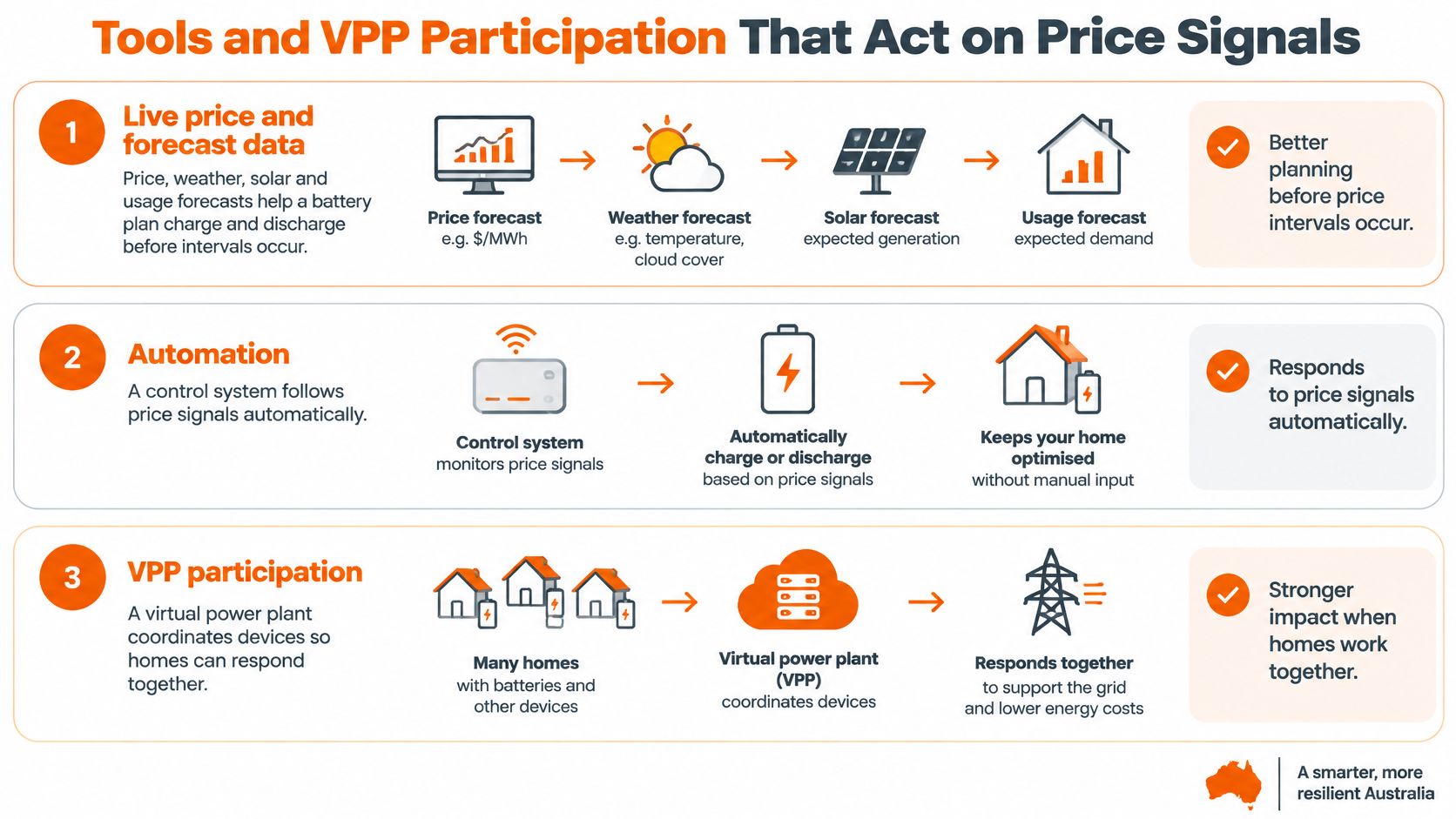
From live data to coordinated dispatch
Live prices and forecasts help identify likely charging and discharge windows. Price information becomes more useful when combined with weather, solar-PV and household usage forecasts, because a low-price interval alone doesn't reveal tomorrow's energy needs.
Automation converts those forecasts into operating decisions. The HighFlow app shows live prices and home energy, and uses price, weather, PV and usage forecasts to create and execute an optimal battery plan, with manual override at any time. Our electricity price forecasting resource explains the role of forecast-led control.
A retailer-based Virtual Power Plant coordinates batteries alongside the electricity plan. HighFlow Energy uses your existing battery to support the grid when it has spare capacity, and the value earned funds your monthly bill-free electricity allowance. Your household energy use is always prioritised before supporting the grid.
Aggregation allows an operator to coordinate charging, discharging and frequency-control responses across participating batteries. Frequency-control services help correct short-term imbalances between supply and demand, rather than shifting energy from midday to evening.
Readiness and trade-offs
A Bring Your Own Battery, or BYOB VPP, arrangement doesn't change who owns the battery. It does require agreement about control, data access and how the resulting value reaches the household.
Before enrolling, check:
- Compatibility: Your battery and inverter must support the required communications and control.
- Connectivity: Reliable internet is needed for coordinated operation.
- Reserve settings: Understand backup capability and the energy retained for household use.
- Warranty conditions: Review cycling, throughput and third-party control provisions.
- Network constraints: Confirm export limits for your connection, not just your state.
- Commercial terms: Read allowance rules, excess rates, data permissions and exit provisions.
Automation doesn't remove forecast error or wholesale risk. Nor does battery ownership guarantee backup during an outage; that depends on the installation's backup configuration.
Frequently Asked Questions About Electricity Spot Prices
What is an electricity spot price?
It's the wholesale price for a five-minute NEM dispatch interval, expressed in A$/MWh. It's a regional market signal, not the complete rate on a household electricity bill.
How do I convert A$/MWh to cents per kWh?
Divide the A$/MWh figure by 10. A wholesale price of A$133/MWh therefore equals 13.3c/kWh before network, retail and environmental charges.
Why can spot prices be negative?
Negative prices can occur when supply is abundant relative to demand and suppliers offer energy below zero. Strong midday solar output and low operational demand can contribute, while administered pricing has its own floor under specified conditions.
Does a negative spot price mean my battery is paid to charge?
Not automatically. The result depends on your import tariff, retailer pass-through rules, charging losses and operating constraints, while household reserve needs may make a different dispatch decision preferable.
Why do NSW and Queensland prices differ?
Each region has its own supply and demand balance. Interconnector and network constraints can prevent cheaper electricity in one region from fully serving the other.
Do spot prices set my bill?
They influence wholesale energy costs, but your tariff determines how that influence reaches you. Fixed, time-of-use and spot-linked plans pass through wholesale changes differently, while other bill components remain separate.
Decide Whether Spot Exposure Suits Your Battery
Spot exposure can suit a household with a compatible battery, flexible consumption and tolerance for variable outcomes. A fixed-rate arrangement may be a better fit if price certainty matters more than responding to individual market intervals.
Assess your location, solar and battery size, usage pattern and existing plan against the readiness checklist. Battery capacity alone doesn't establish financial suitability.
Why HighFlow Energy
Our retailer-based BYOB VPP focuses on the ongoing performance of existing systems. Electricity retail, billing, compliance and market services are provided by ERC Energy Pty Ltd, an authorised Australian electricity retailer trading under our brand.
The Bill-Free Electricity offer is available only in NSW and QLD service areas, and works the same way for Energex and Ergon customers. Current allowance tiers range from 300 kWh to 1,000 kWh per billing month, depending on solar and battery system size; confirm your applicable tier in the current Price Schedule.
Usage above the confirmed allowance is charged at the applicable excess usage rate, without penalties for exceeding it. Other applicable fees can remain, and the Residential Electricity Agreement, Price Schedule and VPP Market Services Agreement contain the binding terms.
Key Takeaways
- Wholesale isn't retail. Your agreement determines your exposure.
- Net value matters. Losses, charges and reserves affect battery economics.
- Control has trade-offs. Review warranties, permissions and network limits.
- Assess performance, not promises. Neither spot exposure nor VPP membership guarantees savings.
HighFlow Energy offers a retailer-based VPP that coordinates your existing compatible battery around household priorities and grid opportunities. Installation quality matters, but ongoing financial performance deserves scrutiny too. Visit HighFlow Energy to request an eligibility assessment and understand your potential allowance, operating terms and whether your battery could deliver greater value.