


8 Ways Australian Homes Can Control Energy Costs in 2026
You've got solar on the roof, a battery beside the house and an app showing plenty of generation. Yet your electricity bill still includes grid purchases and daily supply charges. To control energy costs, you need to know whether those charges come from your tariff, the timing of household demand or stored energy that isn't being used effectively.
Electricity bills combine several different costs. The Australian Government's guide to electricity pricing plans and tariffs distinguishes fixed supply charges from variable usage charges and explains that feed-in tariffs provide a separate credit for exported electricity. Reducing imports therefore won't automatically remove every charge.
For Queensland and New South Wales homeowners, the most useful approach has three levers:
- The tariff you pay on: Compare supply charges, import rates, export credits and contract conditions.
- The timing of consumption: Match flexible appliances and battery discharge to solar output and your actual tariff windows.
- The value your battery earns: Assess whether coordinated grid support can improve its financial performance without compromising household needs.
These levers work together. A generous export rate won't necessarily compensate for expensive evening imports. Likewise, a battery that exports early can leave you buying electricity later. Start with the bill, then change the settings and equipment that affect it.
1. Compare Retail Plans Against the Default Market Offer and Energy Made Easy Benchmarks
A discounted usage rate means little on its own. A plan with cheaper imports can still cost more across the year if it carries a higher daily supply charge or puts its peak window where your demand sits.
The Default Market Offer gives you a regulated standing-offer benchmark in NSW and South-East Queensland. As historical context, residential default electricity prices increased by 0.5% to 9.7% from July 2025, depending on location and usage, according to the Australian Government's summary of the AER determination. Benchmarks move, so an old comparison tells you nothing about whether your current offer is still competitive.
Energy Made Easy lets you test available offers against your own consumption profile. Enter your network area, solar exports, controlled load and battery operation, because each of these shifts which plan structure suits you. A flat-rate plan and a time-of-use plan can rank differently for the same household once those inputs change.

Compare the whole bill
Say a Western Sydney household finds a market offer advertising a large discount off the reference price. Before switching, it should check whether a higher daily supply charge or a lower export credit erases that saving over a full billing period.
Work through a structured electricity retailer comparison to separate headline pricing from the terms that determine the bill:
- Import costs: Apply the proposed rates to when you buy electricity. Cheap off-peak rates help little if most of your imports land in the peak window.
- Fixed charges: Check the supply charge separately. Solar and battery households often import less, so the daily charge makes up a larger share of the bill.
- Export conditions: Look for credit caps, eligibility conditions and different export windows before valuing a high feed-in rate.
- Contract terms: Check benefit periods, exit fees and any bundled VPP obligations. Where grid participation is part of the offer, confirm your household's consumption stays prioritised before the battery supports the grid.
Compare total expected cost across a billing period, not the biggest advertised discount. Repeat the comparison after major changes, such as adding an electric vehicle, shifting work patterns or adjusting battery operation.
2. Align Household Usage With Time-of-Use Tariff Windows
Running an appliance overnight isn't automatically cheaper. Your retailer's tariff schedule determines the cost, and your solar system may make daytime operation more valuable.
Time-of-use tariffs apply different import rates at different times. Demand tariffs add another consideration: a charge linked to your highest measured demand during defined periods, rather than just total energy consumption.
About three in ten consumers were on time-of-use or demand tariffs in Energy Consumers Australia's survey of more than 4,000 households, with most not having actively chosen them, according to its December 2024 consumer electricity-pricing report. Check your actual bill rather than assuming you're on a flat rate.
Schedule around the applicable window
Consider a Queensland household whose hot water, dishwasher and air conditioner operate together during an expensive period. Moving the dishwasher helps, but the hot water schedule may be the larger opportunity.
Download interval data from your retailer portal and compare it with the tariff schedule. Identify loads you can move without affecting comfort or essential services.
- Confirm the windows: Check weekday, weekend and seasonal conditions before setting timers.
- Separate large loads: Where a demand charge applies, avoid unnecessary overlap between high-power appliances.
- Use suitable controls: Appliance delay-start functions and correctly rated timers can automate flexible loads.
- Verify the result: Check imported energy after the change, not just whether the timer activated.
Practical rule: Schedule appliances against your actual tariff and available solar, not a general assumption that nighttime electricity is cheapest.
Battery scheduling should follow the same principle. Discharging during a cheap period can waste energy you'll need when imports become more expensive.
3. Maximise Solar Self-Consumption Through Daytime Load Scheduling
A pool pump running after sunset can draw from your battery while the same home exports surplus solar earlier in the day. Moving that pump to a suitable daylight window can reduce unnecessary storage losses and leave more battery capacity available for evening demand.
Solar self-consumption means using rooftop generation within your home instead of exporting it. Its financial value depends on the import charge avoided and the export credit you give up.
Rooftop solar could meet more than half of underlying National Electricity Market demand during the middle of a sunny day, according to the AER's State of the Energy Market overview. For an individual home, though, cloud cover, shading and appliance demand determine how much surplus is available.

Follow surplus generation, not just the clock
Check your monitoring app for the period when generation consistently exceeds household demand. Stagger the dishwasher, washing machine and pool pump rather than starting everything together.
For example, a Sydney family could run laundry first, then schedule the dishwasher when generation rises. A solar-aware controller can adjust suitable loads when weather changes.
- Protect the evening reserve: Don't consume all available solar if the battery needs charging for later.
- Check export limits: Your connection agreement may restrict exports, including combined solar and battery output.
- Avoid unnecessary consumption: Using electricity solely to avoid exporting it isn't a saving.
The broader distinction between bill savings and exported energy is also explained in this homeowner guide to solar cost savings. For decisions at your property, use Australian tariff terms and your own monitoring data.
4. Improve Heating and Cooling Efficiency and Thermostat Management
An air conditioner can drain a well-managed battery if the home continually loses conditioned air. Fixing draughts, shading and operating habits can be more useful than changing battery settings.
Start with the rooms you occupy. Close doors to unused areas where that suits the system design, lower blinds before direct sun reaches the glass, and keep supply and return-air paths clear.
For a Brisbane household, a practical sequence is to clean the filters, shade sun-exposed windows and choose a moderate cooling setting before increasing system output. In Sydney winter conditions, sealing draughts can improve comfort without raising the thermostat.
Reduce the load before replacing equipment
Our general guidance is to start around 24–26°C for summer cooling and 18–20°C for winter heating, then adjust for health needs, humidity and comfort. These are operating recommendations, not guaranteed savings settings.
- Maintain airflow: Clean filters according to the manufacturer's instructions and arrange servicing when performance deteriorates.
- Seal carefully: Address gaps around doors and windows without blocking required ventilation.
- Use shading: External shading helps prevent heat entering; internal blinds can improve comfort.
- Size replacements properly: Have a licensed installer assess the rooms, building fabric and intended operating pattern.

Pre-cooling is a trade-off, not a default setting. Cooling earlier with solar may reduce evening imports, but excessive pre-cooling can increase total consumption. Compare similar weather conditions before deciding whether it helps your home.
Don't replace a functioning system solely because a newer model has a better rating. Compare purchase cost, expected use, maintenance condition and the building improvements available first.
5. Manage Hot Water Heating Through Timers, Heat Pumps and Controlled Load
Hot water deserves its own review because the heating schedule may be hidden from normal household routines. A storage tank can reheat while you're asleep or during an expensive period without an obvious change in comfort.
Start by identifying the system type and circuit arrangement. Electric resistance storage, heat pumps and continuous-flow systems have different operating characteristics, and not every system can be safely controlled by a household timer.
Controlled load is a separately managed electricity supply commonly used for suitable storage appliances. Our guide to controlled load electricity explains the distinction from ordinary household usage.
Compare the complete heating arrangement
Say a Sydney household wants to move water heating into its solar-generation window. The electrician should first confirm whether the heater is on a dedicated controlled-load circuit, whether the proposed controller is compatible and whether any metering changes are needed.
Compare the controlled-load cost with the cost of daytime operation. Include any additional supply charge and the solar export credit you would forgo.
- Protect hot water availability: Match heating opportunities to tank capacity and household demand.
- Keep safety settings intact: Have a qualified technician confirm storage temperatures and tempering arrangements. Don't lower temperatures casually to save energy.
- Use appropriate controls: Fixed-wired heaters need correctly rated equipment and licensed electrical work.
- Review replacement options: Compare heat-pump suitability, noise, location, maintenance and installed cost when the existing system approaches replacement.
A cheaper heating window only helps if the system can provide enough hot water when the household needs it.
Insulate accessible hot water pipes where appropriate and repair leaks promptly. Check the heating schedule after servicing or power interruptions, because a controller reset can undo an otherwise sensible arrangement.
6. Reduce Standby Power and Upgrade to Efficient Appliances
Not every device with an illuminated light is a meaningful cost problem. Measure first, then target appliances that consume electricity for long periods or perform unnecessary work.
A plug-in energy monitor can help assess suitable plug-connected equipment. Use it over representative operating conditions, particularly for appliances such as refrigerators that cycle rather than draw power continuously.
Consider a Brisbane household with a second fridge in the garage. Monitoring may show that keeping occasional drinks cold requires more energy than expected. The useful choice could be switching it off when unnecessary, repairing a fault or replacing it, rather than chasing small charger loads.
Prioritise operating hours and condition
- Entertainment equipment: Use a switchable power board for devices that can safely lose power.
- Laundry: Use cold-water settings when suitable for the fabric and cleaning requirement.
- Lighting: Replace inefficient lamps with suitable LEDs, checking dimmer and fitting compatibility.
- Replacement appliances: Compare Energy Rating labels between models of similar size and function.
- Essential equipment: Keep refrigeration, medical devices, alarms and required communications operating.
A smart plug is a control device, not permission to switch any load. Check its rating and the appliance manufacturer's instructions. Don't use ordinary plug-in controls on fixed-wired equipment.
Replace for a reason, not just for a label. An efficient appliance that's oversized or rarely needed can still be poor value. Conversely, repairing damaged door seals or removing an unnecessary second appliance can address the problem without a large purchase.
After making changes, compare overnight grid imports and battery discharge. Lower background demand can preserve stored energy for essential household use, but the benefit depends on what the removed load was consuming.
7. Optimise Battery Discharge and Participate in a Retailer-Based Virtual Power Plant
A battery's value depends on when it charges, when it discharges and what the household gives up in return. Maximising exports or minimising imports in isolation can produce the wrong result.
A Virtual Power Plant coordinates distributed systems so they can operate collectively. The Australian Government's battery guidance explains how participation can reduce purchases, respond to time-of-use tariffs and support grid programs.
A Bring Your Own Battery VPP uses an existing compatible battery. In a retailer-based arrangement, electricity supply and VPP benefits are considered together, unlike an export-only feed-in tariff.
Balance household reserves and grid value
Say a NSW household expects heavy evening air-conditioning demand and poor solar generation tomorrow. Exporting stored energy now may be less valuable than retaining it, even if the current export opportunity looks attractive.
AEMO and CSIRO's small-scale solar and battery projections report highlights the importance of customer acceptance and understandable controls. Effective battery optimisation should account for forecast load, weather, reserve settings and the value of alternative uses.
- Retail versus wholesale: A high NEM wholesale price doesn't automatically become your payment. Your contract determines how value and risk reach you.
- Cycling costs: Consider energy losses, warranty conditions and additional battery throughput.
- Network constraints: Export limits and local congestion can restrict delivery during an otherwise valuable event.
- Resilience: Confirm reserve settings and backup capability. Owning a battery doesn't automatically mean every circuit works during an outage.
The video below introduces coordinated battery participation.
HighFlow Energy uses spare battery capacity while prioritising household needs. Grid-service value funds a confirmed monthly allowance covering supply charges, usage within the allowance and associated network and distribution charges. Electricity beyond the allowance is charged at standard rates; a particular bill outcome isn't guaranteed.
Our app uses price, weather, solar and usage forecasts, with manual override. Check the allowance terms alongside battery compatibility, warranty conditions and your expected imports.
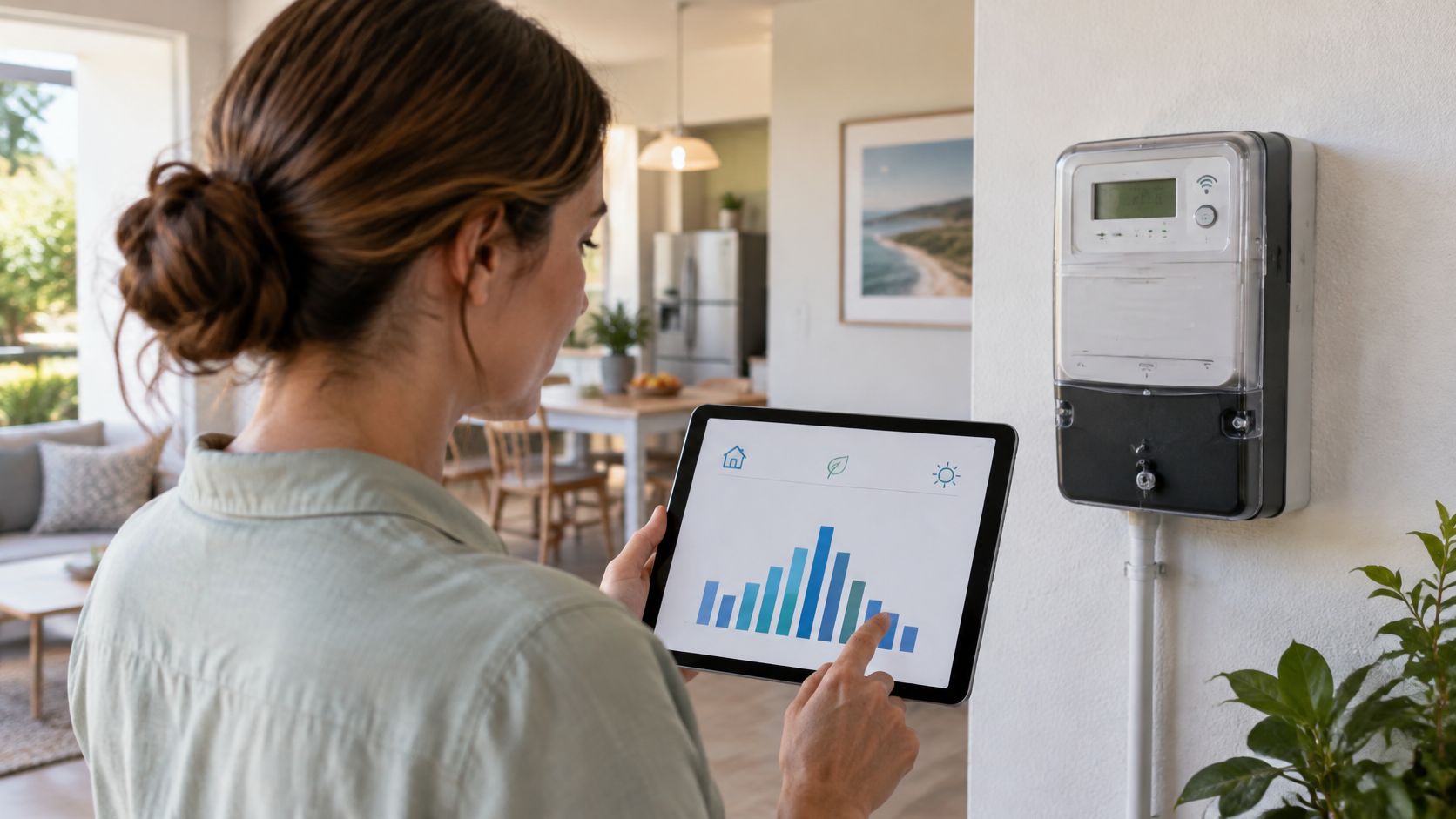
8. Monitor Usage, Review Supply Charges and Use Smart Meter Data Regularly
Your electricity bill shows the financial result. Interval data helps explain how you reached it.
Compare retailer import and export records with solar generation and battery operation. These records describe different flows, so don't assume a solar-app consumption figure should match the retailer's billed imports.
For example, a Sydney household might notice an unfamiliar overnight import pattern. Checking battery reserve settings, hot water operation and refrigeration can narrow the cause before anyone assumes the meter is wrong.
Keep a repeatable review routine
- Review imports: Look for recurring expensive-period purchases and unexpected overnight demand.
- Check battery behaviour: Identify whether discharge stops because of reserves, operating limits or an empty battery.
- Separate charges: Review supply charges, usage charges, export credits and VPP benefits individually.
- Test suspected appliances: Use a suitable energy monitor or arrange professional testing.
- Record changes: Note tariff changes, controller adjustments, visitors and unusual weather.
Change a setting, then observe the result before changing several others. Otherwise, you won't know whether the improvement came from scheduling, lower demand or better weather.
Diagnostic insight: A rise in grid imports isn't automatically a system fault. Check solar generation, household demand and battery reserves together.
Our customer portal lets customers monitor electricity use and consumption patterns. Automated operation means you don't need to watch the system constantly, but periodic reviews remain useful when household needs change.
Keep records of unexplained discrepancies and contact the relevant retailer or installer with dates and operating details. A specific pattern is easier to investigate than a general report that the bill seems high.
How each cost control strategy compares for Australian households
| Item | Upfront Investment | Main Cost Lever | Requires Equipment Change | Best For |
|---|---|---|---|---|
| Compare Retail Plans Against the Default Market Offer and Energy Made Easy Benchmarks | None; free comparison service | Finding a lower total-cost plan | No | Households reviewing rates or changing usage |
| Align Household Usage With Time-of-Use Tariff Windows | None to low; scheduling tools are optional | Shifting flexible use to cheaper periods | No | Households with flexible routines and time-of-use tariffs |
| Maximise Solar Self-Consumption Through Daytime Load Scheduling | None to low; timers or smart controls are optional | Using more solar electricity on site | No for basic scheduling | Homes with rooftop solar and flexible daytime loads |
| Improve Heating and Cooling Efficiency and Thermostat Management | Low for settings and sealing; higher for system upgrades | Reducing heating and cooling demand | Optional; needed for an equipment upgrade | Homes with high heating or cooling use |
| Manage Hot Water Heating Through Timers, Heat Pumps and Controlled Load | Low for timers; higher for a heat pump | Lowering hot water energy use and shifting heating to cheaper periods | Optional; required to replace a resistance system with a heat pump | Homes with high hot water use |
| Reduce Standby Power and Upgrade to Efficient Appliances | Low for switch-off measures; higher for appliance replacements | Cutting standby use and appliance consumption | Optional | Homes with older appliances or high standby loads |
| Optimise Battery Discharge and Participate in a Retailer-Based Virtual Power Plant | No new hardware for eligible existing batteries | Optimising battery use and accessing grid-service value | No, if the existing battery is compatible | Battery owners seeking more value from existing storage |
| Monitor Usage, Review Supply Charges and Use Smart Meter Data Regularly | None to low; monitoring tools are optional | Identifying usage spikes and plan or tariff mismatches | No | Households wanting to track use and review bills regularly |
Turning Monitoring and Scheduling Into Lasting Savings
The most reliable way to control energy costs is to connect your plan, appliance schedules and battery strategy. Switching retailers without checking usage patterns can leave the main problem untouched. Automating battery exports without preserving evening energy can create another one.
Review available offers through Energy Made Easy and compare them with the applicable DMO benchmark. Check interval data regularly, especially after tariff changes or new appliances. Schedule flexible loads around available solar and actual import prices, rather than a fixed assumption about cheap electricity.
Key Takeaways
- Tariff first: Compare the full bill, including fixed charges and conditions.
- Timing second: Move useful consumption into favourable solar or tariff windows.
- Battery value third: Compare avoided imports with export opportunities, losses and cycling costs.
- Household priority: Preserve energy for expected demand and required backup reserves.
- Evidence over promises: Judge improvements against your actual tariff and consumption baseline.
Traditional feed-in tariffs pay for exports. A properly structured VPP can add another value stream through coordinated battery activity, but participation isn't automatically better for every household. Compatibility, available capacity, network restrictions and contract terms determine whether it fits.
Nor should a bill-free allowance be confused with unlimited electricity. Review the confirmed allowance, reset arrangements, eligibility conditions and rates outside it. These details matter more than the offer's headline.
Why HighFlow Energy Fits This Approach
HighFlow Energy coordinates existing compatible batteries in Queensland and New South Wales, using spare capacity to support the grid. Household energy use comes first, and customers retain ownership and control of their batteries. There are no lock-in contracts or exit fees.
We manage eligibility, customer communications and the Bill-Free Allowance program. ERC Energy provides regulated retail services in accordance with Australian energy laws. Our published eligibility criteria, allowance explanations and pricing outside the allowance support a practical comparison against your current arrangement.
Installation quality matters, but ongoing performance deserves the same attention. A battery can work technically while delivering less financial value than its operating settings and retail arrangement allow. Review both before assuming you need more hardware.
HighFlow Energy offers eligible solar and battery owners a retailer-based VPP that uses spare battery capacity to fund a monthly electricity allowance while prioritising household needs. Visit HighFlow Energy to request an eligibility assessment and review how your existing system could contribute to better electricity-cost control.