

Peer to Peer Energy Trading Explained for Battery Owners
Selling solar electricity to your neighbour sounds like an obvious way to cut your bill. But peer to peer energy trading doesn't create savings just because the buyer lives nearby. Your electricity still uses the grid, network charges still matter, and exporting stored energy can leave you buying electricity later.
For Queensland and New South Wales homeowners who already have solar and a battery, the useful question isn't whether local trading is possible. It's whether the arrangement delivers more net value than keeping that energy for your own home, after charges, battery wear and control settings are considered.
What Peer to Peer Energy Trading Means
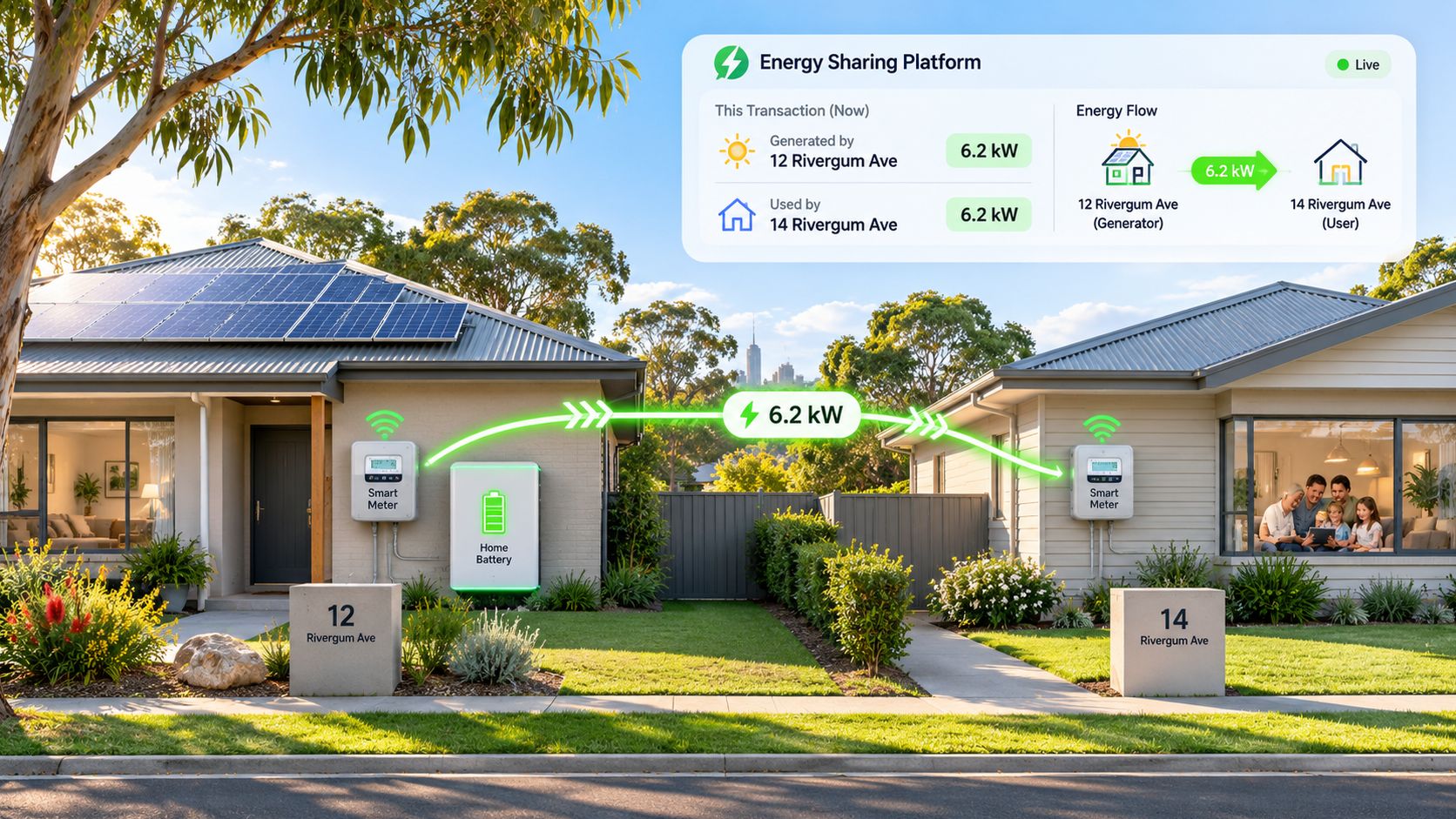
Peer to peer energy trading lets one household sell surplus electricity to another participating home. A platform records the transaction, while the retailer and electricity network continue to handle supply and delivery.
The electricity still travels through shared grid infrastructure. The trade changes how energy is priced and accounted for, not the physical route it takes. A local match, on its own, does not show whether either household's bill will fall.
Suppose your battery is charged and your solar panels are still generating. A platform may match that surplus with a participating household's demand instead of settling it under a conventional feed-in tariff, the payment a retailer gives you for electricity exported to the grid. The result for your household depends on the trade price, applicable charges and what your battery could otherwise do with that energy.
The terms behind the transaction
- Prosumer: A household that both produces and consumes electricity.
- Surplus export: Electricity sent to the grid after household demand and chosen battery-charging requirements are met.
- Settlement: The accounting process that determines who pays or receives money.
- Trading interval: The time block used to match generation, consumption and prices.
The National Electricity Market (NEM) connects wholesale electricity markets serving Queensland, New South Wales and other participating states. Wholesale settlement uses five-minute intervals; household trading platforms may use half-hourly records. These are separate accounting layers, like a market's settlement clock and a platform's matching clock. A match recorded by a platform does not, by itself, explain how the transaction appears on a household bill.
Your battery can shift when electricity is available for a trade. It may store midday solar surplus for a later opportunity, but doing so can leave less stored energy for your home or change how much you export under another arrangement. Forecasting and automated battery decisions are also discussed in this general AI for energy efficiency article.
Peer to peer trading changes how local energy is priced and recorded. Whether it reduces a household's bill depends on the charges, tariff and battery settings behind the trade.
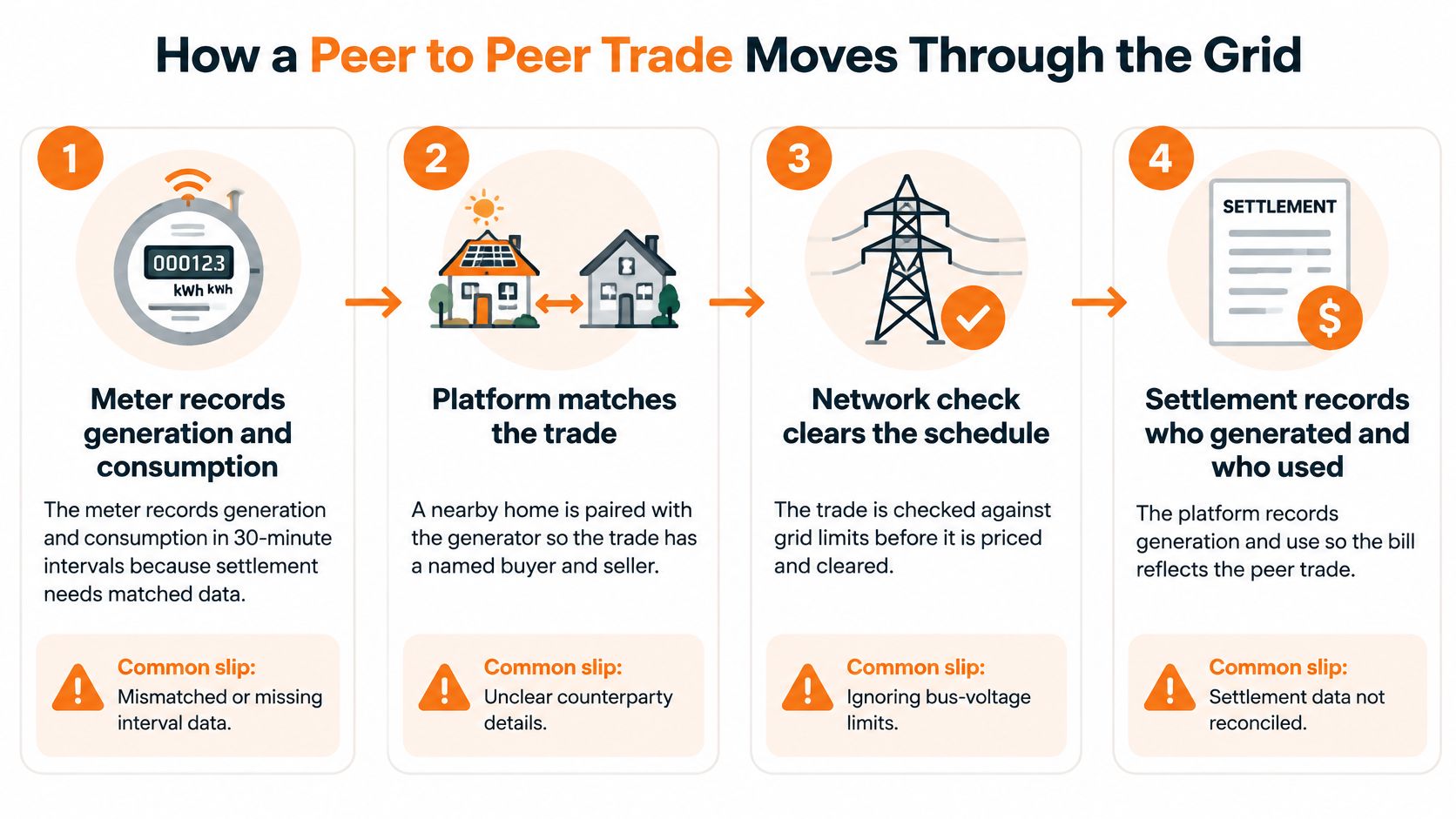
How a Peer to Peer Trade Moves Through the Grid
A local trade needs matching meter records, a permitted operating schedule and reconciled billing. The platform isn't building a private electrical connection between the homes.
The diagram summarises the main accounting and network stages.
From meter reading to bill credit
Match the meter data. The platform aligns generation, imports and exports within its nominated trading intervals so the seller's quantity can be reconciled with the buyer's allocation. Missing readings or estimates need correction before the transaction can be treated as final.
Identify an eligible buyer. The platform matches available surplus with participating demand under its geographic and retail rules. Don't assume everyone in the suburb qualifies, or that sharing a network area automatically gives two households permission to trade.
Check the operating schedule. Battery export must stay within connection permissions and the network's operating limits. A common problem is scheduling many nearby solar homes to export together without accounting for conditions on their shared feeder, the local circuit supplying those properties.
Record quantity and price. A ledger or billing engine records the agreed allocation and rate so both parties use consistent information. Late meter corrections must replace or adjust earlier entries rather than create duplicate credits.
Dispatch available stored energy. Dispatch means instructing the battery when to charge or discharge. The battery exports into the shared network, not exclusively into the buyer's house, and its schedule should respect the household's agreed reserve.
Settle the net amount. The retailer reconciles the trade with energy, network and market charges and applies the contractual customer benefit. A gross export payment isn't the same as an electricity bill reduction.
What the statement should reveal
A useful statement separates gross energy value, retained costs and net customer benefit. It should also identify corrected meter records and explain how a trade credit relates to ordinary import charges.
For background on local electricity arrangements, see our locality planning energy information. Keep the contractual arrangement separate from the physical network: nearby homes can share infrastructure without sharing the same trading eligibility.
The accompanying video offers another way to visualise the trading process.
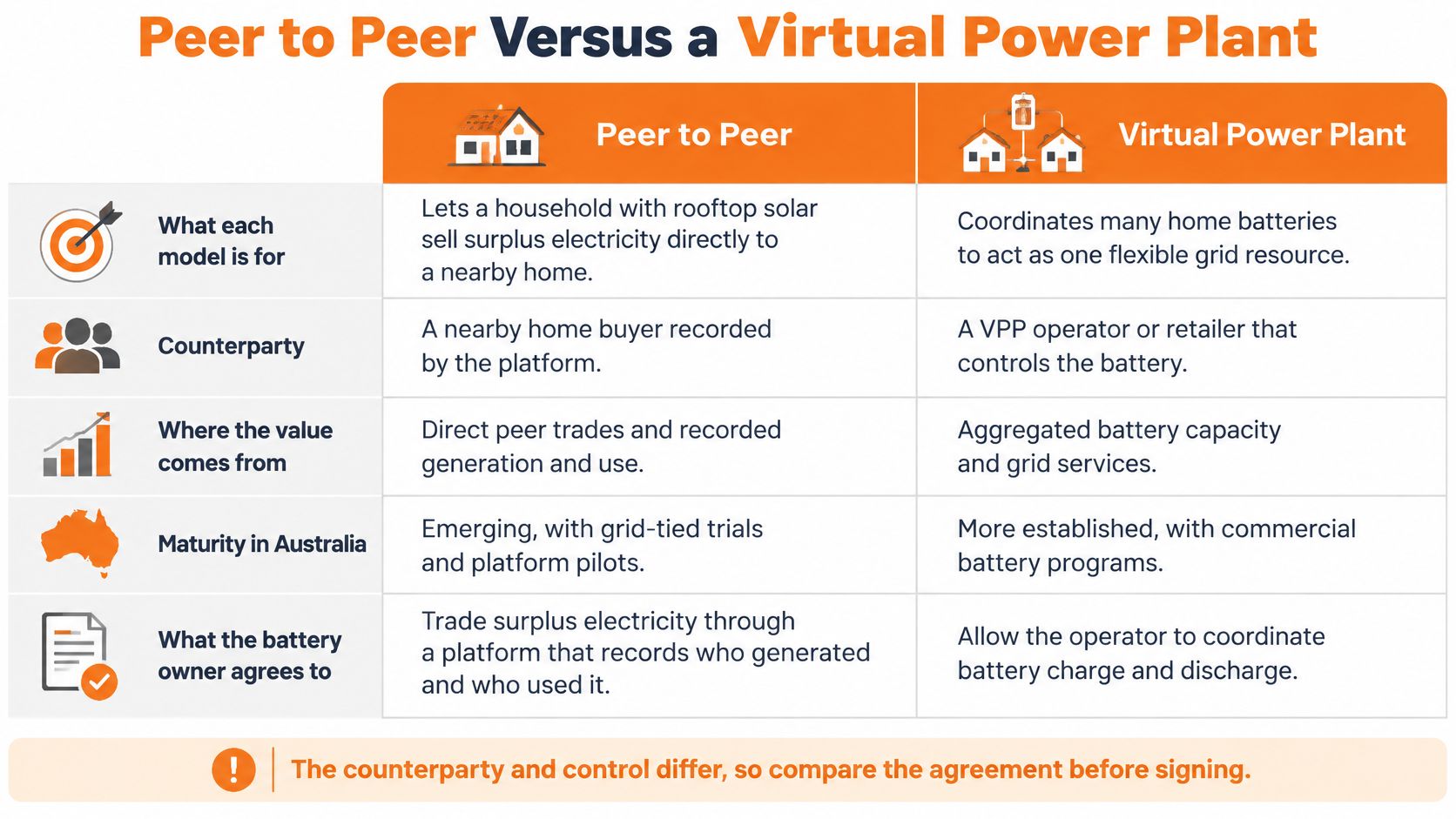
Peer to Peer Versus a Virtual Power Plant
Peer to peer trading and VPP compared
| Feature | Peer to peer energy trading | Virtual power plant (VPP) |
|---|---|---|
| Core purpose | Households trade surplus local energy with nearby homes | Many batteries are aggregated and dispatched as one resource |
| Counterparty | Neighbouring homes, matched through a platform and retailer | Operator or retailer accessing wholesale markets, networks or grid-service buyers |
| Source of value | Local price differences; avoided network costs only where tariff arrangements recognise them | Wholesale price response, frequency control and grid-support payments |
| Australian maturity | Trials and modelling don't establish a fully commercial national marketplace | Operating programs subject to applicable NEM registration and ancillary-service requirements |
| What the owner gives up | Some control over when stored energy is traded | Some control over when the battery charges or discharges for dispatch |
Peer to peer trading allocates trades between participating households; a Virtual Power Plant coordinates batteries as a combined resource. The models can overlap if a platform supports both and prevents the same capacity being committed twice.
Different services create different payments
A VPP can respond to wholesale price volatility, meaning changes in the prices paid for electricity in the bulk market. It may also provide frequency-control ancillary services, rapid adjustments that help keep electricity supply and demand balanced.
Demand response means changing consumption or battery operation when the system needs flexibility. A demand event might call for reduced imports, increased exports or additional charging, rather than selling solar to a neighbour.
AEMO's VPP demonstration report established that qualifying distributed resources could provide frequency services as both generation and load, subject to technical and registration requirements. A battery's ability to export isn't sufficient on its own.
Technical capability isn't commercial viability
ARENA's VPP portfolio evaluation found demonstrated wholesale and frequency-service value, but the marketplace project involved one retailer as the sole VPP, leaving the intended multi-party marketplace and network value unproven; retailers also considered a three-year payback too long to justify implementing the P2P technology.
That distinction matters in an energy retailer comparison. A conventional import-and-export plan doesn't necessarily include battery optimisation, while a retailer-based VPP combines the electricity account with coordinated battery operation. Neither structure guarantees that wholesale earnings flow directly to the household.
Our solar battery Virtual Power Plant guide provides further context for comparing coordinated storage with ordinary exporting.
Before signing, get written answers to these questions:
- Model: Is the arrangement local peer settlement, aggregated market participation or both?
- Payment: Which activities fund the customer benefit, and how is that benefit measured?
- Control: What operating rights does the agreement grant, and what remains under household control?
What Australian Trials Have Proven So Far
Australian peer to peer trials and studies
| Study | Scale and location | Reported result |
|---|---|---|
| RENeW Nexus, Data61 and partners | CSIRO's project report describes 18 homes expanding to 48 in Fremantle, WA | Technically feasible and generally well received, but tariffs offered insufficient financial incentive |
| ARENA distributed-ledger assessment | Modelled scenario assessed against Australia's regulatory framework | The ARENA assessment modelled 84% higher prosumer revenue and 3% lower consumer bills, while identifying regulatory difficulty |
| AGL virtual trial | ARENA's project account describes 68 residential customers in Carrum Downs, Victoria, using simulated trades | Tested trade identification, value and distributed-ledger suitability rather than an open marketplace |
| Deakin-led three-year trial | 296 households, reported in 2026, according to EcoGeneration's account of the Deakin-led study | 39% of imported electricity was matched through the Virtual Energy Network |
| UniSA and Deakin modelling | A 10 kW solar home in Geelong, modelled over 12 months, according to Electrical Connection's study coverage | Participating neighbours' grid electricity consumption fell by more than 30% |
Separate operation from simulation
RENeW Nexus demonstrated that household trading could work with existing meters, an intermediary retailer and regulated distribution infrastructure. It used Australian-developed blockchain technology, a shared transaction record whose entries are cryptographically linked, to coordinate surplus-solar trades.
Its commercial finding was more restrained. A functioning platform and positive participant response didn't establish that existing electricity tariffs offered enough money to make trading attractive.
The distributed-ledger assessment and AGL virtual trial answered different questions. Modelling estimates what could happen under selected assumptions; simulation tests transactions using representative or recorded inputs. Neither proves what a particular Queensland or New South Wales household will save under a current retail contract.
A matched share of electricity is an energy-allocation result, not a measured percentage reduction in the household's bill.
Read the outcome, not just the headline
The trials demonstrate useful progress in transaction design and local matching. Several named projects are outside Queensland and New South Wales, so their operating conditions shouldn't be treated as local tariff evidence.
Apply these tests to any trial claim:
- Scale and setting: Identify the participating households, location and asset mix.
- Transaction type: Establish whether trades were operational, simulated or modelled.
- Full costs: Check whether the calculation included network charges, retailer costs, platform fees and battery operation.
A project can pass its technical test while leaving customer value unresolved. That's a reason to examine the settlement rules, not dismiss the technology.
Where the Bill Savings Come From
An Australian suburban P2P case study published through the IAEE modelled 260 participants, comprising 180 consumers, 40 solar-only prosumers and 40 solar-and-battery prosumers, with the following cost and grid-flow results compared with conventional feed-in exports and grid purchases.
Modelled cost and grid effects by participant group
| Participant group | Average cost reduction | Other reported effect |
|---|---|---|
| Consumers without solar | 5.7% | Continue importing electricity, with part allocated through peer trading |
| Solar-only prosumers | 8.6% | Surplus generation can be matched with participating demand |
| Prosumers with solar and battery | 22.7% | Largest reduction; stored energy can shift to demand periods |
| Whole suburb grid flows | Not reported as a single bill cut | Grid exports down 42.6%; grid imports down 16.5% |
Storage provided the greatest modelled cost reduction because the battery could change when electricity became available. Local coordination also reduced electricity exchanged with the wider grid, including reverse flow, electricity moving upstream from homes into the distribution system.
These are modelled outcomes, not a bill-elimination promise. Tariffs, household behaviour, market rules and platform costs determine whether similar mechanisms create value elsewhere.
Follow the whole bill
For a Queensland or New South Wales household, assess each component separately:
- Energy charges: Count the imports avoided and any replacement imports after trading.
- Daily supply charges: These generally remain unless the retail offer explicitly covers or offsets them.
- Network components: Establish which charges are included in retail rates and which can change.
- Buy-sell spread: Compare the export payment with the cost of buying electricity when the household later needs it.
- Operating costs: Include platform fees, battery losses and additional battery use.
Suppose your battery exports during an attractive trading period, then your home imports during an expensive evening period. The export receipt can look positive even when keeping the stored energy would have produced a better result.
Compare like with like
Use interval meter data, battery records and the applicable tariff to compare self-consumption, ordinary export, VPP dispatch and peer trading. Keep household demand and solar generation consistent across the cases.
Compare bills before and after participation, but adjust for changed usage and weather. Separate the savings from already owning a battery from the additional benefit created by coordinated trading.
What Stops the Saving and How to Verify It
Network feasibility, tariff timing and battery-control rights can each turn an appealing trade into a poor household outcome. Verification means checking the operating schedule and the contract, not just the advertised export rate.
Network limits can block a profitable schedule
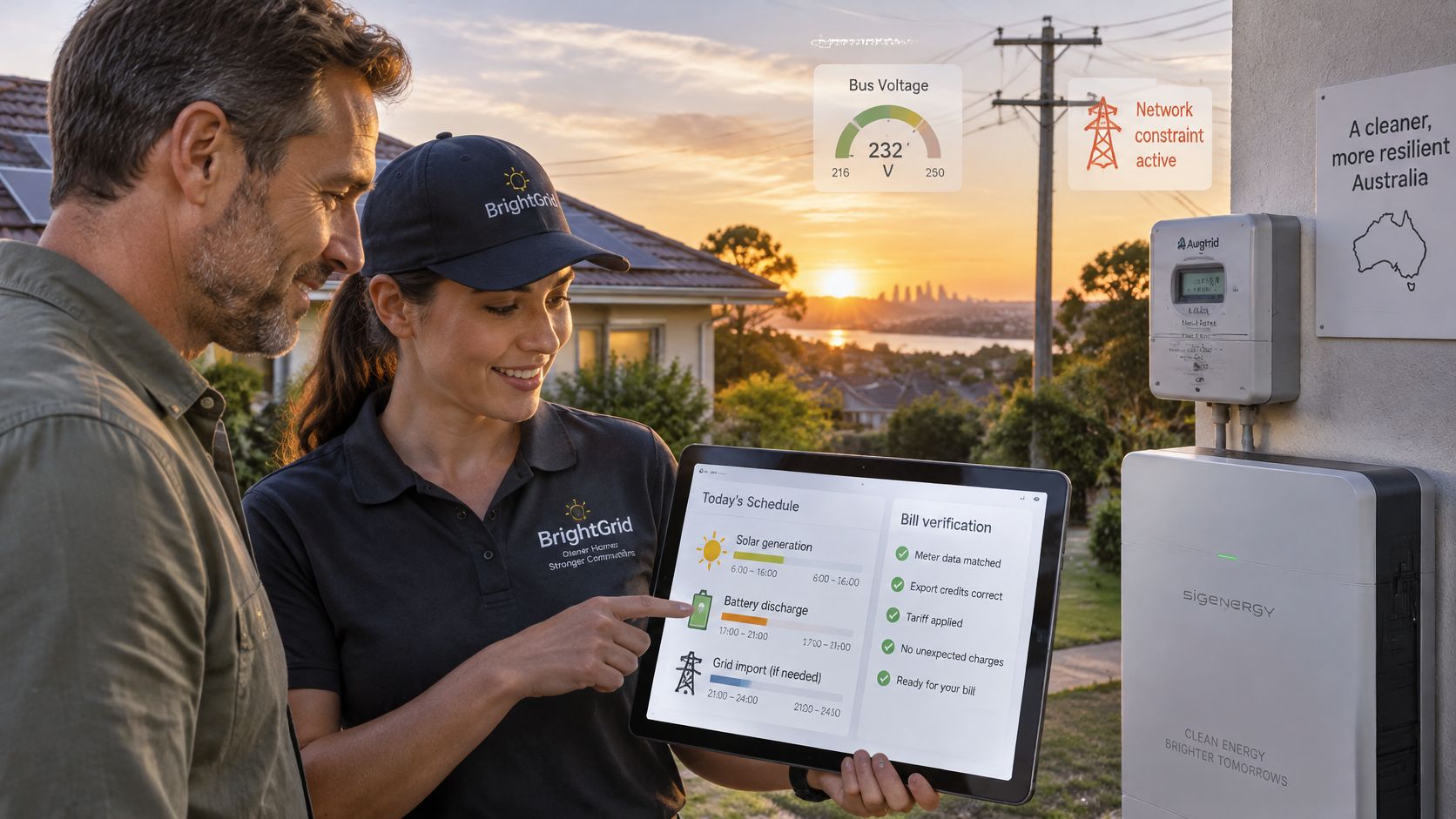
An Australian grid-tied P2P network study found that simultaneous trades could breach bus-voltage limits, the permitted voltage range at electrical connection points. A schedule can therefore balance financially while remaining electrically infeasible.
For Queensland and New South Wales homes, network-aware dispatch should account for feeder voltage, phase imbalance, uneven loading across the network's electrical phases, reverse flow and connection-export limits. The controller needs to constrain the schedule before committing available battery energy.
Local matching doesn't remove congestion. Record whether an export was restricted, whether the platform rescheduled it and how the missed transaction affected the household credit.
Tariff incentives can conflict
A time-of-use tariff charges different rates at different times. During a peak-rate period, using stored electricity at home may avoid an expensive import, while an operator may prefer exporting that same energy.
Australian tariff and VPP analysis covered by RenewEconomy identifies this conflict between household self-consumption and system value. It also explains why volumetric network tariffs, charges based on imported energy, can fall without an equivalent reduction in the network's underlying costs.
Calculate the household's avoided import cost alongside the trading payment. Don't count a reduced import charge as a separate grid-service earning.
Battery use has an opportunity cost
Battery cycling means charging and discharging the battery. Additional throughput contributes to wear and should be assessed against the manufacturer's warranty conditions, including any relevant energy-throughput limits and permitted operating modes.
Set an evening-use or outage reserve before evaluating discretionary exports. A reserve is stored energy held back for a chosen purpose, but backup capability also depends on the installed system, not merely the battery's charge level.
Verify control, accounting and exit rights
The ACCC's National Electricity Market inquiry report identifies concerns about transparency, autonomy and fair value-sharing, including limited VPP compatibility for some battery brands. Compatibility affects switching options as well as initial eligibility.
Use this checklist:
- Identify the arrangement: Establish whether you're joining a local trading trial or a retailer-operated VPP.
- Read dispatch permissions: Check remote charging, discharge limits, reserves and manual override.
- Reconcile customer value: Require a clear distinction between gross earnings, retained costs and the net benefit.
- Check portability: Confirm battery-brand compatibility, exit rights and any implications for another provider.
- Check warranty conditions: Compare expected operation with manufacturer requirements.
- Resolve discrepancies: Match bill entries with meter data and battery records using our billing accuracy guidance.
Why HighFlow Energy
At HighFlow Energy, your household energy use is always prioritised before supporting the grid. We may remotely charge or discharge your battery for market participation, which can affect the stored energy available at any given time, and our app allows manual override.
Our Bring Your Own Battery, or BYOB VPP, uses compatible existing solar and batteries in Queensland and New South Wales; the battery also needs an internet connection. Grid-service value funds a monthly bill-free electricity allowance covering daily supply charges, usage within the allowance and network and distribution charges on that allowance, rather than guaranteeing unlimited free electricity.
Electricity retail, billing, compliance and market services are provided by ERC Energy Pty Ltd, an authorised Australian electricity retailer trading under the HighFlow Energy brand. Customers retain battery ownership and may leave without penalty.
Key Takeaways
- Locality isn't a saving: The net bill result matters more than the location of the buyer.
- Storage adds choices: Compare each export with the value of retaining energy.
- Control needs documentation: Household priority, remote access and reserves should be clear.
- Evidence needs scope: A modelled benefit isn't a household performance guarantee.
Frequently Asked Questions
Can I sell electricity to any neighbour?
No. Both households must qualify under the platform's participation, retail and settlement arrangements. Living next door isn't enough.
Does peer trading require blockchain?
No. Blockchain is one ledger design. A compliant billing engine can also record and reconcile transactions.
Will trading bypass network charges?
Not automatically. Any reduction must follow the applicable tariff and contractual arrangements, rather than an assumption that local electricity uses free infrastructure.
Can my battery join both a VPP and peer trading?
Potentially, if the platform and agreements support it. The controller must avoid committing the same stored energy to competing obligations.
Does a high export payment prove I'm better off?
No. Include replacement imports, fees, losses and battery wear when calculating the net result.
What should I prepare for an eligibility assessment?
Have your electricity bill, solar inverter and battery model details, internet-connectivity information and preferred reserve settings available. These help establish technical compatibility and whether the proposed operation suits your household.
HighFlow Energy helps existing solar and battery owners assess whether coordinated battery operation can deliver better financial performance than their current electricity arrangement. Visit HighFlow Energy to request an eligibility assessment, review compatibility and understand the potential allowance alongside the battery-control trade-offs.