

Battery State of Charge: A Guide for Australian Owners
Your battery might already be doing the obvious job well. It stores your solar during the day and helps run your home after sunset. The part many owners miss is that battery state of charge isn't just a technical readout on an app. It's one of the main levers that determines how much value you can get from the system you already own.
That matters even more in Queensland and New South Wales, where battery owners aren't only thinking about backup or self-consumption. They're also weighing time-of-use tariffs, export limits, and whether spare battery capacity could be used more intelligently through a Virtual Power Plant Australia model.
For most households, the question isn't “what percentage is my battery at?” The better question is “what should my battery's state of charge be right now if I want the best financial outcome without putting unnecessary stress on the battery?”
What Is Battery State of Charge Explained Simply
You check your battery app at 6:30 pm and see 60%. That number looks straightforward, but its real value comes from what it means for your home tonight. Can the battery cover the expensive evening tariff period, hold enough backup for a blackout, or leave capacity available for a Virtual Power Plant event that could earn revenue?
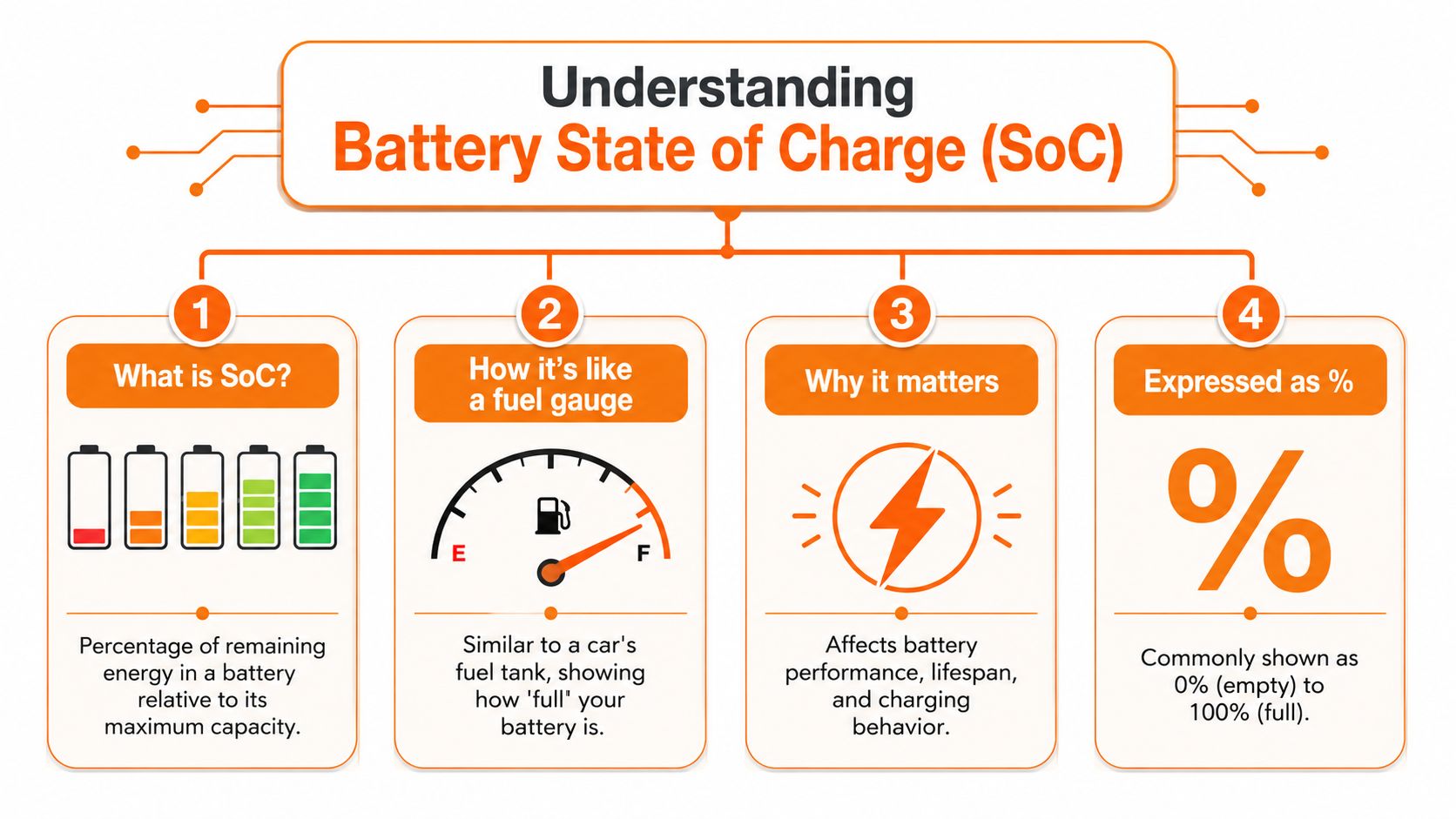
Battery state of charge is the percentage of usable energy remaining in your battery compared with its usable capacity. A practical definition comes from Recurrent's explanation of battery charge measurement, which describes SoC as a normalised estimate of usable energy remaining, usually shown as a percentage. For example, a 10 kWh battery at 60% SoC has about 6 kWh available for use.
What the percentages mean at home
The easiest way to read SoC is to treat it like your household energy budget for the next few hours.
- At 100% SoC: the battery has its full usable stored energy available.
- At 50% SoC: about half of that usable energy remains.
- At 0% SoC: the battery is effectively empty from the homeowner's point of view, although the system may still keep a protected reserve in the background.
If you want to translate battery capacity into real household usage, this guide to what a kWh means in everyday home energy terms helps connect the number in your app with the appliances and loads you run each day.
Simple rule: SoC tells you how much energy is left. The more valuable question is what that stored energy is worth right now.
That second question matters more than many battery owners realise.
A battery at 60% SoC could mean several different things financially. It might be enough to carry your home through the evening peak. It might be deliberately held back as backup protection. Or it might be reserved so your system can respond to a VPP dispatch when prices or grid demand make that energy more valuable.
Why people get confused by SoC
The first source of confusion is that SoC refers to usable energy, not every unit of energy physically sitting inside the battery. Battery systems keep operating margins to protect performance and lifespan, so the percentage on screen is already shaped by those limits.
The second is that SoC looks exact, but it is still an estimate. Your app may show 61%, yet that number should be read as a well-informed operating figure, not a perfectly measured liquid level.
For Australian homeowners, that distinction matters because SoC is not just a health metric. It is a decision-making metric. The percentage helps determine whether your stored solar is best used in your home, saved for later, or directed into a smarter VPP strategy that improves the return from the battery you already own.
How Your System Measures and Displays SoC
You check your battery app at 6:30 pm and see 58%. That number looks precise enough to base a decision on. Run the air conditioner now, hold energy for the evening peak, or keep some capacity available for a VPP event. The useful detail is that your system did not measure 58% the way a ruler measures length. It calculated 58% from several signals.
That calculation happens inside the battery management system, or BMS. The BMS works like the battery's operating brain. It tracks energy flowing in and out, checks voltage and temperature, compares those readings with battery models, and updates the SoC figure shown in your app or inverter portal.
Why the number is an estimate
Battery systems use a few methods to estimate SoC. One method tracks how much energy has moved in and out over time. Another compares voltage with known battery behaviour. More advanced systems combine current, voltage, temperature, and battery modelling to keep the estimate grounded in real operating conditions.
According to Analog Devices' technical overview of SoC and state of health estimation, combining those inputs can keep real-time SoC estimation error below about 4% under validated conditions.
For a homeowner, the practical takeaway is simple. The percentage on screen is a well-informed estimate, not a literal fuel gauge.
A useful analogy is your car's range display. It gives a strong guide based on recent driving, conditions, and remaining fuel, but it can shift as those conditions change. Battery SoC behaves in much the same way.
Why SoC doesn't always move smoothly
SoC charts often rise or fall in steps rather than a perfectly straight line. That can look odd at first. It is usually normal system behaviour, not a sign that something is wrong.
Several factors can shift the estimate:
- Temperature: battery performance changes in hot and cool conditions, so the system adjusts its estimate.
- Load: a large appliance turning on can change voltage behaviour and alter the displayed SoC trend.
- Recent charging or discharging: the battery's recent activity affects how the BMS interprets available energy.
This is why context matters. A good home energy monitoring setup lets you view battery SoC alongside solar production, household demand, and grid imports or exports, so the number makes sense in real time.
Read SoC as an operating estimate you can act on, not as a lab-grade measurement.
Why accuracy matters for VPP participation
For basic self-consumption, a small SoC estimation gap may not change much. For VPP participation, it can affect earnings.
A VPP coordinates thousands of batteries at once. If your system overestimates available energy, it may commit capacity you cannot deliver. If it underestimates available energy, you may miss a profitable dispatch window. Accurate SoC helps the system decide whether your battery should cover your evening usage, hold reserve for backup, or export when market conditions make that stored energy worth more.
That is the point many SoC guides miss. The display is not only about battery health. It also shapes how much financial value your battery can capture.
Optimal SoC Ranges Battery Health and Warranty
A home battery works a bit like a water tank. Keeping it pressed right to the top all the time gives you the most stored energy in that moment, but it is not always the best way to preserve the tank for years of use. The same principle applies to lithium-ion batteries.
For battery owners, the core question is not only “how full can I keep it today?” It is “what SoC range protects this asset while still leaving enough flexibility to cut bills, cover peaks, and support higher-value battery use later?”
The 20% to 80% window
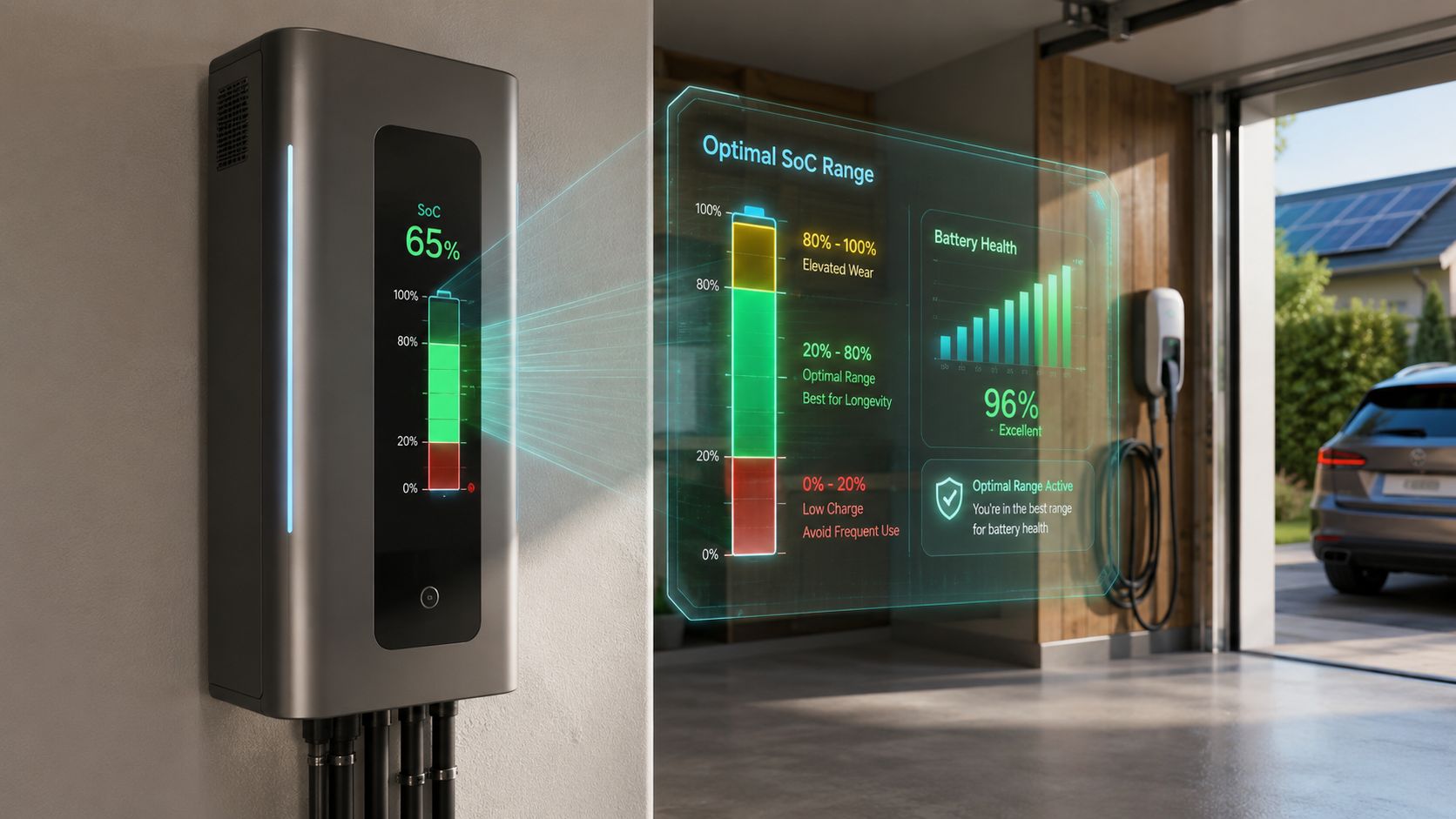
For many lithium-ion batteries, a 20% to 80% SoC range is a practical working band when the goal is longevity. Research discussed by the CSIRO and Energy Networks Australia in their Future Grid Forum work on distributed energy resources supports the broader point that battery operation affects long-term performance, and installers commonly use moderate SoC bands to reduce stress from regular full charging and deep discharge.
That matters financially. A battery that holds its capacity for longer can shift more solar into the evening over more years. It can also stay useful for tariff arbitrage, backup support, and coordinated VPP participation instead of losing value earlier than expected.
Why the edges cause more wear
Battery wear tends to increase near the top and bottom of the charge range. High SoC means more time spent near full charge. Very low SoC means deeper discharge. Both can add stress if they happen often.
This connects to Depth of Discharge, or DoD. A simple way to read it is how much of the battery's stored energy you use in one cycle. Using nearly all of the battery, day after day, usually creates more wear than using a smaller portion and recharging sooner.
Practical rule: Judge battery performance by how well it preserves useful capacity over years, not by whether it reaches 100% every sunny afternoon.
Health, warranty, and household value
Homeowners often face three competing goals. Keep enough energy ready for the evening. Avoid operating patterns that shorten battery life. Stay within the limits that support your warranty.
A simple comparison looks like this:
| Operating approach | Likely benefit | Main trade-off |
|---|---|---|
| Keep battery near full often | More stored energy available immediately | More frequent time at high SoC can be harder on long-term battery health |
| Operate in a moderate SoC band | Better support for battery longevity | Less maximum energy available at every moment |
| Use dynamic SoC targets | Balances home usage, battery wear, and market opportunity | Needs smarter controls and clear operating rules |
That third option is where many battery owners gain more value. A fixed “keep it full” approach focuses on availability alone. A dynamic SoC target treats the battery like a financial asset as well as a backup power source. Some days the best decision is to hold reserve. On other days, preserving headroom or avoiding a full charge can leave the battery in a better position for profitable dispatch later.
If you want a broader view of degradation and lifespan, this guide on how long solar batteries last in Australian conditions explains the longer-term picture.
What this means for warranty thinking
Warranty terms differ by brand, chemistry, and usage limits. Some focus on years. Others focus on throughput, cycle count, retained capacity, or operating conditions.
That is why SoC management and warranty thinking belong together. If your battery is being used for self-consumption only, your settings may be fairly simple. If it is also participating in an advanced VPP, the operating strategy should still respect the manufacturer's limits while aiming for the best financial return. The best outcome is not maximum cycling. It is useful cycling within the rules that protect the asset.
Unlocking VPP Value Through Intelligent SoC Management
A standard home battery routine is easy to understand. Solar charges the battery during the day. The battery discharges in the evening. The household buys less electricity from the grid. That's useful, but it's only one layer of value.
A VPP changes the question. Instead of asking “how do I fill the battery and empty it later?”, it asks “what SoC should this battery be at to create the best outcome for the owner right now?”
Self-consumption versus coordinated optimisation
The difference is easier to see side by side.
| Approach | Typical SoC goal | Main idea |
|---|---|---|
| Basic self-consumption | Keep the battery as full as possible when solar is available | Store excess solar and use it later at home |
| Dynamic VPP operation | Hold, charge, or discharge to suit changing value signals | Balance household needs, battery health, and grid opportunity |
The key point is that there is no single perfect SoC at all times. The Battle Born Batteries discussion of battery state of charge and operating goals makes this well. The ideal SoC depends on the goal. For pure self-consumption, full often looks attractive. For VPP participation, the better answer is a moving target shaped by reliability, spare capacity, and battery preservation.
What a smarter SoC decision looks like
Consider a sunny afternoon in Queensland.
A basic system might try to drive the battery as high as possible. A smarter VPP-oriented strategy may choose not to push to the top if the household's expected usage is already covered and keeping headroom could create more value later.
That can mean:
- Holding reserve capacity: leaving room in the battery when market conditions or network needs may favour a later charging or dispatch decision.
- Discharging selectively: using part of the battery for a grid event when the value of that energy is stronger than simple self-consumption.
- Protecting household priority: maintaining a floor so the home still has energy available when it matters.
This is the part many battery owners don't see. SoC is not only a technical status. It's a financial setting.
A well-managed battery doesn't just answer “how full am I?” It answers “how useful should I be right now?”
Why this matters for homeowners in NSW and QLD
Households in New South Wales and Queensland deal with real-world constraints such as export limits, changing retail pricing structures, and periods where battery timing matters more than battery fullness.
That creates a practical opportunity for Bring Your Own Battery participation. If a retailer-based VPP can coordinate spare capacity without taking away household priority, SoC becomes the mechanism that links technical control with bill outcomes.
In practical terms, one option in the market is High Flow Energy, which coordinates compatible home batteries in Queensland and New South Wales by using spare capacity for grid support while allowing customers to retain priority use of stored energy and app-based visibility.
Monitoring and Managing SoC with the HighFlow Energy App
Battery optimisation works better when the owner can see what the system is doing. If the app only shows a percentage and nothing else, SoC can feel mysterious. If the app shows current status, expected behaviour, and user controls, the same percentage becomes more meaningful.
What to look for in the app
A useful battery app should help you interpret SoC in context, not in isolation.
Look for visibility such as:
- Current battery level: the live SoC reading.
- Recent charging and discharging activity: so you can see whether solar, home usage, or grid dispatch drove the change.
- Planned battery behaviour: a forward view of whether the system expects to hold charge, increase charge, or use energy later.
That sort of visibility makes it easier to understand why a battery may not be sitting at full charge all day.
Control without losing automation
Automation only works for homeowners if it doesn't feel like surrendering control. A good setup should let you set household priorities, such as a minimum reserve, while still allowing the system to optimise around that boundary.
Typical controls may include:
- Reserve settings: to preserve a minimum SoC for household needs.
- Manual overrides: useful before a storm warning or when you want the battery fully charged for a specific reason.
- Performance history: to review how the battery has been used over time.
A video view can help make this clearer in practice:
The important point isn't that the app shows a battery percentage. It's that the app helps you understand the decision behind that percentage.
Key Takeaways for Battery Owners
- Battery state of charge is your battery's fuel gauge. It shows how much usable energy remains as a percentage of capacity.
- SoC is an estimate, not a direct measurement. The BMS calculates it using battery data such as current, voltage, and temperature.
- Full isn't always optimal. For lithium-ion batteries, a moderate SoC range is often better for long-term health than constant full charging.
- SoC has financial importance, not just technical importance. The “best” charge level depends on whether your goal is self-consumption, backup, or VPP participation.
- Smart battery optimisation depends on transparency and control. Owners should be able to see battery status, understand system decisions, and retain household priority.
Frequently Asked Questions About SoC and VPPs
A common household scenario is a battery sitting at 72% in the late afternoon while the app still shows solar production. Many owners assume something is wrong because they expected 100%. In practice, that charge level can be a deliberate setting that protects backup reserve, saves room for later solar, or prepares the battery for a VPP event that pays better at a different time.
Why isn't my battery always at 100%?
A battery works more like a household budget than a petrol tank. Keeping every dollar tied up in one place is not always the best financial move. Your system may hold part of the battery back for evening peaks, backup protection, or VPP dispatch windows that offer more value than filling the battery as early as possible.
Will a VPP leave me without enough power at home?
It should not, if the VPP is set up properly. The key questions are practical ones. Can you keep a minimum reserve? Can you see the rules that decide when energy is exported? Can you override settings if household needs change?
For homeowners, value and control meet. A VPP can create extra earnings, but only if the system respects the battery reserve you want to keep at home.
Does SoC accuracy really matter that much?
Yes. A VPP depends on coordination. If your battery says it has more energy than it really does, the VPP may promise support it cannot deliver. If it understates available charge, you may miss export opportunities that could have earned revenue or helped reduce peak demand.
The Australian Energy Market Operator publishes market and operational reporting that shows how strongly battery performance depends on accurate dispatch and forecasting, including in VPP-style coordination programs: Australian Energy Market Operator.
Is battery state of charge the same as battery health?
No. SoC answers a short-term question: how much usable energy is available right now? Battery health answers a long-term question: how much of the original capacity the battery still retains after months and years of use.
That distinction matters financially. A battery can have a high SoC today and still be ageing faster than expected if it is being cycled poorly or kept at stressful charge levels too often.
Does participating in a VPP automatically damage a battery?
Battery wear depends on how the system is operated, not the label attached to the program. Charge limits, discharge depth, temperature management, and cycling frequency all affect long-term performance.
A well-run VPP should work within those limits, not ignore them. For homeowners, the smart question is whether the extra value from participation is being created within settings your battery warranty and usage goals can support.
What should I check before joining a BYOB VPP?
Check five things. Battery compatibility. Minimum reserve controls. App visibility. Contract terms. The provider's rules for household priority and battery cycling.
If any of those are unclear, ask before joining. The right BYOB VPP should help you earn more from your battery without turning your home into an afterthought.
Many battery owners focus on the installation, then stop there. Ongoing performance matters just as much. High Flow Energy is an electricity retailer focused on helping households get more value from existing solar and battery systems.
If you'd like to understand whether your battery is underperforming financially, request an eligibility assessment with High Flow Energy today.