

Connection Fee for Electricity: A 2026 AU Guide
In Australia, a connection fee for electricity usually means a one-off charge to establish a new supply connection or upgrade an existing one, and it is not a flat national rate because distributors assess it case by case. But many households also use the same phrase to mean the daily supply charge on an electricity bill, and that distinction changes what you can do about the cost.
When you search for connection fee for electricity, are you trying to work out what it costs to get power connected to a new home, or are you trying to reduce the fixed charge that appears on every bill even when your solar is doing most of the work?
Those are two different costs. They come from different parts of the electricity system, they're triggered in different ways, and they respond to different strategies. If you mix them up, you can make the wrong financial decision. That happens often, especially for homeowners in New South Wales and Queensland who already have solar, or who have added a battery and expected their bill to fall further than it did.
For a savvy homeowner, this isn't just a wording issue. It's a wallet issue. A one-off connection charge is about physically getting capacity to your property. A daily supply charge is about staying connected to the grid every day. Solar helps with one part of your bill. A battery helps with another. Neither automatically deals with everything.
What Do You Mean by Electricity Connection Fee
The first thing to clear up is the language.
When someone says connection fee for electricity, they might mean the charge to physically connect a new property to the network. They might also mean the recurring fixed charge on a retail bill that keeps the property connected to the grid. Australian consumer and regulator materials treat those as separate costs, but many households conflate them, which creates confusion about what they'll ultimately pay to get or keep power, as noted in this connection cost explainer.
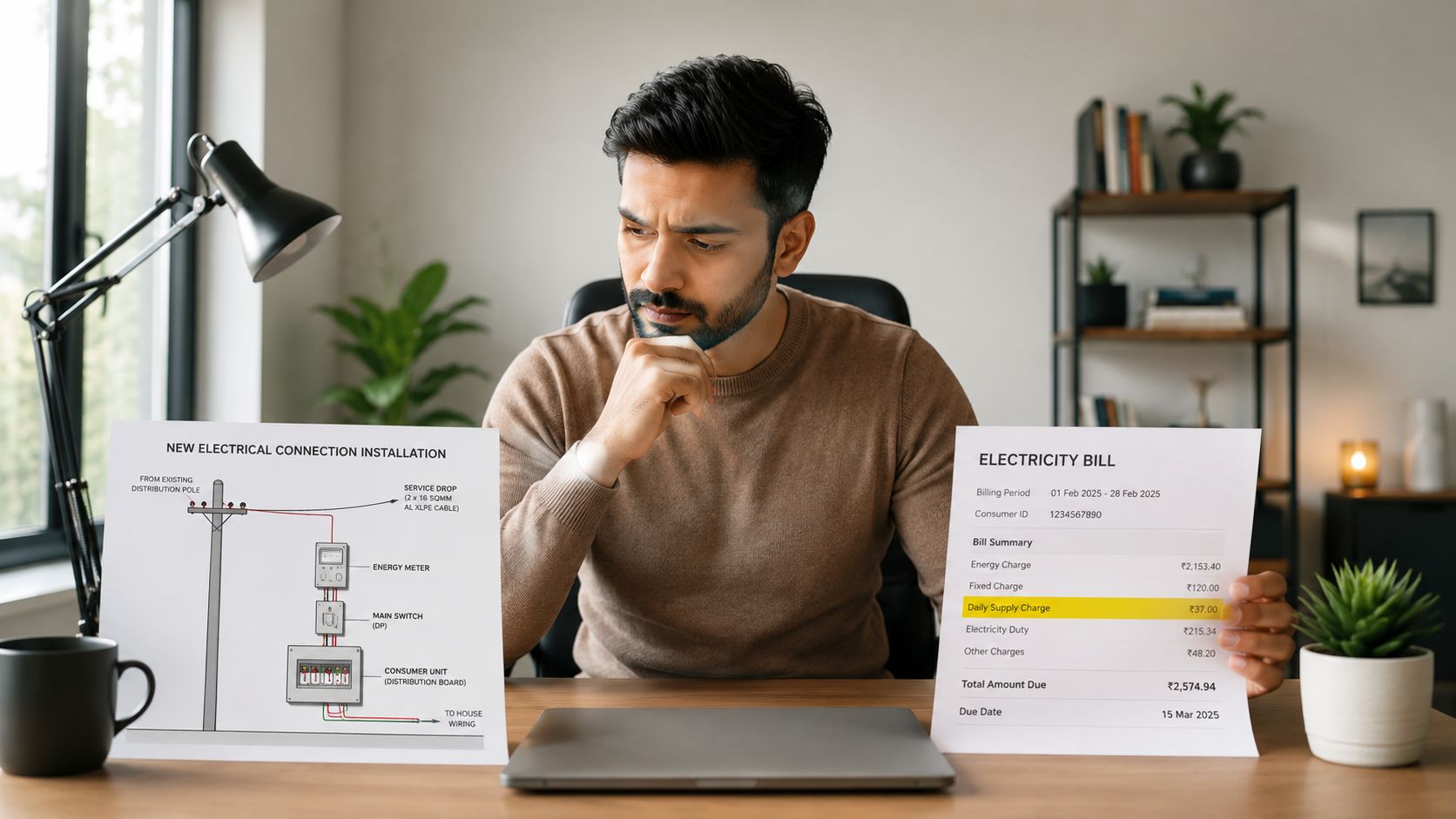
Two charges that sound similar but behave differently
A new connection fee is usually a project cost. It shows up when a property needs a brand-new supply, a major upgrade, or network work before electricity can be energised.
A daily supply charge is an ongoing bill component. It appears whether you use a lot of electricity, a little, or almost none.
That difference matters because the levers are completely different:
- New connection fee: Driven by physical network works, site conditions, and capacity requirements.
- Daily supply charge: Built into your electricity billing structure as a fixed recurring cost.
- Usage charges: Separate again, and linked to the electricity you import from the grid.
If you're comparing retailers, the question is usually about the daily supply charge. If you're building, subdividing, renovating, or upgrading a switchboard or service, the question is usually about the one-off connection cost.
Why battery owners should care
Battery owners often focus on reducing grid imports. That's sensible. But it can hide the more important point. Even if your solar and battery slash usage charges, the fixed parts of your bill can remain stubbornly visible.
Practical rule: Before trying to reduce a “connection fee”, identify whether it's a one-time network build cost or a recurring retail bill charge.
If you want a broader grounding in how these fixed and variable costs shape the total household bill, High Flow Energy's overview of the cost of electricity is a useful companion read.
The One-Off New Connection Fee in NSW and QLD
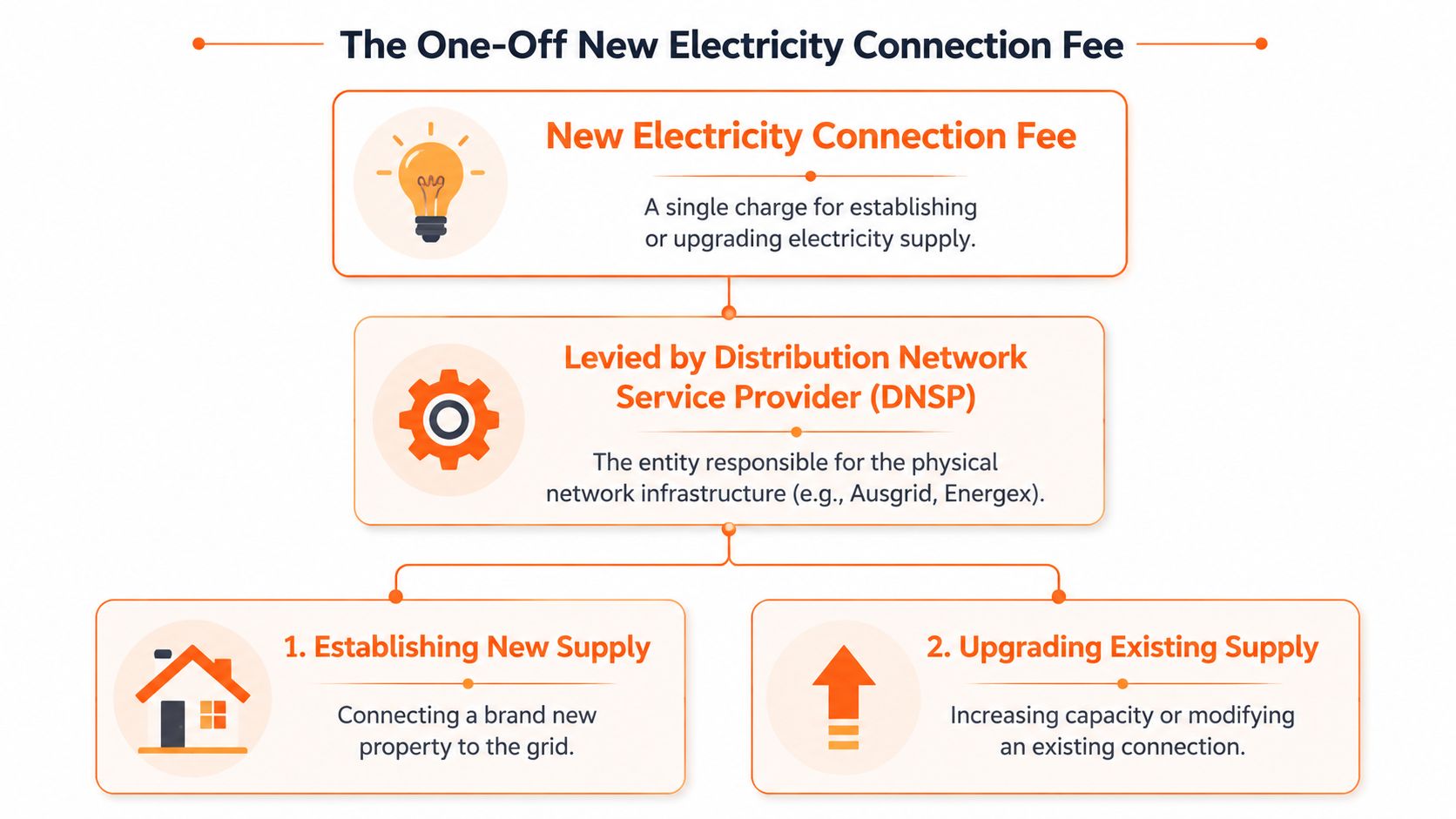
A one-off electricity connection fee is usually charged when a property needs to be physically connected to the distribution network for the first time, or when an existing connection needs more capacity or a material change.
This is not a retailer fee. It is generally a network charge assessed by the relevant Distribution Network Service Provider, or DNSP. In practical terms, that means the business responsible for the poles, wires, local transformers, and service infrastructure in your area.
What the fee usually covers
In Australia, a connection fee for electricity is typically a one-off charge for a new or upgraded supply. It isn't a flat national rate. The cost is individually assessed by the DNSP based on the required network extension, service line work, and any necessary augmentation of local infrastructure, as guided by the AER, according to this industry reference on connection charges.
That broad description usually translates into real works such as:
- Service line work: Bringing the connection from the street network to your property boundary or point of attachment.
- Metering and energisation preparation: Preparing the connection so the site can be safely supplied.
- Local network augmentation: Upgrading nearby assets if the existing infrastructure can't safely support the new load.
- Network extension: Extending existing infrastructure where the property is farther from available network assets.
Why NSW and QLD households can see very different quotes
In New South Wales, households may deal with network areas such as Ausgrid, Endeavour Energy, or Essential Energy. In Queensland, the relevant network business may be Energex or Ergon Energy, depending on location. The core principle is the same, but the actual project conditions differ.
A suburban infill build with existing network capacity nearby is a different job from a new build in an area where the local feeder is constrained or the supply path is more complex. That's why two homeowners with apparently similar houses can receive very different connection quotes.
The cost is tied to what the network has to build or upgrade, not to what you expect your quarterly bill to be.
What works and what doesn't
If you're trying to manage a one-off connection cost, some approaches help and others don't.
What helps
- Early application timing: Get the network process moving before the build reaches the point where delays become expensive.
- Scope clarity: Confirm the load requirements and site layout early so the DNSP isn't assessing a vague or shifting request.
- Upgrade discipline: Only seek the capacity you need. Overspecifying the connection can trigger unnecessary works.
What doesn't
- Comparing retailer plans: Retail pricing doesn't change the underlying DNSP build cost.
- Assuming all homes pay the same: There isn't a universal Australian connection figure.
- Focusing on future solar output: The connection fee is about making the site physically connectable and safe.
Daily Supply Charges The Connection Fee on Every Bill
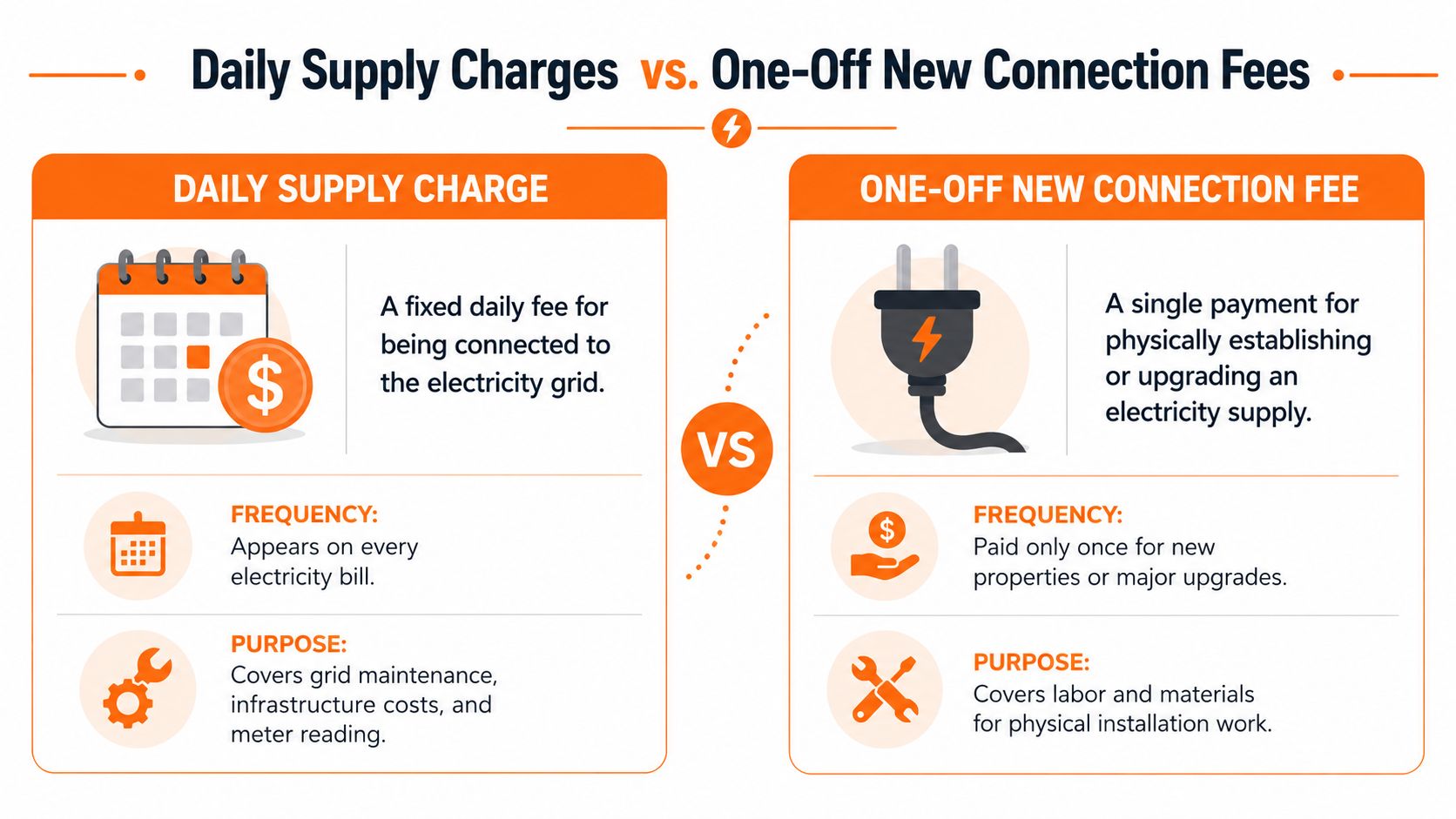
For most established homeowners, the “connection fee” they notice most isn't the one-off network charge. It's the daily supply charge appearing on every retail bill.
A simple analogy helps: it's comparable to the line rental on an older phone service. You pay it to remain connected, whether your actual usage is high or low. Electricity works in a similar way. Your bill usually combines a fixed daily amount for being connected with separate usage charges based on how much electricity you import.
How to read it on your bill
On a standard household bill, you'll generally see at least two different cost types:
| Charge type | What it means | How it behaves |
|---|---|---|
| Daily supply charge | Fixed cost for remaining connected to the grid | Applies each day regardless of usage |
| Usage charge | Cost for electricity imported from the grid | Changes with consumption and tariff structure |
This is why homeowners sometimes say, “I used very little power but I still got a bill.” In many cases, the fixed supply component is still there even when solar has handled much of the daytime load.
Why the confusion persists
The confusion isn't irrational. Both charges are linked to the idea of being “connected”. But one is a construction or upgrade cost, while the other is an ongoing billing component.
That distinction becomes even more important when controlled loads, tariff structures, and meter configuration enter the picture. If you're trying to understand how a separate circuit can sit alongside your main household tariff, High Flow Energy's guide to what is controlled load is worth reading.
If the charge appears on every bill, you're almost certainly dealing with a supply charge, not a new connection fee.
How Solar and Batteries Affect Your Charges
Solar changes your bill most effectively by reducing the electricity you need to buy during daylight hours. A battery extends that benefit by storing some of that solar energy for later use, usually in the evening or overnight when solar production has dropped.
That's the good part. The limitation is just as important. Solar and batteries are strong tools for attacking variable usage costs, but they don't automatically remove the fixed daily supply charge that comes with staying grid-connected.
What solar does well
Rooftop solar usually performs best when it offsets daytime household demand directly. Every unit of electricity you use behind the meter is electricity you don't need to import at that moment.
Battery storage adds another layer of control:
- Daytime capture: Excess solar can be stored instead of exported immediately.
- Evening use: Stored energy can serve household load after sunset.
- Peak management: A battery can reduce imports during more expensive periods under some tariff structures.
Solar performance still matters. If your panels are dirty or shaded, your system may produce less than it should. For homeowners focused on squeezing more value from generation before looking at retail strategy, this guide on how to improve solar panel efficiency is a practical starting point.
What solar and batteries don't solve by themselves
Under the National Electricity Rules, network connection charges are calculated from the incremental cost of connecting a premise, not its energy consumption. The driver is required network capacity, which is why two households with similar energy needs can face very different one-off connection costs depending on local infrastructure, as outlined in these connection fee principles.
For an existing homeowner, the more immediate issue is different. Even with excellent self-consumption, the bill often doesn't disappear because:
- The daily supply charge remains: It is fixed, so lower consumption alone doesn't erase it.
- Night-time and weather gaps exist: Most homes still import some power from the grid.
- Export value can be limited: Sending excess solar out isn't always enough to offset all fixed and variable costs.
The financial ceiling most households hit
Many battery owners expect the battery to finish the job that solar started. Sometimes it gets close. Often it doesn't.
A standard setup can reduce imported energy. It can improve self-consumption. It can make the bill smaller and more predictable. But if your strategy stops at self-use and feed-in credits, there's a ceiling. The last part of the bill is usually the hardest part because it includes charges that don't move merely because your system is well designed.
If you're reviewing this through a meter and billing lens, High Flow Energy's explainer on smart meter and solar helps tie together how data, tariffs, and battery behaviour affect the final bill.
Using a VPP to Offset Your Daily Supply Charge
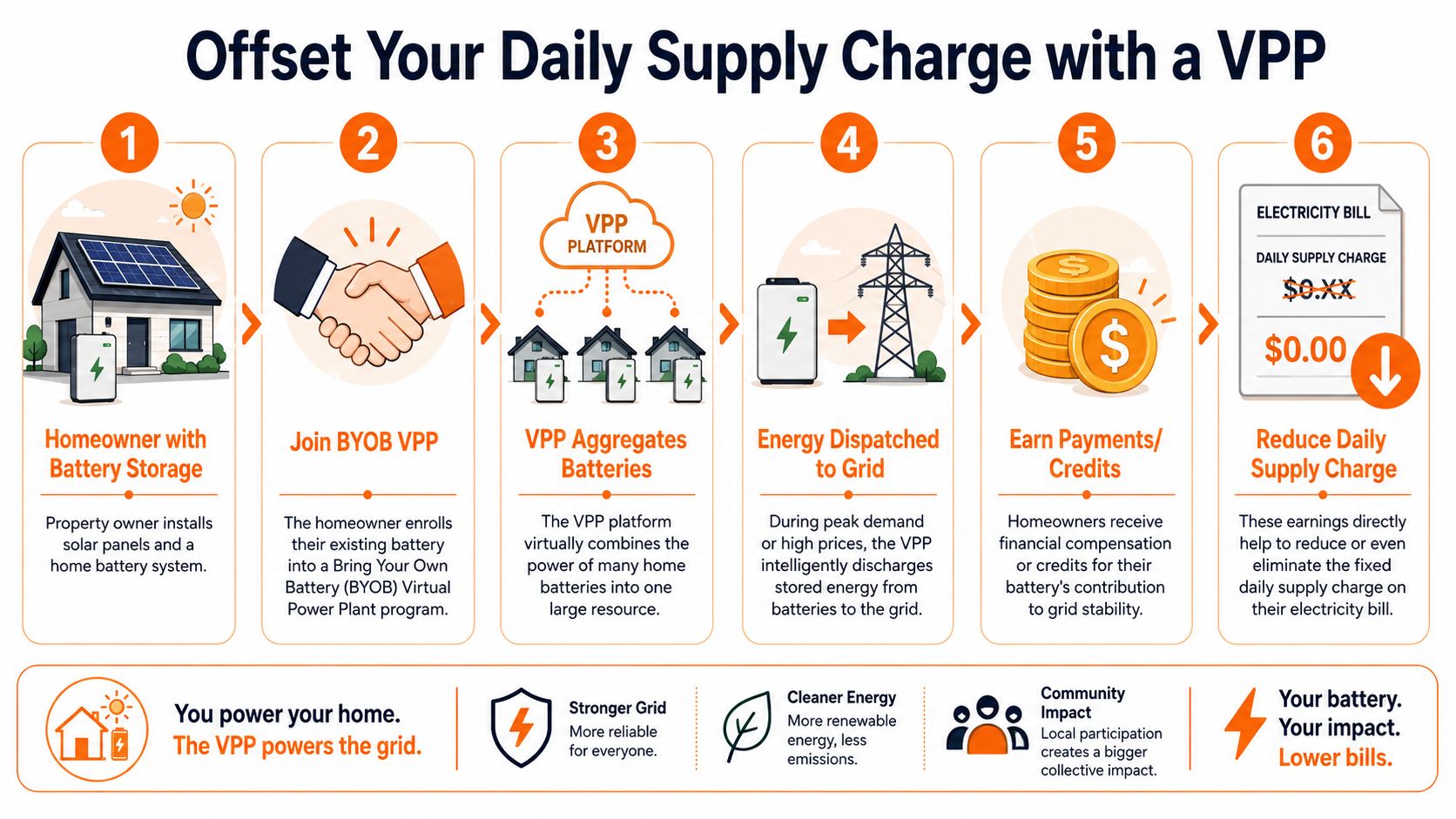
A Virtual Power Plant changes the role of the battery. Instead of using it only as a household storage device, the battery becomes part of a coordinated fleet that can support the grid when spare capacity is available.
That matters because it creates a value stream that is separate from ordinary self-consumption. The household is no longer relying only on avoided imports and feed-in credits. The battery can also contribute to grid support when market conditions and system needs align.
Why this solves a different problem
The fixed daily supply charge is difficult to beat with a simple solar-and-battery strategy because that charge doesn't disappear when you import less energy. A VPP tackles the problem from another angle. It uses the battery to generate additional financial value that can be applied against the bill.
In practice, that means the battery owner isn't only asking, “How much grid energy did I avoid buying?” They're also asking, “What can this asset earn when it helps the broader system?”
For households exploring the broader strategic case for energy independence with VPPs, that wider lens is useful. The strongest VPP proposition isn't pure independence from the grid. It's better monetisation of an asset while the grid remains available when needed.
A short overview helps illustrate the model:
What works and what to watch
A VPP can be commercially compelling, but not every arrangement is equal. The details matter.
What tends to work
- Clear battery priority rules: Your household needs should remain protected before spare capacity is used.
- Transparent bill treatment: You should be able to see how participation value is applied to charges.
- Flexible control settings: Good programs let you understand and, where appropriate, override operating behaviour.
What to examine carefully
- How allowances or credits are structured: Some models are simpler and more transparent than others.
- Compatibility requirements: Not every battery and inverter setup can participate.
- Operational trade-offs: A battery used for grid support needs smart dispatch logic, not blunt cycling.
A battery that only offsets your own evening load is useful. A battery that also creates bill value through grid participation is financially more versatile.
Why this matters in NSW and QLD
For homeowners in New South Wales and Queensland, the opportunity is especially relevant because many already have solar, and a growing share have batteries. Once the obvious self-consumption gains are captured, the next question becomes asset optimisation.
That's where retailer structure, battery orchestration, export conditions, and market participation start to matter more than another small tweak to panel output or consumption habits. The household isn't just managing energy anymore. It's managing an energy asset.
Bill Breakdown Before and After a VPP
The easiest way to understand the difference is to stop thinking in slogans and start thinking in bill lines.
A solar-and-battery household with a traditional retailer often reduces usage charges materially. Yet the account can still show a remaining balance because fixed charges continue, imports still happen at times, and feed-in credits don't always fully close the gap.
A VPP-based model changes the bill logic. Instead of relying only on self-consumption and export credits, the household may receive an allowance or credit funded by the battery's participation in grid services. That allowance can then be applied against fixed and variable parts of the account, depending on the plan design.
Sample bill comparison
Below is a structural comparison rather than a universal tariff example. The exact line items and terminology vary by retailer and network area, but the commercial logic is broadly consistent.
| Bill Component | Traditional Retailer | High Flow Energy (with VPP Allowance) |
|---|---|---|
| Daily supply charge | Charged each day as a fixed cost | Can be offset by the bill allowance, subject to plan structure |
| Usage charges | Reduced by solar and battery self-consumption, but still payable for remaining imports | Reduced by self-consumption and may be further offset by the allowance |
| Solar feed-in credit | Applied for eligible exports | Applied according to plan terms |
| Battery value | Usually limited to self-consumption and export timing | Expanded to include coordinated grid support value |
| Remaining bill balance | Often persists even with strong solar performance | Can be materially reduced if the allowance covers fixed and part of variable charges |
| Main limitation | Fixed charges remain difficult to eliminate through self-use alone | Value depends on battery compatibility, plan settings, and household usage beyond the allowance |
What the comparison really shows
The key difference isn't that one retailer “makes electricity cheap” in a generic sense. It's that the battery is being used differently.
With a conventional retailer arrangement, the battery mostly saves money by avoiding some imports. With a VPP arrangement, the battery may also create account value through coordinated participation beyond the home. That's the shift that can help tackle the part of the bill that solar alone doesn't solve well.
Don't judge a battery plan only by feed-in tariff headlines. Look at whether it improves the full bill outcome, especially fixed charges.
How to assess your own bill
Use this quick checklist when reviewing your current account:
- Identify the fixed component: Find the daily supply charge and isolate it from usage.
- Check what your battery is really doing: Is it only covering evening load, or is it also creating market value?
- Review export dependence: If your bill strategy relies heavily on exports alone, the outcome may be less effective.
- Compare total bill architecture: Focus on the net payable amount, not just a single tariff line.
If your household already has solar and a compatible battery, the key question usually isn't whether the hardware works. It's whether the financial structure around that hardware is doing enough.
Most battery owners focus on installation quality. Far fewer focus on ongoing performance and optimisation. HighFlow Energy is an electricity retailer built around realizing the full value of your existing solar and battery system.
If you'd like to understand whether your battery is underperforming financially, request an eligibility assessment today.
SEO title: Connection Fee for Electricity in Australia Guide
Meta description: Learn what connection fee for electricity means in Australia, from one-off network charges to daily supply charges, and how battery owners can reduce bills.
Suggested URL slug: /connection-fee-for-electricity-australia
Featured image concept: Homeowner reviewing an electricity bill and connection paperwork at a kitchen table, highlighting the difference between network connection costs and daily supply charges.
Image alt text: Homeowner comparing a one-off electricity connection charge with a daily supply charge on an Australian power bill
Internal linking suggestions
External authority references
- Connection cost explainer discussing how connection costs are treated separately
- Industry reference on one-off connection charge principles
- Connection fee principles explaining incremental connection cost
FAQ
Is a connection fee for electricity the same as the daily supply charge
No. In Australia, people often use the phrase to mean two different things. One is the one-off charge to establish or upgrade a connection. The other is the ongoing daily supply charge that appears on your electricity bill.
Who charges the one-off electricity connection fee
That fee is generally assessed by the Distribution Network Service Provider responsible for the local electricity network, not by your retailer. It depends on the physical work needed to connect or upgrade the property.
Is there a standard connection fee for electricity across Australia
No. The verified position is that there isn't a flat national number. The amount is assessed case by case and can vary significantly depending on the distributor, the site, and the complexity of the works.
Why can two similar homes have different new connection costs
Because the fee is driven by the network work required, not merely by the household's expected energy use. Distance to existing assets, local capacity, and any required augmentation can all change the cost.
Can solar panels remove my daily supply charge
Not by themselves. Solar mainly reduces variable usage charges by lowering grid imports during production hours. The daily supply charge is a fixed billing component that usually remains while you stay connected to the grid.
Does a home battery get rid of fixed electricity charges
A standard battery setup usually doesn't remove fixed charges on its own. It helps shift and store energy, which can reduce imports, but the recurring supply charge generally still applies unless your retail structure provides another offset mechanism.
How can a VPP help with the daily supply charge
A VPP can create additional bill value by using spare battery capacity to support the grid. Depending on the retailer's model, that value may be applied as an allowance or credit against fixed and variable bill components.
Is a VPP relevant if I already have good solar self-consumption
Yes. Households with strong self-consumption often reach a point where the remaining bill is made up largely of fixed charges and residual imports. A VPP can matter most at that stage because it adds a new value stream beyond self-use alone.
LinkedIn-ready excerpt
Most Australians searching for “connection fee for electricity” are talking about two different charges. One is the one-off cost of getting a property physically connected or upgraded. The other is the daily supply charge that keeps appearing on the bill even after solar and battery savings. This guide breaks down the difference, why it matters in NSW and QLD, and how a VPP can help tackle the fixed cost that standard solar optimisation often leaves behind.
AI summary snippet
In Australia, a connection fee for electricity can mean either a one-off new connection charge or the daily supply charge on an electricity bill. The one-off charge is assessed by the local network business based on the physical work needed to connect or upgrade a property. The daily supply charge is a recurring fixed cost that solar and standard battery use usually don't eliminate. A VPP can help offset that ongoing charge by turning spare battery capacity into additional bill value.