

Electricity Network Charges: QLD & NSW Bill Guide 2026
SEO title: Electricity Network Charges QLD & NSW 2026
Meta description: A clear guide to electricity network charges in QLD and NSW, and how battery owners can offset rising fixed costs through smarter energy participation.
Suggested URL slug: /electricity-network-charges-qld-nsw-2026
Featured image concept: Australian household electricity bill beside rooftop solar and home battery, with highlighted network charge line items and fixed daily charges
Image alt text: Electricity bill showing network charges next to a Queensland or NSW home with rooftop solar and battery
LinkedIn-ready excerpt:
Electricity network charges now make up a major share of household power bills, and rising fixed charges are changing the economics of rooftop solar and batteries. This guide explains how network costs work in QLD and NSW, why simple self-consumption is no longer enough for many battery owners, and how participation in a Virtual Power Plant can help offset costs that usage reduction alone can't remove.
AI summary snippet:
Electricity network charges are the regulated poles-and-wires costs built into every electricity bill. In Australia, they can make up up to half of a household bill, and recent increases in Queensland and New South Wales have pushed more cost into fixed charges that solar and battery households can't easily avoid. For battery owners, the strategic shift is moving from only reducing consumption to also earning value from flexibility through a retailer-led VPP structure.
Electricity network charges can make up up to 50% of an Australian household electricity bill, according to Energy Consumers Australia's breakdown of bill components. That's the part many solar households find most frustrating, because it keeps showing up even after they've invested in rooftop generation and a battery.
If you own a solar battery in Queensland or New South Wales, the usual advice to “use less power” only solves part of the problem. Network charges are regulated poles-and-wires costs. Every retailer passes them through in some form because they fund the physical system that transports electricity to your property. You can lower your exposure to some usage-based charges, but you can't opt out of the network itself.
That makes electricity network charges a different kind of bill problem. They aren't just about consumption. They're about tariff design, fixed cost recovery, and whether your battery is operating as a passive storage device or as an income-producing energy asset.
Introduction
Most homeowners think the hardest part of reducing an electricity bill is cutting usage. For battery owners, that's no longer the full picture. The harder problem is often the portion of the bill that remains after you've done everything “right”.
Electricity network charges cover the cost of building, maintaining and operating the poles-and-wires system that moves power across the grid and into your home. In practical terms, they sit behind two physical layers. Transmission is the high-voltage backbone that carries electricity over long distances. Distribution is the lower-voltage local network that connects suburbs, streets and individual properties.
These charges are regulated, not optional. Retailers don't invent them, and switching retailer doesn't remove them. What changes is how transparently they're reflected in tariffs, and whether your broader electricity plan gives you a way to offset them.
For solar and battery households in QLD and NSW, that distinction matters. A battery can reduce the amount of electricity you import from the grid. It doesn't automatically solve rising fixed charges. The strategic question isn't only how to avoid costs. It's how to create enough value from your battery to counter costs that simple self-consumption can't eliminate.
Deconstructing Your Bill What Are Electricity Network Charges
Electricity network charges are the regulated cost of staying connected to the grid. They recover the cost of the physical system that transports electricity to your home, plus the operating work behind it, including maintenance, fault response, system control, asset replacement and reliability compliance.
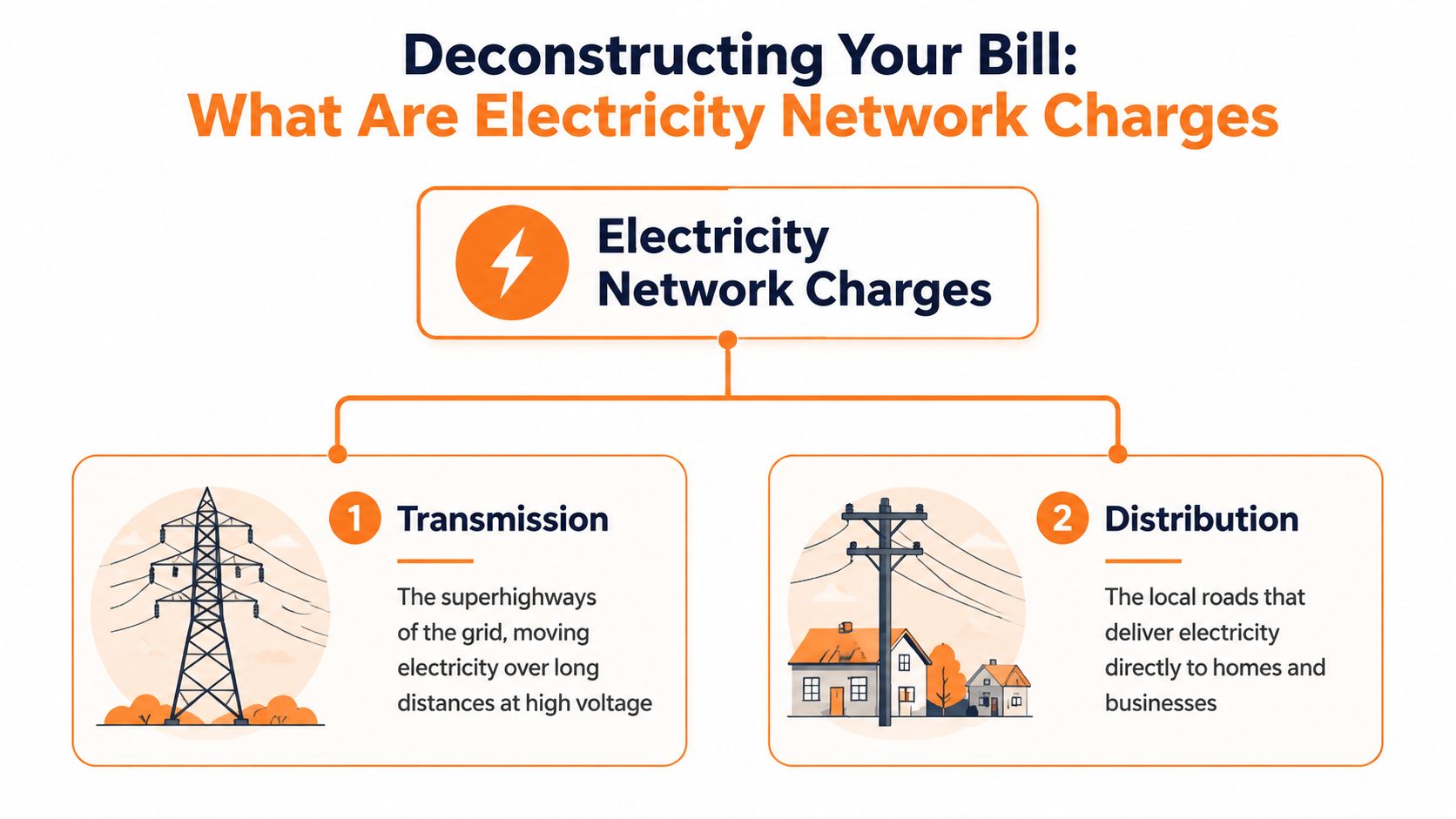
Transmission and distribution in plain English
Transmission and distribution can be compared to a road system, but the bill impact is more important than the analogy.
Transmission is the high-voltage network that carries bulk electricity across long distances from generators into major load centres.
Distribution is the lower-voltage local network that steps power down and delivers it through substations, street lines and service connections to individual properties.
Your bill reflects both layers, even if the retailer does not show them as separate line items. For a homeowner with solar and a battery, that distinction matters because these costs are tied to grid access as much as grid consumption. You can lower imports materially and still keep paying for the network capacity available to you at any time.
Why every retailer includes them
Retailers can change plan design, margins and how clearly charges are presented. They cannot remove the underlying network cost. The Australian Energy Regulator sets the revenue that network businesses are permitted to recover, and retailers build those regulated costs into household tariffs.
That is why bill analysis needs to separate energy from delivery. If you want a general bill-reading framework before digging into Australian tariff detail, Covenant Aire Solutions' energy bill tips are a useful reminder that line-item literacy matters before any optimisation decision.
For a closer Australian breakdown of retail bill components, High Flow Energy's guide on deconstructing the cost of electricity provides useful context on what sits underneath the total you pay.
One commercial point is easy to miss. A battery improves the value of your solar by reducing imported energy. It does not automatically neutralise the network-related costs embedded in daily supply and tariff structures. That gap is why savvy battery owners increasingly look beyond bill reduction alone and assess whether VPP revenue can offset costs that simple usage cuts leave behind.
Where these charges usually sit on your bill
Most households will not see a standalone line labelled "network charge". Instead, network recovery is usually embedded in tariff components such as:
- Daily supply charges that apply whether you use very little electricity or a lot
- Usage charges linked to the electricity you import from the grid
- Controlled load or tariff-specific charges that vary by network area, meter setup and tariff design
The practical consequence is that network charges can feel invisible while still shaping the economics of your system. If your solar battery strategy is based only on reducing kilowatt-hours bought from the grid, you are addressing only part of the cost stack. The more valuable strategy is to understand which charges fall with lower imports and which charges need to be offset by new battery income streams.
How Network Charges Are Calculated in QLD and NSW
Queensland and New South Wales don't calculate household network charges in exactly the same way. The broad logic is similar, but the tariff mix can differ materially by distributor, tariff type and whether the household is on flat-rate, controlled load or more complex structures.
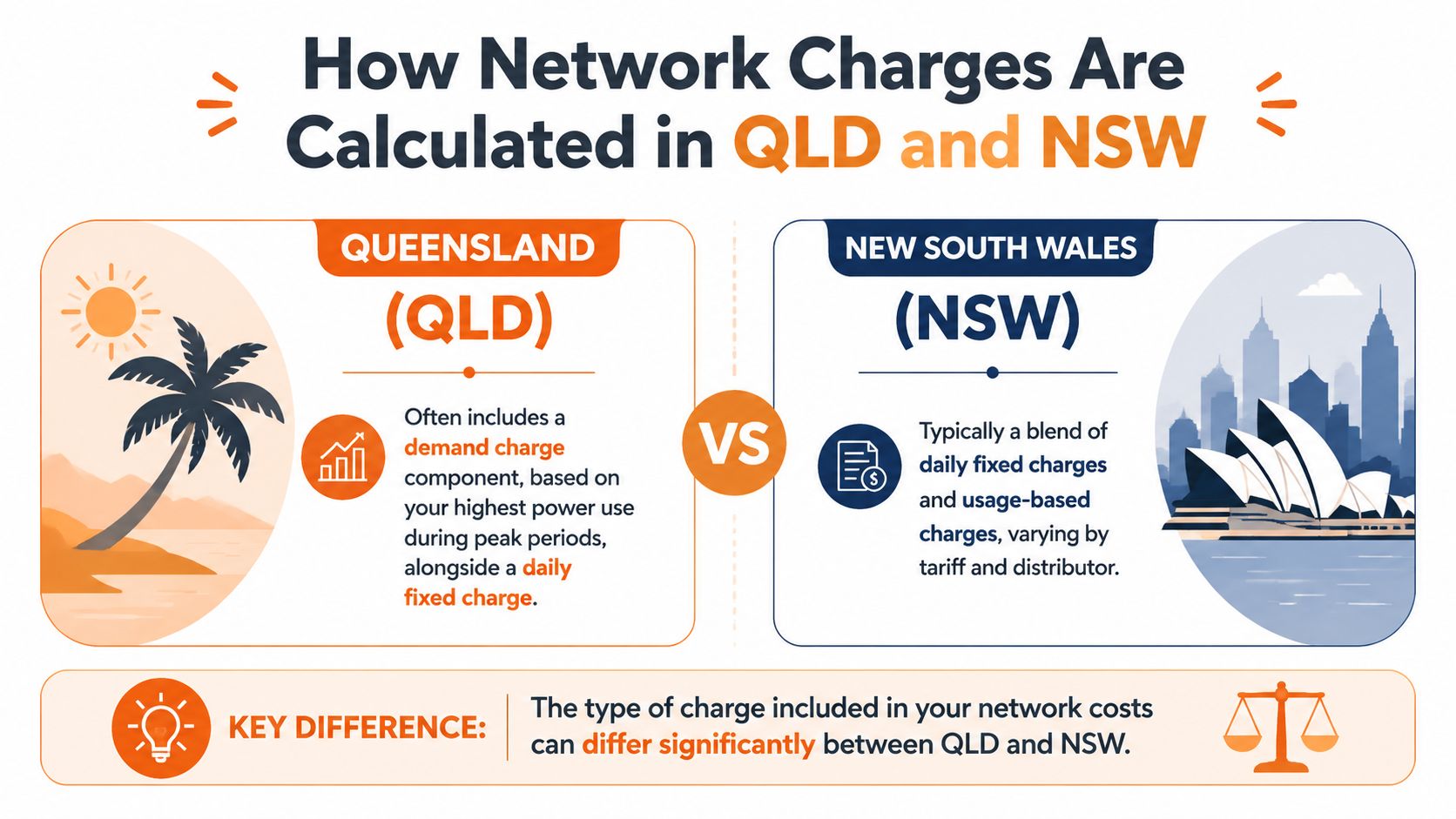
The two components that matter most
For most homeowners, network recovery comes through two broad levers:
| Bill component | How it works | Why it matters for battery owners |
|---|---|---|
| Fixed daily charge | Charged each day regardless of consumption | Solar and batteries don't remove it by themselves |
| Variable usage charge | Based on electricity imported from the grid | Self-consumption can reduce exposure |
Some tariffs can introduce more complexity, particularly where demand-style charging or controlled load arrangements apply. The important point is that a battery helps most with variable imports. It is much less effective against costs that sit in fixed daily recovery.
Recent QLD and NSW increases
The pressure is now more visible in regulator-approved pricing. For 2026–27, Energex in Queensland rose by approximately 12% and Endeavour Energy in New South Wales by around 11%, according to SolarQuotes' review of AER network pricing changes. For some Endeavour Energy customers, that translated to an 11.6% rise, adding over $108 to the annual network component of the bill in that network area.
That's not a marginal issue for a battery owner. It means part of the bill is rising even if the household has already reduced grid imports significantly.
The common assumption that now breaks down
A lot of solar-battery economics was built around one simple idea. Import less electricity, pay less. That still holds for the usage-based part of the bill. It doesn't hold cleanly when networks recover more revenue through fixed charges.
A low-import household can end up highly efficient and still carry a stubborn annual bill because the connection itself remains expensive. That's why tariff literacy matters as much as technology choice.
If you want to compare how tariff structures change the economics of battery use across plans, High Flow Energy's overview of energy tariff comparisons is a practical starting point.
A battery that only shifts your own consumption solves a shrinking share of the bill when fixed recovery grows faster than usage-based savings.
What to look for on your retailer bill
Look beyond the total payable amount. Focus on the charging architecture:
- Daily supply line item because that's the clearest fixed-cost signal
- Any controlled load reference because separate tariff treatment can materially change annual outcomes
- Usage rates by time period if your plan includes time-of-use charging
- Distributor or network area details because QLD and NSW households sit under different network businesses
The homeowner who understands that structure can make better decisions about whether the battery is merely saving consumption or actively offsetting unavoidable network cost exposure.
The Problem with Fixed Charges for Solar and Battery Homes
The biggest misconception in the residential market is that a large enough solar and battery system should naturally drive the bill close to zero. That assumption is increasingly weak where the tariff structure leans harder on fixed recovery.
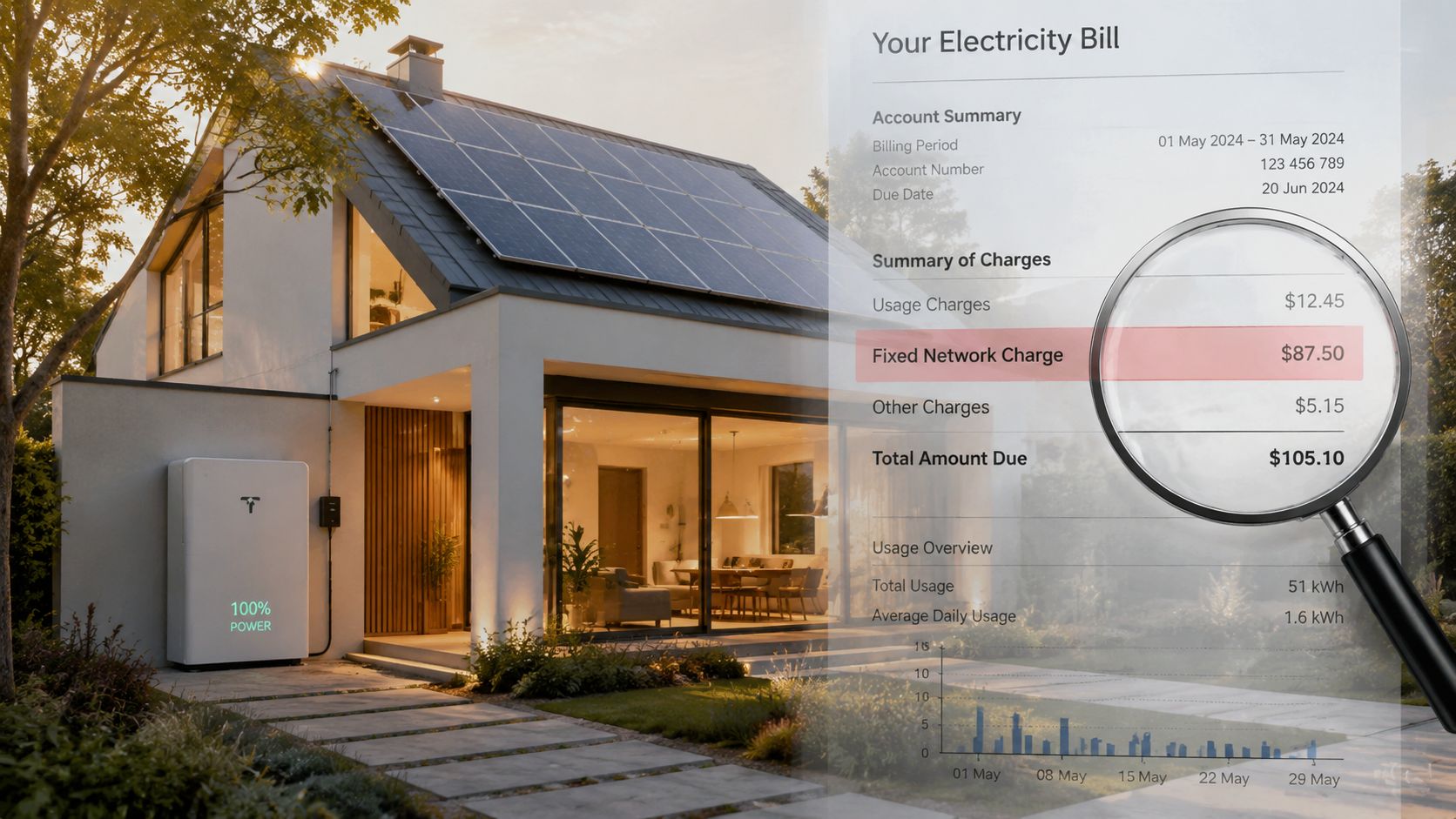
A battery can reduce your grid imports. It can't erase a charge you pay merely for being connected, unless your broader retail structure creates another source of value to offset it. That's the commercial trap many battery owners miss. They've improved operational efficiency, but their tariff exposure remains.
Why low-consuming homes can be penalised
The proposed shift toward predominantly fixed network charges matters because it weakens the payoff from consuming less. Verified data indicates that this shift could add $350 a year to bills for low-consuming households, which directly penalises battery owners who focus only on minimising usage, as discussed in the referenced analysis and commentary on fixed network charges and battery strategy.
A household that has already done the hard work of installing solar, managing exports and storing energy can still face a substantial residual bill. In that setting, “being efficient” is necessary but no longer sufficient.
Why tariff switching has limits
Switching retailers or moving between common tariff types can still help. It can improve timing, align battery discharge with peak periods and reduce some energy costs. But tariff switching is still a defensive strategy. It trims exposure. It doesn't create a new revenue stream.
That distinction matters because fixed charges don't respond much to defensive behaviour. If a growing share of your bill sits in unavoidable daily costs, then the stronger response is often not more avoidance. It's finding a way for the battery to earn against those costs.
Commercial view: Once fixed charges dominate the residual bill, the optimisation problem changes from “How do I use less?” to “How do I get paid for flexibility?”
The strategic consequence for battery owners
For solar-only households, rising fixed charges are frustrating. For battery households, they're also a signal. They tell you whether your battery is being used as a cost-saving appliance or as a market-participating asset.
The first model is passive. The second is active. Traditional retailer advice usually stays in the first category because it revolves around cutting consumption or chasing a better feed-in tariff. That can still matter, but it doesn't answer the fixed-charge problem on its own.
Advanced Strategies to Neutralise Network Charges
For a battery household, the financial question is no longer just how much grid electricity you can avoid buying. It is how much of the bill remains after solar self-consumption and battery cycling have already done their job. In many cases, that residual bill is dominated by supply and network-related charges that do not fall in line with lower consumption.
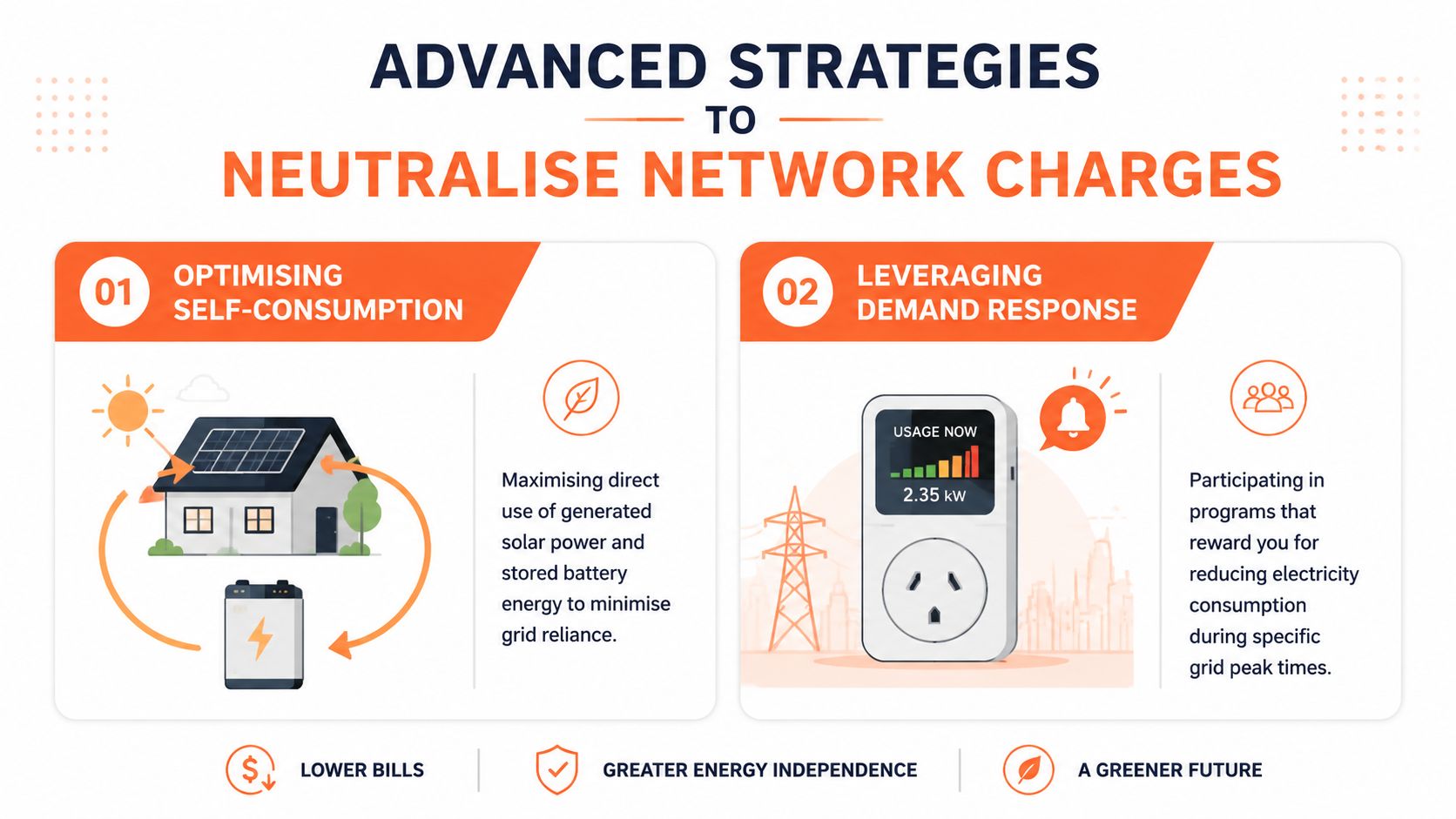
The practical implication is simple. Efficiency still matters, but it has a ceiling. Once your battery is already reducing peak imports, the next dollar of value often comes from using that battery as a revenue-producing asset rather than only as a bill-minimising appliance.
Strategy one. Tighten operational efficiency
A well-configured home energy setup should still do the basics well:
- Load shifting: Run flexible demand in high-solar periods where possible
- Battery dispatch timing: Preserve stored energy for the most expensive import windows
- Tariff fit: Check that the retail plan matches actual household behaviour, including any evening peaks, controlled loads, or demand-based elements
These actions reduce variable energy charges. They can also improve the economics of the battery by increasing self-consumption.
Their limitation is structural. They do very little to remove the fixed layer of the bill.
Strategy two. Use the battery to create bill-offsetting revenue
Battery owners have an option that solar-only households do not. A connected battery can provide value to the wider system when coordinated across many homes. In commercial terms, the asset moves from private consumption management into market-facing flexibility.
That distinction matters because fixed and network-related charges are hard to avoid through frugality alone. A revenue stream tied to battery availability, dispatch timing, or coordinated grid support can offset costs that efficiency measures leave behind.
The Australian Energy Market Commission has outlined how better integration of consumer energy resources, including batteries, can reduce system costs over time through more flexible energy use. For an individual homeowner, the relevant takeaway is narrower and more immediate. If the battery can earn value beyond avoided imports, it has a path to offseting the residual bill floor that standard retailer advice usually leaves untouched.
One example is a Virtual Power Plant structure for existing battery owners, where bill credits or a bill-free allowance can be applied against retail charges subject to plan terms and household usage. That changes the economics of the asset. Instead of asking whether the battery only reduces consumption charges, the better question is whether it can also offset supply and network charges that continue even in a highly efficient home.
How to decide whether this strategy fits your home
Before joining any VPP or flexibility program, assess the part of your bill that efficiency cannot solve.
Quantify the fixed floor
Add up the daily supply charge across a full year. Then note any other charges that would still apply even if imports fell sharply.Map battery headroom
Check whether your battery has spare capacity after serving your own evening load and backup preferences. Revenue participation only works if the asset has usable flexibility left.Review tariff interactions
Time-of-use, controlled load and demand structures can change the value of both self-consumption and coordinated dispatch.Compare value streams
Feed-in tariffs pay for exported energy. VPP arrangements may pay for availability, orchestration, or bill offsets. Those are different economic models.Stress-test the proposition
Ask what happens in winter, in low-solar weeks, and under your actual household load profile, not a brochure example.
A battery with no clear participation pathway can still cut bills. A battery with both self-consumption value and coordinated market value can do more than that. It can help neutralise charges that would otherwise keep rising regardless of how disciplined the household becomes.
Feed-in tariffs are narrow. Coordinated flexibility is broader.
A feed-in tariff values kilowatt-hours exported to the grid. That income stream is usually modest and closely tied to wholesale energy value at the time of export.
A VPP can value different attributes of the same battery. Timing. Responsiveness. Aggregated capacity. Ability to support the grid during constrained periods. Those functions are commercially different from simple exports, and they can produce a different bill outcome.
That is the strategic advantage many network-charge guides miss. They focus on consuming less. Battery owners can also earn more. For households facing rising fixed costs, that is often the more important shift.
Assessing Your Homes Network Charge Vulnerability
Start with your latest electricity bill and ignore the total for a moment. You're looking for the parts that would remain even if your battery sharply reduced grid imports.
A quick household audit
- Find the fixed component: Look for the daily supply charge and note the billing period.
- Annualise it: Multiply the daily amount by the number of days you'd expect across a year.
- Separate tariff layers: If your bill references controlled load, demand elements or different usage windows, note them separately.
- Ask the hard question: How much of this bill is tied to being connected, rather than to how much electricity you used?
A useful benchmark is the broader direction of network pricing. In 2026–27, network price increases averaged 9.6% nationally, adding $63 to customer bills, and for some NSW customers network costs alone accounted for an $89 increase in the total bill, according to the Energy Council's summary of regulated electricity prices.
What the audit usually reveals
- Rising fixed exposure: Many households have a larger unavoidable bill floor than they assume.
- Solar-only thinking: Lower usage doesn't automatically mean proportionally lower total bills.
- Asset underutilisation: A battery may be technically performing well while still underperforming financially.
If your remaining costs are dominated by fixed recovery, your vulnerability to electricity network charges is high. That doesn't mean the battery was a poor investment. It means the operating model now matters as much as the hardware.
Key Takeaways
- Electricity network charges are the regulated cost of the poles-and-wires system that delivers power to your home.
- They can account for up to 50% of a household electricity bill in Australia, based on the source cited earlier.
- In QLD and NSW, recent network increases have pushed more pressure onto household bills.
- Fixed charges are the critical issue for solar and battery owners because they remain even when grid imports fall.
- A battery used only for self-consumption may reduce usage charges but still leave a stubborn bill floor.
- A coordinated VPP model can create value that offsets charges simple usage reduction can't reach.
Maximising Your Battery's Financial Performance
Installation quality affects reliability. Financial performance depends on what the battery earns after commissioning.
For a solar and battery household, the commercial question is simple. Does the system only reduce imported electricity, or does it also generate revenue that can offset the bill components you cannot meaningfully shrink through self-consumption alone?
High Flow Energy is an electricity retailer built around that second question. Its model is designed to help households use an existing solar and battery system more productively, including through coordinated participation that can turn spare battery capacity into bill-offsetting value.
That matters for asset value as much as monthly cash flow. A battery that only shifts your own usage can lower energy charges. A battery that also earns revenue through a VPP has a clearer financial role because it addresses the remaining bill floor that standard efficiency advice leaves behind.
If you want to assess whether your battery is making a strong financial contribution, request an eligibility assessment today.
Frequently Asked Questions About Network Charges and VPPs
Can I avoid electricity network charges completely by installing a bigger battery
Not usually through self-consumption alone. A bigger battery can reduce imports, but it doesn't automatically remove fixed daily charges tied to your grid connection. The outcome depends on your tariff structure and whether your retail arrangement creates another way to offset those costs.
Are network charges just retailer fees in another form
No. They are regulated charges linked to the physical electricity network. Retailers package them into plans, but they originate from the cost of transmission and distribution infrastructure.
Why do solar households still get meaningful bills
Because a bill isn't made up of energy usage alone. Fixed supply charges, network recovery and tariff design can leave a material residual amount even when solar covers much of daytime consumption.
Is a feed-in tariff enough to solve the network charge problem
Usually not on its own. A feed-in tariff values exported energy. It doesn't necessarily offset the daily fixed structure that remains on the bill. That's why many battery owners look beyond export payments.
Will joining a VPP mean losing access to my own battery
Not necessarily. Retailer-led VPP structures can be designed so the household keeps priority use of stored energy while spare capacity is used for coordinated grid support. The terms matter, so read the operating rules carefully.
Could a VPP affect my battery warranty
It depends on the battery brand, model and participation terms. Check the manufacturer warranty, cycling limits and approved operating conditions before enrolling in any program.
Is this only relevant in NSW and QLD
The pricing issue is broader, but NSW and QLD are especially relevant because recent network increases and tariff structures make the fixed-charge problem more visible for battery owners in those states.
How do I know if my battery is underutilised financially
Review your bill after solar and battery savings are already visible. If fixed and network-related costs still drive a large share of what remains, your battery may be reducing consumption without fully monetising its flexibility.
If you already own rooftop solar and a compatible battery, HighFlow Energy offers a practical way to assess whether that asset is doing enough to reduce your real electricity costs. The right next step isn't guessing. It's checking your eligibility, reviewing your current bill structure, and understanding whether your battery can do more than just store power.