

Finding Australia’s Greenest Energy Provider: A 2026 Guide
Most advice about finding the greenest energy provider starts in the wrong place. It tells households to compare labels, renewable claims, or GreenPower options as if buying a greener tariff is the highest-impact decision available.
For many battery owners in Queensland and New South Wales, it isn't. The more important question is whether your home is only consuming green electricity, or whether your battery is actively helping the grid absorb more renewable energy and reduce pressure during demand events. That's a very different standard.
A homeowner who buys a green product is making a passive choice. A homeowner who joins a well-structured BYOB VPP is participating in the power system itself. That shift matters commercially, technically, and environmentally. It also changes how you should compare retailers, VPP programs, and any company claiming to be the greenest option in Australia.
Deconstructing Greenest What This Label Really Means
The phrase greenest energy provider sounds precise, but in the Australian market it often bundles together very different claims.
Some retailers sell GreenPower-backed electricity. Some own renewable generation assets. Others market carbon-neutral or offset-based offers. Those aren't interchangeable. They affect cost, grid outcomes, and credibility in different ways.
The first problem is that many comparisons stop at the retail label. Choice notes that the common narrative around green providers often misses the distinction between buying 100% green power via GreenPower, which costs 10 to 50% more, and using a home battery in a VPP, which can create grid value without that premium surcharge. The same Choice analysis also notes that rooftop solar forms 13% of grid power in Australia and that over 1 million household batteries are projected by 2030 (Choice on green electricity and GreenPower).
Three claims that often get confused
GreenPower-backed retailing means a customer pays for accredited renewable purchasing. That can be meaningful, but it's still primarily a procurement decision at the retail layer. It doesn't automatically mean the provider itself only operates renewable assets, and it doesn't mean the household is helping manage grid stress during peak demand.
Asset-backed renewable generation is different. A company that owns and operates wind, solar, or hydro generation can point to direct renewable supply credentials. That tends to be a stronger claim when assessing source purity.
Offset-based positioning is different again. Offsets may play a role in corporate emissions strategies, but they don't tell you much about whether the electricity product itself improves renewable integration, storage use, or local grid performance.
Green credentials aren't all equal. Some relate to what a retailer buys. Others relate to what a company owns. The most consequential claims relate to how a household asset interacts with the grid.
Why labels alone can mislead
Australia has made real progress in renewable generation. Over one-third of all electricity generated in Australia now comes from renewable sources, including biomass, solar, wind, and hydro, according to the Wikipedia summary of renewable energy in Australia. That's important context. It means a growing share of the grid is already becoming cleaner.
But it also means the next challenge isn't only adding more renewable generation. It's using storage, flexibility, and demand response to make that generation more usable when the grid needs it most. A retailer can market a green plan without solving that system problem.
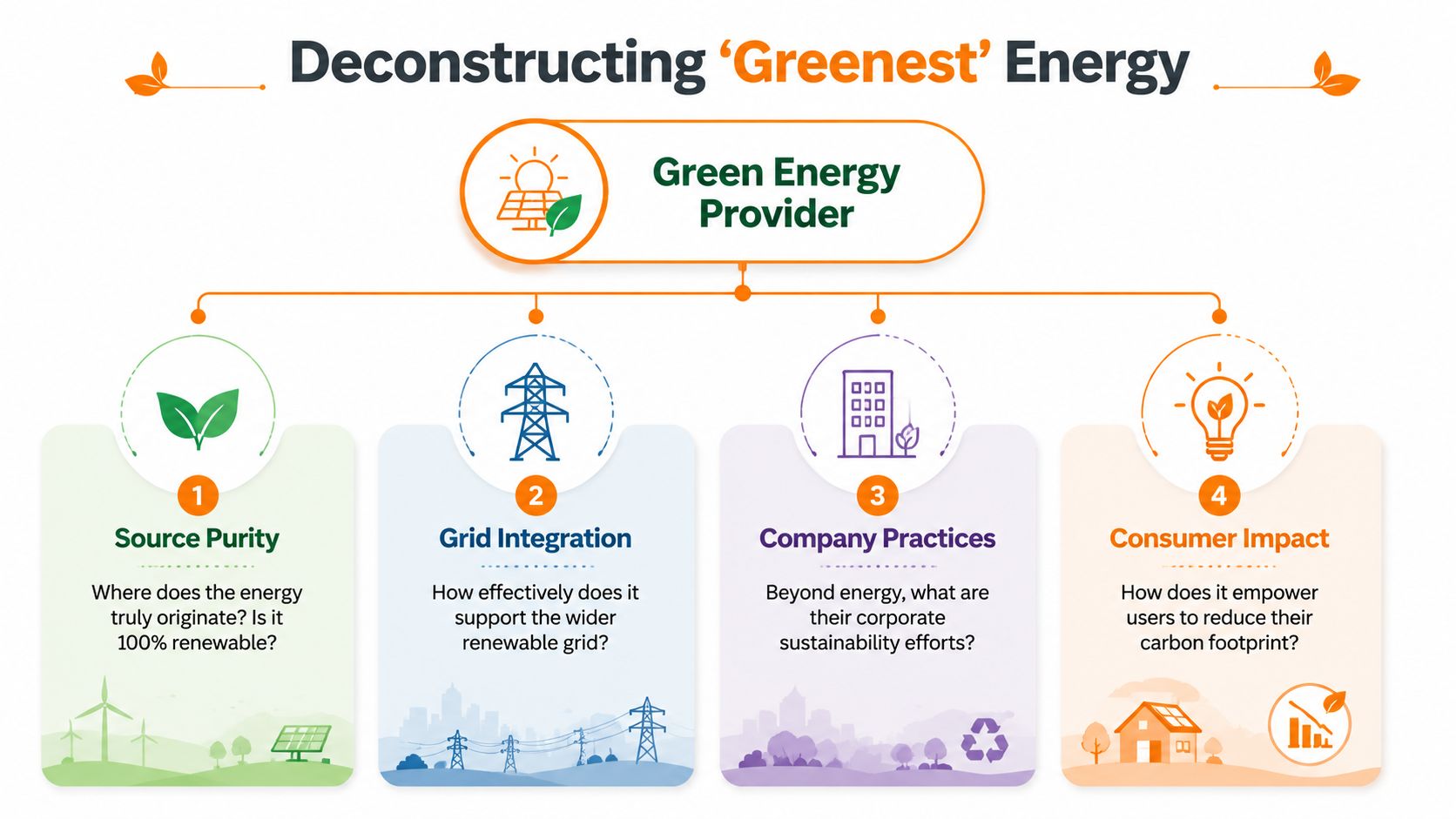
For a battery owner, the sharper definition of “greenest” should include four questions:
- Source integrity. Is the underlying electricity claim tied to actual renewable generation?
- System impact. Does the model help the grid use more renewable energy when conditions are tight?
- Commercial efficiency. Are you paying a premium for the label, or extracting more value from an asset you already own?
- Corporate clarity. Does the broader business structure support the green claim, or complicate it?
That framework leads to a less obvious conclusion. The greenest choice for a battery owner may not be the provider with the strongest marketing language. It may be the model that turns your battery into an active grid-balancing asset.
A Comparison of Green Energy Provider Models
The easiest way to cut through marketing is to compare provider models, not slogans. “Green” can mean renewable generation ownership, a retail add-on, or an active distributed energy model. Each works differently.
Here's a practical comparison.
| Provider Model | Mechanism | Typical Consumer Cost | Grid Impact |
|---|---|---|---|
| True renewable generator | Owns and operates renewable generation assets such as wind, solar, or hydro | Varies by retail structure. Not inherently tied to a premium in this comparison | Strong generation-side decarbonisation. Less direct household flexibility unless paired with storage coordination |
| Major retailer with GreenPower add-on | Customer pays for accredited green purchasing on top of a standard retail relationship | GreenPower can cost more, based on the earlier Choice reference | Supports renewable purchasing claims, but doesn't by itself optimise home battery dispatch or demand response |
| Technology-led retailer using a VPP | Coordinates customer batteries to support grid demand events and battery optimisation | Focus is on performance and asset value rather than a simple green premium | Directly supports grid balancing, renewable integration, and dispatchable household storage |
Model one means generation purity
Pacific Blue is a clear example of a provider with strong source credentials. According to Pacific Blue, it is an Australian energy provider specialising in 100% renewable energy generation and owns and operates solar, hydro, and wind generation assets across Australia, with zero fossil fuel contribution to its generation portfolio.
That matters. If your question is, “Which company has the cleanest owned generation base?”, this is the kind of evidence that counts. It's a stronger claim than a retailer reselling or offsetting.
Still, generation purity and customer impact aren't the same thing. A household with solar and a battery needs to ask a second question. Does the retail model only supply clean energy, or does it also utilize the flexibility value of the battery sitting in the garage?
Model two means paying for a greener retail product
The GreenPower path is familiar. It gives households a way to buy a cleaner retail offer without changing their hardware. For renters or non-solar households, that can be a rational step.
For battery owners, it may be less compelling. You already have a controllable energy asset. Paying more for a passive green label can be less effective than participating in an operating model that lets your battery discharge at the right time and support the broader market.
A lot of industry commentary still underplays that distinction. If you're interested in how renewable businesses expand and structure themselves beyond simple retail claims, this overview of scaling renewable energy companies is a useful commercial read.
Model three means active grid participation
A technology-enabled VPP retailer approaches “green” from a different angle. Instead of asking only where your electricity is sourced, it asks how your battery can be orchestrated to improve system performance while preserving household benefit.
That's the key difference. The household moves from consumer to market participant.
This distinction is especially important when comparing decentralised energy models. For readers weighing local energy coordination models, the difference between virtual power plants and microgrids is worth understanding because both are often discussed as “community energy” even though they solve different problems.
Analyst view: The strongest green offer for a battery owner is rarely the one with the simplest label. It's the one that combines credible renewable alignment with operational value from storage.
The Untapped Decarbonisation Power in Your Home
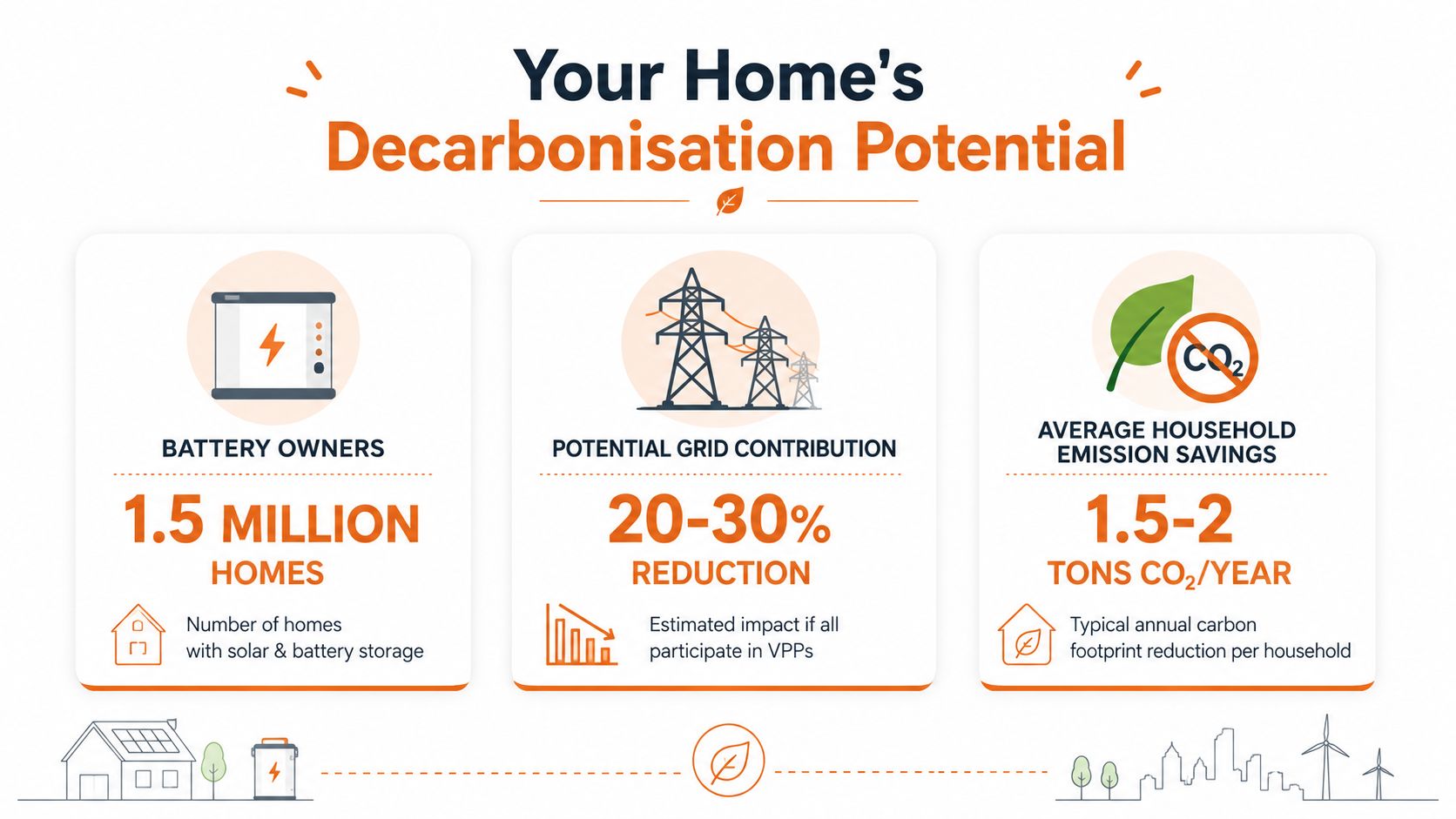
For a battery owner, the biggest climate contribution usually does not come from switching to a greener retail label. It comes from changing how a home energy system behaves once solar output is high, evening demand rises, or the grid is strained.
Australia already has a large and growing base of rooftop solar. The weak point is coordination. Many homes can generate clean electricity in the middle of the day, but without storage or smart control, much of that value is exported at the wrong time or used only to lower an individual bill. A battery changes that equation, especially when household demand is monitored and shaped around smart home energy consumption patterns.
Your battery has two jobs
One job is private. It helps a household store solar, reduce evening imports, and in some systems maintain backup capability.
The second job is economic and system-facing. A battery can charge when solar is abundant, hold energy through low-value periods, and discharge when the grid would otherwise rely more heavily on expensive or higher-emissions supply. That operating pattern matters more for decarbonisation than the marketing colour of a retail plan.
A passive green product mainly changes the accounting attached to your consumption. An actively managed battery can change the timing of electricity flows on the grid.
Underused batteries carry an opportunity cost
A battery that sits idle for most of the year is still an asset, but it is not doing all the work it could. Across thousands of homes, that underuse matters. It leaves flexible capacity stranded behind the meter while networks and wholesale markets continue paying for support elsewhere.
This is also why system maintenance should not be dismissed as a side issue. If rooftop solar underperforms because panels are dirty or shaded, the battery has less low-cost energy available to store and shift into higher-value periods. For households reviewing output, Sparkle Tech's cleaning how-to guide is a practical reference.
Why this matters in Queensland and New South Wales
QLD and NSW operate inside the National Electricity Market, where timing drives value. A battery that exists on-site is different from a battery that can respond during tight supply periods, high wholesale prices, or local network stress.
That changes the meaning of "greenest provider" for battery owners. The opportunity for battery owners is not just buying cleaner energy. It is using an existing household asset to increase renewable utilisation when it helps the system most.
Your home is no longer only a point of consumption. With solar, storage, and the right operating model, it can contribute flexible capacity to a grid that increasingly needs fast, distributed support.
How a VPP Turns Your Battery into a Grid Asset
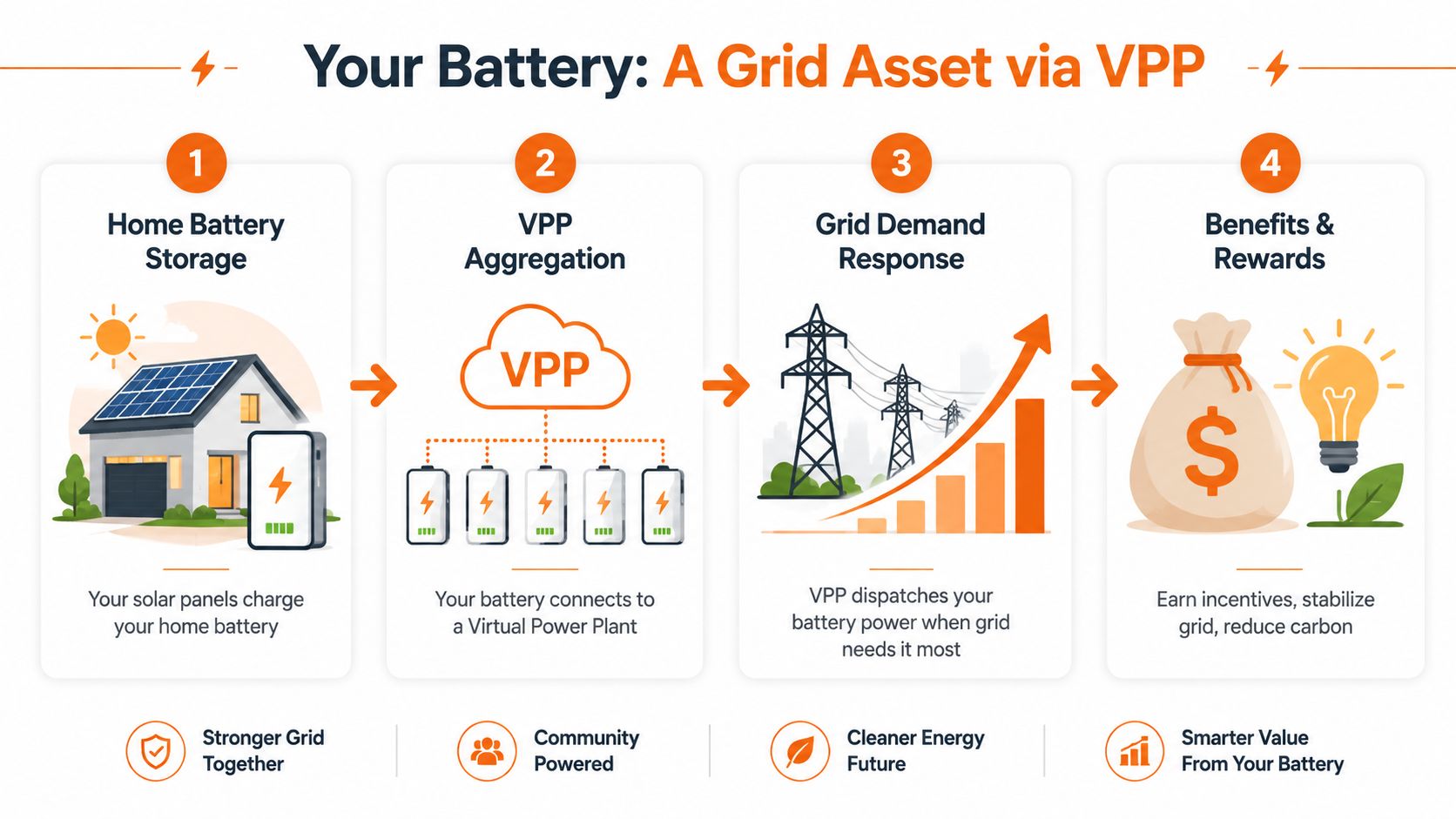
A Virtual Power Plant Australia model links many household batteries through software so they can respond in a coordinated way. The battery stays at your home, but the dispatch logic operates across a fleet.
That matters most when the grid is stressed. A hot summer afternoon in NSW or QLD is a simple example. Air-conditioning load rises, wholesale prices can move sharply, and the network values fast, local support. Instead of each battery acting in isolation, a VPP can coordinate discharge across many homes.
What pay-per-performance actually means
The commercial detail many households never see is how VPP performance is measured. In Australian VPP programs, Leap Energy explains that the core metric for distributed energy resources such as home batteries is:
Performance % = [Baseline – Load] / Nomination
In that formula, Baseline is the expected energy usage, Load is the net load at the meter during the event, and Nomination is the commitment made to the market. Leap's explanation is useful because it shows that the model is pay-per-performance, meaning participants are rewarded for actual energy curtailment during dispatch events rather than a flat participation fee (Leap Energy on VPP performance).
That structure is commercially important. It links household battery value to measurable delivery, not just enrolment.
A more detailed plain-English explainer on what a virtual power plant is can help if you want the operational mechanics behind this market structure.
Why VPPs can outperform simple export thinking
A feed-in tariff pays you for exporting energy. A VPP can do something more targeted. It can time battery discharge to moments when the grid values flexibility most.
That changes the role of the battery from passive exporter to active participant in demand response and grid support. It also makes a better use of battery capability in a market where timing often matters more than sheer exported volume.
Practical rule: A battery creates the most system value when it responds to conditions, not when it exports by default.
For readers who prefer a visual explanation, this short video gives a useful overview of VPP participation and grid coordination.
The homeowner outcome
A well-run VPP should do three things at once:
- Prioritise household needs so the battery still serves the home first
- Respond to market or network events when spare capacity is available
- Translate performance into bill value through a transparent retail structure
That's the core appeal of a Bring Your Own Battery model. You keep the asset. The retailer or VPP operator coordinates the spare capacity.
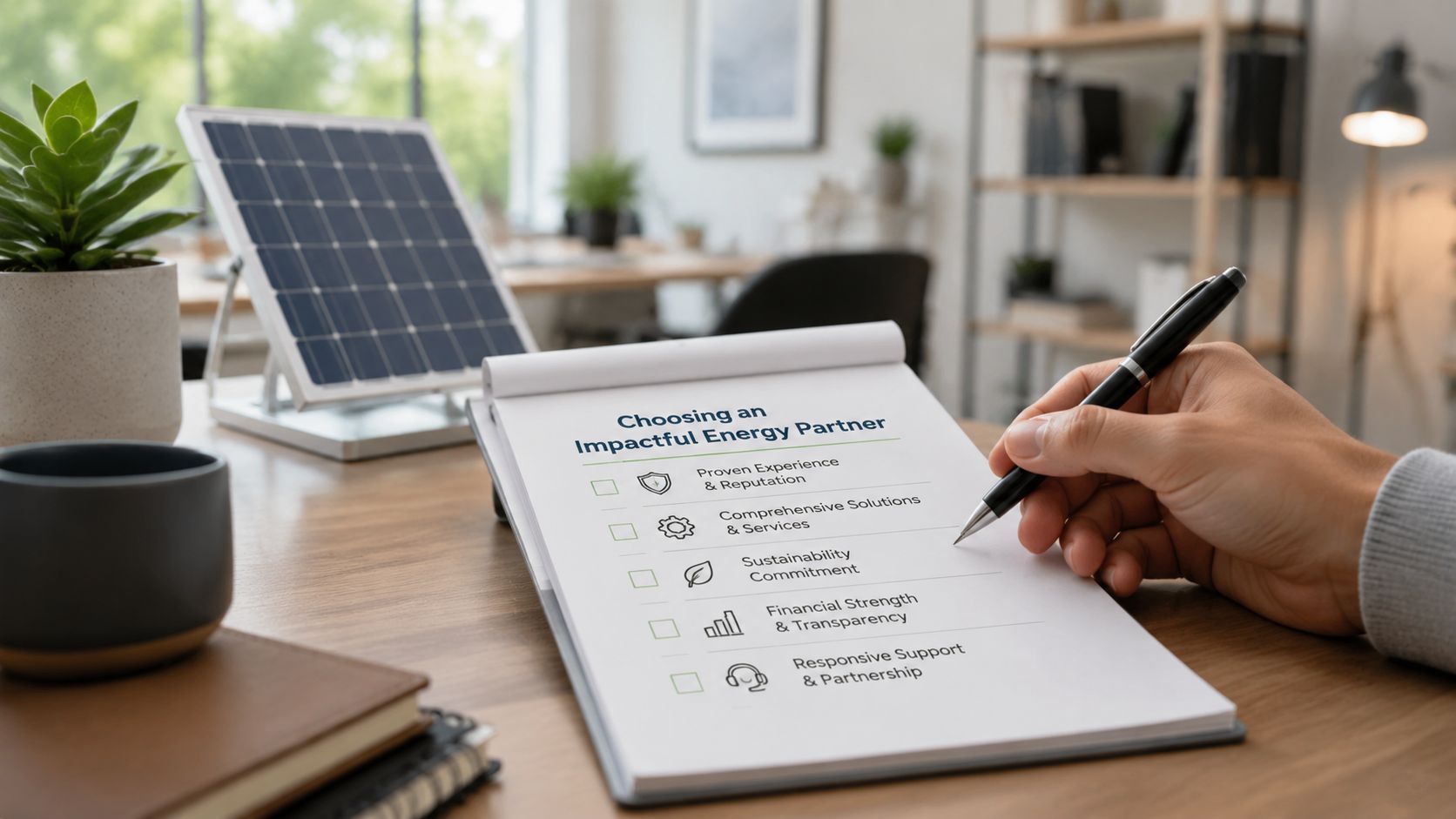
Your Checklist for Choosing an Impactful Energy Partner
The best energy partner for a battery owner isn't always the company with the strongest environmental branding. It's the provider whose commercial model, operating rules, and transparency line up with the actual value of your system.
The checklist below is more useful than a simple retailer comparison page because it starts with your asset, not their marketing.
Start with the uncomfortable questions
ABC reporting highlighted a point many “green retailer” guides avoid. Australia ranks 12th globally in wind and solar share despite being the sunniest nation, and households are often misled by the idea that they can buy 100% green electricity unless fully off-grid. The same report also notes that the “greenest” retailer can sit inside a parent group with fossil fuel exposure, while VPP-integrated battery households save over $2,000 a year on average without paying GreenPower surcharges (ABC on green electricity claims and retailer ownership).
That should change how you evaluate the market.
A practical selection checklist
Check what the provider does
Ask whether the company is a generator, a retailer, a VPP operator, or a mix of those. Those roles affect what “green” really means.Test for battery value, not just tariff colour
If you already own storage, ask how the provider improves your battery's financial performance. A green tariff alone may leave the asset underused.Look at customer control
You should understand whether your household retains priority access to stored energy, what override options exist, and how dispatch decisions are communicated.Ask how performance is measured
If the model involves VPP participation, the calculation method and settlement logic matter. Opaque incentive language is a red flag.Read the retail terms closely
Check for lock-ins, exit fees, conditions around compatible hardware, and any restrictions that affect the practical use of your battery.Look beyond the comparison site headline
A retailer can market sustainability while relying on a corporate structure or product design that tells a more complicated story.
Choose the partner that helps your battery do useful work, not the one that gives you the neatest brochure.
If you're building a broader home efficiency plan alongside battery optimisation, it can also help to review other household upgrade frameworks. Even though it's from a different market context, this guide on how to maximize FPL energy upgrade savings is a useful example of thinking about energy decisions as a system rather than a single product choice.
Why High Flow Energy Optimises for Performance
For households that already own rooftop solar and a compatible battery, the core issue usually isn't installation. It's what happens after installation.
Most retailers still treat the battery as incidental. A performance-led retailer treats it as an asset that can be coordinated, measured, and used to support both the household and the grid. That's the logic behind a retailer-based VPP structure.
High Flow Energy is an electricity retailer for existing battery owners in Queensland and New South Wales. Its model is built around BYOB VPP participation, battery optimisation, and using spare battery capacity to create bill value through coordinated grid support. It doesn't sell or install solar panels or batteries. The focus is on extracting more performance from assets the customer already owns.
That approach fits the commercial reality outlined above. A battery owner doesn't necessarily need another product. They need a structure that can improve dispatch timing, align household control with market participation, and translate performance into a transparent retail outcome.
What informed battery owners should prioritise
- Transparent operating rules so you know when and why your battery may be dispatched
- Priority for household energy needs before spare capacity is used for grid support
- Retail and VPP integration rather than disconnected offers that leave value on the table
- No unnecessary complexity in understanding eligibility, compatibility, and expected performance
Most battery owners focus on installation quality. Far fewer focus on ongoing performance and optimisation. High Flow Energy is an electricity retailer built around maximizing the full value of your existing solar and battery system.
If you would like to understand whether your battery is underperforming financially, request an eligibility assessment today.
Frequently Asked Questions About VPPs and Green Energy
Is a green tariff the same as active grid participation
No. A green tariff is generally a retail purchasing decision. VPP participation uses your battery to help the grid when capacity is needed.
Can a VPP still prioritise my home
Yes, that's a core design question you should ask before joining. The important point is how the provider sets household priority and override controls.
Does joining a VPP mean giving up ownership of my battery
No. In a BYOB VPP, you continue to own the battery. The provider coordinates eligible spare capacity under agreed terms.
Why does timing matter more than just exporting solar
Because the grid doesn't value every kilowatt-hour equally at every moment. Dispatch during tight conditions can be more useful than untimed export.
Are all green energy providers equally credible
No. Some claims relate to renewable ownership, some to GreenPower purchasing, and others to offsets. Those should be assessed separately.
Is this only relevant for large battery systems
No. The principle is the same for many compatible home batteries. What matters is whether the asset can be coordinated effectively within the retailer's VPP structure.
If you already have rooftop solar and a compatible battery, the next question isn't just who supplies your electricity. It's whether your system is being used to its full financial and grid value. High Flow Energy helps battery owners in Queensland and New South Wales assess whether their current setup is underperforming and whether a BYOB VPP model is a better fit.