


How Do Solar Batteries Work Australia: Your 2026 Guide
If you already have rooftop solar, you've probably seen the pattern. Your panels work hard through the middle of the day, exports go to the grid for a modest feed-in tariff, then your household starts buying power back in the evening when prices are higher. That's the gap a battery is built to manage.
For Australian homeowners asking how do solar batteries work in Australia, the technical answer is only half the story. A battery stores surplus solar and releases it later. The more useful answer is commercial. In the National Electricity Market, a home battery can either sit there as a simple self-consumption tool or operate as a flexible asset that responds to tariffs, demand peaks and, in some cases, Virtual Power Plant programs.
Most battery owners understand the installation side. Fewer have a clear view of how the system moves energy, what determines financial value, and where batteries are commonly underused in Queensland and New South Wales. That's where the difference sits.
How a Solar Battery Stores and Releases Energy
At 1 pm, a typical solar home in Queensland can be producing more power than it can use. By 7 pm, the same home is often importing from the grid while the panels sit idle. A battery changes that operating pattern by shifting energy from the low-value part of the day to the hours when grid power is usually more expensive.
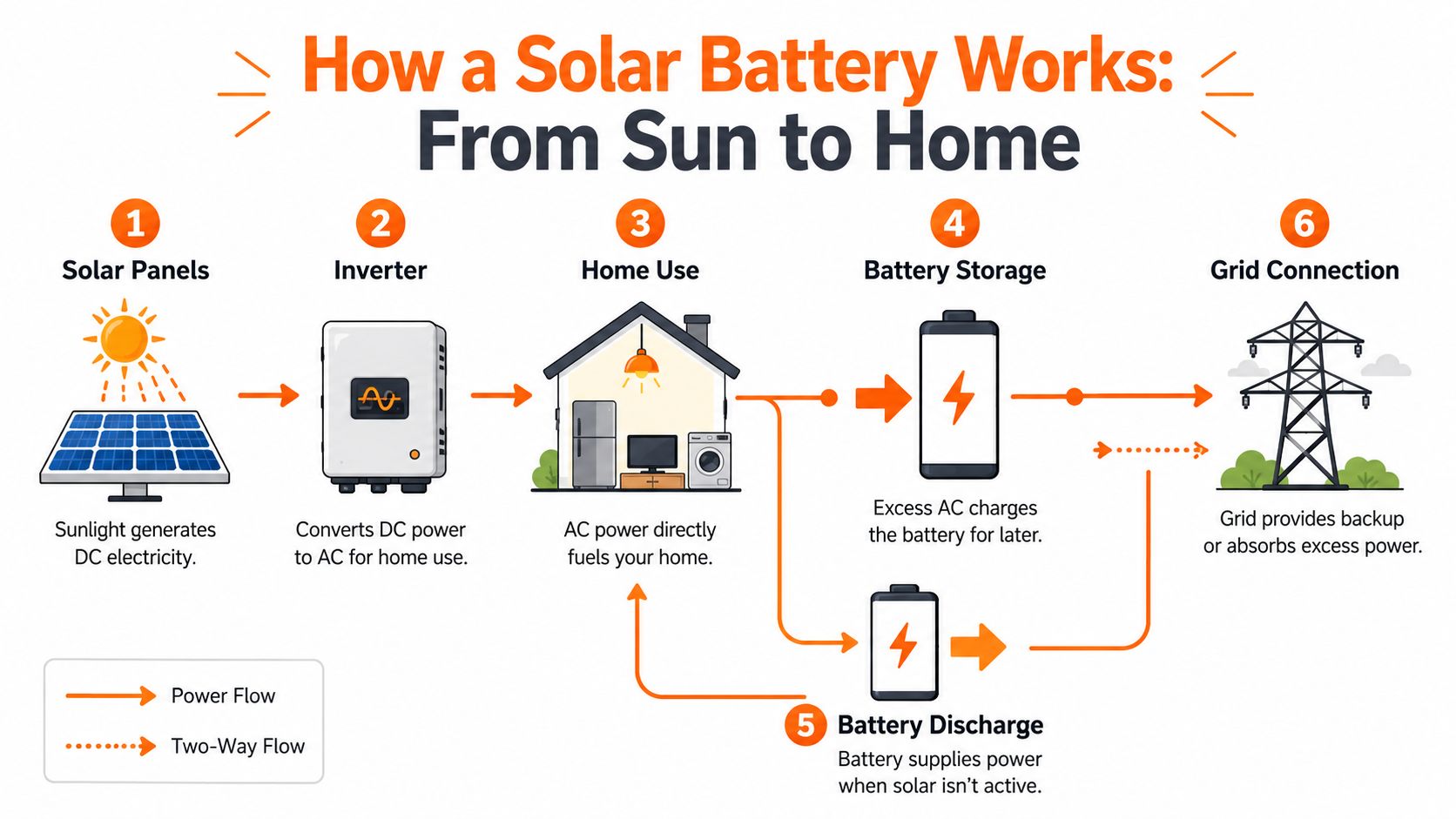
A battery does not store solar in some special form. It stores electricity produced by the solar system after the home has already taken what it needs. The control logic matters as much as the battery itself because the system has to decide, minute by minute, whether energy should run the house, charge the battery, export to the grid, or be held back for later use.
The hardware that determines how the system behaves
Three components do the work:
- Battery cells: the part that stores energy for later use.
- Battery Management System (BMS): the protection and control layer that manages temperature, charge limits, discharge limits and battery safety.
- Inverter: the device that converts electricity and directs where it goes across the home, battery and grid connection.
In practice, the inverter often determines whether a battery is just a storage box or a flexible household asset. Some systems are set up only for basic self-consumption. Others can respond to tariff periods, export settings, backup requirements and retailer control signals. That distinction matters if the owner wants more than bill reduction from simple evening discharge.
DC-coupled and AC-coupled battery systems
Most home battery systems in Australia are built as either DC-coupled or AC-coupled configurations, as outlined in the Clean Energy Regulator guidance on solar batteries.
A DC-coupled system charges the battery on the DC side of the solar setup before conversion for household use. This can reduce conversion losses and is often attractive in new solar-and-battery installs.
An AC-coupled system charges the battery through the AC side of the home. It is commonly used when a battery is added to an existing rooftop solar system because it can be simpler to retrofit without replacing the original solar inverter.
Neither design is automatically better. DC-coupled systems can be more efficient on paper. AC-coupled systems can be easier and cheaper to add later. The right choice depends on what is already installed, whether backup is required, and whether the battery needs to be compatible with future control platforms. For a closer look at battery types and chemistry, see this guide to lithium-ion batteries for solar.
What the battery does through a normal day
Most homes follow a straightforward dispatch order:
- Solar runs household loads first
- Excess solar charges the battery
- Any remaining surplus may export to the grid
- As solar output falls, the battery discharges into the home
- Once the battery reaches its reserve or minimum state of charge, the home imports from the grid
That sequence explains the technical side. The commercial side is more interesting. A battery is only valuable when the stored kilowatt-hours are used at the right time and under the right tariff conditions. A household that discharges too early can still end up buying expensive evening power later. A household with retailer orchestration or VPP capability can use the same hardware more intelligently.
Homeowners comparing battery options should also keep the broader solar economics in view. The economics of the panels and the storage need to work together, not as separate decisions. AdVoltage Electrical on solar panel ROI gives a useful reference point for how the generation side of the system affects overall returns.
The Financial Case for Solar Batteries in Australia
A common Australian bill pattern looks like this. Solar exports pile up through the middle of the day for a modest credit, then the household buys power back in the evening at a much higher retail rate. That price spread is the core financial case for a battery.
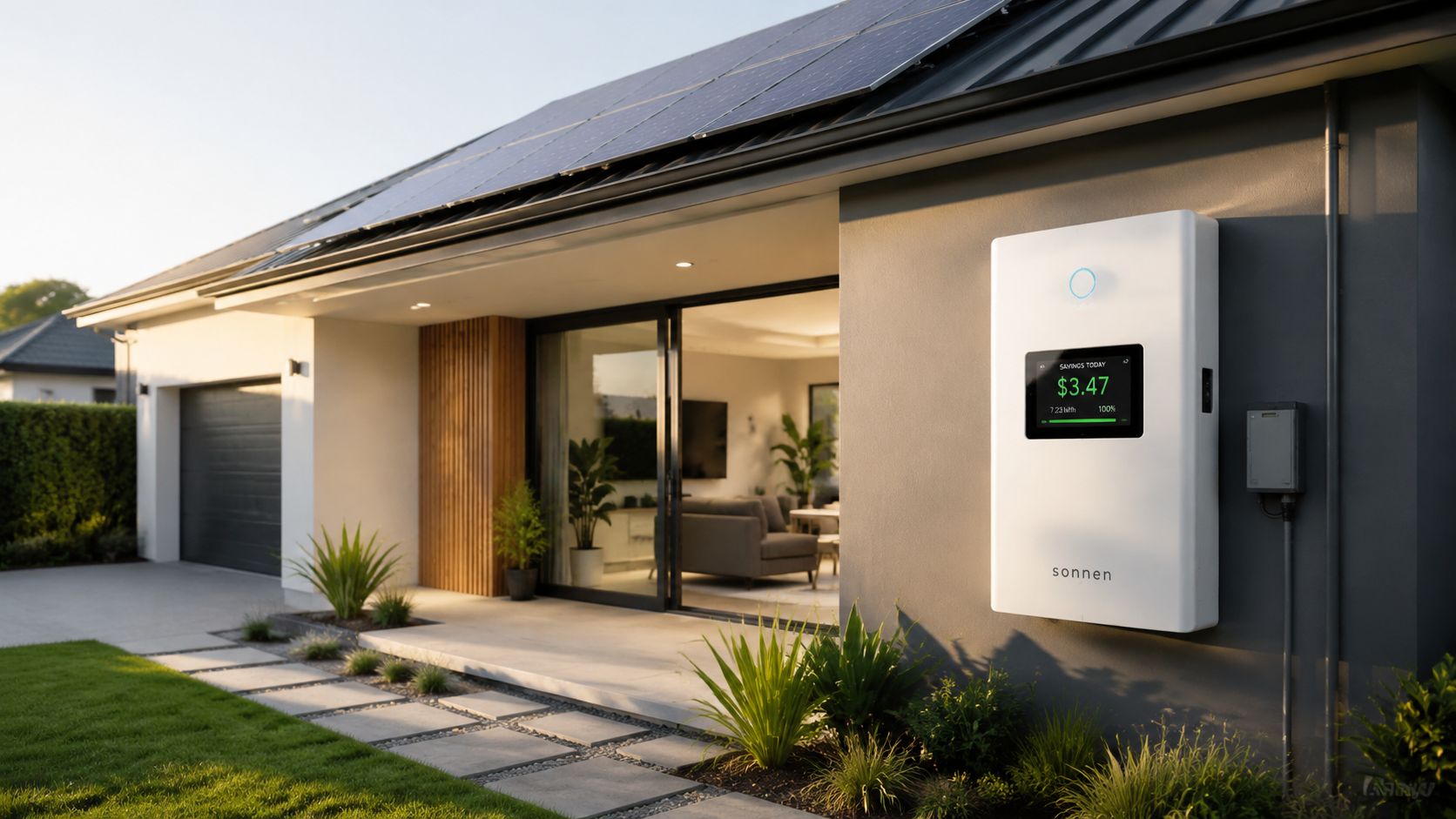
As the RACV explanation of solar battery operation notes, feed-in tariffs are often far lower than peak import rates. In practical terms, a battery can improve returns by shifting your own solar into the expensive part of the day instead of selling it cheaply at noon.
Self-consumption is only the starting point
The first job of a battery is simple. It raises self-consumption. More of your rooftop generation gets used inside the home, which means fewer kilowatt-hours exported at a low rate and fewer bought back later at a high one.
That helps, but it does not guarantee a strong payback. Battery value depends on system size, household load shape, tariff design, battery reserve settings, and whether the battery is controlled intelligently. I see plenty of households focus on storage capacity alone and miss the bigger issue, which is dispatch timing. A battery that empties too early in the evening can still leave the home exposed to the most expensive import period.
If you're still weighing the economics of rooftop generation before the battery layer, this breakdown from AdVoltage Electrical on solar panel ROI is a useful companion resource for understanding the broader return profile of a home solar setup.
A battery sits inside a tariff strategy
Grid-connected batteries in Australia usually work best as part of a broader retail strategy, not as standalone backup hardware. The household still relies on the grid at times. The financial question is when the battery charges, when it discharges, and who controls those decisions.
For most homes, the value stack looks like this:
- Reducing peak-time imports
- Increasing onsite use of rooftop solar
- Responding to time-of-use or demand-based tariff signals
- In some cases, participating in retailer or aggregator programs that pay for battery availability or dispatch
That last point matters more than many sales brochures suggest.
A home battery inside the National Electricity Market can do more than offset your own evening load. With the right retailer setup, it can become an active operating asset that responds to price periods and grid events. That is a different commercial model from simple self-consumption, and it can materially change the return profile. If you want a practical breakdown of capital costs, expected savings and sizing trade-offs, this guide on the cost of a solar battery in Australia is a useful reference.
A short explainer can also help visualise the economics and operating logic in a real home setting.
From Passive Storage to Active Asset The VPP Difference
At 6:30 pm on a hot weekday, your battery can either cover part of your own usage or be dispatched as part of a coordinated fleet during a high-value grid event. That operating choice changes what the asset earns.
A home battery on its own is still limited by one household load profile. Once it joins a Virtual Power Plant, the battery becomes part of a retailer or aggregator portfolio that can respond to price spikes, local constraints, and system support events across the National Electricity Market. The battery is still installed in your garage or on your wall. Commercially, though, it starts behaving like a small flexible unit inside a much larger trading and dispatch strategy.
Solar Victoria notes that household batteries in eastern Australia are increasingly being enrolled into VPP programs, with aggregated fleets showing how residential storage can supply meaningful dispatchable capacity during critical periods. That matters because the market pays for timing and availability, not just stored kilowatt-hours.
Why coordination changes the economics
The main difference is control logic.
A standard battery setup follows household-first rules. It charges from excess solar, discharges later, and cuts grid imports where it can. A VPP-enabled battery may still do that, but it can also reserve capacity for a peak event, export when the value is highest, or hold back when a retailer's optimisation engine expects a better dispatch window later.
That is a very different commercial model from simple self-consumption. Owners need to judge it on actual operating terms, not just on the idea of "helping the grid."
| Value Stream | Standard Solar (No Battery) | Solar + Battery (Self-Consumption) | Solar + Battery with a VPP Retailer |
|---|---|---|---|
| Daytime solar use | Home uses solar first | Home uses solar first | Home uses solar first |
| Surplus daytime energy | Mainly exported for feed-in tariff | Stored for later use where possible | Stored and managed under household and program rules |
| Evening demand | Mostly supplied by the grid | Battery offsets part of evening imports | Battery offsets imports and may also be dispatched for grid events |
| Tariff response | Limited | Moderate | Higher if retailer optimisation is well designed |
| Grid participation value | Export payment only | Usually limited | May include availability, event response, or coordinated dispatch value |
| Battery role | None | Private storage asset | Private storage asset and market-facing flexible asset |
What separates a good VPP offer from a weak one
Many battery owners leave money on the table. They buy capable hardware, then sign up to a retailer plan that barely uses it.
A workable VPP arrangement usually has four features:
- Compatible battery and inverter controls: Some systems can accept external dispatch signals cleanly. Others have tighter limits or clunky integrations.
- Clear customer protections: You need to know the minimum reserve level, override rights, backup settings, and whether household supply always takes priority.
- Transparent payment structure: Credits, fixed payments, event payments, and tariff benefits should be spelled out in plain language.
- A retailer with an actual operating model: Some plans are marketing wrappers. Others actively trade and dispatch batteries. The difference shows up in results.
The weak offers tend to fail in predictable ways. Vague benefit statements, little visibility on dispatch, poor hardware compatibility, and no serious explanation of warranty treatment are all red flags.
If you want to see how retailer-led aggregation works in practice, this guide to a Virtual Power Plant in Australia explains the operating model in more detail.
The trade-off homeowners need to understand
More market participation can mean more battery cycling, less direct control at certain times, and a return profile that depends on the retailer's execution quality. That does not make VPPs bad. It means they should be assessed like a commercial contract.
The practical question is simple. Are you handing over some dispatch flexibility in exchange for enough value to justify it?
For some homes, the answer is yes, especially where export tariffs are weak and the retailer has strong optimisation capability. For others, a battery used mainly for self-consumption and backup will be the cleaner fit. The right answer depends on tariff structure, hardware limits, local network rules, and how much control you want to keep.
The broader trend is clear. Distributed assets behind the meter are being drawn into active market participation. Home batteries are already there. EVs may follow as vehicle-to-home and vehicle-to-grid models mature, and you can explore EV bidirectional charging if you want to understand how mobile storage could join the same value stack.
Choosing the Right Solar Battery Size and System
A common homeowner scenario is simple. The solar system looks productive all day, then the family gets home, cooking starts, the air conditioning runs, and grid imports jump right when tariffs matter most. Battery sizing should be built around that gap between daytime generation and evening demand, because that is where the bill-saving value usually sits.
For most homes, a good battery is not the biggest unit the budget can stretch to. It is the one that cycles through useful energy often enough to justify its cost, while still fitting the home's backup needs, tariff structure, and solar production profile.
Start with the load profile, not the battery brochure
The first number to look at is evening and overnight consumption. Interval data from your retailer or inverter portal will show how much electricity the house uses after solar output drops away. That matters more than total daily usage because batteries are mainly shifting solar into higher-value hours.
A practical sizing check usually includes:
- Evening demand: Identify the typical consumption window from late afternoon to bedtime.
- Recurring loads: Focus on loads that show up most days, such as refrigeration, lighting, cooking, pool pumps, and heating or cooling.
- Usable capacity: Compare the energy you can discharge, not just the headline nominal figure.
- Charge opportunity: Check whether the solar system regularly produces enough surplus energy to fill the battery.
- Operating objective: Bill reduction, backup support, and VPP participation can point to different system choices.
A battery that sits half-full through winter or rarely empties in summer is often poorly matched to the home. Under-sizing has its own problem. The battery empties early, and the household still buys expensive grid power during the peak period.
The commercial test is straightforward. Choose a size that gets used productively on ordinary days, not one that only looks good in a quote.
Capacity is only one part of system value
Two batteries with similar kilowatt-hour ratings can perform very differently in practice. Discharge power affects whether the battery can cover sharp evening peaks. Backup design determines whether it supports a few selected circuits or more of the house. Warranty terms matter too, especially where VPP participation increases cycling over time.
This is also where hardware compatibility becomes a money issue, not just a technical one. If the inverter, battery management system, and communications setup cannot support remote dispatch cleanly, the household may miss future revenue options or face extra retrofit costs later.
The Clean Energy Regulator's solar battery guidance sets out the Small-scale Renewable Energy Scheme rules, including the nominal battery capacity range and the usable-capacity limit relevant to certificate eligibility. It also explains the role of approved system configurations. For buyers, the practical point is clear. Certificate treatment, hardware selection, and installation design need to line up from the start.
VPP readiness should be assessed before purchase
A battery in the Australian market can be more than a self-consumption device. Under the right retailer and tariff arrangement, it can operate as a flexible household asset that earns value through controlled dispatch. That potential depends on whether the system is ready for aggregation.
Before signing off on a quote, ask these questions:
- Is the inverter and battery combination approved for the VPP programs you may want to join?
- What is the battery's usable capacity and continuous discharge rate?
- How is backup configured, and which circuits are covered?
- Can the system accept remote dispatch while preserving household settings and minimum reserve levels?
- If tariff rules or retailer offers change, can the system be enrolled without replacing major hardware?
Those questions cut through a lot of marketing noise. A battery that matches the roof but cannot participate in the parts of the market that pay for flexibility is only solving half the problem.
Common Misconceptions About Home Batteries
Battery marketing often oversimplifies what these systems can do. That leads to bad expectations, poor system design, and frustration later.
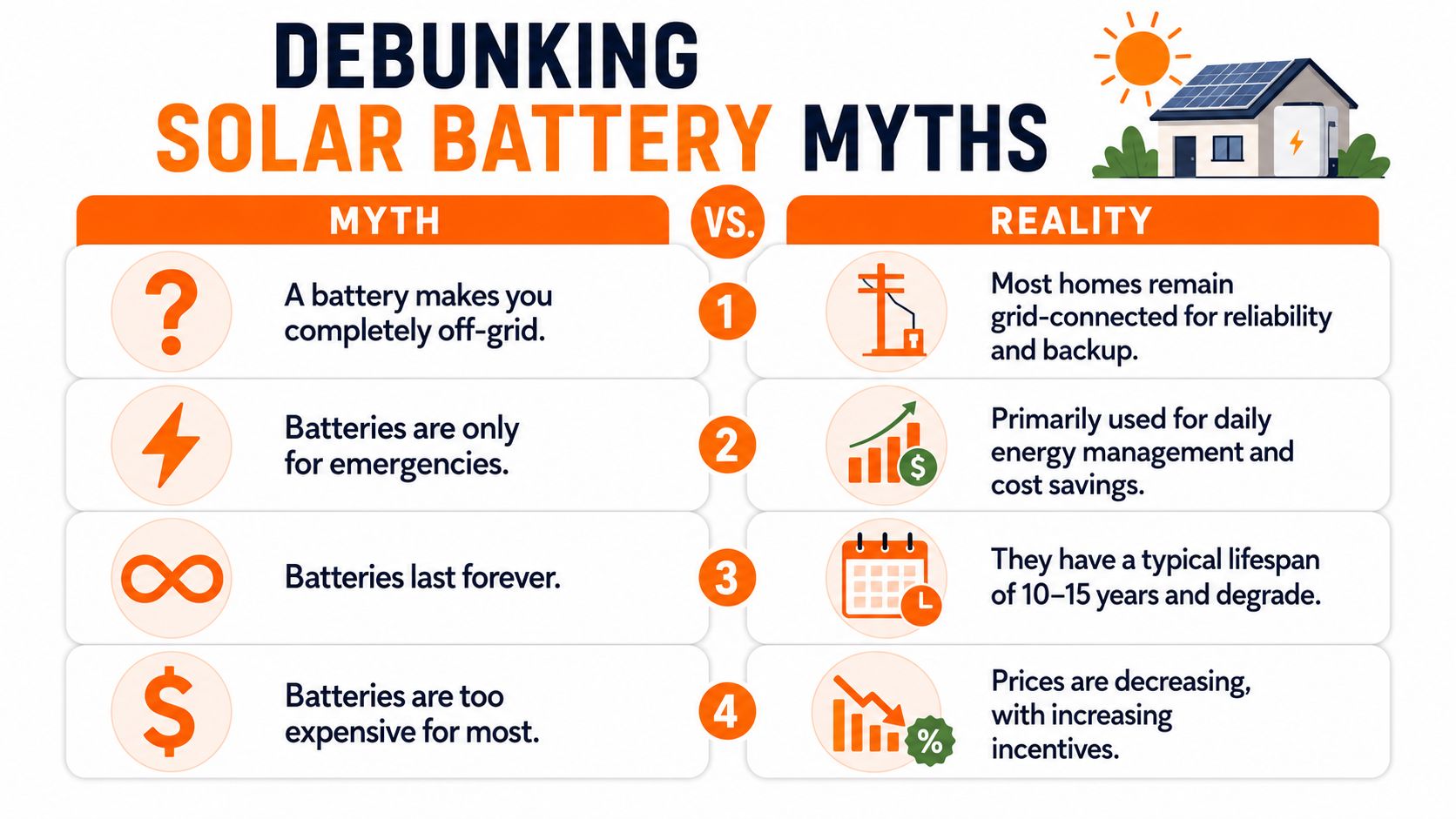
Myth one. A battery makes you fully off-grid
For most homes, it doesn't. Grid-connected systems are designed to work with the grid, not replace it altogether. In normal operation, the home uses solar, then the battery, then grid supply when needed.
That structure is usually a strength. It gives you flexibility without requiring complete energy self-sufficiency year-round.
Myth two. All batteries provide blackout protection
They don't. Some systems can support backup circuits, while others are configured mainly for grid-connected energy shifting. Backup capability depends on the inverter, switchboard design and system configuration, not just on whether a battery is installed.
If blackout support matters to you, ask for the exact backup functionality in writing before relying on assumptions.
Not every battery is a backup system, and not every backup system powers the whole house.
Myth three. Bigger is always better
A larger battery can be the wrong choice if your household doesn't cycle it properly. Oversizing can leave usable capacity sitting idle for long periods, especially in homes with modest evening demand or limited solar surplus in winter.
The better question is whether the battery's usable capacity matches your load shape and operating plan.
Myth four. Joining a VPP means losing control
A properly structured arrangement shouldn't put the grid ahead of your household's essential needs. The point of coordinated dispatch is to use spare flexibility, not to deprive the homeowner of stored energy they reasonably expect to use.
That's why transparency matters. You should understand the dispatch logic, the override settings available to you, and how the operating rules protect customer priority.
Putting Your Battery to Work A Performance Checklist
A battery can be technically sound and still underperform financially. That's common. Good hardware doesn't automatically mean good operation.
Key takeaways
- A solar battery stores surplus daytime generation and shifts it into higher-value periods later in the day.
- The inverter is central to performance because it controls how energy moves between solar, battery, home and grid.
- Low feed-in tariffs and higher evening tariffs are the core reason batteries can improve household economics.
- Self-consumption is only one layer of value. Coordinated participation can make a battery more useful.
- Battery size should match real household demand, especially evening usage.
- VPP-readiness depends on compatibility, controls and transparent operating rules.
A quick battery performance review
Use this checklist against your current system.
- Check your export pattern: If large amounts of solar leave the home during the day while you import heavily in the evening, the battery may not be sized or scheduled well.
- Review inverter capability: Confirm whether the inverter is VPP-ready and capable of advanced control.
- Assess actual battery cycling: A battery that rarely fills or rarely discharges meaningfully may not be aligned with your load.
- Look at tariff exposure: Time-of-use pricing and evening peaks matter. Your battery should be working hardest when grid power is least attractive.
- Confirm control visibility: You should be able to see what the system is doing and why.
- Test market participation potential: If the system is compatible, there may be more value available than simple self-consumption delivers.
Here's the key commercial point. Installation is a one-time event. Optimisation is ongoing. In Queensland and New South Wales especially, households with compatible batteries should think like asset owners, not just energy consumers.
What to do next
If you already own a battery, the most useful next step isn't guessing. It's reviewing how the system performs today.
Ask questions such as:
- Is my battery mostly acting as a backup device?
- Am I still exposed to expensive evening imports more than I should be?
- Is my current retailer doing anything to optimise battery value?
- Could this system participate more actively without compromising household use?
Most battery owners focus on installation quality. Far fewer focus on ongoing performance and optimisation.
That gap is where a lot of financial value sits.
Frequently Asked Questions About Solar Batteries
How long do home solar batteries usually last?
Battery lifespan depends on chemistry, operating conditions, cycling pattern and system management. In practice, degradation is normal over time, and owners should expect performance to gradually change across the battery's life.
Will a battery keep my home running in a blackout?
Not always. Backup capability depends on the inverter and system configuration. Some systems support selected circuits, some can support broader backup, and some are installed mainly for energy shifting rather than outage support.
Does joining a VPP damage the battery?
Battery cycling needs to be managed sensibly in any operating model. The important issue is whether dispatch rules, inverter compatibility and warranty terms are clear. Homeowners should review warranty documentation and understand how participation is handled before enrolling.
What happens if the internet connection drops?
Most systems continue basic local battery operation even if broader remote optimisation is interrupted. The exact behaviour depends on the hardware, software platform and communications setup.
Are home batteries safe?
Modern residential battery systems are designed with control and protection layers, including battery management systems and inverter safeguards. Safety still depends on proper product selection, compliant installation and suitable operating settings.
Can I add a battery to an existing solar system?
Often, yes. Retrofitting is common, but the best path depends on the existing inverter setup, switchboard arrangement and whether you want only self-consumption or broader flexibility such as VPP participation.
Do I need a very large solar system for a battery to make sense?
Not necessarily. The better test is whether your household has usable daytime surplus and meaningful evening demand. Battery value depends on the match between generation, consumption and tariff structure.
Most battery owners focus on installation quality. Far fewer focus on ongoing performance and optimisation. HighFlow Energy is an electricity retailer built around realising the full value of your existing solar and battery system.
If you would like to understand whether your battery is underperforming financially, request an eligibility assessment today.
SEO title: How Do Solar Batteries Work Australia Guide
Meta description: Learn how solar batteries work in Australia and how to gain more value from your battery in QLD and NSW.
Suggested URL slug: /how-do-solar-batteries-work-australia/
Featured image concept: Australian suburban home with rooftop solar, wall battery, evening lighting, and a subtle overlay showing solar-to-home-to-battery-to-grid energy flow.
Image alt text: Home solar battery system in Australia showing rooftop solar, inverter, battery storage and grid connection
Internal linking suggestions:
External authority references:
- Clean Energy Regulator solar battery guidance
- RACV on how solar batteries work
- Solar Victoria on battery and VPP operation
- EcoFlow summary of Australian battery adoption
LinkedIn-ready excerpt:
Most solar battery articles stop at the science. Australian homeowners need the commercial answer too. This guide explains how a battery stores energy, why tariff timing matters, and how a Virtual Power Plant can turn a passive storage device into a more active household asset in the NEM.
AI summary snippet:
Solar batteries in Australia store surplus rooftop solar during the day and discharge it later when household demand rises and solar output falls. Their value comes from reducing exposure to higher evening electricity prices and increasing self-consumption. In Queensland and New South Wales, compatible batteries may also participate in Virtual Power Plants, where coordinated dispatch can create additional value beyond a standard feed-in tariff. The right inverter, battery size and operating model matter as much as the battery itself.