

How Much Does AC Cost in Australia
A split system typically costs $600 to $5,500 upfront, while annual running costs range from roughly $150 to $1,381, depending on system size, climate and household usage. The final bill depends on much more than the air conditioner's price tag.
In Australia, answering “how much does AC cost” requires a whole-of-ownership view. The equipment, installation, electricity tariff, system capacity and time of use all influence the result. For households in Queensland and New South Wales, air conditioning can also coincide with the period when electricity demand is most concentrated.
A rooftop solar system and compatible battery add another variable. With the right operating strategy, cooling demand doesn't have to remain a fixed summer penalty. Battery self-consumption, tariff timing and participation in a retailer-operated Virtual Power Plant can change how much of the AC load is supplied from the grid and how much value the household receives from its existing energy assets.
What You Really Pay for AC in Australia
The headline range is broad because Australian homes use very different cooling systems. CHOICE reports that an air conditioner can cost $600 to $5,500 before installation, depending on its size and type, while annual electricity costs range from about $150 to $370 for a small unit up to 4 kW, $340 to $650 for a medium 4 to 6 kW unit, and $530 to $1,160 for a large unit above 6 kW. These figures are set out in CHOICE's Australian air conditioner buying guide.
That means the purchase price is only one part of the calculation. Installation can add substantially to the total, particularly where the installer must work around difficult access, long cable runs, unusual wall construction or an existing switchboard. Electricity then becomes the recurring cost for as long as the system operates.
A household comparing quotes should separate four questions:
- What does the equipment cost? Capacity, system type and efficiency affect the initial price.
- How difficult is the installation? A straightforward installation differs materially from a job involving structural or electrical work.
- How large does the system need to be? A unit sized for one bedroom has a different operating profile from a system cooling several living areas.
- When will it run? The same air conditioner can produce different bills under different tariffs and usage patterns.
Practical rule: Treat the purchase, installation and electricity use as separate line items. A low equipment price doesn't automatically produce a low lifetime cost.
The annual range is especially relevant in Queensland. Mozo estimates that a reverse-cycle air conditioner used for four hours a day over half the year costs about $723 nationally, but around $1,381 annually in Queensland, reflecting hotter conditions and a longer cooling season. That difference is why a household should assess its likely usage before choosing a system or tariff.
For a broader view of how household consumption affects bills, compare the cooling estimate with your wider cost of electricity. The most useful decision isn't just finding the cheapest unit. It's reducing the amount of high-cost electricity the system needs over its working life.
Upfront and Installation Costs Explained
The equipment quote tells you what arrives in the box. It doesn't necessarily tell you what the installer must do to make the system safe, compliant and suitable for the home.
CHOICE's published range of $600 to $5,500 before installation covers a wide variety of air conditioners. A smaller split system may sit toward the lower end, while a larger or more capable system can sit much higher. The final installed price depends on the equipment and the site conditions, so two homes buying similar capacity can receive different quotes.
Three cost buckets to separate
Equipment includes the indoor unit, outdoor condenser, controls and any included accessories. Capacity matters because a system designed for a larger area generally contains more substantial components.
Installation labour covers mounting, refrigerant pipework, electrical connection and commissioning. A simple back-to-back split-system installation is usually less complex than a job requiring long distances between indoor and outdoor units.
Electrical and structural work can include switchboard work, additional cable, wall reinforcement, condensate drainage and a suitable base for the outdoor unit. Ask the installer to identify these items separately rather than accepting one unexplained total.
The table below is a checklist for reading a quote. The supplied Australian evidence confirms that installation can add substantially to the equipment price, but it doesn't provide a verified national price range for each individual installation component.
| Cost Item | Low ($) | High ($) | Notes |
|---|---|---|---|
| Air conditioner equipment | 600 | 5,500 | CHOICE range before installation |
| Mounting brackets | Not specified | Not specified | Confirm whether brackets are included |
| Electrical runs | Not specified | Not specified | Depends on switchboard and cable distance |
| Condensate drainage | Not specified | Not specified | Check the proposed discharge path |
| Concrete pad or outdoor-unit base | Not specified | Not specified | May be required depending on placement |
| Switchboard work | Not specified | Not specified | Confirm whether existing capacity is suitable |
| Installation total | Not specified | Not specified | Site-specific and not separately quantified in the cited data |
Brand names can help you compare like with like, but they shouldn't replace a proper assessment of the site. Daikin, Mitsubishi Electric and Fujitsu are commonly considered alongside Kelvinator, Hisense and Midea, yet the appropriate choice still depends on capacity, controls, warranty and installation quality.
Inverter and fixed-speed systems also operate differently. An inverter can vary its output rather than repeatedly switching between full output and off, but the financial value depends on how often the system runs, the room load and the household tariff. Seasonal promotions may change the purchase price, but a discount doesn't compensate for poor sizing or an unsuitable installation.
An overseas resource such as this guide to the average cost to replace an AC unit in Arizona can help explain how equipment and labour are often presented separately, but Australian buyers should rely on local conditions, Australian electrical requirements and local quotes.
Running Costs by System Size
System size is the clearest starting point for estimating electricity use. CHOICE groups annual electricity costs into three broad categories: $150 to $370 for a small system up to 4 kW, $340 to $650 for a medium system from 4 to 6 kW, and $530 to $1,160 for a large system above 6 kW. These are estimates, not guarantees, because climate, insulation, setpoint, operating hours and tariff all matter.
Finder provides a separate summer comparison. Its example estimates a cooling-only split system costs $209 over summer, while a reverse-cycle split system costs $277, using state-specific electricity prices including 38.15 cents per kWh in New South Wales and 33.39 cents per kWh in Queensland. The examples are useful for comparing system types, but they shouldn't be treated as a personal forecast.
The size comparison
| System Size | Typical Use Profile | Annual kWh | Annual Cost ($) | QLD Cost ($) |
|---|---|---|---|---|
| Small, up to 4 kW | One bedroom or a smaller occupied room | Not published in cited data | 150 to 370 | Not separately published |
| Medium, 4 to 6 kW | Living area or several connected spaces | Not published in cited data | 340 to 650 | Not separately published |
| Large, above 6 kW | Larger living areas or sustained high demand | Not published in cited data | 530 to 1,160 | Not separately published |
| Reverse-cycle household example | Four hours daily over half the year | Not published in cited data | About 723 nationally | About 1,381 |
The Queensland figure in the final row comes from Mozo's appliance-cost estimate. It demonstrates a point that a simple equipment comparison can miss: the same type of appliance can have a substantially different annual cost when the cooling season is hotter or longer.
A household shouldn't select capacity based only on the total floor area. Cooling the occupied bedroom at night is a different task from cooling an open-plan living area through a hot afternoon. Oversizing can increase the purchase price and may leave the system operating inefficiently for the actual room load. Undersizing can leave the unit running for longer and still fail to deliver comfort.
Use the system's rated capacity as a screening tool, then ask an installer to assess the room, insulation, windows, orientation and expected use. Track actual consumption through the retailer's app where available. The aircon running-cost guide can also help translate measured electricity use into a household-specific estimate.
Why Peak Demand Pushes Summer Bills Up
Cooling costs aren't determined only by total annual consumption. Timing matters because air conditioning often runs when many other households are also using electricity.
Savvy reports that heating and cooling can account for up to 50% of average household energy use. During peak periods, air conditioning can reach 72% of electricity use in Adelaide and as much as 90% in Brisbane, according to the same Australian source. It also reports that annual electricity consumption for stationary air conditioning and heat pumps rose 19% between 2016 and 2022, while the number of units rose 26%. The comparison suggests that newer equipment may be more efficient, even as air conditioning remains widespread.
In Queensland and New South Wales, late-afternoon cooling can overlap with a change in the household's solar position. Rooftop solar output generally falls as the day progresses, while occupants return home and switch on cooling, cooking and other appliances. That creates a practical mismatch between when solar energy is available and when the home needs electricity.
Retail bills don't always expose every wholesale-market movement directly. Retailers combine wholesale energy, network charges, environmental costs and other components into the customer's tariff. Even so, a household with high usage during constrained periods can face a more expensive outcome than one that shifts flexible demand to cheaper or self-generated energy.
The relevant question isn't only how much electricity the AC uses. Ask how much of that electricity arrives from the grid when household demand is already high.
A cooling plan should therefore distinguish between total AC consumption and grid-imported AC consumption. Pre-cooling with available rooftop solar, shifting flexible loads and using stored battery energy later can reduce the amount the household buys from the grid during the most pressured part of the day.
Practical Ways to Reduce AC Running Costs
The most effective changes usually begin with operating behaviour rather than new equipment. Start with actions that cost little, then consider building improvements and technology once the household understands its actual usage.
Adjust comfort settings
A higher cooling setpoint generally reduces the work the compressor must do. Use the highest setting that remains comfortable, and combine cooling with ceiling or portable fans where appropriate. Fans move air across the skin, which can make a room feel cooler without requiring the air conditioner to lower the room temperature as far.
Cool occupied areas
Run only the rooms that people are using where the system allows it. Zoning can prevent a ducted system from conditioning empty bedrooms, while a split system can provide more targeted cooling than a whole-home approach. Keep doors and windows closed during operation and address obvious draughts.
Reduce the heat entering the home
Ceiling insulation, shading and sealed ductwork reduce the heat load that the air conditioner must remove. These measures can be more valuable than choosing a larger unit, because a larger compressor doesn't fix a home that gains heat rapidly through the roof, windows or leaking ducts.
Maintain airflow and compare tariffs
Clean filters and unobstructed outdoor units help the system operate as intended. A tariff should match the household's real pattern, especially if cooling can be shifted towards periods of strong rooftop solar or lower priced electricity.
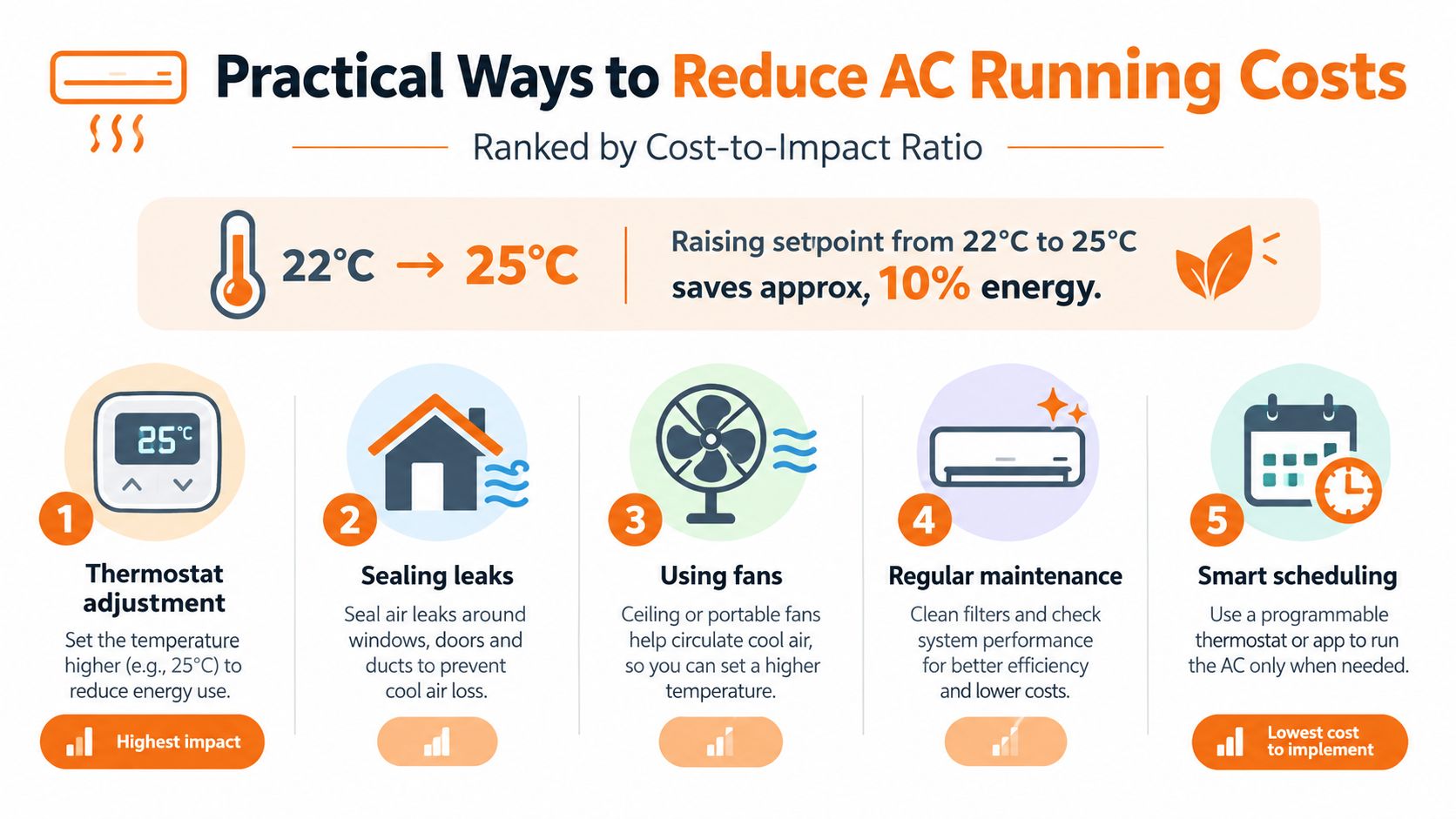
CHOICE's cost ranges and Finder's summer examples show why usage assumptions matter. A household should measure its own electricity consumption rather than applying a generic online estimate without checking the system size, operating schedule and local tariff.
The following video provides another visual explanation of the decisions involved in air conditioner operation and household energy use.
Efficiency measures reduce demand, but they don't necessarily remove grid consumption during the evening. A battery and a properly structured retailer service address that remaining timing problem.
How a Home Battery and VPP Change the Equation
A Virtual Power Plant, or VPP, connects multiple home batteries through software. A retailer or aggregator coordinates charging and discharging so participating batteries can support the household, respond to grid needs or perform both functions under agreed rules.
For an AC user, the basic sequence is straightforward:
- Rooftop solar supplies household loads and charges the battery when solar energy is available.
- The battery retains energy for later use, subject to household priorities and operating limits.
- The air conditioner draws from stored energy when solar output falls, reducing the need for grid imports.
- The VPP operator may coordinate available battery capacity for grid services, with the customer receiving an allowance, credit or other payment structure according to the retail plan.
This changes the ownership calculation. The battery isn't only a backup device or a way to increase solar self-consumption. It can also support demand response and grid stabilisation, although cycling, export constraints, warranty conditions and household reserve settings need careful review.
A retailer-based VPP differs from a simple feed-in tariff. A feed-in tariff pays for eligible exported energy under the retail plan. A VPP may create value through coordinated discharge, demand response and other services, then return some of that value through bill credits or an allowance. The details depend on the authorised retail arrangement and the plan's terms.
| Scenario | Grid import during evening cooling | Annual AC electricity cost | Estimated VPP bill credit | Net annual cost |
|---|---|---|---|---|
| No battery or VPP | Depends on household use | Use the applicable CHOICE or Finder estimate | Not applicable | Depends on usage and tariff |
| Battery used for self-consumption | May be reduced when stored energy is available | Depends on battery dispatch and AC demand | Not determinable from the supplied data | Depends on the retail plan |
| Battery enrolled in a VPP | Depends on household priority settings and events | Depends on grid imports | Plan-specific, not quantified in the supplied data | Plan-specific |
A VPP doesn't guarantee that air conditioning becomes free. The household may still import electricity when the battery is empty, reserve energy for backup, reach an export limit or exceed its allowance. The right comparison is the total retail outcome, including supply charges, usage rates, export treatment, battery access rules and any VPP obligations.
Plan Your Next Cooling Bill and CTA
Use the next billing cycle to replace assumptions with measured information.
First, open the retailer app or bill and record electricity consumption during the previous cooling season. Separate total household usage from the periods when the AC was most likely operating. If the app doesn't provide appliance-level data, use the air conditioner's rated information and operating schedule as an estimate, then label it clearly as an estimate.
Next, test operating changes before buying equipment. Raise the cooling setpoint gradually, cool occupied rooms rather than empty areas, and compare a tariff that reflects your actual usage with your current plan. Review the result over a comparable billing period rather than judging it from one unusually hot or mild week.
Then assess physical improvements. Insulation, shading, duct sealing and zoning can reduce the cooling load before a battery is asked to supply it. A battery and VPP should come after the household understands its load profile and confirms that the battery, retailer plan and local network arrangements are compatible.
Key takeaways
- The equipment price isn't the whole answer. CHOICE places the Australian purchase range at $600 to $5,500 before installation.
- System size changes the annual bill. CHOICE's annual estimates rise from $150 to $370 for small systems to $530 to $1,160 for large systems.
- Queensland usage deserves separate attention. Mozo's example is about $723 nationally and about $1,381 in Queensland for the stated usage pattern.
- Timing is a controllable variable. Solar, battery dispatch, room zoning and tariff selection can change grid imports.
- A VPP adds another value layer. It may provide an allowance or credit, but the result depends on the retail plan and battery operating rules.
Frequently asked questions
How much does an air conditioner cost to buy in Australia?
CHOICE reports a typical purchase range of $600 to $5,500 before installation. The final cost depends on system type, capacity and the complexity of the home.
How much does it cost to run an air conditioner?
CHOICE estimates annual electricity costs of $150 to $370 for a small unit up to 4 kW, $340 to $650 for a medium 4 to 6 kW unit, and $530 to $1,160 for a large unit above 6 kW. Your result will depend on usage, climate and tariff.
Is air conditioning more expensive to run in Queensland?
The available Australian estimates indicate that hotter conditions and longer cooling periods can materially increase costs. Mozo's example is about $723 nationally and about $1,381 in Queensland for a reverse-cycle air conditioner used four hours a day over half the year.
Does a reverse-cycle system cost more to run than cooling-only?
Finder's summer example estimates $209 for a cooling-only split system and $277 for a reverse-cycle split system. The comparison uses stated state electricity prices and should be treated as an example rather than a personal bill forecast.
Can solar reduce AC running costs?
Solar can reduce grid purchases when the air conditioner operates while solar output is available. The benefit depends on the system's production, household demand, export arrangements and the timing of cooling.
Can a VPP make AC electricity free?
A VPP may provide an allowance or bill credit under its retail plan, but it doesn't guarantee that all AC consumption will be covered. Extra usage, limited battery energy, reserve settings and plan conditions can still create charges.
Should I choose a larger air conditioner to cool the whole home?
Not automatically. Choose capacity for the actual rooms and conditions being cooled, then confirm the requirement with a qualified installer. A larger unit can increase the purchase and operating cost when the household mainly needs targeted cooling.
What should I check before joining a VPP?
Check battery compatibility, household priority access, discharge settings, export limits, warranty considerations, retail pricing, allowance rules, contract terms and how the provider handles demand events. The financial comparison should use your own measured consumption.
Most battery owners focus on installation quality. Far fewer focus on ongoing performance and optimisation. HighFlow Energy is an electricity retailer built around maximizing the full value of your existing solar and battery system. If you would like to understand whether your battery is underperforming financially, request an eligibility assessment today.
HighFlow Energy operates a retailer-based VPP for eligible households with existing rooftop solar and compatible batteries, using coordinated battery operation and a bill-free allowance structure that can be applied to electricity use such as summer AC demand. Visit HighFlow Energy to check eligibility and review whether your current battery is being fully utilised.