

How Much Electricity Does a Dryer Use? A 2026 AU Guide
You load the dryer after dinner, the sun is down, and the battery is already covering lights, cooking, and the evening peak. One laundry cycle can then become an expensive timing mistake, not because dryers run all day, but because they pull a large amount of power in a short window.
If you’re asking how much electricity does a dryer use, the useful answer is broader than the appliance label. Dryer consumption depends on the machine type, the cycle length, and moisture sensors or heat settings. For a solar and battery household, timing is just as important as efficiency, because a high-draw appliance can either soak up midday solar or force the battery to discharge earlier than planned.
That distinction matters for households in Queensland and New South Wales participating in Virtual Power Plants. A dryer started during strong solar production may be supplied largely from on-site generation. The same dryer started later can increase grid imports or reduce the battery capacity available for VPP events, peak pricing periods, or evening self-consumption.
A dryer is a laundry appliance, but in a battery-backed home it is also a dispatch decision.
The financially relevant question is not only how much electricity a dryer uses per cycle. It is whether that load is scheduled at a time that preserves battery value, supports VPP optimisation, and avoids buying high-priced grid energy when stored solar could have done the job.
Introduction
A dryer is easy to ignore because it runs for less time than appliances that stay on all day. But its short operating window hides a high electricity draw. That’s why many households underestimate its impact.
The practical answer to how much electricity does a dryer use depends on three things: the machine type, the cycle you choose, and when you run it. For battery owners, timing often matters as much as efficiency. A high-draw load in the wrong part of the day can push you into avoidable grid imports. The same load, shifted intelligently, can be absorbed by solar generation or managed around battery availability.
A dryer isn’t just a laundry appliance. In a solar-and-battery home, it’s a scheduling decision.
That’s where the economics become more interesting than the appliance label alone suggests.
Watts vs Kilowatt-Hours Understanding Your Energy Bill
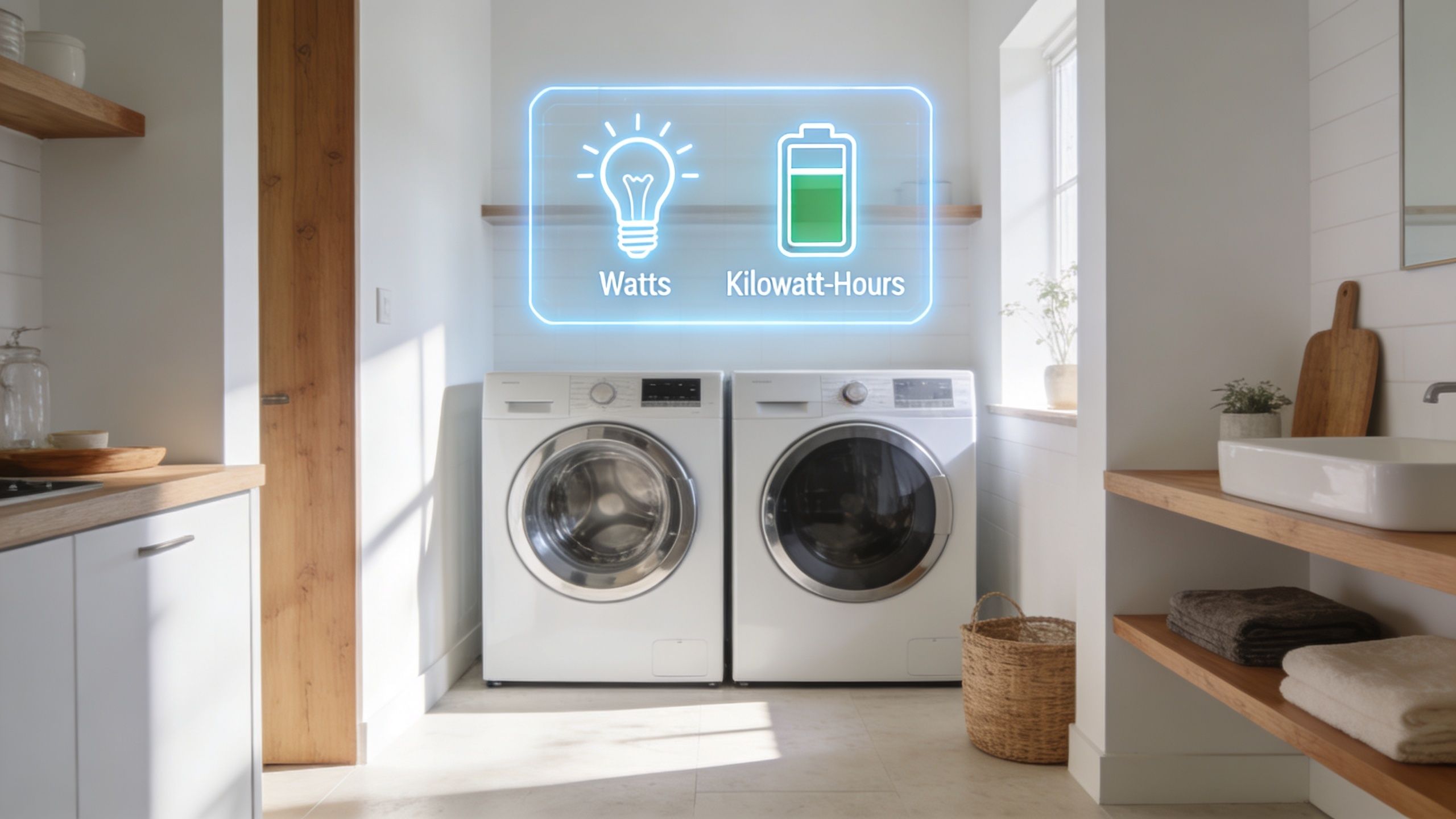
People often mix up watts and kilowatt-hours, but they answer different questions.
Watts tell you how fast an appliance uses electricity at a point in time. Kilowatt-hours tell you how much total energy it consumed over time. Your electricity bill charges for the second one.
A simple way to think about it
Use a bucket analogy.
- Watts are the flow rate. They tell you how fast water is pouring into the bucket.
- Kilowatt-hours are the total volume collected. They tell you how much water ended up in the bucket after a period of time.
A dryer with a high wattage can still use a moderate amount of energy if it runs briefly. A lower-wattage machine can still add up if it runs for a long cycle. That’s why two dryers can feel similar in daily use but show up differently on your bill.
Why battery owners should care
A home battery is also measured in energy terms. It stores a set amount of electricity, and heavy appliances draw from that stored energy quickly if they run at the wrong time. If you don’t understand the difference between instantaneous power draw and total energy use, it’s hard to judge whether a dryer is chewing through stored solar efficiently or forcing an unnecessary import.
If you want to understand what your household is already using in real time, it helps to know how to read your electricity meter. For households on time-based pricing, it’s also worth understanding how off-peak tariffs explained affect the cost of running major appliances outside busier periods.
The billing consequence
A dryer can have a manageable cost per load and still be strategically costly if it runs at the wrong time. That distinction matters in homes with solar, batteries, and time-of-use pricing. The appliance doesn’t just consume electricity. It competes for your lowest-cost electricity.
Practical rule: Power draw tells you whether the appliance is heavy. Kilowatt-hours tell you what you paid for.
Dryer Energy Use by Type A Comparison
A dryer choice changes more than the cost of one load. For a household with solar, a battery, and VPP participation, it also changes how much dispatchable energy is left when the battery is most valuable to the grid.
The three dryer types most Australian households will see are vented, condenser, and heat pump. They remove moisture in different ways, and that difference shows up in both cycle energy use and peak demand. The most credible Australian comparison point is the government-backed Energy Rating dryer registration database, which lists model-by-model energy performance for dryers sold in Australia.
Vented dryers
Vented dryers use electric resistance heating and push moist air out of the machine. It is a simple design, but it usually sits at the higher-energy end of the category because the system keeps heating fresh air rather than reusing much of the heat already created.
For battery owners, the issue is not only total consumption. A vented dryer usually creates a larger coincident load with cooking, cooling, or EV charging. That raises the chance that a battery discharges faster than planned, or that the home imports power during a higher-priced period.
Condenser dryers
Condenser dryers avoid external venting by condensing moisture from warm air and collecting the water internally. That makes them easier to place in apartments or laundries where venting is awkward.
Energy performance varies by model, but standard condenser units still usually rely on electric resistance heating. In practice, many sit closer to vented dryers than to heat pump dryers on running cost. For households on time-based tariffs, installation convenience should be weighed against the value of shifting heavy loads into cheaper windows such as off-peak electricity periods.
Heat pump dryers
Heat pump dryers recirculate and reheat air more efficiently, so they generally use much less energy per cycle than resistance-heated machines. They also tend to draw power more steadily and at a lower rate.
That matters financially. Lower cycle consumption cuts the direct cost of drying. Lower demand also preserves battery capacity for periods when export support, peak avoidance, or VPP dispatch is worth more than using stored energy on laundry.
Dryer Type Energy Consumption Comparison
| Dryer Type | Typical Energy Use (kWh per load) | Approx. Running Cost (per load @ 30c/kWh) | Typical Purchase Price in Australia |
|---|---|---|---|
| Vented | 3.0 to 5.0 | $0.90 to $1.50 | $400 to $900 |
| Condenser | 3.0 to 4.5 | $0.90 to $1.35 | $700 to $1,500 |
| Heat pump | 1.0 to 2.5 | $0.30 to $0.75 | $1,000 to $2,500 |
These ranges reflect commonly listed capacities and efficiency tiers in the Australian retail market and Energy Rating product registrations. Exact results vary with load size, fabric type, ambient temperature, and program selection.
What this means in practice
A heat pump dryer is usually the better strategic fit for a solar-and-battery household, even before you calculate annual running cost. The less obvious benefit is operational flexibility.
If your battery participates in a VPP, a lower-draw dryer can reduce conflict between household comfort and market value. Running a resistance dryer during a VPP event or evening peak can consume energy that might otherwise be exported or held back for a high-price interval. Running a heat pump dryer earlier in the solar window, or during a lower-value battery period, can leave more capacity available for grid support later.
That makes appliance choice part of energy trading strategy, not just appliance efficiency.
The best dryer for a battery household is usually the one that minimises both kilowatt-hours per load and competition for stored energy during high-value periods.
A Practical Guide to Calculating Your Dryer's Running Cost
You don’t need a specialist tool to estimate your dryer cost. The base formula is simple:
(Dryer wattage ÷ 1000) × hours of use × your electricity rate = cost per use

Step one: find the wattage
Check the appliance compliance plate, user manual, or manufacturer specifications. Some households will find the rating in watts. Others may need to interpret the model information more carefully. If you’re on a modern retail plan, comparing the appliance label with your usage profile and off-peak electricity options can reveal whether timing is a bigger lever than the machine itself.
Step two: convert to kilowatts
A 3,000-watt dryer is 3 kilowatts. You divide by 1000.
Step three: multiply by time used
If that dryer runs for one hour, it uses 3 kWh. If it runs for 45 minutes, it uses 2.25 kWh.
Step four: apply your electricity rate
In Queensland and New South Wales, average electricity rates sit around 25 to 35 cents per kWh, and a standard electric dryer using 3.4 kWh for a full load can cost between $0.85 and $1.19 per cycle (dryer running cost in QLD and NSW).
Here are two worked examples using the verified rate range:
Example A
A 3,000-watt dryer runs for 1 hour at $0.25 per kWh
Cost = 3 × 1 × 0.25
Cost per load = $0.75Example B
A 3,500-watt dryer runs for 1 hour at $0.35 per kWh
Cost = 3.5 × 1 × 0.35
Cost per load = $1.225
Small differences in wattage and tariff quickly add up.
For a visual walk-through of the same logic, this explainer is useful:
What the formula misses
The formula gives you the direct appliance cost. It doesn’t tell you whether that electricity came from rooftop solar, stored battery energy, or the grid. For battery owners, that’s the next layer of analysis.
A dryer cycle that looks cheap on paper may still reduce the value of your system if it drains stored energy just before a higher-value period. That’s why cost-per-load is useful, but incomplete.
From Energy Drain to Grid Asset Optimising Your Dryer
A dryer has a reputation as a pure cost centre. That’s only partly true. In a battery-equipped home, the dryer becomes more manageable when you stop treating it as an isolated appliance and start treating it as part of the home’s broader load strategy.
Start with the low-friction changes
Some improvements are operational, not technological.
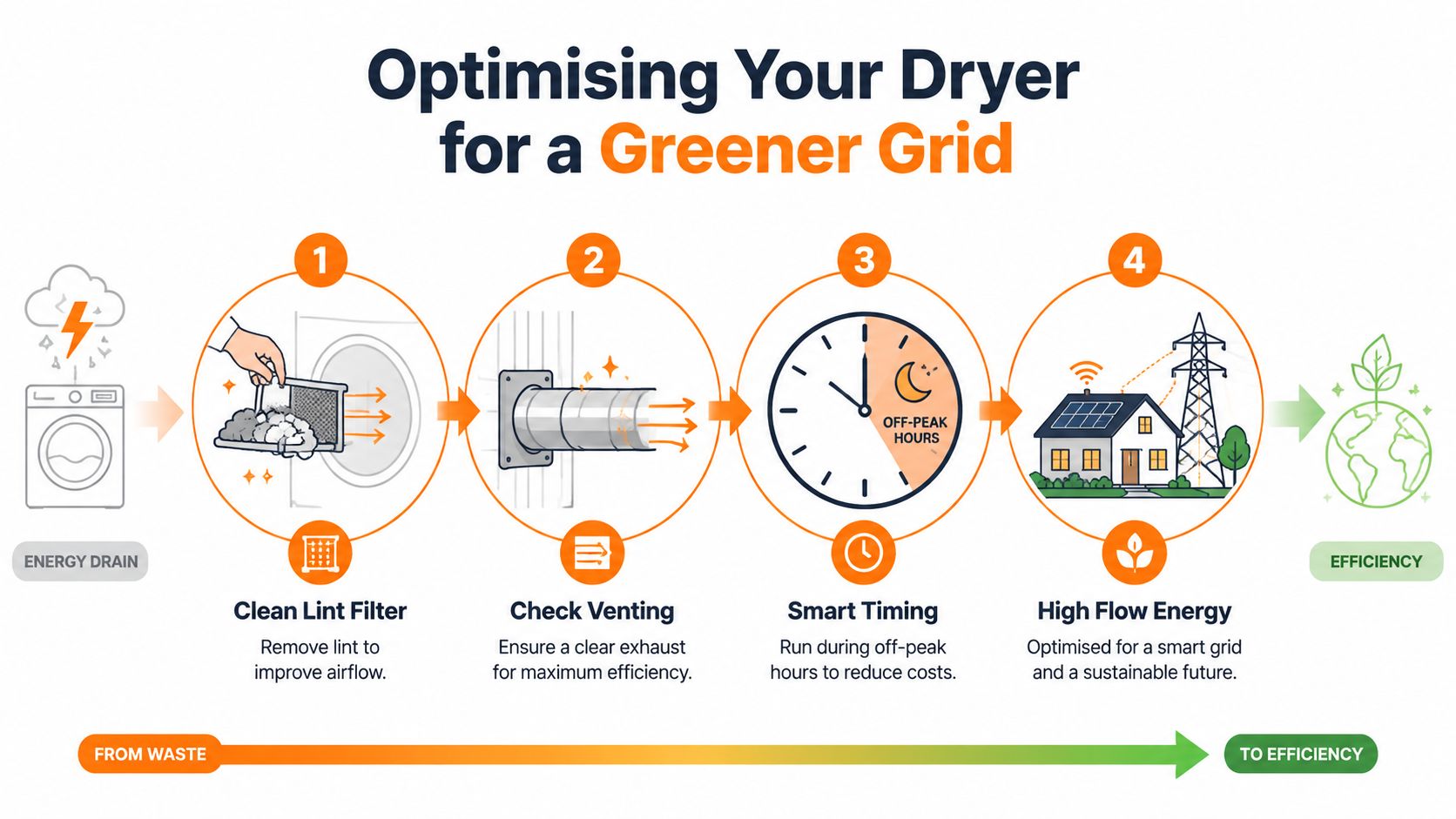
- Run loads in the solar window. If your rooftop system is producing strongly in the middle of the day, the dryer can absorb generation that might otherwise be exported at a low value.
- Use eco settings where practical. Longer, lower-intensity drying can align better with available solar and place less strain on total household demand.
- Keep airflow clean. Lint buildup increases runtime and undermines the efficiency the appliance was designed to deliver.
- Separate heavy and light fabrics. Mixed loads often force the dryer to run for the slowest-drying items.
These aren’t glamorous changes, but they usually improve control. For homeowners already looking at broader sustainable home improvements Melbourne style upgrades, appliance timing belongs in the same conversation as insulation, glazing, and efficient hot water. The appliance itself matters. The operational pattern matters just as much.
Why timing matters more in battery homes
A dryer’s direct cost is only one side of the ledger. The more strategic issue is whether it consumes electricity during a period when your battery could be doing something more valuable.
That might mean:
- preserving charge for evening household use
- avoiding imports when tariffs are less favourable
- keeping flexibility available for coordinated grid support
- reducing overlap with other large loads
The financial logic changes. A dryer used at the wrong time doesn’t just cost money. It can crowd out better uses of your stored energy.
In a conventional home, the dryer is a consumption event. In a battery home, it’s also a dispatch decision.
The appliance choice affects system flexibility
Heat pump dryers are especially relevant here. Their lower wattage of 1,000 to 1,500W makes them well suited to VPP participation because the reduced peak demand is less likely to conflict with other household loads, which increases the battery’s capacity to contribute to grid services and earn credits (heat pump dryers and VPP suitability).
That’s a more commercially useful point than “heat pumps are efficient”. Lower wattage changes the trade-offs inside the home.
A lower-demand dryer can make it easier to:
- run laundry without clipping battery flexibility
- avoid simultaneous high-load conflicts
- maintain more stable battery discharge behaviour
- coordinate appliance use with live household conditions
A better way to think about dryer optimisation
Most appliance advice stops at “use it less” or “buy a more efficient model”. That’s incomplete for solar-and-battery owners.
A more realistic framework looks like this:
| Priority | What to optimise | Why it matters |
|---|---|---|
| First | Appliance timing | It decides whether solar, battery, or grid power covers the load |
| Second | Appliance efficiency | It reduces total energy used per load |
| Third | Load coordination | It limits conflict with other major appliances |
| Fourth | Monitoring | It shows whether your assumptions match actual household behaviour |
If you have visibility into your home’s load profile through home energy monitoring tools, the dryer becomes easier to place in the day with intent rather than habit.
The less obvious conclusion
Battery owners often focus on generation and storage capacity. That makes sense during system selection. But after installation, appliance timing often determines whether the battery delivers its full financial value.
A dryer is one of the clearest examples because the load is large, discretionary, and movable. You usually don’t need to run it at a specific minute. That flexibility is valuable.
The strongest operating pattern is usually not “always run it late at night” or “always run it immediately”. It’s to align the load with the household’s actual energy position on that day. If solar production is strong, the dryer can act as a daytime sponge. If battery charge is limited and evening demand is coming, deferring the cycle may protect higher-value energy use later.
That’s the shift from appliance management to asset optimisation.
Optimise Your Battery Performance with High Flow Energy
A dryer cycle can either erode battery value or improve it. The difference usually comes down to whether the appliance is fitted around your home’s trading position, solar output, and evening demand, rather than run whenever the basket is full.
That matters more for VPP participants than for standard solar households. A dryer is a high-draw but flexible load. Used at the wrong time, it can force battery discharge during a higher-value window or increase grid imports when prices are less favourable. Used at the right time, it can absorb excess generation, reduce avoidable exports, and leave more battery capacity available for periods when your system can earn or save more.
High Flow Energy focuses on that operating layer after installation. The commercial question is not only whether your battery works. It is whether your retailer structure and household load timing are helping the battery produce the best financial outcome available under your tariff and participation settings.
If you want to assess whether your current setup is capturing that value, request an eligibility assessment through High Flow Energy. It is a practical review of how your home uses energy, how major appliances interact with battery strategy, and whether your present arrangement is limiting the return from your solar and battery system.
Frequently Asked Questions
Does a quick-dry cycle always use more electricity?
Cycle labels can mislead. A quick-dry setting often uses higher heat for a shorter period, so the total electricity used depends on the fabric type, load size, and how dry the clothes were before the cycle started. If a quick cycle leaves towels or thicker items damp and you run the dryer again, the apparent time saving turns into a higher cost per load.
Are moisture sensors worth paying for?
Usually, yes. The main financial benefit is avoided over-drying. Moisture sensors stop the cycle closer to the point the load is dry, which cuts unnecessary runtime and reduces the chance that the dryer uses battery energy or grid imports for no practical gain.
That matters more in homes where the dryer runs several times a week. Small savings per load add up faster when the appliance is used often.
Is a heat pump dryer always the best option for a battery home?
A heat pump dryer is often the better strategic fit, but not in every household. Its lower demand profile makes it easier to run alongside other appliances without creating a sharp spike in home load, which can reduce pressure on the battery during constrained periods.
The trade-off is cycle length. If your operating plan depends on finishing loads inside a narrow solar window, a longer cycle can matter. The best choice is the model that fits both your energy tariff and the way your household uses the laundry.
Should I run the dryer at night if I have a battery?
Only if the battery has low-value energy available at that time. For VPP participants, the question is not solely whether the battery can cover the load. It is whether using stored energy for drying clothes is the best use of that charge compared with evening household demand, tariff arbitrage, or VPP events.
In many homes, the strongest option is a controlled daytime run that absorbs surplus solar while preserving battery capacity for periods with higher financial value.
Do smart plugs solve dryer timing?
They help with visibility and scheduling. They do not optimise the whole system.
A smart plug can tell you when the dryer runs and, in some setups, trigger a cycle at a chosen time. It cannot judge whether that timing conflicts with EV charging, hot water heating, battery export strategy, or a VPP dispatch window. That decision needs a whole-home view.
Does lint filter cleaning really matter?
Yes. Poor airflow extends drying time, and longer runtime directly increases electricity use. It also makes dryer performance less predictable, which is unhelpful if you are trying to align appliance loads with solar production or battery strategy.
Is the cheapest dryer to buy usually the cheapest to own?
Often, no. Purchase price only captures the upfront transaction. Ownership cost includes electricity use, the effect on battery cycling, and whether the appliance forces energy consumption into less favourable parts of the day.
That difference is easy to miss if you compare machines only on sticker price. For a solar and battery household, the better question is which dryer gives you the lowest long-run cost while fitting cleanly into your operating schedule.