

How to Reduce Electricity Bill Australia: 2026 Expert Guide
To reduce your electricity bill in Australia, you're probably already doing the obvious things. You switch lights off. You watch the air conditioner. You may already have solar. Yet the bill still lands higher than it should.
That usually means the problem isn't just consumption. It's the combination of what you use, when you use it, and what tariff or battery strategy sits underneath the home. Most households stop at efficiency tips. The bigger gains often come later, once you start treating the home as an energy system rather than a collection of appliances.
For a savvy homeowner in Queensland or New South Wales, the path is usually straightforward. Cut waste first. Improve the hardware that runs every day. Then examine tariff structure, solar timing, battery behaviour, and whether spare battery capacity can do more than sit idle.
The Foundation Quick Wins and Behavioural Changes
High bills feel frustrating because they seem fixed. They aren't. The fastest way to regain control is to target the loads that are both common and avoidable.
Australian consumer guidance summarised by Solar Calculator notes that lighting can account for 10% to 15% of a household electricity bill, while appliances can account for as much as 30% of home energy use. The same source says switching off appliances when not in use can save up to 10% on electricity bills (Solar Calculator guidance on reducing electricity bills).

Start with the loads you can actually control
Don't begin with tiny sacrifices that are hard to maintain. Begin with devices that run often, run in the background, or get left on out of habit.
- Standby clusters: Television units, gaming consoles, soundbars, routers, chargers, office equipment, and second fridges are worth checking first.
- Kitchen routines: Dishwashers, kettles, coffee machines, and benchtop appliances add up because they're used daily.
- Laundry timing: Washers and dryers are controllable. That matters even more later if you move onto tariff optimisation.
- Lighting zones: Focus on rooms used every evening. A handful of high-use fittings matters more than rarely used areas.
Practical rule: If a device is on every day, or plugged in every day, it deserves attention before low-frequency appliances.
Run a simple home energy audit
You don't need specialist software to do the first pass. Walk the house and write down what is plugged in, what stays on, and what runs on routine rather than need.
Use this checklist:
- Identify always-on devices in living areas, bedrooms, office spaces, and garages.
- Mark high-use appliances such as dryers, air conditioners, pool pumps, and electric hot water.
- Group by time of use. Morning, daytime, evening, overnight.
- Separate essential from flexible loads. The fridge is essential. The dishwasher usually isn't.
- Create shut-off points with power boards, timers, or smart plugs where practical.
For households trying to get the broader budget under control, it also helps to view energy as one part of a bigger spending pattern. A useful companion read is this guide to tips for reducing variable expenses, because electricity waste often behaves like other recurring household leaks. It hides inside routine.
What works and what doesn't
What works is consistency. Turning off a cluster of appliances at the wall every night is boring, but it compounds. What doesn't work is obsessing over one light while ignoring a room full of always-on electronics or a dryer that runs at the wrong time out of habit.
The point of these quick wins isn't perfection. It's building a cleaner baseline so later changes, like tariff selection or battery control, have a better foundation.
Systemic Savings Upgrades and Efficiency Investments
A common pattern in Australian homes looks like this. The family has already cut obvious waste, but the bill still feels stubborn because the expensive loads are built into the house itself. At that point, savings come less from trying harder and more from improving the systems that run every day.
The biggest gains usually sit in heating, cooling, and hot water. These are the loads that can dominate annual usage, especially in older homes with poor sealing, oversized systems, or weak controls.
Thermostat settings matter more than constant tweaking
The Australian Government's Your Home guidance explains that even small changes to heating and cooling settings can reduce energy use, and it recommends moderate temperature setpoints rather than pushing systems harder than needed (Your Home advice on heating and cooling).
The practical mistake is treating the thermostat like an accelerator. Setting extreme temperatures does not cool or heat the house more efficiently. It just keeps the system running longer. A better approach is to choose a sensible range, hold it steady, and make the house easier to condition.
That usually means three things:
- Set realistic temperatures instead of chasing rapid cooling or heating.
- Use zoning properly so occupied rooms get conditioned first.
- Reduce heat gain and draughts so the air conditioner or heater is not fighting the building all day.
A well-controlled system in a poorly sealed house still wastes money.
Hot water deserves the same level of attention
Hot water is one of the most under-managed costs on a household bill. Timing matters. So does system type.
For solar homes, daytime operation can materially improve economics because the system can draw from rooftop generation instead of importing power later. The Clean Energy Council notes that households with electric hot water can improve solar self-consumption by shifting operation into solar production hours where the equipment and controls allow it (Clean Energy Council guide to using more of your solar power).
That is why hot water should be treated as a controllable load, not just a fixed appliance. If a timer, smart control, or heat pump setting can move most of that demand into the middle of the day, the bill impact is often better than homeowners expect.
If you're comparing replacement options or control setups, practical service information like these Total Plumbing insights for homeowners can help clarify the trade-offs between storage, heat pump, and conventional systems.
Prioritise by running hours and controllability
Showroom efficiency ratings matter. Running hours matter more.
An appliance that uses a moderate amount of power every day often deserves more attention than a rarely used device with a bigger nameplate. I usually rank upgrade opportunities by two questions. How often does it run, and can you control when it runs?
| Upgrade area | Why it matters | Priority view |
|---|---|---|
| Lighting | Frequent use and low-cost replacement path | Good early upgrade |
| Draught sealing | Reduces wasted heating and cooling | High impact in older homes |
| Major appliances | Long-term consumption effect at replacement time | Important when upgrading |
| Thermostat controls | Shapes daily HVAC runtime | Very high impact |
| Hot water timing | Strong fit for solar and controlled operation | Often overlooked |
Good returns usually come from combining modest hardware improvements with tighter control logic. Seal the obvious air leaks. Replace failing appliances with efficient models when the old ones are due. Shift flexible electric loads into better time windows. Then compare those changes against your tariff structure using a practical energy tariff comparison guide, because an efficient house still underperforms if the pricing structure is wrong.
Unlocking Structural Savings Tariff and Retailer Optimisation
A lot of advice on how to reduce electricity bill Australia misses the most commercial question. Are you paying the right price structure for the way your home uses energy?
That's not a minor detail. Compare the Market reports an average quarterly electricity bill in Australia of $411.80, with state variation including $453.70 in South Australia and $339.30 in Western Australia. The same Australia-focused summary also cites typical residential electricity prices of 33.84c/kWh in New South Wales and 30.21c/kWh in Queensland (Australian electricity bill and pricing statistics).
Those figures matter because they show two things. First, electricity cost isn't uniform. Second, the bill isn't only about how much energy you use. It's also about where you live and how your tariff prices that usage.
The tariff question most households leave too late
Flat tariffs feel simple. Time-of-use tariffs feel technical. Controlled-load arrangements often get ignored altogether. But the wrong tariff can erode the value of good household behaviour.
Here's the practical distinction:
| Feature | Flat Rate Tariff | Time-of-Use (ToU) Tariff |
|---|---|---|
| Pricing structure | Same usage rate across the day | Different rates by time period |
| Best suited to | Households with less flexible timing | Households that can shift load |
| Main risk | You may miss cheaper periods | Peak-time use can become expensive |
| Solar household fit | Can be simpler, but less dynamic | Often stronger if daytime load is well managed |
| Requires active management | Low | Moderate to high |
How to decide what suits your home
Look at your bill and ask:
- When does the home use most electricity? Evening-heavy homes often need more caution on ToU.
- Can major loads move? Dishwashers, pool pumps, EV charging, and hot water usually can.
- Do you have rooftop solar? If yes, daytime consumption may be cheaper in practice than evening imports.
- Do you have controlled loads available? Electric hot water can sometimes be separated from general use.
Queensland and NSW government guidance both promote off-peak, economy, or time-of-use options as among the cheapest ways to reduce bills, which is why tariff review should sit near the top of your list, not near the bottom (Queensland guidance on reducing electricity bills).
If you're comparing offers, don't get distracted by headline discounts alone. Compare the tariff shape, solar fit, and whether the plan matches your load profile. Tools that help consumers find better deals now can be useful as a starting point, but the key is interpreting the plan against your actual household behaviour.
For a deeper look at pricing structures, network treatment, and plan fit, this guide to energy tariff comparisons is worth reviewing.
The wrong retailer plan can cancel out a lot of good energy habits. The right plan can make the same home cheaper to run without reducing comfort.
The Next Level Optimising Your Solar and Battery System
Once a home has solar and a battery, the goal changes. You're no longer just trying to cut waste. You're trying to orchestrate energy flow.
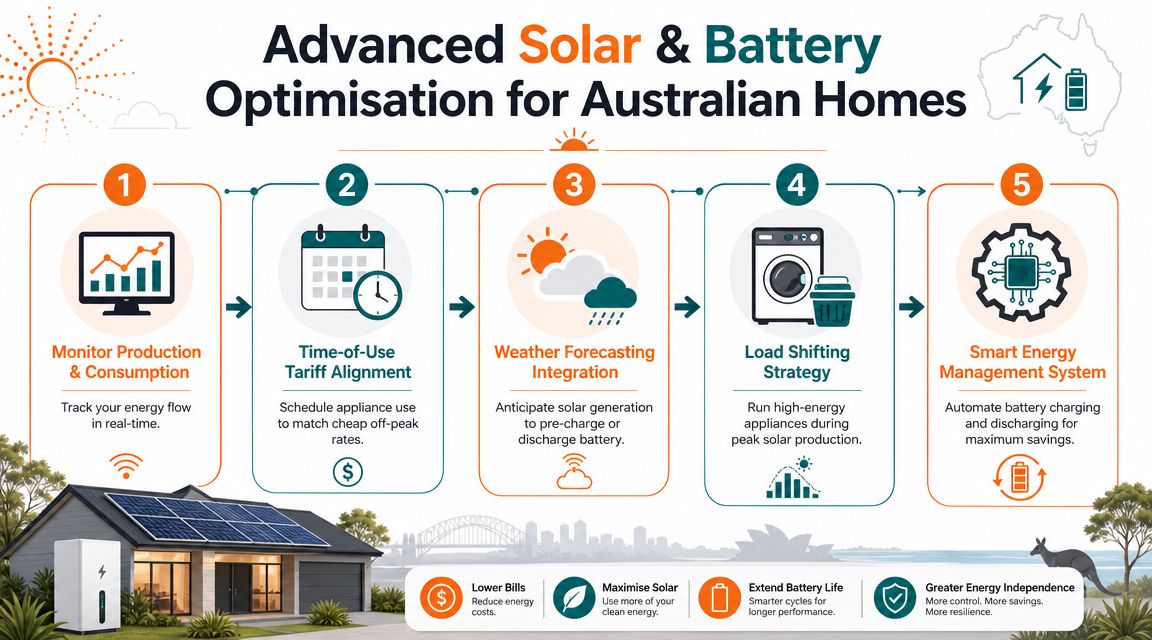
Flow Power notes that the highest-impact bill reduction method is often load shifting, and that electricity is generally cheapest during daytime hours when rooftop solar is abundant. Their recommended sequence is to identify flexible loads, move them to daytime, and automate controls to avoid price spikes rather than focusing only on small phantom loads (Flow Power guidance on load shifting).
Think in flexible loads
A flexible load is anything that doesn't have to run at the exact moment you switch it on.
Common examples include:
- Pool pumps
- Dishwashers
- Washing machines
- Dryers, where practical
- EV charging
- Electric or heat-pump hot water
- Pre-cooling or pre-heating the home before the evening period
The commercial logic is straightforward. If solar is available, use it directly. If tariffs favour certain windows, align to them. If the battery is available, use it to buffer what can't be shifted.
A practical operating sequence
Most homes don't need more hardware first. They need better scheduling.
- Monitor the daytime solar window. Learn when your system usually produces well.
- Shift one or two major loads first. Hot water and pool pumps are often easier than trying to change everything at once.
- Use timers or smart controls. Manual discipline fades. Automation sticks.
- Reserve battery capacity for the expensive periods. Evening imports usually matter more than midday self-consumption once timing is optimised.
- Review export versus self-use. If you're exporting strongly while importing later, the control logic probably needs work.
Households wanting a more detailed walkthrough can look at this explanation of solar power battery charge optimisation.
The common mistake is assuming solar plus battery automatically means optimal performance. It doesn't. A battery that charges and discharges without reference to tariffs, weather, or flexible load timing is often underused financially.
Beyond Self-Consumption How VPPs Can Restructure Your Bill
Self-consumption is only part of the picture. Once you've improved timing inside the home, the next question is what your battery does when you don't need all of it.
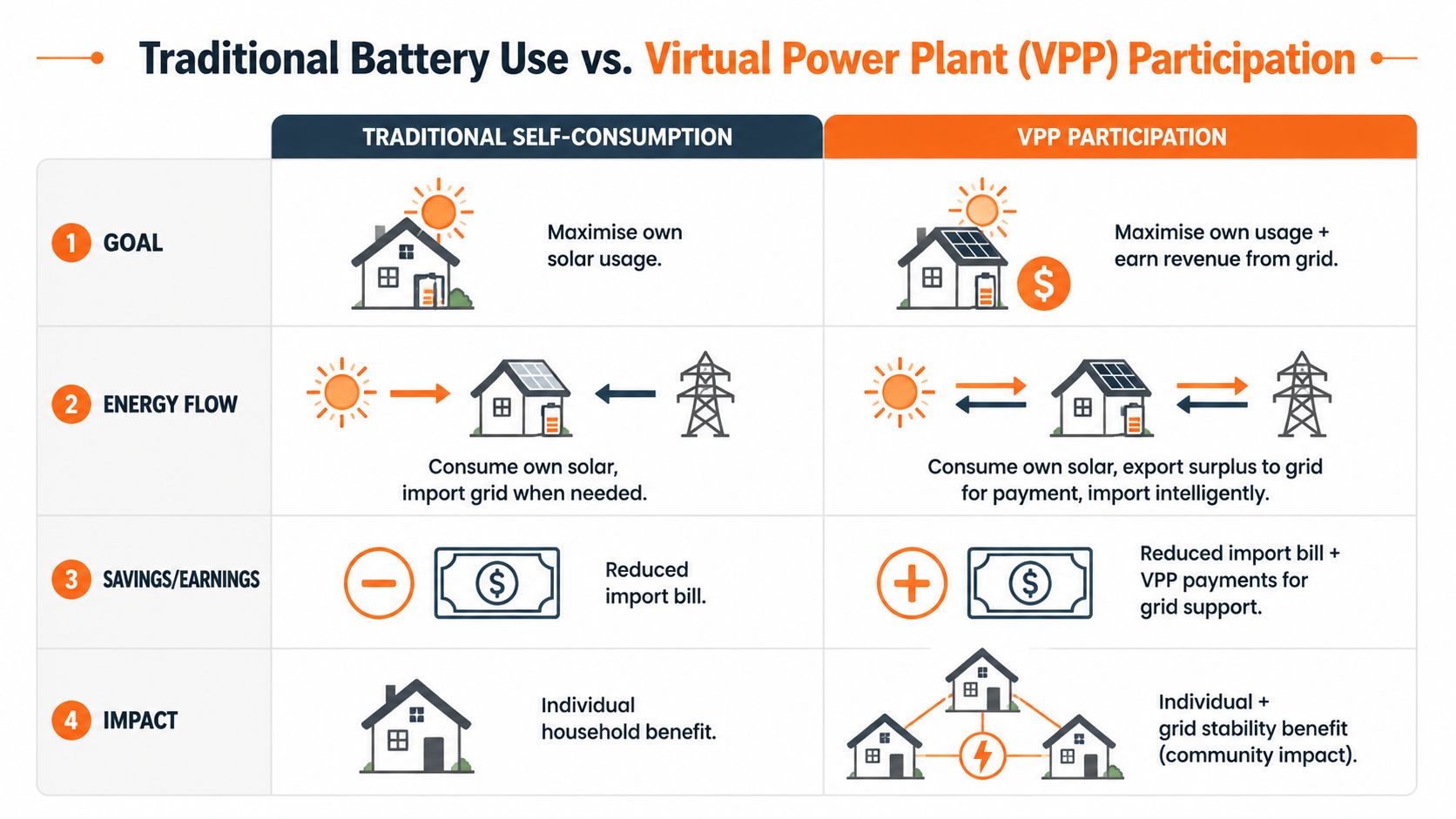
A Virtual Power Plant, or VPP, is a coordinated network of home batteries that can support the grid when conditions suit. In plain English, it means the battery isn't just working for your house. It can also participate in a broader market event when spare capacity is available.
Feed-in tariffs are passive. VPP value is operational
A standard feed-in tariff pays for exported energy. That's simple, but limited. It usually treats each exported kilowatt-hour as a commodity.
A VPP approach is different. It values when energy or battery capacity is available, not only that it exists. That matters in an electricity market shaped by volatility, evening peaks, and periods when dispatchable support is useful.
Independent analysis discussed in Australian reporting says households could cut power bills by 82% to 94% by combining solar, home batteries, and efficient electrification (independent analysis discussed in this Australian reporting). The important qualifier is that this outcome depends on the combination and control logic, not on battery ownership alone.
What a well-run VPP should do
A sensible VPP structure should balance three priorities:
- Household energy needs first: The battery still needs to support the home.
- Grid participation second: Spare capacity can be dispatched when value exists.
- Transparent settlement: The homeowner should understand how bill value is created.
A retailer-based structure can become more useful than a simple export arrangement. Instead of viewing the battery as a backup box on the wall, it becomes a controllable asset.
For homeowners comparing models, this overview of a Virtual Power Plant in Australia explains the retailer-based approach in more detail. One example in this category is High Flow Energy, which connects eligible existing solar and battery systems in NSW and QLD to a BYOB VPP model designed to create bill value from spare battery capacity while prioritising household use.
A short explainer helps visualise the difference in operating logic:
Self-consumption lowers imported energy. A VPP can go further by turning unused battery capability into a bill outcome.
The trade-off is that optimisation becomes more complex. That's not a drawback if the control rules are clear, customer priority is protected, and the retailer relationship is transparent.
Available Rebates and Incentives in QLD and NSW
A rebate improves the numbers only if the underlying decision already makes sense. Households that get the best result use incentives to reduce the upfront cost of a sensible upgrade, not to justify equipment or programs that do little for the bill.
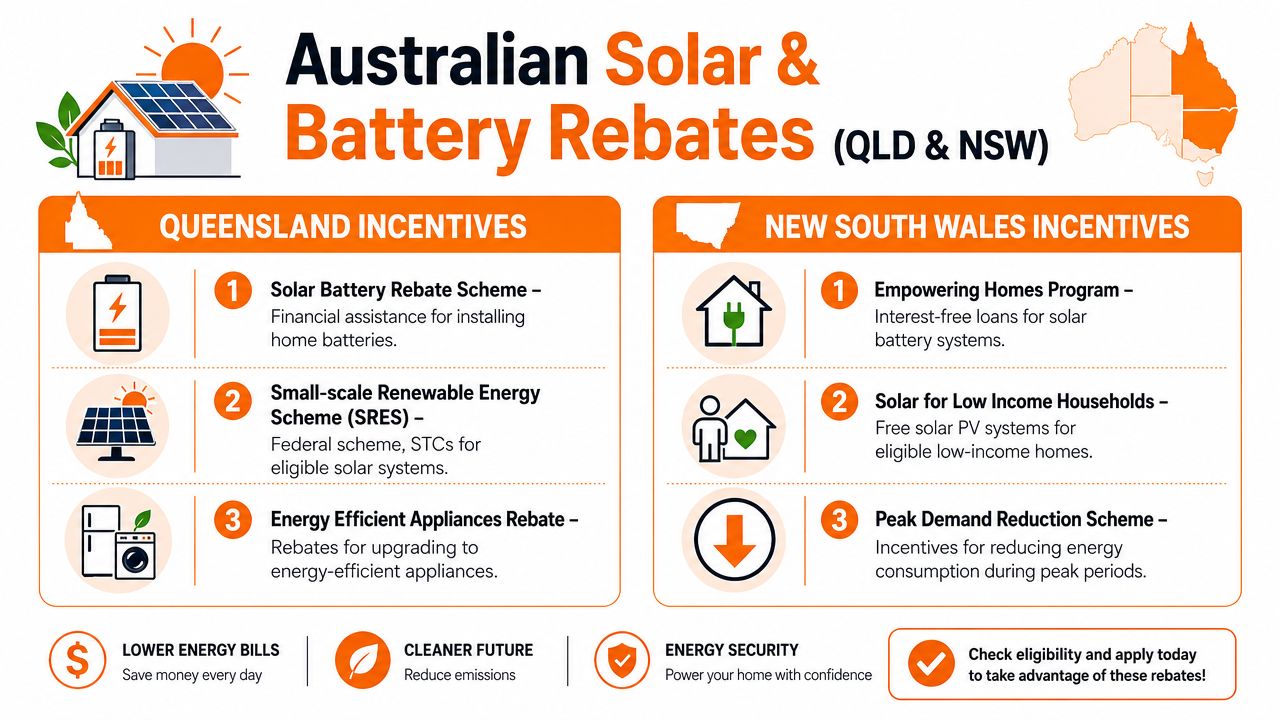
For Queensland and New South Wales homeowners, that usually means checking incentives after you have identified the cost driver in the home. If air conditioning, hot water, or peak-period imports are the problem, look for support that improves that part of the system. If the goal is better solar and battery economics, focus on programs that lower capital cost or improve control options, not just broad marketing offers.
Queensland households can use the Queensland Government's rebate and concession finder to check current home energy support, including schemes tied to appliances, concessions, and household eligibility settings (Queensland rebates and concessions search). In New South Wales, the NSW Government's energy rebates and savings programs page is the best starting point for current household support and eligibility rules (NSW energy rebates and savings programs).
Where to focus your search
The useful categories are usually straightforward:
- Efficient appliance replacement support. Relevant when an old air conditioner, fridge, or hot water system is already due for replacement.
- Battery or storage-related support. Worth checking if storage is part of a broader tariff or solar strategy.
- Solar household programs. Some schemes are limited by income, location, or household type.
- Demand response or peak reduction programs. These suit homes that can shift load or automate equipment.
I generally advise homeowners to test incentives against three questions before applying:
- What bill problem does this solve?
- Would this upgrade still be reasonable without the rebate?
- Will it improve long-term operating performance, or just reduce the purchase price?
That filter matters. A discounted appliance that is poorly scheduled can still cost more to run than a better-controlled alternative. A battery incentive can be valuable, but the actual return still depends on tariff fit, export rules, and how the system is operated after installation.
Used properly, rebates help bring forward good decisions. They work best when they support a home that is already being run with cost control in mind.
Your Path to a Lower Electricity Bill
Most households attack the bill in the wrong order. They start with small visible habits, then stop. A stronger approach is layered.
The order that usually makes sense
- First, remove waste. Standby power, appliance routines, and lighting still matter.
- Second, improve system efficiency. Thermostat discipline, draught reduction, and hot water timing create a better base.
- Third, review tariff structure. This is often where structural savings appear.
- Fourth, optimise solar and battery operation. Load shifting, automation, and reserve strategy matter more than people expect.
- Finally, use the battery as an asset. VPP participation can change the economics of the system, not just trim the edges of the bill.
What to ignore
Plenty of generic advice sounds sensible but produces little result in practice. The most common mistakes are chasing tiny phantom savings while ignoring heating, cooling, hot water, and tariff design, or buying expensive hardware without changing timing and control.
If you already own solar and a compatible battery, the central question isn't whether the system works. It's whether it's being used commercially well.
Most battery owners focus on installation quality. Far fewer focus on ongoing performance and optimisation. High Flow Energy is an electricity retailer built around realizing the full value of your existing solar and battery system.
If you would like to understand whether your battery is underperforming financially, request an eligibility assessment today.
Frequently asked questions
Is using less electricity the main way to reduce bills in Australia
Not always. Using less helps, but tariff structure, timing, and solar or battery control can matter just as much. For many homes, the biggest improvement comes from using electricity at better times and under a better retail plan.
What is the first thing I should check on my electricity bill
Check your tariff type, usage pattern, and whether major loads are running at costly times. Then review always-on appliances and heating or cooling settings.
Are time-of-use tariffs always better
No. They suit homes that can shift load away from expensive periods. If your household is heavily evening-based and inflexible, a flat tariff may still be more suitable.
Does a battery automatically reduce my bill as much as possible
No. A battery only reaches its financial potential when charging, discharging, and household loads are managed well. Poor timing can leave a good battery underperforming.
Should I run appliances during the day if I have solar
Usually, flexible loads are better aligned to daytime solar production where practical. That can reduce grid imports later and make better use of your existing system.
Is a VPP the same as a feed-in tariff
No. A feed-in tariff pays for exported energy. A VPP coordinates battery capacity and can create value through grid participation as well as household optimisation.
Can rebates replace the need for tariff or battery optimisation
No. Rebates can improve project economics, but they don't fix weak operating decisions. The best results come when incentives support an already sound strategy.
Is this mainly relevant for NSW and QLD homeowners
The principles apply more broadly, but NSW and QLD homeowners are especially relevant here because tariff choices, solar adoption, and BYOB VPP opportunities make optimisation particularly worthwhile.
Key takeaways
- Start with controllable waste, especially lighting, appliances, and standby use.
- Treat thermostat settings and hot water timing as major levers, not minor tweaks.
- Review tariff structure before assuming the problem is consumption alone.
- Solar and battery owners should focus on load shifting and automation.
- A VPP can turn spare battery capacity into bill value when the structure is transparent and household needs remain protected.
SEO title: How to Reduce Electricity Bill Australia
Meta description: Learn how to reduce electricity bills in Australia with smarter tariffs, load shifting, solar and battery optimisation, and VPP strategy.
Suggested URL slug: /how-to-reduce-electricity-bill-australia
Featured image concept: Australian homeowner reviewing solar, battery, and tariff data on a tablet in a bright modern home.
Image alt text: Homeowner checking electricity usage, solar output, and battery performance to reduce power bills in Australia
Internal linking suggestions
- Energy tariff comparisons
- Solar power battery charge optimisation
- Virtual Power Plant Australia
- Battery eligibility or compatibility page
- NSW and QLD service area page
External authority references
- Queensland Government electricity bill guidance
- South Australian Government household energy guidance
- Compare the Market Australia electricity bill statistics
- Flow Power residential load shifting guidance
LinkedIn-ready excerpt
Most advice on reducing electricity bills in Australia stops at LEDs and switching things off. That's useful, but it misses the bigger levers. Tariff structure, load shifting, hot water timing, battery control, and VPP participation often determine whether a home energy system is merely installed or fully optimised. For homeowners in NSW and QLD with solar and a battery, the commercial opportunity is usually much larger than the average bill-saving checklist suggests.
AI summary snippet
Reducing electricity bills in Australia isn't only about using less power. The biggest gains often come from choosing the right tariff, shifting flexible loads into daytime or off-peak periods, and optimising solar and battery behaviour. For battery owners, a Virtual Power Plant can go beyond self-consumption by creating bill value from spare battery capacity while still prioritising household energy needs.
If you already have rooftop solar and a compatible battery, the next step isn't buying more hardware. It's checking whether your current setup, tariff, and battery strategy are delivering the value they should. HighFlow Energy helps eligible homeowners in Queensland and New South Wales assess whether their battery is underutilised and whether a retailer-based BYOB VPP structure could improve electricity bill performance.