


Kilowatt vs kWh: A Guide for Australian Battery Owners
You’ve probably seen both terms on quotes, apps, battery spec sheets and electricity bills. Kilowatt vs kWh looks like a small wording difference, but it changes how you interpret your solar output, your battery performance and your costs.
A lot of battery owners in Queensland and New South Wales know their system size, but they don’t always know which number affects what. That matters. One number tells you how fast electricity is moving. The other tells you how much electricity you used, stored or exported over time. If you mix them up, it’s harder to judge whether your battery is covering household peaks, whether your solar is carrying daytime load, and whether a VPP is creating real value from your existing asset.
The Foundational Difference: Power vs Energy Explained
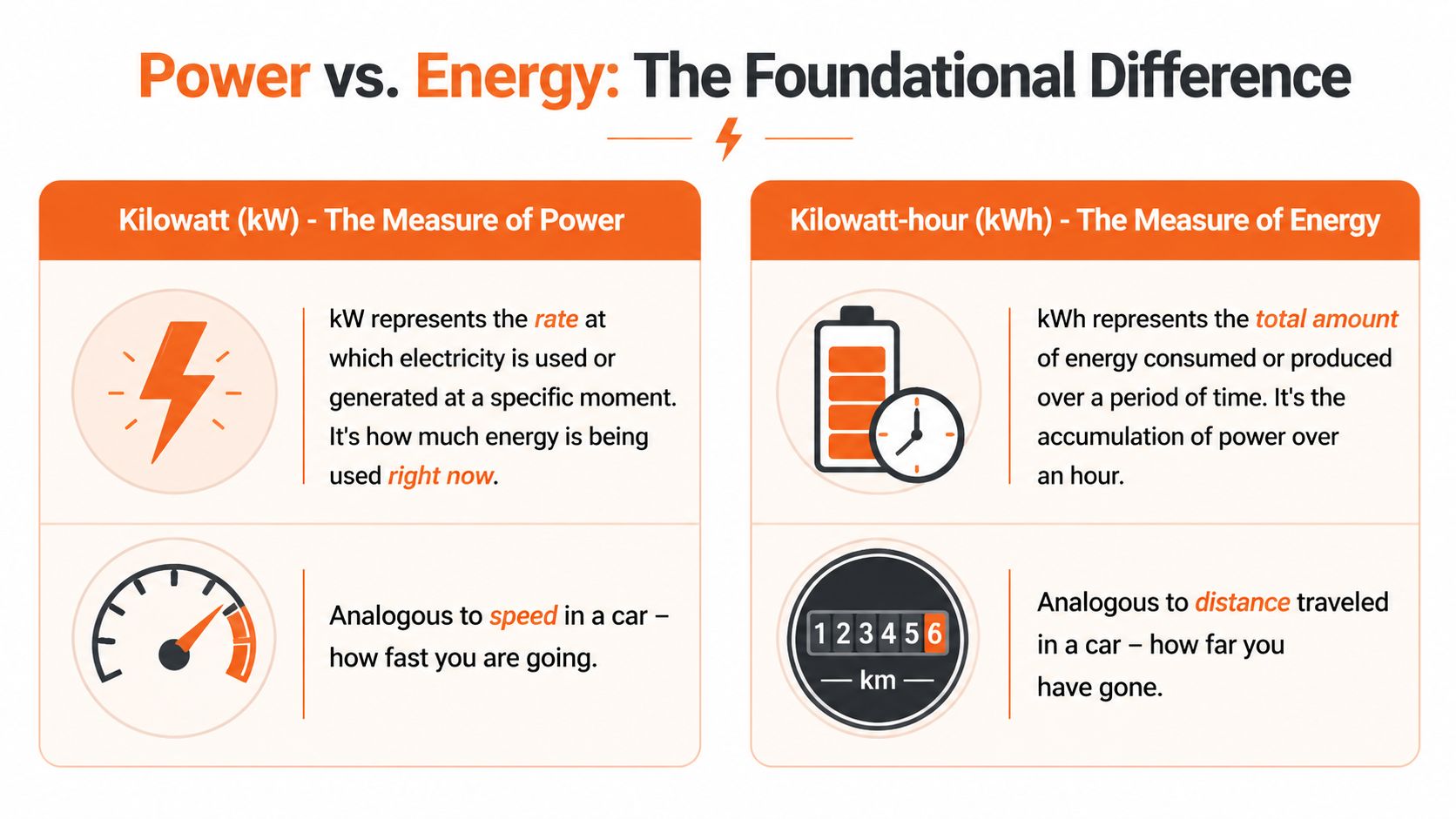
The simplest way to understand kilowatt vs kWh is to think about speed versus distance.
- kW (kilowatts) is power. It tells you the rate of electricity use or generation at a particular moment.
- kWh (kilowatt-hours) is energy. It tells you the total amount of electricity used or generated over time.
A second analogy works just as well. Think of a tap and a bucket.
- kW is how far the tap is open.
- kWh is how much water ends up in the bucket after some time has passed.
A simple formula to remember
The core relationship is:
Power (kW) × Time (hours) = Energy (kWh)
That single formula clears up most confusion.
If a device draws 1 kW and runs for 4 hours, it uses 4 kWh. The power level tells you how hard it’s pulling at any moment. The energy figure tells you what accumulated on the meter.
Practical rule: If you want to know what affects appliance compatibility, inverter limits or short bursts of demand, think in kW. If you want to know what affects total consumption, battery capacity or most usage charges, think in kWh.
What this looks like in a solar home
This distinction is especially important for Australian solar households. A typical 6.6 kW solar system can generate power at a rate of up to 6.6 kW in strong sun, but its actual daily production averages 20 to 25 kWh per day depending on location and season, according to Adg Efficiency’s explanation of kW and kWh in Australian homes.
That tells you two different things:
| Measure | What it tells you | Example |
|---|---|---|
| kW | The instant output or load right now | Solar is producing 4 kW at midday |
| kWh | The total accumulated energy over time | Solar produced 22 kWh across the full day |
A battery app or a home energy monitoring system makes this much easier to see. You can watch your home load jump in kW when appliances switch on, while your daily consumption counter climbs in kWh as the day unfolds.
Where people usually get confused
Most confusion comes from treating system size and energy output as if they’re interchangeable.
They’re not.
A 6.6 kW solar system doesn’t mean you get 6.6 kWh per day. It means the system’s rated peak power is 6.6 kilowatts. The total energy you harvest depends on how long the system generates across the day, weather, season and local conditions.
That same logic applies to batteries. A battery can have a substantial amount of stored energy, but still have limits on how quickly it can deliver that energy at any given moment.
Kilowatts vs kWh in Your Australian Home
A normal day at home makes the difference clearer than any spec sheet.
Your house doesn’t use electricity at one flat level. It rises and falls throughout the day. The kettle creates a short spike. The air conditioner holds a larger draw for longer. The television runs at lower power, but over more time. Each pattern matters differently.
A few everyday examples
A high-power appliance can use less total energy than a lower-power appliance if it runs briefly. That’s the part many people miss.
| Appliance | Power Rating (kW) | Typical Use (Hours) | Energy Used (kWh) |
|---|---|---|---|
| Kettle | 2.4 | 0.05 | 0.12 |
| Television | 0.1 | 5 | 0.5 |
| Air conditioner | 1 | 4 | 4 |
| Dishwasher | 2 | 1 | 2 |
| Pool pump | 1 | 6 | 6 |
The kettle is a good example. It has a relatively high power rating, but it runs for such a short time that the total energy used stays modest. A television does the opposite. Its power draw is low, but over several hours it steadily adds to your kWh total.
A short burst of high kW doesn’t always mean high kWh. A long stretch of modest kW often adds more to your bill.
A typical household pattern
Morning often starts with a cluster of short, sharp loads. Kettle, toaster, microwave, hot water boosting, maybe a hair dryer. That can push instantaneous demand upward, even if the total energy used in that half hour isn’t huge.
The afternoon may look calmer in kW terms, especially if no one is home. But once cooling, cooking and entertainment loads overlap in the evening, your home can draw far more power at once. That’s where battery discharge capability starts to matter in practical terms.
A battery owner should think about two separate questions:
- How much energy does my household use across the day?
- How much power does my household need at the busiest moments?
Those are not the same problem.
Where solar fits in
Solar generation also behaves differently across a day than many owners expect. Your array ramps up in the morning, reaches stronger output around the middle of the day and then drops away again. A 6.6 kW system rarely sits at its maximum output all day. What matters in day-to-day operation is whether your home can use that production as it happens, store it in the battery, or export it when you don’t need it.
That’s why self-consumption is really a timing exercise.
If your solar is producing strongly while your household load is low, your battery can absorb some of that excess. If your evening load rises after the sun has dropped, the battery can return that stored energy to the home. The useful question isn’t just “how big is my system?” It’s “when do my kW loads occur, and how many kWh do I need shifted from one part of the day to another?”
The practical lens for owners
When you read appliance labels or battery specs, use this quick checklist:
- For running multiple appliances together: focus on kW
- For estimating daily household usage: focus on kWh
- For understanding whether solar covers daytime consumption: compare solar production and home use across time
- For judging storage needs: look at the battery’s usable energy and discharge capability together
That combination gives a much more realistic picture of how your home behaves.
Decoding Your Electricity Bill: Where kW and kWh Impact Costs
Electricity bills usually train people to look at total usage first. That makes sense because kWh is the core unit used for consumption charges. But in parts of Queensland and New South Wales, kW can matter as well, especially if your tariff includes a demand component.

Where kWh shows up on the bill
Most households pay for energy consumed over the billing period. That’s your kWh usage charge. If you’re on a time-of-use tariff, the bill may split kWh into peak, shoulder and off-peak periods. Same unit, different price windows.
That means your bill often reflects not just how much energy you used, but when you used it.
If your battery shifts household consumption away from higher-priced periods, it may improve your outcome even when total usage stays similar. If your solar exports energy under a basic feed-in tariff, the value of those exported kWh may be much lower than the value of the same energy used inside the home.
Where kW can affect the bill
For some homes, the hidden issue is peak demand. For customers in Queensland and New South Wales, kWh measures billable consumption and VPP export credits, while kW governs peak demand tariffs and export limits. Under NSW peak demand tariff settings, exceeding a 5 kW instantaneous draw can incur AUD 20 to 50 per kW per month, as noted in Power Sonic’s guide to kW vs kWh.
That changes the financial picture.
A household might keep overall consumption under control, but still get hit by a demand charge if several high-load appliances run together at the wrong time. Electric cooking, cooling and water heating can overlap very quickly in the evening.
Billing insight: kWh charges reward lower total consumption. kW demand charges reward smoother consumption.
A simple way to read the bill more intelligently
Look for these line items or categories:
Usage charges
Measured in kWh. These are your accumulated electricity purchases across the billing period.Supply charges
These are the daily fixed charges that apply regardless of how much electricity you use.Demand charges
If present, these are tied to kW, not total kWh. They’re based on short periods of high demand.Feed-in credits
These reflect exported kWh, usually at a separate rate from what you pay for imported electricity.
If you want to get better at reducing avoidable peaks inside the home, practical efficiency resources can help. For households comparing load-shifting options, Conservation Mart on commercial efficiency offers useful thinking on how control technology affects energy timing, even though the examples aren’t specific to solar batteries.
Why this matters for battery owners
Battery owners often focus on total storage first. That’s understandable, but cost control can also depend on whether the battery can blunt short spikes in household demand. A battery that discharges effectively during your evening peak can reduce imported kWh and may also help keep grid draw below critical thresholds.
That’s one reason tariff structure matters as much as hardware quality. A strong feed-in tariff comparison, such as this overview of the best solar feed in tariff options in Victoria, helps show the broader point. Export value, usage value and tariff design can all pull in different directions.
The financially useful question isn’t just “how much solar did I export?” It’s “did my system reduce expensive imports, avoid high demand moments, and direct energy where it created the most value?”
The Critical Role of kW vs kWh for Solar Battery Systems
Once you own a battery, kilowatt vs kWh stops being a theory question. It becomes a hardware question.
Every battery system has two distinct ratings that owners need to read properly:
- kWh capacity, which tells you how much energy the battery can store
- kW power output, which tells you how fast the battery can charge or discharge
A good way to think about it is this:
- kWh is the size of the tank
- kW is the width of the pipe
Capacity and output are different jobs
A battery with a large energy capacity can store a lot of solar production for later use. But if its discharge power is limited, it may not be able to run several major loads at once.
That’s why a battery can be “full” but still not cover the whole home the way an owner expects.
If the oven, air conditioner and kettle all overlap, the issue might not be available stored energy. It might be discharge rate. The battery may have a ceiling on how much power it can deliver in that moment.
A battery example that matters in the real world
A useful historical example comes from early Australian VPP development. AGL’s VPP, launched in 2018, aggregated 1,000 Tesla Powerwall batteries, each with 13.5 kWh capacity and 5 kW output, and dispatched 5 MW during 2019 summer peaks, according to Jackery’s Australian guide to kW and kWh.
That example matters because it shows how battery fleets create value from both dimensions at once. The stored energy matters. But the power rating is what makes rapid grid support possible.
What owners should check on a spec sheet
When you look at your own battery or inverter documents, pay attention to:
Usable capacity
This is the practical energy available for household use or export over time.Continuous discharge power
This is the sustained kW the system can deliver.Peak output behaviour
Some systems can deliver higher bursts briefly, but not continuously.Inverter limits and export settings
These can cap what the battery can do, even if the cells themselves can provide more.
For readers who want a deeper technical grounding in battery controls, this explainer on how to understand battery management systems is useful context. The management layer affects how the battery protects itself, how it charges and discharges, and how system performance is controlled in practice.
A battery’s headline size can be misleading if you ignore its power rating. Owners need both numbers to judge real-world performance.
Why this changes financial decisions
If you only focus on kWh, you might overestimate how much of your evening load the battery can cover at once.
If you only focus on kW, you might choose a system that responds well to short bursts but runs out of stored energy too quickly.
The more commercially useful view is to match battery capability with your household pattern. Homes with sharp evening peaks need enough discharge power. Homes trying to stretch solar well into the night need enough stored energy. The strongest outcome usually comes from balancing both.
Unlocking Your Battery's Full Value with a VPP
A standard solar setup usually creates value in only a few ways. You self-consume some solar. You charge the battery. You export whatever’s left under a feed-in arrangement. That can work, but it doesn’t always extract the full value available from the battery you already own.
A VPP changes the commercial model because it can monetise both power capability and stored energy.
Two value streams instead of one
The first value stream comes from kWh. Stored energy can be discharged when it creates more value than a low flat export payment would. That’s the energy side of the equation.
The second value stream comes from kW. A battery with fast, controllable discharge can help support the grid during specific events. That’s different from exporting surplus solar. It’s about the battery’s ability to respond when the grid needs power quickly.
Those two streams are related, but they aren’t identical. One depends on energy available over time. The other depends on response capability at the right moment.
Why power matters in VPP participation
In Queensland and New South Wales, where retailer-led and aggregator-led VPP models operate, kW ratings determine a home battery’s discharge capacity for grid support services such as FCAS, while kWh capacity dictates the total energy available. For a typical 13.5 kWh Tesla Powerwall 2, the continuous output is 5 kW, with 7 kW peak output for 10 seconds, enabling response to 6-second FCAS events. That type of capability can earn providers AUD 200 to 500 per kW per year, according to Energy Matters’ guide to understanding kW and kWh for home energy.
That’s an important distinction. A battery owner isn’t only holding energy for later household use. In the right structure, the system may also provide dispatchable capacity that has its own economic value.
Why energy still matters
Fast response alone isn’t enough. The battery still needs sufficient stored energy to participate meaningfully while preserving household priority.
If a battery has strong discharge power but very little available charge, the opportunity is limited. If it has good stored energy but weak power capability, it may miss the most valuable response windows. That’s why kilowatt vs kWh isn’t a semantic detail for VPPs. It sits at the centre of how value is created.
For readers wanting a broader industry view, this overview of virtual power plants driving Australia’s renewable energy revolution gives helpful context on how distributed batteries are being coordinated in the market.
Why simple feed-in thinking leaves value on the table
A basic feed-in arrangement usually treats exported electricity as a flat commodity. But batteries are more flexible than solar panels alone. They can wait, discharge strategically, and respond in ways that better align with grid conditions.
That means battery economics shouldn’t be judged only by asking, “What’s my export rate?” A better question is, “What is the battery worth when it can deliver both energy and controllable power?”
This short video gives a practical overview of how that broader value picture works.
What good optimisation looks like
A well-run VPP should balance several priorities at once:
Household first
The home’s own energy needs should remain the primary constraint.Battery availability
State of charge matters. So does preserving enough energy for expected household demand.Grid event timing
Short response events reward power capability.Export opportunity
Stored energy has more value when timing improves, not just when export happens.
The best battery outcome usually doesn’t come from exporting the most electricity. It comes from exporting the right electricity at the right time and preserving the right amount for the home.
For battery owners, that’s the commercial heart of the issue. A VPP can turn a battery from a passive backup asset into an actively optimised energy asset, but only if both kW and kWh are understood and managed properly.
Key Takeaways and Common Misconceptions
A lot of the confusion around kilowatt vs kWh comes from using one term when the other is the measurement in play. Once you separate them cleanly, most battery decisions become easier to judge.
Key takeaways
kW is power
It tells you how fast electricity is being used, generated, charged or discharged at a particular moment.kWh is energy
It tells you how much electricity accumulates over time.Most usage charges are based on kWh
That’s the total energy imported across the billing period.Some tariffs also make kW financially important
Short bursts of high demand can matter if your tariff includes a demand component.Solar and battery systems need both numbers
The system’s instantaneous capability and its total stored or produced energy do different jobs.VPP participation depends on both dimensions
Power response and available energy are both commercially relevant.
Misconceptions that trip people up
Some misunderstandings are especially common.
| Misconception | What’s actually true |
|---|---|
| A bigger kWh battery automatically means higher power output | Capacity and output are separate ratings |
| A 10 kWh battery can deliver 10 kW | Not unless its power electronics are rated for that output |
| A large solar system produces its full rated output all day | Rated output is an instantaneous maximum, not all-day production |
| Exported energy is always valued the same way | The commercial value of exports depends on structure and timing |
A short checklist for smarter decisions
When you compare plans, apps or system performance, ask:
- What is my home’s highest likely kW demand?
- How many kWh do I typically need shifted from solar hours into evening use?
- Is my battery limited by stored energy, discharge power, export settings, or tariff design?
- Am I being paid only for exported energy, or is battery responsiveness also being valued?
If you only track daily kWh, you can miss the moments that actually drive demand charges, export constraints and battery performance limits.
The practical lesson is simple. Don’t reduce your battery to one headline number. The financially useful interpretation always combines power, energy, timing and tariff structure.
Why High Flow Energy Focuses on Performance
Most battery owners focus on installation quality first. That’s reasonable. But the long-term result depends just as much on how the battery performs after installation, how intelligently it’s operated, and whether its value is being fully captured.
High Flow Energy is an Australian electricity retailer built for homeowners who already have rooftop solar and a compatible battery. The focus isn’t on selling hardware. It’s on helping owners get more financial value from the asset they already have through coordinated VPP participation, transparent retail structures and battery optimisation.
That matters because many traditional retailers don’t treat a home battery as a high-value energy asset. They treat it as a household detail. A performance-focused model looks at the battery differently. It asks whether spare capacity is being monetised, whether household priority is preserved, and whether the customer is getting a better commercial outcome from the same hardware.
If you want to assess whether your battery is underutilised, the right starting point isn’t another equipment quote. It’s a performance review.
Frequently Asked Questions about kW, kWh and VPPs
Is kW the same as kWh
No. kW measures power at a moment in time. kWh measures total energy over time. If you remember one formula, use this one: kW × hours = kWh.
Which one matters more on my electricity bill
Usually kWh matters most because usage charges are based on total energy consumed. But kW can matter if your tariff includes demand charges or if export and discharge limits affect how your battery performs.
Does a larger battery always reduce bills more
Not necessarily. A battery with more kWh can store more energy, but if the kW output is limited, it may not cover your highest household peaks well. The better question is whether the battery matches your home’s usage pattern.
Why does my battery spec sheet show both kW and kWh
Because they describe different capabilities. kWh tells you how much energy can be stored. kW tells you how quickly that energy can be delivered or absorbed.
Can a VPP create value from both kW and kWh
Yes. In practical terms, a VPP may draw value from the battery’s ability to provide stored energy at the right time and from its ability to respond quickly when the grid needs support. That’s why understanding kilowatt vs kWh matters commercially, not just technically.
Will joining a VPP mean I lose control of my battery
A well-structured VPP should prioritise household needs and make operating logic visible to the customer. Owners should understand how much battery capacity is available, what the system is doing, and when they can override automated settings.
Is exported solar the same as battery export
No. Solar export often happens when the sun is producing and household demand is low. Battery export is more controllable because stored energy can be held and discharged later. That flexibility can change the value equation.
What should I check before joining a VPP
Check compatibility, export settings, tariff structure, battery control method, customer priority rules, transparency around credits or allowances, and whether there are lock-in conditions. The best decision is usually operational, not just promotional.
Most battery owners focus on installation quality. Far fewer focus on ongoing performance and optimisation. HighFlow Energy is an electricity retailer built around realizing the full value of your existing solar and battery system.
If you’d like to understand whether your battery is underperforming financially, request an eligibility assessment today.
SEO title: Kilowatt vs kWh for Australian Battery Owners
Meta description: Learn kilowatt vs kWh in plain English and how each affects solar, batteries, bills and VPP value in QLD and NSW.
Suggested URL slug: /kilowatt-vs-kwh-australian-battery-owners
Featured image concept: Australian homeowner reviewing solar battery app and electricity bill with a visual overlay showing kW, kWh and battery flow.
Image alt text: Australian battery owner comparing kilowatts and kilowatt-hours for solar and electricity bill decisions
Internal linking suggestions:
- Home energy monitoring for battery owners
- Virtual power plants in Australia
- Feed-in tariff comparison content
- Battery eligibility or compatibility page
- Retail plan or electricity performance review page
External authority references:
- Australian Energy Regulator
- Australian Energy Market Operator
- Clean Energy Council
- Clean Energy Regulator
LinkedIn-ready excerpt:
Most solar and battery owners know their system size, but many still confuse kW with kWh. That small misunderstanding can lead to poor decisions on tariffs, battery expectations and VPP participation. This guide explains the difference in plain English and shows why both numbers matter financially for battery owners in Queensland and New South Wales.
AI summary snippet:
Kilowatts measure power at a moment in time, while kilowatt-hours measure total energy over time. For Australian battery owners, kWh usually drives usage charges, but kW can affect demand tariffs, export limits and battery responsiveness. A battery’s commercial value depends on both its stored energy and its discharge power. That’s why VPP participation is best understood as monetising both kW and kWh, not just exporting surplus energy.