


Off Grid Battery Systems: A Guide for AU Homeowners
Is going off grid really the endgame for battery ownership, or is it an expensive way to underuse an energy asset?
For most households that already have a grid connection, the commercial objective is simpler than the off-grid ideal suggests. They want lower power bills, better blackout protection, and stronger returns from the solar and battery system sitting on the wall. In that context, full disconnection is usually the higher-cost option because the battery has to be sized for worst-case conditions rather than everyday value.
Australia's home battery market is moving in that direction. The federal government's announced Cheaper Home Batteries Program is designed to lower upfront battery costs for eligible households, according to the Department of Climate Change, Energy, the Environment and Water. That matters, but not because it suddenly makes off-grid economics attractive in suburbia. Lower battery prices generally improve the case for staying grid connected, because they shorten payback on systems that can cycle more often, support backup loads, absorb excess solar, and in some cases earn additional value through coordinated programs such as virtual power plants.
The practical question, then, is not whether a battery can keep a home separate from the grid. It is whether a homeowner gets a better return by treating the grid as a failure to escape, or as a low-cost backup and market access point. For most connected homes in Queensland and New South Wales, the second approach produces the stronger financial outcome.
Is Going Off Grid the Ultimate Goal for Battery Owners?
The appeal is obvious. No retailer. No network dependence. No rising power bills arriving in your inbox. For remote properties, that logic can be completely rational. If grid connection is expensive, unreliable, or both, an off-grid design can be the right engineering and financial answer.

For suburban and regional homeowners who already have a live grid connection, the calculation is different. You're not choosing between power and no power. You're choosing between two models of battery ownership:
- Full disconnection where your system must cover every hour of demand, including bad weather and equipment faults
- Smart integration where your solar and battery reduce purchases from the grid, preserve backup capability, and potentially create additional value through coordinated participation
That second path often delivers what people want. Lower bills, blackout support, and better use of sunk capital.
Commercial view: Energy independence isn't only about cutting the wire. For most connected homes, it's about reducing reliance on imported electricity while keeping access to the grid as a low-cost backup and value pathway.
The difference is asset optimisation. A battery that only waits for emergencies may be emotionally satisfying, but a battery that's sized properly, integrated intelligently, and allowed to respond to market conditions can be financially stronger. That's the lens worth using if you already have rooftop solar and a compatible battery.
Understanding the Components of Off Grid Battery Systems
An off-grid system is a self-supplied electricity stack. Every major function that the grid normally absorbs, generation, conversion, storage, control, and backup, has to be handled on site. That changes the engineering brief. The system is no longer designed to trim bills or shift solar into the evening. It has to keep the house operating through ordinary nights and poor production days.
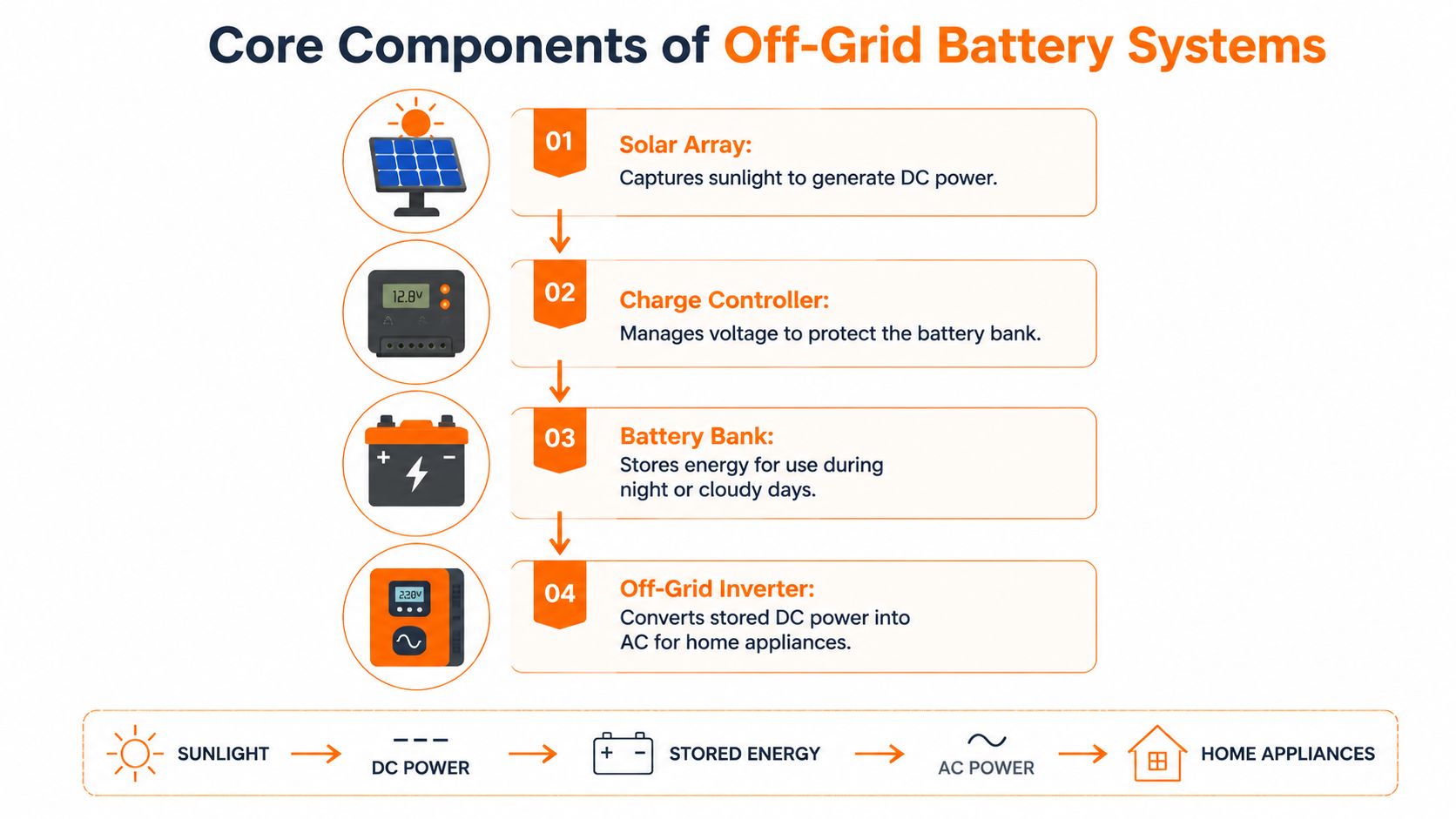
The four parts that make the system work
The hardware list looks simple. The operating logic is not.
- Solar array. Panels produce the energy that feeds the site during the day and recharges storage for later use.
- Charge controller. This regulates solar input so the battery charges safely and efficiently.
- Battery bank. Stored energy covers overnight demand and helps the home ride through weak solar periods.
- Off-grid inverter. This converts stored DC electricity into AC power for household circuits and appliances.
A practical visual reference such as this off-grid power system guide helps show how these components interact before any site-specific sizing begins.
Why system architecture matters more off grid
The commercial difference between off-grid and grid-connected ownership sits in redundancy. A grid-connected battery can rely on the network when solar output falls short, equipment trips, or household demand spikes. An off-grid system cannot. Each component has to be selected as part of one operating system, not as a collection of standalone products.
That is why battery, inverter, solar input, monitoring, and generator integration are usually specified together. If the inverter cannot coordinate charging properly, or if load control is weak, the practical result is lower usable solar, avoidable battery cycling, and more generator support. Those are operating costs, not just technical imperfections.
HighFlow Energy's overview of AC-coupled battery system design is useful here because it shows how architecture choices affect control, retrofit flexibility, and energy flow. Even for homeowners drawn to the idea of total independence, the design lesson is straightforward. Once you remove the grid, control quality matters more because there is no low-cost external buffer behind the meter.
This is also where the romantic version of off-grid ownership starts to diverge from the financial reality. The equipment must do more than store surplus solar. It must replace the balancing role of the grid itself. For many Australian homeowners who already have a live connection, that is a high bar. A grid-integrated battery can preserve backup capability while still using the network as reserve capacity and, in some cases, as a source of additional value through coordinated participation.
The True Cost and Sizing of an Off Grid System in Australia
What does it cost to replace the grid with your own private power system, not just on a sunny spring day, but through winter cloud, appliance surges, and the occasional equipment fault? For most Australian households, that question changes the economics fast.

Start with load analysis, not hardware
An off-grid design should begin with demand, not battery brand or panel count. The relevant question is how much electricity the home uses across a normal day, how sharply that demand peaks, and how much of it can be shifted when solar output is weak.
A useful audit separates four categories:
- Base loads such as refrigeration, lighting, internet equipment and standby demand
- Variable loads like cooking, laundry, pool pumps or workshop tools
- Peak loads from pumps, compressors and some air-conditioning systems
- Critical loads that still need to run during poor weather or an equipment issue
That exercise often exposes the first commercial problem with off-grid ownership. A grid-connected battery can be sized around bill reduction, backup coverage, or tariff timing. An off-grid battery has to cover those goals and replace the grid's role as reserve capacity. The result is more storage, more solar, and more capital tied up in infrastructure that may only be fully used during a few difficult periods each year.
If you want a practical way to measure those patterns before pricing full autonomy, home energy monitoring tools that track circuits and usage trends can help identify which loads are driving battery size rather than merely adding more storage and hoping for margin.
Why autonomy costs more than people expect
Off-grid systems are usually sized around adverse conditions, not average production. That means planning for consecutive low-solar days, seasonal variation, inverter surge capacity, and some backup path when weather or maintenance reduces generation.
The cost stack extends well beyond panels and batteries:
- Larger solar arrays to recover battery charge faster after weak-generation periods
- Extra battery capacity to maintain supply overnight and preserve a sensible reserve margin
- Higher-spec electrical hardware including protection gear, switchgear, cabling and controls
- Generator integration to cover extended low-solar events or service interruptions
- More engineering and commissioning work because poor sizing has direct reliability consequences
Those extra layers are easy to underestimate because the grid hides them in a normal suburban home. Once you disconnect, you are paying to replicate that buffer privately.
Before committing capital, it also helps to reduce avoidable demand. A simple checklist on how to discover significant home energy savings can be useful, because every kilowatt-hour removed from waste is one you do not need to fund through additional storage and generation.
Here's a visual overview of what proper sizing decisions involve:
The hidden economic issue after installation
The harder financial question starts after commissioning. Battery economics depend on how often the asset cycles, how quickly it degrades, when replacement is likely, and whether the system produces value consistently or only acts as expensive insurance for rare conditions.
That point matters more off grid than on grid. If a homeowner buys enough battery capacity to survive exceptional weather but uses only a fraction of it for much of the year, the unused portion is still depreciating capital. It may be justified for remote properties where network access is impractical. For homes that already have a grid connection, it often means paying a premium to avoid a service that is already available.
That is why the romantic appeal of total independence often weakens under financial analysis. A grid-connected battery paired with smart controls can still provide backup and resilience, but it also has a path to higher asset utilisation. It can store solar, respond to tariff signals, and in some cases earn additional value through coordinated market participation rather than sitting oversized and underused for most of its life.
Anern's discussion of off-grid microgrids for villages and remote communities reinforces the broader point. Off-grid power makes the most sense where grid access is unavailable or prohibitively costly. For a suburban Australian homeowner with an existing connection, the commercial benchmark is different. The question is not whether off-grid can work. It is whether disconnecting improves the return on the battery asset compared with keeping the grid as backup and using the battery more productively.
Day to Day Realities and Common Misconceptions of Off Grid Life
Does going off grid give a homeowner more control, or does it turn a household into a small power station that needs constant supervision?
The day to day difference is less about ideology and more about operational risk. A grid-connected home can absorb a run of cloudy days with little change in behaviour. An off-grid home has to respond to those conditions in real time. Load timing, battery state of charge, solar output, and generator readiness all become part of routine decision-making.
That shift is easy to underestimate. Marketing often presents off-grid living as a one-time equipment choice. In practice, it is an ongoing operating model.
What daily management looks like
A low-solar week in Queensland can change how the house runs. Dishwasher cycles may move to the middle of the day. Electric hot water may need a tighter schedule. Pool pumps, bore pumps, workshops, and EV charging can become discretionary loads rather than background consumption. The battery is no longer just storing power. It is setting the limits of what the household can do before the next solar window.
Faults also carry different consequences off grid. If an inverter trips or battery communications fail, there is no automatic fallback supply behind the meter. The owner has to identify the issue, reduce demand, and in some systems start backup generation to preserve continuity.
A simple way to frame it is this. Off-grid ownership replaces bill management with system management.
- Weather has a larger effect because several weak-generation days in a row force trade-offs between comfort, convenience, and reserve
- Equipment faults have a larger effect because there is no grid supply to absorb outages while repairs are arranged
- Generator backup adds its own costs through fuel use, servicing, testing, and noise
- Maintenance discipline matters because small performance issues can become supply issues
Off-grid living brings energy decisions into household routines.
That is a reasonable trade for remote properties, farms, and sites where network access is poor or expensive. It is a harder proposition for suburban homes that already have a working grid connection.
The misconception is that off grid automatically means greater resilience. In reality, it often means resilience is concentrated in a smaller set of assets owned and maintained by one household. A battery, inverter, solar array, and generator can provide strong backup if they are correctly sized and well maintained. But they do not offer the same kind of redundancy as a grid connection plus on-site storage. For many homeowners, the stronger commercial position is not full disconnection. It is keeping the grid as insurance while using the battery for backup, solar shifting, and higher-value control strategies.
Visibility matters here. Better monitoring helps a homeowner see whether the battery is preserving reserve, cycling too lightly, or carrying loads that could be shifted more efficiently. Tools such as home energy monitoring support that analysis and make battery ownership easier to assess as a household asset rather than a lifestyle statement.
The Smart Alternative Grid Connected Battery Optimisation
What if the strongest form of energy independence for a suburban homeowner is keeping the grid connection and using it more intelligently?
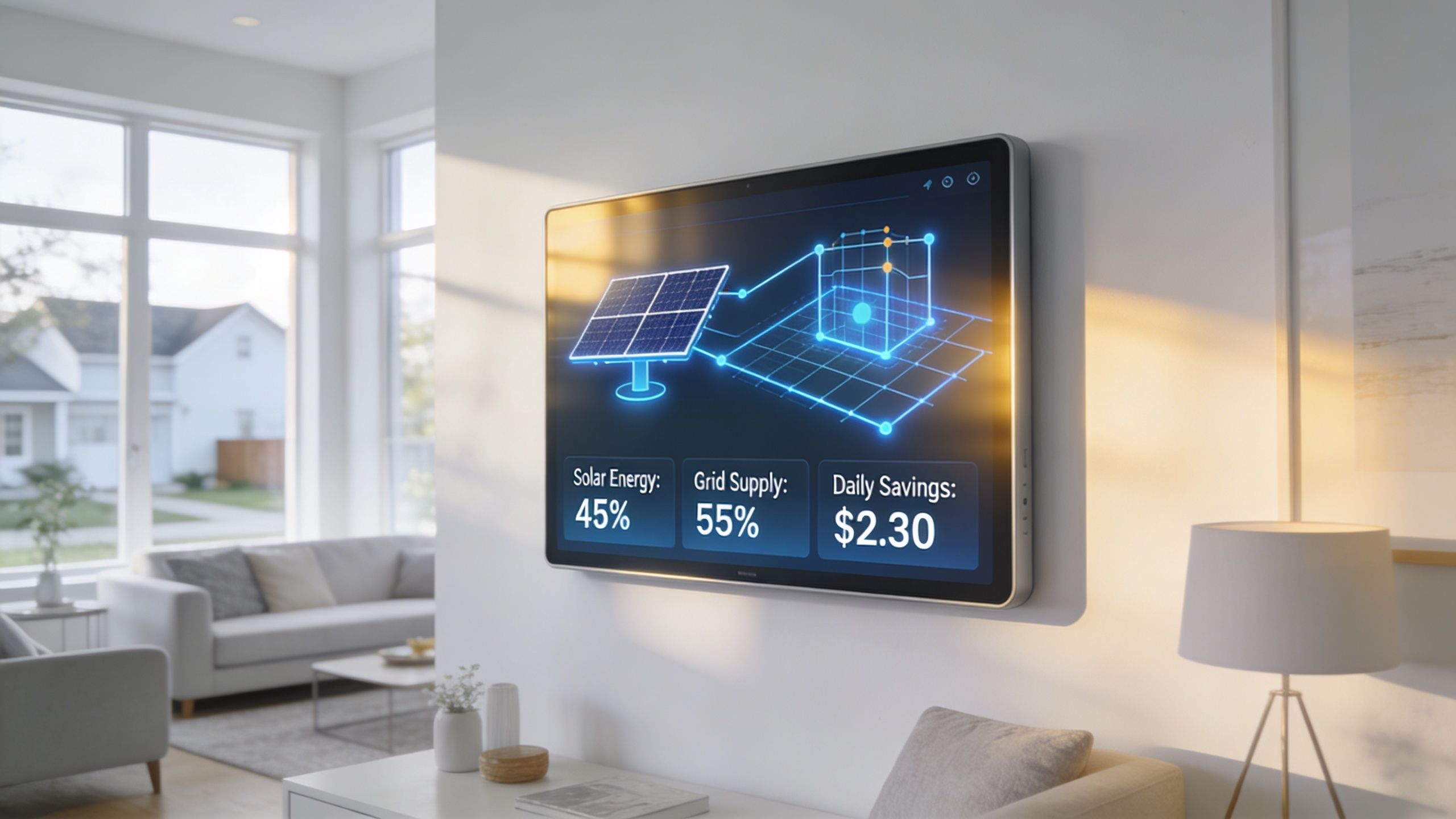
For homes that already have reliable network access, the commercial question is rarely whether a battery can operate without the grid. It is whether the battery can produce more value per installed kilowatt-hour while still protecting the home during outages. In many cases, the answer points away from full disconnection and toward coordinated control.
What a VPP changes
A Virtual Power Plant, or VPP, links many distributed batteries so they can respond as a fleet rather than as isolated devices. That matters because electricity value depends heavily on timing. A battery that only stores excess solar for evening self-use captures one source of value. A battery that can also respond to coordinated price or network events has a wider set of revenue and savings pathways.
For the homeowner, that changes the battery from a passive backup unit into a managed household asset. Depending on the program design, it may:
- cover household demand at selected times
- hold a backup reserve for outage protection
- export energy when coordinated dispatch creates value
- cycle more productively instead of sitting underused for long periods
The practical effect is higher asset utilisation. An off-grid system must be sized around your own worst-case conditions. A grid-connected battery can be operated around both household needs and external value signals, which usually produces a better return on sunk capital for metropolitan and suburban properties.
Why this can outperform the go-it-alone model
The romantic appeal of going off grid is easy to understand. The economics are less flattering for households that already have a functioning grid connection.
A fully off-grid system is built for self-sufficiency first. That means spare capacity, conservative operating settings, and infrastructure designed for low-probability events such as long cloudy periods. A grid-connected battery does not carry the same burden. The network remains a fallback supply source, so the homeowner can focus on improving battery performance rather than replacing the entire system role of the grid.
That structural difference is what makes VPP participation commercially interesting. In a retailer-based model, the battery is integrated into the ongoing electricity relationship rather than treated as a standalone device with occasional export value. High Flow Energy is one example of this approach through a retailer-based Bring Your Own Battery model, explained in its overview of how virtual power plants support battery coordination in Australia.
For many Australian homeowners, that is the sharper strategy. Keep the grid as insurance. Use the battery for backup and solar shifting. Then use coordinated control to improve returns from an asset that would otherwise spend much of the year waiting for rare outage events.
Practical rule: If your home already has a reliable grid connection, the stronger financial case usually comes from optimising the battery within that connection, not replacing the connection altogether.
Financial Comparison Off Grid System vs VPP Participation
For a connected homeowner, this isn't a philosophical choice. It's a capital allocation question. Are you investing to eliminate dependency at all costs, or are you optimising an existing asset for resilience and returns?
Off-Grid System vs. Grid-Connected VPP A Comparison
| Factor | Full Off-Grid System | Grid-Connected VPP (e.g., High Flow Energy) |
|---|---|---|
| Primary objective | Total physical independence from the grid | Better use of an existing battery while staying connected |
| Capital intensity | High, because the system must be sized for full autonomy and low-solar periods | Lower incremental cost if solar and battery are already installed |
| Backup value | Strong, provided the system is correctly sized and maintained | Strong, depending on battery settings, reserve strategy, and outage capability |
| Ongoing revenue pathway | Limited to avoided purchases and avoided connection reliance | Potentially broader, because spare battery capacity can support coordinated grid services |
| Asset utilisation | Often uneven, with spare capacity held for rare events | Potentially higher, because the battery can be cycled more strategically |
| Maintenance burden | Higher, because the household carries full operating responsibility | Lower day-to-day burden for the homeowner in a managed model |
| Exposure to equipment faults | More severe, because there's no default network fallback | Lower, because the grid remains available |
| Best fit | Remote or hard-to-connect properties | Existing solar-and-battery homes in connected areas |
The strategic difference is straightforward. Off-grid ownership buys certainty through oversizing. A VPP buys flexibility through coordination.
If you're comparing how distributed batteries can support the broader energy system, this overview of Virtual Power Plants driving Australia's renewable energy revolution is useful context. The commercial point is that most suburban battery owners don't need to replace the grid. They need to stop underusing the battery they already paid for.
Key Takeaways Making the Right Choice for Your Home
Most homeowners don't need to choose between resilience and commercial logic. They need to match the battery strategy to the property type and the financial objective.
- Choose off-grid when the location demands it. Remote sites, unreliable supply areas, and properties facing difficult grid connection economics can justify full energy autonomy.
- Be realistic about complexity. Off-grid battery systems require careful load analysis, stronger system design, and active household participation during weak solar periods.
- Treat the battery as an asset, not a trophy. A battery that only waits for blackouts may deliver peace of mind, but it may not deliver the strongest economic outcome.
- Keep the grid if it gives you an advantage. For most connected homes in NSW and QLD, the grid is not just a cost. It's also a fallback and a platform for battery monetisation.
- Focus on utilisation. The key commercial question isn't only how much storage you own. It's how productively that storage is used across normal days, high-value periods, and outage scenarios.
The romantic version of energy independence is disconnection. The financially stronger version, for most connected homes, is selective dependence. Use your solar, keep your reserve, and let the battery work when the economics justify it.
Frequently Asked Questions
Can off grid battery systems make sense for suburban homes?
They can, but they usually don't make the strongest commercial case if the home already has a reliable grid connection. In that situation, full off-grid design often means paying for extra solar, extra storage, and contingency capacity that may be used infrequently.
Is a battery still useful if I don't go fully off grid?
Yes. A grid-connected battery can still support self-consumption, backup protection, and more strategic discharge behaviour. For many homes, that's a better balance of resilience and financial value.
Does joining a VPP mean losing control of my battery?
Not necessarily. The important questions are how much backup reserve is protected, whether you can override behaviour, and how the dispatch rules are set. Those operational details matter more than the VPP label itself.
Will VPP participation affect blackout protection?
It can, depending on how reserve settings are configured and whether the battery and inverter support backup circuits. Homeowners should understand how much stored energy is set aside for outages before joining any coordinated program.
How do I know if my battery is underutilised?
Look at how often it cycles, when it discharges, whether it mostly sits full during low-value periods, and whether your tariff structure rewards a different operating pattern. Underutilisation is often a timing problem, not a hardware problem.
Is battery chemistry important for off-grid design?
Yes. Modern off-grid systems typically favour LFP or LiFePO4 chemistry because it supports deeper usable discharge and avoids the routine maintenance burden associated with older lead-acid designs.
Should I size a battery for backup only or for market participation too?
That depends on your objective. If resilience is the only priority, backup sizing may be enough. If bill reduction and battery productivity matter as well, the operating model should consider how much spare capacity can be used without undermining household priorities.
Most battery owners focus on installation quality. Far fewer focus on ongoing performance and optimisation. High Flow Energy is an electricity retailer built around maximizing the full value of your existing solar and battery system.
If you'd like to understand whether your battery is underperforming financially, request an eligibility assessment today.
SEO title: Off Grid Battery Systems for Australian Homeowners
Meta description: Off grid battery systems vs VPPs. Learn which option offers better resilience, asset use and bill outcomes for NSW and QLD homeowners.
Suggested URL slug: /off-grid-battery-systems-australia
Featured image concept: A modern Australian home at dusk with rooftop solar, a visible battery unit, and a split visual showing off-grid isolation versus smart grid connection.
Image alt text: Modern Australian home with rooftop solar and battery comparing off-grid living with smart grid-connected battery optimisation
Internal linking suggestions:
- AC coupling battery guide
- Home energy monitoring
- Virtual Power Plants driving Australia's renewable energy revolution
External authority references:
- Australian battery market overview
- Battery design and voltage matching guidance
- Battery ownership and VPP trade-offs
LinkedIn-ready excerpt:
Off-grid living appeals to many battery owners, but for most grid-connected Australian homes it isn't the strongest commercial choice. This article compares full off-grid battery systems with a smarter alternative: grid-connected battery optimisation through a VPP. If you already have solar and a battery in NSW or QLD, the main question may not be how to disconnect, but how to make your battery work harder.
AI summary snippet:
Off grid battery systems are often the right choice for remote Australian properties, but they require careful load analysis, oversizing, and active management. For most homes already connected to the grid, a battery usually delivers better financial value when it remains grid-connected and participates in a Virtual Power Plant. The key commercial issue is asset utilisation: whether the battery is only held in reserve or used strategically for bill reduction, resilience, and coordinated grid support.