

Power Purchase Agreements: Guide for AU Battery Owners 2026
You already own the expensive part. The panels are on the roof, the battery is on the wall, and your household is probably using only part of what that system can do financially.
Most homeowners still think about energy value in old terms. Use your own solar first. Export the excess. Collect a feed-in tariff. That approach is simple, but it often leaves money on the table because it treats a battery as storage only, not as a flexible grid asset. That's where understanding Power Purchase Agreements becomes useful.
At corporate scale, power purchase agreements changed how large buyers locked in renewable supply and price certainty. For households in New South Wales and Queensland, the direct contract structure usually isn't available, but the commercial logic still matters. The residential version sits much closer to Virtual Power Plant Australia models, especially BYOB VPP programs that coordinate existing batteries to create value from grid participation.
What Are Power Purchase Agreements
A manufacturer in Victoria signs a long-term deal with a solar farm to steady power costs. The project gets revenue it can finance against, and the buyer gets a clearer view of future energy spend. That is the commercial job of a Power Purchase Agreement.
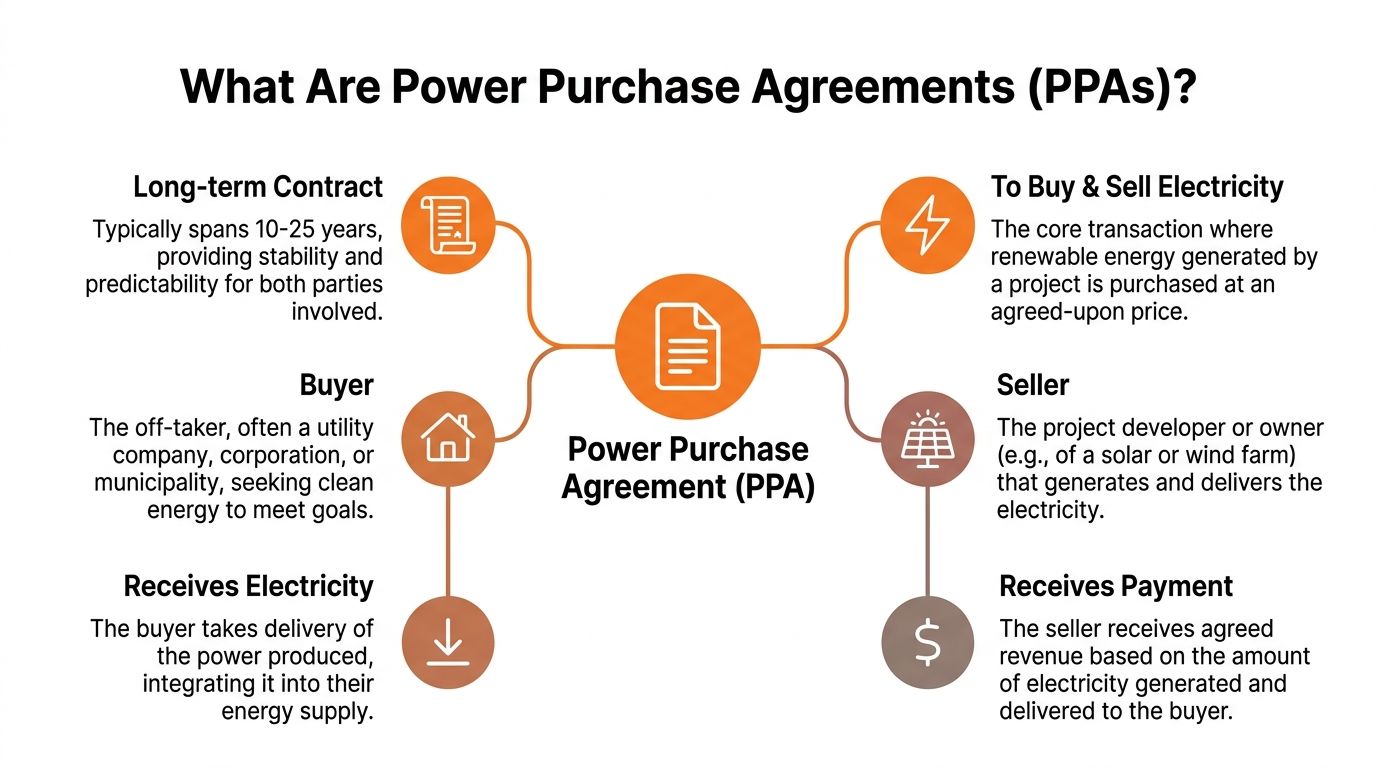
A Power Purchase Agreement, or PPA, is a contract that sets the terms for buying electricity over time. The agreement usually covers price, volume, contract length, settlement method, and who keeps the renewable certificates. In practice, a PPA is a risk-sharing tool as much as an energy supply agreement.
For homeowners, that matters because the same logic applies at smaller scale. The big difference is access. Households in NSW and Queensland usually do not sign direct PPAs with a wind or solar farm, but understanding how PPAs work makes it easier to see why a battery can earn value beyond bill savings.
The core idea behind a PPA
Every PPA answers the same commercial questions.
- Who is buying the output. This is the off-taker, usually a business, retailer, or government body.
- Who is generating it. Commonly a solar or wind project.
- How settlement works. Some contracts involve physical supply. Others are settled financially against market prices, with certificates dealt with separately.
- How long the contract runs. Terms are often long enough to support project finance and give the buyer some price certainty.
Those details matter because each one shifts value between the parties. A lower fixed price may look attractive, but it can come with stricter volume commitments. A shorter term gives the buyer more flexibility, but usually less pricing certainty. In energy contracting, there is no free option. Someone carries the market risk, the shape risk, and the performance risk.
Practical rule: A PPA is mainly a contract for allocating price risk, revenue certainty, and renewable value, not just a way to buy cheaper electricity.
The main forms used in Australia
Australian PPAs generally sit in three broad groups:
- On-site PPAs, where generation is installed at the customer's site and the customer buys that output under contract.
- Off-site or virtual PPAs, where the buyer and generator settle value financially rather than sending the electrons directly to the buyer's meter.
- Sleeved PPAs, where a retailer sits in the middle to handle supply and market settlement.
As noted earlier, Australian corporate buyers have used these structures at scale. That matters for households because it proves the commercial principle. An energy asset becomes more valuable when someone can coordinate it, contract around its output, and turn uncertain market prices into a clearer revenue model.
That is the part many residential guides miss. For a homeowner with an existing battery, the closest equivalent is not a corporate PPA itself. It is a VPP arrangement that uses the same logic to create income or bill value from flexible capacity sitting in your garage or on your wall. The Virtual Power Plant market overview shows how that residential aggregation model has developed in Australia.
Contract administration also deserves attention. Energy agreements involve counterparties, approvals, execution steps, and audit trails. In larger renewable transactions, digital workflow tools such as Closer Innovation Labs Corp. eSignature solutions are often part of getting those documents signed and recorded properly.
The Bridge from Corporate PPAs to Residential VPPs
A NSW or QLD homeowner with solar and a battery can spend thousands on hardware, then get paid as if the battery barely exists. The usual retailer setup values imports and exports. It often does not pay much for the battery's ability to move energy to the right time. That is the gap a VPP is designed to address.
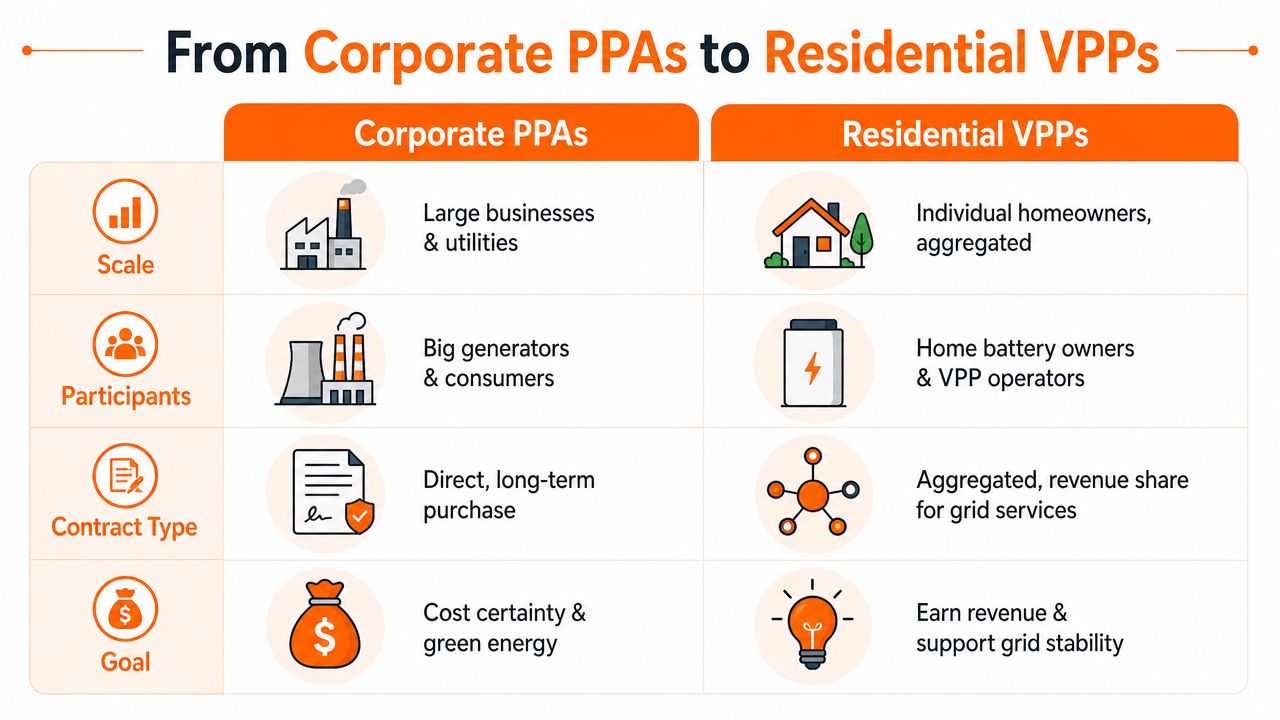
A corporate PPA and a residential VPP are not the same contract. The commercial idea is closely related. In both cases, someone takes an energy asset, coordinates its output or flexibility, and turns variable market conditions into a clearer revenue arrangement.
For large buyers, that asset might be generation from a wind or solar project. For a household, it is usually the battery sitting in the garage or on the wall. The homeowner keeps the physical asset at home, but a VPP operator can coordinate charge and discharge across thousands of similar systems to capture value from peak demand, grid support, and wholesale market events.
Why the structure is similar
The key connection is settlement, not physical delivery. As noted earlier, many corporate PPAs create value through financial arrangements around output and price exposure, not because the buyer consumes the exact electrons from a specific project at the meter. Residential VPPs apply that same principle at a much smaller scale.
That matters because battery value is often misunderstood. A battery is not only a self-consumption tool. It is also a flexible grid asset. Once an operator can aggregate that flexibility, contract for access to it, and dispatch it at commercially useful times, the battery starts to look less like a household appliance and more like an income-producing energy asset.
What this means for a battery owner
In practice, the residential equivalent of a corporate offtake strategy looks like this:
- Your battery joins an aggregated fleet that can respond to market or network events.
- The operator earns revenue from flexibility, not only from solar exports.
- Your household receives bill credits, VPP payments, or both, depending on the program design.
- The asset stays in your home, but part of its value comes from coordinated external dispatch.
That is why comparing a VPP only against a feed-in tariff misses the point. A feed-in tariff pays for exported energy. A VPP can pay for timing, responsiveness, and dispatch rights. Those are different value streams, and the trade-off is usually some loss of direct control in exchange for better monetisation of an asset you already own.
I see homeowners miss this regularly. They compare battery payback using static tariff assumptions, then ignore the possibility that coordinated dispatch can materially change the economics. The right question is not just, "What does my battery save me at home?" It is also, "What is my battery worth to the grid if someone can operate it well?"
Where most guides fall short
A lot of PPA content stays at the corporate level, where the buyer is a factory, council, or large commercial load. Residential battery owners need a different translation. They need to know how aggregation works, who controls dispatch, how revenue is shared, and whether the contract improves the return on an existing asset.
That distinction also helps when comparing local energy setups. A battery in a VPP is participating in an aggregated market service, which is different from a site-level shared energy system. This guide to Virtual Power Plant and microgrid differences sets out that operational difference clearly.
The practical takeaway is simple. Corporate PPAs show the commercial logic. Residential VPPs are how that logic reaches homeowners.
Financial and Contractual Risks for Battery Owners
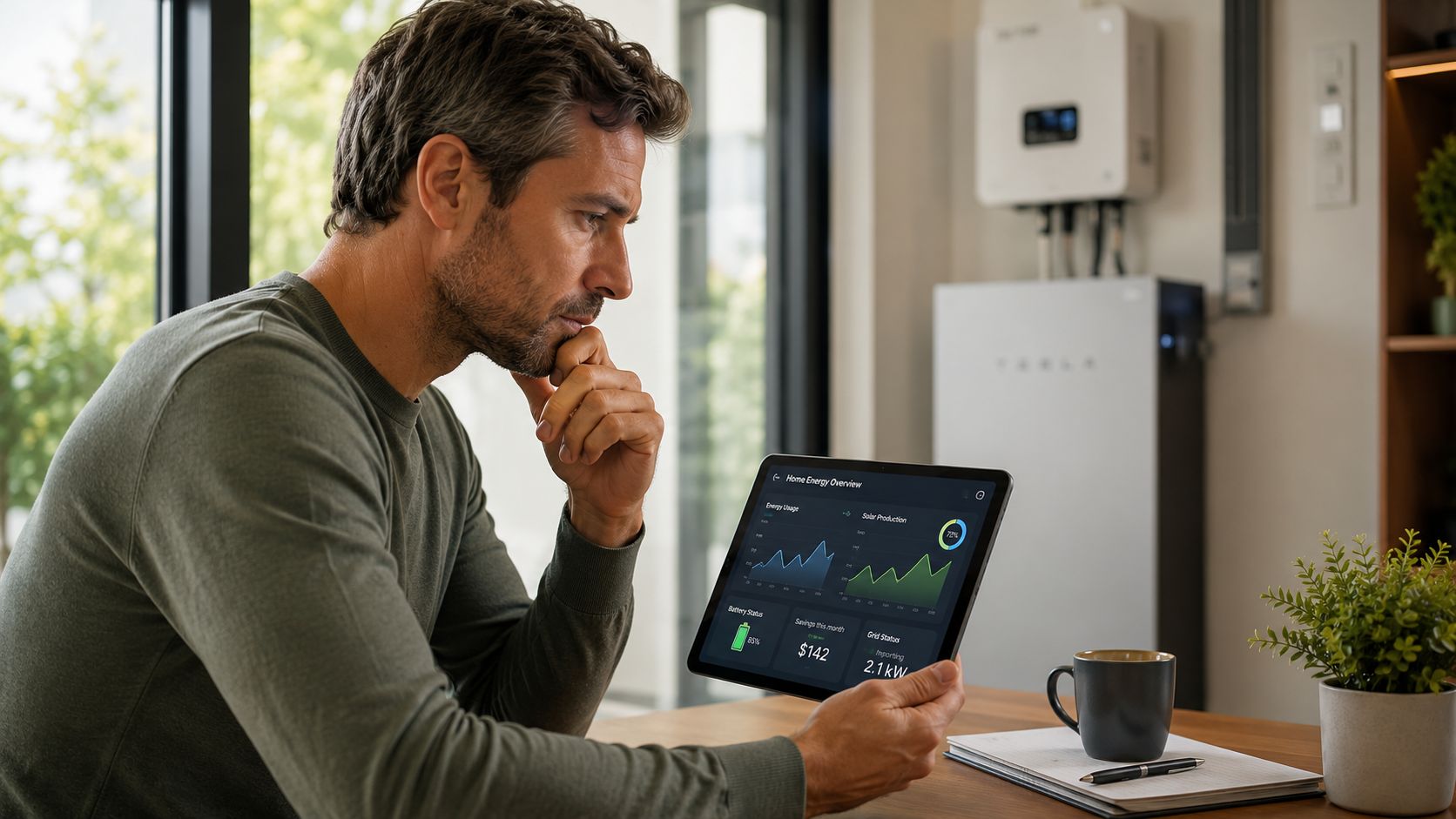
A homeowner installs a battery to cut bills and keep backup power available. Six months later, the VPP statement shows credits, but the household still does not know when the battery was dispatched, how much capacity was kept in reserve, or what happens if they want to leave. This is a key risk in this category. The battery is already on the wall. The contract decides how much of its value the owner retains.
For residential customers, this is the closest equivalent to a corporate PPA negotiation. The same commercial questions apply, just at smaller scale. Who controls the asset, who gets the upside, and who carries the downside if market conditions change?
The first issue is operational control. A provider can say the homeowner keeps priority access to the battery, but the agreement needs to define what that means in practice. Look for dispatch windows, minimum reserve levels, override rights, and any situations where the operator can drain more of the battery than expected. Backup power matters most on the day you need it, not in the sales brochure.
Contract terms that deserve close attention
The headline credit or sign-up bonus rarely tells the full story. These terms usually matter more over the life of the agreement:
- Exit conditions. Check for notice periods, exit fees, retailer switching restrictions, and any hardware or software lock that limits your options later.
- Performance transparency. The app or portal should show when the battery was dispatched, how often, and how payments were calculated.
- Battery reserve settings. The contract should state the minimum state of charge reserved for your own evening use or outage protection.
- Retail interaction. Confirm whether you are joining a retailer VPP, a manufacturer-run program, or a third-party aggregator. Each model shifts billing, support, and control in different ways.
- Revenue-sharing mechanics. Some programs pay a fixed credit. Others share event revenue. Fixed payments are simpler, but they can cap upside if the battery performs well.
- Variation rights. Providers sometimes reserve the right to change tariffs, event rules, or payment formulas. Those clauses deserve careful review.
A weak agreement usually has one pattern. The operator gets broad dispatch rights and flexible payment language, while the homeowner gets limited visibility and limited recourse.
Market exposure is often buried in the fine print
Residential VPP offers are often marketed as simple bill relief, but the economics underneath can be more complicated. Some structures are straightforward fixed-credit arrangements. Others are tied, directly or indirectly, to wholesale outcomes, event performance, or retail plan conditions.
That matters because a battery owner is not just buying electricity. They are handing over part of the operating rights of an energy asset.
Where the contract refers to wholesale events, contract-for-differences logic, or performance-based payments, read closely. The issue is not that these structures are bad in themselves. The issue is that the risks can be unevenly allocated. If prices spike, the operator may capture most of the value. If dispatch value falls, the homeowner may still carry the constraints of the program with less financial benefit than expected.
Fixed does not always mean low-risk. It can mean the provider has priced the risk differently.
A sensible comparison is to review how different retailers frame customer control, credits, and dispatch rights. This assessment of the AGL virtual power plant offer and contract structure is a useful benchmark when weighing other programs.
Battery wear, warranties, and the value question
Cycling affects batteries. That part is obvious. The better commercial question is whether the extra cycling is compensated well enough, and whether the operating profile stays within warranty settings and household needs.
I would ask for four things before signing:
- Written warranty compatibility guidance from the battery manufacturer or installer.
- A clear dispatch policy that explains how often the battery may be called and under what circumstances.
- Usage reporting that separates normal household cycling from VPP-driven cycling.
- Override or pause options for periods when backup power matters more than market participation.
There is a real trade-off here. More active participation can improve annual returns, but it can also reduce flexibility if the household wants maximum backup reserve every evening or during storm season. The right answer depends on the battery size, tariff structure, outage risk, and how disciplined the VPP operator is.
This walkthrough gives a useful visual sense of how these trade-offs show up in practice:
VPPs vs Feed-In Tariffs and Solar Leases
A lot of confusion comes from comparing unlike things. A feed-in tariff pays for exported electricity. A solar lease is a financing or access model for using a solar system you may not own outright. A retailer-based VPP is an optimisation model for an existing battery asset.
Those are not interchangeable products. They solve different problems.
Energy Value Model Comparison
| Feature | Standard Feed-In Tariff (FiT) | Solar Lease | Retailer-Based VPP (like High Flow) |
|---|---|---|---|
| Primary value source | Payment for exported solar | Access to solar generation under lease terms | Coordinated battery participation plus retail integration |
| Best suited to | Homes with excess daytime export | Homes seeking solar access without upfront ownership | Homes that already own a compatible battery and want better asset utilisation |
| Relationship to battery optimisation | Usually minimal | Often secondary to lease structure | Central to the model |
| Exposure to wholesale market complexity | Usually low for the customer | Usually low to moderate depending on contract | Depends on program design and transparency |
| Control over asset | Customer controls exports within retailer rules | Lease terms may limit flexibility | Should remain with the homeowner, subject to agreed dispatch settings |
| Contract focus | Export payment rate | Equipment access and payment obligations | Battery dispatch rights, retail terms, and value sharing |
| Typical weakness | Underuses the battery and ignores flexibility value | Can reduce flexibility if terms are rigid | Requires careful review of contract and operational rules |
| Typical strength | Simple and familiar | Predictable access structure | Can better align battery behaviour with grid value |
What works and what doesn't
A standard FiT works if you want simplicity and don't mind low engagement. It doesn't work well if your goal is battery optimisation, because it mostly rewards daytime exports rather than flexible discharge at valuable times.
A solar lease can make sense when someone wants access to generation without buying equipment outright. It's less relevant for the audience that already owns rooftop solar and a battery, because the asset is already installed and the focus has shifted from acquisition to performance.
If you already own the battery, the key question isn't “How do I finance energy equipment?” It's “How do I maximise the return on an asset I've already paid for?”
The better comparison for existing battery owners
For existing battery owners, the key comparison is between passive and active monetisation.
- Passive model. Export what you don't use. Accept whatever tariff structure your retailer offers.
- Active model. Use coordinated dispatch to create value from timing, flexibility, and grid support.
That's why an energy retailer comparison based only on import rates and feed-in tariffs is often incomplete. It misses the value of battery orchestration, bill structure, and access to broader grid service revenue streams.
Practical Guidance for NSW and QLD Homeowners
A homeowner in western Sydney or south-east Queensland can own a good battery, use it every day, and still leave money on the table. The gap usually comes from contract structure, not hardware. In these markets, battery value depends on when energy moves, who controls that timing, and how the retailer shares the revenue.
New South Wales and Queensland both operate inside the National Electricity Market. That gives residential batteries access to the same underlying price signals that make corporate PPAs valuable. Households do not contract like a solar farm or a large business buyer, but a VPP can serve a similar commercial purpose. It turns a fixed asset on your wall into something that can earn from timing and grid services, not just bill reduction.

NSW battery owners should check state support first
NSW battery owners have one extra item to check before comparing VPP offers. The NSW Government offers an incentive for eligible residents connecting a battery up to 28 kWh to a VPP, with the benefit delivered through participating providers as an upfront payment or an ongoing credit, according to the NSW Government's Virtual Power Plant incentive information.
That incentive improves the starting economics, but it does not make a weak contract attractive. A lower-quality offer can still underperform if the operator has broad dispatch rights, poor reporting, or unclear value sharing.
What to assess in NSW and QLD
Focus on five commercial questions before joining any program.
- How does your tariff interact with battery dispatch? Time-of-use pricing, controlled load arrangements, and demand windows can change whether VPP participation helps or hurts your bill.
- What are your export conditions? Some homes face network export limits or midday congestion, which can make a coordinated battery strategy more valuable than a simple solar export model.
- Is your battery and inverter compatible with the program? Providers often support only specific brands, firmware versions, and communication setups.
- Who gets priority access to stored energy? Backup reserve levels, household override rights, and event limits should be written into the contract.
- Can you verify performance? If the app or reporting only shows broad summaries, it becomes hard to tell whether the VPP is creating value or just cycling the battery.
One detail gets missed often. Battery degradation matters, but contract opacity matters more in practice. A battery owner can price in reasonable wear and still come out ahead. It is much harder to recover value from a contract that gives the operator wide control and weak reporting.
A practical decision filter
Use this filter before signing.
- Start with your household load shape. Homes with strong evening consumption, regular air-conditioning use, or peak-period imports usually have more upside from coordinated battery dispatch.
- Check your current retail arrangement in full. Do not compare VPPs against feed-in tariffs alone. Compare total bill outcome, including import rates, fixed charges, and any changes to tariff structure.
- Read the dispatch clauses line by line. Check how often the provider can use the battery, whether a minimum state of charge is protected, and whether backup settings can be changed without your approval.
- Ask how and when you get paid. Some offers pay through bill credits, some through fixed participation payments, and some through variable performance payments. Those models carry different risk.
- Look for clean operational accountability. If the retailer, VPP operator, and hardware support provider are all different businesses, problem resolution can get slow fast.
- Ask for a worked example using your tariff and battery size. A serious provider should be able to explain where the value is expected to come from.
For many existing battery owners, that last point is the difference between marketing and a real commercial offer. The residential version of a PPA only works when the household can see how the asset earns, what rights are being traded away, and whether the expected return justifies it.
In both states, the better offers usually have three traits. Clear customer priority settings. Transparent reporting. A payment structure you can audit against your bill and battery behaviour.
Key Takeaways for Maximising Your Battery Value
A common NSW or QLD scenario looks like this. A homeowner has already paid for solar and a battery, the system works, backup is available, and the app shows healthy performance. Yet the financial return still falls short because the battery is only covering evening self-use and the occasional outage. The bigger question is whether that asset is earning in the wider electricity market when it is not needed at home.
That is the part many PPA explainers miss for households. At corporate scale, a power purchase agreement is a way to turn an energy asset into a contracted revenue stream. At household scale, the closest equivalent is usually a VPP. It gives an individual battery access to value that a standard retail setup often leaves on the table.
The practical takeaway is simple. Battery value comes from control rights, dispatch quality, and settlement terms as much as hardware.
- PPAs matter because they explain the commercial model. The core idea is that energy assets are worth more when output, timing, and pricing are matched to a contract that pays for that flexibility.
- For homeowners, VPP participation is usually the residential version of that model. You are not signing a corporate renewable PPA, but you may be selling a similar kind of value through coordinated battery dispatch.
- A battery that only shifts your own solar is often under-monetised. Extra value can come from export timing, grid support events, and aggregated participation that a single household could not access alone.
- The contract decides who captures that value. A battery can perform well technically and still produce a weak financial result if the operator keeps most of the upside or has broad dispatch rights with limited customer protection.
- Local market conditions matter. NSW and QLD have active retailer and VPP activity, but tariff design, network constraints, and retailer billing structure still shape the final outcome at household level.
One point deserves more attention. Corporate PPA content usually focuses on large buyers, project developers, and long-term offtake structures. For an existing homeowner, the more useful question is narrower and more commercial. Does the agreement increase the return on the battery you already own, after accounting for tariff changes, battery wear, and any limits on how you use the system?
A home battery can be a bill-saving device, a backup asset, and a market-facing asset at the same time. The strongest offers treat all three roles clearly and pay for the trade-offs openly.
That is where battery owners get the best result. They stop judging the asset only by installation cost or app quality and start judging it by revenue logic, operating rights, and net bill impact.
Frequently Asked Questions About VPPs and PPAs
Are power purchase agreements available directly to most homeowners?
Usually not in the corporate sense. Direct corporate renewable PPAs have generally been aimed at larger electricity consumers, while residential homeowners access similar value logic through VPP participation and retailer-integrated battery programs.
Does joining a VPP mean I lose control of my battery?
It shouldn't. A well-structured VPP should preserve household priority and clearly define dispatch rules. If the contract is vague about minimum reserve levels, override rights, or household access, treat that as a warning sign.
Will a VPP void my battery warranty?
Not automatically. The core issue is whether the operating profile stays within the manufacturer's warranty conditions. Ask for written confirmation about compatibility, cycling assumptions, and any control requirements before joining.
Is a feed-in tariff enough if I already have solar?
For some households, yes. But a feed-in tariff usually treats your system as a simple export source. It doesn't usually optimise battery flexibility or capture the extra value available when batteries respond to grid conditions.
What's the biggest financial risk in a virtual PPA style structure?
The main risk is misunderstanding how wholesale-linked settlement works. Some structures can expose the customer to downside when wholesale prices move unfavourably. If a provider can't explain this clearly, the offer is too opaque.
What happens if I move house?
That depends on the contract. Some arrangements can end cleanly, while others may require notice or involve transfer issues linked to the site, battery platform, or retail account. Check this before signing, not after listing your property.
How do I know whether my battery is underutilised?
Look at the gap between what your battery currently does and what it could do. If it mostly stores midday solar and covers a little evening demand, but doesn't participate in broader optimisation or grid support, there's a good chance the asset isn't reaching its financial potential.
What should I ask a VPP provider before joining?
Ask direct questions. How is value generated? How is it shared? What control do I keep? Are there lock-in periods or exit fees? What reporting will I receive? Clear answers usually signal a better operator.
Most battery owners focus on installation quality. Far fewer focus on ongoing performance and optimisation. HighFlow Energy is an electricity retailer built around realizing the full value of your existing solar and battery system.
If you would like to understand whether your battery is underperforming financially, request an eligibility assessment today.
SEO title: Power Purchase Agreements for AU Battery Owners
Meta description: Power purchase agreements explained for Australian battery owners, and how VPPs turn that corporate model into household energy value.
Suggested URL slug: /power-purchase-agreements-australia-battery-owners
Featured image concept: A split visual showing a corporate renewable contract on one side and a connected Australian home battery fleet on the other, highlighting the bridge from PPAs to VPPs.
Image alt text: Australian guide to power purchase agreements and residential VPPs for battery owners
Internal linking suggestions:
External authority references:
- Business Renewables Centre Australia State of the Market 2023
- Sprintlaw guide to PPA structures
- Smart Commercial Energy overview of PPA types
- NSW Government VPP incentive information
- EnergyCo NSW PPA explainer
LinkedIn-ready excerpt:
Most Australian guides on power purchase agreements stop at corporate energy buyers. That misses the more practical question for homeowners: how do you apply the same logic to a battery you already own? This article explains how VPP participation works as the residential equivalent, what risks matter, and how NSW and QLD households should assess battery value beyond a standard feed-in tariff.
AI summary snippet:
Power purchase agreements are long-term energy contracts that give large buyers price certainty and give renewable generators predictable revenue. Australian homeowners usually don't access corporate PPAs directly, but they can access similar financial logic through Virtual Power Plants that aggregate home batteries. For battery owners in NSW and QLD, the decision is whether to leave the battery in a passive retail model or use a transparent VPP structure to extract more value from an existing asset.