

Smart Home Energy Efficiency: A Guide for Australian Homes
Most households with a “smart home” don't have an energy system that's performing well. They have connected devices, a few automations, and an app that looks impressive. That's not the same as running the home like an asset.
For Australian solar and battery owners, smart home energy efficiency should mean more than shaving a bit off consumption. You've already invested in generation and storage. The sharper question is whether your home is using, storing, and exporting electricity at the times that create the most value.
That distinction matters in Queensland and New South Wales. A battery can reduce grid imports. It can also be underused for long stretches, charge and discharge at the wrong times, or follow a static routine that ignores tariff structure, seasonal demand, and the changing value of flexibility. Plenty of homes are efficient on paper while still underperforming financially.
The practical shift is from energy saving to energy optimisation. Saving energy asks, “How do I use less?” Optimisation asks, “How do I use my existing solar, battery, appliances, and controls in a way that improves the total outcome?” That outcome includes bill reduction, self-consumption, comfort, and in some cases participation in grid support through a Virtual Power Plant.
Introduction Is Your Smart Home Underperforming
A lot of smart home marketing starts with convenience. Turn lights off from your phone. Schedule the air conditioner. Get alerts when appliances are running. Useful features, but they rarely answer the question a financially literate homeowner is primarily interested in: is the home making better energy decisions, or just easier ones?
In practice, many smart homes are only partially optimised. The battery sits in self-consumption mode. The dishwasher runs on a timer. The EV charger has a schedule. None of that is wrong. It's just incomplete.
Connected doesn't mean commercially intelligent
A connected home can still waste value in several ways:
- Poor timing: Appliances run when solar output is weak or grid prices are less favourable.
- Static battery behaviour: The battery follows a fixed routine instead of responding to changing conditions.
- Hidden standby loads: Devices stay active in the background and draw power without adding value.
- Conflicting automations: One device tries to save energy while another creates avoidable load.
- No performance framework: The household measures convenience, not outcomes.
A smart home underperforms when it automates activity without optimising timing.
For solar and battery owners, the home should behave more like a small energy portfolio. Your solar produces value. Your battery stores optionality. Your controllable loads determine whether that value is captured or leaked.
What better performance looks like
A better-performing home does three things well:
| Focus area | Basic setup | Higher-performing setup |
|---|---|---|
| Consumption | Uses less where possible | Uses electricity at better times |
| Solar | Exports excess passively | Matches flexible loads to generation |
| Battery | Stores for generic evening use | Preserves capacity for the most valuable windows |
Often, generic smart home advice falls short. It treats every kilowatt-hour as if it has the same value at every moment. In an Australian home with rooftop solar and a battery, that isn't how the economics work.
What Smart Home Energy Efficiency Means in Australia
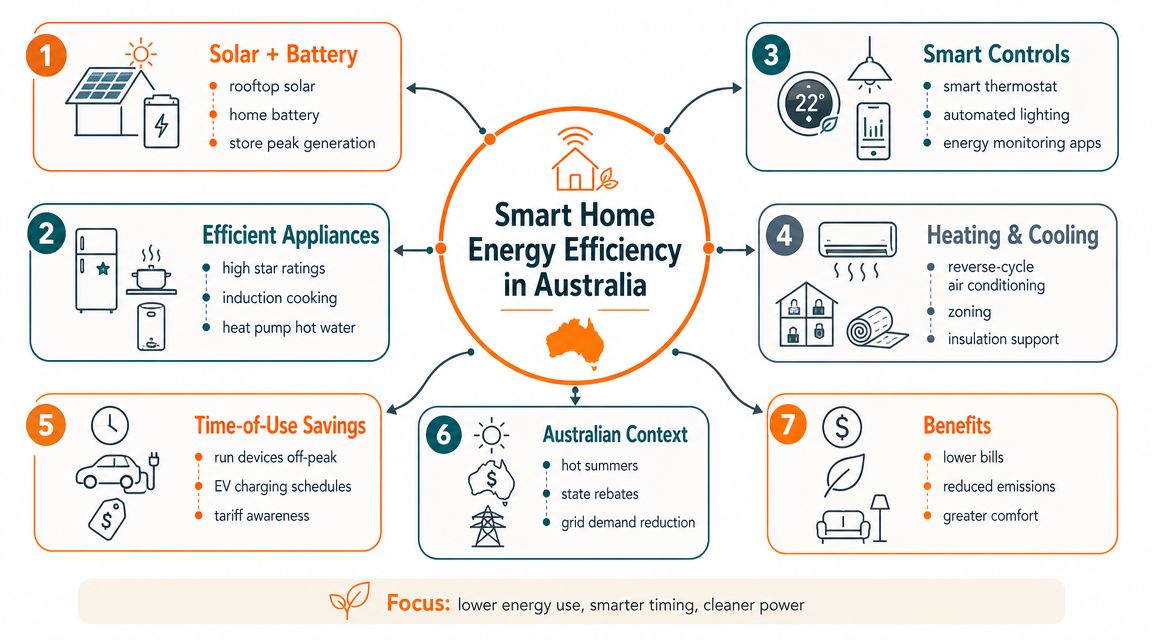
In Australia, smart home energy efficiency isn't just about reducing usage. It's about controlling when electricity is consumed, when solar is absorbed on site, when the battery charges or discharges, and when the home responds to external conditions such as tariff periods or grid needs.
The broader context matters. The IEA's Energy Efficiency 2025 report notes that efficiency is central to cutting electricity use in buildings, and that framing fits Australia especially well because homes and buildings remain a material part of national energy demand. For Australian households with strong rooftop solar uptake, the most valuable improvement often comes from matching consumption to on-site generation, not just consuming less.
The Australian definition is about energy flow
A useful definition is simple: a smart, efficient home manages energy flows deliberately.
That usually involves:
- Load shifting: Moving flexible consumption into periods when rooftop solar is available.
- Self-consumption management: Using more of your own solar before relying on grid imports.
- Battery coordination: Deciding whether stored energy should support the home now or later.
- Demand response readiness: Allowing some loads or storage behaviour to adapt when grid conditions change.
This is one reason digital control now matters as much as efficient hardware. A good appliance with poor scheduling can still deliver a poor financial outcome.
Why this matters more for solar and battery households
Without solar, efficiency is mostly about reducing consumption. With solar and storage, the goal changes. The household now has its own generation profile and stored energy capacity, so timing becomes part of efficiency.
Practical rule: In a solar home, the cheapest unit of electricity is often the one you generate and use at the right moment.
That's why homes with similar devices can perform very differently. One household runs heavy loads during the solar window and reduces evening imports. Another exports solar in the middle of the day, then imports later because appliances and heating loads weren't aligned.
If you're improving your digital presence around energy products or home energy services, it's also worth looking at examples of how Titan Blue built this website because clear information architecture matters when explaining technical energy decisions to homeowners.
Smart efficiency is not a gadget list
The Australian version of smart efficiency is not “buy more connected devices”. It's a control strategy built around:
- Your tariff structure
- Your solar generation profile
- Your battery operating behaviour
- Your seasonal comfort needs
- Your tolerance for automation versus manual control
That's also why the next step after efficiency often isn't another gadget. It's better orchestration.
The Core Technologies Driving Real Savings
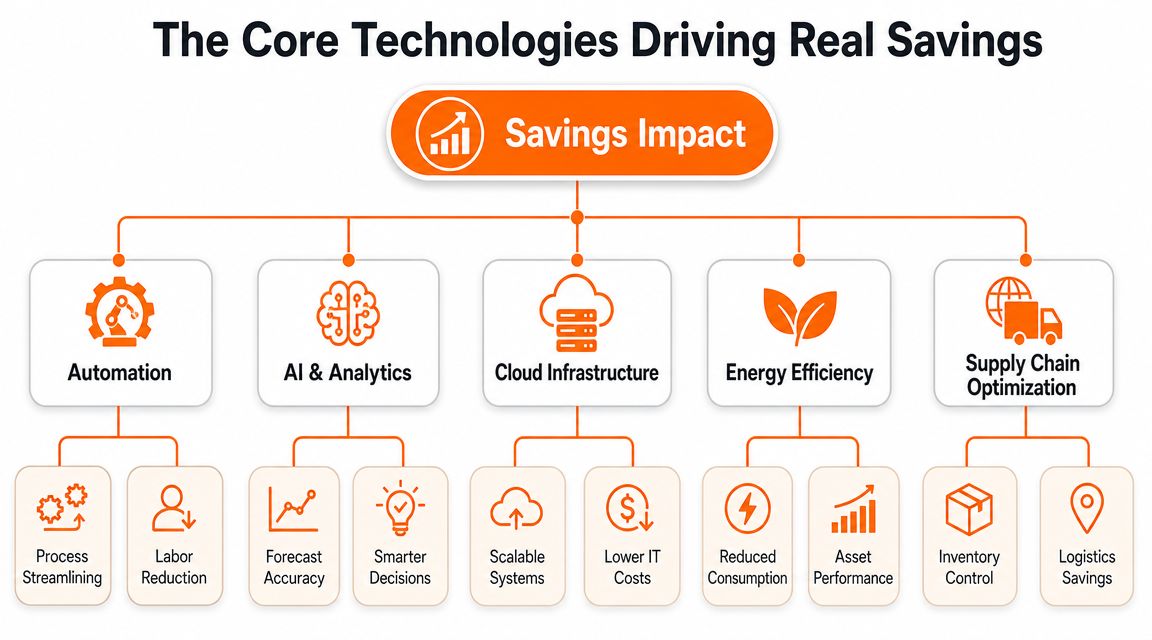
The hardware matters less than the coordination logic behind it. Real savings don't come from owning a collection of smart devices. They come from using measured feedback to control the right loads at the right time.
A review-style industry synthesis reports that real-time home energy consumption feedback has been shown to reduce energy use by 8–9%, and adding a smart thermostat increases savings to about 10%. The same synthesis cites ACEEE findings that smart lighting can save 7–27% of lighting energy and smart thermostats 6–10% for heating and cooling, which supports a practical point: coordinated control across multiple loads is usually more credible than optimising a single device in isolation, as noted in Powerley's summary of smart home energy savings.
The primary asset is the battery, not the app
For a solar household, the core stack usually looks like this:
| Technology | Main role | Where value is often lost |
|---|---|---|
| Solar PV | Generates daytime energy | Excess export without local use |
| Home battery | Stores flexibility | Static charge and discharge rules |
| Smart meter and monitoring | Shows timing and load patterns | Data is available but not acted on |
| Controllable loads | Shift demand into better windows | Manual habits override scheduling |
| Home Energy Management System | Coordinates devices | Setup exists but strategy is weak |
The battery is the anchor because it converts timing into optionality. It lets the home decide whether to consume solar immediately, store it, or preserve flexibility for later.
Supporting devices only matter if they're orchestrated
Smart thermostats, pool pumps, dishwashers, EV chargers, water heating controls, smart plugs, and lighting all play a role. Their value depends on whether they support the broader energy plan.
A few examples:
- Smart thermostat: Most useful when it pre-heats or pre-cools during a favourable energy window rather than merely allowing remote control.
- Smart EV charger: Valuable when it follows solar availability or tariff logic, not when it begins charging at a predetermined time.
- Smart plugs: Helpful for small unmanaged loads, but they won't transform household economics on their own.
- Lighting controls: Good for trimming waste, though they're usually secondary to heating, cooling, hot water, and charging loads.
The strongest smart-home outcomes come from measured feedback first, automation second.
For homeowners trying to coordinate these layers, a smart home energy management system using IoT is useful as a framework because it treats devices as part of one operating system rather than a set of unrelated apps.
What doesn't work well
Three patterns routinely disappoint:
- Automation without data: Rules are set once and never revised.
- Device-by-device optimisation: Each product is “smart”, but the household outcome is fragmented.
- Comfort-first overrides all day: The system is technically efficient, but manual intervention wipes out the timing benefit.
Technology produces the best result when the home has a priority order. Most households should rank it as comfort, then bill impact, then export strategy, then additional grid participation.
Moving from Passive Efficiency to Active Optimisation
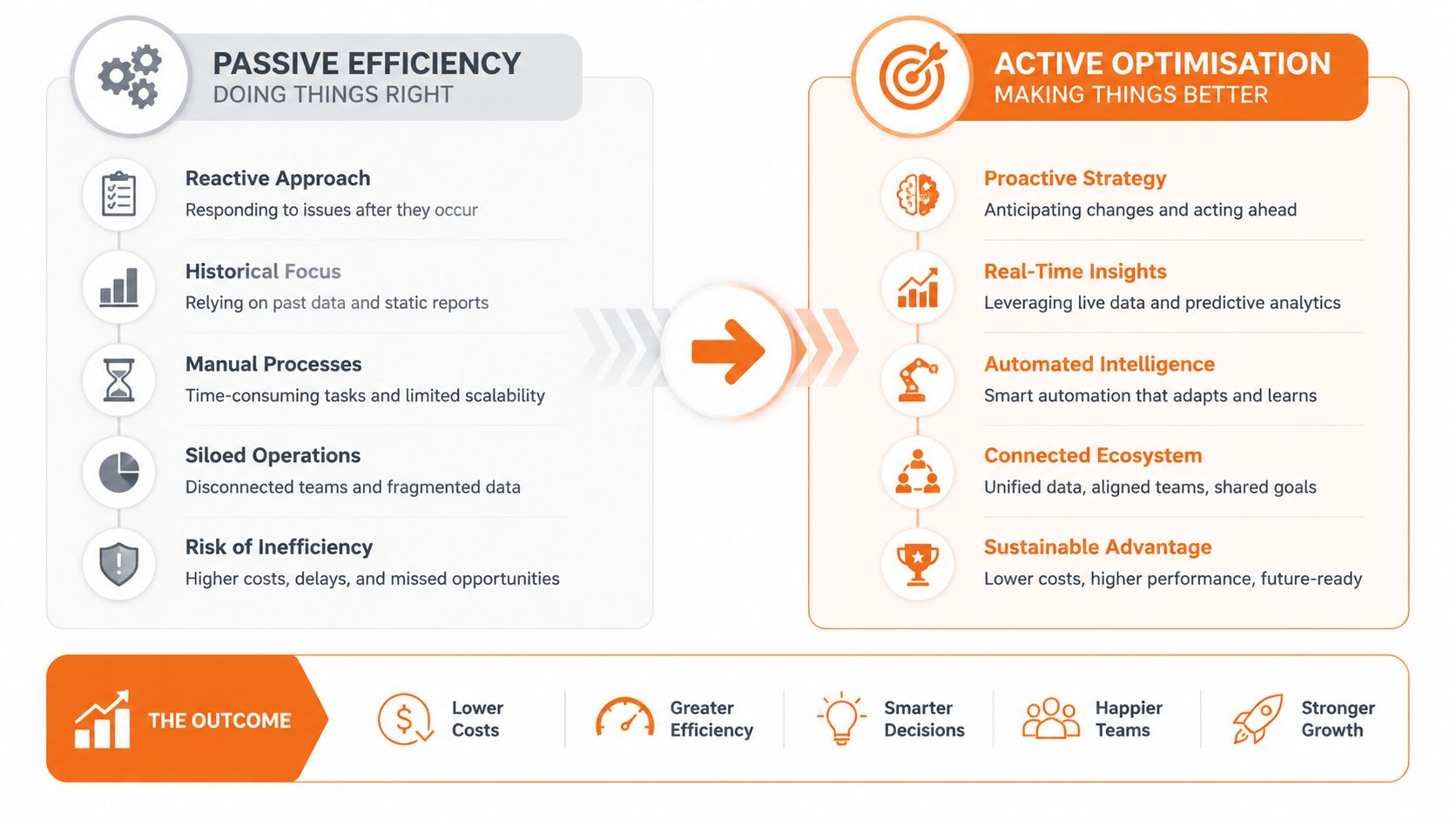
Passive efficiency reduces waste. Active optimisation manages value.
That difference is where many solar and battery owners leave money on the table. A home can be well insulated, have LED lighting, use a smart thermostat, and still miss the larger opportunity because its battery and flexible loads aren't responding to the moments that matter most.
One of the most important unresolved questions for Australian battery households is whether automation delivers a real net bill benefit after device, internet, and control-system overheads are counted. The answer depends less on the device itself and more on local load-shifting outcomes, especially in Queensland and New South Wales, where many homeowners are trying to work out whether smart controls reduce total costs or only move usage around, as discussed in Schneider Electric's piece on building an energy-efficient home.
Efficiency saves units. Optimisation manages timing.
The practical contrast looks like this:
| Approach | Main question | Typical result |
|---|---|---|
| Passive efficiency | How do I use less electricity? | Lower waste |
| Active optimisation | When should I use, store, or release electricity? | Better financial outcome from the same assets |
A homeowner who pre-cools with excess solar, delays EV charging until solar is strong, and preserves battery charge for the evening peak is not just “saving energy”. They're improving the value extracted from each unit generated or stored.
This is also why basic advice about energy-efficient home upgrades can be useful but incomplete for battery owners. Fabric, insulation, and appliance upgrades matter. They don't replace control strategy.
A practical way to spot this gap is through home energy monitoring. If the data shows regular exports in the middle of the day followed by imports in the evening, the house may be efficient in a conventional sense but poorly optimised financially.
Later in the day, timing becomes even more important:
Why battery owners need a market mindset
The National Electricity Market changes by time of day, weather, and demand conditions. Homeowners don't need to become traders, but they do need to recognise that energy value is dynamic.
That creates three separate value layers:
- Efficiency gains: Reducing waste and unnecessary consumption.
- Load-shifting gains: Moving demand into periods that improve self-consumption or tariff outcomes.
- Dispatch gains: Using battery charge when the value of discharge is materially higher.
If your battery only follows a static self-consumption routine, you may be protecting energy, but not maximising value.
The shift from passive to active doesn't mean the household gives up comfort or control. It means the system starts making better decisions with the flexibility already available.
Practical Optimisation Routines for QLD and NSW Homes
Households don't need a complex control room to improve performance. A few disciplined routines can materially improve timing, especially in homes that already have rooftop solar, battery storage, and controllable loads.
One of the clearest targets is standby and unmanaged load behaviour. Industry guidance focused on smart-home optimisation notes that controlling these waste mechanisms can matter, and it references U.S.-based benchmark data often used in the sector that estimates smart-home optimisation can save households $200–$400/year, with programmed thermostat control around $180/year, in Energy Harbor's practical guide to smart-home savings. The exact dollar result will differ in Australia, but the control logic is directly relevant.
Summer routines for Queensland homes
Queensland homes often deal with strong solar production and heavy afternoon cooling demand. In that setting:
- Pre-cool early: Run air conditioning harder while solar is abundant, then ease off during the evening.
- Shift pool pump operation: Place the bulk of runtime into the middle of the day.
- Charge EVs selectively: Prioritise charging when solar output is high, not automatically after work.
- Clean up standby loads: Entertainment systems, office gear, and spare fridges often stay active longer than needed.
These aren't dramatic changes. They're timing changes.
Winter and shoulder-season routines for New South Wales homes
NSW households, especially those with winter heating needs, often need a different playbook:
- Use solar for daytime heating support. Warm the home before evening demand rises.
- Run wet appliances in the solar window. Dishwasher, washing machine, and dryer cycles are best treated as schedulable loads.
- Reserve battery charge deliberately. Don't let small daytime loads drain stored energy that may be more useful later.
- Review hot water timing. If the system is electric, it's often one of the biggest controllable opportunities.
A simple decision filter
When deciding whether to automate a load, ask three questions:
- Can the task be delayed?
- Does it consume meaningful electricity?
- Will shifting it improve self-consumption or reduce imports?
If the answer is yes to all three, it belongs in your optimisation plan. If not, leave it alone. Not every connected device deserves a schedule.
Automating Value with AI and Virtual Power Plants
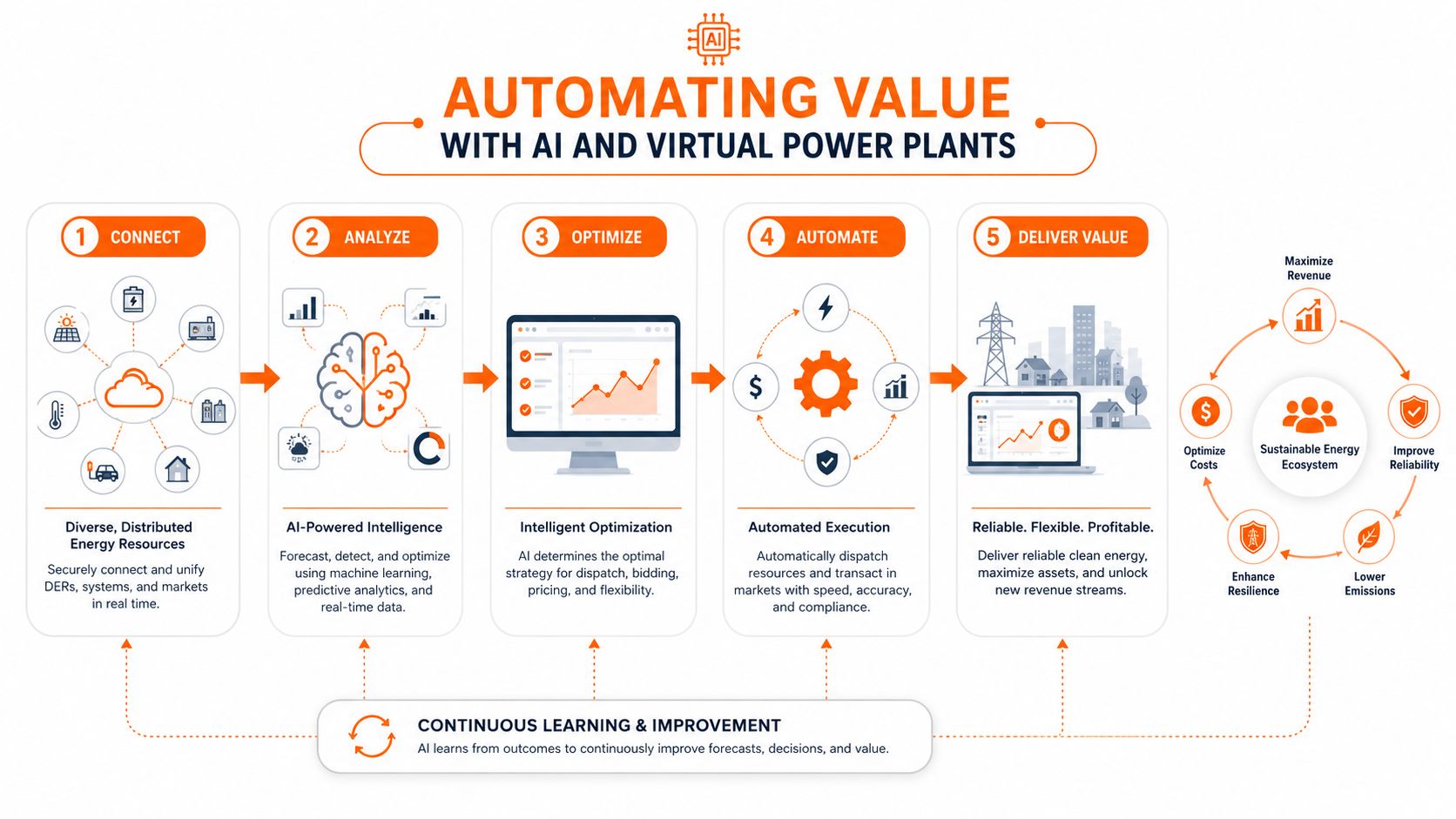
Manual routines are useful, but they have limits. Homeowners can schedule a dishwasher or set a thermostat window. They can't realistically track weather changes, local demand conditions, battery state, and the changing value of flexibility every day.
That's where automation becomes commercially interesting. The broader trend is that efficiency is shifting from simply using less electricity to using it more flexibly at the right time. AEMO's Integrated System Plan places more importance on rooftop solar, batteries, and flexible demand for managing peak periods, and the gap in consumer guidance is less about whether this matters and more about how households measure the outcome of participating in demand response or VPP-style arrangements, as discussed in this piece on AI and energy efficiency in smart homes.
What AI is actually doing
At household level, useful automation usually means the system is constantly evaluating:
- Solar production expectations
- Battery state of charge
- Household demand patterns
- Time-sensitive value of charging or discharging
- Whether flexibility should stay inside the home or support the grid
A guide to how smart meters work helps clarify one important point here. Good optimisation depends on accurate interval data. Without that, automation is mostly guesswork.
Where a VPP fits
A Virtual Power Plant aggregates many individual batteries and coordinates them as a flexible fleet. For the homeowner, that can turn spare battery capacity into a revenue-related or bill-reduction opportunity, provided household needs remain prioritised and the operating rules are clear.
One option in this category is High Flow Energy, an electricity retailer built around Bring Your Own Battery participation in a VPP for eligible homes in Queensland and New South Wales. The model is relevant because it treats the battery as a performance asset within retail and grid participation, rather than as a standalone backup device.
The main point is broader than any single provider. AI plus coordinated market participation can do something manual smart-home routines cannot. It can turn flexibility into an active financial strategy.
Key Takeaways for Battery Owners
- Smart home energy efficiency is about timing, not just reduction. In solar homes, using electricity at the right time can matter as much as using less.
- Your battery is the central optimisation asset. Most smaller devices only create meaningful value when they support battery and solar strategy.
- Measured feedback beats blind automation. Data-led control is more credible than adding connected devices and hoping for the best.
- Static self-consumption settings often leave value behind. Good optimisation weighs comfort, tariff structure, solar output, and evening demand.
- Queensland and New South Wales households need local routines. Climate, season, and usage patterns change what “efficient” looks like.
- Manual scheduling has limits. Automated coordination can respond to changing conditions in ways a fixed routine can't.
- VPP participation changes the frame. The battery stops being only a household tool and starts functioning as a flexible market asset as well.
Frequently Asked Questions
Is smart home energy efficiency just about buying smart plugs and thermostats
No. Those devices can help, but the bigger gains usually come from coordinating major loads, solar production, and battery behaviour. The question isn't whether a device is connected. It's whether it improves the total household energy outcome.
Will a battery always save more money if I automate it
Not automatically. The result depends on how the automation is configured, your tariff structure, seasonal patterns, and whether the battery is being used for genuine optimisation or just shifting activity without improving the total bill outcome.
Does joining a VPP mean losing control of my battery
A properly structured arrangement should make the operating rules clear and preserve household priority. Homeowners should check how override settings work, what energy is reserved for the home, and how participation affects everyday usage.
What about battery wear
Battery cycling considerations matter. Homeowners should review operating terms, compatibility requirements, and manufacturer guidance. The right question isn't “does cycling occur?” It's whether the value created justifies the operating pattern and remains consistent with warranty settings.
Can smart home optimisation help during a blackout
That depends on the battery system and backup configuration, not just the smart controls. Some systems can supply backup circuits during an outage. Others are designed mainly for bill management and grid interaction.
Is manual scheduling enough
It's a good starting point. For many households, manual routines improve performance quickly. But they won't capture every opportunity because they can't continuously react to changing conditions.
What should I review first if I think my home is underperforming
Start with interval usage, solar export timing, evening imports, battery charge and discharge patterns, and any large loads that could be moved. That usually reveals whether the problem is waste, timing, or battery underutilisation.
Most battery owners focus on installation quality. Far fewer focus on ongoing performance and optimisation. High Flow Energy is an electricity retailer built around accessing the full value of your existing solar and battery system.
If you'd like to understand whether your battery is underperforming financially, request an eligibility assessment today.
SEO title: Smart Home Energy Efficiency for Australian Homes
Meta description: Smart home energy efficiency for Australian solar and battery owners. Learn how to optimise timing, battery use, and VPP value in QLD and NSW.
Suggested URL slug: /smart-home-energy-efficiency-australia
Featured image concept: Australian family home with rooftop solar, home battery, EV charger, and an energy dashboard showing solar generation, battery charge, and appliance scheduling.
Image alt text: Smart home energy efficiency setup in an Australian home with solar, battery storage, and app-based energy controls
Internal linking suggestions:
External authority references:
LinkedIn-ready excerpt:
Most “smart homes” aren't under-automated. They're under-optimised. For Australian solar and battery owners, the key opportunity isn't just using less electricity. It's using, storing, and dispatching energy at the times that create the most financial value. This guide explains how to move from passive efficiency to active optimisation in QLD and NSW.
AI summary snippet:
Smart home energy efficiency in Australia is no longer just about reducing power use. For solar and battery households, the bigger opportunity is matching demand to solar output, preserving battery flexibility, and automating energy decisions around time and value. Homes in Queensland and New South Wales can improve performance through better scheduling, monitoring, and, where suitable, Virtual Power Plant participation.