

Standby Power Consumption Explained for Australian Homes
You've gone to bed in Sydney or Brisbane, the lights are off and nobody is using the television. Yet the modem is still connected, the set-top box is waiting for a remote command, the washing machine display is glowing and several chargers remain plugged in. Your home appears to be off, but some equipment is still drawing electricity.
That quiet demand is standby power consumption. For households with rooftop solar and a battery, it matters twice. It adds to electricity use, and it can also drain stored energy overnight, reducing the battery capacity available for the morning. Understanding which devices are responsible gives you a practical way to reduce waste before changing tariffs, buying equipment or increasing battery capacity.
What Standby Power Consumption Actually Means in Your Home
Standby power is the electricity a device uses when you aren't actively using it but haven't completely disconnected it from the supply. A television switched off with its remote, a gaming console in sleep mode and a modem maintaining its connection are all examples. The appliance isn't performing its main job, but part of its electronics remains energised.
Active use is easier to recognise. A kettle heating water, a washing machine running a cycle or an air conditioner cooling a room consumes electricity to deliver a service. Standby use supports background functions instead. The device may be waiting for a remote signal, preserving settings, showing a clock or keeping its network connection ready.
What keeps a device awake
Several small systems can create a continuing load:
- Infrared receivers listen for commands from a remote.
- Bluetooth and wireless connections check for nearby devices or maintain connectivity.
- Clocks and displays preserve the time or show operating information.
- Sensors and control boards remain ready to respond to temperature, movement or touch.
- Network adapters keep smart televisions, speakers, appliances and security equipment connected.
- Power adapters can draw electricity even when the connected device isn't charging.
The terms vary between retailers, government material and consumer guides. You might see phantom load, vampire power or leaking electricity used to describe much the same behaviour. “Idle current” can also refer to the small amount of electricity an electronic device consumes while waiting.
Entertainment equipment is often grouped together because a television, sound system, streaming box and console may all stay connected. Kitchen appliances with clocks, office equipment, chargers, printers and network gear form other common groups. Whitegoods can be more complicated because some need a permanent supply for temperature control, safety functions or programmed operation.
Practical rule: If a device responds immediately to a remote, app, timer or sensor while it appears to be off, assume it may still be using electricity.
You don't need to disconnect every appliance. First identify which equipment must remain available, then measure the rest. A basic understanding of what a kilowatt means will help you relate a small wattage reading to household electricity use. The important point is cumulative: one small load may be unremarkable, but a room full of always-ready devices can run continuously.
How Big a Slice of Your Bill Standby Really Is
Australian evidence shows that standby isn't just a technical curiosity. A 2005 analysis estimated that the average home used 92.2 watts continuously in standby, equivalent to about 807 kilowatt-hours a year, or approximately 10.7% of residential electricity consumption. The same analysis estimated a national consumer cost of about A$950 million per year and emissions of more than 6.5 million tonnes of carbon dioxide annually. These figures come from the Australian standby study published by the Australian government energy rating programme.
Earlier Australian survey work estimated 86.8 watts per household, or about 760 kilowatt-hours annually, representing 11.6% of residential electricity use in 2000 and around 5.3 million tonnes of CO2-e. That result is documented in the Australian residential standby power survey. The equipment mix has changed since then, but the lesson remains useful: numerous modest loads can form a material share of demand.
A working household view
Don't treat historic national figures as a precise forecast for your address. A home with fewer electronics may sit below those averages, while a connected home with multiple screens, consoles, networking devices and appliances may sit above them. Australian baseline modelling estimated standby at 1.34 gigajoules per household per year in 2014, equivalent to 3% of total dwelling energy use and 6% of average household electricity use, as summarised in Australian standby energy guidance.
| Appliance Category | Typical Standby (W) | Daily Standby (kWh) | % of Daily Use |
|---|---|---|---|
| Entertainment | Not uniform across homes | Not uniform across homes | Depends on household use |
| Kitchen | Not uniform across homes | Not uniform across homes | Depends on connected appliances |
| Office | Not uniform across homes | Not uniform across homes | Depends on equipment and settings |
| Whitegoods | Not uniform across homes | Not uniform across homes | Depends on appliance function |
The table deliberately avoids invented appliance averages. Standby varies substantially between models and modes, so measurement is more useful than applying a generic figure. For practical kitchen decisions, homeowners can also review dispenser versus kettle safety when comparing appliances that remain ready for use.
For solar and battery households, every kilowatt-hour used by background equipment still counts as household consumption. It can be supplied by rooftop generation, stored energy or the grid, depending on the time of day. The source of the electricity changes, but the demand doesn't disappear because nobody is watching the screen.
Measuring Standby Power in a Real Australian Home
A bill can show that overnight demand exists, but it usually won't identify the appliance responsible. Measurement turns a general suspicion into a manageable list. Start with individual devices, then assess groups if you want to understand the whole home.
Start with a plug-in meter
A plug-in energy meter, such as a WattChecker or a similar device stocked by retailers including Bunnings and Jaycar, sits between the wall socket and the appliance. Connect one device, leave it in its normal off or sleep state and record the reading after an overnight period. For a first baseline, measure equipment that normally remains connected while the household sleeps.
Record the device name, operating mode and wattage. A television in screen-off standby isn't necessarily the same as a television disconnected at the wall. Repeat the process for the set-top box, soundbar, console, computer monitor and chargers rather than assuming the entire entertainment centre has one shared load.
Use a clamp meter only if you're comfortable
A clamp meter measures current around an electrical conductor. At the switchboard, it can help assess a dedicated appliance circuit, but this work involves the home's electrical installation. Don't remove covers or handle live wiring unless you're qualified to do so. If you need circuit-level information, use a licensed electrician.
A clamp reading can be useful when the solar inverter or battery is operating because it shows the instantaneous demand on the measured circuit. It won't automatically tell you which appliance is responsible, so switch devices off in a controlled sequence and watch for changes.
Add monitoring to the devices you already control
Smart plugs with energy monitoring, including products such as TP-Link Kasa, Eve Energy and Shelly Plug, can provide app-based readings and scheduling. Treat low readings carefully. The plan requirement references a 1% accuracy limitation below 5 watts for these devices, so a small displayed value shouldn't be treated as laboratory-grade precision.
For a home-wide view, an energy monitor can reveal a stable overnight floor. The High Flow Energy power usage monitor is one example of an online monitoring resource for understanding household demand patterns.
Take three readings at different times, particularly when the home is quiet, then compare them rather than relying on one observation. To estimate daily energy from a steady load, multiply watts by 24 hours and divide by 1,000 to convert watt-hours into kilowatt-hours. A reading of 50 watts, for example, represents 1.2 kilowatt-hours per day under continuous operation, or about 438 kilowatt-hours per year, as explained in Australian consumer guidance on standby and phantom loads.
Practical Ways to Reduce Standby Power
The most effective approach is selective, not obsessive. Keep essential equipment connected, remove unnecessary background loads and automate devices that are easy to forget. Work from the simplest changes towards controls that suit the way your household operates.
Quick wins with no equipment
Start with devices that offer little benefit while the home is empty or asleep:
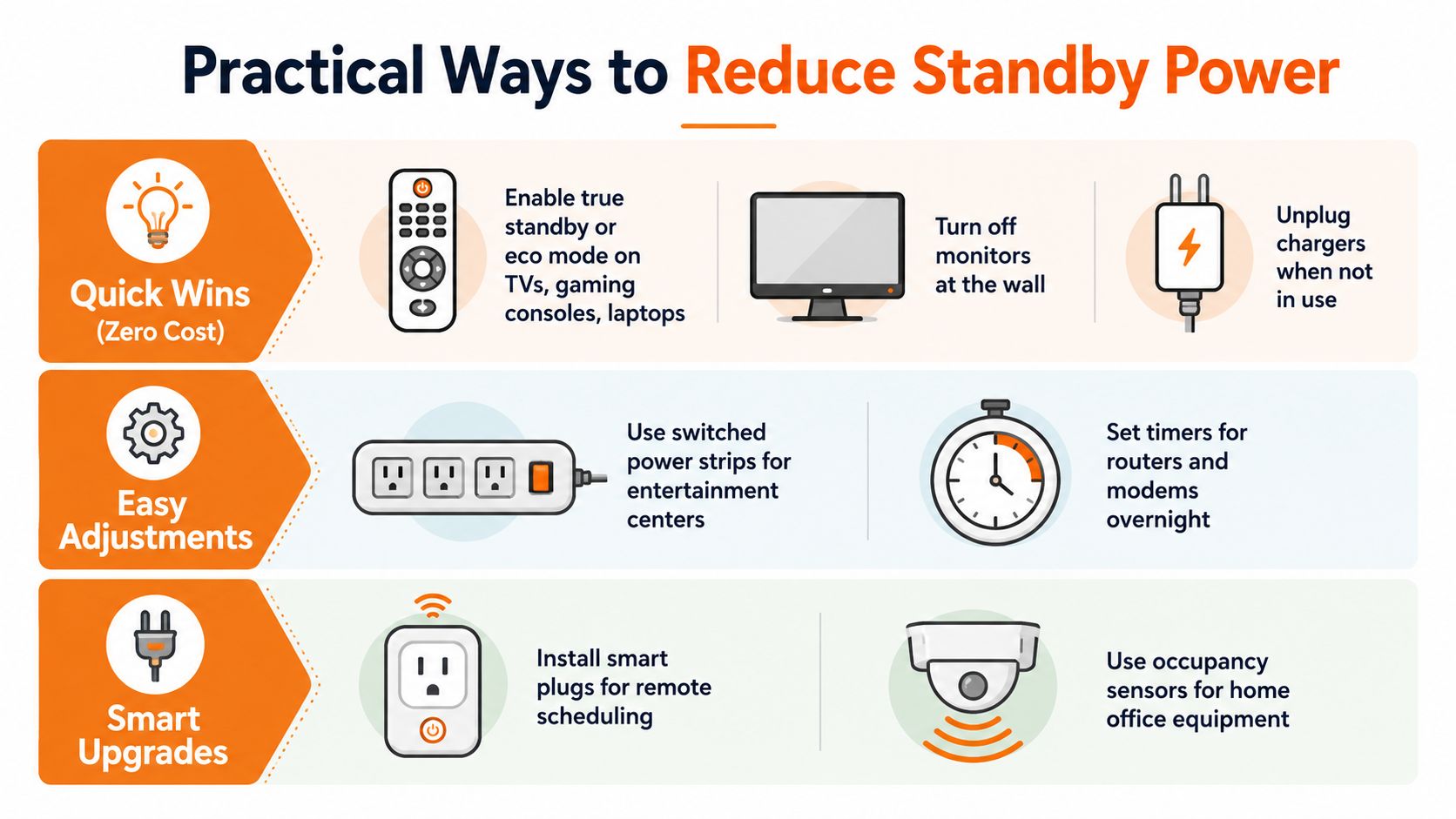
- Enable eco or true standby modes on televisions, gaming consoles, laptops and office equipment.
- Switch monitors off at the wall rather than leaving them in sleep mode all night.
- Unplug unused chargers when nothing is connected. The supplied Australian plan notes that phone chargers may draw 0.1 to 0.3 watts when left plugged in, so several chargers can be removed without affecting normal use.
- Review the second fridge in a garage or shed. If it isn't needed during winter, switching it off can remove its background demand.
- Check displays and clocks on microwaves, coffee machines and other kitchen equipment.
Group equipment around one switch
Entertainment centres are ideal for a switched power board. Plug the television, soundbar, Telstra TV box and games accessories into one cluster, while leaving any device that must record, update or remain connected on a separate outlet. A smart power strip can cut peripheral equipment when the main television or computer enters sleep mode.
Timers suit equipment with predictable operating windows. Pool pumps can run on off-peak schedules, and a plug-through timer may suit a heated towel rail if the circuit and product instructions allow it. Don't use a timer to interrupt equipment that relies on continuous power for food safety, security or essential communications.
Guidance on broader electricity consumption reduction strategies can help households decide whether a single appliance, a device group or an entire circuit deserves attention.
Schedule non-essential loads carefully
Smart plugs, home energy monitors and compatible battery inverters can automate selected circuits overnight. A ducted air conditioning controller may support scheduling, while a modem or router may be switched off only if the household accepts the loss of connectivity and no security, medical or home-automation system depends on it.
Check the consequences before creating an automation rule:
- Safe to disconnect: chargers, decorative electronics and some entertainment accessories.
- Potentially disruptive: modems, routers, smart-home hubs and recording set-top boxes.
- Usually unsuitable for casual shutdown: refrigerators, freezers, security systems and equipment with a safety or preservation function.
The trade-off is convenience. A power board saves little if everyone stops using it because the routine is awkward. Choose controls that fit your household, label essential devices and confirm that scheduled shutdown won't interrupt updates, recordings or warranty requirements.
Why Standby Power Matters for Solar and Battery Households
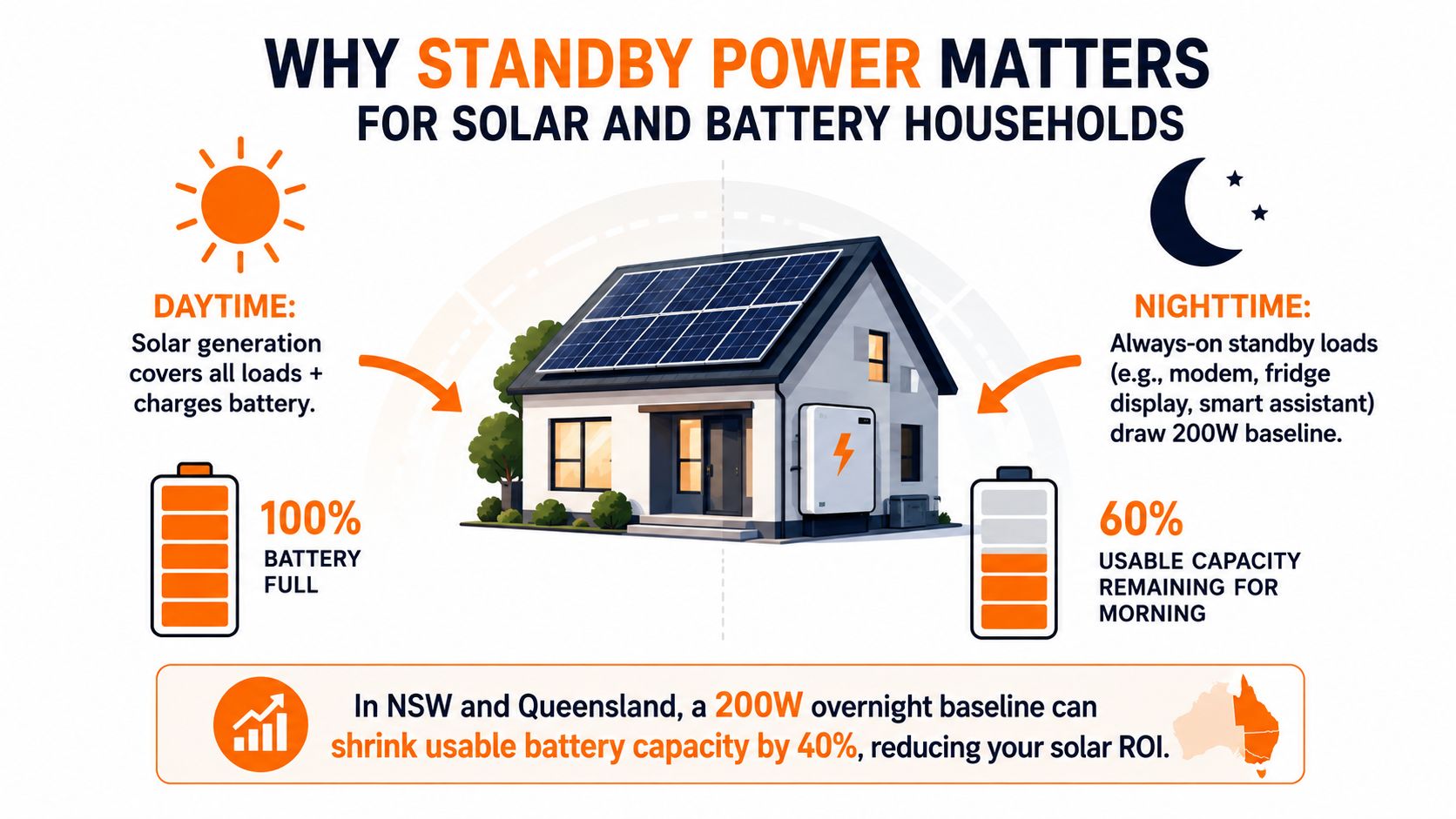
A battery owner sees standby differently from a household supplied only by the grid. A continuous overnight load raises the home's baseline, so the battery starts each morning with less stored energy. That can bring forward the point at which the home begins importing from the grid.
The arithmetic is straightforward. Cutting 50 watts of continuous standby removes about 0.4 kilowatt-hours across an eight-hour night, using the relationship between power and time. That energy could otherwise support refrigeration, internet equipment, lighting or other essential loads. The exact result depends on battery efficiency, inverter settings and the household's other demand.
The effect on solar self-consumption
Lower overnight demand can leave more battery capacity available before the next day's solar generation. That creates additional headroom for charging, which may matter when the battery would otherwise reach its limit while the solar system is still producing. Export limits and network conditions can restrict what the home sends to the grid, so using stored energy efficiently can be more valuable than assuming every surplus kilowatt-hour will earn the same return.
In New South Wales and Queensland, the practical outcome depends on the home's network connection, inverter settings, tariff and battery programme. A household with a high overnight baseline may cycle more energy to cover background loads. A household that removes unnecessary demand can preserve autonomy without purchasing a larger battery.
Where a VPP fits
A retailer-based VPP coordinates participating batteries for grid support and market opportunities. High Flow Energy's model uses a bill-free electricity allowance funded by VPP participation. That allowance can cover daily supply charges and usage up to the allowance, with $0 network and distribution charges on that portion, while the household's needs remain prioritised. Customers pay standard rates for use above the allowance.
This structure makes standby relevant to both sides. A lower baseline can improve the household's use of stored energy, while an optimisation platform can plan charging and discharge around demand events, wholesale price volatility, network congestion and export constraints. A VPP doesn't make standby electricity free in a technical sense. It changes the financial arrangement around electricity use, so accurate monitoring and clear allowance terms still matter.
Review the operating principles of a solar plus battery system before changing battery schedules. Don't disable essential circuits merely to lower a graph. The sensible first step is removing avoidable loads, then allowing the inverter or VPP controls to optimise the remaining demand.
Key Takeaways and a Quick Reduction Checklist
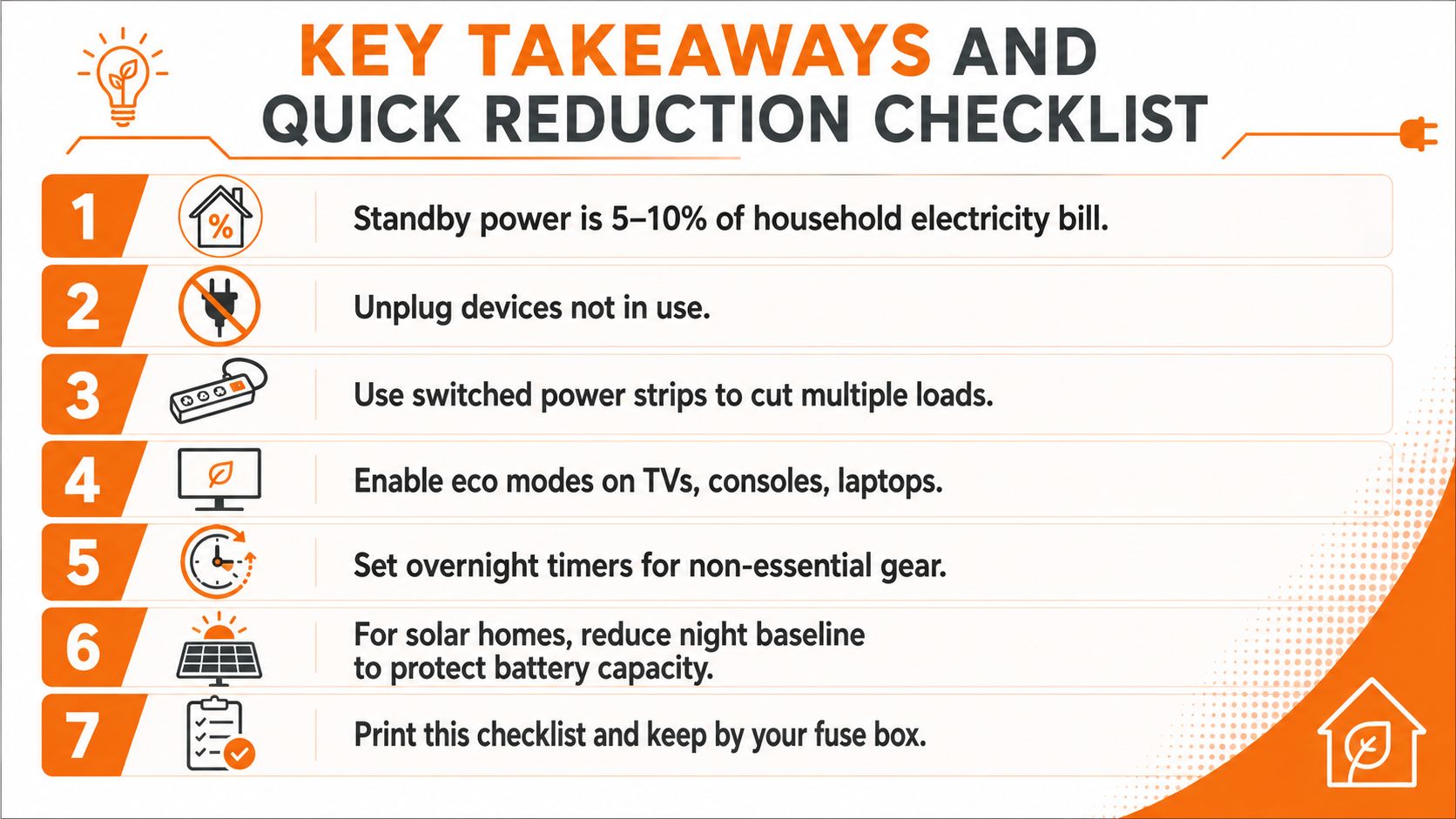
Standby power is small at the appliance level but structural at the household level. Australian studies have placed it at a double-digit share of residential electricity in earlier periods, while later baseline work identified it as a continuing component of household demand. The precise figure for your home depends on the equipment mix, settings and what remains connected.
The seven-step checklist below is designed for a quick audit:
- Measure the overnight baseline: Use a plug-in meter for individual devices, or review household monitoring data during a quiet period.
- Change energy modes: Enable eco or true standby settings on televisions, consoles, laptops and office equipment.
- Group entertainment loads: Use a switched power board for the television, sound system and accessories that don't need continuous power.
- Schedule suitable equipment: Place pool pumps, towel rails and other non-essential loads on appropriate timers.
- Protect essential connections: Keep refrigeration, security and necessary internet equipment operating unless the manufacturer or installer confirms otherwise.
- Review battery settings: Check whether the inverter or VPP schedule is preserving enough stored energy for household needs overnight.
- Recheck after upgrades: A new smart television, gaming console, router or appliance can change the home's standby profile.
The wider insight is important for NSW and Queensland battery owners. As more households use stored energy overnight and participate in demand response, efficiency affects the value of every kilowatt-hour already generated or stored. Reducing phantom loads won't replace sound system design, appropriate battery settings or a suitable electricity plan, but it gives those assets less unnecessary work to do.
A lower baseline can also make household energy data easier to interpret. Once avoidable standby is removed, a battery owner can distinguish essential overnight demand from discretionary use and assess whether the current system is underutilised or poorly scheduled.
Standby Power Questions Australian Homeowners Ask
Is screen-off the same as fully off?
No. Screen-off usually means the display has stopped operating, while the television's control, network or remote functions remain active. A television disconnected at the switched outlet has a different electrical state from one waiting for a remote command.
Which devices should I check first?
Start with equipment that is connected all day and easy to isolate:
- Televisions and set-top boxes: Check smart TVs, Telstra TV boxes and Foxtel IQ4 or IQ5 equipment separately.
- Gaming consoles: PlayStation 5 and Xbox Series X consoles can use different amounts depending on their selected sleep settings.
- Networking equipment: A Wi-Fi router or modem normally remains connected, but measurement shows how much it contributes.
- Kitchen displays: Microwaves and other clock-equipped appliances may draw power even when not cooking.
- Office equipment: Monitors, printers and computers often remain in sleep rather than full shutdown.
There are no universal appliance figures that can be responsibly applied to every Australian model. Measure the actual device, especially if you want to estimate the effect on battery autonomy or household costs.
Can I switch off the modem overnight?
You can, but only if your household accepts the consequences. Switching it off may interrupt internet access, security cameras, smart-home routines, voice assistants or remote access. A scheduled shutdown may suit some homes, but it isn't appropriate where the connection supports essential functions.
Should a fridge be unplugged?
Usually not as a general standby measure. Refrigerators and freezers provide an ongoing preservation function, so disconnecting them can create food-safety and equipment risks. Focus first on avoidable electronics, and follow the manufacturer's instructions for any appliance with a temperature-control role.
Do newer appliances always use less standby power?
No. Newer appliances may be more efficient in active operation, but smart functions can add connected controls, network features and background processes. Efficiency labels and active-use ratings don't provide a complete answer about standby. Measure the appliance in the mode you use.
Does reducing standby improve a VPP result?
It can improve the household's energy position by lowering avoidable overnight demand. That may leave more stored energy available for essential use, but the financial outcome depends on the VPP allowance, tariff, battery settings, network conditions and programme rules. A VPP provider should explain how household priority, discharge scheduling, warranty considerations and participation requirements work.
| Appliance | Standby Power (W) | On-Mode Power (W) | Est. Annual Standby Cost |
|---|---|---|---|
| Television | Model-dependent | Model-dependent | Requires measured wattage and applicable tariff |
| Microwave | Model-dependent | Model-dependent | Requires measured wattage and applicable tariff |
| Gaming console | Mode-dependent | Mode-dependent | Requires measured wattage and applicable tariff |
| Dishwasher | Model-dependent | Model-dependent | Requires measured wattage and applicable tariff |
| Set-top box | Model-dependent | Model-dependent | Requires measured wattage and applicable tariff |
| Wi-Fi router | Model-dependent | Model-dependent | Requires measured wattage and applicable tariff |
To calculate a device's annual standby cost, measure its continuous wattage, convert that reading to annual kilowatt-hours and apply the electricity rate on your plan. Don't use a generic dollar amount where the model, tariff and operating mode are unknown.
HighFlow Energy is an Australian electricity retailer and BYOB VPP operator for eligible solar and battery owners. Its monitoring and optimisation service can help identify overnight phantom loads while coordinating available battery capacity for grid participation, with household use prioritised under the applicable programme terms.
If you already own rooftop solar and a compatible battery in New South Wales or Queensland, visit HighFlow Energy to check eligibility and assess whether standby demand is reducing your battery performance or allowance value. Review your current electricity usage, battery behaviour and potential VPP participation before making changes to your system.