

What Is Supply Charge Electricity: Understand Your Bill
A supply charge in electricity is the fixed daily fee you pay to stay connected to the grid, separate from the cost of the power you use. In Australia, that charge commonly sits at around 90 cents to $1.50 per day, which can add up to roughly $330 to $550 per year before any usage is billed.
That's the part many solar and battery owners underestimate. They focus on reducing imports, increasing self-consumption, and improving export value, but the daily connection fee keeps running in the background. If you're searching what is supply charge electricity, the more useful question is often this: why does it still matter when your home already produces a large share of its own energy?
For households in New South Wales and Queensland, that question isn't academic. It goes directly to bill design. You can shrink the usage side of your bill with rooftop solar and battery storage, but a fixed charge doesn't respond to lower consumption in the same way. That makes it one of the most stubborn line items on the bill, and one of the clearest signals that battery value should be measured in bill outcomes, not just in kilowatt-hours.
Decoding Your Bill Supply, Usage, and Network Charges
Why does a household with solar, a battery, and very low grid imports still carry a recurring bill floor?
The answer sits in the structure of the bill itself. Retail electricity charges are usually built from separate cost layers, and only one of them falls materially when you import less energy. For a solar and battery owner, that distinction matters more than the textbook definition of the supply charge, because it explains why bill savings often plateau before the system has extracted all possible value.
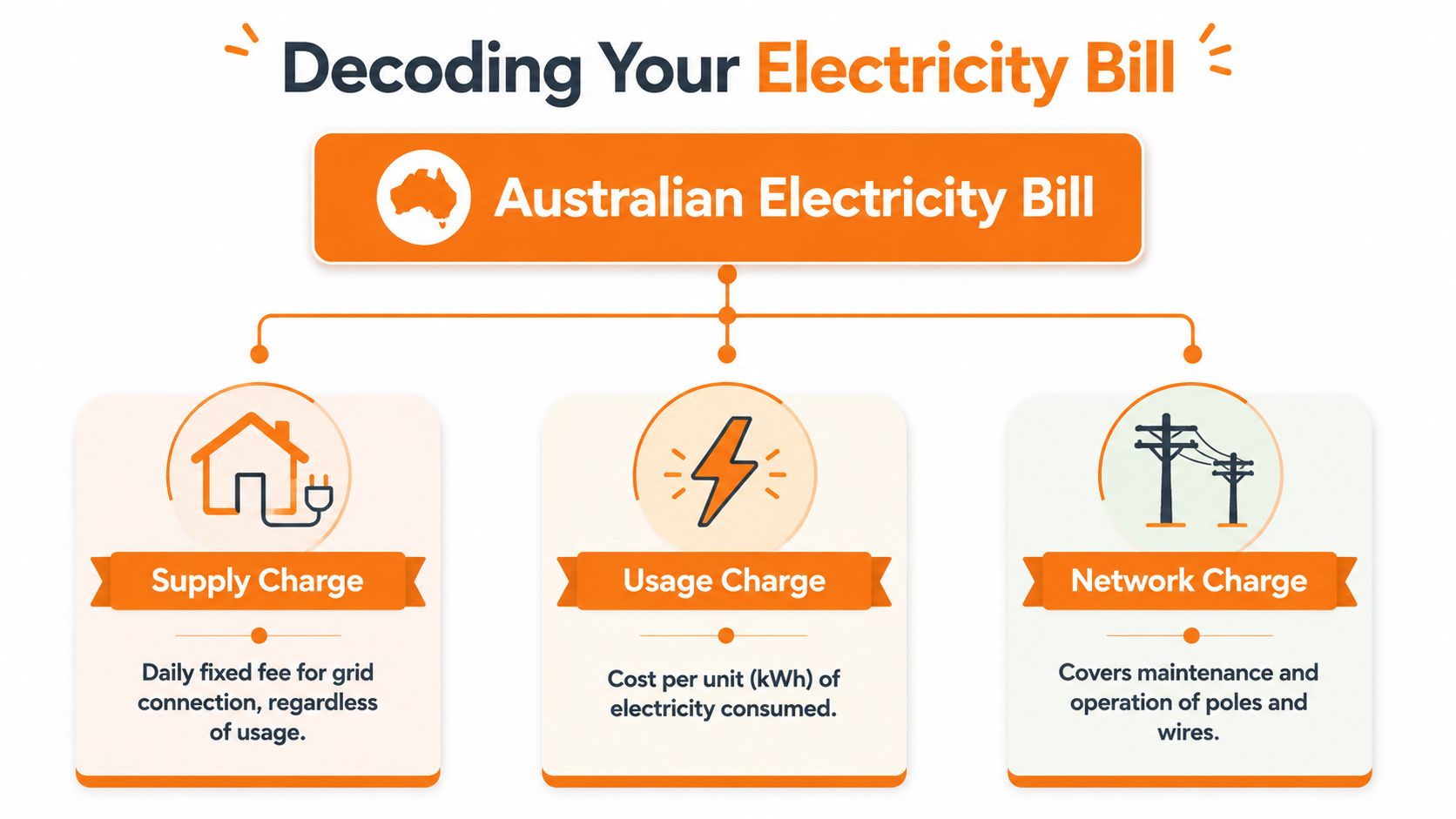
A useful way to read an electricity bill is to separate it into three commercial components:
- Supply charge. The fixed daily fee attached to keeping the site connected under a retail account.
- Usage charge. The variable charge for electricity imported from the grid, usually measured in kWh.
- Network charge. The underlying cost of transmission and distribution infrastructure, which is often embedded within the rates your retailer presents.
These categories behave differently. Usage charges can be reduced by self-consumption, load shifting, and battery dispatch. Fixed charges do not respond in the same way. Network costs are also less visible than many households assume, because retailers often bundle them into tariff design rather than listing them as a separate line item with equal prominence.
That is why a low-import home can still be a high-friction billing outcome.
For solar households, the key commercial point is simple. Your system attacks the variable side of the bill first. It does very little to the fixed side unless the retail model itself is designed to offset or remove that cost. A standard solar-plus-battery setup can therefore improve energy independence without fully solving the economics of staying grid-connected.
This is also why comparing plans on cents per kWh alone can mislead. A technically strong battery strategy should be judged against total bill architecture, including fixed daily costs, tariff structure, export treatment, and retailer credits. The broader cost structure of electricity in Australia makes that clear. The bill is not one price. It is several prices stacked together, with different optimisation paths for each.
The non-obvious conclusion is that the supply charge persists because the grid connection still has commercial value, even when annual imports fall sharply. The home remains able to import at any time, settle through a retailer, and rely on network capacity when solar output is weak or the battery is depleted. From the retailer and network perspective, that ongoing availability still has to be funded.
That persistence creates the opening for a different model. If fixed charges are treated as unavoidable, optimisation stops at reducing usage. If fixed charges are treated as a design problem, a VPP-style structure can go further by using battery participation, bill credits, or allowances to offset the part of the bill that ordinary self-consumption cannot remove. For solar and battery owners, that is the more useful frame. The supply charge is not just a definition on the bill. It is the fixed-cost constraint that separates partial savings from a fully optimised outcome.
Calculating the Daily Supply Charge in NSW & QLD
How much of your bill remains even after solar cuts imports close to zero?
In NSW and QLD, the answer starts with the daily supply charge. It is charged per day, not per kilowatt-hour, so the calculation is mechanically simple and commercially important. Once a home reduces grid imports through solar, load shifting, or battery storage, this fixed line item becomes a larger share of the remaining bill.
How the math works
Use the daily rate on the plan and multiply it by the number of days in the billing period. If the tariff is shown ex GST, add GST at the bill total stage.
| Component | Rate (cents/day) | Billing Period (days) | Total Charge (ex. GST) |
|---|---|---|---|
| Supply charge example A | 90 | 90 | $81.00 |
| Supply charge example B | 120 | 90 | $108.00 |
| Supply charge example C | 150 | 90 | $135.00 |
That arithmetic creates a hard bill floor. A battery can cut evening imports. Solar can reduce daytime consumption from the grid. Neither changes the number of days connected.
For a technically literate solar owner, the implication is clear. The marginal economics of self-consumption and arbitrage improve the variable side of the bill, but they do not remove the fixed connection cost.
Why low-import homes feel this charge more sharply
The daily supply charge does not rise because a home becomes efficient. Its visibility rises because the usage component falls.
That distinction matters in NSW and QLD, where plan comparisons can look attractive on usage rates while hiding a weaker result for low-consumption households. A tariff with a cheaper energy rate can still produce a higher annual bill if the fixed daily charge is materially higher. For that reason, plan selection should assess the full tariff structure, not just the usage line. This overview of electricity prices in Australia on a per kWh basis is useful only when read alongside the daily supply fee.
The commercial point is easy to miss. As imports fall, each additional optimisation on usage delivers smaller savings, while the supply charge stays unchanged. That is why many solar and battery owners reach a point where system performance keeps improving but the bill does not fall in proportion.
What to check on the bill
Retailers use different labels for the same underlying idea. Look for:
- Supply charge
- Daily charge
- Service to property charge
- Customer charge
The wording varies. The financial effect is the same. It is the fixed cost of maintaining an active grid connection across the billing period.
The Solar Owner's Paradox Why the Supply Charge Persists
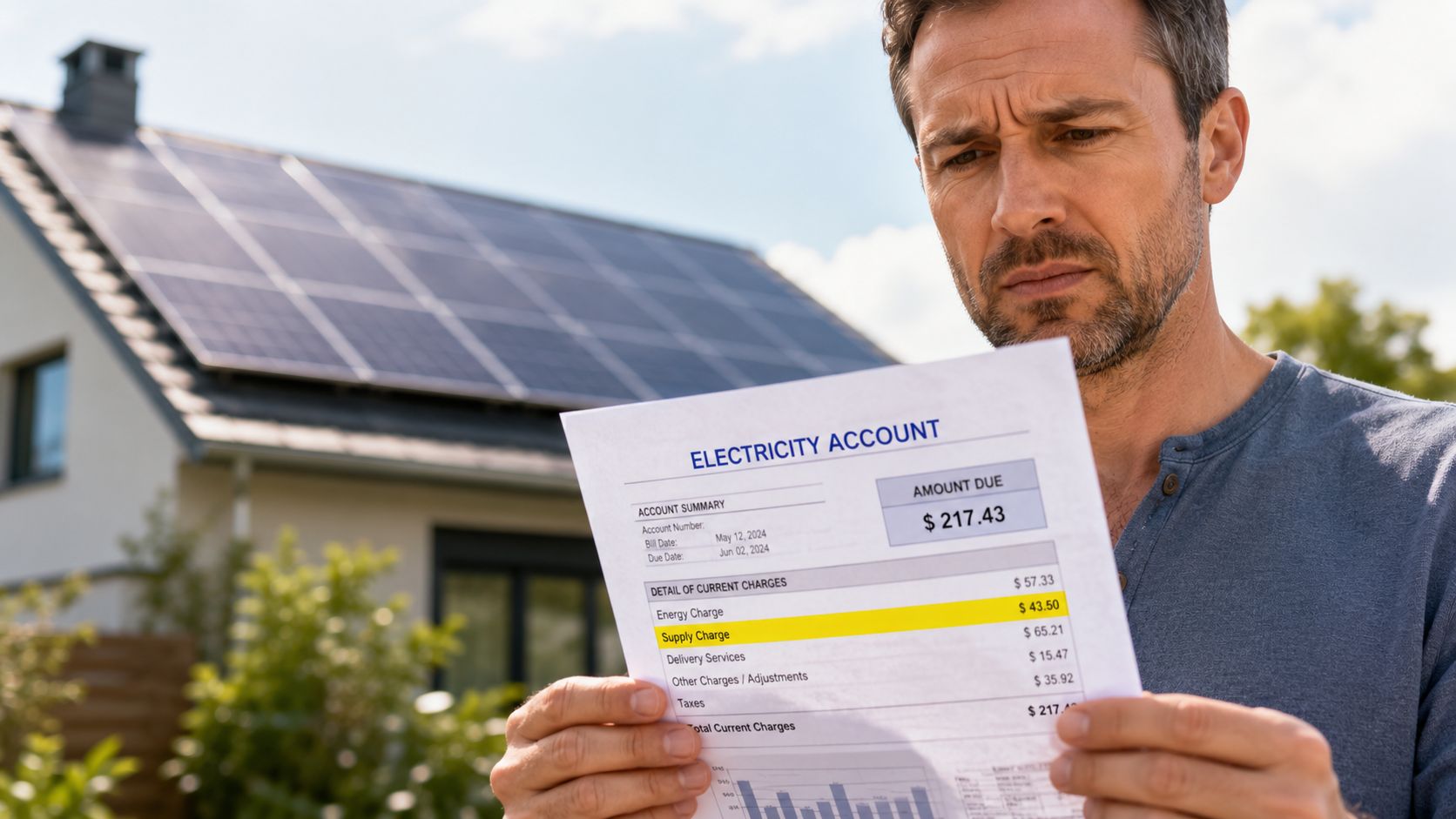
Why does a household that generates most of its own electricity still carry a fixed grid cost every day?
Because solar changes energy flows, not the commercial terms of grid access. A rooftop system can sharply reduce imported kilowatt-hours. A battery can shift imports out of peak periods. Neither automatically removes the retailer and network charges attached to keeping the connection live.
That distinction matters more for technically literate solar owners than for average households. Once imports are already low, the remaining bill is often dominated by items that self-generation does not directly erase. The supply charge persists because the home is still buying something from the market: standing access to the network, settlement through a retailer, and a reliable fallback when on-site generation does not match demand.
Solar lowers usage exposure. It does not terminate the grid relationship.
A solar and battery system usually improves the variable side of the bill first. The fixed side remains in place because the property still depends on the grid in several commercially relevant ways:
- Reliability cover for nights, poor solar days, and unexpected load spikes
- Export pathway for surplus generation, which still requires an active connection
- Seasonal balancing when winter production falls or household demand rises
- Retail market access for billing, metering, credits, and tariff administration
For many homes, that ongoing access is economically rational. Full disconnection requires enough storage, backup planning, and operational tolerance to replace the grid's role across all seasons, not just on a good summer day.
Why this becomes a bigger issue after you install battery storage
Battery owners often expect the fixed charge to become less important once imports fall further. The opposite usually happens. As usage charges shrink, the supply charge becomes a larger share of the remaining bill.
That creates a planning error. Some households keep optimising self-consumption and export timing even after the marginal savings have started to flatten. The next dollar saved is no longer easiest to find in inverter settings or load shifting. It is often found by changing the commercial model around the connection itself.
This is the paradox. The better the system performs, the more obvious the unresolved fixed cost becomes.
Why VPP logic is different
A standard retail arrangement treats the supply charge as a permanent cost of staying connected. A VPP model is designed around a different objective. It uses distributed battery capacity as a market asset and shares the value created, so the fixed connection cost is no longer just a bill item to tolerate. It becomes a cost that can be offset, absorbed, or in some models effectively eliminated through participation value.
That is a more useful framing for solar and battery owners. The question is rarely whether the supply charge exists. The question is whether your current tariff structure leaves it sitting there untouched when your battery could be earning against it.
Before that step, lower grid reliance still helps. Basic load reduction and appliance efficiency improve the economics of any plan, and practical electrical efficiency tips from DLG Electrical can reduce the amount of imported energy that sits on top of the daily fixed fee.
Practical Ways to Reduce Your Daily Supply Charge
The first way to reduce the impact of a supply charge is not technical. It's contractual. Review the plan.
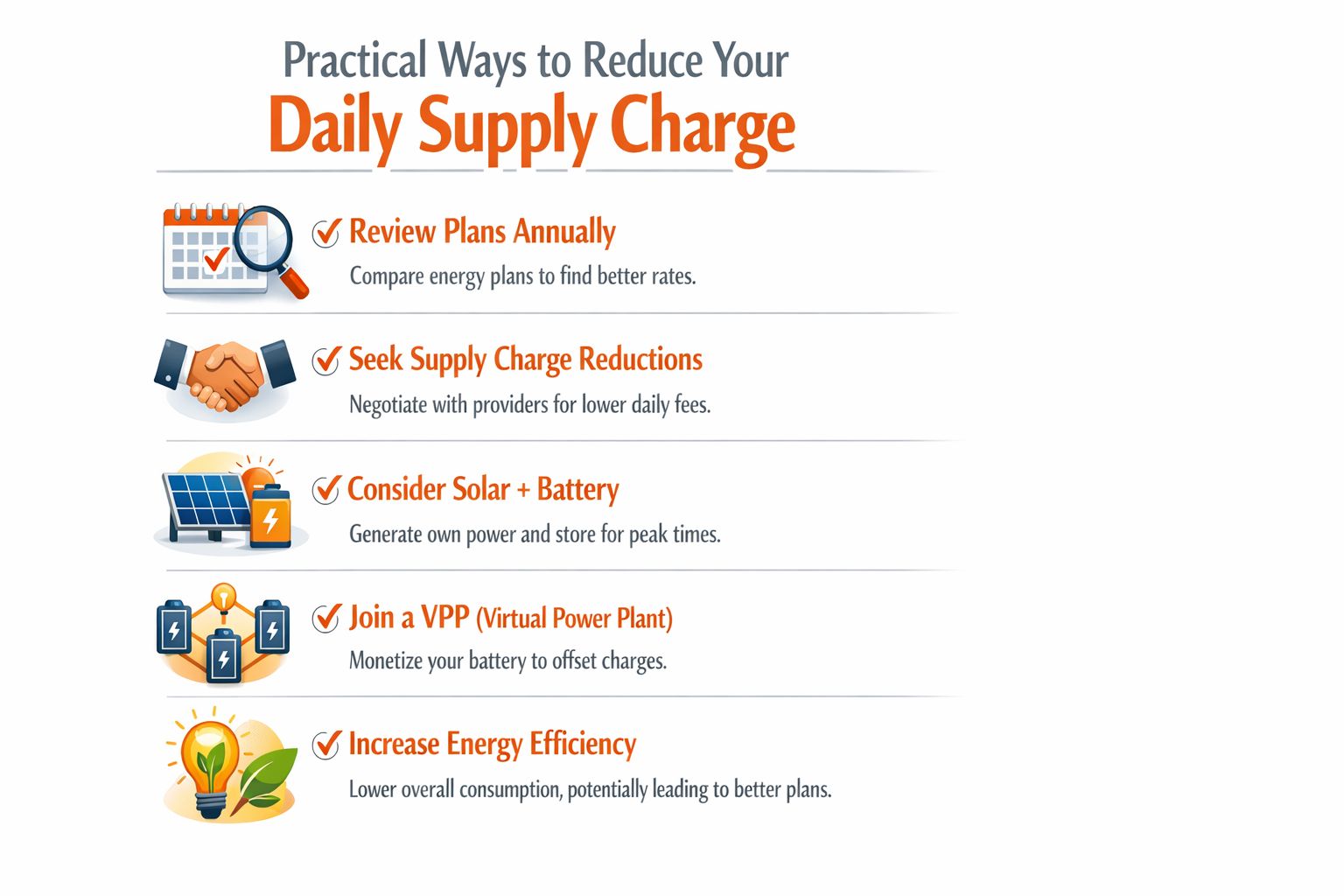
Many households stay on a familiar retail structure long after their home's load profile has changed. A plan that suited a pre-solar household may be poorly matched to a battery-equipped home with lower imports and a different evening demand shape.
Start with the simple checks
Some steps are basic but still commercially useful:
- Compare plan structure, not just headline rates. A low usage rate can be paired with a higher daily charge.
- Review tariff fact sheets annually. Fixed charges can shift over time.
- Check whether your current usage pattern still matches your plan. A battery changes the economics of import timing and bill design.
- Read the line items closely. Many customers know their feed-in tariff but can't state their daily supply charge.
A practical second layer is demand reduction. Lower overall reliance on the grid won't erase the fixed charge on its own, but it can improve your position when choosing between plans and make the remaining bill easier to target. If you want household-level ideas, these electrical efficiency tips from DLG Electrical are a useful operational checklist for Brisbane conditions and are broadly relevant across similar Australian homes.
Then optimise the battery for bill structure
A battery owner has more levers than a standard customer. The point isn't only to store excess solar. It's to deploy stored energy when grid imports are most financially painful under your tariff.
That usually means thinking in terms of priorities:
- Protect self-consumption first. Use your own solar where possible.
- Shift evening imports down. Stored energy is often most valuable when solar has stopped producing.
- Avoid treating exports as the main value engine. For many households, reducing costly imports matters more than maximising exported kilowatt-hours.
- Look beyond the inverter dashboard. Technical performance and bill performance aren't always the same thing.
This short explainer is a useful prompt for the bigger issue of changing bill behaviour, not just reducing usage.
The advanced approach is to monetise flexibility
The supply charge is hard to remove with behaviour alone because it's fixed by tariff design. That changes the strategy. Instead of only trying to consume less, a battery owner can also look for ways to create value from the battery itself.
That's where Virtual Power Plant participation becomes commercially interesting. A battery connected to a coordinated program can provide value to the grid when it has spare capacity available. The battery stops being just a household savings tool and starts acting as a flexible energy asset.
Commercial view: Once your variable imports are already reduced, the next optimisation target is often fixed bill lines, not extra export volume.
That shift in thinking matters. It moves the question from “How do I use less electricity?” to “How do I make my existing battery solve parts of the bill that solar alone doesn't touch?”
How VPPs and Bill Allowances Offset Supply Charges
Why does the supply charge remain one of the hardest bill components to remove, even for households that already have solar and a battery?
Because the charge is tied to staying connected to the grid, not to how efficiently you consume energy on a given day. Once a home has already cut imports through self-consumption and storage, the remaining optimisation problem changes. The question is no longer how to shave another small slice off variable usage. The stronger commercial question is how to turn battery flexibility into value that can absorb a fixed daily cost.
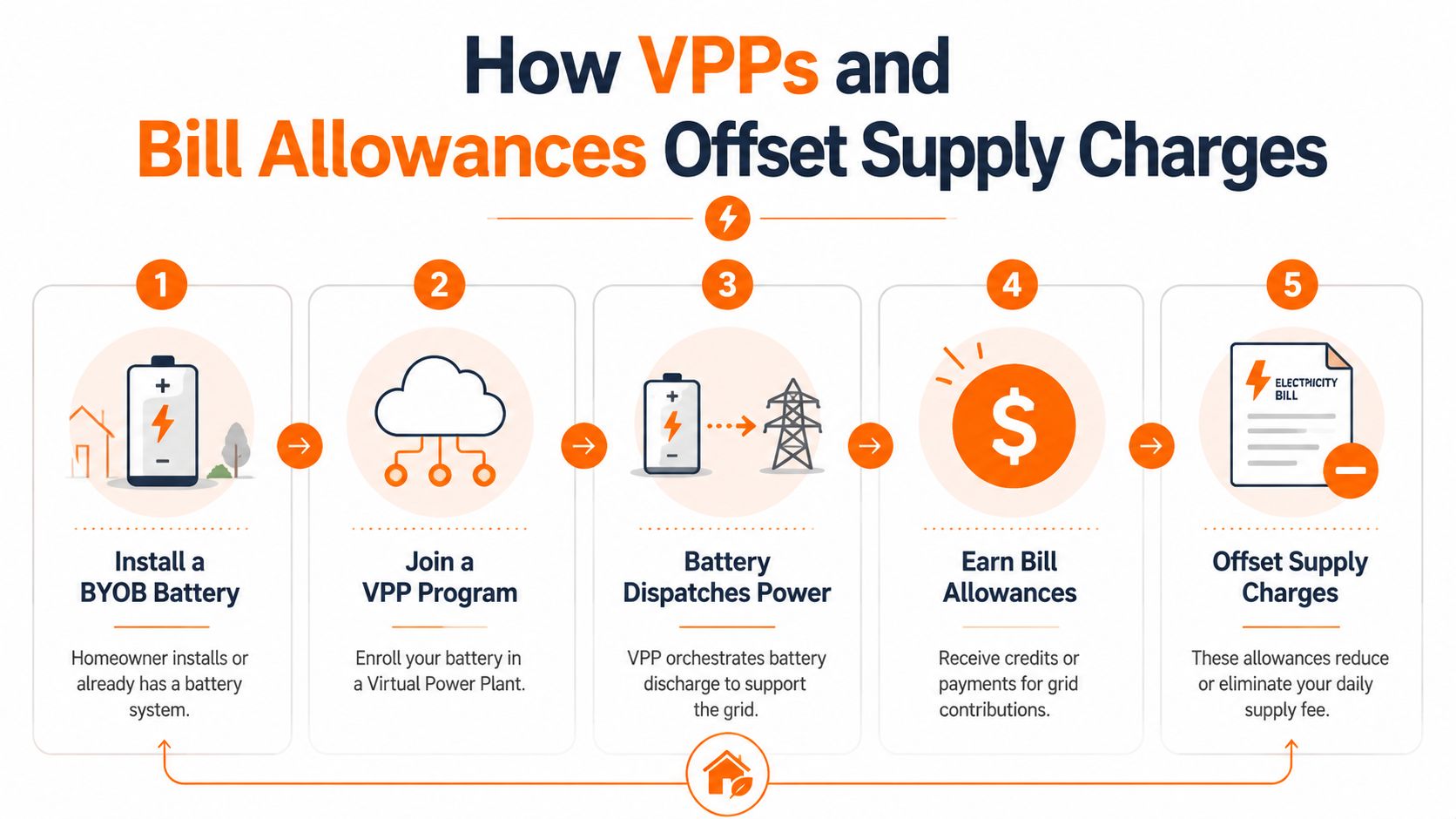
How the logic works
A Bring Your Own Battery VPP coordinates home batteries so they can respond to grid needs at times when that response has market value. For the homeowner, the important shift is financial. Spare battery capacity stops being idle insurance and starts becoming a revenue-producing asset within a broader retail structure.
That matters because a fixed charge usually cannot be reduced by exporting a bit more solar. It needs an offset mechanism.
| Step | What happens | Why it matters financially |
|---|---|---|
| 1 | You already own a compatible battery | The asset can produce value beyond backup and self-consumption |
| 2 | The battery joins a VPP program | Coordination creates access to grid-service value streams |
| 3 | The battery responds when called on, within program rules | Flexibility becomes commercially useful |
| 4 | The retailer converts that value into a customer benefit | Battery performance starts affecting total bill outcome |
| 5 | Bill allowances or credits are applied | A fixed daily charge can be offset rather than merely endured |
Why this matters more than a feed-in tariff
A feed-in tariff rewards exported kilowatt-hours. A VPP can reward controllable battery capacity and timing, which are often more useful to the grid and more strategically useful to the customer.
That distinction is easy to miss on a bill. Export credits usually reduce the total payable amount, but they do not specifically solve the persistence of the supply charge. A retailer-integrated VPP can be designed more precisely. It can return value in the form of a bill allowance that targets the fixed charge first, and in some products, part of usage as well.
For a solar and battery owner, that is the more interesting model. It addresses the bill component that system sizing, load shifting, and extra exports often leave behind.
Why retailer design determines the outcome
The battery by itself does not eliminate the supply charge. The retail model around the battery determines whether flexibility value is passed back in a form that helps with that line item.
A standard retail plan may leave you with a lower usage bill but the same daily connection cost. A VPP-linked plan can structure the customer benefit differently by applying battery-derived value as an allowance against the bill. High Flow Energy explains that model in its overview of a Virtual Power Plant in Australia.
The practical conclusion is straightforward. Once a household has already invested in solar and storage, one of the highest-value decisions is often not more hardware. It is choosing a retail structure that converts battery flexibility into a direct offset against fixed charges.
Solar reduces consumption costs. A well-structured VPP can help neutralise the fixed cost that remains attached to the grid connection.
That is why the supply charge persists for solar and battery owners, and why VPP bill allowances are commercially interesting. They turn a stubborn fixed expense into an optimisation problem with a credible mechanism for solving it.
Why High Flow Energy
Most battery owners focus on installation quality. Far fewer focus on the commercial design wrapped around the battery after installation.
That's where retailer choice becomes strategic. High Flow Energy is an Australian electricity retailer built for homeowners who already have rooftop solar and a compatible battery. The model isn't about selling hardware. It's about extracting more value from the hardware you already own through coordinated battery participation and a retail structure designed around performance.
Why that matters in practice
Traditional electricity plans usually leave the fixed daily supply charge intact as a background cost of staying connected. High Flow Energy's model is built differently. It uses VPP participation to fund a bill-free electricity allowance designed to cover daily supply charges and usage up to the allowance, while prioritising the household's own needs first.
The commercial point is simple. A battery owner doesn't just need a retailer who can bill correctly. They need a retailer whose operating model is aligned with battery optimisation, transparent allowances, and ongoing energy performance.
What battery owners should assess
Before choosing any energy partner, ask:
- Does the model reward battery flexibility, or only energy consumption?
- Is the value returned in a form that targets stubborn bill lines?
- Do you keep control and priority access to the battery for household needs?
- Is the structure transparent enough to evaluate against a standard retail plan?
Those are better questions than asking only for a feed-in tariff or a flat usage rate. For a battery-equipped household, the retailer is part of the optimisation stack.
Frequently Asked Questions
Why does the supply charge survive even after I cut grid imports with solar and a battery?
Because the charge is attached to being grid-connected, not to how efficiently your system reduces consumption. Solar and battery investments usually shrink the variable part of the bill first. What remains is the harder line item: the fixed daily cost that keeps appearing regardless of how well the system performs on self-consumption.
That is why many solar households feel they have done the right things technically but still see a stubborn residual bill.
Is the supply charge the same as the usage charge?
No. The supply charge is a fixed daily fee on the account. The usage charge depends on how much electricity you import from the grid.
For battery owners, that distinction matters commercially. Hardware optimisation mainly attacks usage charges. Retail structure determines whether the fixed charge stays in place or is offset.
If I have solar panels, why am I still paying it?
Solar changes your import profile. It does not usually change the retail fact that your property is still connected to the network and billed on a plan with a daily fixed charge.
So the main question is not whether solar should remove it. The better question is whether your electricity plan has any mechanism designed to deal with it.
Can a battery remove the supply charge on its own?
Usually no. A battery can reduce imports, shift demand, and improve self-consumption. Those are operational gains. The supply charge is usually a retail and billing issue, so battery hardware alone does not solve it.
A VPP-linked retail model is different because it creates a pathway for battery value to be returned against bill components that the battery cannot erase by itself.
Does exporting more solar cancel the daily supply fee?
Usually not. Export credits and daily supply charges are separate bill lines. Strong exports may improve your net bill outcome, but they do not automatically remove a fixed charge.
That is one reason feed-in tariff comparisons can be misleading for efficient homes. A higher export rate can look attractive while a persistent daily charge keeps dragging on annual savings.
Why does the supply charge matter more once a home becomes efficient?
Because fixed costs become more visible after variable costs fall. A home with strong solar production, a well-operated battery, and lower grid reliance often exposes the remaining bill structure more clearly than a conventional household does.
In other words, efficiency can make the problem easier to see, not easier to eliminate.
Are supply charges a bigger issue for solar and battery owners in NSW and QLD?
They are often more noticeable in those markets because rooftop solar adoption is high and many households have already reduced daytime imports. Once usage falls, fixed charges become a larger share of what is left on the bill.
For that group, plan design matters as much as system design.
What is the most effective way for a battery owner to deal with the supply charge?
Assess the full commercial stack. Start with the daily charge, usage rates, export treatment, battery compatibility, and whether the retailer has a model that pays for battery flexibility in a way that can offset fixed bill lines.
That is where a VPP approach becomes financially interesting. It treats the supply charge less as an unavoidable background fee and more as a cost that can be offset through coordinated battery participation.
Should I compare retailers on supply charge alone?
No. A lower daily fee can be offset by weaker usage rates, poor battery integration, limited control, or a model that captures battery value without returning much of it to the household.
Compare the full outcome. For a solar and battery owner, the best plan is the one that reduces total annual cost while preserving battery priority for the home.
Most battery owners focus on installation quality. Fewer assess whether their retailer is designed to convert battery flexibility into bill relief. High Flow Energy is an electricity retailer built around getting more financial value from an existing solar and battery system.
If you want to know whether your current setup is leaving fixed costs untouched, request an eligibility assessment.