

Energy Saver Scheme NSW: A 2026 Guide for Homeowners
You already own the expensive part of the energy transition.
If you're a NSW homeowner with rooftop solar and a battery, the obvious question isn't whether energy efficiency matters. It does. The harder question is whether you're capturing the full financial value of the assets already on your wall and roof. Many households focus heavily on installation cost, rebate eligibility, and feed-in tariffs, then stop there.
That usually leaves money on the table.
The NSW Energy Saver Scheme matters because it can reduce the upfront cost of certain energy-saving upgrades. But for a financially literate homeowner, the more important distinction is this: an upfront incentive helps with acquisition, while a strong operating strategy determines long-term return. If you've ever looked at overseas home upgrade programs for context, Atomic Exteriors' guide to window incentives is a useful example of how incentive structures can shape upgrade decisions, even though the policy settings are different from Australia.
For NSW households comparing available support, concessions, rebates and relief schemes in NSW are worth reviewing alongside your retailer plan, tariff structure, and export settings. The key is to treat the Energy Saver Scheme as one lever in a broader optimisation plan, not the whole plan.
Introduction Navigating NSW Energy Incentives
A common situation looks like this. You've installed solar, added a battery, and cut your reliance on daytime grid imports. Your app shows generation, charge level, and household consumption, but your bills still don't always line up with what you expected. Some months feel efficient. Others don't.
That's where the Energy Saver Scheme NSW enters the conversation. It's often discussed as a rebate-style mechanism, but that framing is too narrow for a serious homeowner. The scheme sits inside a policy architecture designed to encourage lower electricity consumption through supported upgrades. That matters, because the benefit isn't just the product you install. It's the way the scheme changes project economics.
Where homeowners often misread the opportunity
One typically assesses an incentive in one of two ways:
- Upfront discount thinking. They ask whether the scheme lowers the purchase price enough to make an upgrade worthwhile.
- Simple payback thinking. They ask how long the upgrade takes to recover its cost through bill reduction.
- No-further-action thinking. They assume that once the upgrade is installed, the optimisation job is finished.
That last step is where performance often stalls.
A household with solar and battery storage isn't just buying equipment. It's building a small energy asset stack. Some parts of that stack create value once, at installation. Other parts can create value repeatedly, depending on how they're operated, what tariff they sit on, and whether they can participate in more advanced market arrangements.
A one-off incentive improves entry economics. It doesn't guarantee strong ongoing asset performance.
The practical lens that matters
If you own a battery, you should think in two buckets:
- Capital support. What lowers the initial cost of an upgrade?
- Operational optimisation. What improves the financial performance of the asset after installation?
The NSW Energy Saver Scheme sits primarily in the first bucket. That makes it useful. It also means it has limits. For battery owners, those limits matter more than they do for households installing a simple efficiency measure such as LED lighting or draught sealing.
What is the NSW Energy Saver Scheme
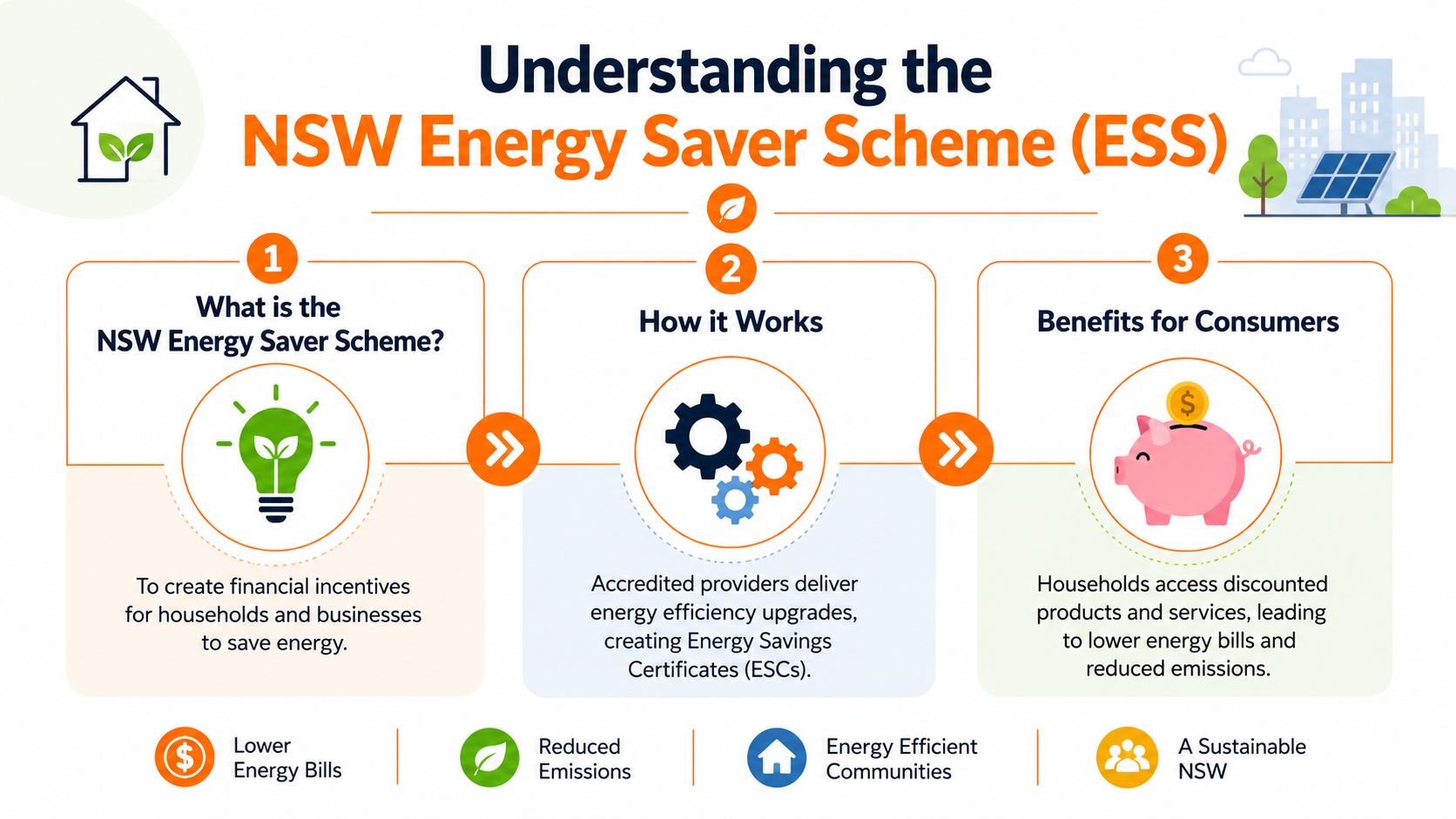
The NSW Energy Saver Scheme is a state-based program designed to encourage lower electricity consumption by creating financial incentives for eligible activities. According to the NSW Government, the scheme aims to help cut electricity consumption in NSW by providing financial incentives, and since its inception in 2009 it has supported activities that are projected to save over 37,000 gigawatt-hours of electricity through eligible activities under the scheme's framework, as outlined on the NSW Energy Saver Scheme overview.
How the scheme works in plain English
The scheme doesn't usually operate like a straightforward government cheque sent to your home after you buy something. Instead, it uses a certificate framework.
The key unit is the Energy Savings Certificate, usually shortened to ESC. An ESC represents eligible energy savings created under approved methods. Those certificates have value within the scheme, which means someone can monetise the energy-saving activity if it meets the rules.
A practical analogy helps. Think of ESCs as tradeable receipts for approved energy-saving work. If an upgrade qualifies, the certificate provider can claim those receipts. The commercial value of those receipts can then be passed back to the customer, often as a discount on the job.
Who does the work inside the scheme
Householders generally don't create or trade ESCs themselves. That role is handled by an Accredited Certificate Provider, or ACP.
An ACP typically does three things:
- Assesses eligibility for an approved activity
- Arranges or coordinates installation through compliant delivery channels
- Claims the certificates created by that activity under the scheme rules
That's why the customer experience often feels simple even though the underlying mechanism is not. The homeowner sees a discounted product or service. The ACP handles the certificate pathway behind the scenes.
Practical rule: If a provider can't explain whether they are the accredited party or working under one, slow the process down and ask more questions.
What the scheme is really designed to do
The Energy Saver Scheme is an incentive framework for efficiency. It supports activities that reduce electricity use or improve how energy is used inside homes and businesses. For homeowners, that usually means approved upgrades rather than open-ended cash support.
That distinction matters because the scheme rewards eligible activity, not just ownership of technology. It also means the best financial result usually comes from matching the scheme to the right upgrade, rather than chasing the scheme for its own sake.
ESS Benefits and Eligibility for NSW Homeowners
For households, the practical question isn't whether the scheme exists. It's whether your home, your intended upgrade, and your installer pathway line up with the rules in a way that produces a genuine financial benefit.
In plain terms, the scheme is usually most useful when you're already considering a qualifying improvement and want to reduce the effective project cost. It's less useful when homeowners chase whatever happens to be subsidised without checking whether it fits their load profile, home layout, or broader electrification plan.
What homeowners should check first
Before engaging a provider, review a few basics:
- Property location. The home needs to be in NSW for the scheme to be relevant.
- Proposed activity. The work needs to fall within an approved activity pathway rather than a generic home improvement idea.
- Delivery model. The upgrade usually needs to be handled through an accredited pathway so certificates can be created and assigned correctly.
- Commercial logic. The upgrade should still make sense for your household if the discount changes, because scheme value can vary by activity and delivery structure.
A financially disciplined homeowner will also ask whether the upgrade reduces imported grid energy at useful times, improves comfort, or supports a larger electrification plan.
Common upgrades under the NSW Energy Saver Scheme
The scheme is commonly associated with efficiency measures that reduce electricity consumption or improve the performance of major household systems. Typical examples include lighting improvements, efficient air conditioning, hot water upgrades, and building-shell measures such as sealing leaks.
| Common Upgrades Under the NSW Energy Saver Scheme | ||
|---|---|---|
| Upgrade Type | Typical Activity | Primary Benefit |
| Lighting | Replacing older lights with LED alternatives | Lower electricity use for everyday lighting loads |
| Air conditioning | Installing a more efficient reverse-cycle system | Improved heating and cooling efficiency |
| Hot water | Upgrading to a more efficient hot water solution | Reduced energy consumed for water heating |
| Draught reduction | Sealing gaps and reducing uncontrolled air leakage | Better comfort and lower heating and cooling demand |
| Building efficiency measures | Selected approved efficiency improvements | Lower ongoing household energy demand |
The exact activity list, installation method, and certificate treatment depend on the approved pathway. That's why broad assumptions can be risky. Two households can both install “efficient” equipment and still end up with different commercial outcomes depending on compliance and provider structure.
What works and what doesn't
What works well:
- Old equipment replacement. Replacing inefficient appliances or systems often has clear household logic.
- Comfort-driven upgrades. Measures that improve thermal comfort can deliver practical daily value, not just lower consumption.
- Bundled planning. Efficiency upgrades tend to work better when considered alongside solar, battery use, and tariff settings.
What often disappoints:
- Scheme-first decisions. Choosing an upgrade purely because a discount is available can lead to poor overall return.
- Ignoring household load shape. A home's energy use pattern determines whether an efficiency measure has real value.
- Overlooking retailer settings. Tariffs, controlled loads, and export arrangements can materially change the benefit of an upgrade.
If you're weighing these choices, energy efficiency support for Australian households is a useful starting point for understanding how different upgrade categories fit into a broader energy strategy.
The Application Process Step by Step
The process is usually simpler than homeowners expect, but only if you deal with a provider who can clearly explain the compliance pathway. The scheme's complexity sits behind the curtain. Your job is to verify that the curtain is attached to something legitimate.
Step one, confirm the activity is actually eligible
Start with the upgrade you want, not the incentive. Ask whether the exact product category and installation pathway can generate ESCs under the scheme. This is important because “energy efficient” and “ESS eligible” are not the same thing.
A provider should be able to explain the approved activity without hand-waving. If they can't, treat that as a warning sign.
Step two, identify the accredited pathway
You'll usually engage either:
- An ACP directly, or
- An installer or supplier working with an ACP
Ask who is responsible for the certificate claim and what documents you'll need to sign. In many cases, part of the process involves assigning the certificate rights arising from the upgrade so the discount can be applied.
Step three, review the commercial offer carefully
This is the point where homeowners often move too fast.
Check:
- The installed scope. Exactly what equipment or service is included?
- The incentive treatment. Is the value reflected as an upfront discount rather than vague “rebate potential”?
- The exclusions. Are switchboard work, compliance items, travel, or remediation excluded?
- The warranty pathway. Who supports the product and who supports the installation?
If the quote shows a discount but doesn't clearly show what you're buying, you're not comparing offers properly.
Step four, complete paperwork before installation
Scheme participation usually requires declarations, customer details, and assignment paperwork. This can feel administrative, but it matters. Incomplete or incorrect paperwork can complicate the certificate claim and create disputes after the work is done.
Keep copies of everything. That includes the quote, acceptance, product details, and any assignment forms.
Step five, installation and evidence capture
The installer completes the work. The accredited pathway then typically handles the evidence needed to support certificate creation. That may include product details, installation records, and customer acknowledgements.
From the homeowner's perspective, this should feel organised. If the provider is scrambling for basic documentation after the job, that's not a good sign.
Step six, confirm the incentive has been applied as agreed
Many homeowners expect a later payment. In practice, the value is often built into the transaction upfront. Confirm that the final invoice reflects what you were promised.
A clean ESS process usually has these characteristics:
- The provider explains eligibility clearly.
- The discount is shown in writing.
- The paperwork is completed before or during delivery.
- The installation is documented properly.
- The final invoice matches the commercial explanation.
That's the benchmark.
Beyond Basic Upgrades For Solar and Battery Owners
A battery owner sits in a different category from the average household replacing lights or upgrading an air conditioner. You're not just reducing consumption. You're managing timing, storage, export decisions, and exposure to tariff design.
That changes how the Energy Saver Scheme should be viewed. For this type of household, the scheme can be relevant, but it rarely captures the full economic story.
The one-off value problem
If an ESS-supported pathway contributes to the economics of a battery-related project, that value is usually concentrated at the point of installation. It affects entry cost. That's useful, but it's a one-time event.
A battery's real financial performance comes later.
Once installed, the battery has to make decisions every day:
- Charge from solar or the grid
- Discharge into household load or hold capacity
- Export when allowed or preserve stored energy
- Respond to tariff structure, household demand, and seasonal variation
Those operational choices determine whether the battery behaves like a passive backup device or a productive energy asset.
Why upfront support isn't the same as optimisation
Many homeowners treat a battery incentive as proof the battery will perform well financially. That doesn't follow.
A battery can receive good upfront support and still be underused because:
- The tariff isn't well matched to household consumption patterns
- Exports are constrained by network settings or inverter limits
- The battery is operated conservatively with little regard for value capture
- The household relies only on self-consumption logic, which can leave other value streams untouched
That's why battery owners should separate two questions:
- Did I reduce the installed cost?
- Am I running the battery in the most valuable way available to me?
Those are related, but they aren't the same.
Where the scheme still fits for battery households
The scheme can still play a sensible role in a battery owner's strategy when it lowers friction around related efficiency improvements or helps improve the economics of an eligible upgrade pathway. For some households, that may support a broader home electrification plan by making the next step more viable.
If you're examining how NSW battery support mechanisms fit together, battery rebate pathways in NSW provide useful context on where installation-stage value ends and operating-stage value begins.
Battery owners often spend months comparing hardware and very little time comparing operating models. That's usually backwards.
The core insight is simple. For a solar-and-battery household, the Energy Saver Scheme is usually best treated as a starting point. It can improve project economics. It does not, by itself, realise the strongest ongoing return from the battery already installed.
Unlocking Ongoing Value with a Virtual Power Plant
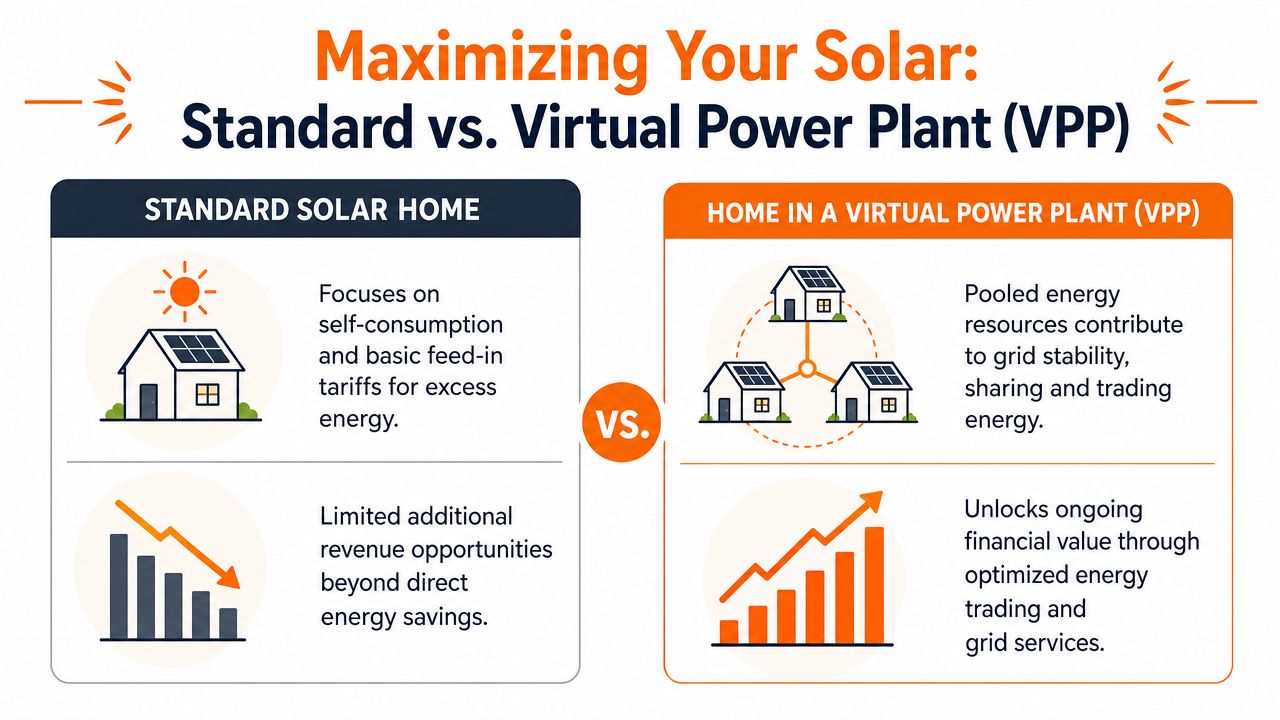
A standard home energy setup captures value in a fairly narrow way. You self-consume your solar, charge the battery, reduce some grid imports, and export whatever surplus remains under your retailer arrangement. That can work reasonably well, but it leaves the battery operating mainly as a household balancing device.
A Virtual Power Plant, or VPP, changes the operating model. It coordinates many distributed batteries so they can respond in a more organised way to grid conditions, demand events, and pricing opportunities that an individual homeowner usually can't access or manage efficiently alone.
Cost support versus return enhancement
The clearest way to think about the difference is this:
| Model | Main financial role | Typical limitation |
|---|---|---|
| ESS-supported upgrade | Reduces upfront project cost | Value is concentrated at installation |
| Standard solar plus battery operation | Cuts some household imports and may earn basic export credits | Battery often remains underutilised |
| Retailer-based VPP participation | Seeks ongoing operational value from coordinated battery use | Requires the right program structure and transparency |
That distinction matters because a battery is an operational asset. It has optionality. The question is whether your retailer arrangement and battery control framework know how to use it.
Why a simple feed-in tariff is often a weak ceiling
A feed-in tariff pays for exported electricity under a standard retail construct. It's simple. It's also limited. It generally values your exports in a straightforward way rather than stacking multiple forms of value that can arise when batteries are coordinated across many households.
That doesn't mean feed-in tariffs are useless. They're just not a complete optimisation strategy for a battery owner.
A retailer-based VPP can potentially improve the financial logic because it can coordinate battery behaviour around a broader set of conditions, including:
- Demand events where stored energy has higher strategic value
- Time-of-use dynamics that change the worth of charging and discharge windows
- Wholesale market exposure managed within a retail framework
- Grid support functions that an individual household usually can't monetise alone
The practical result is that the battery stops behaving like a static appliance and starts behaving more like a responsive portfolio asset.
The trade-offs that matter
Not every VPP structure is equally attractive. Homeowners should pay attention to the details.
Look for clarity on:
- Battery priority. Your home's needs should still come first.
- Control rights. Can you see what the system is doing and override settings where appropriate?
- Contract structure. Avoid arrangements that trap the battery in rigid terms with weak transparency.
- Warranty considerations. Battery cycling strategy should be commercially sensible, not reckless.
- Retail integration. A retailer-based model can align the electricity account and battery operations more coherently than bolt-on schemes.
Here's a short explainer on how VPP participation changes battery economics in practice:
Why NSW and Queensland homeowners should care
Both NSW and Queensland households operate within National Electricity Market dynamics. That means battery value isn't just about how much solar you export. It's also about timing, volatility, and coordination.
A strong VPP structure recognises that:
- self-consumption still matters
- tariff selection still matters
- export constraints still matter
- but coordinated participation can open a separate value stream beyond the installation-stage incentive and beyond a basic retailer export arrangement
That's the real pivot. The Energy Saver Scheme can help lower the cost of getting an asset into the home. A VPP is what can help improve the ongoing return on that asset.
Key Takeaways and Optimising Your Energy Future
The best way to use the Energy Saver Scheme is to place it in the right financial category.
- The ESS is valuable for upfront economics. It can reduce the cost of eligible upgrades when delivered through the proper accredited pathway.
- ACPs do the heavy lifting behind the scenes. Homeowners usually receive the benefit through a commercial discount rather than managing certificates themselves.
- Battery owners need a broader lens. A one-off installation benefit doesn't tell you whether the battery will be financially productive over time.
- Operational strategy matters more after installation. Tariffs, export settings, household load shape, and battery control determine real-world performance.
- VPP participation addresses a different problem. It focuses on ongoing asset value rather than initial purchase support.
For households still refining the efficiency side of the equation, these practical energy-saving tips are a useful complement to the scheme discussion because they help identify everyday consumption issues that technology alone won't solve.
Most battery owners focus on installation quality. Far fewer focus on ongoing performance and optimisation. High Flow Energy is an electricity retailer built around realizing the full value of your existing solar and battery system.
If you would like to understand whether your battery is underperforming financially, request an eligibility assessment today.
Frequently Asked Questions About the Energy Saver Scheme
The questions below address the issues homeowners usually raise once they move past the headline idea of “a rebate” and start looking at actual decision-making.
| FAQ Section | |
|---|---|
| Question | Answer |
| What is the main purpose of the NSW Energy Saver Scheme? | The scheme is designed to encourage lower electricity consumption in NSW by creating financial incentives for eligible energy-saving activities. |
| Do homeowners receive Energy Savings Certificates directly? | Usually not. An Accredited Certificate Provider generally manages the certificate process and passes value back through the commercial offer. |
| Is the ESS the same as a cash rebate paid later? | Not usually. In many cases, the value is reflected as an upfront discount on an eligible product or service. |
| Does an ESS-supported upgrade guarantee the best financial outcome for a battery owner? | No. It can improve installation economics, but battery performance over time depends on operation, tariff settings, export arrangements, and broader optimisation. |
| Can solar and battery owners still benefit from energy efficiency upgrades? | Yes. Even with solar and storage, reducing waste inside the home often improves overall system performance. |
| Is a feed-in tariff enough to maximise battery value? | For many households, no. It may capture only part of the battery's financial potential compared with more coordinated operating models. |
Does the scheme matter if I already have solar and a battery?
Yes, but mainly as part of a wider plan. If there are still inefficient loads in the home, supported upgrades can improve the economics of your whole setup. A battery performs better financially when the house itself is well optimised.
How do I know whether a provider is handling the scheme properly?
Ask direct questions. Who is the accredited party? What activity is being claimed? How is the discount calculated and shown on the quote? If the answers are vague, slow down.
Can I assess the ESS and a VPP opportunity the same way?
Not really. The ESS is mainly about installation-stage value. A VPP is about operating-stage value. One changes what you pay to get the asset. The other changes how the asset performs after it's installed.
What's the biggest mistake battery owners make?
They over-focus on hardware specifications and under-focus on operating structure. A very capable battery can still produce mediocre financial results if it sits on the wrong retail arrangement or never participates in higher-value coordination.
Should I still care about time-of-use tariffs and export limits if I join a VPP?
Yes. Those settings still shape the economics of your system. A good optimisation strategy works with them rather than pretending they don't exist.
Is the NSW Energy Saver Scheme enough on its own?
For a simple efficiency project, it may be enough to make the job worthwhile. For a solar-and-battery household, it usually isn't the full picture. Installation support is helpful. Ongoing value capture is the bigger long-term issue.
If you already have rooftop solar and a compatible battery, High Flow Energy helps you understand whether that asset is being fully utilised. Their retailer-based BYOB Virtual Power Plant is designed for homeowners in NSW and Queensland who want clearer performance, transparent bill structures, and better ongoing value from an existing battery. If you'd like to review your current electricity performance, assess whether your battery is underperforming financially, or check eligibility for a more optimised setup, request an eligibility assessment.