


Solar Battery ROI 2026: An AU Homeowner’s Guide
A battery can cut bills. That's the obvious part. The harder question is whether your battery is producing a strong solar battery ROI, or whether it's sitting in the garage behaving like an expensive appliance that only occasionally reduces grid imports.
Many Australian homeowners assess a battery once, at purchase, then stop managing it. That's a mistake. A battery is closer to an income-capable asset than a passive household device. Its return depends on when it charges, when it discharges, what tariff sits around it, and whether it can earn value during grid events. That broader view matters because financial value doesn't come from storage alone. It comes from how intelligently that storage is used.
If you think about household wealth in terms broader than simple net worth, the same logic applies here. Velzee's guide to real wealth is useful because it challenges single-metric thinking. Battery value works the same way. A narrow payback view can miss how operating strategy changes the economics.
Is Your Solar Battery a Performing Asset or an Expensive Appliance
Most battery owners focus on hardware quality, installer reputation, and app usability. Those matter. They don't tell you whether the battery is financially performing.
The key distinction is simple. A passive battery stores excess solar and discharges when the home needs it. A performing battery does that, but it also responds to the economics around it. It avoids expensive imports when tariffs are high, limits exports when feed-in rates are weak, and may participate in coordinated grid programs when spare capacity has value.
The problem with set and forget ownership
A set and forget mindset usually reduces the battery to one job: increase self-consumption. That's useful, but incomplete. If your system only shifts midday solar into the evening, you may be capturing one layer of value while leaving other revenue or bill reduction pathways untouched.
That gap matters more in Australia because battery economics are already tight for some households. If the asset isn't actively managed, a long payback can drift dangerously close to battery life. That's not a technical failure. It's an operational one.
Your battery doesn't create value just because it exists. It creates value when its charge and discharge decisions align with the price signals around your home.
A better question to ask
Don't ask only, “Will this battery pay for itself?” Ask:
- How often does it avoid high retail imports
- How much solar would otherwise have been exported cheaply
- Whether my tariff rewards battery behaviour or punishes it
- Whether idle capacity could support the grid without compromising household use
That's how financially literate battery owners assess performance. The battery is already in place. The main work is extracting more value from it.
Decoding Solar Battery ROI and Payback Period
How do you judge a battery investment properly if simple payback only tells you when the cash outlay is recovered, not how well the asset performs after that point?
That distinction matters. A battery with an acceptable payback can still be a mediocre asset if it cycles poorly, sits idle during high-value periods, or misses tariff and VPP income opportunities. A battery with a longer payback can produce a stronger lifetime return if it is operated to capture more value each year.
ROI and payback measure different things
Payback period is the recovery timeline. It asks how many years of bill reduction and program credits are needed to cover the upfront cost.
ROI is broader. It asks what financial return the battery generates over its operating life after you account for purchase cost, annual value, degradation, and the way the battery is used.
That difference changes the homeowner decision. If you only focus on payback, you tend to treat the battery as a passive appliance that stores solar for later. If you focus on ROI, you start treating it as an asset whose returns can be improved through tariff fit, control strategy, and VPP participation.
A practical way to frame the calculation
For most households, battery economics rest on three variables:
Net installed cost
This is the battery and installation cost after rebates, incentives, and any bundled discounts.Annual bill reduction
This comes from storing solar that would otherwise be exported cheaply and discharging it when grid electricity is expensive.Annual program value
This includes VPP credits, retailer incentives, or event payments where available.
The maths is simple in structure, even if the inputs vary by home:
Payback period = net installed cost ÷ annual financial value
ROI = total financial value over the battery's useful life relative to net installed cost
The harder part is estimating annual financial value accurately. Generic calculators often understate or overstate it because they assume standard usage patterns and ignore operating strategy.
Why a battery's return can vary so much
Two homes can buy the same battery at the same price and get very different outcomes. The reason is not just energy usage. It is timing.
A household with strong evening demand, low feed-in tariffs, and a retailer that rewards battery participation usually extracts more value per kilowatt-hour discharged. A household with modest evening demand, a flatter tariff, and no access to coordinated programs may recover far less from the same hardware.
Cost still matters, of course. If you need a baseline on purchase and installation pricing before building a return model, High Flow Energy's guide to solar panel and battery costs in Australia gives useful context on current cost components.
Practical rule: Payback is a timing metric. ROI is a performance metric. A smart battery strategy aims to improve both.
Plain English definitions
| Term | What it means in practice |
|---|---|
| Payback period | How long it takes for savings and credits to recover your upfront cost |
| ROI | The financial return the battery produces over its operating life |
| Self-consumption | Using your own solar energy at home instead of exporting it |
| Feed-in tariff | What you're paid for exporting excess energy to the grid |
| VPP | A coordinated program that pays or credits households for making battery capacity available to support the grid |
The Key Factors That Shape Your Battery's Financial Return
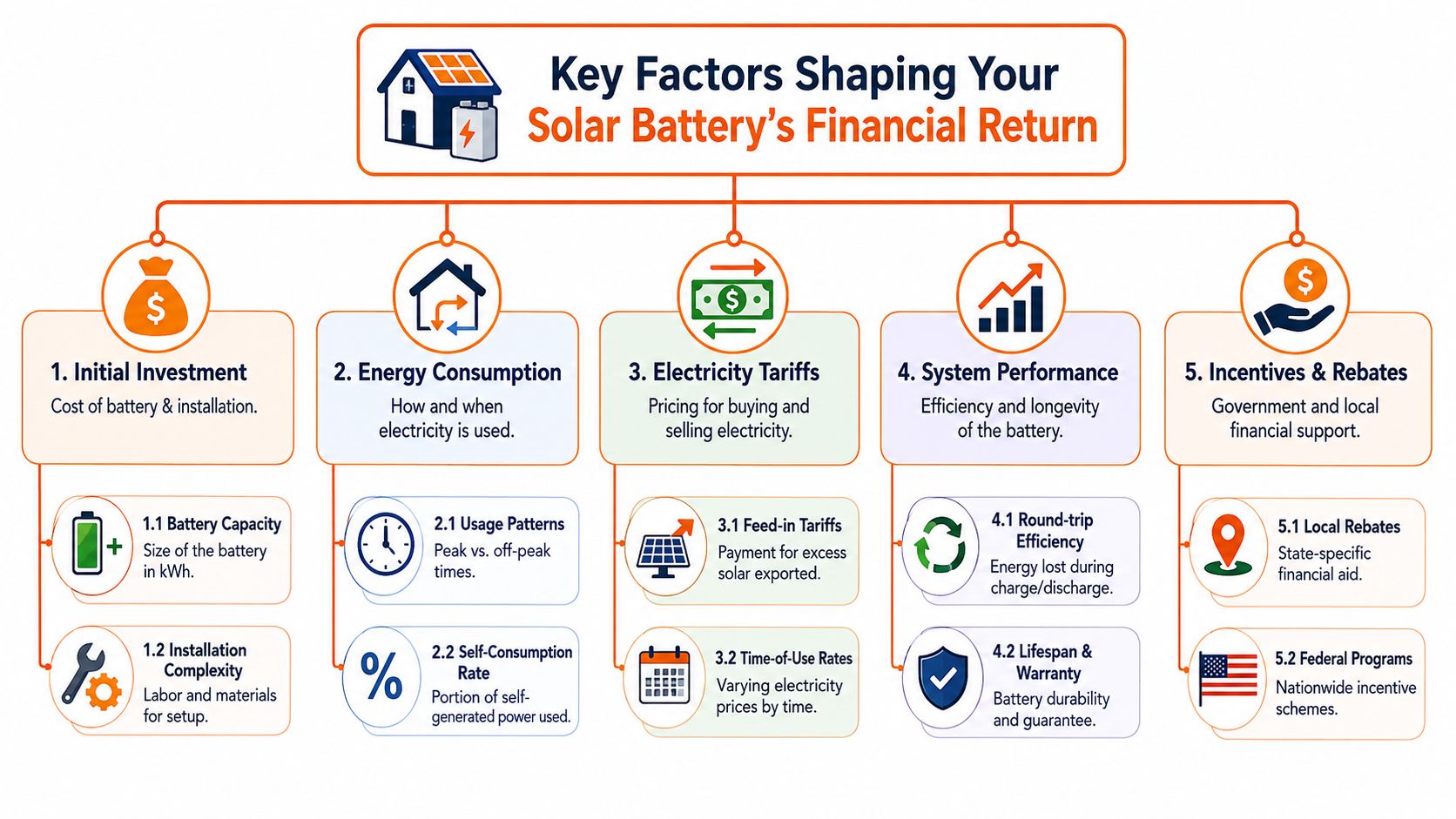
A battery's return is set by the spread between what it costs to buy and operate, and the value you can extract from each kilowatt-hour it stores. Hardware matters, but the larger difference usually comes from tariff structure, load timing, and whether the battery can earn value beyond basic self-consumption.
Upfront cost sets the hurdle rate
The purchase price is your starting hurdle, not your final answer. Two batteries with the same installed cost can produce very different returns if one is better matched to the home's demand profile and retailer plan.
Battery chemistry, usable capacity, cycle limits, and warranty terms all affect how much economic work the system can do over time. If you are still comparing the technical trade-offs, High Flow Energy's guide to lithium-ion batteries for solar systems is a useful reference point.
A lower net cost improves the maths immediately. A lower cost paired with weak operating value can still underperform.
Tariff design often matters more than capacity
The battery creates value when it helps you avoid expensive imports or shifts energy into higher-value periods. That makes tariff design one of the strongest drivers of return.
Homes on flat tariffs usually get value from reducing evening imports. Homes on time-of-use tariffs can get more if the battery is reserved for expensive peak windows rather than discharged too early. Feed-in tariff settings matter as well. As noted earlier, the wider the gap between what you pay to import electricity and what you receive for exports, the stronger the case for storing solar instead of sending it to the grid.
This is also where many simple ROI calculators fall short. They assume the battery passively follows household demand. In practice, dispatch timing determines whether the battery is preserving high-value energy or wasting discharge cycles on low-value periods.
Load shape determines how much value you can actually capture
Households with strong evening demand usually extract more direct savings because stored solar offsets grid purchases when solar production has dropped away. Homes with lighter evening usage may leave battery capacity underused unless they actively shift appliances, add flexible loads, or join a coordinated program.
The available evidence from Australian market commentary points to the same conclusion. Long payback periods are common when a battery is sized without reference to actual evening consumption, export conditions, or control strategy. A technically sound battery can still be a weak financial asset if too much of its stored energy is discharged at the wrong time or not used at all.
Operating strategy changes the economics
A battery is not a fixed-return product. It is a controllable asset.
That distinction matters because every cycle has an opportunity cost. If the battery fills early, discharges before the peak price window, or exports when the retailer pays little for that energy, part of the potential return is lost. A better strategy aligns charging and discharging with the highest-value intervals in your tariff and, where available, with grid events that pay for battery support.
This is the non-obvious point many homeowners miss. The best-performing batteries are not always the largest or cheapest. They are the ones managed to earn from several value streams at once, such as bill reduction, peak avoidance, backup readiness, and VPP credits.
Market conditions in Queensland and New South Wales add another layer
For homeowners in Queensland and New South Wales, battery value sits inside a market shaped by midday solar abundance, periodic export constraints, and wholesale volatility. Those conditions can reduce the value of uncontrolled solar exports and increase the value of stored energy available later.
Retailer structure matters here. Some plans treat the battery as little more than a device that lifts self-consumption. Others allow it to participate in a virtual power plant or use smarter control logic that responds to price signals. That can shift the battery from a passive savings tool to an income-producing household asset.
The five biggest drivers at a glance
Net cost after incentives
Lower entry cost shortens the recovery period and improves lifetime return.Tariff spread
The larger the difference between import rates and export credits, the more valuable each well-timed discharge becomes.Household demand after sunset
Evening-heavy homes usually capture more direct savings from stored solar.Battery control strategy
Dispatch timing affects whether the battery offsets high-cost usage or burns cycles on low-value periods.Access to VPP or retailer-led orchestration
Extra credits and better dispatch can improve returns beyond what self-consumption alone would deliver.
Worked Examples A Tale of Two Batteries
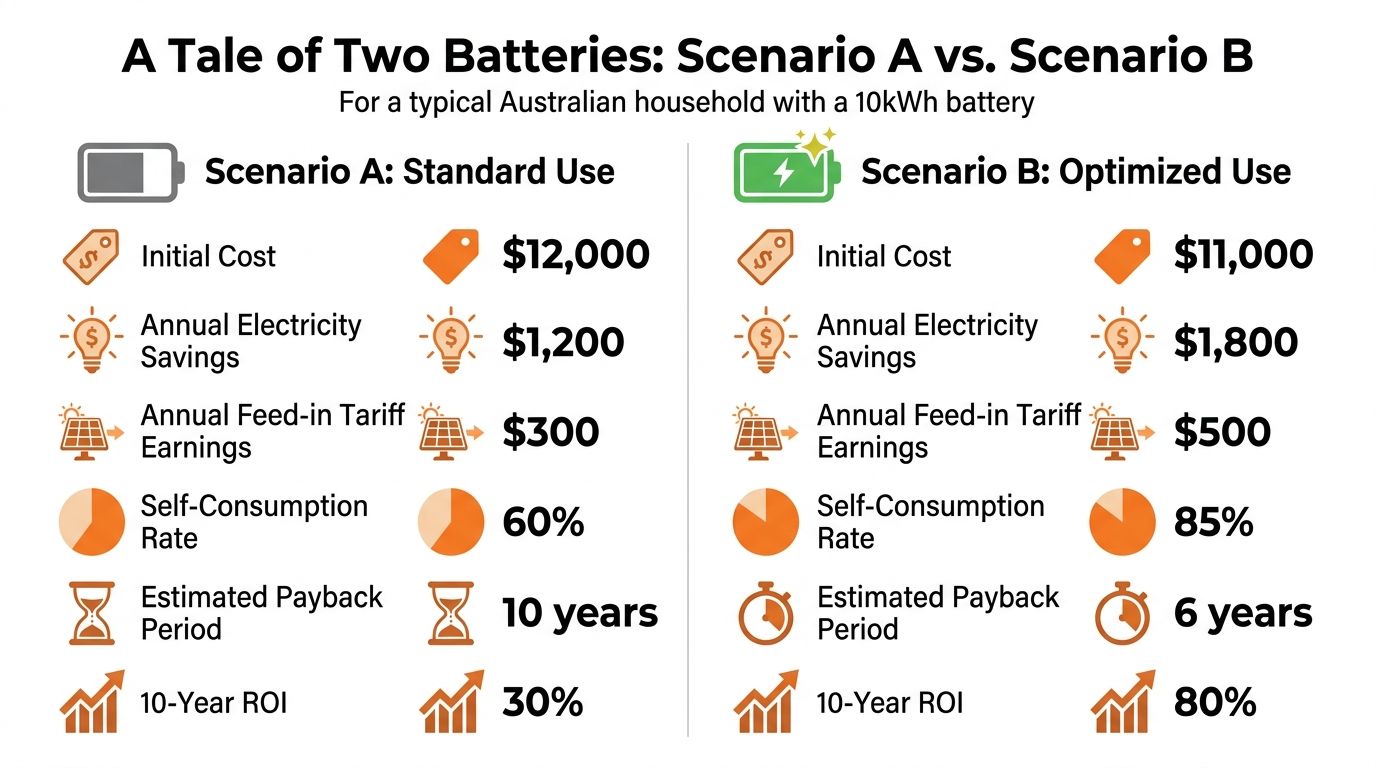
Most homeowners don't need another abstract discussion of optimisation. They need to see what changes when the same battery is treated as a managed asset instead of a passive one.
Scenario comparison
The strongest verified example available is this one. For a typical Australian household using 40 kWh of energy per day with a solar and battery system costing approximately $15,000, annual energy savings of around $3,000 can result in a 5-year ROI payback period. VPP participation can reduce this by a further 12 to 18 months through additional credits, based on the analysis in this Australian battery ROI video example.
That gives us a useful comparison framework.
| Scenario | Household setup | Financial effect |
|---|---|---|
| Battery used mainly for self-consumption | Typical Australian household using 40 kWh per day, solar and battery system costing about $15,000 | Around $3,000 in annual energy savings can produce a 5-year payback |
| Same battery with VPP participation | Same household and system, but battery also earns additional credits through VPP participation | Payback can be reduced by a further 12 to 18 months |
What changes between the two scenarios
The hardware doesn't change. The household doesn't change. What changes is the operating model.
Under standard use, the battery saves money by moving solar energy from low-value periods into higher-value household use. Under optimised use, the battery still does that, but it can also capture extra value when the grid needs support and the program structure rewards participation.
That distinction is often missed in consumer battery discussions. Too many analyses compare “battery” versus “no battery” and stop there. A more commercial comparison is “unmanaged battery” versus “managed battery”.
Why this matters for serious ROI analysis
If your battery is already installed, you're no longer making a hardware decision. You're making a performance decision.
That's important because many homeowners focus on installation quality while ignoring revenue architecture. Yet the difference between a battery that only offsets some imports and a battery that also participates in value-creating grid events can materially alter the investment outcome.
The upside isn't only in owning storage. It's in controlling how that storage participates in the market around your home.
A better way to read battery economics
Use worked examples as a lens, not a promise. Ask:
- Is my household close to the typical high-usage profile in the example
- Am I capturing value only through self-consumption
- Could additional credits or bill allowances shorten my payback
- Does my current retailer structure recognise the value of stored energy
Those questions usually reveal more than a basic solar calculator.
How to Actively Improve Your Solar Battery ROI
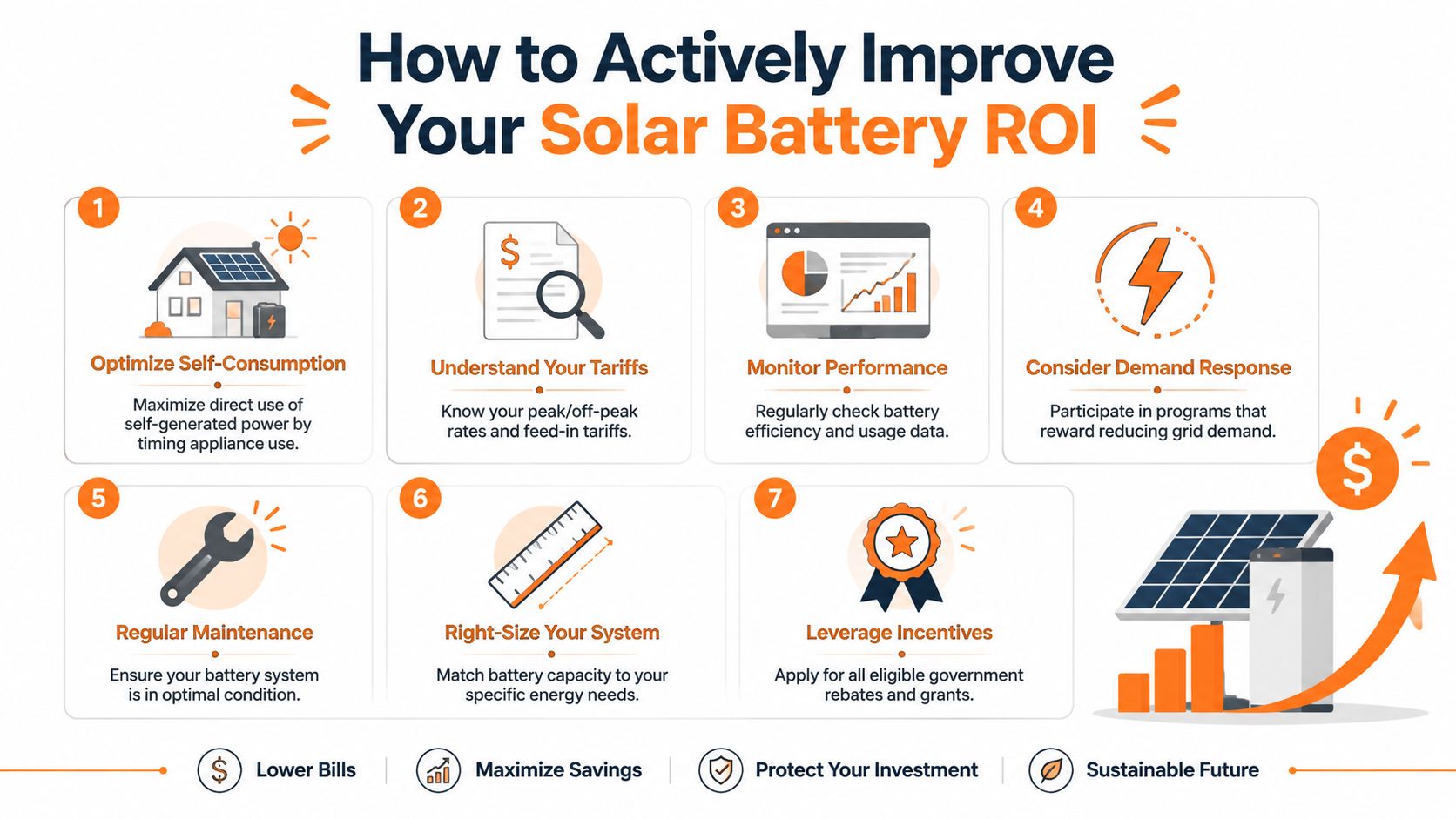
Once the battery is installed, the fastest gains usually come from operating discipline rather than hardware changes.
Start with the load, not the battery
Many households analyse battery settings before analysing their own demand. That gets the sequence backwards. The first job is understanding when the home uses electricity and whether that demand aligns with solar production or battery discharge windows.
Practical actions include:
Shift flexible loads into solar hours
Run appliances such as dishwashers or pool pumps when rooftop generation is strongest, where possible.Preserve stored energy for expensive periods
If your tariff structure makes evening imports costly, don't let the battery discharge too early for low-value loads.Review export behaviour
If large volumes of solar are being exported at weak feed-in rates, the battery may need different discharge logic or tariff support.
Treat tariff selection as an optimisation tool
A battery can underperform on the wrong electricity plan. Flat tariffs, time-of-use structures, and feed-in settings all change the value of each stored kilowatt-hour. The right tariff doesn't just reduce charges. It improves the commercial logic of every charge and discharge cycle.
That's where battery owners need to think like asset managers. The battery should operate inside a plan that rewards the behaviour you want.
To see one perspective on battery optimisation and grid interaction, this short video is a useful companion:
Use active monitoring, not occasional checking
A battery app shouldn't be treated as a novelty. It's your operating dashboard. Regular monitoring helps you spot whether the battery is discharging too early, sitting idle too often, or exporting when holding energy would be more valuable.
A simple review habit helps:
Check evening state of charge
If the battery is empty before the expensive part of the evening, performance may be weak.Look for repeated midday exports
That can indicate spare value is being sent out cheaply rather than used strategically.Review seasonal behaviour
Battery economics often shift across the year as solar generation and household demand change.
Operating insight: The best-performing battery owners don't watch every interval. They check whether the system's behaviour still matches the economics they're trying to capture.
Consider structured grid participation
For many households, the biggest improvement won't come from squeezing a little more self-consumption from the system. It will come from adding a second value stream. That's the financial case for coordinated battery participation programs. They can turn spare battery capacity into additional credits, allowances, or improved energy outcomes without changing the hardware already on site.
If you haven't bought yet, size for your life
Prospective owners should avoid buying on headline capacity alone. A battery should be matched to the home's actual load profile, especially evening demand. Bigger isn't automatically better. A poorly utilised battery can look impressive on paper and disappointing on return.
Key Takeaways and Your Homeowner Checklist
A financially sound battery decision depends on more than hardware and headline payback. It depends on whether the asset is being used well after installation.
Key takeaways
Solar battery ROI is operational, not just technical
The battery's return depends on timing, tariffs, and usage pattern.Payback and ROI aren't the same thing
Payback measures recovery time. ROI measures broader return.Many households underuse the asset they already own
Passive self-consumption can leave value on the table.Lifespan risk matters
If the battery's payback runs too close to battery life, optimisation becomes essential.Grid participation can improve the result
Additional credits or allowances can materially change the economics for the same installed system.
Homeowner checklist
Use these questions to assess whether your battery is financially healthy:
- Do I know when my home uses the most electricity
- Is my battery regularly empty before my highest-value evening demand
- Am I exporting too much solar at low value
- Is my retail tariff designed for battery ownership
- Could my battery earn more through coordinated grid support
- Do I review battery performance often enough to spot underuse
For households with business interests, trust structures, or more complex financial planning, it can also help to think about energy assets alongside broader cash flow planning. Guidance on effective business tax planning from Nanak Accountants and Associates is a useful reference point if your energy decisions intersect with wider advisory questions.
Why Your Retailer Choice is Crucial for Battery Performance
Most battery owners focus on installation quality. Far fewer focus on ongoing performance and optimisation. High Flow Energy is an electricity retailer built around enabling the full value of your existing solar and battery system.

Traditional retailers usually treat the battery as a background feature. They bill around it, but they don't structure the relationship around extracting its full value. A performance-led retailer-based VPP model is different. It's built around battery optimisation, transparent participation, and the idea that customers should retain ownership and priority access to stored energy.
That matters in Queensland and New South Wales, where tariff fit, export conditions, and NEM price volatility can all affect real-world returns. If your battery is already installed, retailer choice becomes one of the few major levers left to improve performance without buying more hardware.
Frequently Asked Questions About Battery ROI and VPPs
Does joining a VPP mean I lose control of my battery
A well-structured BYOB VPP should leave the homeowner in control of the asset. The battery still needs to cover household priorities first, with grid participation using capacity that is genuinely available. If a program does not explain dispatch rules, override settings, and access to stored energy in plain language, treat that as a commercial risk rather than a minor product detail. For a clearer outline of how these programs operate, see High Flow Energy's guide to virtual power plants in Australia.
Can a VPP affect battery warranty
It can. The answer depends on the battery brand, the inverter setup, cycle limits, and whether the operating profile stays within the manufacturer's conditions.
The practical test is simple. Check the warranty documents, confirm the installer's position, and ask the VPP provider how dispatch is managed. A program that increases cycling but avoids clear answers can weaken your economics even if it does not technically void the warranty.
What happens during a blackout
That depends on system design, not battery ownership alone. Some batteries can support selected backup circuits during an outage. Others are installed for bill reduction only and will not supply the home when the grid fails.
This matters financially as well as technically. Backup capability adds value, but only if your system is configured for it and your household benefits from that resilience.
Are VPP earnings taxed
Tax treatment depends on your circumstances and on how the benefit is structured. Bill credits, direct payments, and sign-up incentives may not be treated the same way. Households should get advice from a qualified tax professional rather than assume VPP income is automatically tax free.
Is a battery still worth it if my payback looks long
Sometimes, yes. A long payback period often means the battery is being judged too narrowly.
A battery already installed at your home is a sunk capital asset. The more useful question is whether it can produce stronger annual returns through better tariff alignment, smarter charging and discharge behaviour, and VPP participation. In that context, the decision is less about whether you should have bought the battery and more about how well you are managing it now.
What's the biggest mistake battery owners make
They treat ROI as fixed on installation day.
In practice, battery returns can change over time because tariffs change, retailer structures change, and grid services become available or disappear. Homeowners who review performance only through self-consumption often miss the bigger opportunity. The battery can operate as an active energy asset, not just a device that stores midday solar for evening use.