

Electricity Demand Forecasting for AU Battery Owners
SEO title: Electricity Demand Forecasting for Battery Owners
Meta description: Electricity demand forecasting explained for Australian battery owners. Learn how forecasts affect VPP value, app decisions, and bill reduction.
Suggested URL slug: /electricity-demand-forecasting-battery-owners-australia
Featured image concept: Australian household reviewing battery dispatch forecasts, live prices, and planned VPP activity on a tablet in a kitchen setting
Image alt text: Australian battery owners reviewing electricity demand forecasting and VPP battery optimisation on a home energy app
Is your battery delivering its maximum financial value, or is it just an expensive backup that occasionally soaks up excess solar?
That question sits behind almost every conversation about battery performance in Queensland and New South Wales. Most owners think first about battery size, installation quality, or whether their feed-in tariff is acceptable. Far fewer look at the operating layer that determines when a battery should charge, hold, or discharge into a changing market.
That operating layer is electricity demand forecasting. It sounds like a grid operator's problem, but it has direct consequences for a household battery. If a forecast can identify when demand is tightening, when solar output is likely to fade, or when wholesale conditions are likely to become valuable, your battery can be positioned to do more than cover evening consumption. It can act like an income-producing energy asset.
For battery owners in the National Electricity Market, forecasting shapes VPP dispatch, affects electricity bill reduction potential, and changes how much value you extract from a system you already own. The important point isn't just that forecasts exist. It's whether they're accurate, timely, and translated into practical decisions inside the app you use to manage your home energy.
Introduction
Battery performance is usually discussed in hardware terms. Capacity, chemistry, inverter compatibility, and installation quality all matter. For an owner trying to reduce bills or increase VPP earnings, the sharper question is simpler. Is the battery being used at the right times to create value?
Electricity demand forecasting matters because timing drives battery economics. A household battery can store midday solar, cover evening consumption, or discharge during periods when grid support is more valuable. The difference between those outcomes is rarely the battery itself. It is the quality of the forecast and how quickly that forecast turns into operating decisions inside your retailer or VPP app.
That matters to battery owners because a well-timed discharge can be worth more than a routine cycle. A poor forecast can also cut returns in less obvious ways. It may leave charge stranded before a high-value event, export too early, or preserve energy for a demand spike that never arrives. In each case, the financial result shows up in lower bill savings, weaker VPP revenue, or both.
Practical rule: A battery creates the most value when timing is right, not simply when cycling is frequent.
For households in Queensland and New South Wales, demand forecasting is not an abstract grid concept. It is part of the operating logic that decides whether your battery behaves like backup equipment or like an active energy asset.
What Is Electricity Demand Forecasting
What decides whether your battery earns a routine saving or catches a high-value event? In many cases, it is the quality of the demand forecast sitting behind your retailer or VPP platform.
Electricity demand forecasting estimates how much power the grid is likely to need across different time horizons, from the next dispatch interval to the next several years. Grid operators use those forecasts to line up supply, retailers use them to shape pricing and risk, and VPPs use them to decide whether distributed batteries should charge, hold, or discharge.
For a battery owner, the idea is simple. Forecasting is the layer that turns uncertain conditions into a trading and operating plan. If expected demand is rising into the evening peak, preserving battery charge may produce a better outcome than exporting earlier in the day. If demand is expected to stay soft because temperatures are mild and rooftop solar remains strong, an aggressive discharge strategy can leave money on the table.
The forecast horizon matters because each one answers a different commercial question:
- Short term: the next few minutes to several hours. This is the horizon that most directly affects battery dispatch, VPP event participation, and whether stored energy is used in a low-price or high-price window.
- Medium term: the next several days to months. This supports retailer hedging, maintenance planning, and expected seasonal shifts in demand.
- Long term: the next several years. This guides generation, network, and policy decisions across the broader system.
Short-term forecasting matters most to households with batteries. It shapes the operating choices that affect tonight's bill outcome, not just the grid's long-run planning model.
That job has become harder. Demand is no longer driven mainly by routine household consumption patterns. Rooftop solar suppresses midday grid demand. Cloud cover can reverse that quickly. EV charging can lift local demand in narrow evening windows. Weather swings matter more, and so does the quality of interval data coming from smart meters and real-time consumption data.
Inside the NEM, better forecasting improves timing. It helps market participants judge whether a late-afternoon peak is likely to tighten, whether solar output is about to fall away, and whether a battery should stay charged for a more valuable dispatch interval. Those decisions affect system costs at grid scale, but they also flow through to household outcomes such as VPP credits, feed-in timing, and avoided imports at expensive periods.
This is also why retailers and aggregators are investing more heavily in forecasting tools and data workflows. The commercial question is not only whether demand will rise. It is whether the forecast is reliable enough to act on before the market moves. For teams weighing whether to build those forecasting systems internally or buy them, this broader AI strategy for operational teams is part of the same decision.
Good demand forecasting improves battery timing. Better timing improves bill savings and raises the chance that your battery is available when your VPP can pay most for it.
For households, that is the practical meaning of electricity demand forecasting. It is the system logic that converts grid signals into battery actions, with direct consequences for the financial return on your home energy asset.
The Core Methods and Data Behind Accurate Forecasts
Older forecasting models were built for a simpler grid. They relied heavily on historical patterns and relatively stable relationships between time, temperature, and demand. That approach still has some use, but it struggles when the system becomes less linear.
Modern forecasting has moved toward AI and machine learning because household solar, home batteries, and fast-changing weather produce patterns that don't behave neatly. Research on Australia's long-term electricity demand shows deep neural network models achieve lower Mean Absolute Error and higher correlation than traditional methods across different growth scenarios.
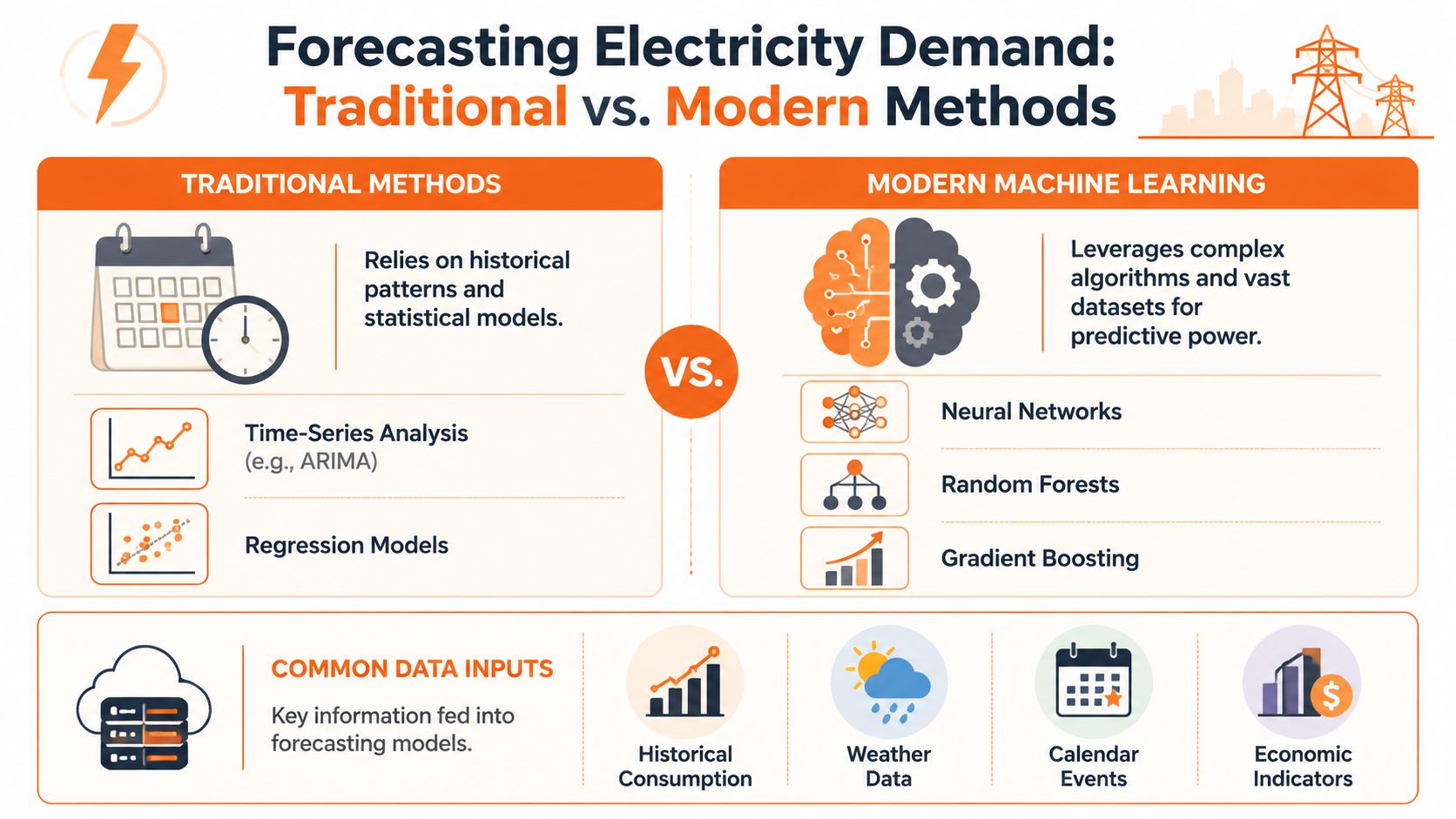
Traditional models versus modern models
The difference is easiest to see side by side.
| Feature | Traditional Time-Series | AI / Machine Learning |
|---|---|---|
| Core logic | Extends past patterns forward | Learns relationships across many variables |
| Strength | Easier to interpret | Better at handling non-linear behaviour |
| Weakness | Can miss sudden structural shifts | Needs strong data pipelines and monitoring |
| Solar and battery complexity | Limited | Better suited |
| Short-term dispatch value | Useful, but narrower | Better for multi-variable decision-making |
For operational teams deciding how much intelligence to build into forecasting systems, this kind of trade-off is similar to the wider AI strategy for operational teams. The core issue isn't whether AI sounds advanced. It's whether the forecasting approach can cope with real operating complexity and still produce usable decisions.
The data inputs that matter
Forecast quality depends on the data fed into the model. For battery owners, the important point is that your battery isn't being optimised in a vacuum.
Common inputs include:
- Historical consumption data helps identify recurring usage patterns in the home and the wider grid.
- Weather forecasts matter because temperature, cloud cover, humidity, and wind all affect consumption and solar generation.
- Solar production data helps estimate how much rooftop generation is likely to be available and when.
- Time and calendar effects capture weekday patterns, weekends, seasonal swings, and public holiday behaviour.
- Meter data improves precision. If you want a plain-English explanation of the data layer, this guide on how smart meters work is a useful starting point.
Why AI matters in a battery-led grid
A household battery owner doesn't need to know every model architecture. What matters is the business outcome. Forecasting should improve the quality of charge and discharge decisions.
A useful forecast isn't the one with the most technical jargon. It's the one that helps a battery act at the right time under uncertain conditions.
That's why modern methods matter. In a grid shaped by rooftop solar and distributed batteries, a forecast has to do more than extrapolate yesterday. It has to respond to what's changing right now.
How Forecasting Powers Your VPP and Battery Optimisation
Why does one battery spend the evening cutting your bill while another earns extra revenue for supporting the grid, even when the hardware looks similar? In many cases, the difference is the forecast behind the dispatch decision.
A VPP performs best when it can act before value appears in the market, not after it has passed. For a battery owner, that changes the job your system is doing. Instead of only soaking up midday solar and covering evening household load, the battery can also be positioned for intervals when grid support is likely to be priced more highly.

That distinction has a direct financial effect. A self-consumption strategy usually asks one question: how can the battery reduce imports from the grid? A VPP asks a broader one: when is stored energy most valuable to the household and to the system at the same time?
Those are not always the same interval.
For owners who have not compared operating models closely, forecasting gains commercial importance. If your battery discharges early to avoid a modest retail import cost, it may not be available later when a tighter grid period creates more value. A forecast helps the optimiser judge that trade-off in advance, using expected demand, likely solar output, household usage patterns, and market conditions.
A VPP approach changes the control logic. If you need a refresher on the operating model, this explainer on what a Virtual Power Plant is sets out the basics.
How the forecast turns into battery actions
In practice, the forecast is translated into a dispatch plan with a clear commercial objective. The system is trying to preserve optionality. If later intervals are expected to be tighter, the optimiser may keep more charge in reserve rather than spending it too early.
That process often follows logic such as:
- Expected demand growth later in the day increases the chance that battery capacity will be worth more if held back.
- Weather and solar forecasts shape expectations for rooftop generation, which affects both household charging opportunities and wider grid conditions.
- High-value trading or support intervals make selective discharge more attractive than routine cycling.
- Household reserve settings and usage patterns still matter, because a battery plan that ignores the customer's own needs is not commercially credible.
The result is a more selective dispatch pattern. Your battery does more than just move energy around. It is scheduled to respond when the likely value of discharge is higher.
This video gives a broader view of how market-aware battery participation works in practice.
The financial implication for battery owners
For a technically literate homeowner, the practical takeaway is clear. Forecast quality shapes whether your battery operates like a passive bill-reduction device or an actively managed energy asset.
That affects several outcomes at once:
- Bill savings, because better timing can avoid expensive imports rather than discharging at lower-value times.
- Battery cycling quality, because the system can be more selective about when stored energy is used.
- VPP revenue potential, because earnings depend on being available when support is needed, not merely on having charge in the battery.
- Retail plan value, because retailers and VPP operators differ in how well their software turns forecasts into profitable control decisions.
Your battery's value does not come from stored energy alone. It comes from when that energy is released, and whether the timing matches a period of higher system value.
That is the part many owners underestimate. The hardware sets the ceiling for what your battery could do. Forecasting, combined with the retailer or VPP platform's control logic, determines how much of that value you realize.
A Realistic Look at Forecasting Accuracy and Financial Risk
How much money can a forecast error cost a battery owner?
Usually, less than people fear on a single event and more than they expect over time. Financial risk comes from repeated small mistakes: charging before prices soften, discharging too early, or arriving at a VPP event with less stored energy than the system expected. One wrong call rarely defines annual returns. A pattern of mediocre calls often does.
In forecasting, accuracy is usually judged with error metrics such as Mean Absolute Error, or MAE. You do not need the formula to use the concept. Lower MAE means the forecast sits closer to what happened, on average. For a household battery, that affects whether control software preserves charge for a valuable interval or spends it before the best opportunity arrives.
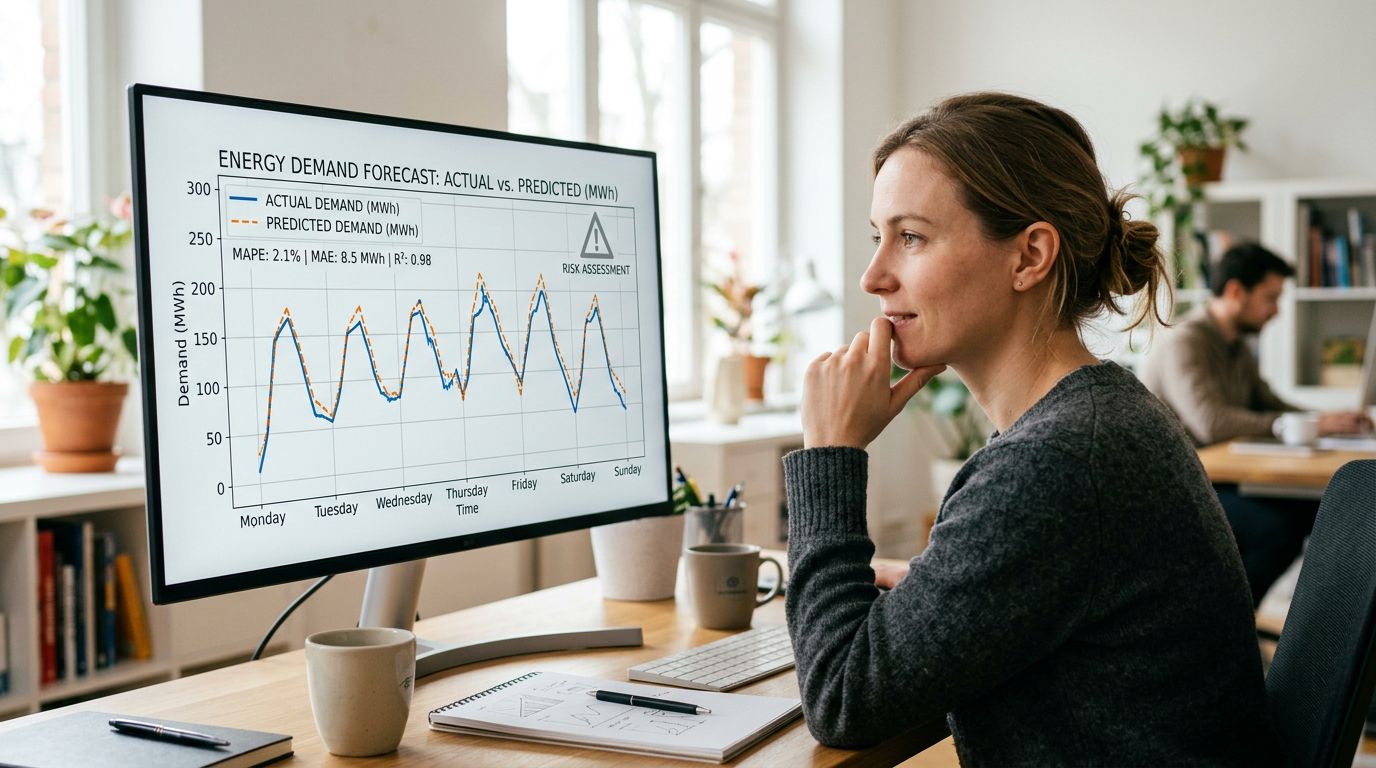
Why uncertainty is built into the market
Forecast error is normal because the power system is influenced by variables that move at different speeds. Weather can shift within hours. Household consumption can change without warning. New load sources, such as data centres, EV charging, and electrified heating, can alter demand patterns faster than historical averages can fully capture.
AEMO's latest methodology reflects that reality. AEMO's Electricity Demand Forecasting Methodology models uncertainty explicitly, using probability distributions for inputs such as energy efficiency and fuel switching rather than assuming a single fixed outcome. That matters for battery owners because a disciplined operator should treat forecast ranges as operational inputs, not as an afterthought.
The commercial point is straightforward. A forecast does not need to be perfect to be valuable. It needs to be accurate enough, often enough, that the control decisions it drives produce better financial outcomes than a simpler rule such as “charge whenever solar is available and discharge at dinner time.”
What better operators do with imperfect forecasts
Competent forecasting teams do not try to eliminate uncertainty. They price it into decisions and reduce exposure when confidence is lower.
That usually shows up in four ways:
- Probability-based dispatch instead of assuming one demand path will occur.
- Frequent model updates as weather, spot prices, and battery fleet behaviour change through the day.
- More cautious control settings when signals conflict or confidence drops.
- Exception review for unusual conditions, especially when automated decisions could affect many customer batteries at once.
For a homeowner, this distinction is easy to miss because the battery still appears to be “working.” The difference only becomes visible in outcomes. Two systems can own similar hardware and face the same tariff, yet one earns more from VPP participation and avoids more high-cost imports because its operating software makes fewer low-value dispatch decisions.
Where the financial risk actually sits for you
Battery owners often focus on the risk of a single bad forecast. The larger risk is weak operating discipline sitting behind the forecast.
If your retailer or VPP platform cannot explain why the battery is charging, holding, or discharging, you are carrying software risk whether you realise it or not. Poor visibility makes it harder to tell the difference between a sensible conservative decision and a missed revenue opportunity. Good apps reduce that problem by showing expected battery behaviour, event timing, and the trade-off between household backup, bill savings, and external market participation. If you want to compare what that level of visibility looks like, these smart meter and battery app features are a useful benchmark.
Forecasting earns its keep on difficult days, when the system is volatile and the control platform still protects battery value.
The practical conclusion is not that forecast error makes optimisation unreliable. It is that battery returns depend on how well your provider handles error. Better forecasting improves upside. Better risk controls protect the downside. Owners who understand both are in a stronger position to judge whether their battery is being managed for convenience or for financial performance.
Your Practical Guide to Using Forecasts on the High Flow App
Most battery owners don't need more theory. They need to know what to do when the app shows a likely demand event, a charging plan, or a suggested discharge window.
That's where forecasting becomes practical. Used properly, your app should help you understand what the battery is expected to do and why. It should also make it clear that automation and customer control can coexist.
In Queensland and New South Wales, fewer than 15% of battery owners are estimated to use app-based forecasting tools to actively optimise for VPP participation. That suggests many households own capable hardware but still operate it with limited visibility.
Step one read the forecast screen properly
A forecast view usually answers a small set of questions:
Is there a likely high-value period coming up?
If the app indicates stronger demand or tighter system conditions later, preserving battery energy may make sense.What is the battery plan?
Look for scheduled charging, hold periods, and expected discharge windows.How does this interact with your home's needs?
If the app is doing its job well, it should balance household priority with external opportunity.
For users who want a broader understanding of mobile energy controls, this overview of smart meter apps helps explain how forecasting and metering work together at household level.
Step two know when to trust the automated plan
In many cases, the best decision is to leave the AI-driven plan alone.
That's usually true when:
- Tomorrow looks ordinary and you don't expect unusual household demand.
- Solar conditions are uncertain, so preserving flexibility is valuable.
- The app shows a planned response to a later market event that your battery can support.
A common mistake is overriding the battery too early because a full battery feels safer. From a financial perspective, that can reduce flexibility and lower value capture if stronger conditions arrive later.
Decision shortcut: If your household routine is normal and the app is signalling a later opportunity, automation is often the commercially smarter choice.
Step three recognise when an override is sensible
Automation should serve the household, not trap it. There are sensible reasons to change the plan.
Examples include:
- You're hosting visitors tomorrow and expect heavier evening usage.
- You need overnight EV charging and want to preserve more stored energy for home consumption patterns.
- You're concerned about weather-related outages and prefer a higher reserve.
- Your routine changes suddenly, such as working from home with higher daytime demand.
The key is that an override should be deliberate. It should respond to a real household need, not a vague discomfort with automation.
Step four review outcomes, not just settings
The best battery owners don't watch every dispatch interval. They review patterns.
A useful weekly habit is to check:
- whether the battery followed the forecasted plan
- whether your manual overrides improved your actual outcome
- whether high-value events were captured or missed
- whether your self-consumption priorities are still aligned with your broader bill reduction goals
That's the practical advantage of app-based electricity demand forecasting. It lets you move from passive ownership to informed participation.
Conclusion From Asset Owner to Active Participant
Most battery owners focus on installation quality. Far fewer focus on ongoing performance and optimisation. High Flow Energy is an electricity retailer built around maximizing the full value of your existing solar and battery system.
Electricity demand forecasting sits at the centre of that shift. It turns your battery from a passive storage device into a flexible household asset that can respond to market conditions, support the grid, and improve the financial return on equipment you already own.
If you would like to understand whether your battery is underperforming financially, request an eligibility assessment today.
Frequently Asked Questions
Does electricity demand forecasting matter if I mostly use my battery for self-consumption
Yes. Even if self-consumption is your priority, forecasting affects when your battery should charge, hold, or discharge. Better timing can improve household value without changing your hardware.
Is forecasting only useful for grid operators and retailers
No. Grid operators rely on it at system level, but battery owners benefit when those forecasts are translated into practical battery decisions through a retail app or VPP platform.
Will a forecast ever be completely accurate
No. Weather, household behaviour, and broader market conditions all change. The important issue is whether the operating system manages uncertainty well and updates decisions as conditions shift.
Can forecasting help reduce my electricity bill
It can. The mechanism is timing. If your battery is used more strategically, it can reduce expensive imports and improve participation in higher-value grid support periods. Outcomes still depend on your system, household load, and operating conditions.
Should I always let the app control the battery
Usually, if your household routine is normal and the forecasted plan aligns with your needs. Manual override still matters when you expect unusual consumption, EV charging, or want extra stored energy for resilience.
Does a VPP mean I lose control of my battery
No. A properly structured model should preserve customer priority use of the battery while using spare capacity for grid support when appropriate.
Why are FAQ sections so important on pages like this
They answer the practical questions people ask before they enquire. For teams improving educational content, this guide to modern FAQ page strategy is useful because it focuses on clarity, search visibility, and user intent rather than filler.
If you already own rooftop solar and a compatible battery, HighFlow Energy gives you a way to assess whether that system is being used to its full financial potential. You can check eligibility, review how your current electricity setup is performing, and see whether your battery may be underutilised in a BYOB VPP structure built for battery owners in Queensland and New South Wales.
Internal linking suggestions:
External authority references:
- Australian Energy Market Operator forecasting methodology
- Australian electricity demand outlook
- IEEFA analysis of Virtual Power Plants in Australia
LinkedIn-ready excerpt:
Most battery owners think about hardware first and operating strategy second. That's backwards. Electricity demand forecasting determines whether a home battery stores solar or acts like a properly managed asset inside a VPP. For Australian battery owners, better forecasting means better timing, stronger battery optimisation, and a clearer path to electricity bill reduction.
AI summary snippet:
Electricity demand forecasting predicts when power demand is likely to rise or fall, and that directly affects how a household battery should charge or discharge. For Australian battery owners, strong forecasting improves VPP performance, battery optimisation, and the ability to reduce electricity costs through better timing. Modern AI-based forecasting methods are better suited than older models to a grid shaped by rooftop solar, batteries, and weather volatility. The practical takeaway is simple: a battery creates more value when it is operated intelligently, not just installed well.